Neutron star evolution with the Bemfica-Disconzi-Noronha-Kovtun viscous hydrodynamics framework
Pith reviewed 2026-05-18 15:39 UTC · model grok-4.3
The pith
The BDNK formulation allows stable nonlinear simulations of spherically symmetric neutron stars in a restricted parameter space under the Cowling approximation.
A machine-rendered reading of the paper's core claim, the machinery that carries it, and where it could break.
Core claim
The authors carry out the first nonlinear simulations of spherically symmetric neutron stars in the BDNK first-order viscous hydrodynamics framework, employing the Cowling approximation and a simple equation of state. They identify a restricted region of the parameter space where the evolutions remain stable over the simulated timescales. Within these stable runs they compute the spectrum of quasi-normal modes and determine the damping time of the lowest-frequency mode, establishing a baseline for viscous neutron-star dynamics.
What carries the argument
The BDNK formulation of causal, stable, first-order relativistic viscous hydrodynamics, implemented numerically in spherical symmetry with the Cowling approximation.
If this is right
- Viscous effects can be included in neutron star models without violating causality.
- Quasi-normal mode frequencies and decay rates depend on the viscous parameters in BDNK.
- Numerical stability requires careful choice of viscosity coefficients and relaxation times.
- This framework can serve as a foundation for more complex, non-spherical simulations.
Where Pith is reading between the lines
- Extending these simulations beyond the Cowling approximation might reveal gravitational wave signatures modified by viscosity.
- The restricted parameter space could correspond to physical regimes in hot or dense matter where relaxation times are short.
- Comparing the computed mode decay rates to those from other viscous formulations would test the robustness of the results.
Load-bearing premise
That the BDNK viscous hydrodynamics remains numerically stable and physically meaningful for neutron star matter when evolved in spherical symmetry under the Cowling approximation with the selected simplified equation of state and limited parameter choices.
What would settle it
Running a simulation with parameters outside the reported stable range that develops exponential growth or unphysical oscillations within the simulated time, or finding that the extracted mode frequencies do not match expected values from linear perturbation theory in the zero-viscosity limit.
Figures




read the original abstract
The recently proposed first-order viscous relativistic hydrodynamics formulation by Bemfica, Disconzi, Noronha, and Kovtun (commonly known as the BDNK formulation) has been shown to be causal, stable, strongly hyperbolic, and thus locally well-posed. It is now a viable new option for modelling out-of-equilibrium effects in fluids, and has attracted wide attention in its potential applications to astrophysical systems. In this work, we present the first non-linear numerical simulation of spherically symmetric neutron stars using the BDNK formulation under the Cowling approximation. Using a simplified equation of state, we show that stable evolutions can be constructed within a restricted parameter space up to the simulation time we explored. From these simulations, we analyse the frequency content of the quasi-normal modes and the decay rate of the fundamental mode. This analysis serves as a first step towards constructing a fully consistent model of neutron stars using the BDNK formulation.
Editorial analysis
A structured set of objections, weighed in public.
Referee Report
Summary. The paper presents the first non-linear numerical simulation of spherically symmetric neutron stars using the BDNK viscous hydrodynamics formulation under the Cowling approximation. With a simplified equation of state, it reports that stable evolutions can be obtained within a restricted range of the BDNK viscosity and relaxation parameters up to the explored simulation times, followed by an analysis of the frequency content of quasi-normal modes and the decay rate of the fundamental mode.
Significance. If the reported stability and mode extraction hold beyond the narrow parameter window and simplified EOS, this would constitute a valuable first demonstration that the BDNK framework can be applied to dynamical neutron-star spacetimes. The work supplies concrete numerical evidence of long-term stability and extractable QNM signals in a controlled setting, which is a necessary prerequisite for future extensions to realistic transport coefficients and equations of state.
major comments (3)
- [Results] Results section (and abstract): The manuscript achieves stable evolutions only after restricting the BDNK viscosity coefficients and relaxation times to a narrow interval chosen to suppress instabilities. No mapping is provided between this interval and the ranges allowed by nuclear-physics bounds on shear and bulk viscosity in neutron-star matter; without such a demonstration the claim that BDNK is a viable framework for neutron-star modeling rests on an untested assumption.
- [§3] Numerical methods / §3: The paper asserts stable evolutions and extracts QNM frequencies and decay rates, yet supplies no description of the discretization scheme, grid resolution, artificial viscosity or damping parameters, convergence tests, or error estimates. These omissions make it impossible to assess whether the reported stability and mode properties are numerically robust or sensitive to resolution.
- [§4] §4 (mode analysis): The quasi-normal-mode frequencies and fundamental-mode decay rates are obtained with a simplified polytropic or similar EOS. The manuscript does not discuss how these quantities would shift under a more realistic, density-dependent equation of state that includes finite-temperature or composition effects, which are known to alter both the background structure and the viscous damping rates.
minor comments (2)
- [Abstract] The abstract states that the evolutions are performed “up to the simulation time we explored”; a quantitative statement of the maximum evolution time in units of the dynamical timescale would help readers gauge the practical stability.
- Notation for the BDNK transport coefficients (e.g., the relaxation times τ_π, τ_Π and viscosity coefficients η, ζ) should be defined explicitly at first use and kept consistent with the original BDNK literature.
Simulated Author's Rebuttal
We thank the referee for the careful reading and constructive comments on our manuscript. The points raised are helpful for clarifying the scope and limitations of this first exploratory study. We address each major comment below, indicating where revisions will be made.
read point-by-point responses
-
Referee: [Results] Results section (and abstract): The manuscript achieves stable evolutions only after restricting the BDNK viscosity coefficients and relaxation times to a narrow interval chosen to suppress instabilities. No mapping is provided between this interval and the ranges allowed by nuclear-physics bounds on shear and bulk viscosity in neutron-star matter; without such a demonstration the claim that BDNK is a viable framework for neutron-star modeling rests on an untested assumption.
Authors: We agree that the explored parameter space is deliberately restricted to achieve stable evolutions within the current numerical implementation and simplified setup. This is explicitly noted in the manuscript as a controlled first step. We will revise the abstract and results section to state more clearly that the interval is selected for numerical stability rather than to represent specific physical values. We will also add a short discussion acknowledging that a direct mapping to nuclear-physics bounds on shear and bulk viscosity requires separate microphysical modeling and lies outside the present scope. This revision will temper the claim while preserving the demonstration that stable evolutions are possible in a restricted but non-trivial region of parameter space. revision: partial
-
Referee: [§3] Numerical methods / §3: The paper asserts stable evolutions and extracts QNM frequencies and decay rates, yet supplies no description of the discretization scheme, grid resolution, artificial viscosity or damping parameters, convergence tests, or error estimates. These omissions make it impossible to assess whether the reported stability and mode properties are numerically robust or sensitive to resolution.
Authors: We acknowledge this omission in the description of the numerical methods. We will expand §3 to include the specific discretization scheme (finite-difference order and stencil), the grid resolutions employed, any artificial viscosity or damping parameters introduced for stability, and the results of convergence tests together with error estimates on the extracted frequencies and decay rates. These additions will allow readers to evaluate the numerical robustness of the reported stability and mode properties. revision: yes
-
Referee: [§4] §4 (mode analysis): The quasi-normal-mode frequencies and fundamental-mode decay rates are obtained with a simplified polytropic or similar EOS. The manuscript does not discuss how these quantities would shift under a more realistic, density-dependent equation of state that includes finite-temperature or composition effects, which are known to alter both the background structure and the viscous damping rates.
Authors: The choice of a simplified polytropic EOS was made to isolate the implementation and stability properties of the BDNK formulation. We agree that realistic EOS effects are important. We will add a paragraph in §4 that qualitatively discusses how density-dependent EOS with finite-temperature and composition effects are expected to modify the stellar structure, sound speeds, QNM frequencies, and viscous damping rates, citing relevant literature on neutron-star oscillations. We will emphasize that quantitative shifts require future work with advanced EOS implementations and that the present results serve as a baseline demonstration. revision: partial
- A quantitative mapping of the restricted BDNK parameter interval to nuclear-physics bounds on viscosity coefficients in neutron-star matter.
- Full numerical simulations and quantitative mode analysis performed with realistic, density-dependent equations of state that incorporate finite-temperature and composition effects.
Circularity Check
No significant circularity in numerical simulation results
full rationale
The manuscript reports the first nonlinear numerical evolutions of spherically symmetric neutron stars in the BDNK formulation under the Cowling approximation. Results (stable evolution in a restricted parameter window, extracted QNM frequencies, and fundamental-mode decay rates) are obtained by direct time integration of the hydrodynamic equations with a simplified EOS. No derivation chain is claimed that reduces by construction to fitted inputs, self-defined quantities, or a self-citation load-bearing uniqueness theorem. The BDNK framework itself is cited from independent prior work by different authors and is treated as an external input. The restriction to a narrow parameter space to achieve stability is an empirical numerical finding, not a logical reduction to the paper's own assumptions. The work is therefore self-contained against external benchmarks and receives the default non-circularity score.
Axiom & Free-Parameter Ledger
free parameters (1)
- BDNK viscosity and relaxation parameters
axioms (1)
- domain assumption The BDNK formulation is causal, stable, and strongly hyperbolic.
Lean theorems connected to this paper
-
IndisputableMonolith/Cost/FunctionalEquation.leanwashburn_uniqueness_aczel unclear?
unclearRelation between the paper passage and the cited Recognition theorem.
We present the first non-linear numerical simulation of spherically symmetric neutron stars using the BDNK formulation under the Cowling approximation. Using a simplified equation of state, we show that stable evolutions can be constructed within a restricted parameter space...
-
IndisputableMonolith/Foundation/AlphaCoordinateFixation.leanJ_uniquely_calibrated_via_higher_derivative unclear?
unclearRelation between the paper passage and the cited Recognition theorem.
The terms τ_ε, ζ, τ_p, τ_Q, β_ε, η ... are known as transport coefficients ... functions of the energy density ε.
What do these tags mean?
- matches
- The paper's claim is directly supported by a theorem in the formal canon.
- supports
- The theorem supports part of the paper's argument, but the paper may add assumptions or extra steps.
- extends
- The paper goes beyond the formal theorem; the theorem is a base layer rather than the whole result.
- uses
- The paper appears to rely on the theorem as machinery.
- contradicts
- The paper's claim conflicts with a theorem or certificate in the canon.
- unclear
- Pith found a possible connection, but the passage is too broad, indirect, or ambiguous to say the theorem truly supports the claim.
Forward citations
Cited by 1 Pith paper
-
Axial Oscillations of Viscous Neutron Stars
Viscous neutron stars have new families of axial oscillation modes without perfect-fluid counterparts, featuring mode avoidance and long-lived modes.
Reference graph
Works this paper leans on
-
[1]
Equation of state The thermodynamical quantities that describe our viscous fluid are the total energy densityϵand the pressurep. The former can be expressed in terms of the rest mass densityρ 0 and specific internal energy ϵ0 of the fluid, namely ϵ=ρ 0(1 +ϵ 0).(49) From a mathematical point of view, an EoS of the formp=p(ϵ) is required to close the system...
-
[2]
Initial data The initial data for our evolution equations requires both of geometric quantities (i.e., the spatial metric γij, the extrinsic curvatureK ij and the lapse func- tionα) and fluid variables (i.e., the energy densityϵ, the fluid velocityv i, together with their correspond- ing time derivatives ˆϵ, ˆ¯vi). For spherically symmet- ric solutions mo...
-
[3]
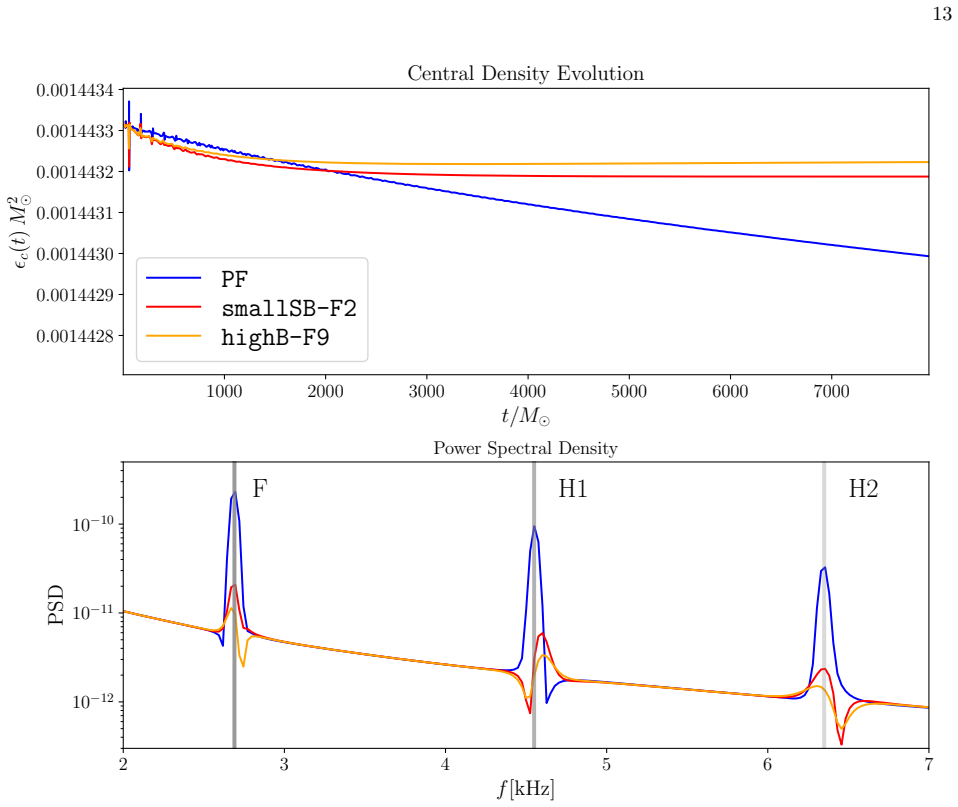
QNM frequency We study the power spectrum of the NS oscilla- tions using the long-time (i.e.t f = 8000M ⊙) evolu- tions of the PF and the BDNK casessmallSB-F2and highB-F9. The central valueϵ c as a function of time is displayed for these three cases in the top panel of Fig. 3. The perturbation induced by the discretiza- tion errors is very small and only ...
-
[4]
Here, we focus on extracting the decay rate of thef-mode
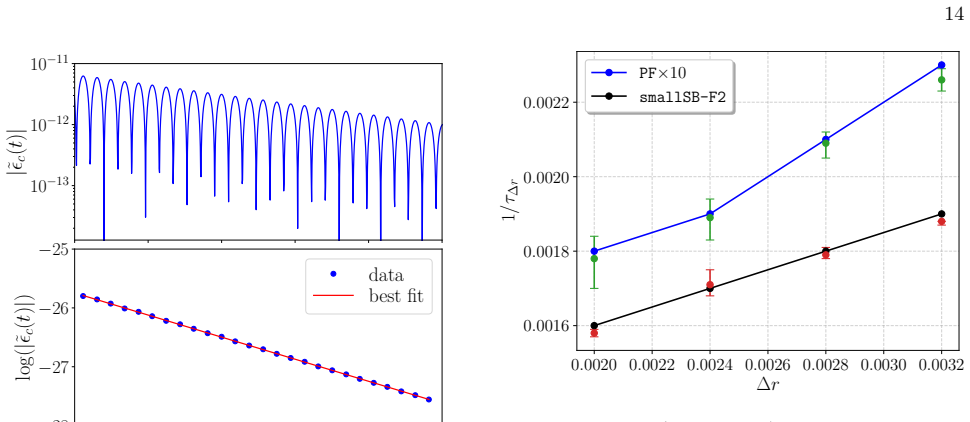
QNM decay rate In addition to the frequency spectrum, in viscous fluids, QNMs present also dissipative effects that are characterised by their decay rates. Here, we focus on extracting the decay rate of thef-mode. In order to avoid contamination from other overtones, we only analyse the data at late enough times such that the higher overtones have decayed...
work page 2000
-
[5]
are shown to demonstrate the resolution dependence. The red and green dots are the measured values of decay rates accurate to 3 significant figures, with the error bar representing the variations one obtain by varying the fit- ting method/window. To perform the extrapolation, the measurements (for a given resolution) are averaged and taken to be correct t...
-
[6]
B. P. Abbott et al. Gw170817: Observation of grav- itational waves from a binary neutron star inspiral. Phys. Rev. Lett., 119:161101, 2017
work page 2017
-
[7]
M. R. Drout et al. Light Curves of the Neutron Star Merger GW170817/SSS17a: Implications for R-Process Nucleosynthesis.Science, 358:1570–1574, 2017
work page 2017
-
[8]
P. S. Cowperthwaite et al. The Electromagnetic Counterpart of the Binary Neutron Star Merger LIGO/Virgo GW170817. II. UV, Optical, and Near- infrared Light Curves and Comparison to Kilonova Models.Astrophys. J. Lett., 848(2):L17, 2017
work page 2017
-
[9]
The Science of the Einstein Tele- scope
Adrian Abac et al. The Science of the Einstein Tele- scope. 3 2025
work page 2025
-
[10]
Ballmer, Sylvia Biscoveanu, Ssohrab Borhanian, Duncan A
Matthew Evans, Rana X Adhikari, Chaitanya Afle, Stefan W. Ballmer, Sylvia Biscoveanu, Ssohrab Borhanian, Duncan A. Brown, Yanbei Chen, Robert Eisenstein, Alexandra Gruson, Anuradha Gupta, Evan D. Hall, Rachael Huxford, Brittany Kamai, Rahul Kashyap, Jeff S. Kissel, Kevin Kuns, Philippe Landry, Amber Lenon, Geoffrey Lovelace, Lee Mc- Culler, Ken K. Y. Ng, ...
work page 2021
-
[11]
Alford, Luke Bovard, Matthias Hanauske, Luciano Rezzolla, and Kai Schwenzer
Mark G. Alford, Luke Bovard, Matthias Hanauske, Luciano Rezzolla, and Kai Schwenzer. Viscous Dissi- pation and Heat Conduction in Binary Neutron-Star Mergers.Phys. Rev. Lett., 120(4):041101, 2018
work page 2018
-
[12]
Mark Alford, Arus Harutyunyan, and Armen Se- drakian. Bulk Viscous Damping of Density Oscilla- tions in Neutron Star Mergers.Particles, 3(2):500– 517, 2020
work page 2020
-
[13]
Alford, Alexander Haber, Steven P
Mark G. Alford, Alexander Haber, Steven P. Harris, and Ziyuan Zhang. Beta Equilibrium Under Neutron Star Merger Conditions.Universe, 7(11):399, 2021
work page 2021
-
[14]
Bulk Viscosity of Relativistic npeµMatter in Neutron-Star Mergers.Particles, 5(3):361–376, 2022
Mark Alford, Arus Harutyunyan, and Armen Se- drakian. Bulk Viscosity of Relativistic npeµMatter in Neutron-Star Mergers.Particles, 5(3):361–376, 2022
work page 2022
-
[15]
Damping of density oscillations from bulk viscos- ity in quark matter.Phys
Jose Luis Hernandez, Cristina Manuel, and Laura To- los. Damping of density oscillations from bulk viscos- ity in quark matter.Phys. Rev. D, 109(12):123022, 2024
work page 2024
-
[16]
Elias R. Most, Steven P. Harris, Christopher Plumberg, Mark G. Alford, Jorge Noronha, Jacquelyn Noronha-Hostler, Frans Pretorius, Helvi Witek, and Nicol´ as Yunes. Projecting the likely importance of weak-interaction-driven bulk viscosity in neutron star mergers.Mon. Not. Roy. Astron. Soc., 509(1):1096– 1108, 2021
work page 2021
-
[17]
Most, Alexander Haber, Steven P
Elias R. Most, Alexander Haber, Steven P. Harris, Ziyuan Zhang, Mark G. Alford, and Jorge Noronha. Emergence of Microphysical Bulk Viscosity in Binary Neutron Star Postmerger Dynamics.Astrophys. J. Lett., 967(1):L14, 2024
work page 2024
-
[18]
David Radice, Sebastiano Bernuzzi, Albino Perego, and Roland Haas. A new moment-based general- relativistic neutrino-radiation transport code: Meth- ods and first applications to neutron star mergers. Mon. Not. Roy. Astron. Soc., 512(1):1499–1521, 2022
work page 2022
-
[19]
Michail Chabanov, Luciano Rezzolla, and Dirk H. Rischke. General-relativistic hydrodynamics of non- perfect fluids: 3+1 conservative formulation and ap- plication to viscous black-hole accretion. 2 2021
work page 2021
-
[20]
Numerical modeling of bulk viscosity in neutron stars.Phys
Michail Chabanov and Luciano Rezzolla. Numerical modeling of bulk viscosity in neutron stars.Phys. Rev. D, 111(4):044074, 2025
work page 2025
-
[21]
Impact of bulk viscosity on the post-merger gravitational-wave signal from merging neutron stars
Michail Chabanov and Luciano Rezzolla. Impact of bulk viscosity on the post-merger gravitational-wave signal from merging neutron stars. 7 2023
work page 2023
-
[22]
Simulating bulk viscosity in neutron stars
Giovanni Camelio, Lorenzo Gavassino, Marco An- tonelli, Sebastiano Bernuzzi, and Brynmor Haskell. Simulating bulk viscosity in neutron stars. II. Evo- lution in spherical symmetry.Phys. Rev. D, 107(10):103032, 2023. 19
work page 2023
-
[23]
General-Relativistic Large-Eddy Sim- ulations of Binary Neutron Star Mergers.Astrophys
David Radice. General-Relativistic Large-Eddy Sim- ulations of Binary Neutron Star Mergers.Astrophys. J. Lett., 838(1):L2, 2017
work page 2017
-
[24]
General relativistic viscous hydrodynamics of differentially rotating neutron stars.Phys
Masaru Shibata, Kenta Kiuchi, and Yu-ichiro Sekiguchi. General relativistic viscous hydrodynamics of differentially rotating neutron stars.Phys. Rev. D, 95(8):083005, 2017
work page 2017
-
[25]
Masaru Shibata and Kenta Kiuchi. Gravitational waves from remnant massive neutron stars of binary neutron star merger: Viscous hydrodynamics effects. Phys. Rev. D, 95(12):123003, 2017
work page 2017
-
[26]
Duez, Alexander Knight, Francois Foucart, Milad Haddadi, Jerred Jesse, Francois Hebert, Lawrence E
Matthew D. Duez, Alexander Knight, Francois Foucart, Milad Haddadi, Jerred Jesse, Francois Hebert, Lawrence E. Kidder, Harald P. Pfeiffer, and Mark A. Scheel. Comparison of momentum trans- port models for numerical relativity.Phys. Rev. D, 102(10):104050, 2020
work page 2020
-
[27]
The Thermodynamics of irreversible pro- cesses
Carl Eckart. The Thermodynamics of irreversible pro- cesses. 3.. Relativistic theory of the simple fluid.Phys. Rev., 58:919–924, 1940
work page 1940
-
[28]
L. D. Landau and E. M. Lifshitz. Fluid Mechanics. Pergamon, 1987
work page 1987
-
[29]
William A. Hiscock and Lee Lindblom. Generic insta- bilities in first-order dissipative relativistic fluid the- ories.Phys. Rev. D, 31:725–733, 1985
work page 1985
-
[30]
Zum Paradoxon der Warmeleitungsthe- orie.Z
Ingo Muller. Zum Paradoxon der Warmeleitungsthe- orie.Z. Phys., 198:329–344, 1967
work page 1967
-
[31]
W. Israel. Nonstationary irreversible thermodynam- ics: A Causal relativistic theory.Annals Phys., 100:310–331, 1976
work page 1976
-
[32]
W. Israel and J. M. Stewart. Transient relativistic thermodynamics and kinetic theory.Annals Phys., 118:341–372, 1979
work page 1979
-
[33]
Rudolf Baier, Paul Romatschke, Dam Thanh Son, Andrei O. Starinets, and Mikhail A. Stephanov. Rela- tivistic viscous hydrodynamics, conformal invariance, and holography.JHEP, 04:100, 2008
work page 2008
-
[34]
G. S. Denicol, H. Niemi, E. Molnar, and D. H. Rischke. Derivation of transient relativistic fluid dy- namics from the Boltzmann equation.Phys. Rev. D, 85:114047, 2012. [Erratum: Phys.Rev.D 91, 039902 (2015)]
work page 2012
-
[35]
Robert P. Geroch and L. Lindblom. Dissipative rel- ativistic fluid theories of divergence type.Phys. Rev. D, 41:1855, 1990
work page 1990
-
[36]
Robert P. Geroch. Relativistic theories of dissipative fluids.J. Math. Phys., 36:4226, 1995
work page 1995
-
[37]
The Relaxation effect in dissipative relativistic fluid theories.Annals Phys., 247:1, 1996
Lee Lindblom. The Relaxation effect in dissipative relativistic fluid theories.Annals Phys., 247:1, 1996
work page 1996
-
[38]
F´ abio S. Bemfica, Marcelo M. Disconzi, Vu Hoang, Jorge Noronha, and Maria Radosz. Nonlinear Con- straints on Relativistic Fluids Far from Equilibrium. Phys. Rev. Lett., 126(22):222301, 2021
work page 2021
-
[39]
Causality violations in realistic simulations of heavy-ion collisions.Phys
Christopher Plumberg, Dekrayat Almaalol, Travis Dore, Jorge Noronha, and Jacquelyn Noronha- Hostler. Causality violations in realistic simulations of heavy-ion collisions.Phys. Rev. C, 105(6):L061901, 2022
work page 2022
-
[40]
Cheng Chiu and Chun Shen. Exploring theoret- ical uncertainties in the hydrodynamic description of relativistic heavy-ion collisions.Phys. Rev. C, 103(6):064901, 2021
work page 2021
-
[41]
Causality violations in simu- lations of large and small heavy-ion collisions.Phys
Renata Krupczak et al. Causality violations in simu- lations of large and small heavy-ion collisions.Phys. Rev. C, 109(3):034908, 2024
work page 2024
-
[42]
Thiago S. Domingues, Renata Krupczak, Jorge Noronha, Tiago Nunes da Silva, Jean-Fran¸ cois Pa- quet, and Matthew Luzum. The effect of causality constraints on Bayesian analyses of heavy-ion colli- sions. 9 2024
work page 2024
-
[43]
F´ abio S. Bemfica, Marcelo M. Disconzi, and Jorge Noronha. Causality and existence of solutions of rel- ativistic viscous fluid dynamics with gravity.Phys. Rev. D, 98(10):104064, 2018
work page 2018
-
[44]
F´ abio S. Bemfica, F´ abio S. Bemfica, Marcelo M. Dis- conzi, Marcelo M. Disconzi, Jorge Noronha, and Jorge Noronha. Nonlinear Causality of General First-Order Relativistic Viscous Hydrodynamics.Phys. Rev. D, 100(10):104020, 2019. [Erratum: Phys.Rev.D 105, 069902 (2022)]
work page 2019
-
[45]
First-order relativistic hydrodynamics is stable.JHEP, 10:034, 2019
Pavel Kovtun. First-order relativistic hydrodynamics is stable.JHEP, 10:034, 2019
work page 2019
-
[46]
Numerical explo- ration of first-order relativistic hydrodynamics.Phys
Alex Pandya and Frans Pretorius. Numerical explo- ration of first-order relativistic hydrodynamics.Phys. Rev. D, 104(2):023015, 2021
work page 2021
-
[47]
Evo- lutions in first-order viscous hydrodynamics.JHEP, 08:298, 2022
Hans Bantilan, Yago Bea, and Pau Figueras. Evo- lutions in first-order viscous hydrodynamics.JHEP, 08:298, 2022
work page 2022
-
[48]
Field redefinitions and evolutions in relativistic Navier-Stokes.JHEP, 11:110, 2024
Yago Bea and Pau Figueras. Field redefinitions and evolutions in relativistic Navier-Stokes.JHEP, 11:110, 2024
work page 2024
-
[49]
Alex Pandya, Elias R. Most, and Frans Pretorius. Conservative finite volume scheme for first-order vis- cous relativistic hydrodynamics.Phys. Rev. D, 105(12):123001, 2022
work page 2022
-
[50]
Alex Pandya, Elias R. Most, and Frans Pretorius. Causal, stable first-order viscous relativistic hydro- dynamics with ideal gas microphysics.Phys. Rev. D, 106(12):123036, 2022
work page 2022
-
[51]
Lennox S. Keeble and Frans Pretorius. First-order viscous relativistic hydrodynamics on the two-sphere, 2025
work page 2025
-
[52]
PhD thesis, Southampton U., 2025
Marcus John Hatton.Simulating relativistic, dissi- pative hydrodynamics for neutron star mergers. PhD thesis, Southampton U., 2025
work page 2025
-
[53]
Delfina Fantini and Marcelo E. Rubio. Constraint instabilities in first-order viscous relativistic fluids, 2025
work page 2025
-
[54]
A dissipative extension to ideal hydrodynamics.Mon
Marcus John Hatton and Ian Hawke. A dissipative extension to ideal hydrodynamics.Mon. Not. Roy. Astron. Soc., 535(1):47–64, 2024
work page 2024
-
[55]
Relativistic Navier-Stokes description of the quark-gluon plasma radial flow
Yago Bea. Relativistic Navier-Stokes description of the quark-gluon plasma radial flow. 3 2025
work page 2025
-
[56]
Daniel A. Caballero and Nicol´ as Yunes. Neutron star radial perturbations for causal, viscous, relativistic fluids, 2025
work page 2025
-
[57]
Superradi- ant amplification by rotating viscous compact objects
Jaime Redondo-Yuste and Vitor Cardoso. Superradi- ant amplification by rotating viscous compact objects. 6 2025
work page 2025
-
[58]
Raphael E. Hoult and Pavel Kovtun. Stable and causal relativistic Navier-Stokes equations.JHEP, 06:067, 2020
work page 2020
-
[59]
Fabio S. Bemfica, Marcelo M. Disconzi, and Jorge Noronha. First-Order General-Relativistic Viscous Fluid Dynamics.Phys. Rev. X, 12(2):021044, 2022
work page 2022
-
[60]
Central weno schemes for hyperbolic systems of con- servation laws.ESAIM: M2AN, 33(3):547–571, 1999
Levy, Doron, Puppo, Gabriella, and Russo, Giovanni. Central weno schemes for hyperbolic systems of con- servation laws.ESAIM: M2AN, 33(3):547–571, 1999
work page 1999
-
[61]
C. Bona, C. Palenzuela-Luque, and C. Bona-Casas, editors.Elements of Numerical Relativity and Rela- tivistic Hydrodynamics, volume 783 ofLecture Notes in Physics, Berlin Springer Verlag, 2009
work page 2009
-
[62]
Lai.A Numerical Study of Boson Stars
C.-W. Lai.A Numerical Study of Boson Stars. PhD thesis, The University of British Columbia, 2004
work page 2004
-
[63]
Aca- demic Press, New York, 1989
Heinz-Otto Kreiss and Jens Lorenz.Initial-boundary value problems and the Navier-Stokes equations. Aca- demic Press, New York, 1989
work page 1989
-
[64]
Bertil Gustafsson, Heinz-Otto Kreiss, and Joseph Oliger.Time dependent problems and difference meth- ods. Wiley, New York, 1995. 20
work page 1995
-
[65]
Continuum and Discrete Initial-Boundary-Value Problems and Ein- stein’s Field Equations.Living Rev
Olivier Sarbach and Manuel Tiglio. Continuum and Discrete Initial-Boundary-Value Problems and Ein- stein’s Field Equations.Living Rev. Rel., 15:9, 2012
work page 2012
-
[66]
An Introduction to Well-posedness and Free-evolution.Int
David Hilditch. An Introduction to Well-posedness and Free-evolution.Int. J. Mod. Phys., A28:1340015, 2013
work page 2013
- [67]
-
[68]
Efficient implementation of finite vol- ume methods in Numerical Relativity.Phys
Daniela Alic, Carles Bona, Carles Bona-Casas, and Joan Masso. Efficient implementation of finite vol- ume methods in Numerical Relativity.Phys. Rev., D76:104007, 2007
work page 2007
-
[69]
C. Bona, C. Bona-Casas, and J. Terradas. Linear high-resolution schemes for hyperbolic conservation laws: TVB numerical evidence.J. Comput. Phys., 228:2266–2281, 2009
work page 2009
-
[70]
Carlos Palenzuela, Borja Mi˜ nano, Daniele Vigan` o, Antoni Arbona, Carles Bona-Casas, Andreu Rigo, Miguel Bezares, Carles Bona, and Joan Mass´ o. A Simflowny-based finite-difference code for high- performance computing in numerical relativity.Class. Quant. Grav., 35(18):185007, 2018
work page 2018
-
[71]
T. G. Cowling. The non-radial oscillations of poly- tropic stars.Monthly Notices of the Royal Astronom- ical Society, 101(8):367–375, 12 1941
work page 1941
-
[72]
Font, Tom Goodale, Sai Iyer, Mark A
Jose A. Font, Tom Goodale, Sai Iyer, Mark A. Miller, Luciano Rezzolla, Edward Seidel, Nikolaos Stergioulas, Wai-Mo Suen, and Malcolm Tobias. Three-dimensional general relativistic hydrodynam- ics. 2. Long term dynamics of single relativistic stars. Phys. Rev. D, 65:084024, 2002
work page 2002
-
[73]
Luca Baiotti, Sebastiano Bernuzzi, Giovanni Corvino, Roberto De Pietri, and Alessandro Nagar. Gravitational-Wave Extraction from Neutron Stars Oscillations: Comparing linear and nonlinear techniques.Phys. Rev. D, 79:024002, 2009
work page 2009
-
[74]
Susana Valdez-Alvarado, Carlos Palenzuela, Daniela Alic, and L. Arturo Ure˜ na L´ opez. Dynamical evolution of fermion-boson stars.Phys. Rev. D, 87(8):084040, 2013
work page 2013
-
[75]
We thank Luis Lehner for private communications
-
[76]
Numerical relativity simulations of bi- nary neutron stars.Phys
Marcus Thierfelder, Sebastiano Bernuzzi, and Bernd Bruegmann. Numerical relativity simulations of bi- nary neutron stars.Phys. Rev. D, 84:044012, 2011
work page 2011
-
[77]
David Radice and Luciano Rezzolla. Discontinu- ous Galerkin methods for general-relativistic hydro- dynamics: formulation and application to spherically symmetric spacetimes.Phys. Rev. D, 84:024010, 2011
work page 2011
-
[78]
Numerical viscosity in hydrody- namics simulations in general relativity.Class
Pablo Cerda-Duran. Numerical viscosity in hydrody- namics simulations in general relativity.Class. Quant. Grav., 27:205012, 2010
work page 2010
-
[79]
Oxford University Press, 04 2008
Miguel Alcubierre.Introduction to 3+1 Numerical Relativity. Oxford University Press, 04 2008
work page 2008
discussion (0)
Sign in with ORCID, Apple, or X to comment. Anyone can read and Pith papers without signing in.