CARINOX: Inference-time Scaling with Category-Aware Reward-based Initial Noise Optimization and Exploration
Pith reviewed 2026-05-18 15:21 UTC · model grok-4.3
The pith
CARINOX improves text-to-image compositional alignment by combining initial noise optimization and exploration with category-aware reward selection.
A machine-rendered reading of the paper's core claim, the machinery that carries it, and where it could break.
Core claim
CARINOX unifies initial noise optimization and exploration through a reward selection step grounded in correlation with human judgments, delivering higher text-image alignment on compositional benchmarks while keeping output quality and diversity unchanged.
What carries the argument
The CARINOX framework, which selects rewards by human-judgment correlation and blends optimization with exploration of the initial noise.
If this is right
- Raises alignment scores on benchmarks that test object relations, attributes, and spatial arrangements.
- Outperforms prior optimization-only and exploration-only techniques across major prompt categories.
- Preserves image quality and sample diversity while achieving the gains.
- Delivers the improvements without any model fine-tuning or additional training.
Where Pith is reading between the lines
- The same reward-guided unification could be tested on video or 3D generation tasks that also suffer from compositional drift.
- Further work might examine whether different reward combination rules produce even larger gains on specific prompt types.
- If the approach scales, it could reduce reliance on post-training alignment techniques for new model releases.
Load-bearing premise
The assumption that rewards chosen by their correlation with human judgments will supply dependable signals for every compositional element in a prompt.
What would settle it
A controlled test on held-out prompts where the combined method yields lower alignment than a single-strategy baseline or where the selected rewards show weak agreement with fresh human ratings.
Figures


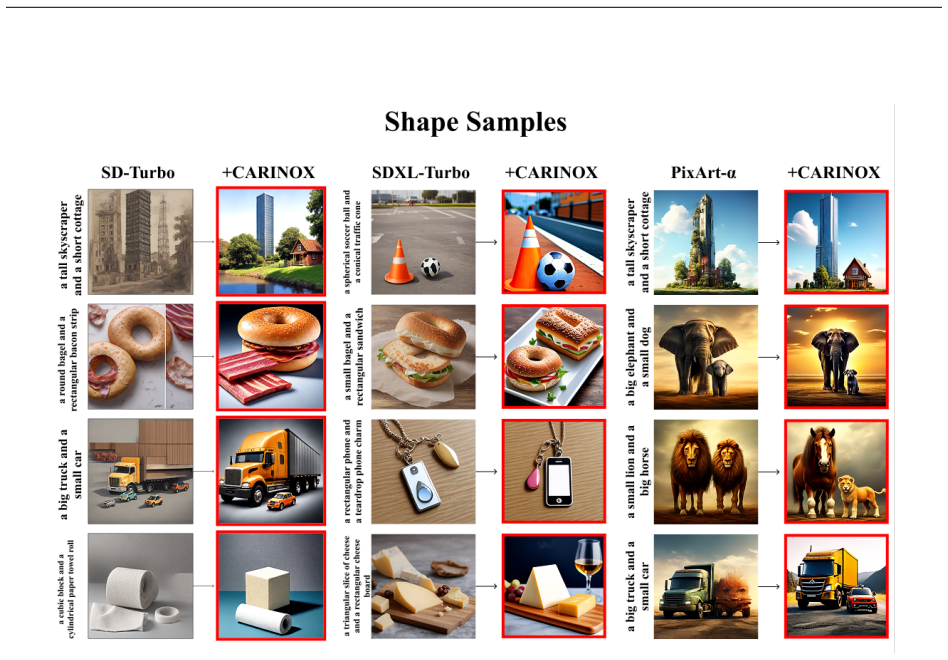
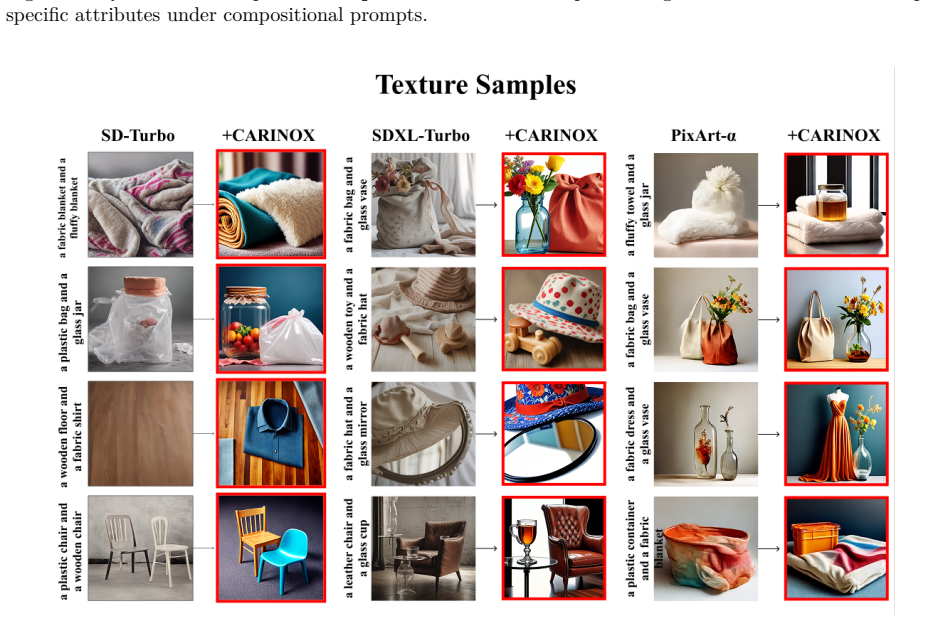


read the original abstract
Text-to-image diffusion models, such as Stable Diffusion, can produce high-quality and diverse images but often fail to achieve compositional alignment, particularly when prompts describe complex object relationships, attributes, or spatial arrangements. Recent inference-time approaches address this by optimizing or exploring the initial noise under the guidance of reward functions that score text-image alignment without requiring model fine-tuning. While promising, each strategy has intrinsic limitations when used alone: optimization can stall due to poor initialization or unfavorable search trajectories, whereas exploration may require a prohibitively large number of samples to locate a satisfactory output. Our analysis further shows that neither single reward metrics nor ad-hoc combinations reliably capture all aspects of compositionality, leading to weak or inconsistent guidance. To overcome these challenges, we present Category-Aware Reward-based Initial Noise Optimization and Exploration (CARINOX), a unified framework that combines noise optimization and exploration with a principled reward selection procedure grounded in correlation with human judgments. Evaluations on two complementary benchmarks covering diverse compositional challenges show that CARINOX raises average alignment scores by +16% on T2I-CompBench++ and +11% on the HRS benchmark, consistently outperforming state-of-the-art optimization and exploration-based methods across all major categories, while preserving image quality and diversity. The project page is available at https://amirkasaei.com/carinox/.
Editorial analysis
A structured set of objections, weighed in public.
Referee Report
Summary. The paper introduces CARINOX, a unified inference-time framework for text-to-image diffusion models that combines initial noise optimization and exploration, guided by a category-aware reward selection procedure chosen for its correlation with human judgments. It claims this overcomes limitations of single rewards or ad-hoc combinations and reports average alignment gains of +16% on T2I-CompBench++ and +11% on the HRS benchmark, with consistent outperformance over prior optimization and exploration methods across categories while preserving quality and diversity.
Significance. If the empirical gains prove robust under proper controls, the work would meaningfully advance inference-time scaling techniques for compositional text-to-image generation by addressing the complementary weaknesses of pure optimization and pure exploration. The explicit grounding of reward selection in human correlation data is a positive step toward more reliable guidance, and the dual-strategy design is a clear conceptual contribution.
major comments (2)
- [Abstract and §3] Abstract and §3 (method): the load-bearing claim that the reward selection procedure 'grounded in correlation with human judgments' reliably captures all compositional aspects is not supported by any reported correlation coefficients, human-study protocol, sample size, or per-category breakdown on T2I-CompBench++. Without these, it is impossible to verify that the chosen reward(s) provide consistent guidance for the exact failure modes (object relationships, attributes, spatial arrangements) the paper targets.
- [§4] §4 (experiments): no description of experimental controls, number of random seeds, statistical significance tests, or ablation on post-hoc reward choices is provided. This makes it difficult to assess whether the reported +16% and +11% average gains are stable or driven by favorable prompt subsets.
minor comments (2)
- [Figures 3-5] Figure captions and axis labels in the benchmark comparison plots should explicitly state the number of samples per method and whether error bars represent standard deviation or standard error.
- [Eq. (3)] The notation for the combined optimization-exploration objective in Eq. (3) would benefit from an explicit statement of how the exploration sampling budget interacts with the optimization steps.
Simulated Author's Rebuttal
We thank the referee for the constructive feedback. We address each major comment below and indicate the planned revisions to strengthen the manuscript.
read point-by-point responses
-
Referee: [Abstract and §3] Abstract and §3 (method): the load-bearing claim that the reward selection procedure 'grounded in correlation with human judgments' reliably captures all compositional aspects is not supported by any reported correlation coefficients, human-study protocol, sample size, or per-category breakdown on T2I-CompBench++. Without these, it is impossible to verify that the chosen reward(s) provide consistent guidance for the exact failure modes (object relationships, attributes, spatial arrangements) the paper targets.
Authors: We agree that the current presentation of the reward selection procedure would benefit from explicit supporting details. In the revised manuscript we will expand §3 with the correlation coefficients (Pearson and Spearman) between each candidate reward and human ratings, the human-study protocol including number of raters and images evaluated, sample size, and per-category breakdowns on T2I-CompBench++. These additions will directly show alignment with the targeted compositional failure modes. revision: yes
-
Referee: [§4] §4 (experiments): no description of experimental controls, number of random seeds, statistical significance tests, or ablation on post-hoc reward choices is provided. This makes it difficult to assess whether the reported +16% and +11% average gains are stable or driven by favorable prompt subsets.
Authors: We acknowledge that the experimental section currently omits several standard controls. In the revision we will add to §4 the number of random seeds used, a description of the prompt sampling procedure, statistical significance tests (e.g., paired t-tests or Wilcoxon tests) on the reported gains, and an ablation on the post-hoc reward selection choices. These changes will demonstrate stability across seeds and prompt subsets. revision: yes
Circularity Check
No circularity: empirical benchmark results with external grounding
full rationale
The paper's core contribution is an empirical framework (CARINOX) that combines noise optimization and exploration under a reward selection procedure. The reported gains (+16% on T2I-CompBench++ and +11% on HRS) are obtained via direct benchmark comparisons against baselines, not via any derivation that reduces to fitted parameters or self-referential definitions. The reward selection is explicitly tied to correlation with human judgments (an external reference), and the abstract and method description contain no equations, uniqueness theorems, or ansatzes that collapse back to the inputs by construction. No self-citation chains are load-bearing for the central claims. The results are therefore self-contained against external benchmarks and falsifiable via replication on the stated datasets.
Axiom & Free-Parameter Ledger
free parameters (1)
- optimization hyperparameters
axioms (1)
- domain assumption Reward functions based on text-image alignment scores provide meaningful guidance for compositionality.
Lean theorems connected to this paper
-
IndisputableMonolith/Cost/FunctionalEquation.leanwashburn_uniqueness_aczel unclear?
unclearRelation between the paper passage and the cited Recognition theorem.
a principled reward selection procedure grounded in correlation with human judgments... HPS, ImageReward, DA Score, and VQA Score as the most consistently effective
-
IndisputableMonolith/Foundation/BranchSelection.leanbranch_selection unclear?
unclearRelation between the paper passage and the cited Recognition theorem.
unified framework that combines noise optimization and exploration
What do these tags mean?
- matches
- The paper's claim is directly supported by a theorem in the formal canon.
- supports
- The theorem supports part of the paper's argument, but the paper may add assumptions or extra steps.
- extends
- The paper goes beyond the formal theorem; the theorem is a base layer rather than the whole result.
- uses
- The paper appears to rely on the theorem as machinery.
- contradicts
- The paper's claim conflicts with a theorem or certificate in the canon.
- unclear
- Pith found a possible connection, but the passage is too broad, indirect, or ambiguous to say the theorem truly supports the claim.
Forward citations
Cited by 1 Pith paper
-
Erasure or Erosion? Evaluating Compositional Degradation in Unlearned Text-To-Image Diffusion Models
Unlearning methods that strongly erase concepts from text-to-image diffusion models consistently degrade performance on attribute binding, spatial reasoning, and counting tasks.
Reference graph
Works this paper leans on
-
[1]
Lital Binyamin, Yoad Tewel, Hilit Segev, Eran Hirsch, Royi Rassin, and Gal Chechik. Make it count: Text-to-image generation with an accurate number of objects.arXiv preprint arXiv:2406.10210,
-
[2]
Getting it right: Improving spatial consistency in text-to-image models.CoRR, abs/2404.01197,
Agneet Chatterjee, Gabriela Ben Melech Stan, Estelle Aflalo, Sayak Paul, Dhruba Ghosh, Tejas Gokhale, Ludwig Schmidt, Hannaneh Hajishirzi, Vasudev Lal, Chitta Baral, and Yezhou Yang. Getting it right: Improving spatial consistency in text-to-image models.CoRR, abs/2404.01197,
-
[3]
Getting it right: Improving spatial consistency in text-to-image models.CoRR, abs/2404.01197,
URLhttps://doi. org/10.48550/arXiv.2404.01197. Hila Chefer, Yuval Alaluf, Yael Vinker, Lior Wolf, and Daniel Cohen-Or. Attend-and-excite: Attention-based semantic guidance for text-to-image diffusion models.ACM Transactions on Graphics (TOG), 42:1 – 10, 2023a. URLhttps://api.semanticscholar.org/CorpusID:256416326. Hila Chefer, Yuval Alaluf, Yael Vinker, L...
-
[4]
Jaemin Cho, Yushi Hu, Roopal Garg, Peter Anderson, Ranjay Krishna, Jason Baldridge, Mohit Bansal, Jordi Pont-Tuset, and Su Wang. Davidsonian scene graph: Improving reliability in fine-grained evaluation for text-image generation.arXiv preprint arXiv:2310.18235,
-
[5]
Manipulating embeddings of stable diffusion prompts
Thomas Deckers, Brian Davis, and Joris Martens. Manipulating embeddings of stable diffusion prompts. arXiv preprint arXiv:2402.04567,
-
[6]
arXiv preprint arXiv:2212.05032 , year=
Chun-Mei Feng, Kai Yu, Yong Liu, Salman Khan, and Wangmeng Zuo. Diverse data augmentation with diffusions for effective test-time prompt tuning. InProceedings of the IEEE/CVF International Conference on Computer Vision, pp. 2704–2714, 2023a. Weixi Feng, Xuehai He, Tsu-Jui Fu, Varun Jampani, Arjun Akula, Pradyumna Narayana, Sugato Basu, Xin Eric Wang, and ...
-
[7]
Benchmarking spatial relationships in text-to-image generation.arXiv preprint arXiv:2212.10015, 2022
Tejas Gokhale, Hamid Palangi, Besmira Nushi, Vibhav Vineet, Eric Horvitz, Ece Kamar, Chitta Baral, and Yezhou Yang. Benchmarking spatial relationships in text-to-image generation.ArXiv, abs/2212.10015,
-
[8]
URLhttps://api.semanticscholar.org/CorpusID:254877055. Jianshu Guo, Wenhao Chai, Jie Deng, Hsiang-Wei Huang, Tian Ye, Yichen Xu, Jiawei Zhang, Jenq-Neng Hwang, and Gaoang Wang. VersaT2I: Improving text-to-image models with versatile reward.arXiv preprint arXiv:2403.18493, 2024a. Xiefan Guo, Jinlin Liu, Miaomiao Cui, Jiankai Li, Hongyu Yang, and Di Huang. ...
-
[9]
CLIPScore: A Reference-free Evaluation Metric for Image Captioning
Jack Hessel, Ari Holtzman, Maxwell Forbes, Ronan Le Bras, and Yejin Choi. Clipscore: A reference-free evaluation metric for image captioning.arXiv preprint arXiv:2104.08718,
work page internal anchor Pith review Pith/arXiv arXiv
-
[10]
Chest-diffusion: a light-weight text-to-image model for report-to-cxr generation
Peng Huang, Xue Gao, Lihong Huang, Jing Jiao, Xiaokang Li, Yuanyuan Wang, and Yi Guo. Chest-diffusion: a light-weight text-to-image model for report-to-cxr generation. In2024 IEEE International Symposium on Biomedical Imaging (ISBI), pp. 1–5. IEEE, 2024a. Yi Huang, Jiancheng Huang, Yifan Liu, Mingfu Yan, Jiaxi Lv, Jianzhuang Liu, Wei Xiong, He Zhang, Shif...
-
[11]
Scaling up gans for text-to-image synthesis
Minguk Kang, Jun-Yan Zhu, Richard Zhang, Jaesik Park, Eli Shechtman, Sylvain Paris, and Taesung Park. Scaling up gans for text-to-image synthesis. InProceedings of the IEEE/CVF conference on computer vision and pattern recognition, pp. 10124–10134, 2023a. 15 Wonjun Kang, Kevin Galim, and Hyung Il Koo. Counting guidance for high fidelity text-to-image synt...
-
[12]
Multi-concept cus- tomization of text-to-image diffusion
Nupur Kumari, Bingliang Zhang, Richard Zhang, Eli Shechtman, and Jun-Yan Zhu. Multi-concept cus- tomization of text-to-image diffusion. InProceedings of the IEEE/CVF conference on computer vision and pattern recognition, pp. 1931–1941,
work page 1931
-
[13]
Junnan Li, Dongxu Li, Silvio Savarese, and Steven Hoi. Blip-2: Bootstrapping language-image pre-training with frozen image encoders and large language models. InInternational conference on machine learning, pp. 19730–19742. PMLR, 2023a. Shuangqi Li, Hieu Le, Jingyi Xu, and Mathieu Salzmann. Enhancing compositional text-to-image generation with reliable ra...
-
[14]
Chenlin Mou, Jian Zhang, Xuan Liu, et al. T2I-Adapter: Learning adapters to dig out more controllable ability for text-to-image diffusion models.arXiv preprint arXiv:2302.08453,
work page internal anchor Pith review Pith/arXiv arXiv
-
[15]
GLIDE: Towards Photorealistic Image Generation and Editing with Text-Guided Diffusion Models
Alex Nichol, Prafulla Dhariwal, Aditya Ramesh, Pranav Shyam, Pamela Mishkin, Bob McGrew, Ilya Sutskever, and Mark Chen. Glide: Towards photorealistic image generation and editing with text-guided diffusion models.arXiv preprint arXiv:2112.10741,
work page internal anchor Pith review Pith/arXiv arXiv
-
[16]
SDXL: Improving Latent Diffusion Models for High-Resolution Image Synthesis
Dustin Podell, Zion English, Kyle Lacey, Andreas Blattmann, Tim Dockhorn, Jonas Müller, Joe Penna, and Robin Rombach. Sdxl: Improving latent diffusion models for high-resolution image synthesis.arXiv preprint arXiv:2307.01952,
work page internal anchor Pith review Pith/arXiv arXiv
-
[17]
Hierarchical Text-Conditional Image Generation with CLIP Latents
Aditya Ramesh, Prafulla Dhariwal, Alex Nichol, Casey Chu, and Mark Chen. Hierarchical text-conditional image generation with clip latents.arXiv preprint arXiv:2204.06125, 1(2):3,
work page internal anchor Pith review Pith/arXiv arXiv
-
[18]
John Smith, Jane Doe, Hao Wang, and Minsoo Kim. Iterative object count optimization for text-to-image diffusion models.arXiv preprint arXiv:2405.12345,
-
[19]
Predicated diffusion: Predicate logic-based attention guidance for text-to-image diffusion models
Kota Sueyoshi and Takashi Matsubara. Predicated diffusion: Predicate logic-based attention guidance for text-to-image diffusion models. InProceedings of the IEEE/CVF Conference on Computer Vision and Pattern Recognition (CVPR), pp. 8651–8660, June 2024a. Kota Sueyoshi and Takashi Matsubara. Predicated diffusion: Predicate logic-based attention guidance fo...
work page 2024
-
[20]
Human preference score: Better aligning text-to-image models with human preference
Xiaoshi Wu, Keqiang Sun, Feng Zhu, Rui Zhao, and Hongsheng Li. Human preference score: Better aligning text-to-image models with human preference. InProceedings of the IEEE/CVF International Conference on Computer Vision, pp. 2096–2105,
work page 2096
-
[21]
A new creative generation pipeline for click-through rate with stable diffusion model
Hao Yang, Jianxin Yuan, Shuai Yang, Linhe Xu, Shuo Yuan, and Yifan Zeng. A new creative generation pipeline for click-through rate with stable diffusion model. InCompanion Proceedings of the ACM Web Conference 2024, pp. 180–189,
work page 2024
-
[22]
Ming Yu, Zeyu Zhang, Haoran Wang, Xinyu Gu, Ping Luo, and Dahua Lin. Seek for incantations: Towards accurate text-to-image diffusion synthesis through prompt engineering.arXiv preprint arXiv:2401.06345,
-
[23]
URLhttps://arxiv.org/abs/2408.11721. Arman Zarei, Keivan Rezaei, Samyadeep Basu, Mehrdad Saberi, Mazda Moayeri, Priyatham Kattakinda, and Soheil Feizi. Understanding and mitigating compositional issues in text-to-image generative models. arXiv preprint arXiv:2406.07844,
-
[24]
Lvmin Zhang, Anyi Rao, and Maneesh Agrawala
doi: 10.1109/PerComWorkshops65533.2025.00044. Lvmin Zhang, Anyi Rao, and Maneesh Agrawala. Adding conditional control to text-to-image diffusion models.arXiv preprint arXiv:2302.05543,
-
[25]
Yang Zhang, Teoh Tze Tzun, Lim Wei Hern, Tiviatis Sim, and Kenji Kawaguchi. Enhancing semantic fidelity in text-to-image synthesis: Attention regulation in diffusion models.CoRR, abs/2403.06381, 2024a. URL https://doi.org/10.48550/arXiv.2403.06381. Yang Zhang, Teoh Tze Tzun, Lim Wei Hern, Tiviatis Sim, and Kenji Kawaguchi. Enhancing semantic fidelity in t...
- [26]
-
[27]
0.684 0.336 0.423 0.311 0.351 0.519 0.1950.526 DSG (Cho et al.,
work page 1950
-
[28]
The highest value in each category is shown in bold, and the second-highest is underlined
0.599 0.388 0.628 0.328 0.470 0.4110.4270.469 VQA Score (Lin et al., 2024b) 0.678 0.405 0.7010.5330.4950.6380.339 0.473 Table 5: Spearman correlation of evaluation metrics with human scores across compositional categories on T2I-CompBench++. The highest value in each category is shown in bold, and the second-highest is underlined. Metric Color Shape Textu...
-
[29]
0.456 0.279 0.512 0.195 0.293 0.267 0.231 0.322 DA Score (Singh & Zheng, 2023)0.6030.337 0.534 0.247 0.357 0.364 0.206 0.347 TIFA (Hu et al.,
work page 2023
-
[30]
The highest value in each category is shown in bold, and the second-highest is underlined
0.499 0.303 0.503 0.292 0.408 0.3250.3550.363 VQA Score (Lin et al., 2024b) 0.512 0.292 0.5160.4220.3900.4810.243 0.352 Table 6: Kendall’sτcorrelation of evaluation metrics with human scores across compositional categories on T2I-CompBench++. The highest value in each category is shown in bold, and the second-highest is underlined. Embedding-based Metrics...
-
[31]
0 DA Score (Singh & Zheng, 2023)✓ ✓ ✓ ✓ 4 TIFA (Hu et al.,
work page 2023
-
[32]
estimates aesthetic value from large-scale human ratings. C.2 Experimental Setting Our analysis is based on T2I-CompBench++ (Huang et al., 2025), which provides curated prompts across attributes (color, shape, texture), spatial relations (2D and 3D), non-spatial relations, complex prompts, and numeracy. Each prompt is paired with images from multiple text...
work page 2025
-
[33]
on the MS-COCO dataset (Lin et al., 2014). FID captures distributional distance from real images (lower is better), while Density and Coverage measure fidelity and diversity relative to the real distribution (higher is better). Table 8 shows that CARINOX achieves competitive results on all three measures while providing substan- tial compositional improve...
work page 2014
discussion (0)
Sign in with ORCID, Apple, or X to comment. Anyone can read and Pith papers without signing in.