LucidFlux: Caption-Free Photo-Realistic Image Restoration via a Large-Scale Diffusion Transformer
Pith reviewed 2026-05-18 13:06 UTC · model grok-4.3
The pith
LucidFlux adapts Flux.1 for caption-free image restoration by conditioning on degraded inputs and lightly restored proxies through dual-branch signals and adaptive modulation.
A machine-rendered reading of the paper's core claim, the machinery that carries it, and where it could break.
Core claim
LucidFlux shows that for large diffusion transformers the governing lever for robust caption-free image restoration is determining when, where, and what to condition on. A lightweight dual-branch conditioner injects signals from the degraded input to anchor geometry and from a lightly restored proxy to suppress artifacts. These cues are routed via a timestep- and layer-adaptive modulation schedule to yield context-aware, coarse-to-fine updates. Caption-free semantic alignment is enforced through SigLIP features from the proxy, backed by a curation pipeline that selects structure-rich training data.
What carries the argument
Lightweight dual-branch conditioner that supplies signals from the degraded input and a lightly restored proxy, combined with timestep- and layer-adaptive modulation that routes those signals across the Flux.1 hierarchy.
If this is right
- Restored images preserve global structure while recovering fine texture across mixed unknown degradations.
- Training and inference no longer require generating or using text captions or vision-language model descriptions.
- The same conditioning approach scales to other large diffusion transformers by focusing on signal routing rather than added parameters.
- Performance gains hold on both synthetic benchmarks and real-world photographs without task-specific retraining.
Where Pith is reading between the lines
- The emphasis on conditioning location and timing could transfer to other conditional generation tasks where reliable text prompts are unavailable.
- Iterating the proxy restoration step inside the same framework might produce a self-refining loop for progressively harder degradations.
- Applying the dual-branch and adaptive schedule to video or multi-view restoration would test whether the coarse-to-fine routing generalizes across temporal or spatial dimensions.
Load-bearing premise
That signals from the degraded input and lightly restored proxy can be injected through the dual-branch conditioner and modulated across timesteps and layers to anchor geometry and suppress artifacts without introducing new hallucinations or drift.
What would settle it
A controlled test set of heavily degraded in-the-wild images where the outputs show increased geometry distortion or semantic drift relative to the strongest baselines would falsify the central claim.
Figures
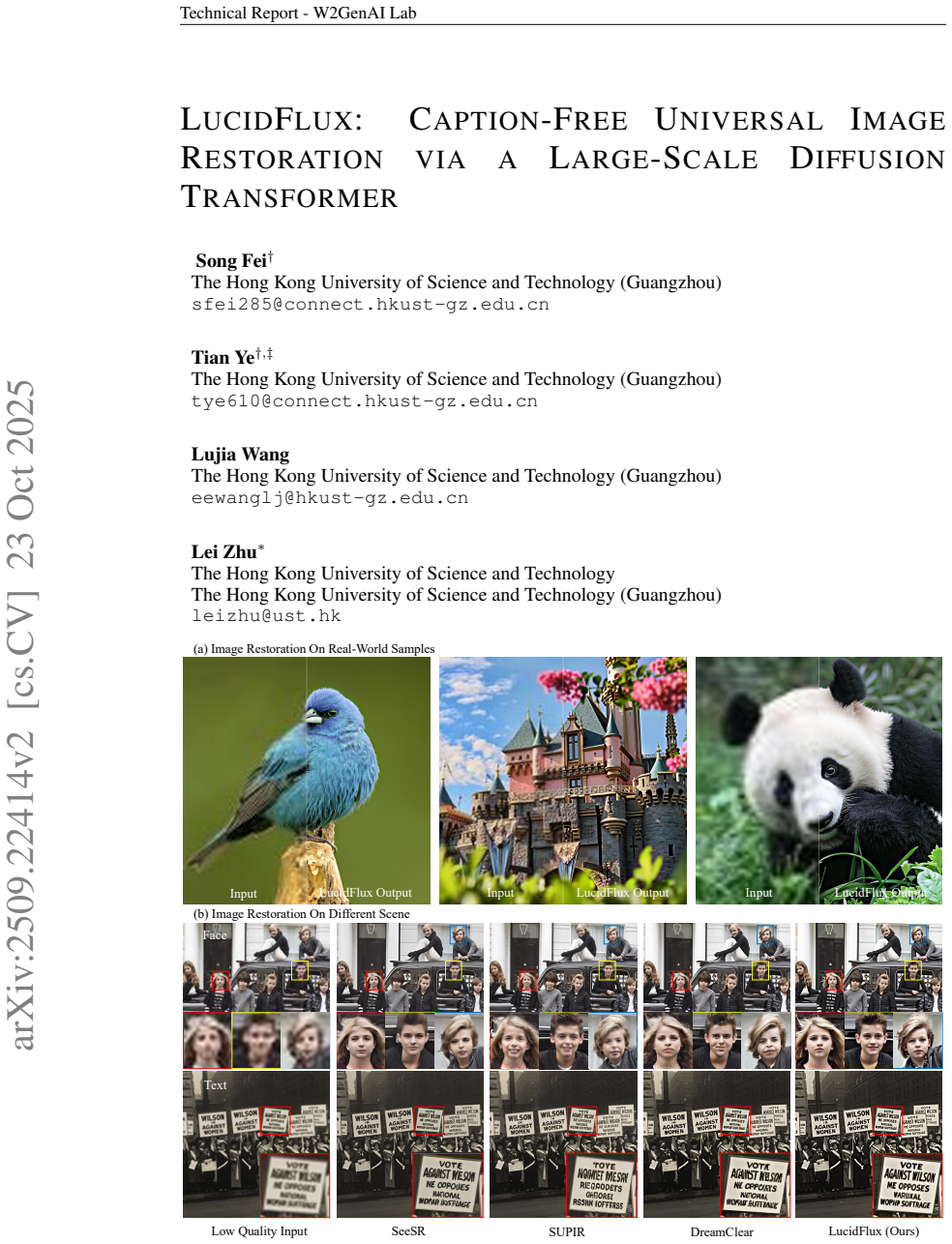


read the original abstract
Image restoration (IR) aims to recover images degraded by unknown mixtures while preserving semanticsconditions under which discriminative restorers and UNet-based diffusion priors often oversmooth, hallucinate, or drift. We present LucidFlux, a caption-free IR framework that adapts a large diffusion transformer (Flux.1) without image captions. Our LucidFlux introduces a lightweight dual-branch conditioner that injects signals from the degraded input and a lightly restored proxy to respectively anchor geometry and suppress artifacts. Then, a timestep- and layer-adaptive modulation schedule is designed to route these cues across the backbones hierarchy, in order to yield coarse-to-fine and context-aware updates that protect the global structure while recovering texture. After that, to avoid the latency and instability of text prompts or Vision-Language Model (VLM) captions, we enforce caption-free semantic alignment via SigLIP features extracted from the proxy. A scalable curation pipeline further filters large-scale data for structure-rich supervision. Across synthetic and in-the-wild benchmarks, our LucidFlux consistently outperforms strong open-source and commercial baselines, and ablation studies verify the necessity of each component. LucidFlux shows that, for large DiTs, when, where, and what to condition onrather than adding parameters or relying on text promptsis the governing lever for robust and caption-free image restoration in the wild.
Editorial analysis
A structured set of objections, weighed in public.
Referee Report
Summary. The paper introduces LucidFlux, a caption-free framework for photo-realistic image restoration that adapts the Flux.1 diffusion transformer. It employs a lightweight dual-branch conditioner to inject signals from the degraded input (for geometry anchoring) and a lightly restored proxy (for artifact suppression), combined with a timestep- and layer-adaptive modulation schedule to enable coarse-to-fine, context-aware updates. Caption-free semantic alignment is achieved via SigLIP features extracted from the proxy, supported by a scalable curation pipeline for structure-rich training data. The method is evaluated on synthetic and in-the-wild benchmarks, where it is claimed to consistently outperform open-source and commercial baselines, with ablations verifying the contribution of each component.
Significance. If the empirical results hold under rigorous verification, the work is significant for demonstrating that targeted conditioning strategies on large-scale DiTs can achieve robust restoration without text prompts or VLMs, potentially lowering latency and instability. The dual-branch design and adaptive modulation highlight that the 'when, where, and what' of conditioning may be more critical than parameter scaling for handling unknown degradation mixtures while preserving global structure. The curation pipeline could also aid future training of similar models.
major comments (2)
- [§4 (Experiments and Ablations)] The central claim that the dual-branch conditioner and modulation schedule reliably anchor geometry, suppress artifacts, and avoid new hallucinations or drift rests primarily on component ablations (as described in the abstract and §4). However, these do not isolate whether the lightly restored proxy introduces systematic bias or whether the modulation fails under severe/mixed degradations outside the training distribution, which is load-bearing for the robustness assertion in the wild.
- [§5 (Results)] The performance claims of consistent outperformance across benchmarks lack explicit quantitative tables, exact metric values, error bars, or statistical significance tests in the reported results, making the magnitude and reliability of gains difficult to verify independently from the abstract and high-level descriptions.
minor comments (2)
- [§3.2 (Method)] Clarify the exact formulation of the timestep- and layer-adaptive modulation (e.g., how routing weights are computed per layer and timestep) to improve reproducibility.
- Add more detailed captions or annotations to qualitative figures to highlight differences in artifact suppression and structure preservation compared to baselines.
Simulated Author's Rebuttal
We thank the referee for the constructive and detailed feedback. We address each major comment below and have revised the manuscript accordingly to improve clarity, verifiability, and robustness analysis.
read point-by-point responses
-
Referee: [§4 (Experiments and Ablations)] The central claim that the dual-branch conditioner and modulation schedule reliably anchor geometry, suppress artifacts, and avoid new hallucinations or drift rests primarily on component ablations (as described in the abstract and §4). However, these do not isolate whether the lightly restored proxy introduces systematic bias or whether the modulation fails under severe/mixed degradations outside the training distribution, which is load-bearing for the robustness assertion in the wild.
Authors: We agree that isolating potential proxy-induced bias and testing modulation robustness under severe out-of-distribution degradations would further strengthen the claims. Our existing component ablations in §4 already include variants with and without the proxy branch, showing clear contributions to artifact suppression and geometry anchoring on the reported benchmarks. To directly address the concern, we have added new experiments in the revised §4: (i) controlled injections of proxy noise to quantify bias, and (ii) evaluation on additional severe mixed-degradation sets outside the original training distribution. These results are now included with qualitative failure-case analysis. revision: yes
-
Referee: [§5 (Results)] The performance claims of consistent outperformance across benchmarks lack explicit quantitative tables, exact metric values, error bars, or statistical significance tests in the reported results, making the magnitude and reliability of gains difficult to verify independently from the abstract and high-level descriptions.
Authors: We acknowledge that explicit numerical presentation improves independent verification. The original §5 contains comparative results against baselines on synthetic and in-the-wild benchmarks, but we have expanded the section in revision to include full quantitative tables with exact PSNR, SSIM, LPIPS, and FID values, standard deviations across multiple runs as error bars, and paired statistical significance tests (p-values) for the reported gains. These tables are now presented with all numerical details. revision: yes
Circularity Check
No significant circularity; empirical method with external benchmarks
full rationale
The paper proposes an architectural design (dual-branch conditioner, adaptive modulation schedule, SigLIP-based caption-free alignment) for adapting Flux.1 to image restoration and validates it through benchmark comparisons and component ablations on synthetic and in-the-wild data. No equations, fitted parameters, or predictions are presented that reduce by construction to the inputs or to self-citations. The central claims rest on performance metrics external to the conditioning choices themselves, with no self-definitional loops, uniqueness theorems imported from prior author work, or ansatzes smuggled via citation. This is the standard case of a self-contained empirical contribution against independent test sets.
Axiom & Free-Parameter Ledger
axioms (1)
- domain assumption Large diffusion transformers such as Flux.1 can be effectively conditioned for image restoration tasks when provided appropriate spatial and semantic signals.
Lean theorems connected to this paper
-
IndisputableMonolith/Cost/FunctionalEquation.leanwashburn_uniqueness_aczel unclear?
unclearRelation between the paper passage and the cited Recognition theorem.
lightweight dual-branch conditioner that injects signals from the degraded input and a lightly restored proxy … timestep- and layer-adaptive modulation schedule … caption-free semantic alignment via SigLIP features
-
IndisputableMonolith/Foundation/DimensionForcing.leanalexander_duality_circle_linking unclear?
unclearRelation between the paper passage and the cited Recognition theorem.
coarse-to-fine and context-aware updates that protect the global structure while recovering texture
What do these tags mean?
- matches
- The paper's claim is directly supported by a theorem in the formal canon.
- supports
- The theorem supports part of the paper's argument, but the paper may add assumptions or extra steps.
- extends
- The paper goes beyond the formal theorem; the theorem is a base layer rather than the whole result.
- uses
- The paper appears to rely on the theorem as machinery.
- contradicts
- The paper's claim conflicts with a theorem or certificate in the canon.
- unclear
- Pith found a possible connection, but the passage is too broad, indirect, or ambiguous to say the theorem truly supports the claim.
Forward citations
Cited by 2 Pith papers
-
OP4KSR: One-Step Patch-Free 4K Super-Resolution with Periodic Artifact Suppression
OP4KSR enables efficient one-step 4K super-resolution without patches by adapting Flux with RoPE rescaling and periodicity loss to suppress artifacts.
-
LucidNFT: LR-Anchored Multi-Reward Preference Optimization for Flow-Based Real-World Super-Resolution
LucidNFT combines a new LR-referenced consistency reward, decoupled normalization, and a real-degradation dataset to improve perceptual quality in flow-matching super-resolution while preserving input fidelity.
Reference graph
Works this paper leans on
-
[1]
Ntire 2017 challenge on single image super-resolution: Dataset and study
Eirikur Agustsson and Radu Timofte. Ntire 2017 challenge on single image super-resolution: Dataset and study. InProceedings of the IEEE conference on computer vision and pattern recog- nition workshops, pp. 126–135, 2017a. Eirikur Agustsson and Radu Timofte. Ntire 2017 challenge on single image super-resolution: Dataset and study. InProceedings of the IEE...
work page 2017
-
[2]
URLhttps://huggingface.co/datasets/ bghira/photo-concept-bucket. Accessed: 2025-09-05. ByteDance Seed Vision Team. Seedream 4.0.https://www.doubao.com/chat/,
work page 2025
-
[3]
Jianrui Cai, Hui Zeng, Hongwei Yong, Zisheng Cao, and Lei Zhang
Accessed: 2025-09-24. Jianrui Cai, Hui Zeng, Hongwei Yong, Zisheng Cao, and Lei Zhang. Toward real-world single image super-resolution: A new benchmark and a new model. InProceedings of the IEEE/CVF international conference on computer vision, pp. 3086–3095,
work page 2025
-
[4]
google.com/models/gemini-2-5-flash-image
URLhttps://aistudio. google.com/models/gemini-2-5-flash-image. Accessed: 2025-09-24. 10 Technical Report - W2GenAI Lab Chao Dong, Chen Change Loy, Kaiming He, and Xiaoou Tang. Image super-resolution using deep convolutional networks.IEEE Transactions on Pattern Analysis and Machine Intelligence, 38(2): 295–307,
work page 2025
-
[5]
doi: 10.1109/TPAMI.2015.2439281. Patrick Esser, Sumith Kulal, Andreas Blattmann, Rahim Entezari, Jonas M ¨uller, Harry Saini, Yam Levi, Dominik Lorenz, Axel Sauer, Frederic Boesel, et al. Scaling rectified flow transformers for high-resolution image synthesis. InForty-first international conference on machine learning,
-
[6]
URLhttps://www.hypir. org/. Accessed: 2025-09-24. Junjie Ke, Qifei Wang, Yilin Wang, Peyman Milanfar, and Feng Yang. Musiq: Multi-scale im- age quality transformer. InProceedings of the IEEE/CVF international conference on computer vision, pp. 5148–5157,
work page 2025
-
[7]
URLhttps://arxiv.org/ abs/2504.17825. Black Forest Labs. Flux.https://github.com/black-forest-labs/flux,
-
[8]
Swinir: Image restoration using swin transformer.arXiv preprint arXiv:2108.10257,
Jingyun Liang, Jiezhang Cao, Guolei Sun, Kai Zhang, Luc Van Gool, and Radu Timofte. Swinir: Image restoration using swin transformer.arXiv preprint arXiv:2108.10257,
-
[9]
Harnessing diffusion-yielded score priors for image restoration
Xinqi Lin, Fanghua Yu, Jinfan Hu, Zhiyuan You, Wu Shi, Jimmy S Ren, Jinjin Gu, and Chao Dong. Harnessing diffusion-yielded score priors for image restoration.arXiv preprint arXiv:2507.20590,
-
[10]
Yong-Hyun Park, Mingi Kwon, Jaewoong Choi, Junghyo Jo, and Youngjung Uh
Accessed: 2025-09-24. Yong-Hyun Park, Mingi Kwon, Jaewoong Choi, Junghyo Jo, and Youngjung Uh. Understanding the latent space of diffusion models through the lens of riemannian geometry.Advances in Neural Information Processing Systems, 36:24129–24142,
work page 2025
-
[11]
Scalable Diffusion Models with Transformers
William Peebles and Saining Xie. Scalable diffusion models with transformers.arXiv preprint arXiv:2212.09748,
work page internal anchor Pith review Pith/arXiv arXiv
-
[12]
SDXL: Improving Latent Diffusion Models for High-Resolution Image Synthesis
Dustin Podell, Zion English, Kyle Lacey, Andreas Blattmann, Tim Dockhorn, Jonas M ¨uller, Joe Penna, and Robin Rombach. Sdxl: Improving latent diffusion models for high-resolution image synthesis.arXiv preprint arXiv:2307.01952,
work page internal anchor Pith review Pith/arXiv arXiv
-
[13]
Jianyi Wang, Zongsheng Yue, Shangchen Zhou, Kelvin CK Chan, and Chen Change Loy. Exploiting diffusion prior for real-world image super-resolution.International Journal of Computer Vision, 132(12):5929–5949, 2024a. Xintao Wang, Liangbin Xie, Chao Dong, and Ying Shan. Real-esrgan: Training real-world blind super-resolution with pure synthetic data. InProcee...
work page 1905
-
[14]
Q-Align: Teaching LMMs for Visual Scoring via Discrete Text-Defined Levels
Haoning Wu, Zicheng Zhang, Weixia Zhang, Chaofeng Chen, Chunyi Li, Liang Liao, Annan Wang, Erli Zhang, Wenxiu Sun, Qiong Yan, Xiongkuo Min, Guangtai Zhai, and Weisi Lin. Q-align: Teaching lmms for visual scoring via discrete text-defined levels.arXiv preprint arXiv:2312.17090,
work page internal anchor Pith review Pith/arXiv arXiv
-
[15]
One-step effective diffusion network for real-world image super-resolution
Equal Contribution by Wu, Haoning and Zhang, Zicheng. Project Lead by Wu, Haoning. Corresponding Authors: Zhai, Guangtai and Lin, Weisi. Rongyuan Wu, Lingchen Sun, Zhiyuan Ma, and Lei Zhang. One-step effective diffusion network for real-world image super-resolution.arXiv preprint arXiv:2406.08177, 2024a. Rongyuan Wu, Tao Yang, Lingchen Sun, Zhengqiang Zha...
-
[16]
IEEE Transactions on Image Processing 26(5), 2274–2285 (2017)
doi: 10.1109/TIP. 2015.2426416. Lvmin Zhang, Anyi Rao, and Maneesh Agrawala. Adding conditional control to text-to-image diffusion models,
work page doi:10.1109/tip 2015
-
[17]
describe the key subjects and style
13 Technical Report - W2GenAI Lab A APPENDIX A.1 LIKELIHOOD OFDEGRADATION-RELATEDTERMS INCAPTIONSGENERATED BY DIFFERENTMULTIMODALLARGELANGUAGEMODELS When using captions from multimodal large language models (MLLMs) as semantic guidance for restoration tasks, a potential risk is that these models may unintentionally introduce degradation- related terms (e....
work page 2024
discussion (0)
Sign in with ORCID, Apple, or X to comment. Anyone can read and Pith papers without signing in.