Energy-Efficient Movable Antennas: Mechanical Power Modeling and Performance Optimization
Pith reviewed 2026-05-18 12:47 UTC · model grok-4.3
The pith
Modeling mechanical power in movable antenna systems enables higher energy efficiency than fixed-position antennas via joint optimization.
A machine-rendered reading of the paper's core claim, the machinery that carries it, and where it could break.
Core claim
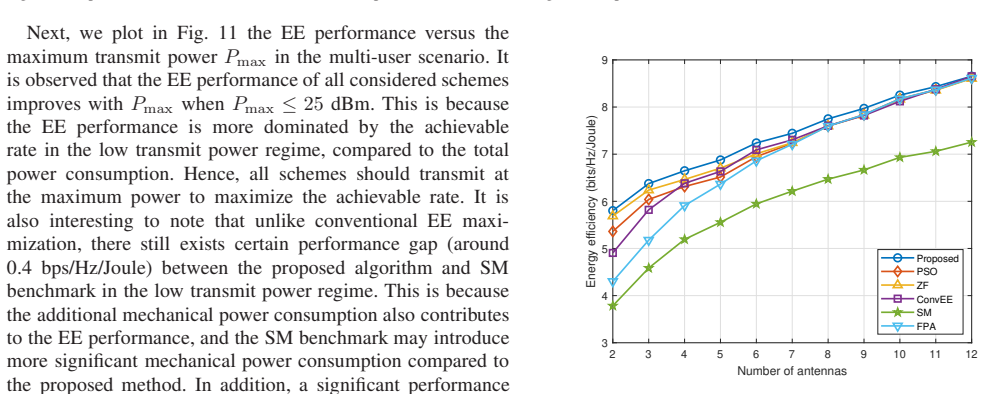
We develop a fundamental power consumption model for stepper motor-driven multi-MA systems based on electric motor theory. We formulate an EE maximization problem to jointly optimize the MAs' positions, moving speeds, and the BS's transmit precoding matrix subject to collision-avoidance constraints. We reveal that the collision-avoidance constraints can always be relaxed without loss of optimality by properly renumbering the MA indices. For the relaxed problem, we develop a two-layer optimization framework for the single-user case and an alternating optimization algorithm for the multi-user case. Numerical results demonstrate that despite the additional mechanical power consumption, the 0.3
What carries the argument
The power consumption model for stepper motor-driven movable antennas based on electric motor theory, which is used to formulate and solve the energy efficiency maximization problem with relaxed collision constraints.
If this is right
- The EE has a monotonicity property with respect to moving speeds in single-user scenarios.
- Optimal precoding can be found efficiently for fixed MA positions using the Dinkelbach algorithm.
- The alternating optimization algorithm converges to good solutions for multi-user EE maximization.
- Movable antennas can provide energy efficiency gains when mechanical costs are properly modeled and optimized.
Where Pith is reading between the lines
- The renumbering relaxation technique could be applied to other optimization problems involving interchangeable agents or objects with movement constraints.
- Improving motor efficiency would further amplify the advantages of movable antennas in energy-constrained environments.
- The framework might be extended to dynamic scenarios where user positions change over time.
Load-bearing premise
The collision-avoidance constraints can always be relaxed without loss of optimality by properly renumbering the MA indices.
What would settle it
A counterexample where renumbering MA indices results in an optimal solution that collides in the original setup, or numerical results where the proposed method's energy efficiency is consistently lower than fixed-position antennas.
Figures


read the original abstract
Movable antennas (MAs) offer additional spatial degrees of freedom (DoFs) to enhance communication performance through local antenna movement. However, to achieve accurate and fast antenna movement, MA drivers entail non-negligible mechanical power consumption, rendering energy efficiency (EE) optimization more critical compared to conventional fixed-position antenna (FPA) systems. To address this issue, we develop a fundamental power consumption model for stepper motor-driven multi-MA systems based on electric motor theory. Based on this model, we formulate an EE maximization problem from a multi-MA base station (BS) to multiple single-FPA users. We aim to jointly optimize the MAs' positions, moving speeds, and the BS's transmit precoding matrix subject to collision-avoidance constraints during the multi-MA movements. However, this problem is difficult to solve. To tackle this challenge, we first reveal that the collision-avoidance constraints can always be relaxed without loss of optimality by properly renumbering the MA indices. For the resulting relaxed problem, we first consider a simplified single-user setup and uncover a hidden monotonicity of the EE performance with respect to the MAs' moving speeds. To solve the remaining optimization problem, we develop a two-layer optimization framework. In the inner layer, the Dinkelbach algorithm is employed to derive the optimal beamforming solution for any given MA positions. In the outer layer, a sequential update algorithm is proposed to iteratively refine the MA positions based on the optimal values obtained from the inner layer. Next, we proceed to the general multi-user case and propose an alternating optimization (AO) algorithm. Numerical results demonstrate that despite the additional mechanical power consumption, the proposed algorithms can outperform both conventional FPA systems and other existing EE maximization benchmarks
Editorial analysis
A structured set of objections, weighed in public.
Referee Report
Summary. The paper develops a mechanical power consumption model for stepper motor-driven movable antennas (MAs) based on electric motor theory. It formulates an energy-efficiency (EE) maximization problem for a multi-MA base station serving multiple single-antenna users, jointly optimizing MA positions, moving speeds, and the BS transmit precoding matrix subject to collision-avoidance constraints. The authors claim that collision-avoidance constraints can always be relaxed without loss of optimality by renumbering MA indices; they then derive a two-layer framework (Dinkelbach inner beamforming + sequential outer position updates) for the single-user case and an alternating-optimization algorithm for the multi-user case. Numerical results are said to show that the proposed schemes outperform both conventional fixed-position antenna (FPA) systems and existing EE benchmarks despite the added mechanical power.
Significance. If the power model and the claimed relaxation are valid, the work supplies a concrete, hardware-motivated framework for EE optimization in MA systems that accounts for real mechanical costs—an important step toward assessing whether the spatial DoFs of MAs remain advantageous once actuator energy is included. The explicit stepper-motor derivation and the monotonicity observation in the single-user case are constructive contributions that could be reused in follow-on studies.
major comments (1)
- [Optimization formulation / abstract] Optimization formulation section (and abstract): the claim that collision-avoidance constraints can always be relaxed without loss of optimality by renumbering MA indices assumes that total mechanical power is invariant to permutation of target assignments. Because the derived power model depends on each MA’s individual speed, travel distance, and trajectory from its fixed initial position, reassigning which MA moves to which final location generally changes the per-motor energy terms and therefore the summed mechanical power. This assumption is load-bearing for the validity of the relaxed problem that enables the subsequent Dinkelbach and AO algorithms.
minor comments (2)
- [Numerical results] Numerical-results section: the abstract states that the proposed algorithms outperform FPA and other EE benchmarks, yet no error bars, Monte-Carlo repetition count, or explicit validation that the stepper-motor model matches measured hardware data are mentioned. Adding these details would strengthen confidence in the reported gains.
- [System model] Notation: the distinction between the mechanical power consumed during movement and the steady-state power after positioning is not always explicit when the EE objective is written; a short clarifying sentence or equation label would help readers track which term is active in each phase of the optimization.
Simulated Author's Rebuttal
We sincerely thank the referee for the careful and constructive review of our manuscript. The major comment raises an important point about the validity of relaxing the collision-avoidance constraints. We address it in detail below and will revise the manuscript to strengthen the exposition.
read point-by-point responses
-
Referee: Optimization formulation section (and abstract): the claim that collision-avoidance constraints can always be relaxed without loss of optimality by renumbering MA indices assumes that total mechanical power is invariant to permutation of target assignments. Because the derived power model depends on each MA’s individual speed, travel distance, and trajectory from its fixed initial position, reassigning which MA moves to which final location generally changes the per-motor energy terms and therefore the summed mechanical power. This assumption is load-bearing for the validity of the relaxed problem that enables the subsequent Dinkelbach and AO algorithms.
Authors: We thank the referee for this observation. We agree that the total mechanical power is generally not invariant to arbitrary permutations of target assignments, since each MA has a distinct initial position and the power model depends on individual travel distances and speeds. However, the claimed relaxation remains valid without loss of optimality. The communication rate depends only on the set of final positions (the MAs being identical), not on the specific assignment of MAs to positions. For any candidate set of final positions, the mechanical power is minimized by the assignment that minimizes aggregate travel cost. On a line, this minimum is achieved by the order-preserving (non-crossing) matching between sorted initial positions and sorted final positions. This matching automatically satisfies the collision-avoidance constraints. Any crossing permutation yields strictly larger total mechanical power and thus weakly lower energy efficiency. Therefore, the globally optimal energy-efficiency solution can always be attained within the relaxed problem by appropriately renumbering (i.e., sorting) the MA indices. We will add a concise justification of this argument, including the observation that the optimal matching is order-preserving, to the optimization formulation section. revision: yes
Circularity Check
No significant circularity; standard optimization on derived power model
full rationale
The paper first derives a mechanical power model from stepper-motor electric theory, then formulates the EE maximization problem with collision-avoidance constraints. It states that these constraints can be relaxed without loss of optimality via MA index renumbering, presented as an internal revelation rather than a self-citation or fitted input. The solution proceeds with the Dinkelbach algorithm for beamforming (inner layer) and sequential/AO updates for positions (outer layer), both standard methods applied to the newly derived model. Numerical outperformance claims rest on solving this optimization, not on any quantity that reduces by construction to the paper's own fitted parameters or prior self-citations. The derivation chain remains self-contained against external benchmarks.
Axiom & Free-Parameter Ledger
Lean theorems connected to this paper
-
IndisputableMonolith/Cost/FunctionalEquation.leanwashburn_uniqueness_aczel unclear?
unclearRelation between the paper passage and the cited Recognition theorem.
we develop a fundamental power consumption model for stepper motor-driven multi-MA systems based on electric motor theory... collision-avoidance constraints can always be relaxed without loss of optimality by properly renumbering the MA indices
-
IndisputableMonolith/Foundation/RealityFromDistinction.leanreality_from_one_distinction unclear?
unclearRelation between the paper passage and the cited Recognition theorem.
two-layer optimization framework... Dinkelbach algorithm... sequential update algorithm... alternating optimization (AO)
What do these tags mean?
- matches
- The paper's claim is directly supported by a theorem in the formal canon.
- supports
- The theorem supports part of the paper's argument, but the paper may add assumptions or extra steps.
- extends
- The paper goes beyond the formal theorem; the theorem is a base layer rather than the whole result.
- uses
- The paper appears to rely on the theorem as machinery.
- contradicts
- The paper's claim conflicts with a theorem or certificate in the canon.
- unclear
- Pith found a possible connection, but the passage is too broad, indirect, or ambiguous to say the theorem truly supports the claim.
Forward citations
Cited by 2 Pith papers
-
Joint Communication and Trajectory Design for Movable Antenna Systems
Movable antennas achieve higher average data rates by transmitting while moving along trajectories optimized via closed-form solutions for two-path cases and graph-based shortest-path reformulation for general cases.
-
Joint Communication and Trajectory Design for Movable Antenna Systems
Joint communication-trajectory design for a single movable antenna yields closed-form optimal paths for two-path channels and an optimal graph-theoretic solution for general channels via discretization into a fixed-ho...
Reference graph
Works this paper leans on
-
[1]
Mechanical power modeling and energy efficiency maximization for movable ant enna systems,
X. Wei, W. Mei, X. Huang, Z. Chen, and B. Ning, “Mechanical power modeling and energy efficiency maximization for movable ant enna systems,” 2025. [Online]. Available: https://arxiv.org/ pdf/2505.05914
-
[2]
Massive MIMO for next generation wireless systems,
E. G. Larsson, O. Edfors, F. Tufvesson, and T. L. Marzetta , “Massive MIMO for next generation wireless systems,” IEEE Commun. Mag. , vol. 52, no. 2, pp. 186–195, Feb. 2014
work page 2014
-
[3]
A tutorial on extremely large-scale MIMO for 6G: Fundamentals, signal processing, and applications,
Z. Wang et al. , “A tutorial on extremely large-scale MIMO for 6G: Fundamentals, signal processing, and applications,” IEEE Commun. Surveys Tuts., vol. 26, no. 3, pp. 1560–1605, 2024
work page 2024
-
[4]
Movable antennas for wireles s commu- nication: Opportunities and challenges,
L. Zhu, W. Ma, and R. Zhang, “Movable antennas for wireles s commu- nication: Opportunities and challenges,” IEEE Commun. Mag. , vol. 62, no. 6, pp. 114–120, Jun. 2024
work page 2024
-
[5]
J. Zheng, J. Zhang, H. Du, D. Niyato, S. Sun, B. Ai, and K. B. Letaief, “Flexible-position MIMO for wireless communications: Fun damentals, challenges, and future directions,” IEEE Wireless Commun. , vol. 31, no. 5, pp. 18–26, Oct. 2024
work page 2024
-
[6]
W. K. New et al. , “A tutorial on fluid antenna system for 6G networks: Encompassing communication theory, optimization methods and hard- ware designs,” IEEE Commun. Surveys Tuts. , vol. 27, no. 4, pp. 2325– 2377, Aug. 2025
work page 2025
-
[7]
A tutorial on movable antennas for wi reless networks,
L. Zhu, W. Ma, W. Mei, Y . Zeng, Q. Wu, B. Ning, Z. Xiao, X. Sha o, J. Zhang, and R. Zhang, “A tutorial on movable antennas for wi reless networks,” IEEE Commun. Surveys Tuts. , 2025, early access
work page 2025
-
[8]
Modeling and performance ana lysis for movable antenna enabled wireless communications,
L. Zhu, W. Ma, and R. Zhang, “Modeling and performance ana lysis for movable antenna enabled wireless communications,” IEEE Trans. Wireless Commun., vol. 23, no. 6, pp. 6234–6250, Jun. 2024
work page 2024
-
[9]
Movable antenna-enhanced wireless communications: General architectures and implementation methods,
B. Ning et al. , “Movable antenna-enhanced wireless communications: General architectures and implementation methods,” IEEE Wireless Commun., 2025, early access
work page 2025
-
[10]
MIMO capacity characteriza tion for movable antenna systems,
W. Ma, L. Zhu, and R. Zhang, “MIMO capacity characteriza tion for movable antenna systems,” IEEE Trans. Wireless Commun. , vol. 23, no. 4, pp. 3392–3407, Sep. 2024
work page 2024
-
[11]
Movable-antenna array enha nced beam- forming: Achieving full array gain with null steering,
L. Zhu, W. Ma, and R. Zhang, “Movable-antenna array enha nced beam- forming: Achieving full array gain with null steering,” IEEE Commun. Lett., vol. 27, no. 12, pp. 3340–3344, Dec. 2023
work page 2023
-
[12]
Multi-beam forming with mov able- antenna array,
W. Ma, L. Zhu, and R. Zhang, “Multi-beam forming with mov able- antenna array,” IEEE Commun. Lett. , vol. 28, no. 3, pp. 697–701, Mar. 2024
work page 2024
-
[13]
Movab le antennas for thz multicasting: Grating-lobe analysis and p osition opti- mization,
K. Liu, X. Wei, W. Mei, X. Wei, B. Ning, and Z. Chen, “Movab le antennas for thz multicasting: Grating-lobe analysis and p osition opti- mization,” Sci. China Inf. Sci. , vol. 68, no. 10, pp. 209 302:1–209 302:2, Oct. 2025
work page 2025
-
[14]
Movable a ntenna enhanced wide-beam coverage: Joint antenna position and be amforming optimization,
D. Wang, W. Mei, B. Ning, Z. Chen, and R. Zhang, “Movable a ntenna enhanced wide-beam coverage: Joint antenna position and be amforming optimization,” IEEE Trans. Wireless Commun. , pp. 1–1, 2025, early access
work page 2025
-
[15]
Movable-ant enna position optimization for physical-layer security via dis crete sampling,
W. Mei, X. Wei, Y . Liu, B. Ning, and Z. Chen, “Movable-ant enna position optimization for physical-layer security via dis crete sampling,” in Proc. IEEE Global Commun. Conf. , Cape Town, South Africa, Dec. 2024, pp. 4739–4744
work page 2024
-
[16]
Secure MIM O communication relying on movable antennas,
J. Tang, C. Pan, Y . Zhang, H. Ren, and K. Wang, “Secure MIM O communication relying on movable antennas,” IEEE Trans. Commun. , vol. 73, no. 4, pp. 2159–2175, Apr. 2025
work page 2025
-
[17]
X. Shen, X. Wei, W. Mei, Z. Chen, J. Fang, and B. Ning, “Mov able- antenna-enhanced physical-layer service integration: Pe rformance anal- ysis and optimization,” IEEE Wireless Commun. Lett. , pp. 1–1, 2025, early access
work page 2025
-
[18]
Movable-a ntenna po- sition optimization: A graph-based approach,
W. Mei, X. Wei, B. Ning, Z. Chen, and R. Zhang, “Movable-a ntenna po- sition optimization: A graph-based approach,” IEEE Wireless Commun. Lett., vol. 13, no. 7, pp. 1853–1857, Jul. 2024
work page 2024
-
[19]
Movable-antenna en hanced multiuser communication via antenna position optimizatio n,
L. Zhu, W. Ma, B. Ning, and R. Zhang, “Movable-antenna en hanced multiuser communication via antenna position optimizatio n,” IEEE Trans. Wireless Commun. , vol. 23, no. 7, pp. 7214–7229, Jul. 2024
work page 2024
-
[20]
Robust movabl e- antenna position optimization with imperfect CSI for MISO s ystems,
H. Ma, W. Mei, X. Wei, B. Ning, and Z. Chen, “Robust movabl e- antenna position optimization with imperfect CSI for MISO s ystems,” IEEE Commun. Lett. , vol. 29, no. 7, pp. 1594–1598, Jul. 2025
work page 2025
-
[21]
X. Wei, W. Mei, D. Wang, B. Ning, and Z. Chen, “Joint beamf orming and antenna position optimization for movable antenna-ass isted spec- trum sharing,” IEEE Wireless Commun. Lett. , vol. 13, no. 9, pp. 2502– 2506, Sep. 2024
work page 2024
-
[22]
Movable antenna enhanced DF and AF relaying systems: Performance analysis and optimi zation,
N. Li, W. Mei, P . Wu, B. Ning, and L. Zhu, “Movable antenna enhanced DF and AF relaying systems: Performance analysis and optimi zation,” IEEE Trans. Commun. , pp. 1–1, 2025, early access
work page 2025
-
[23]
Sum rate maximization f or movable antenna enabled uplink NOMA,
N. Li, P . Wu, B. Ning, and L. Zhu, “Sum rate maximization f or movable antenna enabled uplink NOMA,” IEEE Wireless Commun. Lett. , vol. 13, no. 8, pp. 2140–2144, Aug. 2024
work page 2024
-
[24]
Sum-r ate maximization for movable-antenna array enhanced downlink NOMA systems,
N. Li, P . Wu, L. Zhu, W. Mei, B. Ning, and D. W. K. Ng, “Sum-r ate maximization for movable-antenna array enhanced downlink NOMA systems,” 2025. [Online]. Available: https://arxiv.org/ pdf/2507.15555
-
[25]
Movable antennas meet intelligent reflecting surface: Friends or fo es?
X. Wei, W. Mei, Q. Wu, Q. Jia, B. Ning, Z. Chen, and J. Fang, “Movable antennas meet intelligent reflecting surface: Friends or fo es?” IEEE Trans. Commun., pp. 1–1, 2025, early access
work page 2025
-
[26]
B. Zhang, K. Xu, X. Xia, G. Hu, C. Wei, C. Li, and K. Cheng, “ Sum-rate enhancement for RIS-assisted movable antenna systems: Joi nt transmit beamforming, reflecting design, and antenna positioning,” IEEE Trans. V eh. Technol., vol. 74, no. 3, pp. 4376–4392, Mar. 2025
work page 2025
-
[27]
Movable antenna enhanced wi reless sensing via antenna position optimization,
W. Ma, L. Zhu, and R. Zhang, “Movable antenna enhanced wi reless sensing via antenna position optimization,” IEEE Trans. Wireless Com- mun., vol. 23, no. 11, pp. 16 575–16 589, Nov. 2024
work page 2024
-
[28]
Antenna pos ition optimization for movable antenna-empowered near-field sen sing,
Y . Wang, W. Mei, X. Wei, B. Ning, and Z. Chen, “Antenna pos ition optimization for movable antenna-empowered near-field sen sing,” in Proc. IEEE Int. Conf. Commun. W orkshops , 2025, pp. 324–329
work page 2025
-
[29]
Mo vable antenna enabled integrated sensing and communication,
W. Lyu, S. Y ang, Y . Xiu, Z. Zhang, C. Assi, and C. Y uen, “Mo vable antenna enabled integrated sensing and communication,” IEEE Trans. Wireless Commun., vol. 24, no. 4, pp. 2862–2875, Apr. 2025
work page 2025
-
[30]
L. Chen, M.-M. Zhao, M.-J. Zhao, and R. Zhang, “Antenna p osition and beamforming optimization for movable antenna enabled ISAC : Optimal solutions and efficient algorithms,” IEEE Trans. Signal Process. , pp. 1–16, 2025, early access
work page 2025
-
[31]
X. Shao and R. Zhang, “6DMA enhanced wireless network wi th flexible antenna position and rotation: Opportunities and challeng es,” IEEE Commun. Mag. , vol. 63, no. 4, pp. 121–128, Apr. 2025
work page 2025
-
[32]
Flexible-ant enna systems: A pinching-antenna perspective,
Z. Ding, R. Schober, and H. Vincent Poor, “Flexible-ant enna systems: A pinching-antenna perspective,” IEEE Trans. Commun. , pp. 1–1, 2025, early access
work page 2025
-
[33]
Energy efficiency maximization for movable antenna-enhanced system based on statistical CSI,
X. Chen, B. Feng, Y . Wu, and W. Zhang, “Energy efficiency maximization for movable antenna-enhanced system based on statistical CSI,” 2025. [Online]. Available: https://arxiv.org/pdf/ 2501.10694
-
[34]
Y . Wu, D. Xu, D. W. K. Ng, W. Gerstacker, and R. Schober, “G lobally optimal movable antenna-enabled multiuser communication : Discrete antenna positioning, power consumption, and imperfect CSI ,” IEEE Trans. Commun., pp. 1–1, 2025, early access
work page 2025
-
[35]
E nergy efficiency maximization for movable antenna communication systems,
J. Ding, Z. Zhou, L. Zhu, Y . Zhao, B. Jiao, and R. Zhang, “E nergy efficiency maximization for movable antenna communication systems,” IEEE Trans. Wireless Commun. , pp. 1–1, 2025, early access
work page 2025
-
[36]
Energy efficiency optimization for MIM O broadcast channels,
J. Xu and L. Qiu, “Energy efficiency optimization for MIM O broadcast channels,” IEEE Trans. Wireless Commun. , vol. 12, no. 2, pp. 690–701, Feb. 2013
work page 2013
-
[37]
Acarnley, Stepping motors: A guide to theory and practice
P . Acarnley, Stepping motors: A guide to theory and practice . Iet, 2002, no. 63
work page 2002
-
[38]
Compressed sensing based ch annel estimation for movable antenna communications,
W. Ma, L. Zhu, and R. Zhang, “Compressed sensing based ch annel estimation for movable antenna communications,” IEEE Commun. Lett. , vol. 27, no. 10, pp. 2747–2751, Oct. 2023
work page 2023
-
[39]
Channel estimation for movable-antenna MIMO systems via t ensor decomposition,
R. Zhang, L. Cheng, W. Zhang, X. Guan, Y . Cai, W. Wu, and R. Zhang, “Channel estimation for movable-antenna MIMO systems via t ensor decomposition,” IEEE Wireless Commun. Lett. , vol. 13, no. 11, pp. 3089–3093, Nov. 2024
work page 2024
-
[40]
CNN-based channel map estimation for movable antenna systems,
Y . Huang, W. Mei, X. Wei, Z. Chen, and B. Ning, “CNN-based channel map estimation for movable antenna systems,” in Proc. IEEE 26th Int. IEEE Int. Wkshps. Sig. Proc. Adv. Wireless Commun. (SPAWC) , 2025, pp. 1–5
work page 2025
-
[41]
Z. Xiao, X. Pi, L. Zhu, X.-G. Xia, and R. Zhang, “Multiuse r commu- nications with movable-antenna base station: Joint antenn a positioning, receive combining, and power control,” IEEE Trans. Wireless Commun., vol. 23, no. 12, pp. 19 744–19 759, Dec. 2024
work page 2024
-
[42]
K.-Y . Wang, A. M.-C. So, T.-H. Chang, W.-K. Ma, and C.-Y . Chi, “Outage constrained robust transmit optimization for mult iuser MISO downlinks: Tractable approximations by conic optimizatio n,” IEEE Trans. Signal Process. , vol. 62, no. 21, pp. 5690–5705, Nov 2014
work page 2014
-
[43]
Stepper Motors, Series AM2224,
Faulhaber, “Stepper Motors, Series AM2224,” [Online] , https://www.faulhaber.com/en/products/series/am2224/
-
[44]
Q. Shi, M. Razaviyayn, Z.-Q. Luo, and C. He, “An iterativ ely weighted MMSE approach to distributed sum-utility maximization for a MIMO interfering broadcast channel,” IEEE Trans. Signal Process. , vol. 59, no. 9, pp. 4331–4340, Sep. 2011
work page 2011
-
[45]
Reconfigurable intelligent surfaces for energy ef ficiency in wireless communication,
C. Huang, A. Zappone, G. C. Alexandropoulos, M. Debbah, and C. Y uen, “Reconfigurable intelligent surfaces for energy ef ficiency in wireless communication,” IEEE Trans. Wireless Commun., vol. 18, no. 8, pp. 4157–4170, Aug. 2019
work page 2019
-
[46]
Trajectory optimization for minimizing movement delay in movable antenna systems,
Q. Li, W. Mei, R. Zhang, and B. Ning, “Trajectory optimization for minimizing movement delay in movable antenna systems,” 2025. [Online]. Available: https://www.techrxiv.org/doi/full/10.36227/techrxiv.174952511.11885387
discussion (0)
Sign in with ORCID, Apple, or X to comment. Anyone can read and Pith papers without signing in.