Lepton number violating signals of a parity symmetric model at μTRISTAN
Pith reviewed 2026-05-18 12:54 UTC · model grok-4.3
The pith
A 10 TeV muon collider can probe right-handed W bosons up to 16 TeV using lepton number violation.
A machine-rendered reading of the paper's core claim, the machinery that carries it, and where it could break.
Core claim
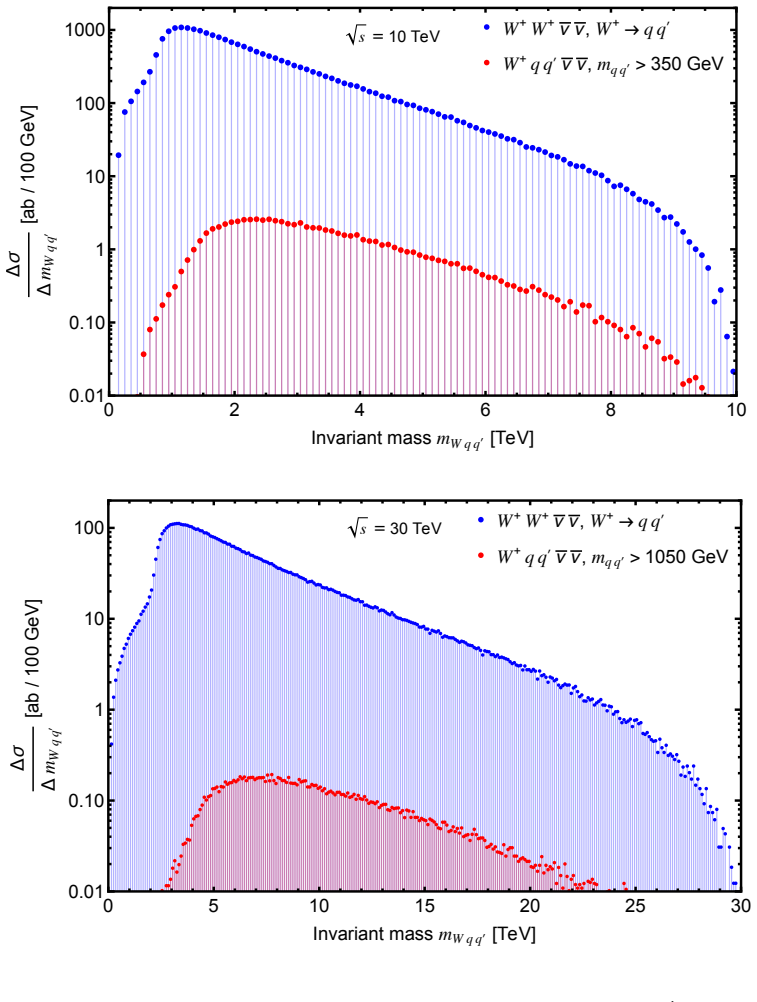
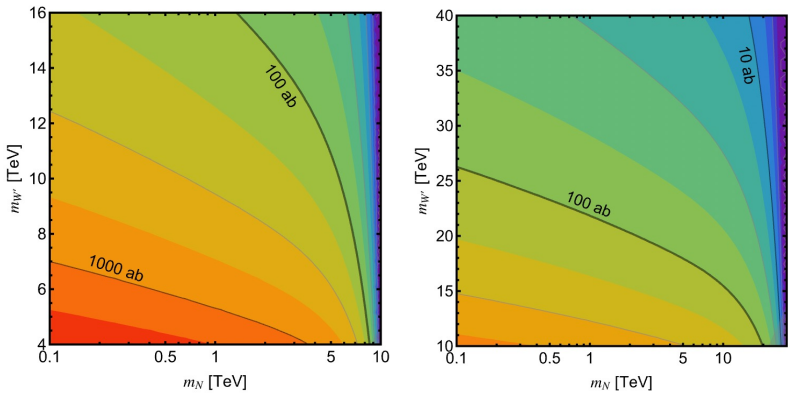
The parity solution to the strong CP problem extends the Standard Model with an SU(2)_R gauge sector that restricts Yukawa interactions. In an appealing neutrino sector structure, small neutrino masses arise naturally while lepton number symmetry is violated substantially at the TeV scale. This permits observable lepton number violating collider signals not suppressed by small neutrino masses. The process μ⁺ μ⁺ → W⁺ W'⁺ at a 10 TeV μ⁺ μ⁺ collider can probe the W' mass up to 10 TeV on-shell and 16 TeV off-shell.
What carries the argument
The W' boson of the SU(2)_R sector, which carries lepton number violating interactions at TeV scales due to the parity-symmetric model and the neutrino structure.
If this is right
- Neutrinoless double beta decay imposes constraints on the model parameters.
- Detection of these signals would indicate TeV-scale lepton number violation linked to the strong CP solution.
- Off-shell W' contributions extend the searchable mass range beyond on-shell production.
- The framework predicts distinctive signals at muon colliders that differ from standard model backgrounds.
Where Pith is reading between the lines
- Similar lepton number violating processes could be studied at other future colliders to cross-check the model.
- This setup might explain why neutrino masses are small while allowing observable effects in high-energy experiments.
- If confirmed, it would suggest that parity symmetry plays a role in both strong CP and lepton sectors.
Load-bearing premise
The neutrino sector has a structure that naturally explains small neutrino masses while permitting substantial lepton number violation at the TeV scale.
What would settle it
A search at the μTRISTAN collider finding no events above background in the μ⁺ μ⁺ → W⁺ W'⁺ channel for W' masses below 10 TeV would rule out the predicted rates in this model.
Figures





read the original abstract
The parity solution to the strong CP problem necessarily extends the Standard Model to include the SU$(2)_{\rm R}$ gauge sector and imposes restrictions on the structure of the Yukawa interactions. In this framework, one can consider an appealing structure of the neutrino sector in which the smallness of the neutrino masses is naturally explained, while lepton number symmetry is substantially violated at the TeV scale. Observation of distinctive lepton number violating signals at collider experiments can therefore be expected, since the rates are not suppressed by the small neutrino masses. We study the constraints from neutrinoless double beta decay and discuss the prospects for discovering new TeV-scale particles, such as the $W'$ boson of SU$(2)_{\rm R}$, via lepton number violating processes at a $\mu^+ \mu^+$ collider, $\mu^+ \mu^+ \to W^+ W'^+$. A $\mu^+ \mu^+$ collider with a center-of-mass energy of 10 TeV can probe the $W'$ boson mass up to about 10 TeV through on-shell production, and the reach can extend to 16 TeV by studying processes involving off-shell $W'$ boson.
Editorial analysis
A structured set of objections, weighed in public.
Referee Report
Summary. The manuscript proposes a parity-symmetric extension of the Standard Model that solves the strong CP problem via an SU(2)_R gauge sector with restricted Yukawa interactions. It introduces a neutrino sector structure that accounts for small neutrino masses while allowing substantial lepton number violation at the TeV scale. The work derives constraints from neutrinoless double beta decay and computes the discovery reach for the W' boson through lepton number violating processes at a μ⁺μ⁺ collider, specifically via μ⁺μ⁺ → W⁺W'⁺, claiming on-shell sensitivity to m_{W'} ≈ 10 TeV and off-shell extension to 16 TeV at √s = 10 TeV.
Significance. If the neutrino sector permits unsuppressed TeV-scale LNV rates consistent with observed neutrino masses, the paper provides a concrete, falsifiable link between the parity solution to strong CP and observable signals at proposed muon colliders. The dual on-shell/off-shell analysis and explicit 0νββ constraints add phenomenological value, though the result's robustness hinges on the model's internal consistency rather than new data or machine-checked elements.
major comments (1)
- [Abstract / model setup] Abstract and model setup: the claim that 'rates are not suppressed by the small neutrino masses' is load-bearing for both the 10 TeV on-shell and 16 TeV off-shell reaches, yet the provided text does not exhibit an explicit effective operator, amplitude expression, or parameter scan demonstrating that the LNV vertex (involving right-handed Yukawas and W' couplings) remains O(1) after fitting to neutrino oscillation data and 0νββ bounds. This leaves the off-shell extension particularly vulnerable to propagator suppression combined with seesaw-like relations.
minor comments (2)
- [Collider phenomenology] Clarify the precise definition of the center-of-mass energy and luminosity assumptions used for the cross-section estimates leading to the 16 TeV reach.
- [Results] Add a brief comparison table of the predicted LNV cross sections against standard left-right symmetric model benchmarks to highlight the distinguishing feature of the parity-symmetric neutrino structure.
Simulated Author's Rebuttal
We thank the referee for the thorough review and constructive feedback on our manuscript. We address the major comment below and have incorporated clarifications to strengthen the presentation of the model.
read point-by-point responses
-
Referee: [Abstract / model setup] Abstract and model setup: the claim that 'rates are not suppressed by the small neutrino masses' is load-bearing for both the 10 TeV on-shell and 16 TeV off-shell reaches, yet the provided text does not exhibit an explicit effective operator, amplitude expression, or parameter scan demonstrating that the LNV vertex (involving right-handed Yukawas and W' couplings) remains O(1) after fitting to neutrino oscillation data and 0νββ bounds. This leaves the off-shell extension particularly vulnerable to propagator suppression combined with seesaw-like relations.
Authors: We thank the referee for highlighting this point. In the parity-symmetric model the restricted Yukawa structure of the SU(2)_R sector allows the right-handed neutrinos to acquire TeV-scale Majorana masses while the light-neutrino masses remain suppressed by the standard type-I seesaw. The lepton-number-violating vertices relevant for μ⁺μ⁺ → W⁺W'⁺ are mediated by the right-handed gauge coupling g_R and the right-handed neutrino mixing matrix; these couplings are independent of the small Dirac Yukawas that set the light-neutrino scale. Consequently the LNV amplitude is not additionally suppressed by the light-neutrino masses. In the revised manuscript we have added an explicit effective-operator expression for the LNV process (new Eq. (3.4)) together with a short parameter-space discussion showing that O(1) right-handed Yukawas remain compatible with neutrino-oscillation data and current 0νββ limits. The off-shell reach calculation already includes the propagator factor 1/(ŝ − m_W'²); the quoted 16 TeV sensitivity is obtained for benchmark points where the effective LNV strength stays unsuppressed. We therefore maintain that the off-shell extension is not further compromised by seesaw-like relations beyond the propagator suppression already accounted for. revision: partial
Circularity Check
No significant circularity; derivation relies on external benchmarks and posited model choices
full rationale
The paper introduces a parity-symmetric extension of the SM to address strong CP, posits an 'appealing structure' for the neutrino sector that allows TeV-scale LNV without suppression by eV-scale masses, and computes collider reaches for on-shell and off-shell W' production using standard simulation techniques. No parameter is fitted to a data subset and then relabeled as a prediction, no equation reduces to its input by construction, and no load-bearing step depends on a self-citation chain that itself assumes the target result. The central claims rest on independent model-building assumptions and external collider phenomenology rather than internal self-reference.
Axiom & Free-Parameter Ledger
free parameters (2)
- W' boson mass
- Right-handed Yukawa couplings
axioms (2)
- domain assumption Parity symmetry solves the strong CP problem
- ad hoc to paper Neutrino sector structure with TeV-scale lepton number violation
invented entities (1)
-
W' boson of SU(2)_R
no independent evidence
Lean theorems connected to this paper
-
IndisputableMonolith/Foundation/AlexanderDuality.leanalexander_duality_circle_linking unclear?
unclearRelation between the paper passage and the cited Recognition theorem.
The parity solution to the strong CP problem necessarily extends the Standard Model to include the SU(2)_R gauge sector... lepton number symmetry is substantially violated at the TeV scale... rates are not suppressed by the small neutrino masses.
-
IndisputableMonolith/Cost/FunctionalEquation.leanwashburn_uniqueness_aczel unclear?
unclearRelation between the paper passage and the cited Recognition theorem.
Finite neutrino masses are generated only after we introduce a small Majorana mass for S and include quantum corrections... even though the neutrino masses are very small, one can expect large experimental signals of lepton number violation.
What do these tags mean?
- matches
- The paper's claim is directly supported by a theorem in the formal canon.
- supports
- The theorem supports part of the paper's argument, but the paper may add assumptions or extra steps.
- extends
- The paper goes beyond the formal theorem; the theorem is a base layer rather than the whole result.
- uses
- The paper appears to rely on the theorem as machinery.
- contradicts
- The paper's claim conflicts with a theorem or certificate in the canon.
- unclear
- Pith found a possible connection, but the passage is too broad, indirect, or ambiguous to say the theorem truly supports the claim.
Forward citations
Cited by 1 Pith paper
-
Same-Sign Tetralepton Signature at $\mu$TRISTAN
The paper identifies promising parameter regions for observing same-sign tetralepton events from charged Higgs pair and single production decaying to muons and heavy neutral leptons at μTRISTAN.
Reference graph
Works this paper leans on
-
[1]
M. A. B. Beg and H. S. Tsao,Strong P, T Noninvariances in a Superweak Theory, Phys. Rev. Lett.41(1978) 278
work page 1978
-
[2]
R. N. Mohapatra and G. Senjanovic,Natural suppression of strongPandT non-invariance,Phys. Lett. B79(1978) 283
work page 1978
-
[3]
Solution to the Strong CP Problem: Supersymmetry with Parity
R. Kuchimanchi,Solution to the StrongCPProblem: Supersymmetry with Parity, Phys. Rev. Lett.76(1996) 3486 [hep-ph/9511376]
work page internal anchor Pith review Pith/arXiv arXiv 1996
-
[4]
R. N. Mohapatra and A. Rasin,Simple supersymmetric solution to the strong CP problem,Phys. Rev. Lett.76(1996) 3490 [hep-ph/9511391]
work page internal anchor Pith review Pith/arXiv arXiv 1996
-
[5]
K. S. Babu and R. N. Mohapatra,CPviolation in seesaw models of quark masses, Phys. Rev. Lett.62(1989) 1079
work page 1989
-
[6]
K. S. Babu and R. N. Mohapatra,Solution to the strong CP problem without an axion, Phys. Rev. D41(1990) 1286
work page 1990
-
[7]
L. J. Hall and K. Harigaya,Implications of Higgs discovery for the strong CP problem and unification,JHEP10(2018) 130 [1803.08119]
work page internal anchor Pith review Pith/arXiv arXiv 2018
-
[8]
A Grand Unified Parity Solution to Strong CP Problem
Y. Mimura, R. N. Mohapatra and M. Severson,Grand unified parity solution to the strong CP problem,Phys. Rev. D99(2019) 115025 [1903.07506]. 24
work page internal anchor Pith review Pith/arXiv arXiv 2019
- [9]
-
[10]
J. Carrasco-Martinez, L. J. Hall, K. Harigaya and K. Langhoff,A Flavor of SO(10) Unification with a Spinor Higgs,2506.20708
- [11]
-
[12]
K. Harigaya and I. R. Wang,Baryogenesis in a parity solution to the strong CP problem,JHEP11(2023) 189 [2210.16207]
-
[13]
J. Carrasco-Martinez, D. I. Dunsky, L. J. Hall and K. Harigaya,Leptogenesis in parity solutions to the strong CP problem and Standard Model parameters,JHEP06(2024) 048 [2307.15731]
-
[14]
A. Dasgupta, M. Knauss and M. Sher,Gravitational wave production and baryogenesis in a simple left-right model,Phys. Rev. D112(2025) 055034 [2505.04751]
- [15]
- [16]
- [17]
- [18]
-
[19]
K. S. Babu and X. G. He,DIRAC NEUTRINO MASSES AS TWO LOOP RADIATIVE CORRECTIONS,Mod. Phys. Lett. A4(1989) 61
work page 1989
- [20]
- [21]
-
[22]
Witten,LargeNchiral dynamics,Ann
E. Witten,LargeNchiral dynamics,Ann. Phys.128(1980) 363. 25
work page 1980
-
[23]
G. ’t Hooft,Topology of the gauge condition and new confinement phases in non-abelian gauge theories,Nucl. Phys. B190(1981) 455
work page 1981
-
[24]
Theta Dependence In The Large N Limit Of Four-Dimensional Gauge Theories
E. Witten,Theta Dependence in the LargeNLimit of Four-Dimensional Gauge Theories,Phys. Rev. Lett.81(1998) 2862 [hep-th/9807109]
work page internal anchor Pith review Pith/arXiv arXiv 1998
-
[25]
Theta, Time Reversal, and Temperature
D. Gaiotto, A. Kapustin, Z. Komargodski and N. Seiberg,Theta, time reversal and temperature,JHEP05(2017) 091 [1703.00501]
work page internal anchor Pith review Pith/arXiv arXiv 2017
-
[26]
R. Kitano, N. Yamada and M. Yamazaki,IsN= 2Large?,JHEP02(2021) 073 [2010.08810]. [30]ATLAScollaboration,Search for a heavy charged boson in events with a charged lepton and missing transverse momentum fromppcollisions at √s= 13 TeVwith the ATLAS detector,Phys. Rev. D100(2019) 052013 [1906.05609]. [31]ATLAScollaboration,Search for vector-boson resonances d...
-
[27]
X. Cid Vidal, M. D’Onofrio, P. J. Fox, R. Torre, K. A. Ulmer, A. Aboubrahim, A. Albert et al.,Report from Working Group 3: Beyond the Standard Model physics at the HL-LHC and HE-LHC,CERN Yellow Rep. Monogr.7(2019) 585 [1812.07831]. [34]Particle Data Groupcollaboration,Review of particle physics,Phys. Rev. D110 (2024) 030001. [35]CMScollaboration,Search fo...
- [28]
-
[29]
Neutrinoless double beta decay in seesaw models
M. Blennow, E. Fernandez-Martinez, J. Lopez-Pavon and J. Menendez,Neutrinoless double beta decay in seesaw models,JHEP07(2010) 096 [1005.3240]. 26
work page internal anchor Pith review Pith/arXiv arXiv 2010
-
[30]
J. Barry and W. Rodejohann,Lepton number and flavour violation in TeV-scale left-right symmetric theories with large left-right mixing,JHEP09(2013) 153 [1303.6324]. [39]KamLAND-Zencollaboration,Search for Majorana Neutrinos with the Complete KamLAND-Zen Dataset,2406.11438
work page internal anchor Pith review Pith/arXiv arXiv 2013
-
[31]
Phase space factors for double-$\beta$ decay
J. Kotila and F. Iachello,Phase-space factors for double-βdecay,Phys. Rev. C85 (2012) 034316 [1209.5722]
work page internal anchor Pith review Pith/arXiv arXiv 2012
-
[32]
Phase Space Factors for Double Beta Decay: an up-date
M. Mirea, T. Pahomi and S. Stoica,Phase Space Factors for Double Beta Decay: an up-date,1411.5506
work page internal anchor Pith review Pith/arXiv arXiv
-
[33]
Neutrinoless double beta decay in minimal left-right symmetric model with universal seesaw
D. Borah, A. Dasgupta and S. Patra,Neutrinoless double beta decay in minimal left-right symmetric model with universal seesaw,Int. J. Mod. Phys. A33(2018) 1850198 [1706.02456]
work page internal anchor Pith review Pith/arXiv arXiv 2018
-
[34]
NuFit-6.0: Updated global analysis of three-flavor neutrino oscillations
I. Esteban, M. C. Gonzalez-Garcia, M. Maltoni, I. Martinez-Soler, J. P. Pinheiro and T. Schwetz,NuFit-6.0: updated global analysis of three-flavor neutrino oscillations, JHEP12(2024) 216 [2410.05380]
work page internal anchor Pith review Pith/arXiv arXiv 2024
-
[35]
C. A. Heusch and F. Cuypers,Physics with like-sign muon beams in a TeV muon collider,AIP Conf. Proc.352(1996) 219 [hep-ph/9508230]
work page internal anchor Pith review Pith/arXiv arXiv 1996
-
[36]
Lower Bounds on Bilepton Processes at e-e- and mu-mu- Colliders
M. Raidal,Lower bounds on bilepton processes ate −e− andµ −µ− colliders,Phys. Rev. D57(1998) 2013 [hep-ph/9706279]
work page internal anchor Pith review Pith/arXiv arXiv 1998
-
[37]
Inverse Neutrino-less Double Beta Decay Revisited: Neutrinos, Higgs Triplets and a Muon Collider
W. Rodejohann,Inverse neutrinoless double beta decay revisited: Neutrinos, Higgs triplets, and a muon collider,Phys. Rev. D81(2010) 114001 [1005.2854]
work page internal anchor Pith review Pith/arXiv arXiv 2010
-
[38]
J.-L. Yang, C.-H. Chang and T.-F. Feng,Leptonic di-flavor and di-number violation processes at high energyµ ±µ± colliders,Chin. Phys. C48(2024) 043101 [2302.13247]
- [39]
-
[40]
K. Fridell, R. Kitano and R. Takai,Lepton flavor physics atµ +µ+ colliders,JHEP06 (2023) 086 [2304.14020]
- [41]
-
[42]
S. Bhattacharya, S. Datta and A. Sarkar,Probing∆L= 2lepton number violating SMEFT operators at the same-sign muon collider,2505.20936
-
[43]
C. F. Uhlemann and N. Kauer,Narrow-width approximation accuracy,Nucl. Phys. B 814(2009) 195 [0807.4112]
work page internal anchor Pith review Pith/arXiv arXiv 2009
-
[44]
J. Alwall, R. Frederix, S. Frixione, V. Hirschi, F. Maltoni, O. Mattelaer, H. S. Shao et al.,The automated computation of tree-level and next-to-leading order differential cross sections, and their matching to parton shower simulations,JHEP07(2014) 079 [1405.0301]
work page internal anchor Pith review Pith/arXiv arXiv 2014
-
[45]
Cheyette,Production of SingleWBosons ine +e− Collisions,Phys
O. Cheyette,Production of SingleWBosons ine +e− Collisions,Phys. Lett. B137 (1984) 431
work page 1984
-
[46]
Philipsen,W W γcouplings from singleW-production in polarizede +e− collisions, Z
O. Philipsen,W W γcouplings from singleW-production in polarizede +e− collisions, Z. Phys. C54(1992) 643
work page 1992
- [47]
- [48]
discussion (0)
Sign in with ORCID, Apple, or X to comment. Anyone can read and Pith papers without signing in.