Non-destructive optical read-out and manipulation of circular Rydberg atoms
Pith reviewed 2026-05-21 22:10 UTC · model grok-4.3
The pith
Ancilla atoms enable non-destructive optical readout and manipulation of circular Rydberg atoms via Förster blockade.
A machine-rendered reading of the paper's core claim, the machinery that carries it, and where it could break.
Core claim
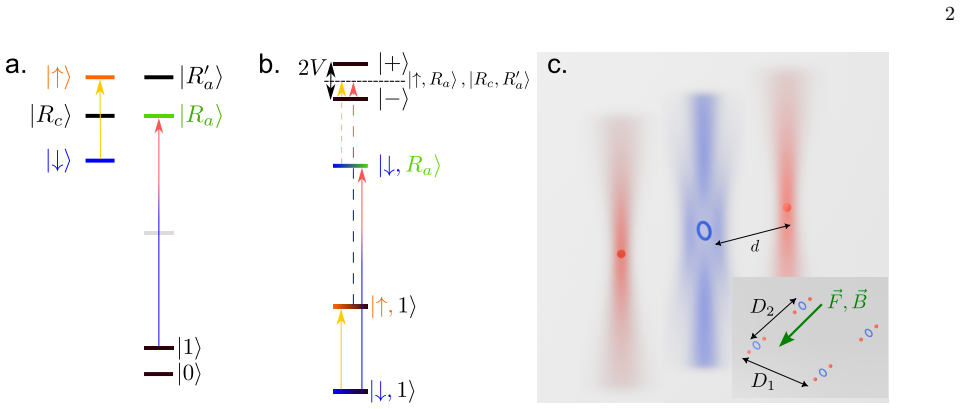
The authors introduce a dual-Rydberg platform that combines an array of laser-trapped circular Rydberg atoms of rubidium serving as logical qubits with a separate array of ancilla atoms that are transiently excited to low-ℓ Rydberg levels. Quantum non-demolition detection of each logical qubit is performed through blockade of the ancilla optical excitation caused by a Förster resonance; the same mechanism is used in reverse to manipulate the logical qubit locally by driving the ancilla.
What carries the argument
Hybrid dual-Rydberg platform in which Förster resonance between a circular logical atom and a low-ℓ ancilla atom produces a blockade that reports or alters the logical state without optical access to the circular atom itself.
If this is right
- The platform supplies mid-circuit measurements that are required for quantum error correction with circular Rydberg atoms.
- Long-lived circular states can now be used for quantum simulations that track time correlations over durations inaccessible to short-lived Rydberg levels.
- The same blockade mechanism provides a route to local single-qubit and two-qubit gates without additional laser access to the circular manifold.
Where Pith is reading between the lines
- If the ancilla atoms can be reused or recycled without perturbing the logical array, the scheme becomes compatible with repeated error-correction cycles in larger processors.
- The hybrid approach may generalize to other atom species or trap geometries where one Rydberg manifold lacks optical transitions.
- Precise control of the Förster resonance detuning could allow tunable interaction strengths for both readout and entangling operations within the same hardware.
Load-bearing premise
The ancilla atoms can be transiently excited to low-ℓ Rydberg levels and interact via a suitable Förster resonance with the circular atoms while leaving the logical array and its laser traps essentially undisturbed.
What would settle it
Failure to observe a clear shift or suppression in ancilla excitation probability that depends on the circular atom's state, or the appearance of measurable heating or loss in the circular-atom traps during ancilla driving, would falsify the non-destructive claim.
Figures


read the original abstract
Among the thriving quantum computation and quantum simulation platforms based on arrays of Rydberg atoms, those using circular Rydberg atoms are particularly promising. These atoms uniquely combine the strong dipole-dipole interactions typical of Rydberg states with long lifetimes. However, low-angular-momentum ($\ell$) laser-accessible Rydberg levels have been so far mostly used, because circular Rydberg atoms have no optical transitions, hindering their individual detection and manipulation. We remove this limitation with a hybrid platform, combining an array of logical laser-trapped circular Rydberg atoms of rubidium with an auxiliary array of Rb ancilla atoms transiently excited to a low-$\ell$ Rydberg level. We perform a quantum non-demolition detection of the logical qubit with the ancilla, through the blockade of the ancilla optical excitation induced by a F\"orster resonance. Conversely, we locally manipulate the logical qubit through the excitation of the ancilla. This dual-Rydberg platform is highly promising for quantum computation and simulation. It adds to the circular-atom toolbox the mid-circuit measurements, essential for error correction. More strikingly, it gives access to time correlations in long-term quantum simulations, uniquely accessible to circular Rydberg atoms.
Editorial analysis
A structured set of objections, weighed in public.
Referee Report
Summary. The manuscript proposes and demonstrates a hybrid dual-Rydberg platform in which an array of laser-trapped circular Rydberg atoms (logical qubits) is paired with an auxiliary array of Rb ancilla atoms that are transiently excited to low-ℓ Rydberg states. Quantum non-demolition readout of the logical qubit is achieved via Förster-resonance blockade of the ancilla optical transition; conversely, local manipulation of the logical qubit is performed by exciting the ancilla. The work claims this architecture supplies mid-circuit measurements essential for error correction and enables time-correlated measurements in long-term quantum simulations.
Significance. If the central claims are experimentally validated, the hybrid platform would remove a long-standing obstacle to the use of circular Rydberg atoms in quantum information processing by adding individual, non-destructive readout and control while preserving their long lifetimes and strong dipole-dipole interactions. This would strengthen the viability of circular-Rydberg platforms for fault-tolerant quantum computation and for simulations requiring extended coherence times.
major comments (2)
- [Abstract / hybrid platform section] Abstract and hybrid-platform description: the load-bearing assumption that transient excitation of the ancilla atoms leaves the logical array and its laser traps essentially undisturbed is stated but not accompanied by quantitative estimates of induced heating rates, AC Stark shifts, or residual dipole-dipole coupling to the circular states. Without these bounds the selectivity of the Förster blockade cannot be assessed.
- [Förster resonance discussion] The manuscript states that a suitable Förster resonance is used for blockade, yet no specific pair of circular and low-ℓ levels, resonance condition, or calculated interaction strength is provided. This information is required to verify that the blockade is strong enough for high-fidelity QND detection while remaining compatible with the trap wavelengths.
minor comments (2)
- [Abstract] Notation: the LaTeX rendering of “Föster” appears inconsistently; standardize to “Förster” throughout.
- [Introduction / Results] The abstract claims “we perform” the QND detection and manipulation; the main text should explicitly separate the theoretical proposal from any experimental data or methods section so that readers can distinguish demonstrated results from projected performance.
Simulated Author's Rebuttal
We thank the referee for their positive assessment of the work and for the constructive comments. We address each major comment below and will incorporate the requested details into a revised manuscript.
read point-by-point responses
-
Referee: [Abstract / hybrid platform section] Abstract and hybrid-platform description: the load-bearing assumption that transient excitation of the ancilla atoms leaves the logical array and its laser traps essentially undisturbed is stated but not accompanied by quantitative estimates of induced heating rates, AC Stark shifts, or residual dipole-dipole coupling to the circular states. Without these bounds the selectivity of the Förster blockade cannot be assessed.
Authors: We agree that quantitative bounds are necessary to fully substantiate the claim of minimal disturbance. In the revised manuscript we will add explicit estimates, calculated from the experimental parameters (laser intensities, wavelengths, and atomic positions), for AC Stark shifts on the circular states, off-resonant scattering heating rates, and residual dipole-dipole couplings. These will confirm that the ancilla excitation remains compatible with the trap and preserves the selectivity of the Förster blockade. revision: yes
-
Referee: [Förster resonance discussion] The manuscript states that a suitable Förster resonance is used for blockade, yet no specific pair of circular and low-ℓ levels, resonance condition, or calculated interaction strength is provided. This information is required to verify that the blockade is strong enough for high-fidelity QND detection while remaining compatible with the trap wavelengths.
Authors: We acknowledge that the specific levels and interaction parameters should be stated more explicitly. The revised manuscript will identify the exact circular and low-ℓ Rydberg pair, the resonance condition (including any magnetic-field tuning), and the calculated interaction strength. These additions will allow direct verification of the blockade fidelity and trap compatibility. revision: yes
Circularity Check
No significant circularity; proposal relies on established physics
full rationale
The manuscript describes a hybrid experimental platform for non-destructive readout and manipulation of circular Rydberg atoms using ancilla atoms and Förster resonances. No derivation chain, equations, or predictions are presented that reduce to fitted parameters, self-definitions, or self-citation load-bearing steps. The central claims rest on standard atomic-physics interactions (Rydberg blockade, Förster resonance) that are externally established and not internally constructed from the paper's own inputs. This is a self-contained proposal without circular reduction.
Axiom & Free-Parameter Ledger
axioms (1)
- domain assumption A suitable Förster resonance exists between the circular Rydberg state and the ancilla low-ℓ Rydberg state that produces strong blockade of optical excitation.
Forward citations
Cited by 1 Pith paper
-
Fast measurement of neutral atoms with a multi-atom gate
A multi-atom Rydberg gate with N ancillae enables N-fold photon collection for fast neutral-atom measurement, achieving infidelity below 10^{-3} in 6 μs with N=5 in Cs-Rb simulations.
Reference graph
Works this paper leans on
-
[1]
A. Browaeys and T. Lahaye, Many-body physics with individually controlled Rydberg atoms, Nature Physics 16, 132 (2020)
work page 2020
-
[2]
M. Morgado and S. Whitlock, Quantum simulation and computing with Rydberg-interacting qubits, AVS Quan- tum Science3, 023501 (2021). 7
work page 2021
-
[3]
D. Barredo, S. de Léséleuc, V. Lienhard, T. Lahaye, and A. Browaeys, An atom-by-atom assembler of defect-free arbitrary two-dimensional atomic arrays, Science354, 1021 (2016)
work page 2016
- [4]
-
[5]
T. M. Graham, Y. Song, J. Scott, C. Poole, L. Phutti- tarn, K. Jooya, P. Eichler, X. Jiang, A. Marra, B. Grinke- meyer, M. Kwon, M. Ebert, J. Cherek, M. T. Licht- man, M. Gillette, J. Gilbert, D. Bowman, T. Ballance, C. Campbell, E. D. Dahl, O. Crawford, N. S. Blunt, B. Rogers, T. Noel, and M. Saffman, Multi-qubit en- tanglement and algorithms on a neutra...
work page 2022
-
[6]
D. Bluvstein, H. Levine, G. Semeghini, T. T. Wang, S. Ebadi, M. Kalinowski, A. Keesling, N. Maskara, H. Pichler, M. Greiner, V. Vuletić, and M. D. Lukin, A quantum processor based on coherent transport of en- tangled atom arrays, Nature604, 451 (2022)
work page 2022
- [7]
-
[8]
S. Ebadi, T. T. Wang, H. Levine, A. Keesling, G. Se- meghini, A. Omran, D. Bluvstein, R. Samajdar, H. Pich- ler, W. W. Ho, S. Choi, S. Sachdev, M. Greiner, V. Vuletić, and M. D. Lukin, Quantum phases of matter on a 256-atom programmable quantum simulator, Nature 595, 227 (2021)
work page 2021
-
[9]
S. Ma, G. Liu, P. Peng, B. Zhang, S. Jandura, J. Claes, A. P. Burgers, G. Pupillo, S. Puri, and J. D. Thompson, High-fidelity gates and mid-circuit erasure conversion in an atomic qubit, Nature622, 279 (2023)
work page 2023
- [10]
-
[11]
S. J. Evered, D. Bluvstein, M. Kalinowski, S. Ebadi, T. Manovitz, H. Zhou, S. H. Li, A. A. Geim, T. T. Wang, N. Maskara, H. Levine, G. Semeghini, M. Greiner, V. Vuletić, and M. D. Lukin, High-fidelity parallel entan- gling gates on a neutral-atom quantum computer, Nature 622, 268 (2023)
work page 2023
-
[12]
D. Bluvstein, S. J. Evered, A. A. Geim, S. H. Li, H. Zhou, T. Manovitz, S. Ebadi, M. Cain, M. Kali- nowski, D. Hangleiter, J. P. Bonilla Ataides, N. Maskara, I. Cong, X. Gao, P. Sales Rodriguez, T. Karolyshyn, G. Semeghini, M. J. Gullans, M. Greiner, V. Vuletić, and M. D. Lukin, Logical quantum processor based on reconfigurable atom arrays, Nature626, 58 (2024)
work page 2024
-
[13]
C. Chen, G. Emperauger, G. Bornet, F. Caleca, B. Gély, M. Bintz, S. Chatterjee, V. Liu, D. Barredo, N. Y. Yao, T. Lahaye, F. Mezzacapo, T. Roscilde, and A. Browaeys, Spectroscopy of elementary excitations from quench dy- namics in a dipolar XY Rydberg simulator, Science389, 483 (2025)
work page 2025
-
[14]
T. Manovitz, S. H. Li, S. Ebadi, R. Samajdar, A. A. Geim, S. J. Evered, D. Bluvstein, H. Zhou, N. U. Koylu- oglu, J. Feldmeier, P. E. Dolgirev, N. Maskara, M. Kali- nowski, S. Sachdev, D. A. Huse, M. Greiner, V. Vuletić, and M. D. Lukin, Quantum coarsening and collective dy- namics on a programmable simulator, Nature638, 86 (2025)
work page 2025
-
[15]
D. González-Cuadra, M. Hamdan, T. V. Zache, B. Braverman, M. Kornjača, A. Lukin, S. H. Cantú, F. Liu, S.-T. Wang, A. Keesling, M. D. Lukin, P. Zoller, and A. Bylinskii, Observation of string breaking on a (2 + 1)D Rydberg quantum simulator, Nature642, 321 (2025)
work page 2025
-
[16]
A. Bergschneider, V. M. Klinkhamer, J. H. Becher, R. Klemt, G. Zürn, P. M. Preiss, and S. Jochim, Spin- resolvedsingle-atomimagingof 6Liinfreespace,Physical Review A97, 063613 (2018)
work page 2018
-
[17]
I. I. Beterov and M. Saffman, Rydberg Blockade, Förster Resonances, and Quantum State Measurements with Dif- ferent Atomic Species, Physical Review A92, 042710 (2015)
work page 2015
-
[18]
A. M. Kaufman and K.-K. Ni, Quantum science with optical tweezer arrays of ultracold atoms and molecules, Nature Physics17, 1324 (2021)
work page 2021
-
[19]
C. Zhang and M. Tarbutt, Quantum Computation in a Hybrid Array of Molecules and Rydberg Atoms, PRX Quantum3, 030340 (2022)
work page 2022
-
[20]
K. Wang, C. P. Williams, L. R. Picard, N. Y. Yao, and K.-K. Ni, Enriching the Quantum Toolbox of Ul- tracold Molecules with Rydberg Atoms, PRX Quantum 3, 030339 (2022)
work page 2022
-
[21]
K. A. Safinya, J. F. Delpech, F. Gounand, W. Sandner, and T. F. Gallagher, Resonant Rydberg-Atom-Rydberg- Atom Collisions, Physical Review Letters47, 405 (1981)
work page 1981
-
[22]
I. I. Ryabtsev, D. B. Tretyakov, I. I. Beterov, and V. M. Entin, Observation of the Stark-Tuned Förster Reso- nance between Two Rydberg Atoms, Physical Review Letters104, 073003 (2010)
work page 2010
-
[23]
D. Petrosyan, S. Norrell, C. Poole, and M. Saffman, Fast measurements and multiqubit gates in dual-species atomic arrays, Physical Review A110, 042404 (2024)
work page 2024
- [24]
- [25]
- [26]
-
[27]
T. Cantat-Moltrecht, R. Cortiñas, B. Ravon, P. Méhaignerie, S. Haroche, J. M. Raimond, M. Favier, M. Brune, and C. Sayrin, Long-lived circular Rydberg states of laser-cooled rubidium atoms in a cryostat, Physical Review Research2, 022032 (2020)
work page 2020
-
[28]
K. S. Thorne, R. W. P. Drever, C. M. Caves, M. Zim- mermann, and V. D. Sandberg, Quantum Nondemolition Measurements of Harmonic Oscillators, Phys. Rev. Lett. 40, 667 (1978)
work page 1978
-
[29]
W. G. Unruh, Analysis of quantum-nondemolition mea- surement, Physical Review D18, 1764 (1978)
work page 1978
-
[30]
See Supplementary Material
-
[31]
M. D. Lukin, M. Fleischhauer, R. Cote, L. M. Duan, D. Jaksch, J. I. Cirac, and P. Zoller, Dipole Blockade and Quantum Information Processing in Mesoscopic Atomic Ensembles, Phys. Rev. Lett.87, 037901 (2001). 8
work page 2001
- [32]
-
[33]
L. Isenhower, W. Williams, A. Dally, and M. Saffman, Atom trapping in an interferometrically generated bottle beam trap, Optics Letters34, 1159 (2009)
work page 2009
-
[34]
P. Méhaignerie, Y. Machu, A. Durán Hernández, G. Creutzer, D. Papoular, J. Raimond, C. Sayrin, and M. Brune, Interacting Circular Rydberg Atoms Trapped in Optical Tweezers, PRX Quantum6, 010353 (2025)
work page 2025
-
[35]
T. L. Nguyen, J. M. Raimond, C. Sayrin, R. Cor- tiñas, T. Cantat-Moltrecht, F. Assemat, I. Dotsenko, S. Gleyzes, S. Haroche, G. Roux, Th. Jolicoeur, and M. Brune, Towards Quantum Simulation with Circular Rydberg Atoms, Phys. Rev. X8, 011032 (2018)
work page 2018
-
[36]
S. R. Cohen and J. D. Thompson, Quantum Computing with Circular Rydberg Atoms, PRX Quantum2, 030322 (2021)
work page 2021
-
[37]
Tailoring interaction ranges in atom arrays
T. Botzung, G. Creutzer, C. Sayrin, and J. Schachen- mayer, Tailoring interaction ranges in atom arrays (2025), arXiv:2508.02815 [quant-ph]
work page internal anchor Pith review Pith/arXiv arXiv 2025
-
[38]
M.-T. Nguyen, J.-G. Liu, J. Wurtz, M. D. Lukin, S.-T. Wang, and H. Pichler, Quantum Optimization with Ar- bitrary Connectivity Using Rydberg Atom Arrays, PRX Quantum4, 010316 (2023)
work page 2023
-
[39]
A.Kruckenhauser, R.vanBijnen, T.V.Zache, M.D.Lib- erto, and P. Zoller, High-dimensional SO(4)-symmetric Rydberg manifolds for quantum simulation, Quantum Science and Technology8, 015020 (2022)
work page 2022
-
[40]
R. C. Teixeira, A. Larrouy, A. Muni, L. Lachaud, J.-M. Raimond, S. Gleyzes, and M. Brune, Prepara- tion of Long-Lived, Non-Autoionizing Circular Rydberg StatesofStrontium,PhysicalReviewLetters125,263001 (2020)
work page 2020
- [41]
-
[42]
Swingle, Unscrambling the physics of out-of-time- order correlators, Nature Physics14, 988 (2018)
B. Swingle, Unscrambling the physics of out-of-time- order correlators, Nature Physics14, 988 (2018)
work page 2018
-
[43]
R. J. Lewis-Swan, A. Safavi-Naini, A. M. Kaufman, and A. M. Rey, Dynamics of quantum information, Nature Reviews Physics1, 627 (2019)
work page 2019
- [44]
- [45]
-
[46]
C. J. Turner, A. A. Michailidis, D. A. Abanin, M. Serbyn, and Z. Papić, Weak ergodicity breaking from quantum many-body scars, Nature Physics14, 745 (2018)
work page 2018
- [47]
-
[48]
M. J. Gullans and D. A. Huse, Dynamical Purification Phase Transition Induced by Quantum Measurements, Physical Review X10, 041020 (2020)
work page 2020
-
[49]
X. Turkeshi, A. Biella, R. Fazio, M. Dalmonte, and M. Schiró, Measurement-induced entanglement transi- tions in the quantum Ising chain: From infinite to zero clicks, Physical Review B103, 224210 (2021)
work page 2021
- [50]
discussion (0)
Sign in with ORCID, Apple, or X to comment. Anyone can read and Pith papers without signing in.