Kinetically constrained cavity QED: from blockaded ferromagnetism to long-range quantum scars
Pith reviewed 2026-05-18 10:25 UTC · model grok-4.3
The pith
Restricting Rydberg-cavity systems to the strong blockade subspace produces a distinct blockaded ferromagnetic phase and long-range quantum scars with logarithmic entanglement growth.
A machine-rendered reading of the paper's core claim, the machinery that carries it, and where it could break.
Core claim
By focusing on the strong Rydberg blockade regime and projecting onto the corresponding subspace, the authors obtain a kinetically constrained long-range model whose equilibrium phase diagram includes a blockaded ferromagnetic/superradiant phase distinct from the conventional superradiant phase, while its dynamics feature long-range quantum many-body scars that evade thermalization and generate logarithmic entanglement growth.
What carries the argument
The kinetically constrained long-range model in one dimension obtained by restricting the Hilbert space to the subspace enforced by strong Rydberg blockade.
If this is right
- The restricted model exhibits a blockaded ferromagnetic/superradiant phase that is distinct from the usual superradiant phase.
- Long-range quantum many-body scars appear as atypical nonthermal eigenstates that violate the eigenstate thermalization hypothesis.
- These scars produce logarithmic entanglement growth in contrast to the linear growth found in short-range scarred models.
- The construction supplies a scalable and conceptually transparent framework for Rydberg-cavity experiments in the strong-interaction regime.
Where Pith is reading between the lines
- The same blockade-restriction technique could be applied to two-dimensional or ladder geometries to search for higher-dimensional analogs of the blockaded phase and scars.
- Logarithmic entanglement growth may imply slower information spreading that could be exploited for protecting quantum information in cavity-mediated systems.
- Similar kinetic constraints might be engineered in other cavity-QED platforms that lack Rydberg atoms but possess tunable short-range repulsion.
Load-bearing premise
The strong Rydberg blockade regime permits a faithful effective description by restricting the Hilbert space without appreciable leakage or higher-order corrections from states outside the blockaded subspace.
What would settle it
Direct observation, in a one-dimensional Rydberg-cavity array under strong blockade, of either a ferromagnetic magnetization pattern or entanglement entropy that grows logarithmically rather than linearly with time would support the restricted model; significant population leakage outside the blockade subspace or strictly linear entanglement growth would falsify it.
Figures


read the original abstract
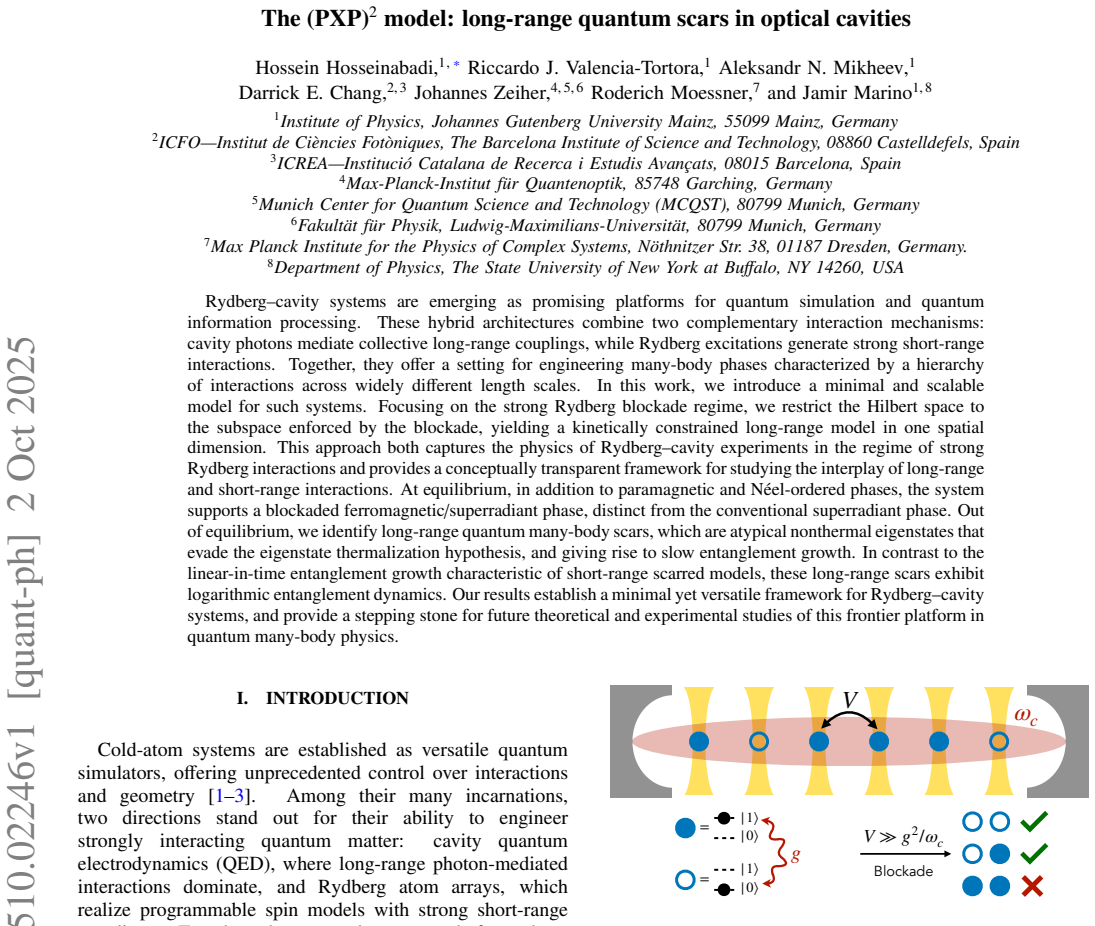
Rydberg-cavity systems are emerging as promising platforms for quantum simulation and quantum information processing. These hybrid architectures combine two complementary interaction mechanisms: cavity photons mediate collective long-range couplings, while Rydberg excitations generate strong short-range interactions. Together, they offer a setting for engineering many-body phases characterized by a hierarchy of interactions across widely different length scales. In this work, we introduce a minimal and scalable model for such systems. Focusing on the strong Rydberg blockade regime, we restrict the Hilbert space to the subspace enforced by the blockade, yielding a kinetically constrained long-range model in one spatial dimension. This approach both captures the physics of Rydberg-cavity experiments in the regime of strong Rydberg interactions and provides a conceptually transparent framework for studying the interplay of long-range and short-range interactions. At equilibrium, in addition to paramagnetic and N\'eel-ordered phases, the system supports a blockaded ferromagnetic/superradiant phase, distinct from the conventional superradiant phase. Out of equilibrium, we identify long-range quantum many-body scars, which are atypical nonthermal eigenstates that evade the eigenstate thermalization hypothesis, and giving rise to slow entanglement growth. In contrast to the linear-in-time entanglement growth characteristic of short-range scarred models, these long-range scars exhibit logarithmic entanglement dynamics. Our results establish a minimal yet versatile framework for Rydberg-cavity systems, and provide a stepping stone for future theoretical and experimental studies of this frontier platform in quantum many-body physics.
Editorial analysis
A structured set of objections, weighed in public.
Referee Report
Summary. The manuscript introduces a minimal 1D kinetically constrained model for Rydberg-cavity QED systems obtained by projecting the full Hamiltonian onto the strong Rydberg blockade subspace (no double Rydberg excitations). Within this restricted model the authors report a blockaded ferromagnetic/superradiant phase distinct from the conventional superradiant phase, together with long-range quantum many-body scars that evade the eigenstate thermalization hypothesis and produce logarithmic entanglement growth rather than the linear growth seen in short-range scarred systems.
Significance. If the effective description is controlled, the work supplies a transparent, scalable framework that isolates the interplay between cavity-mediated long-range couplings and short-range Rydberg blockade. The reported blockaded phase and long-range scars with slow entanglement dynamics would constitute a concrete advance in the study of hybrid long-range/short-range quantum many-body systems and could guide future Rydberg-cavity experiments.
major comments (1)
- [model construction / effective Hamiltonian] The central claims rest on the fidelity of the projected kinetically constrained Hamiltonian. In the model-construction section the authors restrict the Hilbert space to the blockade subspace but do not supply a perturbative expansion in 1/V (where V is the Rydberg blockade strength) or an explicit error bound quantifying leakage induced by the cavity-mediated virtual processes. Without such control it remains unclear whether the reported blockaded ferromagnetic phase and the long-range scars remain stable in the regime where the distinct superradiant behavior is claimed.
minor comments (2)
- [equilibrium phases] The distinction between the blockaded ferromagnetic/superradiant phase and the conventional superradiant phase would be clearer if the order parameters or correlation functions used to identify each phase were defined explicitly (e.g., in a dedicated paragraph or figure caption).
- [out-of-equilibrium dynamics] The logarithmic entanglement growth for the long-range scars is an interesting claim; a brief comparison plot or table contrasting the entanglement dynamics of the long-range versus short-range scarred models would strengthen the presentation.
Simulated Author's Rebuttal
We thank the referee for the positive evaluation of the significance of our results and for the constructive comment on the construction of the effective Hamiltonian. We address the concern point by point below.
read point-by-point responses
-
Referee: The central claims rest on the fidelity of the projected kinetically constrained Hamiltonian. In the model-construction section the authors restrict the Hilbert space to the blockade subspace but do not supply a perturbative expansion in 1/V (where V is the Rydberg blockade strength) or an explicit error bound quantifying leakage induced by the cavity-mediated virtual processes. Without such control it remains unclear whether the reported blockaded ferromagnetic phase and the long-range scars remain stable in the regime where the distinct superradiant behavior is claimed.
Authors: We agree that an explicit perturbative control of the projection would strengthen the presentation. In the strong-blockade regime that defines our model, the Rydberg interaction V is taken to be the largest energy scale, so that the cavity-mediated terms induce only virtual processes suppressed by 1/V. In the revised manuscript we will add a short subsection deriving the leading-order virtual corrections and providing a simple bound on the leakage amplitude out of the blockade subspace. This analysis will confirm that the blockaded ferromagnetic phase and the long-range scars remain stable throughout the parameter window in which we report their distinct phenomenology. revision: yes
Circularity Check
No significant circularity; effective model follows from standard blockade projection
full rationale
The paper constructs its kinetically constrained model by restricting the Hilbert space to the strong Rydberg blockade subspace, a standard physical approximation in Rydberg-cavity systems rather than a self-referential definition or fitted input. From this effective long-range model the blockaded ferromagnetic phase and long-range scars are derived via direct analysis of the projected Hamiltonian. No load-bearing step reduces by construction to its own inputs, no uniqueness theorem is imported from self-citation, and no ansatz is smuggled via prior work. The derivation chain is self-contained against external benchmarks of Rydberg blockade physics and does not rely on tautological renaming or prediction-by-fit.
Axiom & Free-Parameter Ledger
axioms (1)
- domain assumption Strong Rydberg blockade restricts the Hilbert space to a kinetically constrained subspace that faithfully captures the physics
Lean theorems connected to this paper
-
IndisputableMonolith.Constantsphi_golden_ratio echoes?
echoesECHOES: this paper passage has the same mathematical shape or conceptual pattern as the Recognition theorem, but is not a direct formal dependency.
D e⇒ | σx_i | e⇒ / D e⇒ | e⇒ = 2 / (2 + φ) + O(φ^{-2L}) ≈ 0.55, where φ = (1 + √5)/2 ≈ 1.6 is the golden ratio.
What do these tags mean?
- matches
- The paper's claim is directly supported by a theorem in the formal canon.
- supports
- The theorem supports part of the paper's argument, but the paper may add assumptions or extra steps.
- extends
- The paper goes beyond the formal theorem; the theorem is a base layer rather than the whole result.
- uses
- The paper appears to rely on the theorem as machinery.
- contradicts
- The paper's claim conflicts with a theorem or certificate in the canon.
- unclear
- Pith found a possible connection, but the passage is too broad, indirect, or ambiguous to say the theorem truly supports the claim.
Forward citations
Cited by 2 Pith papers
-
Extensive mixed-state entanglement in kinetically constrained superradiance
Local Boolean kinetic constraints added to Dicke superradiance generate extensive mixed-state entanglement and a hierarchy of long-range entangled singlet dark states while retaining superradiant N^2 scaling.
-
Kinetically constrained superradiance
Kinetically constrained superradiance splits Dicke superradiance into selective collective decay channels that trap finite-momentum spin waves and produce dissipation-generated entanglement.
Reference graph
Works this paper leans on
-
[1]
We begin with the limit∆≫1, where the interaction term becomes negligible
Qualitative analysis Considerable insight into the ground state structure of the system as a function of∆can be obtained on physical grounds, as we now discuss. We begin with the limit∆≫1, where the interaction term becomes negligible. In this case, the ground state is a classical paramagnet (PM), given by a product state of atomic ground states: |ΩPM⟩ = ...
-
[2]
This suggests a transition from the FM to the N ´eel phase is associated with the restoration of theZ 2 symmetry. However, as we will show using exact numerical results in Section IV A 2, this ansatz does not describe the true FM ground state. Although the FM phase does break theZ 2 symmetry, it remains translationally invariant. Taking this observation i...
-
[3]
As an unbiased indicator of phase transitions, we use the half-chain entanglement entropyS L/2
Numerical results Following the discussion of the previous section, we numerically diagonalize ˜Hin the blockade subspace to study its ground state phases. As an unbiased indicator of phase transitions, we use the half-chain entanglement entropyS L/2. Deep within conventional ordered phases, entanglement is typically weak, as the ground states can often b...
-
[4]
In the thermodynamic limit, infinitesimal symmetry-breaking fields are expected to drive the system toward one of the symmetry-broken N ´eel states. Nonetheless, in finite-sized systems, such a symmetric metastable state can be adiabatically prepared [67, 68], similar to the phenomenon of supercooling in liquids [69, 70]. Finally, in the intermediate regi...
-
[5]
Zero detuning (∆ =0) As discussed earlier, the case∆ =0 is closely related to the standard PXP model. Consequently, we follow a similar approach to analyzing entanglement dynamics by tracking the evolution of the half-chain entanglement entropy, S L/2(t)=−Tr A ρA(t) lnρ A(t) ,(43) whereρ A(t) is the reduced density matrix of a subsystem Aof sizeL/2, obtai...
-
[6]
We find that, when initialized in the vacuum state, the entanglement growth in both the (PXP) 2 and LMG models agrees at early times, with their corresponding curves nearly overlapping. This agreement can be attributed to the fact that, at short times, the number of spin flips remains small, and the blockade projectors (Eq. (6)) have a negligible effect o...
-
[7]
Finite detuning (∆,0) Having discussed the case of vanishing∆ =0, we now turn to the more general regime of finite∆. As we shall demonstrate, the interplay between the blockade constraint and long-range interactions gives rise to a non- trivial dependence of the entanglement dynamics on∆, exhibiting a marked asymmetry between positive and negative values....
- [8]
-
[9]
C. Gross and I. Bloch, Quantum simulations with ultracold atoms in optical lattices, Science357, 995 (2017)
work page 2017
-
[10]
E. Altman, K. R. Brown, G. Carleo, L. D. Carr, E. Demler, C. Chin, B. DeMarco, S. E. Economou, M. A. Eriksson, K.- M. C. Fu, M. Greiner, K. R. Hazzard, R. G. Hulet, A. J. Koll´ar, B. L. Lev, M. D. Lukin, R. Ma, X. Mi, S. Misra, C. Monroe, K. Murch, Z. Nazario, K.-K. Ni, A. C. Potter, P. Roushan, M. Saffman, M. Schleier-Smith, I. Siddiqi, R. Simmonds, M. S...
work page 2021
-
[11]
F. Mivehvar, F. Piazza, T. Donner, and H. Ritsch, Cavity qed with quantum gases: new paradigms in many-body physics, Advances in Physics70, 1–153 (2021)
work page 2021
-
[12]
R. H. Dicke, Coherence in spontaneous radiation processes, Phys. Rev.93, 99 (1954)
work page 1954
-
[13]
K. Hepp and E. H. Lieb, On the superradiant phase transition for molecules in a quantized radiation field: the dicke maser model, Annals of Physics76, 360 (1973)
work page 1973
- [14]
-
[15]
K. Baumann, C. Guerlin, F. Brennecke, and T. Esslinger, Dicke quantum phase transition with a superfluid gas in an optical cavity, Nature464, 1301 (2010)
work page 2010
-
[16]
K. Baumann, R. Mottl, F. Brennecke, and T. Esslinger, Exploring symmetry breaking at the dicke quantum phase transition, Phys. Rev. Lett.107, 140402 (2011)
work page 2011
- [17]
-
[18]
J. L ´eonard, A. Morales, P. Zupancic, T. Esslinger, and T. Donner, Supersolid formation in a quantum gas breaking a continuous translational symmetry, Nature543, 87 (2017)
work page 2017
-
[19]
F. Piazza and P. Strack, Umklapp superradiance with a collisionless quantum degenerate fermi gas, Physical Review Letters112, 143003 (2014)
work page 2014
-
[20]
Y . Chen, Z. Yu, and H. Zhai, Superradiance of degenerate fermi gases in a cavity, Physical Review Letters112, 143004 (2014)
work page 2014
-
[21]
J. Keeling, M. Bhaseen, and B. Simons, Fermionic superradiance in a transversely pumped optical cavity, Physical Review Letters112, 143002 (2014)
work page 2014
- [22]
-
[23]
T. Zwettler, G. Del Pace, F. Marijanovic, S. Chattopadhyay, T. B ¨uhler, C.-M. Halati, L. Skolc, L. Tolle, V . Helson, G. Bolognini, A. Fabre, S. Uchino, T. Giamarchi, E. Demler, and J. P. Brantut, Nonequilibrium dynamics of long-range interacting fermions, Phys. Rev. X15, 021089 (2025)
work page 2025
-
[24]
B. P. Marsh, Y . Guo, R. M. Kroeze, S. Gopalakrishnan, S. Ganguli, J. Keeling, and B. L. Lev, Enhancing associative memory recall and storage capacity using confocal cavity qed, Phys. Rev. X11, 021048 (2021)
work page 2021
-
[25]
S. Gopalakrishnan, B. L. Lev, and P. M. Goldbart, Frustration and glassiness in spin models with cavity-mediated interactions, Phys. Rev. Lett.107, 277201 (2011)
work page 2011
-
[26]
P. Strack and S. Sachdev, Dicke quantum spin glass of atoms and photons, Phys. Rev. Lett.107, 277202 (2011)
work page 2011
-
[27]
B. P. Marsh, R. M. Kroeze, S. Ganguli, S. Gopalakrishnan, J. Keeling, and B. L. Lev, Entanglement and replica symmetry breaking in a driven-dissipative quantum spin glass, Phys. Rev. X14, 011026 (2024)
work page 2024
-
[28]
R. M. Kroeze, B. P. Marsh, D. A. Schuller, H. S. Hunt, A. N. Bourzutschky, M. Winer, S. Gopalakrishnan, J. Keeling, and B. L. Lev, Directly observing replica symmetry breaking in a vector quantum-optical spin glass, Science0, eadu7710, https://www.science.org/doi/pdf/10.1126/science.adu7710
- [29]
-
[30]
H. Hosseinabadi, D. E. Chang, and J. Marino, Quantum-to- classical crossover in the spin glass dynamics of cavity qed simulators, Physical Review Research6, 043313 (2024)
work page 2024
-
[31]
H. Hosseinabadi, D. E. Chang, and J. Marino, Far from equilibrium field theory for strongly coupled light and matter: Dynamics of frustrated multimode cavity qed, Physical Review Research6, 043314 (2024)
work page 2024
-
[32]
A. Browaeys and T. Lahaye, Many-body physics with individually controlled rydberg atoms, Nature Physics16, 132 (2020)
work page 2020
-
[33]
Lesanovsky, Many-body spin interactions and the ground state of a dense rydberg lattice gas, Phys
I. Lesanovsky, Many-body spin interactions and the ground state of a dense rydberg lattice gas, Phys. Rev. Lett.106, 025301 (2011)
work page 2011
-
[34]
S. Ebadi, T. T. Wang, H. Levine, A. Keesling, G. Semeghini, A. Omran, D. Bluvstein, R. Samajdar, H. Pichler, W. W. Ho, S. Choi, S. Sachdev, M. Greiner, V . Vuleti ´c, and M. D. Lukin, Quantum phases of matter on a 256-atom programmable quantum simulator, Nature595, 227 (2021)
work page 2021
- [35]
-
[36]
C. Chen, G. Bornet, M. Bintz, G. Emperauger, L. Leclerc, V . S. Liu, P. Scholl, D. Barredo, J. Hauschild, S. Chatterjee, M. Schuler, A. M. L¨auchli, M. P. Zaletel, T. Lahaye, N. Y . Yao, and A. Browaeys, Continuous symmetry breaking in a two- dimensional rydberg array, Nature616, 691 (2023)
work page 2023
-
[37]
S. de L ´es´eleuc, V . Lienhard, P. Scholl, D. Barredo, S. Weber, N. Lang, H. P. B ¨uchler, T. Lahaye, and A. Browaeys, Observation of a symmetry-protected topological phase of interacting bosons with rydberg atoms, Science365, 775 (2019)
work page 2019
-
[38]
G. Semeghini, H. Levine, A. Keesling, S. Ebadi, T. T. Wang, D. Bluvstein, R. Verresen, H. Pichler, M. Kalinowski, R. Samajdar, A. Omran, S. Sachdev, A. Vishwanath, M. Greiner, V . Vuletic, and M. D. Lukin, Probing topological spin liquids on a programmable quantum simulator, Science 374, 1242–1247 (2021), arXiv:2104.04119 [cond-mat, physics:physics, physi...
-
[39]
H. Bernien, S. Schwartz, A. Keesling, H. Levine, A. Omran, H. Pichler, S. Choi, A. S. Zibrov, M. Endres, M. Greiner, V . Vuleti´c, and M. D. Lukin, Probing many-body dynamics on a 51-atom quantum simulator, Nature551, 579–584 (2017)
work page 2017
-
[40]
D. Bluvstein, A. Omran, H. Levine, A. Keesling, G. Semeghini, S. Ebadi, T. T. Wang, A. A. Michailidis, N. Maskara, W. W. Ho, S. Choi, M. Serbyn, M. Greiner, V . Vuleti´c, and M. D. Lukin, Controlling quantum many-body dynamics in driven rydberg atom arrays, Science371, 1355–1359 (2021)
work page 2021
-
[41]
C. J. Turner, A. A. Michailidis, D. A. Abanin, M. Serbyn, and Z. Papi´c, Weak ergodicity breaking from quantum many-body scars, Nature Physics14, 745–749 (2018)
work page 2018
-
[42]
W. W. Ho, S. Choi, H. Pichler, and M. D. Lukin, Periodic orbits, entanglement, and quantum many-body scars in constrained models: Matrix product state approach, Physical Review Letters122, 040603 (2019)
work page 2019
- [43]
-
[44]
S. Moudgalya, B. A. Bernevig, and N. Regnault, Quantum many-body scars and hilbert space fragmentation: a review of exact results, Reports on Progress in Physics85, 086501 (2022)
work page 2022
-
[45]
R. J. Valencia-Tortora, N. Pancotti, M. Fleischhauer, H. Bernien, and J. Marino, Rydberg platform for nonergodic chiral quantum dynamics, Physical Review Letters132, 223201 (2024)
work page 2024
-
[46]
R. J. Valencia-Tortora, N. Pancotti, and J. Marino, Kinetically constrained quantum dynamics in superconducting circuits, PRX Quantum3, 020346 (2022)
work page 2022
-
[47]
L. W. Clark, N. Schine, C. Baum, N. Jia, and J. Simon, Observation of laughlin states made of light, Nature582, 41 (2020)
work page 2020
- [48]
-
[49]
J. Vaneecloo, S. Garcia, and A. Ourjoumtsev, Intracavity rydberg superatom for optical quantum engineering: Coherent control, single-shot detection, and opticalπphase shift, Phys. Rev. X12, 021034 (2022)
work page 2022
- [50]
-
[51]
E. Deist, Y .-H. Lu, J. Ho, M. K. Pasha, J. Zeiher, Z. Yan, and D. M. Stamper-Kurn, Mid-circuit cavity measurement in a neutral atom array, Phys. Rev. Lett.129, 203602 (2022)
work page 2022
-
[52]
Z. Yan, J. Ho, Y .-H. Lu, S. J. Masson, A. Asenjo-Garcia, and D. M. Stamper-Kurn, Superradiant and subradiant cavity scattering by atom arrays, Phys. Rev. Lett.131, 253603 (2023)
work page 2023
-
[53]
B. Hu, J. Sinclair, E. Bytyqi, M. Chong, A. Rudelis, J. Ramette, Z. Vendeiro, and V . Vuleti´c, Site-selective cavity readout and classical error correction of a 5-bit atomic register, Phys. Rev. Lett.134, 120801 (2025)
work page 2025
-
[54]
J. Gelhausen, M. Buchhold, A. Rosch, and P. Strack, Quantum-optical magnets with competing short- and long- range interactions: Rydberg-dressed spin lattice in an optical cavity, SciPost Physics1, 004 (2016)
work page 2016
-
[55]
T. O. Puel and T. Macr`ı, Confined meson excitations in rydberg- atom arrays coupled to a cavity field, Physical Review Letters 133, 106901 (2024)
work page 2024
-
[56]
Z. Bacciconi, H. B. Xavier, M. Marinelli, D. S. Bhakuni, and M. Dalmonte, Local vs nonlocal dynamics in cavity-coupled rydberg atom arrays, Physical Review Letters134, 213604 (2025)
work page 2025
- [57]
-
[58]
H. Hosseinabadi, O. Chelpanova, and J. Marino, User-friendly truncated wigner approximation for dissipative spin dynamics, PRX Quantum6, 030344 (2025)
work page 2025
-
[59]
P. Ribeiro, J. Vidal, and R. Mosseri, Thermodynamical limit of the lipkin-meshkov-glick model, Phys. Rev. Lett.99, 050402 (2007)
work page 2007
-
[60]
A. S. Buyskikh, M. Fagotti, J. Schachenmayer, F. Essler, and A. J. Daley, Entanglement growth and correlation spreading with variable-range interactions in spin and fermionic tunneling models, Phys. Rev. A93, 053620 (2016)
work page 2016
-
[61]
S. Pappalardi, A. Russomanno, B. ˇZunkoviˇc, F. Iemini, A. Silva, and R. Fazio, Scrambling and entanglement spreading in long-range spin chains, Phys. Rev. B98, 134303 (2018)
work page 2018
-
[62]
A. Lerose and S. Pappalardi, Origin of the slow growth of entanglement entropy in long-range interacting spin systems, Phys. Rev. Res.2, 012041 (2020)
work page 2020
- [63]
-
[64]
J. Marino, Universality class of ising critical states with long- range losses, Physical Review Letters129, 050603 (2022)
work page 2022
- [65]
-
[66]
I. Lesanovsky and H. Katsura, Interacting fibonacci anyons in a rydberg gas, Phys. Rev. A86, 041601 (2012)
work page 2012
-
[67]
A. Das, K. Sengupta, D. Sen, and B. K. Chakrabarti, Infinite-range ising ferromagnet in a time-dependent transverse magnetic field: Quench and ac dynamics near the quantum critical point, Phys. Rev. B74, 144423 (2006)
work page 2006
- [68]
-
[69]
J. F. Rodriguez-Nieva, A. Pi ˜neiro Orioli, and J. Marino, Far-from-equilibrium universality in the two-dimensional heisenberg model, Proceedings of the National Academy of Sciences119, e2122599119 (2022)
work page 2022
-
[70]
A. Russomanno, F. Iemini, M. Dalmonte, and R. Fazio, Floquet time crystal in the lipkin-meshkov-glick model, Phys. Rev. B 95, 214307 (2017)
work page 2017
- [71]
-
[72]
Sachdev,Quantum Phase Transitions, 2nd ed
S. Sachdev,Quantum Phase Transitions, 2nd ed. (Cambridge University Press, 2011)
work page 2011
-
[73]
R. Moessner and S. L. Sondhi, Slow holes in the triangular ising antiferromagnet, Phys. Rev. B62, 14122 (2000)
work page 2000
-
[74]
A. Omran, H. Levine, A. Keesling, G. Semeghini, T. T. Wang, S. Ebadi, H. Bernien, A. S. Zibrov, H. Pichler, S. Choi, J. Cui, M. Rossignolo, P. Rembold, S. Montangero, T. Calarco, M. Endres, M. Greiner, V . Vuleti´c, and M. D. Lukin, Generation and manipulation of schr ¨odinger cat states in rydberg atom arrays, Science365, 570 (2019)
work page 2019
- [75]
-
[76]
F. C. Frank, Supercooling of liquids, Proceedings of the Royal Society of London. Series A. Mathematical and Physical Sciences215, 43 (1952)
work page 1952
-
[77]
C. A. Angell, Supercooled water, inWater and Aqueous Solutions at Subzero Temperatures, edited by F. Franks (Springer US, Boston, MA, 1982) pp. 1–81
work page 1982
-
[78]
J. Ye, S. Sachdev, and N. Read, Solvable spin glass of quantum rotors, Phys. Rev. Lett.70, 4011 (1993)
work page 1993
-
[79]
J. Schachenmayer, B. P. Lanyon, C. F. Roos, and A. J. Daley, Entanglement growth in quench dynamics with variable range interactions, Phys. Rev. X3, 031015 (2013)
work page 2013
- [80]
discussion (0)
Sign in with ORCID, Apple, or X to comment. Anyone can read and Pith papers without signing in.