Tensor Network Loop Cluster Expansions for Quantum Many-Body Problems
Pith reviewed 2026-05-18 09:42 UTC · model grok-4.3
The pith
Loop cluster expansions correct belief propagation in tensor networks to achieve exponential convergence of contraction errors for quantum many-body observables.
A machine-rendered reading of the paper's core claim, the machinery that carries it, and where it could break.
Core claim
The tensor network loop cluster expansion, introduced as a systematic correction to belief propagation, yields contraction errors that converge approximately exponentially with cluster size. This enables accurate computation of ground-state observables and energies for high bond dimension tensor networks in two- and three-dimensional systems with open or periodic boundaries and for both spin and fermion problems.
What carries the argument
The loop cluster expansion, which systematically incorporates loop corrections to improve belief propagation contractions of tensor networks.
Load-bearing premise
The exponential convergence seen in the tested models and settings extends to general quantum many-body problems beyond those specific cases.
What would settle it
Finding a model or dimension where contraction error fails to converge exponentially with larger clusters would disprove the claimed generality.
Figures


read the original abstract
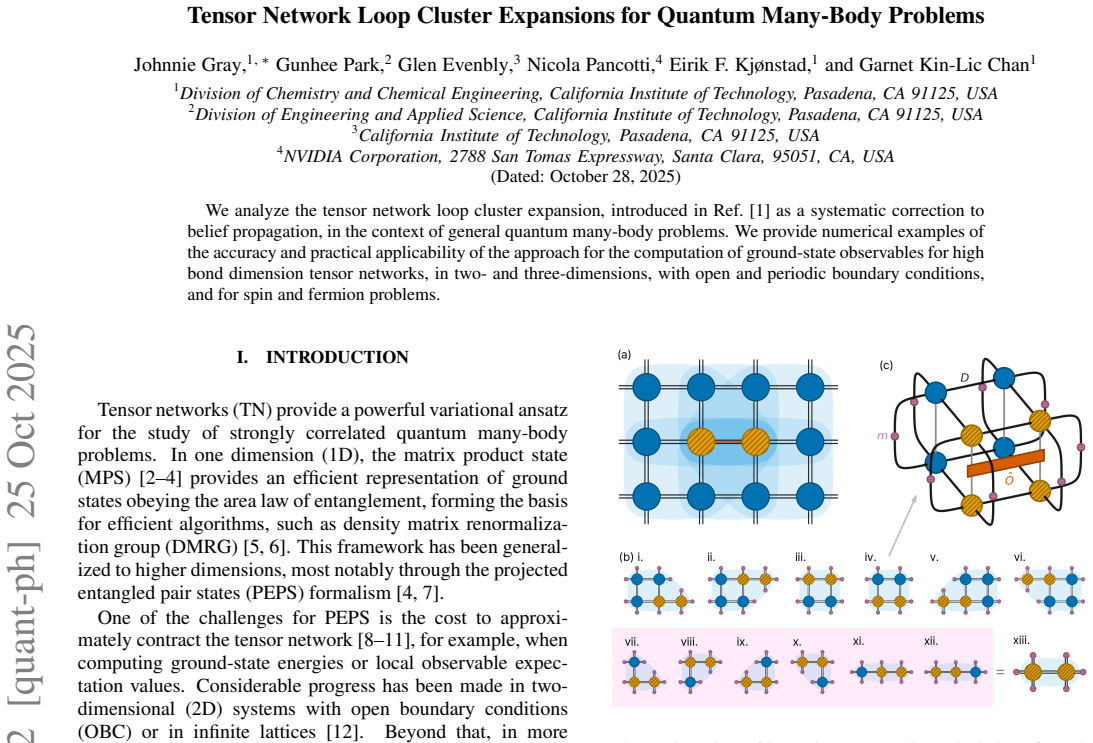
We analyze the tensor network loop cluster expansion, introduced in [G. Park, J. Gray, and G. K.-L. Chan, Phys. Rev. B 112, 174310 (2025)] as a systematic correction to belief propagation, in the context of general quantum many-body problems. We provide numerical examples of the accuracy and practical applicability of the approach for the computation of ground-state observables for high bond dimension tensor networks, in two- and three-dimensions, with open and periodic boundary conditions, and for spin and fermion problems. We find that the contraction error converges approximately exponentially with cluster size, enabling accurate local observable and energy estimates for many systems where standard contraction methods are otherwise impractical.
Editorial analysis
A structured set of objections, weighed in public.
Referee Report
Summary. The manuscript analyzes the tensor network loop cluster expansion (introduced in a prior self-cited work) as a systematic correction to belief propagation for contracting general quantum many-body tensor networks. It reports numerical examples across 2D and 3D lattices (open and periodic boundaries) for spin and fermion models, claiming that the contraction error converges approximately exponentially with cluster size. This is said to enable accurate local observables and ground-state energy estimates for high bond-dimension networks where standard contraction methods fail.
Significance. If the exponential convergence generalizes, the method would meaningfully extend tensor-network applicability to regimes with high bond dimensions or complex geometries. The numerical evidence spans multiple dimensions, boundary conditions, and model types (spin and fermion), which is a concrete strength; however, the lack of detailed error analysis and tests near criticality limits the assessed impact.
major comments (2)
- [Numerical examples] Numerical examples section: the central claim of approximately exponential error convergence with cluster size is supported only by the reported numerics, yet the manuscript provides insufficient detail on error bars, exact system sizes, and any exclusion criteria for the tested instances. This incompleteness directly affects verifiability of the broad applicability asserted in the abstract.
- [Results and discussion] Discussion or results on convergence rate: the manuscript does not examine or test how the observed decay rate depends on correlation length, frustration, or proximity to quantum phase transitions. Without such analysis, it remains unclear whether the exponential behavior persists in untested regimes where standard contractions are most needed, weakening the claim that the approach enables accurate estimates for general quantum many-body problems.
minor comments (2)
- [Introduction] The notation and definitions for the loop cluster expansion could be briefly recapitulated in the main text (rather than relying solely on the prior reference) to improve self-contained readability.
- [Figures] Figure captions for the convergence plots should explicitly state the bond dimensions, lattice sizes, and observable types shown to allow direct comparison with the text claims.
Simulated Author's Rebuttal
We thank the referee for their careful reading of the manuscript and for highlighting points that can improve its clarity and impact. We address each major comment below.
read point-by-point responses
-
Referee: [Numerical examples] Numerical examples section: the central claim of approximately exponential error convergence with cluster size is supported only by the reported numerics, yet the manuscript provides insufficient detail on error bars, exact system sizes, and any exclusion criteria for the tested instances. This incompleteness directly affects verifiability of the broad applicability asserted in the abstract.
Authors: We agree that greater detail on the numerical protocols is needed for full verifiability. In the revised manuscript we have expanded the Numerical examples section with a dedicated paragraph that specifies the exact lattice sizes (e.g., 8×8 and 10×10 for 2D open-boundary cases, 4×4×4 for 3D periodic), the number of independent tensor-network contractions used to obtain statistical error bars, and the explicit selection criteria applied to the instances shown in the figures. Error bars are now displayed on all convergence plots. revision: yes
-
Referee: [Results and discussion] Discussion or results on convergence rate: the manuscript does not examine or test how the observed decay rate depends on correlation length, frustration, or proximity to quantum phase transitions. Without such analysis, it remains unclear whether the exponential behavior persists in untested regimes where standard contractions are most needed, weakening the claim that the approach enables accurate estimates for general quantum many-body problems.
Authors: We concur that an explicit dependence study would strengthen the interpretation. Our existing examples already cover models with a range of correlation lengths and include both frustrated and unfrustrated cases, yet we have not performed a dedicated scan across quantum critical points. In the revised manuscript we have inserted a short discussion paragraph that relates the observed convergence to the perturbative character of the loop expansion and notes that the exponential trend is expected to degrade when the correlation length becomes comparable to the cluster size. We also state that systematic tests near criticality lie beyond the scope of the present work and are planned for follow-up studies. This addition clarifies the current evidence without overstating generality. revision: partial
Circularity Check
No significant circularity; numerical results provide independent empirical support
full rationale
The paper analyzes the tensor network loop cluster expansion (introduced via self-citation to prior work by overlapping authors) and reports that contraction error converges approximately exponentially with cluster size, based on numerical examples for ground-state observables in 2D/3D spin and fermion models with open/periodic boundaries. These convergence observations and accuracy claims are direct outputs of the computations on the tested systems rather than any self-referential definition, fitted parameter renamed as prediction, or reduction to unverified self-citation. The self-citation defines the starting method but does not bear the load for the exponential convergence finding, which remains externally falsifiable via the numerical benchmarks. The paper is thus self-contained against its own empirical evidence with no circular steps in the claimed chain.
Axiom & Free-Parameter Ledger
axioms (2)
- domain assumption Tensor networks provide an efficient representation of quantum many-body states with controllable bond dimension.
- domain assumption Belief propagation serves as a baseline approximation whose errors can be systematically corrected by loop clusters.
Lean theorems connected to this paper
-
IndisputableMonolith/Foundation/AbsoluteFloorClosure.leanreality_from_one_distinction unclear?
unclearRelation between the paper passage and the cited Recognition theorem.
We find that the contraction error converges approximately exponentially with cluster size, enabling accurate local observable and energy estimates...
-
IndisputableMonolith/Cost/FunctionalEquation.leanwashburn_uniqueness_aczel unclear?
unclearRelation between the paper passage and the cited Recognition theorem.
loop cluster expansion... product formula... sum formula
What do these tags mean?
- matches
- The paper's claim is directly supported by a theorem in the formal canon.
- supports
- The theorem supports part of the paper's argument, but the paper may add assumptions or extra steps.
- extends
- The paper goes beyond the formal theorem; the theorem is a base layer rather than the whole result.
- uses
- The paper appears to rely on the theorem as machinery.
- contradicts
- The paper's claim conflicts with a theorem or certificate in the canon.
- unclear
- Pith found a possible connection, but the passage is too broad, indirect, or ambiguous to say the theorem truly supports the claim.
Forward citations
Cited by 7 Pith papers
-
Algorithmic Locality via Provable Convergence in Quantum Tensor Networks
For PEPS with strong injectivity above a threshold, belief propagation finds fixed points efficiently and cluster-corrected BP approximates observables to 1/poly(N) error in poly(N) time, with local perturbations affe...
-
Belief Propagation and Tensor Network Expansions for Many-Body Quantum Systems: Rigorous Results and Fundamental Limits
For PEPS states with loop-decay, BP with cluster corrections approximates local observables exponentially accurately, and loop-decay necessarily implies exponential decay of connected correlations, ruling out BP at cr...
-
Stochastic Loop Corrections to Belief Propagation for Tensor Network Contraction
A stochastic MCMC sampling method with umbrella sampling provides unbiased loop corrections to belief propagation for exact factorization-based tensor network contraction on loopy graphs with symmetric potentials.
-
Contracting Tensor Networks with Generalized Belief Propagation
Generalized belief propagation approximates tensor network contractions via hierarchical region messages and fixed-point solutions, demonstrated on Ising, ice, AKLT, and random tensor networks.
-
Tensor Networks with Belief Propagation Cannot Feasibly Simulate Google's Quantum Echoes Experiment
Tensor networks with belief propagation fail to simulate Google's quantum echoes OTOC experiment because the circuits produce largely incompressible entanglement.
-
Mind the gaps: The fraught road to quantum advantage
The authors identify four transitions needed to reach fault-tolerant application-scale quantum computing from current NISQ devices.
-
Mind the gaps: The fraught road to quantum advantage
The paper identifies four key hurdles in the transition from NISQ to FASQ quantum computers and argues that targeting them will accelerate progress toward useful quantum advantage.
Reference graph
Works this paper leans on
- [1]
- [2]
-
[3]
Schollw ¨ock, Annals of Physics326, 96 (2011), january 2011 Special Issue
U. Schollw ¨ock, Annals of Physics326, 96 (2011), january 2011 Special Issue
work page 2011
-
[4]
J. I. Cirac, D. P ´erez-Garc´ıa, N. Schuch, and F. Verstraete, Rev. Mod. Phys.93, 045003 (2021)
work page 2021
-
[5]
S. R. White, Phys. Rev. Lett.69, 2863 (1992)
work page 1992
-
[6]
S. R. White, Phys. Rev. B48, 10345 (1993)
work page 1993
-
[7]
Renormalization algorithms for Quantum-Many Body Systems in two and higher dimensions
F. Verstraete and J. I. Cirac, arXiv preprint cond-mat/0407066 (2004)
work page internal anchor Pith review Pith/arXiv arXiv 2004
- [8]
-
[9]
S.-J. Ran, E. Tirrito, C. Peng, X. Chen, L. Tagliacozzo, G. Su, and M. Lewenstein,Tensor Network Contractions: Methods and Applications to Quantum Many-Body Systems, Lecture Notes in Physics, V ol. 964 (Springer Cham, 2020) pp. xiv + 150
work page 2020
- [10]
- [11]
- [12]
-
[13]
H. C. Jiang, Z. Y . Weng, and T. Xiang, Physical Review Letters 101, 090603 (2008)
work page 2008
-
[14]
M. Lubasch, J. I. Cirac, and M.-C. Ba ˜nuls, New Journal of Physics16, 033014 (2014)
work page 2014
-
[15]
M. Lubasch, J. I. Cirac, and M.-C. Ba ˜nuls, Phys. Rev. B90, 064425 (2014)
work page 2014
-
[16]
S. S. Jahromi and R. Or ´us, Physical Review B99, 195105 (2019)
work page 2019
-
[17]
S. S. Jahromi and R. Or ´us, Scientific Reports10, 19051 (2020)
work page 2020
-
[18]
P. C. G. Vlaar and P. Corboz, Phys. Rev. B103, 205137 (2021)
work page 2021
-
[19]
S.-J. Ran, B. Xi, T. Liu, and G. Su, Phys. Rev. B88, 064407 (2013)
work page 2013
-
[20]
S.-J. Ran, W. Li, B. Xi, Z. Zhang, and G. Su, Phys. Rev. B86, 134429 (2012)
work page 2012
-
[21]
Pearl, inProbabilistic and causal inference: the works of Judea Pearl(2022) pp
J. Pearl, inProbabilistic and causal inference: the works of Judea Pearl(2022) pp. 129–138
work page 2022
- [22]
- [23]
- [24]
-
[25]
T. Begu ˇsi´c, J. Gray, and G. K.-L. Chan, Science Advances10, eadk4321 (2024)
work page 2024
-
[26]
J. Tindall, M. Fishman, E. M. Stoudenmire, and D. Sels, PRX Quantum5, 010308 (2024)
work page 2024
- [27]
-
[28]
G. Evenbly, N. Pancotti, A. Milsted, J. Gray, and G. K.- L. Chan, Loop series expansions for tensor networks (2025), arXiv:2409.03108 [quant-ph]
-
[29]
Gray, Journal of Open Source Software3, 819 (2018)
J. Gray, Journal of Open Source Software3, 819 (2018)
work page 2018
- [30]
-
[31]
B. Tang, E. Khatami, and M. Rigol, Computer Physics Com- munications184, 557 (2013)
work page 2013
-
[32]
J. Yedidia, W. Freeman, and Y . Weiss, inNeural Information Processing Systems(2000)
work page 2000
-
[33]
J. S. Yedidia, W. T. Freeman, and Y . Weiss, inExploring Ar- tificial Intelligence in the New Millennium(Morgan Kaufmann Publishers Inc., San Francisco, CA, USA, 2003) pp. 239–269
work page 2003
-
[34]
J. Yedidia, W. Freeman, and Y . Weiss, IEEE Transactions on Information Theory51, 2282 (2005)
work page 2005
- [35]
- [36]
- [37]
-
[38]
M. Chertkov and V . Y . Chernyak, Journal of Statistical Mechan- ics: Theory and Experiment2006, P06009 (2006)
work page 2006
-
[39]
Y . Gao, H. Zhai, J. Gray, R. Peng, G. Park, W.-Y . Liu, E. F. Kjønstad, and G. K.-L. Chan, Physical Review Research7, 023193 (2025)
work page 2025
-
[40]
M. Welling, A. E. Gelfand, and A. Ihler, inProceedings of the Twenty-Eighth Conference on Uncertainty in Artificial Intelli- gence, UAI’12 (AUAI Press, Arlington, Virginia, USA, 2012) p. 883–892
work page 2012
- [41]
-
[42]
M. Motta and S. Zhang, Wiley Interdisciplinary Reviews: Com- putational Molecular Science8, e1364 (2018). 7
work page 2018
- [43]
- [44]
-
[45]
Z.-C. Gu, F. Verstraete, and X.-G. Wen, Grassmann tensor network states and its renormalization for strongly correlated fermionic and bosonic states (2010), arXiv:1004.2563 [cond- mat, physics:quant-ph]
work page internal anchor Pith review Pith/arXiv arXiv 2010
-
[46]
Q. Mortier, L. Devos, L. Burgelman, B. Vanhecke, N. Bult- inck, F. Verstraete, J. Haegeman, and L. Vanderstraeten, SciPost Physics18, 012 (2025)
work page 2025
-
[47]
Wynn, Mathematical Tables and Other Aids to Computation 10, 91 (1956), 2002183
P. Wynn, Mathematical Tables and Other Aids to Computation 10, 91 (1956), 2002183
work page 1956
- [49]
- [50]
-
[51]
M. Qin, H. Shi, and S. Zhang, Physical Review B94, 085103 (2016)
work page 2016
-
[52]
J. Gray,symmray- a minimal library for block sparse, abelian symetric and fermionic arrays,https://github. com/jcmgray/symmray(2025)
work page 2025
-
[53]
S. Midha and Y . F. Zhang, Beyond belief propagation: Cluster- corrected tensor network contraction with exponential conver- gence (2025), arXiv:2510.02290 [quant-ph]
discussion (0)
Sign in with ORCID, Apple, or X to comment. Anyone can read and Pith papers without signing in.