Recognition: unknown
Tensor Networks with Belief Propagation Cannot Feasibly Simulate Google's Quantum Echoes Experiment
Pith reviewed 2026-05-10 10:57 UTC · model grok-4.3
The pith
Tensor networks with belief propagation cannot simulate the OTOC circuits from Google's quantum echoes experiment.
A machine-rendered reading of the paper's core claim, the machinery that carries it, and where it could break.
Core claim
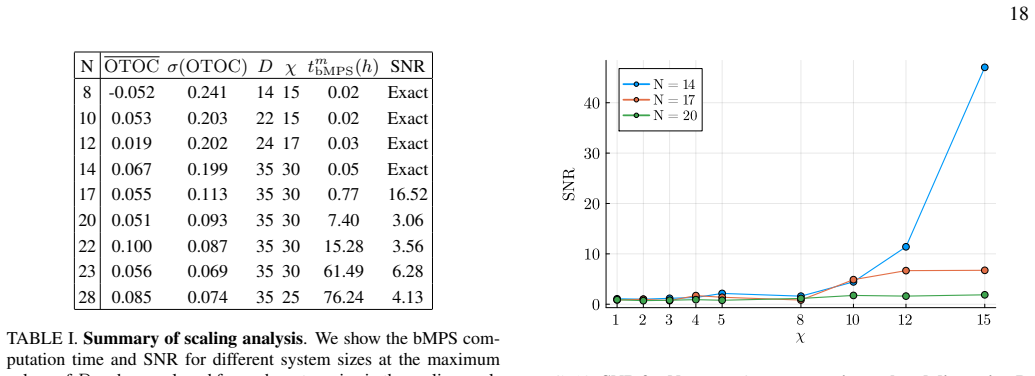
The OTOC circuits generate enough entanglement that the quantum states are largely incompressible by tensor network methods, and the dense connectivity of the processor makes belief propagation ineffective, so TNBP cannot feasibly simulate the full experiment to the accuracy reached by the quantum device.
What carries the argument
Entanglement growth in the OTOC random circuits, which overwhelms the compression power of tensor network states when belief propagation is applied on a lattice with dense connections.
If this is right
- Other tensor network methods that evolve states in the Schrödinger picture will encounter the same incompressibility barrier for these circuits.
- Classical simulation of the echoes experiment via TNBP is ruled out at the reported scale and accuracy.
- The quantum processor's measured speedup over the tested classical methods extends to this additional simulation approach.
- Similar highly entangled dynamics in random circuits will remain hard for TNBP-style methods.
Where Pith is reading between the lines
- The incompressibility argument may apply to other measurement protocols that rely on out-of-time-order correlators in chaotic quantum systems.
- Verification of such experiments may increasingly require either quantum hardware or entirely different classical algorithms that do not rely on state compression.
- If entanglement continues to grow without compressible patterns, it could bound the reach of tensor-network techniques for many classes of quantum dynamics experiments.
Load-bearing premise
Entanglement scaling and numerical behavior observed on smaller or simplified circuits continue without new compressible structure appearing at the full size and connectivity of the Google experiment.
What would settle it
A TNBP calculation that reproduces the full experiment's OTOC values to the same accuracy as the quantum processor within feasible classical resources would disprove the claim.
Figures







read the original abstract
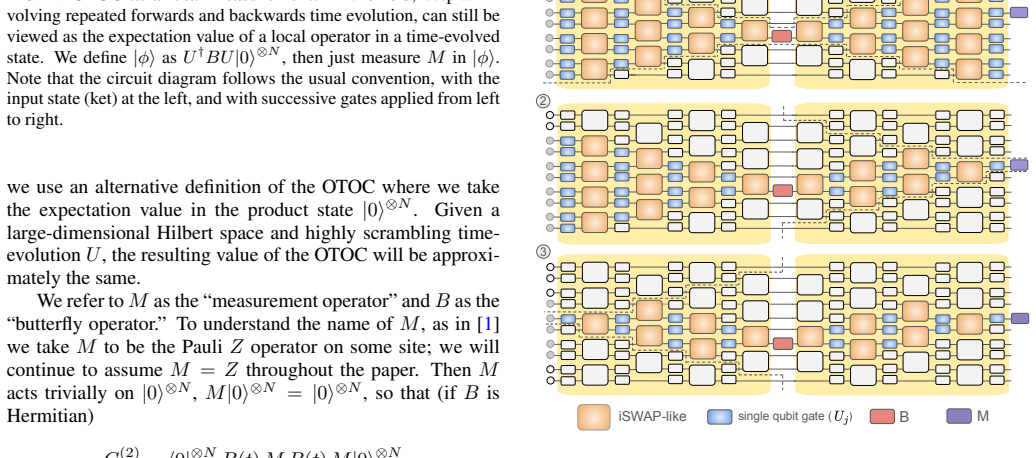
In the recent quantum echoes experiment, Google Quantum AI showed that out-of-time-order correlators (OTOCs) for random-circuit time evolution can be measured using a quantum processor more than 10,000x faster than they can be computed to similar accuracy via classical computation. This claim was substantiated by comparison with a variety of state-of-the-art classical simulation methods. One classical simulation method that was not explicitly tested was tensor networks with belief propagation (TNBP). TNBP should be poorly suited to simulating Google's echoes experiment: the states involved are highly entangled, a challenge for tensor network states; and the Willow chip has dense 2D connectivity, a challenge for belief propagation. Here we confirm, via a combination of theoretical scaling arguments and explicit numerical simulation, the intuition that TNBP is unable to simulate the quantum echoes experiment. We show that the OTOC circuits generate enough entanglement that they are largely incompressible, implying that other approaches in which OTOCs are computed by evolving a tensor network state in the Schr\"odinger picture will also fail. Our results further reinforce the claim that the quantum echoes experiment cannot be reproduced by classical computation.
Editorial analysis
A structured set of objections, weighed in public.
Referee Report
Summary. The manuscript claims that tensor networks with belief propagation (TNBP) cannot feasibly simulate Google's quantum echoes experiment on out-of-time-order correlators (OTOCs). It combines theoretical scaling arguments based on entanglement growth with explicit numerical simulations on smaller circuits to argue that the OTOC circuits produce volume-law entanglement making them incompressible, and the dense connectivity challenges BP. This implies failure for other Schrödinger-picture TN methods and reinforces the quantum advantage claim.
Significance. If the result holds, it is significant as it rules out TNBP as a classical simulator for this experiment, a method potentially suited to entangled systems but hindered here by entanglement volume and connectivity. This provides additional support for the infeasibility of classical computation of the OTOCs to the accuracy achieved experimentally.
major comments (1)
- The simulations are performed on smaller or simplified circuits. The extrapolation to the full-size Google experiment with its specific random-circuit + OTOC protocol and dense 2D connectivity assumes that no additional compressible structure emerges at scale, but this is not demonstrated or tested, which is load-bearing for the infeasibility conclusion.
Simulated Author's Rebuttal
We thank the referee for their careful reading and constructive feedback on our manuscript. We address the major comment below.
read point-by-point responses
-
Referee: The simulations are performed on smaller or simplified circuits. The extrapolation to the full-size Google experiment with its specific random-circuit + OTOC protocol and dense 2D connectivity assumes that no additional compressible structure emerges at scale, but this is not demonstrated or tested, which is load-bearing for the infeasibility conclusion.
Authors: We agree that our numerical simulations are necessarily restricted to smaller circuit sizes, as exact classical simulation of the full Google experiment is computationally prohibitive. Our primary argument, however, rests on theoretical scaling analysis of entanglement growth under the random-circuit + OTOC protocol, which establishes volume-law entanglement that increases with system size and precludes compressible structure. The dense 2D connectivity of the Willow chip is a fixed architectural property independent of circuit depth or width, and belief propagation is known to fail on such graphs due to short loops. We have revised the manuscript to include an expanded discussion (new paragraph in Section 4 and strengthened language in the conclusion) explaining why the random, scrambling nature of the circuits makes additional compressible features at scale unlikely, with supporting citations to entanglement scaling results in random quantum circuits. revision: partial
Circularity Check
No circularity: scaling arguments and small-circuit simulations are independent of the target claim
full rationale
The paper's central argument relies on standard entanglement scaling (linear growth implying exponential bond-dimension cost) plus explicit TNBP simulations on smaller or simplified OTOC circuits. These inputs are drawn from general tensor-network theory and direct computation rather than from fitting parameters to the full Google experiment or from self-citations that define the result. No equation reduces the infeasibility conclusion to a quantity defined by the target data, and the extrapolation step is presented as an assumption rather than a derived identity. The derivation chain therefore remains self-contained against external benchmarks.
Axiom & Free-Parameter Ledger
axioms (2)
- domain assumption OTOC circuits on the Willow chip generate entanglement that exceeds the compressibility threshold of tensor networks.
- domain assumption Belief propagation cannot efficiently handle the dense 2D connectivity of the chip for these states.
Reference graph
Works this paper leans on
-
[1]
Google Quantum AI and Collaborators, Observation of con- structive interference at the edge of quantum ergodicity, Nature 646, 825 (2025)
2025
-
[2]
Google Quantum AI and Collaborators, Quantum supremacy using a programmable superconducting processor, Nature574, 505 (2019)
2019
-
[3]
Zhong, H
H.-S. Zhong, H. Wang,et al., Quantum computational advan- tage using photons, Science370, 1460 (2020)
2020
-
[4]
Wu, W.-S
Y . Wu, W.-S. Bao,et al., Strong quantum computational ad- vantage using a superconducting quantum processor, Phys. Rev. Lett.127, 180501 (2021)
2021
-
[5]
Zhong, Y .-H
H.-S. Zhong, Y .-H. Deng,et al., Phase-programmable gaus- sian boson sampling using stimulated squeezed light, Phys. Rev. Lett.127, 180502 (2021)
2021
-
[6]
Q. Zhu, S. Cao,et al., Quantum computational advantage via 60-qubit 24-cycle random circuit sampling, Science Bulletin67, 240 (2022)
2022
-
[7]
L. S. Madsen, F. Laudenbach,et al., Quantum computational advantage with a programmable photonic processor, Nature 606, 75 (2022)
2022
-
[8]
Morvan, B
A. Morvan, B. Villalonga, X. Mi, S. Mandr `a, A. Bengtsson, P. Klimov, Z. Chen, S. Hong, C. Erickson, I. Drozdov,et al., Phase transitions in random circuit sampling, Nature634, 328 (2024)
2024
-
[9]
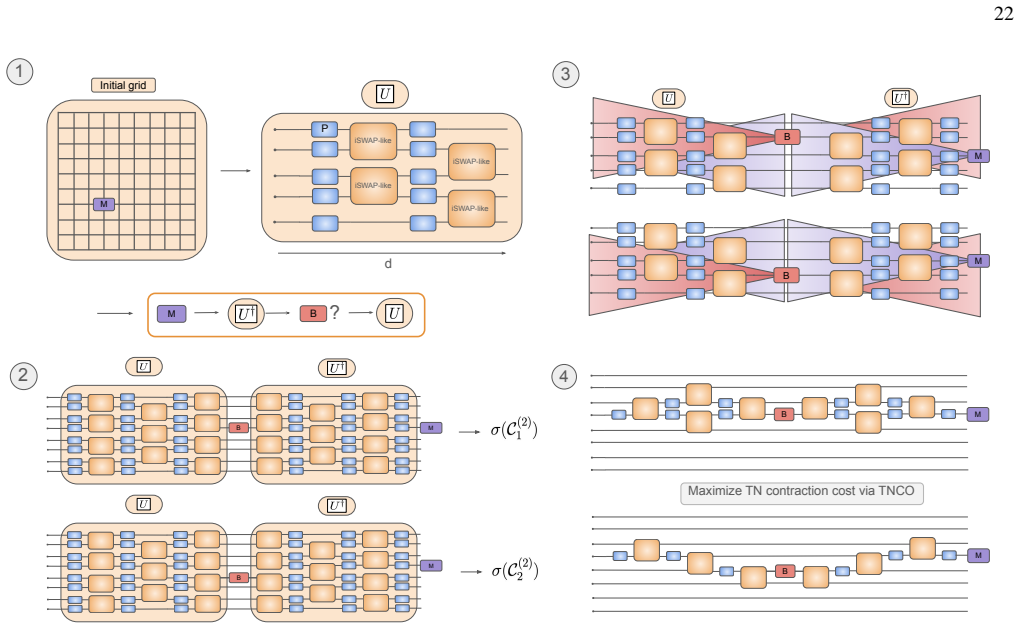
Y .-H. Deng, Y .-C. Gu,et al., Gaussian boson sampling with pseudo-photon-number resolving detectors and quantum com- 22 Initial grid M d iSWAP-like iSWAP-like iSWAP-like iSWAP-like P M B ? B M 3 M B 4 1 2 Maximize TN contraction cost via TNCO B M M B B M M B FIG. 14.Procedure to generate the light cones simulated in the scaling analysis. 1) Fix a10×10gri...
-
[10]
Y . Kim, A. Eddins, S. Anand, K. X. Wei, E. van den Berg, S. Rosenblatt, H. Nayfeh, Y . Wu, M. Zaletel, K. Temme, and A. Kandala, Evidence for the utility of quantum computing be- fore fault tolerance, Nature618, 500 (2023)
2023
-
[11]
A. D. King, A. Nocera,et al., Beyond-classical computation in quantum simulation, Science388, 199 (2025)
2025
-
[12]
T. I. Andersen, N. Astrakhantsev,et al., Thermalization and crit- icality on an analogue–digital quantum simulator, Nature638, 79 (2025)
2025
-
[13]
M. Liu, R. Shaydulin,et al., Certified randomness using a trapped-ion quantum processor, Nature640, 343 (2025)
2025
-
[14]
Digital quantum magnetism on a trapped-ion quantum computer
R. Haghshenas, E. Chertkov,et al., Digital quantum magnetism at the frontier of classical simulations (2025), arXiv:2503.20870 [quant-ph]
work page internal anchor Pith review Pith/arXiv arXiv 2025
- [15]
-
[16]
Tindall, M
J. Tindall, M. Fishman, E. M. Stoudenmire, and D. Sels, Ef- ficient tensor network simulation of IBM’s Eagle kicked Ising experiment, PRX Quantum5, 010308 (2024)
2024
-
[17]
Beguˇsi´c, J
T. Beguˇsi´c, J. Gray, and G. K.-L. Chan, Fast and converged clas- sical simulations of evidence for the utility of quantum com- puting before fault tolerance, Science Advances10, eadk4321 (2024)
2024
-
[18]
R. LaRose, A brief history of quantum vs classical computa- tional advantage (2024), arXiv:2412.14703 [quant-ph]
-
[19]
Zhao, H.-S
X.-H. Zhao, H.-S. Zhong, F. Pan, Z.-H. Chen, R. Fu, Z. Su, X. Xie, C. Zhao, P. Zhang, W. Ouyang,et al., Leapfrogging Sycamore: Harnessing 1432 GPUs for 7×faster quantum ran- dom circuit sampling, National Science Review12, nwae317 (2025)
2025
-
[20]
C. Zhang, R. G. Corti ˜nas,et al., Quantum computation of molecular geometry via many-body nuclear spin echoes (2025), arXiv:2510.19550 [quant-ph]
-
[21]
J. S. Yedidia, W. T. Freeman, and Y . Weiss, Understanding be- lief propagation and its generalizations, inExploring Artificial Intelligence in the New Millennium(Morgan Kaufmann Pub- lishers Inc., San Francisco, CA, USA, 2003) p. 239–269
2003
-
[22]
Alkabetz and I
R. Alkabetz and I. Arad, Tensor networks contraction and the belief propagation algorithm, Physical Review Research3, 023073 (2021)
2021
-
[23]
J. Tindall, A. Mello, M. Fishman, M. Stoudenmire, and D. Sels, Dynamics of disordered quantum systems with two-and three- dimensional tensor networks, arXiv preprint arXiv:2503.05693 (2025)
-
[24]
S. Sahu and B. Swingle, Efficient tensor network simula- tion of quantum many-body physics on sparse graphs (2022), arXiv:2206.04701 [quant-ph]
-
[25]
Tindall and M
J. Tindall and M. Fishman, Gauging tensor networks with belief propagation, SciPost Physics15, 222 (2023)
2023
- [26]
-
[27]
Hashimoto, K
K. Hashimoto, K. Murata, and R. Yoshii, Out-of-time-order cor- relators in quantum mechanics, Journal of High Energy Physics 2017, 1 (2017)
2017
-
[28]
Haehl, R
F. Haehl, R. Loganayagam, P. Narayan, and M. Rangamani, Classification of out-of-time-order correlators, SciPost Physics 6, 001 (2019)
2019
-
[29]
Out-of-time-order correlators and quantum chaos
I. Garc ´ıa-Mata, R. A. Jalabert, and D. A. Wisniacki, Out- of-time-order correlators and quantum chaos, arXiv preprint arXiv:2209.07965 (2022)
-
[30]
X. Mi, P. Roushan, C. Quintana, S. Mandra, J. Marshall, C. Neill, F. Arute, K. Arya, J. Atalaya, R. Babbush,et al., In- formation scrambling in quantum circuits, Science374, 1479 (2021)
2021
-
[31]
Khemani, A
V . Khemani, A. Vishwanath, and D. A. Huse, Operator spread- ing and the emergence of dissipative hydrodynamics under uni- tary evolution with conservation laws, Physical Review X8, 031057 (2018)
2018
-
[32]
Nahum, S
A. Nahum, S. Vijay, and J. Haah, Operator spreading in random unitary circuits, Phys. Rev. X8, 021014 (2018)
2018
-
[33]
DeCross, R
M. DeCross, R. Haghshenas, M. Liu, E. Rinaldi, J. Gray, Y . Alexeev, C. H. Baldwin, J. P. Bartolotta, M. Bohn, E. Chertkov,et al., Computational power of random quantum circuits in arbitrary geometries, Physical Review X15, 021052 (2025)
2025
-
[34]
Kechedzhi, S
K. Kechedzhi, S. Isakov, S. Mandr `a, B. Villalonga, X. Mi, S. Boixo, and V . Smelyanskiy, Effective quantum volume, fi- delity and computational cost of noisy quantum processing experiments, Future Generation Computer Systems153, 431 (2024)
2024
- [35]
-
[36]
Renormalization algorithms for Quantum-Many Body Systems in two and higher dimensions
F. Verstraete and J. I. Cirac, Renormalization algorithms for quantum-many body systems in two and higher dimensions, arXiv preprint cond-mat/0407066 (2004)
work page internal anchor Pith review arXiv 2004
-
[37]
Jiang, Z.-Y
H.-C. Jiang, Z.-Y . Weng, and T. Xiang, Accurate determination of tensor network state of quantum lattice models in two dimen- sions, Physical review letters101, 090603 (2008)
2008
-
[38]
Lubasch, J
M. Lubasch, J. I. Cirac, and M.-C. Banuls, Algorithms for finite projected entangled pair states, Physical Review B90, 064425 (2014)
2014
-
[39]
Jordan, R
J. Jordan, R. Or ´us, G. Vidal, F. Verstraete, and J. I. Cirac, Clas- sical simulation of infinite-size quantum lattice systems in two spatial dimensions, Physical review letters101, 250602 (2008)
2008
-
[40]
Gonz ´alez-Garc´ıa, S
S. Gonz ´alez-Garc´ıa, S. Sang, T. H. Hsieh, S. Boixo, G. Vidal, A. C. Potter, and R. Vasseur, Random insights into the com- plexity of two-dimensional tensor network calculations, Physi- cal Review B109, 235102 (2024)
2024
-
[42]
Zhou and A
T. Zhou and A. Nahum, Entanglement membrane in chaotic many-body systems, Physical Review X10, 031066 (2020)
2020
-
[43]
Bertini, P
B. Bertini, P. Kos, and T. c. v. Prosen, Exact correlation func- tions for dual-unitary lattice models in1 + 1dimensions, Phys. Rev. Lett.123, 210601 (2019)
2019
-
[44]
Xu and B
S. Xu and B. Swingle, Accessing scrambling using matrix prod- uct operators, Nature Physics16, 199 (2020)
2020
-
[45]
G. Evenbly, N. Pancotti, A. Milsted, J. Gray, and G. K. Chan, Loop series expansions for tensor networks, arXiv preprint arXiv:2409.03108 (2024)
-
[46]
J. Gray, G. Park, G. Evenbly, N. Pancotti, and G. K. Chan, Ten- sor network loop cluster expansions for quantum many-body problems, arXiv preprint arXiv:2510.05647 (2025)
work page internal anchor Pith review Pith/arXiv arXiv 2025
-
[47]
S. Midha and Y . F. Zhang, Beyond belief propagation: Cluster- corrected tensor network contraction with exponential conver- gence (2025), arXiv:2510.02290 [quant-ph]
-
[48]
S. Midha, G. M. Sommers, J. Tindall, and D. A. Abanin, Be- lief propagation and tensor network expansions for many-body quantum systems: Rigorous results and fundamental limits, arXiv preprint arXiv:2604.03228 (2026)
work page internal anchor Pith review Pith/arXiv arXiv 2026
-
[49]
Research, TNCO (2025), https://github.com/ google-research/tnco/tree/main/tnco
G. Research, TNCO (2025), https://github.com/ google-research/tnco/tree/main/tnco
2025
-
[50]
Fishman, S
M. Fishman, S. White, and E. M. Stoudenmire, The ITensor software library for tensor network calculations, SciPost Physics Codebases , 004 (2022)
2022
-
[51]
symmetric up- date
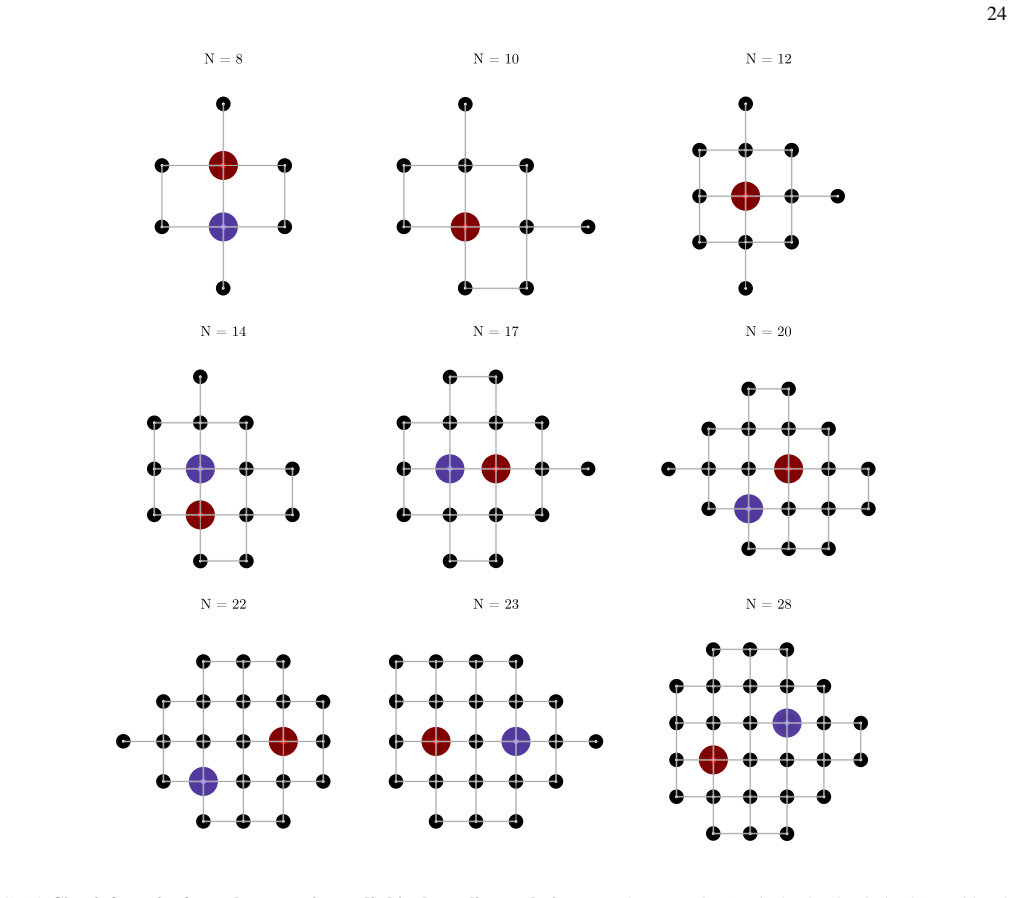
J. Tindall and M. Rudolph, TensorNetworkQuan- tumSimulator.jl (2025), https://github.com/JoeyT1994/ TensorNetworkQuantumSimulator.jl. Appendix A: Details of construction of circuits for scaling analysis a. Procedure to determine the locations of measurement and butterfly operators In the main text, we study the performance of TNBP in two different scenari...
2025
-
[52]
horizontal,
The result is shown in Fig. 20 — the physical lightcone has a cross-section which is like a square with rounded-off corners. We additionally extract velocities for a number of angular rays from linear fits to these distances versus time, showing that the physical lightcone size is an angle-dependent fraction of the geometric lightcone, where the fraction ...
-
[53]
horizontal
The physi- cal lightcone is closer to circular. As shown in Fig. 20(b), the physical lightcone velocity varies by only about 10% from one direction to another. The result is that the physical lightcone spreads nearly as fast as the geometric lightcone along the di- agonal directions (vd/cd ≈0.95), and more slowly relative to the geometric lightcone alongˆ...
-
[54]
No PEPS wavefunction can accurately represent the state|ϕ⟩without a largeD
-
[55]
There exists a PEPS with a smallerDthat could faith- fully represent the state, but performing even a single BP truncation, which does not accurately take into ac- count correlations around loops in the lattice, makes the bond dimensionDinsufficient
-
[56]
With only a single large BP truncation after exact evolution, the final state would still contain enough in- formation to extract the OTOC
The relevant information in the state is only lost because we perform many BP truncations throughout the evolu- tion. With only a single large BP truncation after exact evolution, the final state would still contain enough in- formation to extract the OTOC. If 3. were the case, the OTOC would be easy to simulate clas- sically. We can afford to run time ev...
discussion (0)
Sign in with ORCID, Apple, or X to comment. Anyone can read and Pith papers without signing in.