REVIEW 3 major objections 4 minor 7 cited by
Complementarity of gravitational wave analyses and di-Higgs production in the exploration of the Electroweak Phase Transition dynamics in the RxSM
T0 review · 3 major / 4 minor · reviewed 2026-08-04 · deepseek-v4-flash
Pith's one-line read The paper claims that in the real-singlet extension of the Standard Model, the field-space direction that drives a strong first-order electroweak phase transition determines whether the transition is visible in gravitational waves or in di-
desk verdict A solid, carefully done RxSM study with a plausible singlet/doublet complementarity claim, but the claim rests on two tailored benchmark planes and one region-description inconsistency. read the letter →
The pith
A machine-rendered reading of the paper's core claim, the machinery that carries it, and where it could break.
The reading
What carries the argument
The central organizing object is the direction of the tunnelling path in the (doublet, singlet) field space during the SFOEWPT, identified by the sign and size of the singlet VEV at nucleation. The quantitative machinery is the one-loop, temperature-dependent effective potential (with thermal resummation and an on-shell-like renormalization) used to compute the bounce action, the nucleation temperature Tn, the phase-transition strength ξn = vn/Tn, and the gravitational-wave power spectrum; consistency requires using the same one-loop order for the trilinear couplings λhhh and λhhH that enter di-Higgs production. The key output relation is the anticorrelation: singlet-driven transitions give
What would settle it
A scan over the full five-dimensional RxSM parameter space that locates a singlet-driven SFOEWPT with a sizeable deviation in the Higgs trilinear coupling, or a doublet-driven SFOEWPT with a LISA-detectable gravitational-wave signal while κλ remains near one, would falsify the claimed dichotomy; conversely, observing both a LISA background and clear di-Higgs deviations for the same parameters would also break it.
Extended reading notes
Core claim
The paper establishes that the RxSM's strong first-order electroweak phase transition (SFOEWPT) comes in two phenomenologically disjoint varieties. In the first, the transition is driven by the singlet field direction: tunnelling starts from a negative singlet VEV, the nucleation temperature is low (Tn ≲ 70 GeV), and the resulting stochastic gravitational-wave background is detectable at LISA with signal-to-noise ratios above 10 for a conservative wall velocity vw = 0.95 across a large part of the plane; at the same points the trilinear couplings λhhh and λhhH are essentially SM-like, so di-Higgs production is indistinguishable from the Standard Model. In the second, the transition is driven
Load-bearing premise
The paper's central separation is demonstrated only on two specially chosen two-dimensional slices of the five-dimensional parameter space, and the paper itself calls the analysis a proof of concept; if those slices are not representative of the full space, the clean split between gravitational-wave-visible and collider-visible scenarios could be an artifact of the selection.
Editorial extensions
If this is right
- If a space-based gravitational-wave observatory sees a stochastic background matching an SFOEWPT, and di-Higgs measurements at the HL-LHC and a 1 TeV e+e− collider remain SM-like, the transition in the RxSM was almost certainly singlet-driven.
- If a future collider sees a di-Higgs deviation consistent with κλ around 1.5–1.7 in the mhh distribution, the same model would predict little or no LISA signal for the doublet-driven transition; the two observations should not be expected together.
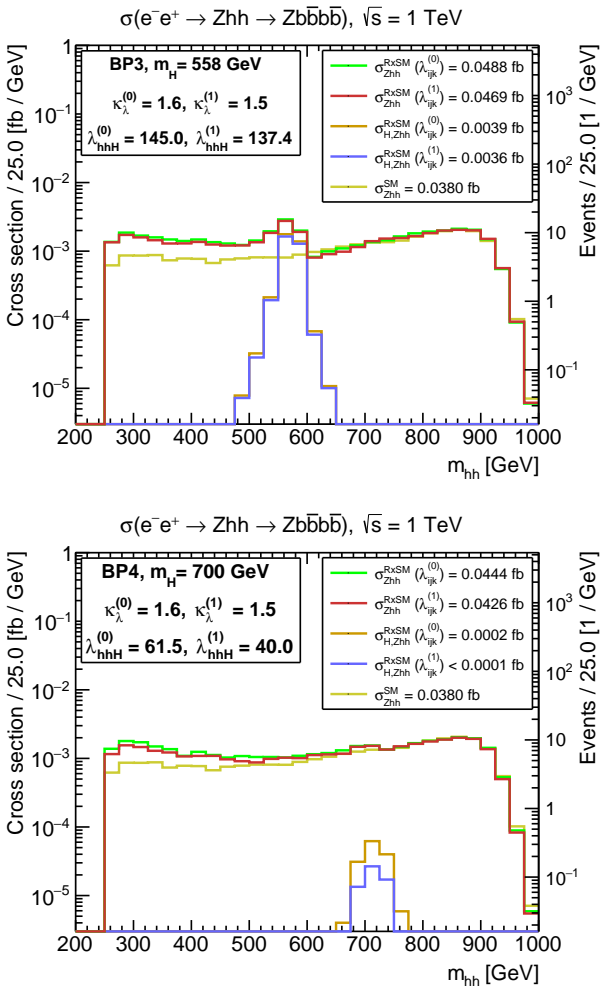
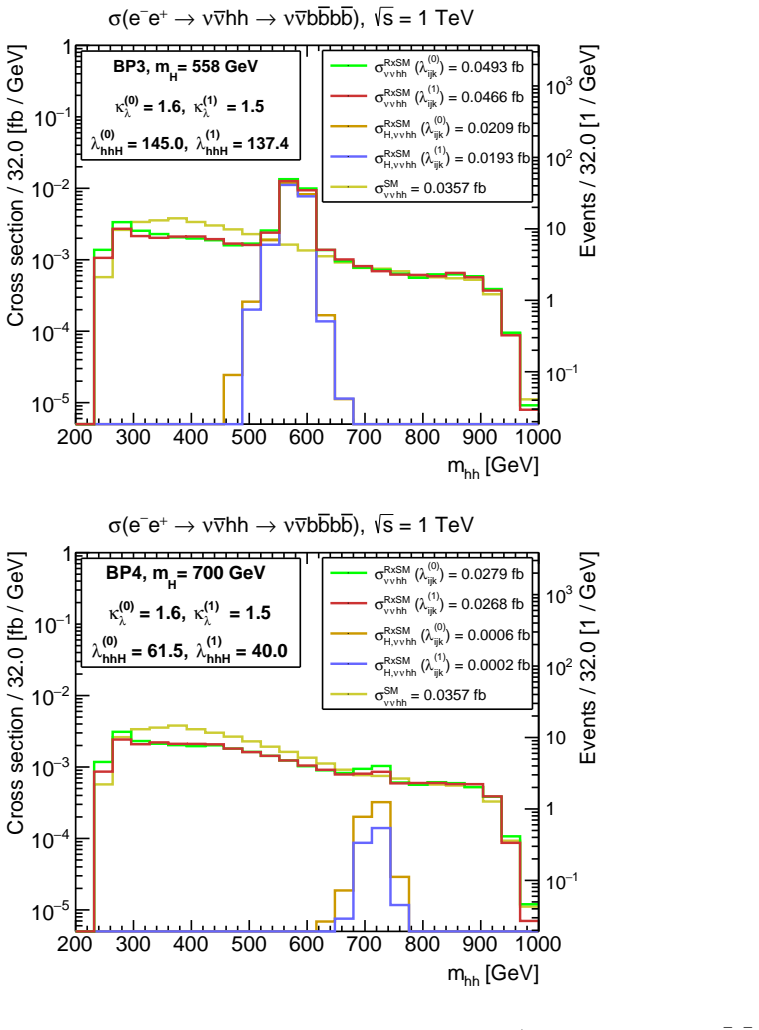
- Total di-Higgs cross-sections are not a reliable probe on their own: cancellations between enhanced λhhh and resonant H contributions can restore SM values, so only differential mhh distributions, and channels like e+e−→ννhh for mH ≲ 650 GeV, can separate model from SM.
- A singlet-driven SFOEWPT that is visible at LISA would leave essentially no trace in di-Higgs searches; collider null results would not constrain these scenarios, so gravitational-wave observatories are the only way to access them.
- The complementarity reverses the usual intuition: the stronger the gravitational-wave signal, the more Standard-Model-like the Higgs sector appears at colliders.
Reading between the lines
- If this direction-based dichotomy is generic, it suggests a selection rule for model-building: extensions that use a singlet-like field to strengthen the transition will hide from colliders but shine in gravitational-wave observatories, while doublet-driven models are the natural targets of precision Higgs programs; neither search alone maps the full SFOEWPT parameter space.
- The paper's benchmark planes are constructed to maximize ξn; a full five-dimensional scan or a random sample would test whether the clean separation persists away from these slices. Until then, the 'significant parts of parameter space' claim for singlet-driven gravitational waves should be read as conditional on this selection.
- Since the sign of the singlet VEV at nucleation appears to control the delay of the transition and hence the gravitational-wave strength, a natural next step is to map the phenomenology as a function of vS(Tn) rather than the fixed input vS; this may uncover additional singlet-driven regions in the full parameter space.
- A dedicated computation of the bubble wall velocity, which the paper treats as an input, could shift the boundary of the doublet-driven gravitational-wave region; if vw turns out systematically below 0.6, the 'narrow strip' could become a substantial discovery region.
Editorial analysis
A structured set of objections, weighed in public.
Referee Report
Summary. The paper studies the real singlet extension of the Standard Model (RxSM) and investigates whether scenarios with a strong first-order electroweak phase transition (SFOEWPT) can be probed complementarily by future gravitational-wave (GW) observations, specifically LISA, and by di-Higgs production at the HL-LHC and a 1 TeV e+e− collider. The authors implement the RxSM in BSMPTv3, compute the one-loop finite-temperature effective potential, identify six thermal histories, and map regions with ξn = vn/Tn > 1. From a five-dimensional parameter scan they isolate two benchmark planes, constructed to maximize ξn: plane 1 (Eq. 37) features a singlet-driven SFOEWPT with strong GW signals and SM-like di-Higgs production; plane 2 (Eq. 39) features a doublet-driven SFOEWPT with substantial deviations in κλ and di-Higgs rates but only a narrow GW-observable region. The central claim is that singlet-driven SFOEWPTs are GW-loud and collider-quiet, while doublet-driven SFOEWPTs are collider-visible but GW-quiet.
Significance. If the qualitative complementarity holds across the RxSM parameter space, the result would be an important guide for future experimental strategy: it would show that no single probe can cover all SFOEWPT scenarios, and that singlet-driven transitions may be invisible to colliders while being accessible to LISA. The paper has clear strengths: it uses and extends public tools (BSMPTv3, anyH3, HPAIR, MadGraph5), includes one-loop corrections consistently in both the phase-transition and di-Higgs computations, applies existing experimental constraints via HiggsBounds/HiggsSignals, and provides concrete benchmark points with tabulated couplings and significances. These features make the analysis reproducible in principle. However, the central qualitative claim is currently demonstrated only on two specially engineered two-dimensional planes, not on the full five-dimensional parameter space, and the paper itself labels the study a 'proof of concept' in Sec. 5. The strength of the abstract's 'significant parts of the parameter space' is therefore not yet fully supported.
major comments (3)
- [Sec. 4.2, Eqs. (37) and (39), Figs. 2-10] The central complementarity claim is a statement about the RxSM parameter space, but it is demonstrated only on two two-dimensional benchmark planes that are specifically constructed to maximize ξn. The full five-dimensional scan in Fig. 2 is not used to compute SNR or κλ, and no quantitative, systematic classification into 'singlet-driven' versus 'doublet-driven' transitions is applied across the allowed region. If, for example, some singlet-driven points outside these planes have sizeable κλ, or some doublet-driven points have SNR > 10 at realistic vw, the dichotomy would be an artifact of the slice selection rather than a property of the model. The paper's own caveat that the work is a 'proof of concept' (Sec. 5) tempers the claim, but the abstract's 'significant parts of the parameter space' needs either a full-volume demonstration or a weakened formulation.
- [Sec. 4.2 vs. Sec. 4.3.1, Eq. (37)] The description of the first SFOEWPT region in Sec. 4.2 states that the strongest transitions occur for κS ≳ −300 GeV, yet benchmark plane 1 fixes κS = −900 GeV. This places the plane outside the stated region and, together with the fitted relations for κSH(cosα) and vS(cosα), makes the plane's claimed representativeness unclear. The authors should clarify how Eq. (37) was selected, and ideally show the location of the plane relative to the regions identified in Fig. 2 (e.g., in the {κS, κSH} plane).
- [Sec. 4.3.3, Figs. 9 and 10] The observability conclusions are sensitive to the assumed bubble-wall velocity vw, which is not computed. In benchmark plane 2, no point reaches SNR > 10 for vw = 0.95, but sizeable regions become observable for vw = 0.6. Since the central asymmetry relies on identifying one class as 'GW-quiet', this conclusion is conditional on an external parameter. The authors do discuss this dependence and state that vw = 0.95 is conservative, but the abstract's categorical phrasing should be qualified so that the reader does not overinterpret the dichotomy without a full wall-velocity determination or a more robust scan.
minor comments (4)
- [Sec. 6, first paragraph] Typo: 'we have explored the the dynamics' should read 'we have explored the dynamics'.
- [Sec. 4.3.3] The text says 'a maximum is reached in all four BPs for vw ∼ 7'; this should presumably be 'vw ∼ 0.7'.
- [Sec. 5, first paragraph] The renormalisation-scheme consistency check is performed for only four representative benchmark points. This is a useful spot check, but the statement that the two schemes agree 'within the renormalisation scale dependence of the BSMPT predictions' should be presented as a limited check, not a general proof, especially since the full benchmark planes are not tested.
- [Sec. 3.3.3] The SNR threshold for observability is set to 10 without an explicit justification or reference to a LISA detection criterion. Please provide a reference or a brief motivation for this threshold.
Circularity Check
No significant circularity: GW/di-Higgs predictions are forward computations from the RxSM Lagrangian; the ξn-maximising benchmark planes are parameter-space choices, not fitted proxies for the claimed observables.
full rationale
The derivation chain is a forward computation: Lagrangian (Eq. 2) -> one-loop thermal potential (Eq. 14) in BSMPTv3 -> bounce action and nucleation (Eqs. 25-28) -> ξn (Eq. 24), transition parameters (Eqs. 29-30), and LISA SNR (Eq. 35); on the collider side, tree-level trilinears (Eq. 11) -> one-loop trilinears via the public code anyH3 with the OS scheme of Ref. [64] -> cross-sections with HPAIR/MadGraph. The abstract's complementarity statement is obtained by evaluating these observables on two benchmark planes (Eqs. 37 and 39). Those planes are selected using the 5D scan to maximise ξn, but this is parameter-space selection, not a fit to the predicted observables: the SNR and di-Higgs rates are then computed, not imposed. No relation such as 'plane 1 is GW-loud because it was chosen to be GW-loud' appears; the planes are chosen for phase-transition strength only. Self-citations to Refs. [64,74] provide the renormalisation scheme and the di-Higgs framework; they are public, code-based, and not used to forbid alternatives, so they are not load-bearing circularity. The manuscript itself flags its scope: 'we emphasise that our work is meant to be a proof of concept...' (Sec. 5) and 'our study only takes into account parts of the experimental effects and uncertainties' (Sec. 6); these limit generality but are not circular. A separate consistency issue (Sec. 4.2 describes the first strong-transition region with κS ≳ −300 GeV, while plane 1 in Eq. (37) uses κS = −900 GeV) is a correctness/representativeness concern, not a circular step.
Assumptions & free parameters
free parameters (4)
- bubble wall velocity vw =
0.95 (assumed), 0.6 (alternative)
- benchmark plane 1 relation coefficients (κSH, vS as functions of cosα) =
κSH=5662.9 cosα−5688.4 GeV; vS=4239.5 cosα−4067.6 GeV; κS=-900 GeV
- benchmark plane 2 fixed parameters =
cosα=0.98, κS=-300 GeV, vS=280 GeV
- SNR observability threshold =
10
assumptions (6)
- domain assumption Perturbative finite-temperature effective potential at one loop with Arnold-Espinosa daisy resummation is sufficiently accurate for EWPT dynamics.
- domain assumption SFOEWPT criterion ξn = vn/Tn ≥ 1.
- ad hoc to paper Bubble wall velocity vw can be treated as an external parameter; assumed 0.95 or 0.6.
- ad hoc to paper Benchmark plane relations (Eq. 37 and Eq. 39) are representative of the two SFOEWPT regions.
- domain assumption Non-runaway bubble regime (α < 1): GW spectrum dominated by sound waves and turbulence; bubble collisions neglected.
- domain assumption OS-like and full OS renormalisation schemes yield compatible trilinear couplings.
Cite this review
Pith. "Pith review of Complementarity of gravitational wave analyses and di-Higgs production in the exploration of the Electroweak Phase Transition dynamics in the RxSM." pith.science (2026). https://pith.science/paper/OEACCBCR
@misc{pith2026251012569,
  author       = {Pith},
  title        = {Pith review of: Complementarity of gravitational wave analyses and di-Higgs production in the exploration of the Electroweak Phase Transition dynamics in the RxSM},
  year         = {2026},
  howpublished = {\url{https://pith.science/paper/OEACCBCR}},
  note         = {Machine review of arXiv:2510.12569}
}
abstract
The real singlet extension of the Standard Model (SM), RxSM, is one of the simplest Beyond-the-Standard Model (BSM) theories that can accommodate a strong first-order electroweak phase transition (SFOEWPT). We survey the possible thermal histories of the early Universe in the RxSM, and find that a SFOEWPT can occur in this model as single- or two-step phase transitions. We investigate complementary approaches to probe such scenarios experimentally: either via searches for a stochastic background of gravitational waves (GWs) or via searches for di-Higgs production processes at future collider experiments: the HL-LHC, or a possible high-energy $e^+e^-$ collider. For these analyses we consistently include one-loop corrections to the trilinear Higgs couplings. We find that entirely different phenomenological signals are possible, depending on how the SFOEWPT occurs. In scenarios where such a transition is driven by the Higgs doublet direction in field space, BSM deviations in properties of the detected Higgs boson, particularly in the trilinear scalar coupling, typically lead to observable signals at colliders, while the regions of parameter space with detectable GW signals are very narrow. On the other hand, if the SFOEWPT is triggered by the singlet field direction, the detected Higgs boson is very SM-like and no signs of BSM physics would appear in di-Higgs production processes. However, strong GW signals could be produced for significant parts of the RxSM parameter space with singlet-driven SFOEWPT. This work highlights the crucial importance of exploiting complementary experimental directions to determine the dynamics of the electroweak phase transition and access the shape of the Higgs potential realised in Nature.
Figures


Figures from the paper (19 more)



Forward citations
Cited by 7 Pith papers
-
Refining two-loop corrections to trilinear Higgs couplings in the Two-Higgs-Doublet Model
Leading two-loop corrections to trilinear Higgs couplings in the 2HDM are calculated with focus on renormalization and di-Higgs phenomenology.
-
Strong First-Order Electroweak Phase Transitions and Gravitational Waves in the Normal Two-Higgs-Doublet Model: A Comparative Study of the Four Yukawa Types and Thermal Resummation Schemes
In the Normal 2HDM, SFOEWPTs are single-step and alignment-favoring across all four Yukawa types, yet Parwani versus Arnold–Espinosa resummation changes the viable heavy-mass range from ~1.6 TeV to ≲800 GeV and leaves...
-
Polyakov Loops Tame Phase Transitions
Polyakov loop contributions to the thermal effective potential soften electroweak phase transitions, disfavoring first-order transitions and suppressing gravitational-wave signals.
-
Investigating a strong first-order electroweak phase transition in the RxSM at future linear $e^+e^-$ colliders and LISA
In the RxSM, singlet-driven SFOEWPTs yield strong LISA GW signals with SM-like Higgs couplings, while doublet-driven ones yield large κ_λ deviations visible at ILC1000 but weak GWs.
-
Refining two-loop corrections to trilinear Higgs couplings in the Two-Higgs-Doublet Model
Leading two-loop corrections to λ_hhh and λ_hhH in the 2HDM are computed, with renormalisation of the alignment limit and impact on di-Higgs distributions.
-
Constraining the real scalar singlet extension of the SM
Real scalar singlet extension of SM permits strong first-order EWPT for singlet masses up to ~1 TeV; HL-LHC tests large fraction of space while FCC offers discovery reach.
-
Interference effects in new physics searches
Interference between new-physics resonances and Standard Model backgrounds must be included in collider searches; the review shows it can distort, enhance, or even cancel expected signals.
Reference graph
Works this paper leans on
-
[1]
Aadet al.[ATLAS Collaboration], Phys
G. Aadet al.[ATLAS Collaboration], Phys. Lett. B716(2012) 1 [arXiv:1207.7214 [hep-ex]]
arXiv 2012
-
[2]
Chatrchyanet al.[CMS Collaboration], Phys
S. Chatrchyanet al.[CMS Collaboration], Phys. Lett. B716(2012) 30 [arXiv:1207.7235 [hep-ex]]
arXiv 2012
-
[3]
Aadet al.[ATLAS and CMS Collaborations], JHEP1608(2016) 045 [arXiv:1606.02266 [hep-ex]]
G. Aadet al.[ATLAS and CMS Collaborations], JHEP1608(2016) 045 [arXiv:1606.02266 [hep-ex]]
arXiv 2016
-
[4]
Englert and R
F. Englert and R. Brout, Phys. Rev. Lett.13(1964), 321-323. 44
1964
-
[5]
P. W. Higgs, Phys. Rev. Lett.13(1964), 508-509
1964
-
[6]
G. S. Guralnik, C. R. Hagen and T. W. B. Kibble, Phys. Rev. Lett.13(1964), 585-587
1964
-
[7]
S. L. Glashow, Nucl. Phys.22(1961), 579-588
1961
-
[8]
Weinberg, Phys
S. Weinberg, Phys. Rev. Lett.19(1967), 1264-1266
1967
Show all 183 references
-
[9]
Salam, Conf
A. Salam, Conf. Proc. C680519(1968), 367-377
1968
-
[10]
V. A. Kuzmin, V. A. Rubakov and M. E. Shaposhnikov, Phys. Lett. B155(1985), 36
1985
-
[11]
A. G. Cohen, D. B. Kaplan and A. E. Nelson, Ann. Rev. Nucl. Part. Sci.43(1993), 27-70 [arXiv:hep-ph/9302210 [hep-ph]]
1993 arXiv
-
[12]
A. D. Sakharov, Pisma Zh. Eksp. Teor. Fiz.5(1967), 32-35
1967
-
[13]
J. R. Espinosa and M. Quiros, Phys. Lett. B305(1993), 98-105 [arXiv:hep-ph/9301285 [hep-ph]]
1993 arXiv
-
[14]
S. W. Ham, Y. S. Jeong and S. K. Oh, J. Phys. G31(2005) no.8, 857-871 [arXiv:hep- ph/0411352 [hep-ph]]
2005
-
[15]
Profumo, M
S. Profumo, M. J. Ramsey-Musolf and G. Shaughnessy, JHEP08(2007), 010 [arXiv:0705.2425 [hep-ph]]
2007 arXiv
-
[16]
J. R. Espinosa and M. Quiros, Phys. Rev. D76(2007), 076004 [arXiv:hep-ph/0701145 [hep-ph]]
2007 arXiv
-
[17]
Barger, P
V. Barger, P. Langacker, M. McCaskey, M. Ramsey-Musolf and G. Shaughnessy, Phys. Rev. D79(2009), 015018 [arXiv:0811.0393 [hep-ph]]
2009 arXiv
-
[18]
J. R. Espinosa, T. Konstandin and F. Riva, Nucl. Phys. B854(2012), 592-630 [arXiv:1107.5441 [hep-ph]]
2012 arXiv
-
[19]
D. E. Morrissey and M. J. Ramsey-Musolf, New J. Phys.14(2012), 125003 [arXiv:1206.2942 [hep-ph]]
2012 arXiv
- [20]
-
[21]
Kurup and M
G. Kurup and M. Perelstein, Phys. Rev. D96(2017) no.1, 015036 [arXiv:1704.03381 [hep-ph]]
2017 arXiv
-
[22]
M. J. Ramsey-Musolf, JHEP09(2020), 179 [arXiv:1912.07189 [hep-ph]]
2020 arXiv
-
[23]
Kajantie, M
K. Kajantie, M. Laine, K. Rummukainen and M. E. Shaposhnikov, Phys. Rev. Lett. 77(1996), 2887-2890 [arXiv:hep-ph/9605288 [hep-ph]]
1996 arXiv
-
[24]
de Florianet al.[LHC Higgs Cross Section Working Group], CERN Yellow Rep
D. de Florianet al.[LHC Higgs Cross Section Working Group], CERN Yellow Rep. Monogr.2(2017), 1-869 [arXiv:1610.07922 [hep-ph]]. 45
2017 arXiv
-
[25]
Barklow, K
T. Barklow, K. Fujii, S. Jung, M. E. Peskin and J. Tian, Phys. Rev. D97(2018) no.5, 053004 [arXiv:1708.09079 [hep-ph]]
2018 arXiv
-
[26]
Attiéet al.[Linear Collider Vision], [arXiv:2503.19983 [hep-ex]]
D. Attiéet al.[Linear Collider Vision], [arXiv:2503.19983 [hep-ex]]
-
[27]
Altmann, P
J. Altmann, P. Skands, A. Desai, W. Mitaroff, S. Plätzer, D. Dobur, K. Skovpen, M. Drewes, G. Durieux and Y. Georis,et al.2025, ISBN 978-92-9083-700-8, 978-92- 9083-701-5 [arXiv:2506.15390 [hep-ex]]
2025
-
[28]
Grojean, G
C. Grojean, G. Servant and J. D. Wells, Phys. Rev. D71(2005), 036001 [arXiv:hep- ph/0407019 [hep-ph]]
2005
-
[29]
Kanemura, Y
S. Kanemura, Y. Okada and E. Senaha, Phys. Lett. B606(2005), 361-366 [arXiv:hep- ph/0411354 [hep-ph]]
2005
-
[30]
Kakizaki, S
M. Kakizaki, S. Kanemura, T. Matsui, Phys.Rev.D92(2015) 11, 115007, [arXiv:1509.08394 [hep-ph]]
2015 arXiv
-
[31]
Hashino, M
K. Hashino, M. Kakizaki, S. Kanemura, T. Matsui, Phys.Rev.D94(2016) 1, 015005, [arXiv:1604.02069 [hep-ph]]
2016 arXiv
-
[32]
Hashino, M
K. Hashino, M. Kakizaki, S. Kanemura, P. Ko, T. Matsui, Phys.Lett.B766(2017) 49-54, [arXiv:1609.00297 [hep-ph]]
2017 arXiv
-
[33]
Basler, M
P. Basler, M. Mühlleitner and J. Wittbrodt, JHEP03(2018), 061 [arXiv:1711.04097 [hep-ph]]
2018 arXiv
-
[34]
Biekötter, S
T. Biekötter, S. Heinemeyer, J. M. No, M. O. Olea-Romacho and G. Weiglein, JCAP 03(2023), 031 [arXiv:2208.14466 [hep-ph]]
2023 arXiv
-
[35]
Bittar, S
P. Bittar, S. Roy and C. E. M. Wagner, [arXiv:2504.02024 [hep-ph]]
-
[36]
J. F. Gunion and H. E. Haber, Phys. Rev. D67(2003), 075019 [arXiv:hep-ph/0207010 [hep-ph]]
2003 arXiv
-
[37]
Kanemura, S
S. Kanemura, S. Kiyoura, Y. Okada, E. Senaha and C. P. Yuan, Phys. Lett. B558 (2003), 157-164 [arXiv:hep-ph/0211308 [hep-ph]]
2003 arXiv
-
[38]
Kanemura, Y
S. Kanemura, Y. Okada, E. Senaha and C. P. Yuan, Phys. Rev. D70(2004), 115002 [arXiv:hep-ph/0408364 [hep-ph]]
2004 arXiv
-
[39]
M. Aoki, S. Kanemura, M. Kikuchi and K. Yagyu, Phys. Rev. D87(2013) no.1, 015012 [arXiv:1211.6029 [hep-ph]]
2013 arXiv
-
[40]
Kanemura, M
S. Kanemura, M. Kikuchi and K. Yagyu, Nucl. Phys. B907(2016), 286-322 [arXiv:1511.06211 [hep-ph]]
2016 arXiv
-
[41]
Kanemura, M
S. Kanemura, M. Kikuchi and K. Yagyu, Nucl. Phys. B896(2015), 80-137 [arXiv:1502.07716 [hep-ph]]. 46
2015 arXiv
-
[42]
Arhrib, R
A. Arhrib, R. Benbrik, J. El Falaki and A. Jueid, JHEP12(2015), 007 [arXiv:1507.03630 [hep-ph]]
2015 arXiv
-
[43]
Kanemura, M
S. Kanemura, M. Kikuchi and K. Sakurai, Phys. Rev. D94(2016) no.11, 115011 [arXiv:1605.08520 [hep-ph]]
2016 arXiv
-
[44]
Kanemura, M
S. Kanemura, M. Kikuchi and K. Yagyu, Nucl. Phys. B917(2017), 154-177 [arXiv:1608.01582 [hep-ph]]
2017 arXiv
-
[45]
S. P. He and S. h. Zhu, Phys. Lett. B764(2017), 31-37 [erratum: Phys. Lett. B797 (2019), 134782] [arXiv:1607.04497 [hep-ph]]
2017 arXiv
-
[46]
Kanemura, M
S. Kanemura, M. Kikuchi, K. Sakurai and K. Yagyu, Phys. Rev. D96(2017) no.3, 035014 [arXiv:1705.05399 [hep-ph]]
2017 arXiv
-
[47]
Kanemura, M
S. Kanemura, M. Kikuchi, K. Sakurai and K. Yagyu, Comput. Phys. Commun.233 (2018), 134-144 [arXiv:1710.04603 [hep-ph]]
2018 arXiv
-
[48]
C. W. Chiang, A. L. Kuo and K. Yagyu, Phys. Rev. D98(2018) no.1, 013008 [arXiv:1804.02633 [hep-ph]]
2018 arXiv
-
[49]
Basler and M
P. Basler and M. Mühlleitner, Comput. Phys. Commun.237(2019), 62-85 [arXiv:1803.02846 [hep-ph]]
2019 arXiv
- [50]
-
[51]
Braathen and S
J. Braathen and S. Kanemura, Phys. Lett. B796(2019), 38-46 [arXiv:1903.05417 [hep-ph]]
2019 arXiv
-
[52]
Kanemura, M
S. Kanemura, M. Kikuchi, K. Mawatari, K. Sakurai and K. Yagyu, Comput. Phys. Commun.257(2020), 107512 [arXiv:1910.12769 [hep-ph]]
2020 arXiv
-
[53]
Braathen and S
J. Braathen and S. Kanemura, Eur. Phys. J. C80(2020) no.3, 227 [arXiv:1911.11507 [hep-ph]]
2020 arXiv
-
[54]
Braathen, S
J. Braathen, S. Kanemura and M. Shimoda, JHEP03(2021), 297 [arXiv:2011.07580 [hep-ph]]
2021 arXiv
-
[55]
Basler, M
P. Basler, M. Mühlleitner and J. Müller, Comput. Phys. Commun.269(2021), 108124 [arXiv:2007.01725 [hep-ph]]
2021 arXiv
-
[56]
H. Bahl, J. Braathen and G. Weiglein, Phys. Rev. Lett.129(2022) no.23, 23 [arXiv:2202.03453 [hep-ph]]
2022 arXiv
-
[57]
H. Bahl, W. H. Chiu, C. Gao, L. T. Wang and Y. M. Zhong, Eur. Phys. J. C82(2022) no.10, 944 [arXiv:2207.04059 [hep-ph]]
2022 arXiv
-
[58]
J. E. Falaki, Phys. Lett. B840(2023), 137879 [arXiv:2301.13773 [hep-ph]]
2023 arXiv
-
[59]
H. Bahl, J. Braathen, M. Gabelmann and G. Weiglein, Eur. Phys. J. C83(2023) no.12, 1156 [erratum: Eur. Phys. J. C84(2024) no.5, 498] [arXiv:2305.03015 [hep-ph]]. 47
2023 arXiv
-
[60]
M. Aiko, J. Braathen and S. Kanemura, Eur. Phys. J. C85(2025) no.5, 489 [arXiv:2307.14976 [hep-ph]]
2025 arXiv
-
[61]
Cherchiglia and L
A. Cherchiglia and L. J. Ferreira Leite, [arXiv:2411.00094 [hep-ph]]
-
[62]
Basler, L
P. Basler, L. Biermann, M. Mühlleitner, J. Müller, R. Santos and J. Viana, Comput. Phys. Commun.316(2025), 109766 [arXiv:2404.19037 [hep-ph]]
2025 arXiv
-
[63]
H. Bahl, J. Braathen, M. Gabelmann and S. Paßehr, [arXiv:2503.15645 [hep-ph]]
-
[64]
Braathen, S
J. Braathen, S. Heinemeyer, A. Parra Arnay and A. Verduras Schaeidt, [arXiv:2507.02569 [hep-ph]]
-
[65]
Aadet al.[ATLAS], Phys
G. Aadet al.[ATLAS], Phys. Lett. B843(2023), 137745 [arXiv:2211.01216 [hep-ex]]
2023 arXiv
-
[66]
[ATLAS], ATLAS-CONF-2022-050
2022
-
[67]
Tumasyanet al.[CMS], Nature607(2022) no.7917, 60-68 [erratum: Nature623 (2023) no.7985, E4] [arXiv:2207.00043 [hep-ex]]
A. Tumasyanet al.[CMS], Nature607(2022) no.7917, 60-68 [erratum: Nature623 (2023) no.7985, E4] [arXiv:2207.00043 [hep-ex]]
2022 arXiv
-
[68]
Aadet al.[ATLAS], Phys
G. Aadet al.[ATLAS], Phys. Rev. Lett.133(2024) no.10, 101801 [arXiv:2406.09971 [hep-ex]]
2024 arXiv
-
[69]
Hayrapetyanet al.[CMS], Phys
A. Hayrapetyanet al.[CMS], Phys. Lett. B861(2025), 139210 [arXiv:2407.13554 [hep-ex]]
2025 arXiv
-
[70]
[ATLAS], ATLAS-CONF-2025-005
2025
-
[71]
[arXiv:2504.00672 [hep-ex]]
[ATLAS and CMS], ATL-PHYS-PUB-2025-018, CMS-HIG-25-002. [arXiv:2504.00672 [hep-ex]]
2025 arXiv
-
[72]
F. Arco, S. Heinemeyer and M. Mühlleitner, [arXiv:2505.02947 [hep-ph]]
-
[73]
H. Bahl, J. Braathen, M. Gabelmann, K. Radchenko and G. Weiglein,in preparation. See: (https://gitlab.com/anybsm/anybsm)
-
[74]
F. Arco, S. Heinemeyer, M. Mühlleitner, A. P. Arnay, N. R. González and A. V. Schaeidt, JHEP06(2025), 211 [arXiv:2502.03878 [hep-ph]]
2025 arXiv
-
[75]
Grojean and G
C. Grojean and G. Servant, Phys. Rev. D75(2007), 043507 [arXiv:hep-ph/0607107 [hep-ph]]
2007 arXiv
-
[76]
Ashoorioon and T
A. Ashoorioon and T. Konstandin, JHEP07(2009), 086 [arXiv:0904.0353 [hep-ph]]
2009 arXiv
-
[77]
J. M. No, Phys. Rev. D84(2011), 124025 [arXiv:1103.2159 [hep-ph]]
2011 arXiv
-
[78]
S. J. Huber, T. Konstandin, G. Nardini and I. Rues, JCAP03(2016), 036 [arXiv:1512.06357 [hep-ph]]
2016 arXiv
-
[79]
G. C. Dorsch, S. J. Huber, T. Konstandin and J. M. No, JCAP05(2017), 052 [arXiv:1611.05874 [hep-ph]]. 48
2017 arXiv
-
[80]
Z. Kang, P. Ko and T. Matsui, JHEP02(2018), 115 [arXiv:1706.09721 [hep-ph]]
2018 arXiv
-
[81]
Bruggisser, B
S. Bruggisser, B. Von Harling, O. Matsedonskyi and G. Servant, JHEP12(2018), 099 [arXiv:1804.07314 [hep-ph]]
2018 arXiv
-
[82]
M.Chala, C.KrauseandG.Nardini, JHEP07(2018), 062[arXiv:1802.02168[hep-ph]]
2018 arXiv
-
[83]
A. P. Morais, R. Pasechnik and T. Vieu, PoSEPS-HEP2019(2020), 054 [arXiv:1802.10109 [hep-ph]]
2020 arXiv
-
[84]
Hashino, M
K. Hashino, M. Kakizaki, S. Kanemura, P. Ko and T. Matsui, JHEP06(2018), 088 [arXiv:1802.02947 [hep-ph]]
2018 arXiv
-
[85]
Hashino, R
K. Hashino, R. Jinno, M. Kakizaki, S. Kanemura, T. Takahashi and M. Takimoto, Phys. Rev. D99(2019) no.7, 075011 [arXiv:1809.04994 [hep-ph]]
2019 arXiv
-
[86]
Gonçalves, A
D. Gonçalves, A. Kaladharan and Y. Wu, Phys. Rev. D105(2022) no.9, 095041 [arXiv:2108.05356 [hep-ph]]
2022 arXiv
-
[87]
Lewicki, P
M. Lewicki, P. Toczek and V. Vaskonen, Phys. Rev. Lett.133(2024) no.22, 221003 [arXiv:2402.04158 [astro-ph.CO]]
2024 arXiv
-
[88]
Kodama, M
H. Kodama, M. Sasaki and K. Sato, Prog. Theor. Phys.68(1982), 1979
1982
-
[89]
J. Liu, L. Bian, R. G. Cai, Z. K. Guo and S. J. Wang, Phys. Rev. D105(2022) no.2, L021303 [arXiv:2106.05637 [astro-ph.CO]]
2022 arXiv
-
[90]
Hashino, S
K. Hashino, S. Kanemura and T. Takahashi, Phys. Lett. B833(2022), 137261 [arXiv:2111.13099 [hep-ph]]
2022 arXiv
-
[91]
T. H. Jung and T. Okui, Phys. Rev. D110(2024) no.11, 115014 [arXiv:2110.04271 [hep-ph]]
2024 arXiv
-
[92]
Kawana, T
K. Kawana, T. Kim and P. Lu, Phys. Rev. D108(2023) no.10, 103531 [arXiv:2212.14037 [astro-ph.CO]]
2023 arXiv
-
[93]
Lewicki, P
M. Lewicki, P. Toczek and V. Vaskonen, JHEP09(2023), 092 [arXiv:2305.04924 [astro-ph.CO]]
2023 arXiv
-
[94]
Gouttenoire and T
Y. Gouttenoire and T. Volansky, Phys. Rev. D110(2024) no.4, 4 [arXiv:2305.04942 [hep-ph]]
2024 arXiv
-
[95]
Baldes and M
I. Baldes and M. O. Olea-Romacho, JHEP01(2024), 133 [arXiv:2307.11639 [hep-ph]]
2024 arXiv
-
[96]
M. M. Flores, A. Kusenko and M. Sasaki, Phys. Rev. D110(2024) no.1, 015005 [arXiv:2402.13341 [hep-ph]]
2024 arXiv
-
[97]
Kanemura, M
S. Kanemura, M. Tanaka and K. P. Xie, JHEP06(2024), 036 [arXiv:2404.00646 [hep- ph]]. 49
2024 arXiv
-
[98]
Hashino, S
K. Hashino, S. Kanemura, T. Takahashi, M. Tanaka and C. M. Yoo, JCAP09(2025), 006 [arXiv:2501.11040 [hep-ph]]
2025 arXiv
- [99]
- [100]
-
[101]
Vachaspati, Phys
T. Vachaspati, Phys. Lett. B265(1991), 258-261
1991
-
[102]
Ellis, M
J. Ellis, M. Fairbairn, M. Lewicki, V. Vaskonen and A. Wickens, JCAP09(2019), 019 [arXiv:1907.04315 [astro-ph.CO]]
2019 arXiv
-
[103]
M. O. Olea-Romacho, Phys. Rev. D109(2024) no.1, 015023 [arXiv:2310.19948 [hep- ph]]
2024 arXiv
-
[104]
Caprini, M
C. Caprini, M. Chala, G. C. Dorsch, M. Hindmarsh, S. J. Huber, T. Konstandin, J. Kozaczuk, G. Nardini, J. M. No and K. Rummukainen,et al.JCAP03(2020), 024 [arXiv:1910.13125 [astro-ph.CO]]
2020 arXiv
-
[105]
Auclairet al.[LISA Cosmology Working Group], Living Rev
P. Auclairet al.[LISA Cosmology Working Group], Living Rev. Rel.26(2023) no.1, 5 [arXiv:2204.05434 [astro-ph.CO]]
2023 arXiv
-
[106]
Kawamura, M
S. Kawamura, M. Ando, N. Seto, S. Sato, T. Nakamura, K. Tsubono, N. Kanda, T. Tanaka, J. Yokoyama and I. Funaki,et al.Class. Quant. Grav.28(2011), 094011
2011
-
[107]
Corbin and N
V. Corbin and N. J. Cornish, Class. Quant. Grav.23(2006), 2435-2446 [arXiv:gr- qc/0512039 [gr-qc]]
2006
-
[108]
Shelton and K
J. Shelton and K. M. Zurek, Phys. Rev. D82(2010), 123512 [arXiv:1008.1997 [hep- ph]]
2010 arXiv
-
[109]
J. R. Espinosa, B. Gripaios, T. Konstandin and F. Riva, JCAP01(2012), 012 [arXiv:1110.2876 [hep-ph]]
2012 arXiv
-
[110]
Azevedo, P
D. Azevedo, P. M. Ferreira, M. M. Muhlleitner, S. Patel, R. Santos and J. Wittbrodt, JHEP11(2018), 091 [arXiv:1807.10322 [hep-ph]]
2018 arXiv
-
[111]
E. Hall, T. Konstandin, R. McGehee, H. Murayama and G. Servant, JHEP04(2020), 042 [arXiv:1910.08068 [hep-ph]]
2020 arXiv
-
[112]
Biermann, M
L. Biermann, M. Mühlleitner and J. Müller, Eur. Phys. J. C83(2023) no.5, 439 [arXiv:2204.13425 [hep-ph]]
2023 arXiv
-
[113]
Huang, A
P. Huang, A. J. Long and L. T. Wang, Phys. Rev. D94(2016) no.7, 075008 [arXiv:1608.06619 [hep-ph]]
2016 arXiv
-
[114]
Alves, T
A. Alves, T. Ghosh, H. K. Guo, K. Sinha and D. Vagie, JHEP04(2019), 052 [arXiv:1812.09333 [hep-ph]]
2019 arXiv
-
[115]
Ellis, M
J. Ellis, M. Lewicki, M. Merchand, J. M. No and M. Zych, JHEP01(2023), 093 [arXiv:2210.16305 [hep-ph]]. 50
2023 arXiv
-
[116]
Blasi, R
S. Blasi, R. Jinno, T. Konstandin, H. Rubira and I. Stomberg, JCAP10(2023), 051 [arXiv:2302.06952 [astro-ph.CO]]
2023 arXiv
-
[117]
M. J. Ramsey-Musolf, T. V. I. Tenkanen and V. Q. Tran, [arXiv:2409.17554 [hep-ph]]
-
[118]
Niemi and T
L. Niemi and T. V. I. Tenkanen, Phys. Rev. D111(2025) no.7, 075034 doi:10.1103/PhysRevD.111.075034 [arXiv:2408.15912 [hep-ph]]
2025 arXiv
- [119]
-
[120]
Niemi, M
L. Niemi, M. J. Ramsey-Musolf and G. Xia, Phys. Rev. D110(2024) no.11, 115016 [arXiv:2405.01191 [hep-ph]]
2024 arXiv
-
[121]
Gonçalves, A
D. Gonçalves, A. Kaladharan and Y. Wu, Phys. Rev. D111(2025) no.3, 035009 [arXiv:2406.07622 [hep-ph]]
2025 arXiv
-
[122]
Feuerstake, E
F. Feuerstake, E. Fuchs, T. Robens and D. Winterbottom, JHEP04(2025), 094 [arXiv:2409.06651 [hep-ph]]
2025 arXiv
-
[123]
I. M. Lewis, J. Scott, M. A. S. Alcaraz and M. Sullivan, [arXiv:2410.08275 [hep-ph]]
-
[124]
Aboudonia, C
M. Aboudonia, C. Balazs, A. Papaefstathiou and G. White, JHEP04(2025), 093 [arXiv:2410.22700 [hep-ph]]
2025 arXiv
-
[125]
H. L. Li, M. Ramsey-Musolf, S. Willocq Phys.Rev.D100(2019) 7, 075035, [1906.05289 [hep-ph]]
2019 arXiv
-
[126]
Zhang, H
W. Zhang, H. L. Li, K. Liu, M. J. Ramsey-Musolf, Y. Zeng and S. Arunasalam, JHEP 12(2023), 018 [arXiv:2303.03612 [hep-ph]]
2023 arXiv
-
[127]
Palit and S
P. Palit and S. Shil, J. Phys. G51(2024) no.9, 095005 [arXiv:2302.04191 [hep-ph]]
2024 arXiv
-
[128]
R. N. Lerner, J. McDonald, Phys.Rev.D80(2009), 123507, [arXiv:0909.0520]
2009 arXiv
-
[129]
Gonderinger, Y
M. Gonderinger, Y. Li, H. Patel, M. J. Ramsey-Musolf, JHEP01(2010) 053, [0910.3167 [hep-ph]]
2010 arXiv
-
[130]
Braathen, M
J. Braathen, M. D. Goodsell, M. E. Krauss, T. Opferkuch and F. Staub, Phys. Rev. D97(2018) no.1, 015011 [arXiv:1711.08460 [hep-ph]]
2018 arXiv
-
[131]
Bechtle, O
P. Bechtle, O. Brein, S. Heinemeyer, G. Weiglein and K. E. Williams, Comput. Phys. Commun.181(2010) 138 [arXiv:0811.4169 [hep-ph]]
2010 arXiv
-
[132]
Bechtle, O
P. Bechtle, O. Brein, S. Heinemeyer, G. Weiglein and K. E. Williams, Comput. Phys. Commun.182(2011) 2605 [arXiv:1102.1898 [hep-ph]]
2011 arXiv
-
[133]
Bechtle, O
P. Bechtle, O. Brein, S. Heinemeyer, O. Stål, T. Stefaniak, G. Weiglein and K. E. Williams, Eur. Phys. J. C74(2014) no.3, 2693 [arXiv:1311.0055 [hep-ph]]
2014 arXiv
-
[134]
Bechtle, S
P. Bechtle, S. Heinemeyer, O. Stål, T. Stefaniak and G. Weiglein, Eur. Phys. J. C75 (2015) no.9, 421 [arXiv:1507.06706 [hep-ph]]. 51
2015 arXiv
-
[135]
Bechtle, D
P. Bechtle, D. Dercks, S. Heinemeyer, T. Klingl, T. Stefaniak, G. Weiglein and J. Wit- tbrodt, Eur. Phys. J. C80(2020) no.12, 1211 [arXiv:2006.06007 [hep-ph]]
2020 arXiv
-
[136]
H. Bahl, T. Biekötter, S. Heinemeyer, C. Li, S. Paasch, G. Weiglein and J. Wittbrodt, Comput. Phys. Commun.291(2023), 108803 [arXiv:2210.09332 [hep-ph]]
2023 arXiv
-
[137]
Bechtle, S
P. Bechtle, S. Heinemeyer, O. Stål, T. Stefaniak and G. Weiglein, Eur. Phys. J. C74 (2014) no.2, 2711 [arXiv:1305.1933 [hep-ph]]
2014 arXiv
-
[138]
Bechtle, S
P. Bechtle, S. Heinemeyer, O. Stål, T. Stefaniak and G. Weiglein, JHEP1411(2014) 039 [arXiv:1403.1582 [hep-ph]]
2014 arXiv
-
[139]
Bechtleet al., Eur.Phys.J.C81(2021) 2, 145 [2012.09197 [hep-ph]]
P. Bechtleet al., Eur.Phys.J.C81(2021) 2, 145 [2012.09197 [hep-ph]]
2021 arXiv
-
[140]
Coleman, E.J
S.R. Coleman, E.J. Weinberg„ Phys. Rev. D7(1973) 1888
1973
-
[141]
Jackiw, Phys
R. Jackiw, Phys. Rev. D9 (1974) 1686
1974
- [142]
- [143]
-
[144]
P. B. Arnold and O. Espinosa, Phys. Rev. D47(1993), 3546 [erratum: Phys. Rev. D 50(1994), 6662] [arXiv:hep-ph/9212235 [hep-ph]]
1993 arXiv
-
[145]
F. R. Klinkhamer and N. S. Manton, Phys. Rev. D30(1984), 2212
1984
-
[146]
Banks, C
T. Banks, C. M. Bender, T. T. Wu, Phys. Rev. D8, 3346, (1973), [https://doi.org/10.1103/PhysRevD.8.3346]
1973 doi
-
[147]
A. D. Linde, Phys.Lett.B100(1981), 37-40
1981
-
[148]
A. D. Linde, Physics Letters B100Issue 1 (1981), 37-40
1981
-
[149]
Coleman, Phys
S. Coleman, Phys. Rev. D15(1977)
1977
-
[150]
Broadbent, J.M
S.R. Broadbent, J.M. Hammersley, Math.Proc.Cambridge Phil.Soc.53(2008) 3, 629- 641, Proc.Cambridge Phil.Soc.53(1957) 629-641
2008
-
[151]
Biekötter, A
T. Biekötter, A. Dashko, M. Löschner and G. Weiglein,in preparation,DESY-25-131, IFT-UAM/CSIC-25-104
-
[152]
van de Vis, JCAP07(2023) 002, [2303.10171 [astro- ph.CO]]
W.Y.Ai, Benoit Laurent, J. van de Vis, JCAP07(2023) 002, [2303.10171 [astro- ph.CO]]
2023 arXiv
-
[153]
Ekstedt, O
A. Ekstedt, O. Gould, J. Hirvonen, B. Laurent, L. Niemi, P. Schicho and J. van de Vis, JHEP04(2025), 101 [arXiv:2411.04970 [hep-ph]]
2025 arXiv
-
[154]
Caprini, M
C. Caprini, M. Hindmarsh, S. Huber, T. Konstandin, J. Kozaczuk, G. Nardini, J. M. No, A. Petiteau, P. Schwaller and G. Servant,et al.JCAP04(2016), 001 [arXiv:1512.06239 [astro-ph.CO]]. 52
2016 arXiv
-
[155]
Aadet al.[ATLAS], Eur
G. Aadet al.[ATLAS], Eur. Phys. J. C81(2021) no.4, 332 [arXiv:2009.14791 [hep-ex]]
2021 arXiv
-
[156]
Aaboudet al.[ATLAS], Phys
M. Aaboudet al.[ATLAS], Phys. Rev. D98(2018) no.5, 052008 [arXiv:1808.02380 [hep-ex]]
2018 arXiv
-
[157]
Tumasyanet al.[CMS], JHEP11(2021), 057 [arXiv:2106.10361 [hep-ex]]
A. Tumasyanet al.[CMS], JHEP11(2021), 057 [arXiv:2106.10361 [hep-ex]]
2021 arXiv
-
[158]
Guth, S.H.H
A.H. Guth, S.H.H. Tye, Phys.Rev.Lett.44(1980) 631, Phys.Rev.Lett.44(1980) 963 (erratum)
1980
-
[159]
Lewicki, M
M. Lewicki, M. Merchand, L. Sagunski, P. Schicho and D. Schmitt, Phys. Rev. D110 (2024) no.2, 023538 [arXiv:2403.03769 [hep-ph]]
2024 arXiv
-
[160]
Dawson, S
S. Dawson, S. Dittmaier and M. Spira, Phys. Rev. D58(1998), 115012 [arXiv:hep- ph/9805244 [hep-ph]]
1998
-
[161]
D. T. Nhung, M. Mühlleitner, J. Streicher and K. Walz, JHEP11(2013), 181 [arXiv:1306.3926 [hep-ph]]
2013 arXiv
-
[162]
Gröber, M
R. Gröber, M. Mühlleitner, M. Spira and J. Streicher, JHEP09(2015), 092 [arXiv:1504.06577 [hep-ph]]
2015 arXiv
-
[163]
Gröber, M
R. Gröber, M. Mühlleitner, M. Spira, Nucl.Phys.B925(2017), 1-27, [arXiv:1705.05314 [hep-ph]]
2017 arXiv
-
[164]
Abouabidet al., JHEP09(2022), 011 [arXiv:2112.12515 [hep-ph]]
H. Abouabidet al., JHEP09(2022), 011 [arXiv:2112.12515 [hep-ph]]
2022 arXiv
-
[165]
F. Arco, S. Heinemeyer, M. Mühlleitner and K. Radchenko, Eur. Phys. J. C83(2023) no.11, 1019 [arXiv:2212.11242 [hep-ph]]
2023 arXiv
-
[166]
Baglio, A
J. Baglio, A. Djouadi, R. Gröber, M. M. Mühlleitner, J. Quevillon and M. Spira, JHEP 04(2013), 151 [arXiv:1212.5581 [hep-ph]]
2013 arXiv
-
[167]
Heinemeyer, M
S. Heinemeyer, M. Mühlleitner, K. Radchenko and G. Weiglein, Eur. Phys. J. C85 (2025) no.4, 437 [arXiv:2403.14776 [hep-ph]]
2025 arXiv
-
[168]
Frank, S
M. Frank, S. Heinemeyer, M. Mühlleitner and K. Radchenko, [arXiv:2506.18981 [hep- ph]]
-
[169]
Alwall, R
J. Alwall, R. Frederix, S. Frixione, V. Hirschi, F. Maltoni, O. Mattelaer, H. S. Shao, T. Stelzer, P. Torrielli and M. Zaro, JHEP07(2014), 079 [arXiv:1405.0301 [hep-ph]]
2014 arXiv
- [170]
-
[171]
Staub, Comput
F. Staub, Comput. Phys. Commun.181(2010), 1077-1086 [arXiv:0909.2863 [hep-ph]]
2010 arXiv
-
[172]
Staub, Comput
F. Staub, Comput. Phys. Commun.182(2011), 808-833 [arXiv:1002.0840 [hep-ph]]
2011 arXiv
-
[173]
Staub, Comput
F. Staub, Comput. Phys. Commun.184(2013), 1792-1809 [arXiv:1207.0906 [hep-ph]]
2013 arXiv
-
[174]
Staub, Comput
F. Staub, Comput. Phys. Commun.185(2014), 1773-1790 [arXiv:1309.7223 [hep-ph]]. 53
2014 arXiv
- [175]
-
[176]
Moortgat-Pick, H
G. Moortgat-Pick, H. Baer, M. Battaglia, G. Belanger, K. Fujii, J. Kalinowski, S. Heinemeyer, Y. Kiyo, K. Olive and F. Simon,et al.Eur. Phys. J. C75(2015) no.8, 371 [arXiv:1504.01726 [hep-ph]]
2015 arXiv
-
[177]
Bambade, T
P. Bambade, T. Barklow, T. Behnke, M. Berggren, J. Brau, P. Burrows, D. Denisov, A. Faus-Golfe, B. Foster and K. Fujii,et al.[arXiv:1903.01629 [hep-ex]]
1903 arXiv
-
[178]
Subbaet al.[Linear Collider], [arXiv:2503.24049 [hep-ex]]
A. Subbaet al.[Linear Collider], [arXiv:2503.24049 [hep-ex]]
-
[179]
Catani, Y
S. Catani, Y. L. Dokshitzer, M. Olsson, G. Turnock and B. R. Webber, Phys. Lett. B 269(1991), 432-438
1991
-
[180]
Benoit, B
H.Abramowicz, A.Abusleme, K.Afanaciev, N.A.Tehrani, C.Balázs, Y.Benhammou, M. Benoit, B. Bilki, J. J. Blaising and M. J. Boland,et al.Eur. Phys. J. C77(2017) no.7, 475 [arXiv:1608.07538 [hep-ex]]
2017 arXiv
-
[181]
C. F. Dürig, doi:10.3204/PUBDB-2016-04283
2016 doi
-
[182]
Study of Higgs self-coupling at the ILC based on the full detector simulation at √ s = 500 GeV and√ s = 1 TeV
J. Tian, “Study of Higgs self-coupling at the ILC based on the full detector simulation at √ s = 500 GeV and√ s = 1 TeV”, see:https://flc.desy.de/lcnotes/notes/LC-REP-2013-003.pdf
2013
-
[183]
J.deBlasetal., [CERN-ESU-2025-001], see:https://cds.cern.ch/record/2944678. 54
2025
Reviewed August 4, 2026 · model on record in the stance chip above.
Discussion (0). Sign in to comment.