REVIEW 2 major objections 5 minor 146 references
In the Normal 2HDM, single-step strong first-order electroweak transitions dominate and favor Higgs alignment, but the allowed heavy-scalar masses and LISA-detectable gravitational-wave regions depend sharply on which thermal-resummation sc
Reviewed by Pith at T0; open to challenge. T0 means a machine referee read the full paper against a public rubric. the ladder, T0–T4 →
T0 review · grok-4.5
2026-07-14 14:57 UTC pith:VASPZEPK
load-bearing objection High-statistics Normal-2HDM map that cleanly quantifies Parwani vs AE scheme dependence; fixed vw is a real but secondary limit that does not erase the comparative result. the 2 major comments →
Strong First-Order Electroweak Phase Transitions and Gravitational Waves in the Normal Two-Higgs-Doublet Model: A Comparative Study of the Four Yukawa Types and Thermal Resummation Schemes
The pith
A machine-rendered reading of the paper's core claim, the machinery that carries it, and where it could break.
Core claim
Across all four Yukawa types of the Normal CP-conserving 2HDM, single-step strong first-order electroweak phase transitions dominate and favor the Higgs alignment limit, yet the viable heavy-scalar mass range and the existence of LISA-detectable gravitational-wave signals exhibit pronounced scheme dependence: Arnold–Espinosa restricts masses below approximately 800 GeV with fragmented distributions, while Parwani allows masses below about 1.6 TeV; the acoustic source is generically short-lived, substantially suppressing the predicted signal amplitude.
What carries the argument
Side-by-side comparison of the Parwani and Arnold–Espinosa daisy-resummation prescriptions inside a high-statistics finite-temperature scan (BSMPT) that tracks percolation order parameter, transition strength α_GW, inverse duration β_GW/H_*, and the short-lifetime acoustic suppression factor Υ.
Load-bearing premise
The bubble-wall velocity is fixed by hand to the single benchmark value 0.6 for every parameter point, even though percolation temperature, transition strength, duration, and the resulting signal-to-noise ratio all depend on that velocity.
What would settle it
A first-principles calculation of the bubble-wall velocity for the reported GW-parameter points that yields a substantially different value, or a high-statistics scan under a partial-dressing thermal prescription that removes the LISA-detectable regions found under Parwani.
If this is right
- Heavy scalars heavier than about 1.6 TeV are cosmologically disfavored for producing a strong first-order transition in the Normal 2HDM, independent of Yukawa type.
- Only a narrow intermediate window of the percolation order parameter (roughly 2.8–3.8) can produce an observable LISA signal once short acoustic lifetime is taken into account.
- Future multi-TeV colliders that can cover the 500–700 GeV heavy-Higgs window will directly probe the same parameter space that LISA could see.
- The extreme fragmentation under Arnold–Espinosa implies that conclusions drawn solely from that scheme about allowed mass spectra are theoretically fragile.
Where Pith is reading between the lines
- If partial-dressing formalisms continue to track Parwani more closely than Arnold–Espinosa, the larger 1.6 TeV mass window will become the default target for collider–GW complementarity studies.
- The short-lived acoustic regime found here is likely generic for multi-scalar models with moderate supercooling, so lifetime-suppression factors of order 10^{-2} should be included in forecasts for other extended Higgs sectors.
- A wall-velocity scan that lets vw vary with α_GW would either enlarge or erase the reported LISA islands, providing a sharp microphysical test of the claimed GW regions.
Editorial analysis
A structured set of objections, weighed in public.
Referee Report
Summary. The paper presents a high-statistics global scan of the Normal Scenario of the CP-conserving 2HDM with softly broken Z2 symmetry, covering all four Yukawa types. Using BSMPT v3.1.8 on 10^6 physical points per type, it compares the Parwani and Arnold–Espinosa daisy-resummation schemes for the finite-temperature effective potential. Both schemes find that single-step SFOEWPTs (ξp > 1) dominate and favor the Higgs alignment limit, while multi-step histories are rare. The viable heavy-scalar mass range and the existence of LISA-detectable GW signals (SNR ≥ 10) exhibit strong scheme dependence: AE restricts masses ≲ 800 GeV with fragmented distributions, whereas Parwani allows masses up to ∼1.6 TeV and yields continuous regions. Under Parwani the acoustic source is generically short-lived (Υ ∼ 10^{-2}–10^{-4}), suppressing the GW amplitude, and the observable GW points occupy a narrow intermediate window of ξp. The work also documents a source-code fix for the bubble-wall velocity in BSMPT and supplies explicit cosmological-viability cuts.
Significance. If the numerical results hold, the paper supplies the first uniform, high-statistics comparison of thermal-resummation schemes across all four Normal 2HDM Yukawa types, quantifying a previously under-appreciated theoretical uncertainty that changes both the absolute size of the SFOEWPT/GW parameter space and its geometric structure. The demonstration that the acoustic source is short-lived (Υ ≪ 1) and that single-step transitions dominate is scheme-independent and therefore robust. The explicit upper bounds on heavy-scalar masses (∼1.6 TeV under Parwani, ≲800 GeV under AE) and the highly restricted GW regions provide concrete, falsifiable targets for future multi-TeV colliders and LISA, strengthening the complementarity argument between collider and gravitational-wave probes of the 2HDM. The documented BSMPT wall-velocity patch and the transparent Appendix A cuts further enhance reproducibility.
major comments (2)
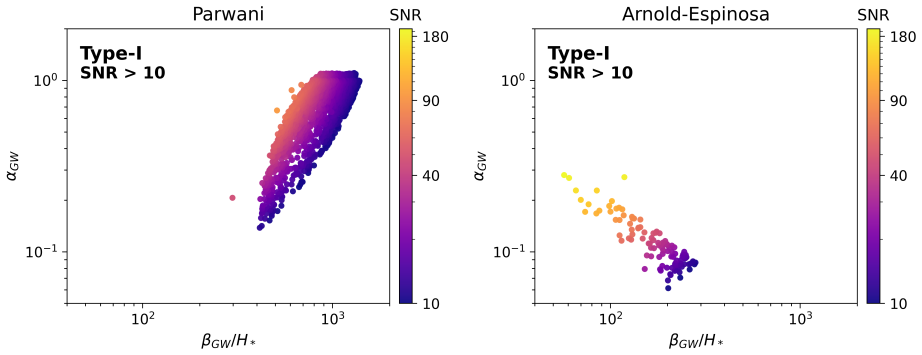
- Sec. II.C and the accompanying BSMPT source-code note: the bubble-wall velocity is fixed by hand to the single benchmark vw = 0.6 for every parameter point. Because Tp, αGW, βGW/H∗ and the resulting SNR all depend on vw, a microphysically different wall velocity could shift or eliminate the reported GW-parameter regions (Table II, Figs. 5, 11–16). While the same fixed-vw protocol is applied to both resummation schemes (so the relative scheme dependence remains robust), the absolute location and size of the LISA-detectable islands are not. A short sensitivity study at one or two additional values of vw (or an explicit statement that the absolute GW yields are benchmark-dependent) would strengthen the claim.
- Sec. II.B and the discussion surrounding Figs. 1–3: the authors correctly note that partial dressing is computationally prohibitive for an 8-million-point scan, yet they adopt Parwani as the “more stable” and “preferred” scheme on the basis of recent partial-dressing comparisons. Because the central claim is the pronounced scheme dependence itself, the paper would benefit from a clearer statement that both schemes remain approximate one-loop treatments and that the absolute mass cut-offs (∼1.6 TeV vs ≲800 GeV) should be regarded as scheme-dependent theoretical uncertainties rather than definitive physical bounds.
minor comments (5)
- Table II: the AE yields for Type-II and Type-Y are extremely small (NSFO = 230 and 278). A brief remark on whether these numbers are statistically stable under a larger scan would help the reader assess the robustness of the “vanishing GW sample” statement.
- Fig. 5 and the surrounding text: the mild positive correlation (Parwani) versus anti-correlation (AE) between αGW and βGW/H∗ is interesting; a short quantitative measure (e.g., Spearman rank) would make the qualitative description more precise.
- Eq. (24) and the discussion of Υ: the short-lifetime regime H∗τsw ≪ 1 is central to the suppression claim; it would be helpful to quote the typical numerical range of H∗τsw itself, not only Υ.
- Appendix A: the condition |v − vtree|T=0 < 1 GeV is sensible, but the precise numerical tolerance is never motivated; a one-sentence justification would improve transparency.
- Throughout: the notation PT(n-step)i is clear once defined, but a short reminder in the captions of Figs. 1–10 would aid readers who consult the figures first.
Circularity Check
No circularity: high-statistics parameter scan of a standard Lagrangian with public finite-temperature code; scheme comparison and GW yields are independent numerical outputs, not tautologies of inputs.
full rationale
The paper performs a global random scan over the six free parameters of the CP-conserving Normal 2HDM (Eq. 6, ranges in Eq. 26), subjects 10^6 points per Yukawa type to theoretical/experimental filters (2HDMC + ScannerS/HiggsTools), then evaluates the one-loop finite-temperature potential (Eq. 9) under two standard daisy-resummation prescriptions (Parwani vs Arnold–Espinosa) inside BSMPT v3.1.8. SFOEWPT points are defined by the conventional order-parameter cut ξ_p > 1 (Eq. 12) and GW points by SNR ≥ 10 (Eq. 25); both are computed outputs, not fitted inputs re-labeled as predictions. The central claim—pronounced scheme dependence of the viable mass range (∼1.6 TeV vs ≲800 GeV) and of N_SFO/N_GW (Table II, Figs. 1–5)—is a direct numerical comparison under identical scan and fixed-v_w = 0.6 protocol; it does not reduce by construction to any input definition or self-citation. Self-citations (e.g., prior Inverted-Scenario study [45]) serve only for contrast and for shared notation; they are not load-bearing uniqueness theorems or ansätze that force the Normal-Scenario results. Fixed v_w is an acknowledged modeling choice, not a circular step. The derivation chain is therefore self-contained against external benchmarks and free of the six circularity patterns.
Axiom & Free-Parameter Ledger
free parameters (5)
- bubble wall velocity vw =
0.6
- SFOEWPT threshold ξ_p =
>1
- LISA SNR threshold =
≥10
- g_* (relativistic d.o.f.) =
110.75
- scan ranges for MH, MA, MH±, |sβ−α|, tβ, m12² =
MH∈[130,2000] GeV etc.
axioms (4)
- domain assumption One-loop finite-temperature effective potential (tree + CW + counterterms + thermal integrals) adequately describes the electroweak phase transition.
- domain assumption Daisy resummation is performed either by the Parwani global-mass replacement or by the Arnold–Espinosa zero-mode dressing.
- domain assumption The physical electroweak vacuum at T=0 is the global minimum and the thermal history must terminate there (v−v_tree < 1 GeV).
- domain assumption Sound-wave contribution dominates the GW spectrum for non-runaway walls and is modeled by the double-broken power law with lifetime factor Υ.
read the original abstract
We present a comprehensive global analysis of strong first-order electroweak phase transitions (SFOEWPTs) and their associated stochastic gravitational-wave (GW) backgrounds within the Normal Scenario of the $CP$-conserving Two-Higgs-Doublet Model (2HDM) with softly broken $Z_2$ symmetry, where the lighter $CP$-even scalar is identified as the observed $125~\text{GeV}$ Higgs boson. Across all four Yukawa structures (Type-I, II, X, and Y), we track the finite-temperature vacuum evolution, transition dynamics, and GW signatures. To quantify the theoretical uncertainty associated with thermal resummation, we perform a detailed comparison between the Parwani and Arnold--Espinosa prescriptions. While both schemes find that single-step paths overwhelmingly dominate successful transitions and consistently favor the Higgs alignment limit, the resulting SFOEWPT parameter space exhibits a pronounced scheme dependence. The Arnold-Espinosa prescription severely restricts the viable parameter space (with upper bounds on the heavy-scalar masses below approximately 800 GeV) and introduces an extreme parametric sensitivity that produces fragmented distributions and irregular voids in the heavy-scalar mass planes. In contrast, the more stable Parwani prescription allows heavy-scalar masses below $\sim 1.6~\text{TeV}$. We further identify highly restricted GW parameter regions capable of yielding a four-year LISA signal-to-noise ratio above 10, while demonstrating that the acoustic GW source is generically short-lived, leading to a substantial suppression of the predicted signal amplitude. Our results highlight the strong complementarity between future space-based GW observations and high-energy collider searches in probing the cosmological viability of the 2HDM.
Figures




Reference graph
Works this paper leans on
-
[1]
The first notable feature is that the SFOEWPT requirement reduces the maximum allowed value of m2 12 by approximately a factor of two
plane for the single-step transition scenario across the four Yukawa types, with the color code of ξp. The first notable feature is that the SFOEWPT requirement reduces the maximum allowed value of m2 12 by approximately a factor of two. The resulting upper bound, m2 12,max ≃ 106 GeV2, is nearly identical across all four Yukawa types and is consistently r...
-
[2]
The color scale denotes the order parameter ξp
plane for the single-step transition scenario across the four 2HDM types under the Parwani resummation scheme. The color scale denotes the order parameter ξp. The subpanels correspond to Type-I (upper left), Type-II (upper right), Type-X (lower left), and Type-Y (lower right). parameter-space distributions. Within the Parwani framework, only the second st...
-
[3]
Planck collaboration, P. A. R. Ade et al., Planck 2015 results. XIII. Cosmological parame- ters, Astron. Astrophys. 594 (2016) A13, [ 1502.01589]
Pith/arXiv arXiv 2015
-
[4]
P. Huet and E. Sather, Electroweak baryogenesis and standard model CP violation , Phys. Rev. D 51 (1995) 379–394, [ hep-ph/9404302]
Pith/arXiv arXiv 1995
-
[5]
K. Kajantie, M. Laine, K. Rummukainen and M. E. Shaposhnikov, Is there a hot electroweak phase transition at mH ≳ mW ?, Phys. Rev. Lett. 77 (1996) 2887–2890, [ hep-ph/9605288]
Pith/arXiv arXiv 1996
-
[6]
A. D. Sakharov, Violation of CP Invariance, C asymmetry, and baryon asymmetry of the universe, Pisma Zh. Eksp. Teor. Fiz. 5 (1967) 32–35
1967
-
[7]
D. J. Weir, Gravitational waves from a first order electroweak phase transition: a brief review, Phil. Trans. Roy. Soc. Lond. A 376 (2018) 20170126, [ 1705.01783]. [Erratum: Phil.Trans.Roy.Soc.Lond.A 381, 20230212 (2023)]
Pith/arXiv arXiv 2018
-
[8]
C. Caprini and D. G. Figueroa, Cosmological backgrounds of gravitational waves , Class. Quant. Grav. 35 (2018) 163001, [ 1801.04268]
Pith/arXiv arXiv 2018
-
[9]
Amaro-Seoane et al., Laser Interferometer Space Antenna , 1702.00786
LISA collaboration, P. Amaro-Seoane et al., Laser Interferometer Space Antenna , 1702.00786. 40
-
[10]
D. Cutting, M. Hindmarsh and D. J. Weir, Gravitational waves from vacuum first-order phase transitions: from the envelope to the lattice , Phys. Rev. D 97 (2018) 123513, [ 1802.05712]
Pith/arXiv arXiv 2018
-
[11]
H.-K. Guo, K. Sinha, D. Vagie and G. White, Phase Transitions in an Expanding Universe: Stochastic Gravitational Waves in Standard and Non-Standard Histories , JCAP 01 (2021) 001, [2007.08537]
Pith/arXiv arXiv 2021
-
[12]
K. Schmitz, New Sensitivity Curves for Gravitational-Wave Signals from Cosmological Phase Transitions, JHEP 01 (2021) 097, [ 2002.04615]
Pith/arXiv arXiv 2021
-
[13]
F. Csikor, Z. Fodor and J. Heitger, Endpoint of the hot electroweak phase transition , Phys. Rev. Lett. 82 (1999) 21–24, [ hep-ph/9809291]
Pith/arXiv arXiv 1999
-
[14]
A. I. Bochkarev, S. V. Kuzmin and M. E. Shaposhnikov, Electroweak baryogenesis and the Higgs boson mass problem , Phys. Lett. B 244 (1990) 275–278
1990
-
[15]
G. C. Dorsch, S. J. Huber and J. M. No, A strong electroweak phase transition in the 2HDM after LHC8, JHEP 10 (2013) 029, [ 1305.6610]
Pith/arXiv arXiv 2013
-
[16]
P. Basler, M. Krause, M. Muhlleitner, J. Wittbrodt and A. Wlotzka, Strong First Order Electroweak Phase Transition in the CP-Conserving 2HDM Revisited , JHEP 02 (2017) 121, [1612.04086]
Pith/arXiv arXiv 2017
-
[17]
K. Fuyuto, W.-S. Hou and E. Senaha, Electroweak baryogenesis driven by extra top Yukawa couplings, Phys. Lett. B 776 (2018) 402–406, [ 1705.05034]
Pith/arXiv arXiv 2018
-
[18]
J. Bernon, L. Bian and Y. Jiang, A new insight into the phase transition in the early Universe with two Higgs doublets , JHEP 05 (2018) 151, [ 1712.08430]
Pith/arXiv arXiv 2018
-
[19]
K. Kainulainen, V. Keus, L. Niemi, K. Rummukainen, T. V. I. Tenkanen and V. Vaskonen, On the validity of perturbative studies of the electroweak phase transition in the Two Higgs Doublet model, JHEP 06 (2019) 075, [ 1904.01329]
Pith/arXiv arXiv 2019
- [20]
-
[21]
D. Land and E. D. Carlson, Two stage phase transition in two Higgs models , Phys. Lett. B 292 (1992) 107–112, [ hep-ph/9208227]
Pith/arXiv arXiv 1992
-
[22]
H. H. Patel and M. J. Ramsey-Musolf, Stepping Into Electroweak Symmetry Breaking: Phase Transitions and Higgs Phenomenology , Phys. Rev. D 88 (2013) 035013, [ 1212.5652]
Pith/arXiv arXiv 2013
-
[23]
S. Inoue, G. Ovanesyan and M. J. Ramsey-Musolf, Two-Step Electroweak Baryogenesis, Phys. Rev. D 93 (2016) 015013, [ 1508.05404]
Pith/arXiv arXiv 2016
-
[24]
N. Blinov, J. Kozaczuk, D. E. Morrissey and C. Tamarit, Electroweak Baryogenesis from Exotic Electroweak Symmetry Breaking, Phys. Rev. D 92 (2015) 035012, [ 1504.05195]
Pith/arXiv arXiv 2015
-
[25]
L. Bian, H.-K. Guo and J. Shu, Gravitational Waves, baryon asymmetry of the universe and electric dipole moment in the CP-violating NMSSM , Chin. Phys. C 42 (2018) 093106, [1704.02488]. [Erratum: Chin.Phys.C 43, 129101 (2019)]
Pith/arXiv arXiv 2018
-
[26]
W. Chao, H.-K. Guo and J. Shu, Gravitational Wave Signals of Electroweak Phase Transition Triggered by Dark Matter, JCAP 09 (2017) 009, [ 1702.02698]. 41
Pith/arXiv arXiv 2017
-
[27]
M. J. Ramsey-Musolf, P. Winslow and G. White, Color Breaking Baryogenesis, Phys. Rev. D 97 (2018) 123509, [ 1708.07511]
Pith/arXiv arXiv 2018
-
[28]
M. Chala, M. Ramos and M. Spannowsky, Gravitational wave and collider probes of a triplet Higgs sector with a low cutoff , Eur. Phys. J. C 79 (2019) 156, [ 1812.01901]
Pith/arXiv arXiv 2019
-
[29]
A. P. Morais and R. Pasechnik, Probing multi-step electroweak phase transition with multi- peaked primordial gravitational waves spectra, JCAP 04 (2020) 036, [ 1910.00717]
Pith/arXiv arXiv 2020
-
[30]
S. Fabian, F. Goertz and Y. Jiang, Dark matter and nature of electroweak phase transition with an inert doublet , JCAP 09 (2021) 011, [ 2012.12847]
Pith/arXiv arXiv 2021
-
[31]
M. Aoki, T. Komatsu and H. Shibuya, Possibility of a multi-step electroweak phase transition in the two-Higgs doublet models , PTEP 2022 (2022) 063B05, [ 2106.03439]
Pith/arXiv arXiv 2022
-
[32]
D. Gon¸ calves, A. Kaladharan and Y. Wu,Electroweak phase transition in the 2HDM: Collider and gravitational wave complementarity , Phys. Rev. D 105 (2022) 095041, [ 2108.05356]
Pith/arXiv arXiv 2022
-
[33]
Z.-g. Si, H.-x. Wang, L. Wang and Y. Zhang, Exploring multi-step electroweak phase transi- tions in the 2HDM+ a, Eur. Phys. J. C 85 (2025) 273, [ 2410.15975]
Pith/arXiv arXiv 2025
-
[34]
G. C. Branco, P. M. Ferreira, L. Lavoura, M. N. Rebelo, M. Sher and J. P. Silva, Theory and phenomenology of two-Higgs-doublet models , Phys. Rept. 516 (2012) 1–102, [ 1106.0034]
Pith/arXiv arXiv 2012
-
[35]
S. L. Glashow and S. Weinberg, Natural Conservation Laws for Neutral Currents, Phys. Rev. D 15 (1977) 1958
1977
-
[36]
E. A. Paschos, Diagonal Neutral Currents, Phys. Rev. D 15 (1977) 1966
1977
-
[37]
J. Haller, A. Hoecker, R. Kogler, K. M¨ onig, T. Peiffer and J. Stelzer, Update of the global electroweak fit and constraints on two-Higgs-doublet models , Eur. Phys. J. C 78 (2018) 675, [1803.01853]
Pith/arXiv arXiv 2018
-
[38]
M. Misiak, A. Rehman and M. Steinhauser, Towards B → Xsγ at the NNLO in QCD without interpolation in m c, JHEP 06 (2020) 175, [ 2002.01548]
Pith/arXiv arXiv 2020
-
[39]
T. Biek¨ otter, D. Fontes, M. M¨ uhlleitner, J. C. Rom˜ ao, R. Santos and J. P. Silva,Impact of new experimental data on the C2HDM: the strong interdependence between LHC Higgs data and the electron EDM , JHEP 05 (2024) 127, [ 2403.02425]
Pith/arXiv arXiv 2024
-
[40]
T. Biek¨ otter and M. O. Olea-Romacho,Benchmarking a fading window: electroweak baryoge- nesis in the C2HDM, LHC constraints after Run 2 and prospects for LISA , JHEP 12 (2025) 040, [2505.09670]
arXiv 2025
-
[41]
ATLAS collaboration, M. Aaboud et al., Search for additional heavy neutral Higgs and gauge bosons in the ditau final state produced in 36 fb −1 of pp collisions at √s = 13 TeV with the ATLAS detector, JHEP 01 (2018) 055, [ 1709.07242]
Pith/arXiv arXiv 2018
-
[42]
S. Kanemura, K. Tsumura and H. Yokoya, Multi-tau-lepton signatures at the LHC in the two Higgs doublet model , Phys. Rev. D 85 (2012) 095001, [ 1111.6089]
Pith/arXiv arXiv 2012
-
[43]
T. Abe, R. Sato and K. Yagyu, Lepton-specific two Higgs doublet model as a solution of muon g − 2 anomaly, JHEP 07 (2015) 064, [ 1504.07059]
Pith/arXiv arXiv 2015
-
[44]
CMS collaboration, A. M. Sirunyan et al., Search for additional neutral MSSM Higgs bosons 42 in the τ τ final state in proton-proton collisions at √s = 13 TeV , JHEP 09 (2018) 007, [1803.06553]
Pith/arXiv arXiv 2018
-
[45]
ATLAS collaboration, G. Aad et al., Search for heavy Higgs bosons decaying into two tau leptons with the ATLAS detector using pp collisions at √s = 13 TeV, Phys. Rev. Lett. 125 (2020) 051801, [ 2002.12223]
Pith/arXiv arXiv 2020
-
[46]
J. Kim, S. Lee, P. Sanyal, J. Song and D. Wang, τ ±νγγ and ℓ±ℓ±γγ /ET X to probe the fermiophobic Higgs boson with high cutoff scales , JHEP 04 (2023) 083, [ 2302.05467]
Pith/arXiv arXiv 2023
-
[47]
S. Lee, D. Kim, J.-H. Cho, J. Kim and J. Song, Multistep strong first-order electroweak phase transitions in the inverted type-I 2HDM: Parameter space, gravitational waves, and collider phenomenology, Phys. Rev. D 112 (2025) 055035, [ 2506.03260]
Pith/arXiv arXiv 2025
-
[48]
R. R. Parwani, Resummation in a hot scalar field theory , Phys. Rev. D 45 (1992) 4695, [hep-ph/9204216]. [Erratum: Phys.Rev.D 48, 5965 (1993)]
Pith/arXiv arXiv 1992
-
[49]
P. B. Arnold and O. Espinosa, The Effective potential and first order phase transitions: Be- yond leading-order, Phys. Rev. D 47 (1993) 3546, [hep-ph/9212235]. [Erratum: Phys.Rev.D 50, 6662 (1994)]
Pith/arXiv arXiv 1993
-
[50]
J. Braathen, S. Heinemeyer, C. P. Boatella and A. Verduras Schaeidt, Complementarity of gravitational wave analyses and di-Higgs production in the exploration of the electroweak phase transition dynamics in the RxSM , JHEP 06 (2026) 035, [ 2510.12569]
Pith/arXiv arXiv 2026
-
[51]
Anisha, F. Arco, S. Di Noi, C. Englert and M. M¨ uhlleitner,Z and Higgs factory implications of two Higgs doublets with first-order phase transitions , JHEP 10 (2025) 179, [2506.18555]
arXiv 2025
-
[52]
C. Branchina, A. Conaci, L. Delle Rose and S. De Curtis, Electroweak phase transition and bubble wall velocity in local thermal equilibrium , Phys. Rev. D 112 (2025) 095008, [2504.21213]
Pith/arXiv arXiv 2025
-
[53]
C. G. Boyd, D. E. Brahm and S. D. H. Hsu, Resummation methods at finite temperature: The Tadpole way, Phys. Rev. D 48 (1993) 4963–4973, [ hep-ph/9304254]
Pith/arXiv arXiv 1993
-
[54]
D. Curtin, P. Meade and H. Ramani, Thermal Resummation and Phase Transitions , Eur. Phys. J. C 78 (2018) 787, [ 1612.00466]
Pith/arXiv arXiv 2018
-
[55]
D. Curtin, J. Roy and G. White, Gravitational waves and tadpole resummation: Efficient and easy convergence of finite temperature QFT, Phys. Rev. D 109 (2024) 116001, [2211.08218]
Pith/arXiv arXiv 2024
-
[56]
H. Bahl, M. Carena, A. Ireland and C. E. M. Wagner, Improved thermal resummation for multi-field potentials, JHEP 09 (2024) 153, [ 2404.12439]
Pith/arXiv arXiv 2024
-
[57]
P. Basler and M. M¨ uhlleitner,BSMPT (Beyond the Standard Model Phase Transitions): A tool for the electroweak phase transition in extended Higgs sectors , Comput. Phys. Commun. 237 (2019) 62–85, [ 1803.02846]
Pith/arXiv arXiv 2019
-
[58]
P. Basler, M. M¨ uhlleitner and J. M¨ uller,BSMPT v2 a tool for the electroweak phase tran- sition and the baryon asymmetry of the universe in extended Higgs Sectors , Comput. Phys. Commun. 269 (2021) 108124, [ 2007.01725]
Pith/arXiv arXiv 2021
-
[59]
P. Basler, L. Biermann, M. M¨ uhlleitner, J. M¨ uller, R. Santos and J. Viana,BSMPT v3 a tool 43 for phase transitions and primordial gravitational waves in extended Higgs sectors , Comput. Phys. Commun. 316 (2025) 109766, [ 2404.19037]
Pith/arXiv arXiv 2025
-
[60]
ATLAS collaboration, G. Aad et al., Observation of a new particle in the search for the Standard Model Higgs boson with the ATLAS detector at the LHC , Phys. Lett. B 716 (2012) 1–29, [1207.7214]
Pith/arXiv arXiv 2012
-
[61]
CMS collaboration, S. Chatrchyan et al., Observation of a New Boson at a Mass of 125 GeV with the CMS Experiment at the LHC , Phys. Lett. B 716 (2012) 30–61, [ 1207.7235]
Pith/arXiv arXiv 2012
-
[62]
P. S. Bhupal Dev and A. Pilaftsis, Maximally Symmetric Two Higgs Doublet Model with Natural Standard Model Alignment, JHEP 12 (2014) 024, [1408.3405]. [Erratum: JHEP 11, 147 (2015)]
Pith/arXiv arXiv 2014
-
[63]
J. R. Espinosa, M. Quiros and F. Zwirner, On the nature of the electroweak phase transition , Phys. Lett. B 314 (1993) 206–216, [ hep-ph/9212248]
Pith/arXiv arXiv 1993
-
[64]
N. Herring, S. Cao and D. Boyanovsky, Is the finite temperature effective potential effective for dynamics?, Phys. Rev. D 111 (2025) 016028, [ 2410.21633]
Pith/arXiv arXiv 2025
-
[65]
J. Chakrabortty and S. Mohanty, One Loop Thermal Effective Action , Nucl. Phys. B 1020 (2025) 117165, [ 2411.14146]
Pith/arXiv arXiv 2025
-
[66]
I. Masina and M. Quiros, An introduction to effective potential methods in field theory , 2501.12713
-
[67]
P. M. Ferreira and B. Swiezewska, One-loop contributions to neutral minima in the inert doublet model, JHEP 04 (2016) 099, [ 1511.02879]
Pith/arXiv arXiv 2016
-
[68]
J. R. Espinosa, M. Quiros and F. Zwirner, On the phase transition in the scalar theory , Phys. Lett. B 291 (1992) 115–124, [ hep-ph/9206227]
Pith/arXiv arXiv 1992
-
[69]
C. L. Wainwright, CosmoTransitions: Computing Cosmological Phase Transition Tempera- tures and Bubble Profiles with Multiple Fields , Comput. Phys. Commun. 183 (2012) 2006– 2013, [1109.4189]
Pith/arXiv arXiv 2012
- [70]
- [71]
-
[72]
P. Athron, C. Bal´ azs, A. Fowlie and Y. Zhang,PhaseTracer: tracing cosmological phases and calculating transition properties, Eur. Phys. J. C 80 (2020) 567, [ 2003.02859]
Pith/arXiv arXiv 2020
-
[73]
P. Athron, C. Balazs, A. Fowlie, L. Morris, W. Searle, Y. Xiao et al., PhaseTracer2: from the effective potential to gravitational waves , Eur. Phys. J. C 85 (2025) 559, [ 2412.04881]
Pith/arXiv arXiv 2025
-
[74]
S. R. Coleman, The Fate of the False Vacuum. 1. Semiclassical Theory , Phys. Rev. D 15 (1977) 2929–2936. [Erratum: Phys.Rev.D 16, 1248 (1977)]
1977
-
[75]
C. G. Callan, Jr. and S. R. Coleman, The Fate of the False Vacuum. 2. First Quantum 44 Corrections, Phys. Rev. D 16 (1977) 1762–1768
1977
-
[76]
A. D. Linde, Decay of the False Vacuum at Finite Temperature , Nucl. Phys. B 216 (1983)
1983
-
[77]
[Erratum: Nucl.Phys.B 223, 544 (1983)]
1983
-
[78]
M. Bardsley, An optimisation based algorithm for finding the nucleation temperature of cos- mological phase transitions, Comput. Phys. Commun. 273 (2022) 108252, [ 2103.01985]
Pith/arXiv arXiv 2022
- [79]
-
[80]
C. Caprini et al., Detecting gravitational waves from cosmological phase transitions with LISA: an update , JCAP 03 (2020) 024, [ 1910.13125]
Pith/arXiv arXiv 2020
discussion (0)
Sign in with ORCID, Apple, or X to comment. Anyone can read and Pith papers without signing in.