Photon radiation induced by rescattering in strong-interacting medium with a magnetic field
Pith reviewed 2026-05-18 06:11 UTC · model grok-4.3
The pith
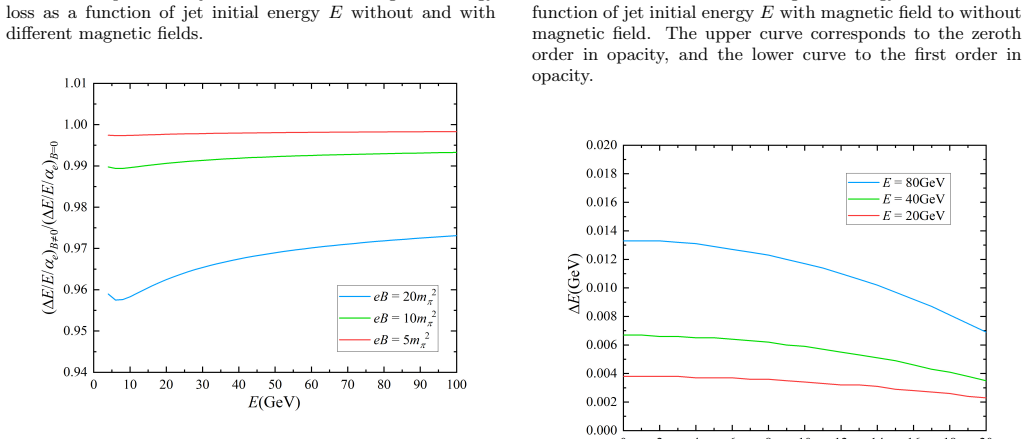
A background magnetic field slightly suppresses photon radiation from quark jet rescattering in the quark-gluon plasma.
A machine-rendered reading of the paper's core claim, the machinery that carries it, and where it could break.
Core claim
Within the high-energy limit the photon emission rate and associated electromagnetic energy loss are obtained for a quark jet propagating through a quark-gluon plasma that carries a background magnetic field. The results exhibit a slight suppression of the overall photon radiation over a broad range of jet energies, which in turn produces a moderate decrease in the electromagnetic energy loss of the jet.
What carries the argument
The single-rescattering process that generates photons when a quark jet interacts with the magnetized medium.
If this is right
- The total number of photons emitted through this rescattering channel is reduced.
- The electromagnetic energy carried away by the jet decreases by a moderate amount.
- The electromagnetic properties of the medium in nucleus-nucleus collisions become better constrained.
- Photon-yield comparisons become a potential diagnostic for media that differ mainly in magnetic-field strength.
Where Pith is reading between the lines
- Photon spectra could serve as an indirect gauge of the magnetic-field strength inside the plasma if other variables are held fixed.
- The same field-induced suppression may appear in related electromagnetic observables such as dilepton production.
- Accounting for this effect could refine the extraction of medium transport properties from jet-quenching data.
Load-bearing premise
The high-energy limit and the treatment of scattering at the lowest relevant order remain valid once the uniform magnetic field is introduced into the medium.
What would settle it
An experimental measurement that finds equal or higher photon yields in collisions producing stronger magnetic fields than in those producing weaker fields would contradict the calculated suppression.
Figures


read the original abstract
The photon radiation induced by rescattering in a magnetized medium is investigated in relativistic heavy-ion collisions. Within the high-energy limit, the photon emission rate and the associated electromagnetic energy loss are derived using the Gyulassy-Levai-Vitev formalism at first order in opacity, for a quark jet propagating a quark-gluon plasma under a background magnetic field. Quantitative analysis shows a slight suppression of the overall photon radiation over a broad range of jet energies in this process. This reduction in photon yield consequently leads to a moderate decrease in the electromagnetic energy loss of the jet. Our results contribute to a better understanding of the electromagnetic properties of strongly interacting matter in high-energy nucleus-nucleus collisions and motivate experimental comparison of photon yields from quark-gluon plasma with similar properties but distinct magnetic field strengths.
Editorial analysis
A structured set of objections, weighed in public.
Referee Report
Summary. The manuscript calculates photon radiation induced by rescattering of a high-energy quark jet propagating through a magnetized quark-gluon plasma. Using the Gyulassy-Levai-Vitev formalism at first order in opacity in the high-energy limit, it derives the photon emission rate and associated electromagnetic energy loss, reporting a slight suppression of the overall photon yield over a broad range of jet energies that leads to a moderate decrease in the jet's electromagnetic energy loss.
Significance. If the derivation holds, the result offers a concrete prediction for how uniform magnetic fields modify jet-induced photon production in heavy-ion collisions, contributing to the understanding of electromagnetic observables in strongly interacting matter. The quantitative suppression finding is falsifiable and could motivate targeted experimental comparisons of photon spectra in systems with varying magnetic field strengths. The adoption of the established GLV approach provides a clear baseline, though the extension to the magnetized case is the load-bearing step.
major comments (2)
- [§2] §2 (Formalism section): The manuscript applies the standard GLV first-order opacity kernel for photon emission but does not re-derive the rescattering matrix elements or formation length from the magnetized quark propagator (Landau levels or cyclotron frequency). The high-energy limit does not automatically guarantee that Lorentz deflection of the quark trajectory remains negligible when the magnetic length competes with the formation length; this omission directly affects the sign and magnitude of the reported suppression.
- [§3] §3 (Results and quantitative analysis): The claimed slight suppression of photon radiation and moderate reduction in electromagnetic energy loss rest on the unmodified GLV kernel with an inserted B-field factor. Without explicit verification that the eikonal straight-line approximation survives the uniform background field, the central quantitative claim cannot be trusted at the reported precision.
minor comments (2)
- Notation for the magnetic field strength and its direction relative to the jet axis should be defined explicitly in the first equation where it appears.
- The abstract states 'quantitative analysis shows a slight suppression'; the corresponding figure or table should include error bands or sensitivity to the magnetic field strength to make the claim precise.
Simulated Author's Rebuttal
We thank the referee for the careful reading and constructive comments on our manuscript. We address the major comments point by point below, providing clarifications on the approximations used and indicating where revisions will be made to strengthen the presentation.
read point-by-point responses
-
Referee: [§2] §2 (Formalism section): The manuscript applies the standard GLV first-order opacity kernel for photon emission but does not re-derive the rescattering matrix elements or formation length from the magnetized quark propagator (Landau levels or cyclotron frequency). The high-energy limit does not automatically guarantee that Lorentz deflection of the quark trajectory remains negligible when the magnetic length competes with the formation length; this omission directly affects the sign and magnitude of the reported suppression.
Authors: We thank the referee for this important point. In the high-energy limit adopted throughout the work, the formation length is parametrically shorter than the magnetic length scale set by the background field, allowing the standard GLV kernel to be used with an effective B-dependent factor arising from the modified quark propagator. We will revise §2 to include an explicit estimate comparing the formation time to the cyclotron period for the magnetic field strengths and jet energies relevant to heavy-ion collisions, thereby justifying the neglect of leading Lorentz deflection to the order considered. revision: partial
-
Referee: [§3] §3 (Results and quantitative analysis): The claimed slight suppression of photon radiation and moderate reduction in electromagnetic energy loss rest on the unmodified GLV kernel with an inserted B-field factor. Without explicit verification that the eikonal straight-line approximation survives the uniform background field, the central quantitative claim cannot be trusted at the reported precision.
Authors: We agree that explicit verification of the eikonal approximation is necessary for the quantitative reliability of the results. The reported suppression follows from the B-modified kernel within the high-energy limit. In the revised manuscript we will add a dedicated paragraph (or short appendix) that quantifies the regime of validity by comparing the relevant length scales, confirming that the straight-line trajectory remains a good approximation over the formation length for the parameter range studied. This addition will directly support the central claim. revision: yes
Circularity Check
No significant circularity; derivation applies external GLV formalism
full rationale
The paper derives photon emission rate and electromagnetic energy loss by applying the Gyulassy-Levai-Vitev formalism at first order in opacity to a quark jet in a magnetized QGP within the high-energy limit. The reported slight suppression of photon yield emerges from this calculation rather than reducing to a self-definition, a fitted parameter renamed as prediction, or a load-bearing self-citation chain. No equations or steps in the abstract or description indicate that the result is presupposed in the inputs by construction; the formalism is an established external reference and the magnetic field enters as a background modification. The derivation is therefore self-contained against external benchmarks.
Axiom & Free-Parameter Ledger
axioms (1)
- domain assumption High-energy limit and first-order opacity expansion of the Gyulassy-Levai-Vitev formalism remain applicable for quark jets in magnetized QGP.
Lean theorems connected to this paper
-
IndisputableMonolith/Foundation/AbsoluteFloorClosure.leanreality_from_one_distinction unclear?
unclearRelation between the paper passage and the cited Recognition theorem.
Within the high-energy limit, the photon emission rate and the associated electromagnetic energy loss are derived using the Gyulassy-Levai-Vitev formalism at first order in opacity, for a quark jet propagating a quark-gluon plasma under a background magnetic field.
-
IndisputableMonolith/Foundation/AlexanderDuality.leanalexander_duality_circle_linking unclear?
unclearRelation between the paper passage and the cited Recognition theorem.
iΔ(p) = i/(p²-m²) [1 - (qB)²/(p²-m²)² - 2(qB)² p⊥²/(p²-m²)³]
What do these tags mean?
- matches
- The paper's claim is directly supported by a theorem in the formal canon.
- supports
- The theorem supports part of the paper's argument, but the paper may add assumptions or extra steps.
- extends
- The paper goes beyond the formal theorem; the theorem is a base layer rather than the whole result.
- uses
- The paper appears to rely on the theorem as machinery.
- contradicts
- The paper's claim conflicts with a theorem or certificate in the canon.
- unclear
- Pith found a possible connection, but the passage is too broad, indirect, or ambiguous to say the theorem truly supports the claim.
Reference graph
Works this paper leans on
- [1]
-
[2]
does not con- tribute to the result due to TrT a(j) = 0. A. Spontaneous emission photon of the hard jet A wave packetJ(p) localized atx 0 = (t0,x 0) is used to describe the hard parton jet with momentumpproduced in the plasma. The jet will interact with target partons by exchange gluons and subsequently radiates a photon. The initial and final jet momenta...
-
[3]
=−4g 2 e(1−x) 2 H 2 +x 2H·H B −cos[ω 0(z−z 0)] x2H·H B + 2x2(1−x) 2H·H B . (B5) 13 Finally, we obtain the expression in first order in opacity, Tr |M1|2 + 2Re(M2M∗ 0) =d RdT |J(p)| 2 L λ Z µ2d2q⊥ π(q 2 ⊥ +µ 2)2 Z dz0dzρ(z0, z) |R1|2 + 2Re(R2R∗ 0) = 4g2 e dRdT |J(p)| 2(1−x) 2 L λ Z d2q⊥|¯v(0,q⊥)|2 Z dz0dzρ(z0, z) × (H−C 1)2 +x 2(3 + 4(1−x) 2)H·H B + 2x2(1−...
-
[4]
D. J. Gross, R. D. Pisarski, and L. G. Yaffe, QCD and Instantons at Finite Temperature, Rev. Mod. Phys.53, 43 (1981)
work page 1981
-
[5]
M. Gyulassy and M. Plumer, Jet Quenching in Dense Matter, Phys. Lett. B243, 432 (1990)
work page 1990
-
[6]
New Forms of QCD Matter Discovered at RHIC
M. Gyulassy and L. McLerran, New forms of QCD mat- ter discovered at RHIC, Nucl. Phys. A750, 30 (2005), arXiv:nucl-th/0405013
work page internal anchor Pith review Pith/arXiv arXiv 2005
-
[7]
E. V. Shuryak, What RHIC experiments and theory tell us about properties of quark-gluon plasma?, Nucl. Phys. A750, 64 (2005), arXiv:hep-ph/0405066
work page internal anchor Pith review Pith/arXiv arXiv 2005
-
[8]
I. Arseneet al.(BRAHMS), Quark gluon plasma and color glass condensate at RHIC? The Perspective from the BRAHMS experiment, Nucl. Phys. A757, 1 (2005), arXiv:nucl-ex/0410020
-
[9]
Properties of hot and dense matter from relativistic heavy ion collisions
P. Braun-Munzinger, V. Koch, T. Sch¨ afer, and J. Stachel, Properties of hot and dense matter from relativis- tic heavy ion collisions, Phys. Rept.621, 76 (2016), arXiv:1510.00442 [nucl-th]
work page internal anchor Pith review Pith/arXiv arXiv 2016
-
[10]
J. Alam, B. Sinha, and S. Raha, Electromagnetic probes of quark gluon plasma, Phys. Rept.273, 243 (1996)
work page 1996
-
[11]
W. Cassing and E. L. Bratkovskaya, Hadronic and elec- tromagnetic probes of hot and dense nuclear matter, Phys. Rept.308, 65 (1999)
work page 1999
-
[12]
O. Linnyk, E. L. Bratkovskaya, and W. Cassing, Ef- fective QCD and transport description of dilepton and photon production in heavy-ion collisions and elemen- tary processes, Prog. Part. Nucl. Phys.87, 50 (2016), arXiv:1512.08126 [nucl-th]
work page internal anchor Pith review Pith/arXiv arXiv 2016
-
[13]
Dilepton production in proton-proton and Pb+Pb collisions at sqrt(s_NN)=2.76 TeV
O. Linnyk, W. Cassing, J. Manninen, E. L. Bratkovskaya, P. B. Gossiaux, J. Aichelin, T. Song, and C. M. Ko, Dilep- ton production in proton-proton and Pb+Pb collisions at √sN N = 2.76 TeV, Phys. Rev. C87, 014905 (2013), arXiv:1208.1279 [nucl-th]
work page internal anchor Pith review Pith/arXiv arXiv 2013
- [14]
-
[15]
A. Adareet al.(PHENIX), Detailed measurement of thee +e− pair continuum inp+pand Au+Au colli- sions at √sN N = 200 GeV and implications for direct photon production, Phys. Rev. C81, 034911 (2010), arXiv:0912.0244 [nucl-ex]
work page internal anchor Pith review Pith/arXiv arXiv 2010
- [16]
-
[17]
David, Direct real photons in relativistic heavy ion collisions, Rept
G. David, Direct real photons in relativistic heavy ion collisions, Rept. Prog. Phys.83, 046301 (2020), arXiv:1907.08893 [nucl-ex]
-
[18]
C. Gale, S. Jeon, S. McDonald, J.-F. Paquet, and C. Shen, Photon radiation from heavy-ion collisions in the √sN N = 19−200 GeV regime, Nucl. Phys. A982, 767 (2019), arXiv:1807.09326 [nucl-th]
work page internal anchor Pith review Pith/arXiv arXiv 2019
- [19]
-
[20]
Electromagnetic radiation from nuclear collisions at RHIC energies
S. Turbide, C. Gale, E. Frodermann, and U. Heinz, Elec- tromagnetic radiation from nuclear collisions at RHIC en- ergies, Phys. Rev. C77, 024909 (2008), arXiv:0712.0732 [hep-ph]
work page internal anchor Pith review Pith/arXiv arXiv 2008
-
[21]
Hadronic and partonic sources of direct photons in relativistic heavy-ion collisions
O. Linnyk, V. Konchakovski, T. Steinert, W. Cassing, and E. L. Bratkovskaya, Hadronic and partonic sources of direct photons in relativistic heavy-ion collisions, Phys. Rev. C92, 054914 (2015), arXiv:1504.05699 [nucl-th]
work page internal anchor Pith review Pith/arXiv arXiv 2015
- [22]
-
[23]
Buesching (PHENIX), Highlights from the PHENIX experiment: Part 2, Nucl
H. Buesching (PHENIX), Highlights from the PHENIX experiment: Part 2, Nucl. Phys. A774, 103 (2006), arXiv:nucl-ex/0511044
-
[24]
T. Isobe (PHENIX), Systematic study of high-p(T) di- rect photon production with the PHENIX experiment at RHIC, J. Phys. G34, S1015 (2007), arXiv:nucl- ex/0701040
- [25]
-
[26]
A. Adareet al.(PHENIX), Enhanced production of di- rect photons in Au+Au collisions at √sN N = 200 GeV and implications for the initial temperature, Phys. Rev. Lett.104, 132301 (2010), arXiv:0804.4168 [nucl-ex]
work page internal anchor Pith review Pith/arXiv arXiv 2010
-
[27]
A. Adareet al.(PHENIX), Centrality dependence of low-momentum direct-photon production in Au+Au col- lisions at √sN N = 200 GeV, Phys. Rev. C91, 064904 (2015), arXiv:1405.3940 [nucl-ex]
-
[28]
S. Turbide, C. Gale, and R. J. Fries, Azimuthal Asym- 14 metry of Direct Photons in High Energy Nuclear Col- lisions, Phys. Rev. Lett.96, 032303 (2006), arXiv:hep- ph/0508201
-
[29]
Electromagnetic Radiation from QCD Matter: Theory Overview
C. Shen, Electromagnetic Radiation from QCD Mat- ter: Theory Overview, Nucl. Phys. A956, 184 (2016), arXiv:1601.02563 [nucl-th]
work page internal anchor Pith review Pith/arXiv arXiv 2016
-
[30]
Jet quenching in high-energy heavy-ion collisions
G.-Y. Qin and X.-N. Wang, Jet quenching in high-energy heavy-ion collisions, Int. J. Mod. Phys. E24, 1530014 (2015), arXiv:1511.00790 [hep-ph]
work page internal anchor Pith review Pith/arXiv arXiv 2015
-
[31]
X.-N. Wang and M. Gyulassy, Gluon shadowing and jet quenching in A + A collisions at s**(1/2) = 200-GeV, Phys. Rev. Lett.68, 1480 (1992)
work page 1992
- [32]
- [33]
-
[34]
B. G. Zakharov, Induced photon emission from quark jets in ultrarelativistic heavy-ion collisions, JETP Lett.80, 1 (2004), arXiv:hep-ph/0405101
work page internal anchor Pith review Pith/arXiv arXiv 2004
-
[35]
Photon Radiation and Dilepton Production Induced by Rescattering in Strong Interacting Medium
H.-Z. Zhang, Z.-B. Kang, B.-W. Zhang, and E. Wang, Photon Radiation and Dilepton Production Induced by Rescattering in Strong Interacting Medium, Eur. Phys. J. C67, 445 (2010), arXiv:hep-ph/0609159
work page internal anchor Pith review Pith/arXiv arXiv 2010
-
[36]
L. Zhang, D.-F. Hou, and G.-Y. Qin, Photon bremsstrahlung from quark jet via transverse and lon- gitudinal scattering: Single versus multiple scattering, Phys. Rev. C94, 024916 (2016), arXiv:1603.04679 [hep- ph]
work page internal anchor Pith review Pith/arXiv arXiv 2016
-
[37]
K. Hattori, K. Itakura, and S. Ozaki, Strong-field physics in QED and QCD: From fundamentals to ap- plications, Prog. Part. Nucl. Phys.133, 104068 (2023), arXiv:2305.03865 [hep-ph]
-
[38]
I. Siddique, A. Huang, M. Huang, and M. A. Wasaye, Dynamical electromagnetic fields and dynamical elec- tromagnetic anomaly in heavy ion collisions at inter- mediate energies, Phys. Rev. C112, 014906 (2025), arXiv:2501.11328 [nucl-th]
-
[39]
D. Shen, J. Chen, X.-G. Huang, Y.-G. Ma, A. Tang, and G. Wang, A Review of Intense Electromagnetic Fields in Heavy-Ion Collisions: Theoretical Predictions and Ex- perimental Results, Research8, 0726 (2025)
work page 2025
-
[40]
D. E. Kharzeev, L. D. McLerran, and H. J. Warringa, The Effects of topological charge change in heavy ion collisions: ’Event by event P and CP violation’, Nucl. Phys. A803, 227 (2008), arXiv:0711.0950 [hep-ph]
work page internal anchor Pith review Pith/arXiv arXiv 2008
-
[41]
Estimate of the magnetic field strength in heavy-ion collisions
V. Skokov, A. Y. Illarionov, and V. Toneev, Estimate of the magnetic field strength in heavy-ion collisions, Int. J. Mod. Phys. A24, 5925 (2009), arXiv:0907.1396 [nucl-th]
work page internal anchor Pith review Pith/arXiv arXiv 2009
-
[42]
Electromagnetic field evolution in relativistic heavy-ion collisions
V. Voronyuk, V. D. Toneev, W. Cassing, E. L. Bratkovskaya, V. P. Konchakovski, and S. A. Voloshin, (Electro-)Magnetic field evolution in relativistic heavy- ion collisions, Phys. Rev. C83, 054911 (2011), arXiv:1103.4239 [nucl-th]
work page internal anchor Pith review Pith/arXiv arXiv 2011
-
[43]
Event-by-event generation of electromagnetic fields in heavy-ion collisions
W.-T. Deng and X.-G. Huang, Event-by-event generation of electromagnetic fields in heavy-ion collisions, Phys. Rev. C85, 044907 (2012), arXiv:1201.5108 [nucl-th]
work page internal anchor Pith review Pith/arXiv arXiv 2012
-
[44]
Particle production in strong electromagnetic fields in relativistic heavy-ion collisions
K. Tuchin, Particle production in strong electromagnetic fields in relativistic heavy-ion collisions, Adv. High En- ergy Phys.2013, 490495 (2013), arXiv:1301.0099 [hep- ph]
work page internal anchor Pith review Pith/arXiv arXiv 2013
-
[45]
Time and space dependence of electromagnetic field in relativistic heavy-ion collisions
K. Tuchin, Time and space dependence of the electro- magnetic field in relativistic heavy-ion collisions, Phys. Rev. C88, 024911 (2013), arXiv:1305.5806 [hep-ph]
work page internal anchor Pith review Pith/arXiv arXiv 2013
-
[46]
Comments About the Electromagnetic Field in Heavy-Ion Collisions
L. McLerran and V. Skokov, Comments About the Elec- tromagnetic Field in Heavy-Ion Collisions, Nucl. Phys. A 929, 184 (2014), arXiv:1305.0774 [hep-ph]
work page internal anchor Pith review Pith/arXiv arXiv 2014
-
[47]
Electromagnetic fields with electric and chiral magnetic conductivities in heavy ion collisions
H. Li, X.-L. Sheng, and Q. Wang, Electromagnetic fields with electric and chiral magnetic conductivities in heavy ion collisions, Phys. Rev. C94, 044903 (2016), arXiv:1602.02223 [nucl-th]
work page internal anchor Pith review Pith/arXiv arXiv 2016
-
[48]
S. S. Avancini, D. P. Menezes, and C. Providencia, Finite temperature quark matter under strong magnetic fields, Phys. Rev. C83, 065805 (2011)
work page 2011
-
[49]
H.-X. Zhang, K.-M. Shen, Y.-X. Xiao, and B.-W. Zhang, Impact of the magnetothermoelectric effect on the diffu- sion of conserved charges in hot and dense hadronic mat- ter, Phys. Rev. D110, 034023 (2024), arXiv:2403.02705 [nucl-th]
-
[50]
Multiple Collisions and Induced Gluon Bremsstrahlung in QCD
M. Gyulassy and X.-N. Wang, Multiple collisions and induced gluon Bremsstrahlung in QCD, Nucl. Phys. B 420, 583 (1994), arXiv:nucl-th/9306003
work page internal anchor Pith review Pith/arXiv arXiv 1994
-
[51]
Jet Quenching in Thin Quark-Gluon Plasmas I: Formalism
M. Gyulassy, P. Levai, and I. Vitev, Jet quenching in thin quark gluon plasmas. 1. Formalism, Nucl. Phys. B571, 197 (2000), arXiv:hep-ph/9907461
work page internal anchor Pith review Pith/arXiv arXiv 2000
-
[52]
Non-Abelian Energy Loss at Finite Opacity
M. Gyulassy, P. Levai, and I. Vitev, NonAbelian energy loss at finite opacity, Phys. Rev. Lett.85, 5535 (2000), arXiv:nucl-th/0005032
work page internal anchor Pith review Pith/arXiv arXiv 2000
-
[53]
Reaction Operator Approach to Non-Abelian Energy Loss
M. Gyulassy, P. Levai, and I. Vitev, Reaction operator approach to nonAbelian energy loss, Nucl. Phys. B594, 371 (2001), arXiv:nucl-th/0006010
work page internal anchor Pith review Pith/arXiv arXiv 2001
-
[54]
The weak-field expansion for processes in a homogeneous background magnetic field
T.-K. Chyi, C.-W. Hwang, W. F. Kao, G.-L. Lin, K.- W. Ng, and J.-J. Tseng, The weak field expansion for processes in a homogeneous background magnetic field, Phys. Rev. D62, 105014 (2000), arXiv:hep-th/9912134
work page internal anchor Pith review Pith/arXiv arXiv 2000
-
[55]
J. S. Schwinger, On gauge invariance and vacuum polar- ization, Phys. Rev.82, 664 (1951)
work page 1951
-
[56]
A. Ayala, A. Sanchez, G. Piccinelli, and S. Sahu, Effective potential at finite temperature in a constant magnetic field. I. Ring diagrams in a scalar theory, Phys. Rev. D 71, 023004 (2005), arXiv:hep-ph/0412135
work page internal anchor Pith review Pith/arXiv arXiv 2005
-
[57]
Dynamical mass generation in strongly coupled Quantum Electrodynamics with weak magnetic fields
A. Ayala, A. Bashir, A. Raya, and E. Rojas, Dynam- ical mass generation in strongly coupled quantum elec- trodynamics with weak magnetic fields, Phys. Rev. D73, 105009 (2006), arXiv:hep-ph/0602209
work page internal anchor Pith review Pith/arXiv arXiv 2006
-
[58]
E. Braaten and R. D. Pisarski, Soft Amplitudes in Hot Gauge Theories: A General Analysis, Nucl. Phys. B337, 569 (1990)
work page 1990
- [59]
-
[60]
Heavy Quark Radiative Energy Loss in QCD Matter
M. Djordjevic and M. Gyulassy, Heavy quark radiative energy loss in QCD matter, Nucl. Phys. A733, 265 (2004), arXiv:nucl-th/0310076
work page internal anchor Pith review Pith/arXiv arXiv 2004
-
[61]
Parton Energy Loss with Detailed Balance
E. Wang and X.-N. Wang, Parton energy loss with detailed balance, Phys. Rev. Lett.87, 142301 (2001), arXiv:nucl-th/0106043
work page internal anchor Pith review Pith/arXiv arXiv 2001
- [62]
discussion (0)
Sign in with ORCID, Apple, or X to comment. Anyone can read and Pith papers without signing in.