RADRON: Cooperative Localization of Ionizing Radiation Sources by MAVs with Compton Cameras
Pith reviewed 2026-05-21 19:05 UTC · model grok-4.3
The pith
Cooperating MAVs with lightweight Compton cameras fuse sparse directional data to locate and track radiation sources in real time.
A machine-rendered reading of the paper's core claim, the machinery that carries it, and where it could break.
Core claim
By fusing Compton camera measurements from a tightly cooperating swarm of MAVs, the position of an ionizing radiation source can be estimated in real time even from extremely sparse data, with all readout, processing, and motion feedback performed onboard to drive the vehicles toward maximal information gain.
What carries the argument
Fusion of directional measurements from single-detector Compton cameras across a coordinated MAV swarm, used for real-time source position estimation and dynamic feedback control of the vehicles.
If this is right
- Localization succeeds with far fewer measurements than traditional approaches require.
- The swarm can maintain continuous tracking of a moving source through ongoing motion adjustments.
- All computation stays onboard, removing the need for external data links or ground stations during operation.
- Cooperation among vehicles directly increases the rate at which useful directional data is collected.
Where Pith is reading between the lines
- The same fusion idea could apply to other directional sensors on mobile platforms for cooperative search tasks.
- In search-and-rescue or nuclear incident response, such lightweight swarms might reduce the time and equipment needed compared with heavier ground-based detectors.
- Testing the approach with varying swarm sizes would show how many vehicles are required before information gain saturates.
Load-bearing premise
A single lightweight Compton camera supplies accurate enough directional information from very few readings to support reliable real-time position estimates and swarm control without extra sensors or prior maps.
What would settle it
Field trials with a known moving radiation source where the swarm's fused position estimates fail to converge within a few meters of the true location or lose track after a small number of measurements.
Figures
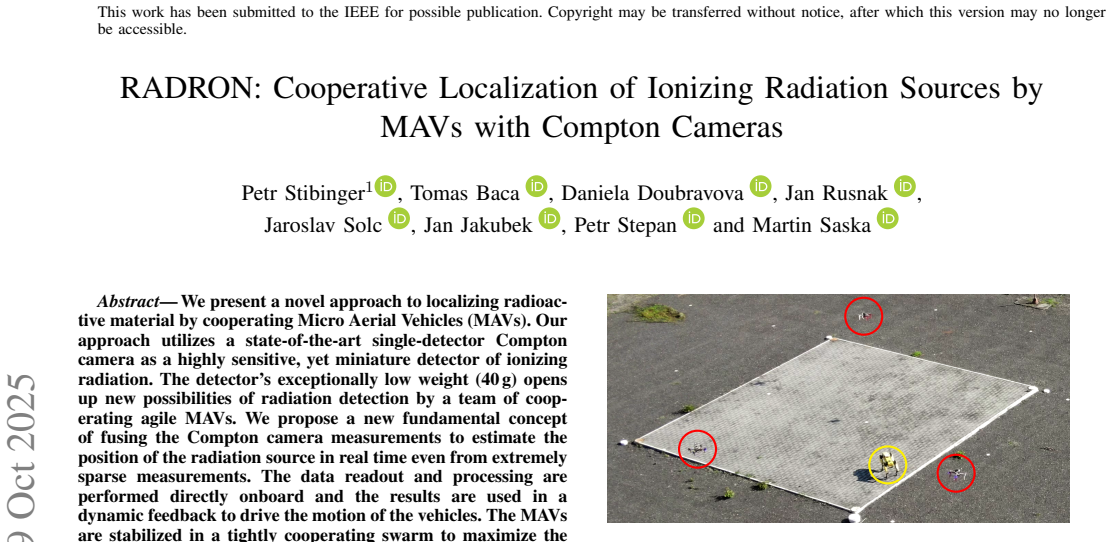


read the original abstract
We present a novel approach to localizing radioactive material by cooperating Micro Aerial Vehicles (MAVs). Our approach utilizes a state-of-the-art single-detector Compton camera as a highly sensitive, yet miniature detector of ionizing radiation. The detector's exceptionally low weight (40 g) opens up new possibilities of radiation detection by a team of cooperating agile MAVs. We propose a new fundamental concept of fusing the Compton camera measurements to estimate the position of the radiation source in real time even from extremely sparse measurements. The data readout and processing are performed directly onboard and the results are used in a dynamic feedback to drive the motion of the vehicles. The MAVs are stabilized in a tightly cooperating swarm to maximize the information gained by the Compton cameras, rapidly locate the radiation source, and even track a moving radiation source.
Editorial analysis
A structured set of objections, weighed in public.
Referee Report
Summary. The manuscript presents RADRON, a cooperative localization system in which a swarm of MAVs equipped with 40 g single-detector Compton cameras fuses directional measurements to estimate the 3-D position of an ionizing radiation source in real time. The central claim is that this fusion supports reliable onboard position estimation and dynamic swarm feedback control even from extremely sparse event counts, enabling rapid localization and tracking of both static and moving sources without prior maps or additional sensors.
Significance. If the claimed performance with sparse Compton-cone data is substantiated, the work would demonstrate a practical advance in miniature radiation sensing on agile platforms, opening applications in nuclear-site inspection and emergency response where weight and real-time onboard computation are constraints.
major comments (2)
- [§3, §4] §3 (Measurement Model) and §4 (Fusion Algorithm): the directional information from each Compton event is modeled as a cone whose angular uncertainty is not propagated through the fusion step or the swarm controller. With typical single-detector angular resolutions of tens of degrees, the posterior after the reported number of sparse measurements may remain multi-modal or too diffuse to support stable real-time feedback; no Monte-Carlo study or covariance analysis of this effect is provided.
- [§5] §5 (Experimental Validation): the reported localization errors and tracking results are presented without an ablation on measurement sparsity or an explicit comparison against the cone-uncertainty bound derived from the detector specifications. It is therefore unclear whether the observed performance actually relies on the claimed “extremely sparse” regime or on denser data sets.
minor comments (2)
- [§3] Notation for the Compton-cone parametrization is introduced without a clear diagram relating the cone axis, opening angle, and measurement covariance.
- [Figures 4–6] Figure captions for the swarm trajectories do not state the number of Compton events used in each trial or the corresponding angular-resolution assumption.
Simulated Author's Rebuttal
We thank the referee for the constructive and detailed feedback on our manuscript describing RADRON, a cooperative MAV swarm system for real-time localization of ionizing radiation sources using miniature Compton cameras. The comments highlight important aspects of uncertainty handling and experimental validation that we will address to strengthen the paper. We respond to each major comment below.
read point-by-point responses
-
Referee: [§3, §4] §3 (Measurement Model) and §4 (Fusion Algorithm): the directional information from each Compton event is modeled as a cone whose angular uncertainty is not propagated through the fusion step or the swarm controller. With typical single-detector angular resolutions of tens of degrees, the posterior after the reported number of sparse measurements may remain multi-modal or too diffuse to support stable real-time feedback; no Monte-Carlo study or covariance analysis of this effect is provided.
Authors: We agree that a more explicit treatment of angular uncertainty propagation is valuable for substantiating claims about stable real-time feedback from sparse Compton-cone data. Our fusion approach models each event as a probabilistic cone whose width reflects the detector's angular resolution, and the particle-filter-based estimator maintains a multi-hypothesis representation to handle potential multimodality. However, we acknowledge that the current manuscript does not include a dedicated covariance propagation analysis or Monte-Carlo study quantifying posterior spread under realistic 20–40° resolutions. In the revision we will add this analysis to §4, including Monte-Carlo trials that illustrate posterior convergence and controller stability as a function of event count and cone opening angle. revision: yes
-
Referee: [§5] §5 (Experimental Validation): the reported localization errors and tracking results are presented without an ablation on measurement sparsity or an explicit comparison against the cone-uncertainty bound derived from the detector specifications. It is therefore unclear whether the observed performance actually relies on the claimed “extremely sparse” regime or on denser data sets.
Authors: The referee is correct that an explicit ablation on sparsity and a direct comparison to the theoretical uncertainty bound would clarify the operating regime. Our reported experiments already include trials with very low event rates (down to a few events per second) to demonstrate the sparse regime, yet we did not systematically vary measurement density or overlay the Cramér–Rao-type bound implied by the detector’s angular resolution. We will revise §5 to add an ablation study showing localization and tracking error versus cumulative event count, together with a comparison against the expected cone-uncertainty bound computed from the 40 g Compton camera specifications. revision: yes
Circularity Check
No circularity: claims rest on external sensor fusion without self-referential reductions
full rationale
The paper presents a proposal for cooperative MAV localization of radiation sources using single-detector Compton cameras. The abstract and available text describe a fusion concept for real-time position estimation from sparse measurements and swarm control, but contain no equations, fitted parameters, or derivation steps that reduce by construction to author-defined inputs. No self-citations, uniqueness theorems, or ansatzes are invoked in a load-bearing way within the provided content. The central premise relies on the physical properties of the Compton camera and standard sensor-fusion ideas, which are treated as independent of the paper's own outputs. This is the expected honest non-finding for a high-level systems paper without visible mathematical reductions.
Axiom & Free-Parameter Ledger
Lean theorems connected to this paper
-
IndisputableMonolith/Foundation/RealityFromDistinction.leanreality_from_one_distinction unclear?
unclearRelation between the paper passage and the cited Recognition theorem.
We extend the Compton data fusion method from [24] to the multi-robot domain and introduce a novel control law that uses distributed radiation measurements processed in real time to dynamically drive the motion of the swarm.
-
IndisputableMonolith/Foundation/Cost.leanJcost_pos_of_ne_one unclear?
unclearRelation between the paper passage and the cited Recognition theorem.
The approach relies on event-based processing of individual Compton scattering occurrences while the MAV is moving through the environment at high speed.
What do these tags mean?
- matches
- The paper's claim is directly supported by a theorem in the formal canon.
- supports
- The theorem supports part of the paper's argument, but the paper may add assumptions or extra steps.
- extends
- The paper goes beyond the formal theorem; the theorem is a base layer rather than the whole result.
- uses
- The paper appears to rely on the theorem as machinery.
- contradicts
- The paper's claim conflicts with a theorem or certificate in the canon.
- unclear
- Pith found a possible connection, but the passage is too broad, indirect, or ambiguous to say the theorem truly supports the claim.
Reference graph
Works this paper leans on
-
[1]
Y . Sanada and T. Torii, “Aerial radiation monitoring around the fukushima dai-ichi nuclear power plant using an unmanned helicopter,” Journal of environmental radioactivity, vol. 139, pp. 294–299, 2015
work page 2015
-
[2]
J. Jianget al., “A prototype of aerial radiation monitoring system using an unmanned helicopter mounting a gagg scintillator compton camera,”Journal of Nuclear Science and Technology, vol. 53, no. 7, pp. 1067–1075, 2016
work page 2016
-
[3]
Radiation source localization in gps-denied environments using aerial robots,
F. Mascarich, T. Wilson, C. Papachristos, and K. Alexis, “Radiation source localization in gps-denied environments using aerial robots,” in IEEE ICRA, 2018
work page 2018
-
[4]
A quantum theory of the scattering of x-rays by light elements,
A. H. Compton, “A quantum theory of the scattering of x-rays by light elements,”Physical review, vol. 21, no. 5, p. 483, 1923
work page 1923
-
[5]
Development and applications of compton camera—a review,
R. K. Parajuli, M. Sakai, R. Parajuli, and M. Tashiro, “Development and applications of compton camera—a review,”Sensors, vol. 22, no. 19, p. 7374, 2022
work page 2022
-
[6]
Y . Sato, Y . Tanifuji, Y . Terasaka, H. Usami, M. Kaburagi, K. Kawabata, W. Utsugi, H. Kikuchi, S. Takahira, and T. Torii, “Radiation imaging using a compact compton camera inside the fukushima daiichi nuclear power station building,”Journal of Nuclear Science and Technology, vol. 55, no. 9, pp. 965–970, 2018
work page 2018
-
[7]
Y . Sato, Y . Terasaka, W. Utsugi,et al., “Radiation imaging using a compact Compton camera mounted on a crawler robot inside reactor buildings of Fukushima Daiichi Nuclear Power Station,”Journal of Nuclear Science and Technology, vol. 56, no. 9-10, pp. 801–808, 2019
work page 2019
-
[8]
Development of semiconductor imaging detectors for a si/cdte comp- ton camera,
S. Watanabe, S. Takeda, S.-n. Ishikawa, H. Odaka, M. Ushio, T. Tanaka, K. Nakazawa, T. Takahashi, H. Tajima, Y . Fukazawa,et al., “Development of semiconductor imaging detectors for a si/cdte comp- ton camera,”Nuclear Instruments and Methods in Physics Research Section A: Accelerators, Spectrometers, Detectors and Associated Equipment, vol. 579, no. 2, pp...
work page 2007
-
[9]
Compton camera based on timepix3 technology,
D. Turecek, J. Jakubek, E. Trojanova, and L. Sefc, “Compton camera based on timepix3 technology,”Journal of Instrumentation, vol. 13, no. 11, p. C11022, 2018
work page 2018
-
[10]
Radiation mapping in post-disaster environments using an autonomous helicopter,
J. Towler, B. Krawiec, and K. Kochersberger, “Radiation mapping in post-disaster environments using an autonomous helicopter,”Remote Sensing, vol. 4, no. 7, pp. 1995–2015, 2012
work page 1995
-
[11]
Radiation search operations using scene understand- ing with autonomous uav and ugv,
G. Christie, A. Shoemaker, K. Kochersberger, P. Tokekar, L. McLean, and A. Leonessa, “Radiation search operations using scene understand- ing with autonomous uav and ugv,”Journal of Field Robotics, vol. 34, no. 8, pp. 1450–1468, 2017
work page 2017
-
[12]
The use of unmanned aerial systems for the mapping of legacy uranium mines,
P. Martin, O. Payton, J. Fardoulis,et al., “The use of unmanned aerial systems for the mapping of legacy uranium mines,”Journal of environmental radioactivity, vol. 143, pp. 135–140, 2015
work page 2015
-
[13]
Mapping of radiation anoma- lies using UA V mini-airborne gamma-ray spectrometry,
O. Salek, M. Matolin, and L. Gryc, “Mapping of radiation anoma- lies using UA V mini-airborne gamma-ray spectrometry,”Journal of environmental radioactivity, vol. 182, pp. 101–107, 2018
work page 2018
-
[14]
Source identification of uranium-containing materials at mine legacy sites in Portugal,
A. Keatley, P. Martin, K. Hallam, O. Payton, R. Awbery, F. Carvalho, J. Oliveira, L. Silva, M. Malta, and T. Scott, “Source identification of uranium-containing materials at mine legacy sites in Portugal,”Journal of Environmental Radioactivity, vol. 183, pp. 102–111, 2018
work page 2018
-
[15]
C. Kunze, B. Preugschat, R. Arndt, F. Kandzia, B. Wiens, and S. Alt- felder, “Development of a uav-based gamma spectrometry system for natural radionuclides and field tests at central asian uranium legacy sites,”Remote Sensing, vol. 14, no. 9, p. 2147, 2022
work page 2022
-
[16]
T. Baca, M. Petrlik, M. Vrba, V . Spurny, R. Penicka, D. Hert, and M. Saska, “The mrs uav system: Pushing the frontiers of reproducible research, real-world deployment, and education with autonomous unmanned aerial vehicles,”Journal of Intelligent & Robotic Systems, vol. 102, no. 1, pp. 1–28, 2021
work page 2021
-
[17]
Darpa subterranean challenge: Multi-robotic exploration of underground environments,
T. Rou ˇcek, M. Pecka, P. ˇC´ıˇzek, T. Pet ˇr´ıˇcek, J. Bayer, V . ˇSalansk´y, D. He ˇrt, M. Petrl ´ık, T. B´aˇca, V . Spurn´y,et al., “Darpa subterranean challenge: Multi-robotic exploration of underground environments,” inInternational Conference on Modelling and Simulation for Au- tonomous Systems. Springer, 2019, pp. 274–290
work page 2019
-
[18]
A Robust UA V System for Operations in a Constrained Environment,
M. Petrlik, T. Baca, D. Hert, M. Vrba, T. Krajnik, and M. Saska, “A Robust UA V System for Operations in a Constrained Environment,” IEEE Robotics and Automation Letters, vol. 5, 4 2020
work page 2020
-
[19]
Autonomous reflectance transformation imaging by a team of unmanned aerial vehicles,
V . Kratky, P. Petracek,et al., “Autonomous reflectance transformation imaging by a team of unmanned aerial vehicles,”IEEE Robotics and Automation Letters, vol. 5, no. 2, pp. 2302–2309, 4 2020
work page 2020
-
[20]
Formation Control of Unmanned Micro Aerial Vehicles for Straitened Environ- ments,
M. Saska, D. Hert, T. Baca, V . Kratky, and T. Nascimento, “Formation Control of Unmanned Micro Aerial Vehicles for Straitened Environ- ments,”Autonomous Robots, pp. 1573–7527, 2020
work page 2020
-
[21]
Autonomous flying into buildings in a firefighting scenario,
V . Pritzl, P. Stepan, and M. Saska, “Autonomous flying into buildings in a firefighting scenario,” in2021 IEEE International Conference on Robotics and Automation (ICRA). IEEE, May 2021, pp. 239–245
work page 2021
-
[22]
Improved multi-resolution method for mle- based localization of radiation sources,
G. Cordone, R. R. Brooks, S. Sen, N. S. Rao, C. Q. Wu, M. L. Berry, and K. M. Grieme, “Improved multi-resolution method for mle- based localization of radiation sources,” in2017 20th International Conference on Information Fusion (Fusion). IEEE, 2017, pp. 1–8
work page 2017
-
[23]
On the gradient descent localization of radioactive sources,
H. E. Baidoo-Williams, S. Dasgupta, R. Mudumbai, and E. Bai, “On the gradient descent localization of radioactive sources,”IEEE Signal Processing Letters, vol. 20, no. 11, pp. 1046–1049, 2013
work page 2013
-
[24]
T. Baca, P. Stibinger, D. Doubravova, D. Turecek, J. Solc, J. Rusnak, M. Saska, and J. Jakubek, “Gamma Radiation Source Localization for Micro Aerial Vehicles with a Miniature Single-Detector Compton Event Camera,” in2021 International Conference on Unmanned Aircraft Systems (ICUAS). IEEE, June 2021, pp. 338–346
work page 2021
-
[25]
W. Gao, W. Wang, H. Zhu, G. Huang, D. Wu, and Z. Du, “Robust radiation sources localization based on the peak suppressed particle filter for mixed multi-modal environments,”Sensors, vol. 18, no. 11, p. 3784, 2018
work page 2018
-
[26]
Informative mobile robot exploration for radiation source localization with a particle filter,
N. Pinkam, A. Elibol, and N. Y . Chong, “Informative mobile robot exploration for radiation source localization with a particle filter,” in 2020 Fourth IEEE International Conference on Robotic Computing (IRC). IEEE, 2020, pp. 107–112
work page 2020
-
[27]
Mobile robotic radiation surveying with recursive bayesian estimation and attenuation modeling,
R. B. Anderson, M. Pryor, A. Abeyta, and S. Landsberger, “Mobile robotic radiation surveying with recursive bayesian estimation and attenuation modeling,”IEEE Transactions on Automation Science and Engineering, 2020
work page 2020
-
[28]
Radiation field estimation us- ing a gaussian mixture,
M. R. Morelande and A. Skvortsov, “Radiation field estimation us- ing a gaussian mixture,” in2009 12th International Conference on Information Fusion. IEEE, 2009, pp. 2247–2254
work page 2009
-
[29]
3d radiation imaging using mobile robot equipped with radiation detector,
D. Kim, H. Woo, Y . Ji, Y . Tamura, A. Yamashita, and H. Asama, “3d radiation imaging using mobile robot equipped with radiation detector,” inIEEE/SICE SII, 2017
work page 2017
-
[30]
Uav- based multiple source localization and contour mapping of radiation fields,
A. A. R. Newaz, S. Jeong, H. Lee, H. Ryu, and N. Y . Chong, “Uav- based multiple source localization and contour mapping of radiation fields,”Robotics and Autonomous Systems, vol. 85, pp. 12–25, 2016
work page 2016
-
[31]
F. Mascarich, C. Papachristos, T. Wilson, and K. Alexis, “Distributed radiation field estimation and informative path planning for nuclear environment characterization,” inIEEE ICRA, 2019
work page 2019
-
[32]
Autonomous distributed 3d radiation field estimation for nuclear environment characterization,
F. Mascarich, P. De Petris, H. Nguyen, N. Khedekar, and K. Alexis, “Autonomous distributed 3d radiation field estimation for nuclear environment characterization,” in2021 IEEE International Conference on Robotics and Automation (ICRA). IEEE, 2021, pp. 2163–2169
work page 2021
-
[33]
Detection of nuclear sources by uav teleoperation using a visuo-haptic augmented reality interface,
J. Aleotti, G. Micconi, S. Caselli, G. Benassi, N. Zambelli, M. Bettelli, and A. Zappettini, “Detection of nuclear sources by uav teleoperation using a visuo-haptic augmented reality interface,”Sensors, vol. 17, no. 10, p. 2234, 2017
work page 2017
-
[34]
Lightweight aerial vehicles for monitoring, assessment and mapping of radiation anomalies,
J. MacFarlane, O. Payton,et al., “Lightweight aerial vehicles for monitoring, assessment and mapping of radiation anomalies,”Journal of environmental radioactivity, vol. 136, pp. 127–130, 2014
work page 2014
-
[35]
3d unmanned aerial vehicle radiation mapping for assessing contaminant distribution and mobility,
P. G. Martin, S. Kwong, N. Smith, Y . Yamashiki,et al., “3d unmanned aerial vehicle radiation mapping for assessing contaminant distribution and mobility,”International Journal of Applied Earth Observation and Geoinformation, vol. 52, pp. 12–19, 2016
work page 2016
-
[36]
Low-cost multi-uav technologies for contour mapping of nuclear radiation field,
J. Han, Y . Xu, L. Di, and Y . Chen, “Low-cost multi-uav technologies for contour mapping of nuclear radiation field,”Journal of Intelligent & Robotic Systems, vol. 70, no. 1-4, pp. 401–410, 2013
work page 2013
-
[37]
Post-disaster remote sensing and sampling via an autonomous helicopter,
K. Kochersberger, K. Kroeger, B. Krawiec, E. Brewer, and T. We- ber, “Post-disaster remote sensing and sampling via an autonomous helicopter,”Journal of Field Robotics, vol. 31, no. 4, pp. 510–521, 2014
work page 2014
-
[38]
Unmanned aircraft applications in radiological surveys,
K. Kochersberger, J. Peterson, P. Kumar, J. Bird, M. McLean, W. Czaja, W. Li, and N. Monson, “Unmanned aircraft applications in radiological surveys,” in2018 IEEE International Symposium on Technologies for Homeland Security (HST). IEEE, 2018, pp. 1–5
work page 2018
-
[39]
S. Schraml, M. Hubner, P. Taupe, M. Hofst ¨atter, P. Amon, and D. Rothbacher, “Real-time gamma radioactive source localization by data fusion of 3d-lidar terrain scan and radiation data from semi- autonomous uav flights,”Sensors, vol. 22, no. 23, p. 9198, 2022
work page 2022
-
[40]
Autonomous mapping and spectroscopic analysis of distributed radi- ation fields using aerial robots,
F. Mascarich, M. Kulkarni, P. De Petris, T. Wilson, and K. Alexis, “Autonomous mapping and spectroscopic analysis of distributed radi- ation fields using aerial robots,”Autonomous Robots, vol. 47, no. 2, pp. 139–160, 2023
work page 2023
-
[41]
M. Werner, T. B ´aˇca, P. ˇStibinger, D. Doubravov ´a, J. ˇSolc, J. Rus ˇn´ak, and M. Saska, “Autonomous localization of multiple ionizing radiation sources using miniature single-layer compton cameras onboard a group of micro aerial vehicles,” in2024 IEEE/RSJ International Conference on Intelligent Robots and Systems (IROS), 2024, pp. 5710–5717
work page 2024
-
[42]
Uav-enabled mobile radiation source tracking with deep reinforcement learning,
J. Gu, H. Wang, G. Ding, Y . Xu, and Y . Jiao, “Uav-enabled mobile radiation source tracking with deep reinforcement learning,” in2020 International Conference on Wireless Communications and Signal Processing (WCSP). IEEE, 2020, pp. 672–678
work page 2020
-
[43]
Sensor networks for the detection and tracking of radiation and other threats in cities,
A. H. Liu, J. J. Bunn, and K. M. Chandy, “Sensor networks for the detection and tracking of radiation and other threats in cities,” inProceedings of the 10th ACM/IEEE International Conference on Information Processing in Sensor Networks. IEEE, 2011, pp. 1–12
work page 2011
-
[44]
Ionizing radiation monitoring technology at the verge of internet of things,
M. I. Ahmad, M. H. Ab. Rahim, R. Nordin, F. Mohamed, A. Abu- Samah, and N. F. Abdullah, “Ionizing radiation monitoring technology at the verge of internet of things,”Sensors, vol. 21, no. 22, p. 7629, 2021
work page 2021
-
[45]
Mobile sensors network for detection of ionizing radiation sources,
A. Victor, S. Viorica, S. Anatoliy, R. Oleksiy, and I. Maykiv, “Mobile sensors network for detection of ionizing radiation sources,” in2015 IEEE 8th International Conference on Intelligent Data Acquisition and Advanced Computing Systems: Technology and Applications (IDAACS), vol. 2. IEEE, 2015, pp. 913–917
work page 2015
-
[46]
Single layer comp- ton camera based on timepix3 technology,
D. Turecek, J. Jakubek, E. Trojanova, and L. Sefc, “Single layer comp- ton camera based on timepix3 technology,”Journal of Instrumentation, vol. 15, no. 01, p. C01014, 2020
work page 2020
-
[47]
A filtered back- projection algorithm for 4πcompton camera data,
A. Haefner, D. Gunter, R. Barnowski, and K. Vetter, “A filtered back- projection algorithm for 4πcompton camera data,”IEEE Transactions on Nuclear Science, vol. 62, no. 4, pp. 1911–1917, 2015
work page 1911
-
[48]
T. Baca, D. Hert, G. Loianno, M. Saska, and V . Kumar, “Model predictive trajectory tracking and collision avoidance for reliable outdoor deployment of unmanned aerial vehicles,” in2018 IEEE/RSJ International Conference on Intelligent Robots and Systems (IROS). IEEE, 2018, pp. 1–8
work page 2018
-
[49]
MRS Drone: A Modular Platform for Real-World Deployment of Aerial Multi-Robot Systems,
D. Hert, T. Baca, P. Petracek, V . Kratky, R. Penicka, V . Spurny, M. Petrlik, M. Vrba, D. Zaitlik, P. Stoudek, V . Walter, P. Stepan, J. Horyna, V . Pritzl, M. Sramek, A. Ahmad, G. Silano, D. Bonilla Licea, P. Stibinger, T. Nascimento, and M. Saska, “MRS Drone: A Modular Platform for Real-World Deployment of Aerial Multi-Robot Systems,”Journal of Intelli...
work page 2023
discussion (0)
Sign in with ORCID, Apple, or X to comment. Anyone can read and Pith papers without signing in.