High CO/H2 ratios supports an exocometary origin for a CO-rich debris disk
Pith reviewed 2026-05-18 01:06 UTC · model grok-4.3
The pith
High CO/H2 ratios in two debris disks indicate gas comes from exocomets rather than leftover protoplanetary material.
A machine-rendered reading of the paper's core claim, the machinery that carries it, and where it could break.
Core claim
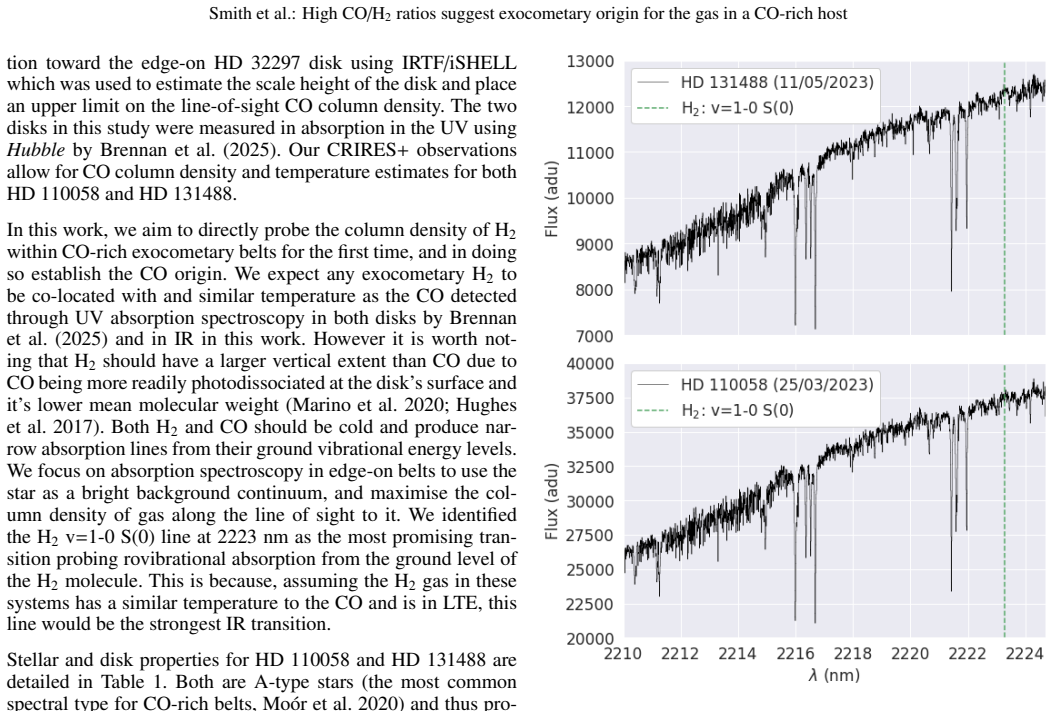
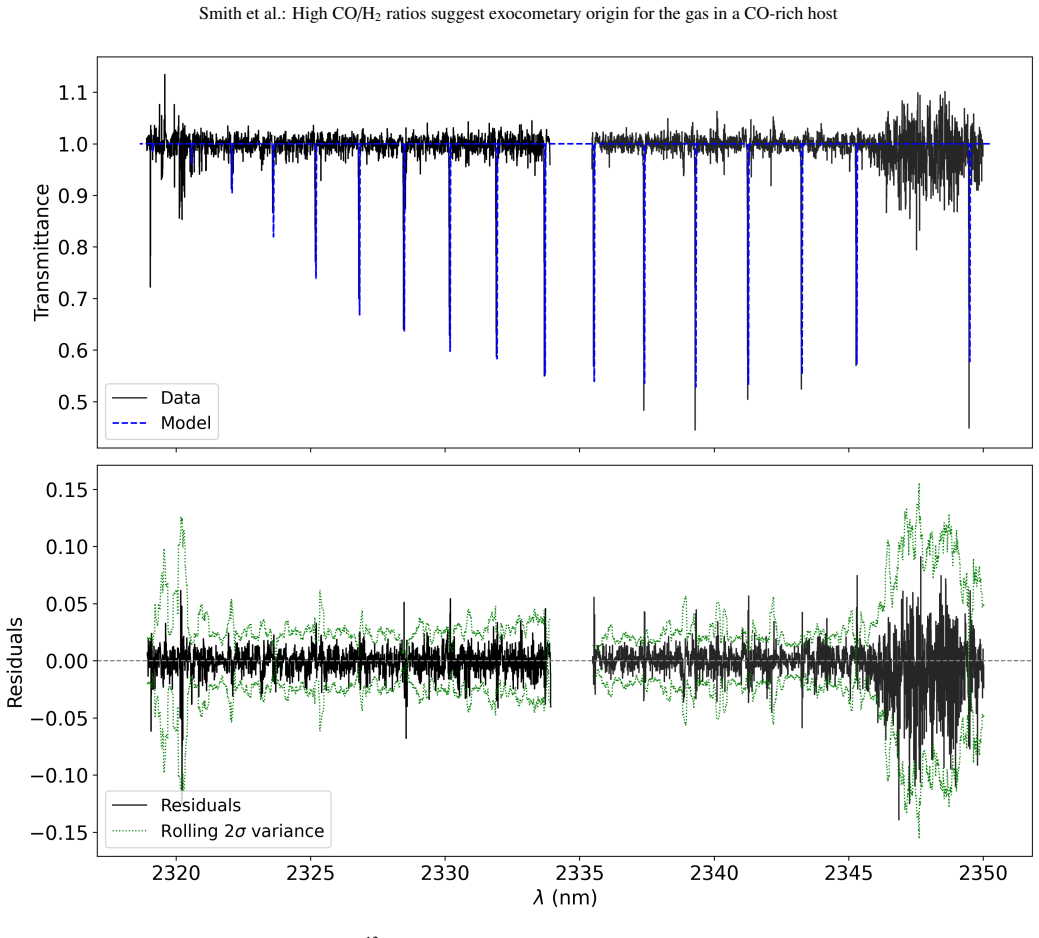
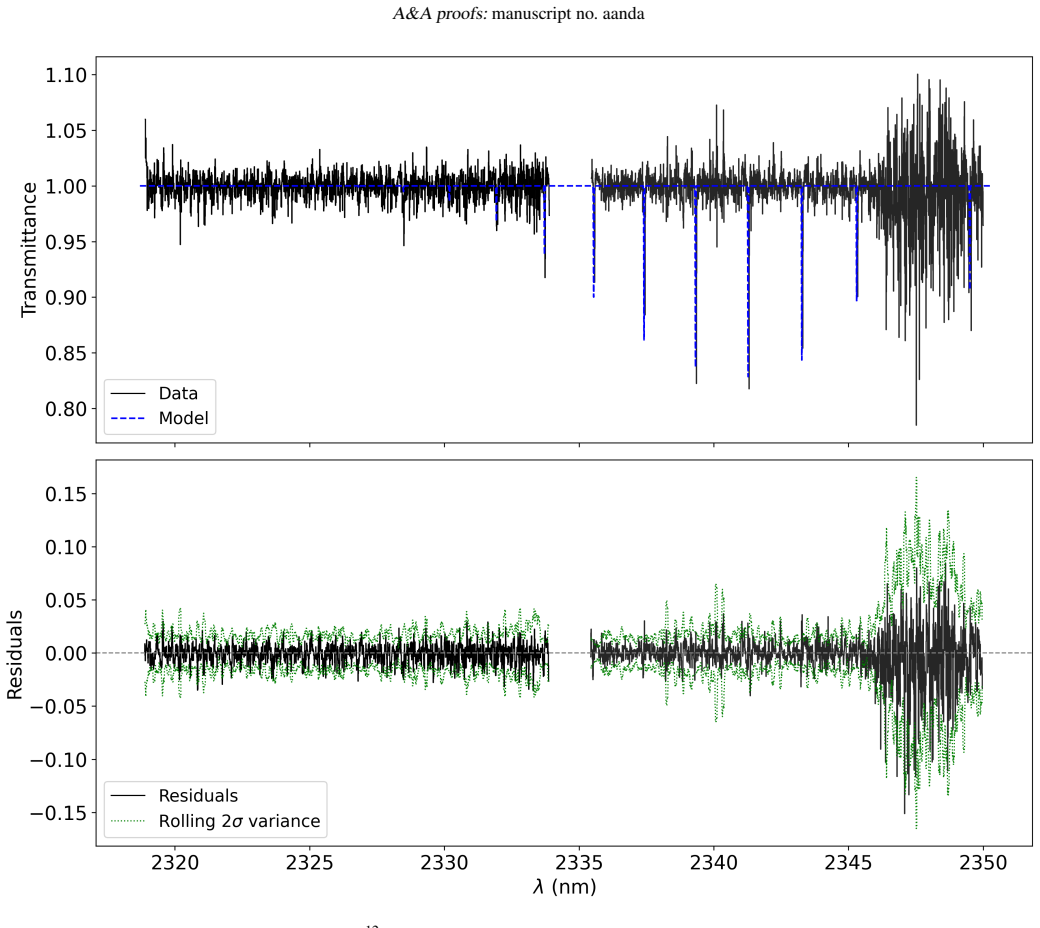
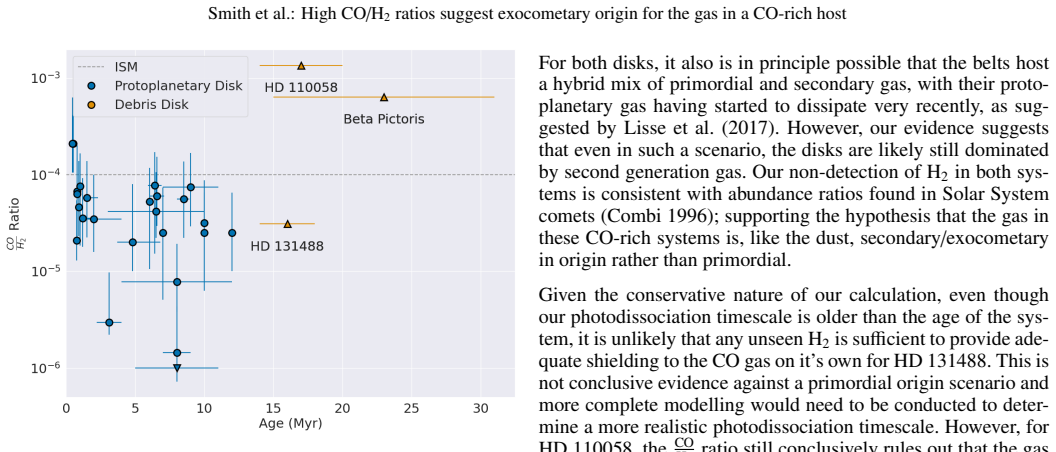
Spectra of the edge-on belts around HD 110058 and HD 131488 reveal clear 12CO v=2-0 rovibrational absorption but no detectable H2 (v=1-0 S(0)) absorption. This produces 3-sigma lower limits on the line-of-sight CO/H2 ratios of greater than 1.35 times 10 to the minus 3 and greater than 3.09 times 10 to the minus 5. These ratios are compositionally distinct from the much lower values in protoplanetary disks, and H2 shielding alone cannot sustain the observed CO over the 15 Myr system ages. The measurements therefore favor in-situ release of gas by exocomets within the belts.
What carries the argument
Rovibrational absorption spectroscopy targeting the H2 (v=1-0 S(0)) line at 2223.3 nm and 12CO v=2-0 lines near 2334 nm to derive line-of-sight column densities in edge-on viewing geometry.
If this is right
- The gas in these belts is H2-poor and chemically distinct from gas in protoplanetary disks.
- Exocometary outgassing supplies the observed CO rather than survival of primordial material.
- H2 shielding by itself cannot account for the persistence of CO over the lifetime of the systems.
- Other CO-rich exocometary belts are likely to exhibit similarly elevated CO/H2 ratios.
Where Pith is reading between the lines
- The same absorption technique applied to additional molecular species could map the full volatile inventory of exocometary gas.
- High CO/H2 ratios may be a general signature distinguishing secondary gas in mature debris disks from primordial gas in younger systems.
- If exocomets routinely release such gas, the process could deliver volatiles to any planets forming or orbiting within these belts.
Load-bearing premise
The absence of the H2 absorption line reflects a genuinely low H2 column density rather than effects from temperature, excitation conditions, or the specific line-of-sight geometry of these edge-on systems.
What would settle it
A future detection of the H2 (v=1-0 S(0)) line at a level that would produce a CO/H2 ratio below 10 to the minus 4 in either system or in similar CO-rich belts would undermine the claim of an exocometary origin.
Figures

read the original abstract
Over 20 exocometary belts host detectable circumstellar gas, mostly in the form of CO. Two competing theories for its origin have emerged, positing the gas to be primordial or secondary. Primordial gas survives from the belt's parent protoplanetary disk and is therefore H$_2$-rich. Secondary gas is outgassed \textit{in-situ} by exocomets and is relatively H$_2$-poor. Discriminating between these scenarios has not been possible for belts hosting unexpectedly large quantities of CO. We aim to break this gas origin dichotomy \textit{via} direct measurement of H$_2$ column densities in two edge-on CO-rich exocometary belts around $\sim$15 Myr-old A-type stars, constraining the $\frac{\text{CO}}{\text{H}_2}$ ratio and CO gas lifetimes. Observing edge-on belts enables rovibrational absorption spectroscopy against the stellar background. We present near-IR CRIRES+ spectra of HD 110058 and HD 131488 which provide the first direct probe of H$_2$ gas in CO-rich exocometary belts. We target the H$_2$ (v=1-0 S(0)) line at 2223.3 nm and and the $^{12}$CO $v=2\rightarrow0$ rovibrational lines in the range 2333.8-2335.5 nm and derive constraints on column densities along the line-of-sight to the stars. We strongly detect $^{12}$CO but not H$_2$ in the CRIRES+ spectra. This allows us to place $3\sigma$ lower limits on the $\frac{\text{CO}}{\text{H}_2}$ ratios of $> 1.35 \times 10^{-3}$ and $> 3.09 \times 10^{-5}$ for HD 110058 and HD 131488 respectively. These constraints demonstrate that at least for HD 110058, the exocometary gas is compositionally distinct and significantly H$_2$-poor, compared to the $<10^{-4}$ $\frac{\text{CO}}{\text{H}_2}$ ratios typical of protoplanetary disks. We also find H$_2$ alone is unlikely to shield CO over the lifetime of the systems. Overall this suggests that the gas in CO-rich belts is most likely not primordial in origin, supporting the presence of exocometary gas.
Editorial analysis
A structured set of objections, weighed in public.
Referee Report
Summary. The paper presents CRIRES+ near-IR absorption spectra toward two edge-on CO-rich debris disks (HD 110058 and HD 131488) around ~15 Myr A stars. Strong 12CO v=2-0 lines are detected while the H2 (v=1-0 S(0)) line at 2223.3 nm is not, yielding 3σ lower limits on the line-of-sight CO/H2 ratio of >1.35×10^{-3} and >3.09×10^{-5}. These limits are compared to the <10^{-4} values typical of protoplanetary disks to argue that the gas is H2-poor and therefore most likely exocometary (secondary) rather than primordial in origin. The work also assesses whether H2 shielding alone can sustain the observed CO lifetimes.
Significance. If the H2 upper limits are robust, the result supplies the first direct compositional constraint on gas in CO-rich debris belts and offers a concrete observational test that can distinguish primordial from secondary gas scenarios. The limits for HD 110058 are sufficiently high to place it outside the range of known protoplanetary-disk ratios, strengthening the exocometary interpretation for at least this system and motivating similar observations of other CO-rich belts.
major comments (2)
- [§4.1] §4.1 (H2 column-density upper limit derivation): The 3σ non-detection is converted to N(H2) < 1.1×10^{19} cm^{-2} (HD 110058) under an assumed excitation temperature and ortho/para ratio. No sensitivity analysis is shown for T_kin = 150–300 K, where the J=0 level population drops sharply; if the gas is warmer, the same non-detection permits a substantially higher total N(H2) and the reported CO/H2 lower limit weakens below the threshold needed to exclude primordial-disk values.
- [§5.2] §5.2 (comparison to protoplanetary disks and shielding calculation): The claim that H2 alone cannot shield CO over the system lifetime rests on the same N(H2) upper limit. Because the excitation assumption is untested, the shielding timescale argument is not yet load-bearing; a revised N(H2) limit at higher T would require re-evaluation of both the compositional distinction and the lifetime conclusion.
minor comments (2)
- [Figure 2] Figure 2 caption and §3.3: the velocity scale for the CO lines should explicitly state the systemic velocity adopted and whether the plotted range includes the full expected Keplerian width for the belt.
- [Table 1] Table 1: the 3σ column-density limits are given without the corresponding 1σ noise values or the exact integration window used; adding these would improve reproducibility.
Simulated Author's Rebuttal
We thank the referee for their careful and constructive review. The comments highlight an important point regarding the temperature dependence of our H2 upper limits. We have revised the manuscript to include a sensitivity analysis and re-evaluation of the shielding argument, which we detail below.
read point-by-point responses
-
Referee: [§4.1] §4.1 (H2 column-density upper limit derivation): The 3σ non-detection is converted to N(H2) < 1.1×10^{19} cm^{-2} (HD 110058) under an assumed excitation temperature and ortho/para ratio. No sensitivity analysis is shown for T_kin = 150–300 K, where the J=0 level population drops sharply; if the gas is warmer, the same non-detection permits a substantially higher total N(H2) and the reported CO/H2 lower limit weakens below the threshold needed to exclude primordial-disk values.
Authors: We agree that an explicit sensitivity analysis strengthens the result. In the revised manuscript we have added this to §4.1, testing T_kin = 50–400 K under LTE with ortho/para = 3. For HD 110058 the CO/H2 lower limit remains > 4.5 × 10^{-4} even at 300 K (still well above the < 10^{-4} protoplanetary-disk range), while the limit for HD 131488 is more sensitive to temperature. We include a new table and brief discussion of the range of allowed N(H2) values. The core conclusion for HD 110058 is robust; we now state the temperature caveat explicitly for HD 131488. revision: yes
-
Referee: [§5.2] §5.2 (comparison to protoplanetary disks and shielding calculation): The claim that H2 alone cannot shield CO over the system lifetime rests on the same N(H2) upper limit. Because the excitation assumption is untested, the shielding timescale argument is not yet load-bearing; a revised N(H2) limit at higher T would require re-evaluation of both the compositional distinction and the lifetime conclusion.
Authors: We have re-computed the shielding timescales in §5.2 using the full range of N(H2) upper limits from the new sensitivity analysis. Even adopting the highest allowed N(H2) at 300 K, the H2-shielding lifetime for CO in HD 110058 remains shorter than the ~15 Myr system age. We have updated the text and added a short paragraph noting that the shielding argument is weaker for HD 131488. The revised discussion now presents both the compositional and lifetime results with the temperature dependence made explicit. revision: yes
Circularity Check
Direct spectroscopic limits on CO/H2 ratios derived from observed non-detections without reduction to fitted inputs or self-citation chains
full rationale
The paper's core result follows from CRIRES+ spectra: strong detection of 12CO rovibrational lines combined with non-detection of the H2 (v=1-0 S(0)) line at 2223.3 nm, yielding 3σ lower limits on CO/H2 of >1.35e-3 (HD 110058) and >3.09e-5 (HD 131488). These limits are obtained by converting equivalent widths or upper limits on line depths to column densities using standard rovibrational spectroscopy formulas and an assumed excitation temperature range. No equation defines the target ratio in terms of itself, no parameter is fitted to a data subset and then relabeled as a prediction of a closely related quantity, and no uniqueness theorem or shielding lifetime calculation is justified solely by overlapping-author citations. The exocometary-origin conclusion rests on the empirical contrast with protoplanetary-disk CO/H2 values (<10^{-4}) rather than on any self-referential step. Minor self-citations may exist for context but are not load-bearing for the reported limits or the origin inference.
Axiom & Free-Parameter Ledger
axioms (1)
- domain assumption The H2 (v=1-0 S(0)) line is the dominant accessible transition and its non-detection directly constrains total H2 column under typical disk temperatures.
Lean theorems connected to this paper
-
IndisputableMonolith/Cost/FunctionalEquationwashburn_uniqueness_aczel unclear?
unclearRelation between the paper passage and the cited Recognition theorem.
We strongly detect 12CO but not H2 ... 3σ lower limits on the CO/H2 ratios of >1.35×10⁻³ and >3.09×10⁻⁵
-
IndisputableMonolith/Foundation/AlphaCoordinateFixationcostAlphaLog_high_calibrated_iff unclear?
unclearRelation between the paper passage and the cited Recognition theorem.
H2 (v=1-0 S(0)) line at 2223.3 nm ... non-detection ... column density upper limits
What do these tags mean?
- matches
- The paper's claim is directly supported by a theorem in the formal canon.
- supports
- The theorem supports part of the paper's argument, but the paper may add assumptions or extra steps.
- extends
- The paper goes beyond the formal theorem; the theorem is a base layer rather than the whole result.
- uses
- The paper appears to rely on the theorem as machinery.
- contradicts
- The paper's claim conflicts with a theorem or certificate in the canon.
- unclear
- Pith found a possible connection, but the passage is too broad, indirect, or ambiguous to say the theorem truly supports the claim.
Forward citations
Cited by 1 Pith paper
-
The multi-wavelength vertical structure of the archetypal $\beta$ Pictoris debris disk
The β Pictoris debris disk is on average 1.5 times thicker vertically in the mid-infrared than at millimeter wavelengths, with a relatively constant scale height across radius and warping consistent with secular pertu...
Reference graph
Works this paper leans on
-
[1]
, " * write output.state after.block = add.period write newline
ENTRY address archiveprefix author booktitle chapter edition editor howpublished institution eprint journal key month note number organization pages publisher school series title type volume year label extra.label sort.label short.list INTEGERS output.state before.all mid.sentence after.sentence after.block FUNCTION init.state.consts #0 'before.all := #1 ...
-
[2]
" write newline "" before.all 'output.state := FUNCTION n.dashify 't := "" t empty not t #1 #1 substring "-" = t #1 #2 substring "--" = not "--" * t #2 global.max substring 't := t #1 #1 substring "-" = "-" * t #2 global.max substring 't := while if t #1 #1 substring * t #2 global.max substring 't := if while FUNCTION word.in bbl.in " " * FUNCTION format....
-
[3]
Anderson, D. E., Blake, G. A., Bergin, E. A., et al. 2019, The Astrophysical Journal, 881, 127, publisher: The American Astronomical Society
work page 2019
-
[4]
Andrews, S. M., Wilner, D. J., Hughes, A. M., Qi, C., & Dullemond, C. P. 2009, The Astrophysical Journal, 700, 1502, publisher: The American Astronomical Society
work page 2009
-
[5]
Artur de la Villarmois, E., Kristensen, L. E., J rgensen, J. K., et al. 2018, Astronomy and Astrophysics, 614, A26, aDS Bibcode: 2018A&A...614A..26A
work page 2018
-
[6]
2021, Astronomy and Astrophysics, 652, A101, publisher: EDP ADS Bibcode: 2021A&A...652A.101A
Asensio-Torres, R., Henning, T., Cantalloube, F., et al. 2021, Astronomy and Astrophysics, 652, A101, publisher: EDP ADS Bibcode: 2021A&A...652A.101A
work page 2021
-
[7]
Backman, D. E. & Paresce, F. 1993, Main- Sequence Stars with Circumstellar Solid Material - the VEGA Phenomenon , conference Name: Protostars and Planets III Pages: 1253 ADS Bibcode: 1993prpl.conf.1253B
work page 1993
-
[8]
Bergin, E. A. & Williams, J. P. 2018, The determination of protoplanetary disk masses, publication Title: arXiv e-prints ADS Bibcode: 2018arXiv180709631B
work page 2018
-
[9]
Bockel \'e e-Morvan, D. & Biver, N. 2017, Philosophical Transactions of the Royal Society of London Series A, 375, 20160252, aDS Bibcode: 2017RSPTA.37560252B
work page 2017
-
[10]
D., Walsh, C., & van Dishoeck, E
Bosman, A. D., Walsh, C., & van Dishoeck, E. F. 2018, Astronomy and Astrophysics, 618, A182, publisher: EDP ADS Bibcode: 2018A&A...618A.182B
work page 2018
-
[11]
Brennan, A., Matr \`a , L., Marino, S., et al. 2025, Monthly Notices of the Royal Astronomical Society, 531, 4482, publisher: OUP ADS Bibcode: 2024MNRAS.531.4482B
work page 2025
-
[12]
Bruderer, S., Dishoeck, E. F. v., Doty, S. D., & Herczeg, G. J. 2012, Astronomy & Astrophysics, 541, A91, publisher: EDP Sciences
work page 2012
-
[13]
2023, The Astrophysical Journal, 951, 111, aDS Bibcode: 2023ApJ...951..111C
Cataldi, G., Aikawa, Y., Iwasaki, K., et al. 2023, The Astrophysical Journal, 951, 111, aDS Bibcode: 2023ApJ...951..111C
work page 2023
-
[14]
Chen, C. H., Li, A., Bohac, C., et al. 2007, The Astrophysical Journal, 666, 466, publisher: IOP Publishing
work page 2007
-
[15]
Collaboration, T. A., Price-Whelan, A. M., Lim, P. L., et al. 2022, The Astropy Project : Sustaining and Growing a Community -oriented Open -source Project and the Latest Major Release (v5.0) of the Core Package , arXiv:2206.14220 [astro-ph]
work page internal anchor Pith review Pith/arXiv arXiv 2022
-
[16]
Combi, M. R. 1996, Icarus, 123, 207, aDS Bibcode: 1996Icar..123..207C
work page 1996
-
[17]
Cronin-Coltsmann, P. F., Kennedy, G. M., Kral, Q., et al. 2023, Monthly Notices of the Royal Astronomical Society, 526, 5401, publisher: OUP ADS Bibcode: 2023MNRAS.526.5401C
work page 2023
-
[18]
Crotts, K. A., Matthews, B. C., Duch \^e ne, G., et al. 2024, The Astrophysical Journal, 961, 245, publisher: IOP ADS Bibcode: 2024ApJ...961..245C
work page 2024
-
[19]
Cutri, R. M., Skrutskie, M. F., van Dyk, S., et al. 2003, VizieR Online Data Catalog, 2246, II/246, aDS Bibcode: 2003yCat.2246....0C
work page 2003
-
[20]
D'Antona, F. & Mazzitelli, I. 1997, Memorie della Societa Astronomica Italiana, 68, 807, aDS Bibcode: 1997MmSAI..68..807D
work page 1997
-
[21]
Dent, W. R. F., Greaves, J. S., & Coulson, I. M. 2005, Monthly Notices of the Royal Astronomical Society, 359, 663, publisher: OUP ADS Bibcode: 2005MNRAS.359..663D
work page 2005
-
[22]
2025, Astronomy and Astrophysics, 698, A183, publisher: EDP ADS Bibcode: 2025A&A...698A.183D
Desgrange, C., Milli, J., Chauvin, G., et al. 2025, Astronomy and Astrophysics, 698, A183, publisher: EDP ADS Bibcode: 2025A&A...698A.183D
work page 2025
-
[23]
Dohnanyi, J. S. 1969, Journal of Geophysical Research, 74, 2531, aDS Bibcode: 1969JGR....74.2531D
work page 1969
-
[24]
Dorn, R. J., Bristow, P., Smoker, J. V., et al. 2023, Astronomy and Astrophysics, 671, A24, publisher: EDP ADS Bibcode: 2023A&A...671A..24D
work page 2023
-
[25]
Favre, C., Cleeves, L. I., Bergin, E. A., Qi, C., & Blake, G. A. 2013, The Astrophysical Journal, 776, L38, publisher: IOP ADS Bibcode: 2013ApJ...776L..38F
work page 2013
-
[26]
Feldman, P. D., Weaver, H. A., & Burgh, E. B. 2002, The Astrophysical Journal, 576, L91
work page 2002
-
[27]
2005, Journal of the Royal Astronomical Society of Canada, 99, 137, aDS Bibcode: 2005JRASC..99S.137F
Fernandez, R., Wu, Y., & Brandeker, A. 2005, Journal of the Royal Astronomical Society of Canada, 99, 137, aDS Bibcode: 2005JRASC..99S.137F
work page 2005
-
[28]
Flagg, L., Johns-Krull, C. M., France, K., et al. 2021, The Astrophysical Journal, 921, 86, publisher: IOP ADS Bibcode: 2021ApJ...921...86F
work page 2021
-
[29]
Flagg, L., Johns-Krull, C. M., France, K., et al. 2022, The Astrophysical Journal, 934, 8, publisher: IOP ADS Bibcode: 2022ApJ...934....8F
work page 2022
-
[30]
Foreman-Mackey, D., Hogg, D. W., Lang, D., & Goodman, J. 2013, Publications of the Astronomical Society of the Pacific, 125, 306, arXiv:1202.3665 [astro-ph, physics:physics, stat]
work page internal anchor Pith review Pith/arXiv arXiv 2013
-
[31]
R., Vispoel, B., Rey, M., et al
Gamache, R. R., Vispoel, B., Rey, M., et al. 2021, Journal of Quantitative Spectroscopy and Radiative Transfer, 271, 107713
work page 2021
-
[32]
Gordon, I. E., Rothman, L. S., Hargreaves, R. J., et al. 2022, Journal of Quantitative Spectroscopy and Radiative Transfer, 277, 107949
work page 2022
-
[33]
Hales, A. S., Marino, S., Sheehan, P. D., et al. 2022, The Astrophysical Journal, 940, 161, publisher: The American Astronomical Society
work page 2022
-
[34]
Heays, A. N., Bosman, A. D., & Dishoeck, E. F. v. 2017, Astronomy & Astrophysics, 602, A105, publisher: EDP Sciences
work page 2017
-
[35]
E., Sato, A., Tsukagoshi, T., et al
Higuchi, A. E., Sato, A., Tsukagoshi, T., et al. 2017, The Astrophysical Journal Letters, 839, L14, publisher: The American Astronomical Society
work page 2017
-
[36]
M., Vidal-Madjar, A., Ferlet, R., Albert, C
Hobbs, L. M., Vidal-Madjar, A., Ferlet, R., Albert, C. E., & Gry, C. 1985, The Astrophysical Journal, 293, L29, aDS Bibcode: 1985ApJ...293L..29H
work page 1985
-
[37]
M., Duch \^e ne, G., & Matthews, B
Hughes, A. M., Duch \^e ne, G., & Matthews, B. C. 2018, Annual Review of Astronomy and Astrophysics, 56, 541, aDS Bibcode: 2018ARA&A..56..541H
work page 2018
-
[38]
M., Lieman-Sifry, J., Flaherty, K
Hughes, A. M., Lieman-Sifry, J., Flaherty, K. M., et al. 2017, The Astrophysical Journal, 839, 86, aDS Bibcode: 2017ApJ...839...86H
work page 2017
-
[39]
Iwasaki, K., Kobayashi, H., Higuchi, A. E., & Aikawa, Y. 2023, The Astrophysical Journal, 950, 36, aDS Bibcode: 2023ApJ...950...36I
work page 2023
-
[40]
Kama, M., Bruderer, S., Dishoeck, E. F. v., et al. 2016, Astronomy & Astrophysics, 592, A83, publisher: EDP Sciences
work page 2016
-
[41]
Klusmeyer, J., Hughes, A. M., Matr \`a , L., et al. 2021, The Astrophysical Journal, 921, 56, aDS Bibcode: 2021ApJ...921...56K
work page 2021
-
[42]
Kochanov, R. V., Gordon, I. E., Rothman, L. S., et al. 2016, Journal of Quantitative Spectroscopy and Radiative Transfer, 177, 15
work page 2016
-
[43]
2013, The Astrophysical Journal, 776, 77, aDS Bibcode: 2013ApJ...776...77K
K \'o sp \'a l, \'A ., Mo \'o r, A., Juh \'a sz, A., et al. 2013, The Astrophysical Journal, 776, 77, aDS Bibcode: 2013ApJ...776...77K
work page 2013
-
[44]
Kral, Q., Marino, S., Wyatt, M. C., Kama, M., & Matr \`a , L. 2019, Monthly Notices of the Royal Astronomical Society, 489, 3670, aDS Bibcode: 2019MNRAS.489.3670K
work page 2019
-
[45]
Kral, Q., Matr \`a , L., Wyatt, M. C., & Kennedy, G. M. 2017, Monthly Notices of the Royal Astronomical Society, 469, 521, aDS Bibcode: 2017MNRAS.469..521K
work page 2017
-
[46]
Kraus, A. L. & Hillenbrand, L. A. 2009, The Astrophysical Journal, 704, 531, publisher: The American Astronomical Society
work page 2009
-
[47]
Krijt, S., Bosman, A. D., Zhang, K., et al. 2020, The Astrophysical Journal, 899, 134, publisher: IOP ADS Bibcode: 2020ApJ...899..134K
work page 2020
-
[48]
Krijt, S., Schwarz, K. R., Bergin, E. A., & Ciesla, F. J. 2018, The Astrophysical Journal, 864, 78, publisher: IOP ADS Bibcode: 2018ApJ...864...78K
work page 2018
-
[49]
2001, Nature, 412, 706, aDS Bibcode: 2001Natur.412..706L
Lecavelier des Etangs, A., Vidal-Madjar, A., Roberge, A., et al. 2001, Nature, 412, 706, aDS Bibcode: 2001Natur.412..706L
work page 2001
-
[50]
A., Gaidos, E., van Saders, J., Feiden, G
Lee, R. A., Gaidos, E., van Saders, J., Feiden, G. A., & Gagn \'e , J. 2024, Monthly Notices of the Royal Astronomical Society, 528, 4760, publisher: OUP ADS Bibcode: 2024MNRAS.528.4760L
work page 2024
-
[51]
2022, The Messenger, 187, 17, aDS Bibcode: 2022Msngr.187...17L
Leibundgut, B., van den Ancker, M., Courtney-Barrer, B., et al. 2022, The Messenger, 187, 17, aDS Bibcode: 2022Msngr.187...17L
work page 2022
-
[52]
Lieman-Sifry, J., Hughes, A. M., Carpenter, J. M., et al. 2016, The Astrophysical Journal, 828, 25, publisher: IOP ADS Bibcode: 2016ApJ...828...25L
work page 2016
-
[53]
Lisse, C. M., Sitko, M. L., Russell, R. W., et al. 2017, The Astrophysical Journal, 840, L20, publisher: IOP ADS Bibcode: 2017ApJ...840L..20L
work page 2017
-
[54]
Luhman, K. L. & Rieke, G. H. 1999, The Astrophysical Journal, 525, 440, publisher: IOP Publishing
work page 1999
-
[55]
Mac \'i as, E., Espaillat, C. C., Ribas, \'A ., et al. 2018, The Astrophysical Journal, 865, 37, publisher: IOP ADS Bibcode: 2018ApJ...865...37M
work page 2018
-
[56]
Makarov, V. V. 2007, The Astrophysical Journal, 658, 480, publisher: IOP ADS Bibcode: 2007ApJ...658..480M
work page 2007
-
[57]
Mannings, V. & Sargent, A. I. 2000, The Astrophysical Journal, 529, 391, publisher: IOP Publishing
work page 2000
-
[58]
Marino, S., Bonsor, A., Wyatt, M. C., & Kral, Q. 2018, Monthly Notices of the Royal Astronomical Society, 479, 1651
work page 2018
-
[59]
2020, Monthly Notices of the Royal Astronomical Society, 492, 4409
Marino, S., Flock, M., Henning, T., et al. 2020, Monthly Notices of the Royal Astronomical Society, 492, 4409
work page 2020
-
[60]
Marino, S., Matr \`a , L., Stark, C., et al. 2016, Monthly Notices of the Royal Astronomical Society, 460, 2933, publisher: OUP ADS Bibcode: 2016MNRAS.460.2933M
work page 2016
-
[61]
Matr \`a , L., Dent, W. R. F., Wyatt, M. C., et al. 2017 a , Monthly Notices of the Royal Astronomical Society, 464, 1415, publisher: OUP ADS Bibcode: 2017MNRAS.464.1415M
work page 2017
-
[62]
Matr \`a , L., MacGregor, M. A., Kalas, P., et al. 2017 b , The Astrophysical Journal, 842, 9, aDS Bibcode: 2017ApJ...842....9M
work page 2017
- [63]
- [64]
-
[65]
Matr \`a , L., \"O berg, K. I., Wilner, D. J., Olofsson, J., & Bayo, A. 2019, The Astronomical Journal, 157, 117, publisher: The American Astronomical Society
work page 2019
-
[66]
Matr \`a , L., Wilner, D. J., \"O berg, K. I., et al. 2018 b , The Astrophysical Journal, 853, 147, aDS Bibcode: 2018ApJ...853..147M
work page 2018
-
[67]
2012, Astronomy & Astrophysics, 544, A131, publisher: EDP Sciences
Mawet, D., Absil, O., Montagnier, G., et al. 2012, Astronomy & Astrophysics, 544, A131, publisher: EDP Sciences
work page 2012
-
[68]
McClure, M. K., Bergin, E. A., Cleeves, L. I., et al. 2016, The Astrophysical Journal, 831, 167, publisher: The American Astronomical Society
work page 2016
-
[69]
Copious Amounts of Hot and Cold Dust Orbiting the Main Sequence A-type Stars HD 131488 and HD 121191
Melis, C., Zuckerman, B., Rhee, J. H., et al. 2013, The Astrophysical Journal, 778, 12, arXiv:1308.2753 [astro-ph]
work page internal anchor Pith review Pith/arXiv arXiv 2013
-
[70]
2004, Astronomy and Astrophysics, 419, 301, publisher: EDP ADS Bibcode: 2004A&A...419..301M
Mer \'i n, B., Montesinos, B., Eiroa, C., et al. 2004, Astronomy and Astrophysics, 419, 301, publisher: EDP ADS Bibcode: 2004A&A...419..301M
work page 2004
-
[71]
2017, The Astrophysical Journal, 849, 123, aDS Bibcode: 2017ApJ...849..123M
Mo \'o r, A., Cur \'e , M., K \'o sp \'a l, \'A ., et al. 2017, The Astrophysical Journal, 849, 123, aDS Bibcode: 2017ApJ...849..123M
work page 2017
-
[72]
Mo \'o r, A., K \'o sp \'a l, \'A ., \'A brah \'a m, P., & Pawellek, N. 2020, 345, 349, conference Name: Origins: From the Protosun to the First Steps of Life ADS Bibcode: 2020IAUS..345..349M
work page 2020
-
[73]
Morbidelli, A., Lunine, J., O'Brien, D., Raymond, S., & Walsh, K. 2012, Annual Review of Earth and Planetary Sciences, 40, 251, \_eprint: https://doi.org/10.1146/annurev-earth-042711-105319
-
[74]
M \"u ller, A., van den Ancker, M. E., Launhardt, R., et al. 2011, Astronomy and Astrophysics, 530, A85, publisher: EDP ADS Bibcode: 2011A&A...530A..85M
work page 2011
-
[75]
Nakatani, R., Turner, N. J., Hasegawa, Y., et al. 2023, The Astrophysical Journal, 959, L28, aDS Bibcode: 2023ApJ...959L..28N
work page 2023
-
[76]
2006, Astronomy and Astrophysics, 452, 245, publisher: EDP ADS Bibcode: 2006A&A...452..245N
Natta, A., Testi, L., & Randich, S. 2006, Astronomy and Astrophysics, 452, 245, publisher: EDP ADS Bibcode: 2006A&A...452..245N
work page 2006
-
[77]
Neuh \"a user, R., Walter, F. M., Covino, E., et al. 2000, Astronomy and Astrophysics Supplement Series, 146, 323, number: 2 Publisher: EDP Sciences
work page 2000
- [78]
-
[79]
Pearce, T. D. 2024, Debris disks around main-sequence stars, publication Title: arXiv e-prints ADS Bibcode: 2024arXiv240311804P
work page 2024
-
[80]
Pecaut, M. J., Mamajek, E. E., & Bubar, E. J. 2012, The Astrophysical Journal, 746, 154, publisher: IOP ADS Bibcode: 2012ApJ...746..154P
work page 2012
discussion (0)
Sign in with ORCID, Apple, or X to comment. Anyone can read and Pith papers without signing in.