REVIEW 1 major objections 44 references
Noise-augmented training of audio autoencoders produces latent spaces ordered by perceptual importance, so pitch and other salient information survives in coarse structures and improves surprisal and EEG prediction.
Reviewed by Pith at T0; open to challenge. T0 means a machine referee read the full paper against a public rubric. the ladder, T0–T4 →
2026-08-03 23:28 UTC pith:DWKE2NEF
load-bearing objection Real empirical gains, but the perceptual-hierarchy mechanism is inferred rather than shown — the latent spectral assumption needs a direct test. the 1 major comments →
Perceptually Aligning Representations of Music via Noise-Augmented Autoencoders
The pith
A machine-rendered reading of the paper's core claim, the machinery that carries it, and where it could break.
Core claim
After finetuning an audio consistency autoencoder to reconstruct clean input from noised latent vectors (z'=(1−t)z + t·noise, at strengths spanning the latent-diffusion range), the encoding is claimed to become hierarchically aligned with perception: 'coarse' means 'survives heavy noise,' because diffusion noise erases low-power structures first. Reconstructions from latents corrupted to SNR 4, 1, and 0.25 retain higher perceptual quality (ViSQOL, SI-SDR) than unaligned latents, and at the lowest SNR the aligned decoder produces more plausible but invented content. An autoregressive rectified-flow model in the aligned space yields pitch-surprisal information content correlating better with a
What carries the argument
The central mechanism is noise-augmented reconstruction training: during autoencoder training, latent vectors are interpolated with Gaussian noise at random strengths and the decoder must reconstruct the clean input, which forces the encoder to place information according to how easily it can be recovered from noise. Two details make the mechanism work: a perceptual reconstruction loss defines what 'salient' means, and a layer-normalization bottleneck fixes the latent variance so the expected signal-to-noise ratio stays constant, preventing the encoder from inflating its outputs to dodge the noise. The paper also relies on the spectral signal-to-noise ratio property of diffusion noise—noise
Load-bearing premise
The premise that carries the paper is that noise level tracks structure coarseness in the learned latent space: adding stronger noise removes progressively finer latent structures, so what survives the most noise is exactly the coarse perceptual code.
What would settle it
Corrupt only the coarsest latent components versus only the finest components at equal total power and measure reconstruction quality: the hierarchy claim predicts a large drop in ViSQOL and SI-SDR when coarse components are corrupted and a small drop when fine components are corrupted. If both corruptions hurt about equally, the observed gains come from decoder robustness to noise, not from perceptual structure in the encoder. A second check: use a diffusion noise process that removes low frequencies before high frequencies; the spectral-SNR assumption predicts this ordering should destroy th
If this is right
- Perceptual quality of reconstructions from heavily noised latents is higher when the autoencoder was trained with noise augmentation than under conventional, unaligned training.
- Pitch-surprisal estimates computed in the aligned latent space correlate more strongly with a perceptually validated symbolic pitch model than unaligned latents or the baseline, with the correlation peaking at intermediate noise levels—evidence that pitch information sits in coarse structures.
- Information content from aligned latents explains significantly more unique variance in EEG responses to sung music than unaligned latents, with widespread fronto-central effects.
- Because diffusion models denoise coarse structures most accurately, aligning salient perceptual information with coarse structure should improve latent diffusion decoding generally, not only for surprisal estimation.
- The intermediate-noise peak identifies a useful operating point: enough noise to strip less relevant detail, not so much that pitch information is lost.
Where Pith is reading between the lines
- If the perceptual loss is changed, the induced hierarchy should re-rank accordingly; for example, a loss emphasizing timbre should move timbre into coarser structures, making the method a potential tool for controllable perceptual organization of latent spaces.
- The variance-fixing bottleneck is likely load-bearing: without it, the encoder can grow latent variance to neutralize the noise, so the perceptual hierarchy may not emerge. Replications should monitor latent SNR during training.
- The low-SNR behavior of the aligned decoder—plausible but invented content—suggests the alignment doubles as a generative prior; the same encodings may improve generation, inpainting, or music continuation, not just surprisal measurement.
- A direct test of the hierarchy would corrupt only coarse versus only fine latent components; the paper's account predicts strongly asymmetric effects on perceptual metrics.
Editorial analysis
A structured set of objections, weighed in public.
Referee Report
Summary. The paper proposes that training an audio autoencoder to reconstruct clean inputs from noised versions of its latents, together with perceptually motivated losses, induces a perceptual hierarchy in which the most perceptually salient information is captured in coarse latent structures and less salient information in finer structures. The authors finetune Music2Latent with such noise-augmented latents (Eq. 1), fixing latent variance via LayerNorm, and evaluate the resulting representations through three lines of evidence: reconstruction quality at different signal-to-noise ratios (Section 4), correlation of diffusion-model information content with IDyOM pitch surprisal (Section 5), and neural encoding of EEG responses to sung music (Section 5). They report consistent improvements over an unaligned baseline and over the prior method [13], especially at intermediate noise levels, and release pretrained weights.
Significance. If the central claim holds, the paper makes a useful contribution by connecting latent diffusion noise schedules to perceptual organization, with practical implications for audio representation learning and music surprisal estimation. The strengths include the use of two external, perceptually validated benchmarks (IDyOM, EEG), a decoder-only control condition (NT=D) that addresses part of the train/inference mismatch, and the public release of pretrained weights. The reported improvements are nontrivial and the results are internally consistent across reconstruction, behavioral correlation, and neural encoding. However, the main interpretation rests on an assumption about the spectral properties of the learned latents that is not directly verified, and the model-selection procedure is partly based on the same evaluation tasks.
major comments (1)
- [Sections 2–4, Eq. (1)] The paper's central mechanism is the spectral SNR property of diffusion noise: adding Gaussian noise destroys fine structures (low spectral power) before coarse structures (high spectral power), as established for natural signals with power-law spectra (refs. [14,15,42]). The authors assume this transfers to Music2Latent latents, but they never verify that the learned latent representation z actually has a power-law decaying temporal power spectrum. If z is spectrally flat—possible due to LayerNorm, TanH, or CAE training—then Gaussian noise does not preferentially remove fine structures, and the observed improvements at intermediate noise levels could instead reflect decoder robustness or increased redundancy, not a coarse-to-fine perceptual hierarchy. This is load-bearing for the paper's main claim. I request a direct test: plot the average power spectrum of z=E(x) for held-out audio, o
Circularity Check
Headline aligned-space advantage partly reflects model selection on the same benchmarks; the central hierarchy claim is not otherwise circular.
specific steps
-
fitted input called prediction
[Appendix B.4 (model selection), applied to main results in Sections 4 and 5]
"Due to the mostly superior performance of the most heavily noised LayerNorm variant (m=−1) across our experiments, we select it when reporting results in the main manuscript."
The main manuscript's headline comparisons (aligned vs unaligned IDyOM correlations in Fig. 1 and EEG cortical tracking in Fig. 2) use the autoencoder variant selected because it performed best on those very experiments ('across our experiments'). Thus the reported aligned-space advantage is not an independent prediction: the model was chosen on the outcome it is then used to demonstrate. This is a fitted-input-called-prediction pattern. It is partial rather than total because the paper also states that the other aligned variants often outperform the unaligned variant, so the central hierarchy claim does not rest solely on the selected configuration.
full rationale
The derivation chain is otherwise self-contained: the training objective (Eq. 1) is defined independently of the evaluation metrics; reconstruction comparisons include a decoder-only noise-adaptation control (NT=D) that isolates the encoder; and the downstream IDyOM and EEG benchmarks are external to the training loss. The spectral SNR argument is an explicit hypothesis, not a result imported from the authors' prior work, and the paper acknowledges in Appendix A that transfer to latent diffusion is underexplored—this is a correctness/assumption risk, not circularity. Self-citations such as [13] are used as motivation and as baseline, but the central claim is also supported by external evidence and by the authors' own controlled experiments. The main circularity concern is the model-selection procedure in B.4, where the variant reported in the main text was chosen on the basis of the same IDyOM/EEG comparisons used as evidence. This is a validity/selection issue and a mild form of fitted-input-called-prediction, but it does not make the central claim equivalent to its inputs by construction.
Axiom & Free-Parameter Ledger
free parameters (6)
- Logit-normal noise mean m for autoencoder finetuning =
m = -1 (LayerNorm final; also tested -2, 0, 1 for TanH/LayerNorm)
- Logit-normal scaling s for autoencoder finetuning =
1
- Latent noise variance γ² =
1
- Bottleneck activation =
LayerNorm (replacing TanH)
- Diffusion logit-normal schedule (m, s) =
m=0, s=1
- Finetuning length for singing-voice diffusion model =
36k steps (plus 12k warmup), lr 5e-5
axioms (7)
- domain assumption Diffusion noise processes have spectral SNR properties: all frequency components are noised with equal strength, so low-power fine structures become indistinguishable from noise before coarse structures.
- ad hoc to paper Training an autoencoder to reconstruct clean inputs from noised latents forces perceptually important information into coarse latent structures.
- domain assumption IDyOM pitch surprisal is a valid proxy for human musical expectation.
- domain assumption EEG responses to music are a valid neural measure of surprisal, and the acoustic envelope suffices as a nuisance regressor.
- domain assumption ViSQOL and SI-SDR quantify perceptual audio quality.
- domain assumption The CAE consistency training implicitly minimizes a perceptually weighted spectrogram difference.
- standard math The instantaneous change-of-variables formula provides valid information content estimates for the autoregressive rectified flow model.
Cite this review
Pith. "Pith review of Perceptually Aligning Representations of Music via Noise-Augmented Autoencoders." pith.science (2026). https://pith.science/paper/DWKE2NEF
@misc{pith2026251105350,
  author       = {Pith},
  title        = {Pith review of: Perceptually Aligning Representations of Music via Noise-Augmented Autoencoders},
  year         = {2026},
  howpublished = {\url{https://pith.science/paper/DWKE2NEF}},
  note         = {Machine review of arXiv:2511.05350}
}
read the original abstract
We argue that training autoencoders to reconstruct inputs from noised versions of their encodings, when combined with perceptually motivated losses, yields encodings that are structured according to a perceptual hierarchy. We demonstrate the emergence of this hierarchy by showing that, after training an audio autoencoder in this manner, perceptually salient information is captured in coarser representation structures than with conventional training. Furthermore, we show that such perceptual hierarchies improve latent diffusion decoding in the context of estimating pitch surprisal in music and predicting EEG-brain responses to music listening. In both cases, our results surpass those of previous methods. Pretrained weights are available on github.com/CPJKU/pa-audioic.
Figures
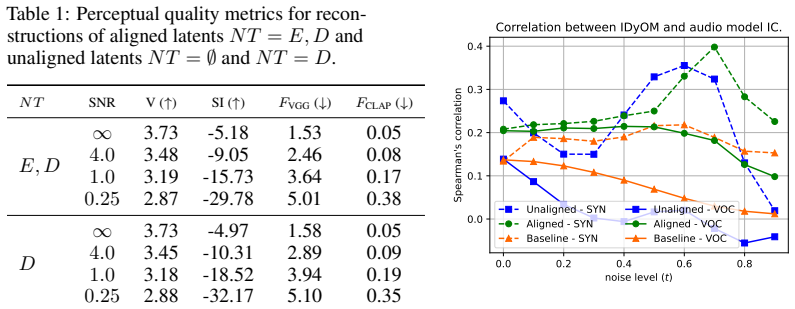


Reference graph
Works this paper leans on
-
[1]
Meaning in music and information theory.The Journal of Aesthetics and Art Criticism, 15(4):412–424, 1957
Leonard B Meyer. Meaning in music and information theory.The Journal of Aesthetics and Art Criticism, 15(4):412–424, 1957
1957
-
[2]
Multiple viewpoint systems for music prediction.Journal of New Music Research, 24(1):51–73, 1995
Darrell Conklin and Ian H Witten. Multiple viewpoint systems for music prediction.Journal of New Music Research, 24(1):51–73, 1995
1995
-
[3]
PhD thesis, Department of Computing, City University, London, UK, 2005
Marcus Pearce.The Construction and Evaluation of Statistical Models of Melodic Structure in Music Perception and Composition. PhD thesis, Department of Computing, City University, London, UK, 2005
2005
-
[4]
Controlling surprisal in music generation via information content curve matching
Mathias Rose Bjare, Stefan Lattner, and Gerhard Widmer. Controlling surprisal in music generation via information content curve matching. InISMIR, 2024
2024
-
[5]
Estimating musical surprisal in audio
Mathias Rose Bjare, Giorgia Cantisani, Stefan Lattner, and Gerhard Widmer. Estimating musical surprisal in audio. InICASSP, 2025
2025
-
[6]
Unsupervised statistical learning underpins computational, behavioural, and neural manifestations of musical expectation.NeuroImage, 50(1):302–313, 2010
Marcus T Pearce, María Herrojo Ruiz, Selina Kapasi, Geraint A Wiggins, and Joydeep Bhat- tacharya. Unsupervised statistical learning underpins computational, behavioural, and neural manifestations of musical expectation.NeuroImage, 50(1):302–313, 2010
2010
-
[7]
Cortical encoding of melodic expectations in human temporal cortex.Elife, 9:e51784, 2020
Giovanni M Di Liberto, Claire Pelofi, Roberta Bianco, Prachi Patel, Ashesh D Mehta, Jose L Herrero, Alain De Cheveigné, Shihab Shamma, and Nima Mesgarani. Cortical encoding of melodic expectations in human temporal cortex.Elife, 9:e51784, 2020
2020
-
[8]
Predictive uncertainty in auditory sequence processing
Niels Chr Hansen and Marcus T Pearce. Predictive uncertainty in auditory sequence processing. Frontiers in psychology, 5:1052, 2014
2014
-
[9]
Pupil responses to pitch deviants reflect predictability of melodic sequences.Brain and Cognition, 138:103621, 2020
Roberta Bianco, Lena Esther Ptasczynski, and Diana Omigie. Pupil responses to pitch deviants reflect predictability of melodic sequences.Brain and Cognition, 138:103621, 2020
2020
-
[10]
Statistical learning of melodic patterns influences the brain’s response to wrong notes.Journal of cognitive neuroscience, 29 (12):2114–2122, 2017
Toviah Moldwin, Odelia Schwartz, and Elyse S Sussman. Statistical learning of melodic patterns influences the brain’s response to wrong notes.Journal of cognitive neuroscience, 29 (12):2114–2122, 2017
2017
-
[11]
Detecting change in stochastic sound sequences
Benjamin Skerritt-Davis and Mounya Elhilali. Detecting change in stochastic sound sequences. PLoS Comput. Biol., 14(5), 2018
2018
-
[12]
A model for statistical regularity extraction from dynamic sounds.Acta Acustica united with Acustica, 105(1):1–4, 2019
Benjamin Skerritt-Davis and Mounya Elhilali. A model for statistical regularity extraction from dynamic sounds.Acta Acustica united with Acustica, 105(1):1–4, 2019
2019
-
[13]
Estimating musical surprisal from audio in autoregressive diffusion model noise spaces
Mathias Rose Bjare, Stefan Lattner, and Gerhard Widmer. Estimating musical surprisal from audio in autoregressive diffusion model noise spaces. InISMIR, 2025
2025
-
[14]
Diffusion is spectral autoregression, 2024
Sander Dieleman. Diffusion is spectral autoregression, 2024. URL https://sander.ai/ 2024/09/02/spectral-autoregression.html
2024
-
[15]
Turner, Edward Meeds, Javier Zazo, and Sushrut Karmalkar
Fabian Falck, Teodora Pandeva, Kiarash Zahirnia, Rachel Lawrence, Richard E. Turner, Edward Meeds, Javier Zazo, and Sushrut Karmalkar. A fourier space perspective on diffusion models. CoRR, abs/2505.11278, 2025
Pith/arXiv arXiv 2025
-
[16]
Latent denoising makes good visual tokenizers.arXiv preprint arXiv:2507.15856, 2025
Jiawei Yang, Tianhong Li, Lijie Fan, Yonglong Tian, and Yue Wang. Latent denoising makes good visual tokenizers.arXiv preprint arXiv:2507.15856, 2025
arXiv 2025
-
[17]
Elucidating the design space of diffusion-based generative models
Tero Karras, Miika Aittala, Timo Aila, and Samuli Laine. Elucidating the design space of diffusion-based generative models. InNeurIPS, 2022. 5
2022
-
[18]
Scaling rectified flow transformers for high-resolution image synthesis
Patrick Esser, Sumith Kulal, Andreas Blattmann, Rahim Entezari, Jonas Müller, Harry Saini, Yam Levi, Dominik Lorenz, Axel Sauer, Frederic Boesel, Dustin Podell, Tim Dockhorn, Zion English, and Robin Rombach. Scaling rectified flow transformers for high-resolution image synthesis. InICML. OpenReview.net, 2024
2024
-
[19]
Music2latent: Consistency autoencoders for latent audio compression
Marco Pasini, Stefan Lattner, and George Fazekas. Music2latent: Consistency autoencoders for latent audio compression. InISMIR, 2024
2024
-
[20]
Consistency models
Yang Song, Prafulla Dhariwal, Mark Chen, and Ilya Sutskever. Consistency models. InICML, volume 202, pages 32211–32252, 2023
2023
-
[21]
Speech enhancement and dereverberation with diffusion-based generative models.IEEE ACM Trans
Julius Richter, Simon Welker, Jean-Marie Lemercier, Bunlong Lay, and Timo Gerkmann. Speech enhancement and dereverberation with diffusion-based generative models.IEEE ACM Trans. Audio Speech Lang. Process., 31:2351–2364, 2023
2023
-
[22]
Parker, CJ Carr, Zack Zukowski, Josiah Taylor, and Jordi Pons
Zach Evans, Julian D. Parker, CJ Carr, Zack Zukowski, Josiah Taylor, and Jordi Pons. Stable audio open. InICASSP, pages 1–5. IEEE, 2025
2025
-
[23]
Autoregressive image generation without vector quantization
Tianhong Li, Yonglong Tian, He Li, Mingyang Deng, and Kaiming He. Autoregressive image generation without vector quantization. InNeurIPS, 2024
2024
-
[24]
Continuous autoregressive models with noise augmentation avoid error accumulation
Marco Pasini, Javier Nistal, Stefan Lattner, and George Fazekas. Continuous autoregressive models with noise augmentation avoid error accumulation. InAudio Imagination: NeurIPS 2024 Workshop AI-Driven Speech, Music, and Sound Generation, 2024
2024
-
[25]
Flow straight and fast: Learning to generate and transfer data with rectified flow
Xingchao Liu, Chengyue Gong, and Qiang Liu. Flow straight and fast: Learning to generate and transfer data with rectified flow. InICLR, 2023
2023
-
[26]
Yaron Lipman, Ricky T. Q. Chen, Heli Ben-Hamu, Maximilian Nickel, and Matthew Le. Flow matching for generative modeling. InICLR. OpenReview.net, 2023
2023
-
[27]
Gomez, Lukasz Kaiser, and Illia Polosukhin
Ashish Vaswani, Noam Shazeer, Niki Parmar, Jakob Uszkoreit, Llion Jones, Aidan N. Gomez, Lukasz Kaiser, and Illia Polosukhin. Attention is all you need. InNeurIPS, pages 5998–6008, 2017
2017
-
[28]
Neural ordinary differential equations
Tian Qi Chen, Yulia Rubanova, Jesse Bettencourt, and David Duvenaud. Neural ordinary differential equations. InNeurIPS, pages 6572–6583, 2018
2018
-
[29]
Lei Jimmy Ba, Jamie Ryan Kiros, and Geoffrey E. Hinton. Layer normalization.CoRR, abs/1607.06450, 2016
Pith/arXiv arXiv 2016
-
[30]
Logistic-normal distributions: Some properties and uses
Jhon Atchison and Sheng M Shen. Logistic-normal distributions: Some properties and uses. Biometrika, 67(2):261–272, 1980
1980
-
[31]
Visqol: an objective speech quality model.EURASIP Journal on Audio, Speech, and Music Processing, 2015(1):13, 2015
Andrew Hines, Jan Skoglund, Anil C Kokaram, and Naomi Harte. Visqol: an objective speech quality model.EURASIP Journal on Audio, Speech, and Music Processing, 2015(1):13, 2015
2015
-
[32]
Objective assessment of perceptual audio quality using visqolaudio.IEEE Transactions on Broadcasting, 63(4):693–705, 2017
Colm Sloan, Naomi Harte, Damien Kelly, Anil C Kokaram, and Andrew Hines. Objective assessment of perceptual audio quality using visqolaudio.IEEE Transactions on Broadcasting, 63(4):693–705, 2017
2017
-
[33]
Visqol v3: An open source production ready objective speech and audio metric
Michael Chinen, Felicia SC Lim, Jan Skoglund, Nikita Gureev, Feargus O’Gorman, and Andrew Hines. Visqol v3: An open source production ready objective speech and audio metric. In 2020 twelfth international conference on quality of multimedia experience (QoMEX), pages 1–6. IEEE, 2020
2020
-
[34]
Sdr–half-baked or well done? InICASSP 2019-2019 IEEE International Conference on Acoustics, Speech and Signal Processing (ICASSP), pages 626–630
Jonathan Le Roux, Scott Wisdom, Hakan Erdogan, and John R Hershey. Sdr–half-baked or well done? InICASSP 2019-2019 IEEE International Conference on Acoustics, Speech and Signal Processing (ICASSP), pages 626–630. IEEE, 2019
2019
-
[35]
High fidelity neural audio compression.arXiv preprint arXiv:2210.13438, 2022
Alexandre Défossez, Jade Copet, Gabriel Synnaeve, and Yossi Adi. High fidelity neural audio compression.arXiv preprint arXiv:2210.13438, 2022. 6
Pith/arXiv arXiv 2022
-
[36]
Musiclm: Generating music from text.arXiv preprint arXiv:2301.11325, 2023
Andrea Agostinelli, Timo I Denk, Zalán Borsos, Jesse Engel, Mauro Verzetti, Antoine Caillon, Qingqing Huang, Aren Jansen, Adam Roberts, Marco Tagliasacchi, et al. Musiclm: Generating music from text.arXiv preprint arXiv:2301.11325, 2023
Pith/arXiv arXiv 2023
-
[37]
Fréchet audio distance: A reference-free metric for evaluating music enhancement algorithms
Kevin Kilgour, Mauricio Zuluaga, Dominik Roblek, and Matthew Sharifi. Fréchet audio distance: A reference-free metric for evaluating music enhancement algorithms. InINTERSPEECH, pages 2350–2354. ISCA, 2019
2019
-
[38]
Large-scale contrastive language-audio pretraining with feature fusion and keyword- to-caption augmentation
Yusong Wu, Ke Chen, Tianyu Zhang, Yuchen Hui, Taylor Berg-Kirkpatrick, and Shlomo Dubnov. Large-scale contrastive language-audio pretraining with feature fusion and keyword- to-caption augmentation. InICASSP, pages 1–5. IEEE, 2023
2023
-
[39]
B. L. Sturm, J. F. Santos, O. Ben-Tal, and I. Korshunova. Music transcription modelling and composition using deep learning. InProceedings of the Conference on Computer Simulation of Musical Creativity, Huddersfield,UK, 2016
2016
-
[40]
Investigating the cortical tracking of speech and music with sung speech
Giorgia Cantisani, Amirhossein Chalehchaleh, Giovanni Di Liberto, and Shihab Shamma. Investigating the cortical tracking of speech and music with sung speech. InINTERSPEECH, pages 5157–5161. ISCA, 2023
2023
-
[41]
Neural signatures of musical and linguistic interactions during natural song listening.Hal preprint, 2024
Giorgia Cantisani, Shihab Shamma, and Giovanni M Di Liberto. Neural signatures of musical and linguistic interactions during natural song listening.Hal preprint, 2024
2024
-
[42]
Modelling the power spectra of natural images: statistics and information.Vision research, 36(17):2759–2770, 1996
van A Van der Schaaf and JH van van Hateren. Modelling the power spectra of natural images: statistics and information.Vision research, 36(17):2759–2770, 1996
1996
-
[43]
Nhss: A speech and singing parallel database.Speech Communication, 133:9–22, 2021
Bidisha Sharma, Xiaoxue Gao, Karthika Vijayan, Xiaohai Tian, and Haizhou Li. Nhss: A speech and singing parallel database.Speech Communication, 133:9–22, 2021
2021
-
[44]
The multivariate temporal response function (mtrf) toolbox: a matlab toolbox for relating neural signals to continuous stimuli.Frontiers in human neuroscience, 10:604, 2016
Michael J Crosse, Giovanni M Di Liberto, Adam Bednar, and Edmund C Lalor. The multivariate temporal response function (mtrf) toolbox: a matlab toolbox for relating neural signals to continuous stimuli.Frontiers in human neuroscience, 10:604, 2016. 7 A Perceptual alignment in image-pixel domain Opposite to latent diffusion, for diffusion models operating o...
2016
This paper was first reviewed by deepseek-v4-flash on August 3, 2026.
discussion (0)
Sign in with ORCID, Apple, or X to comment. Anyone can read and Pith papers without signing in.