Spin-averaged B_c Spectrum in a Cornell-type Potential Using VMC Baseline and GFMC Evolution
Pith reviewed 2026-05-17 22:54 UTC · model grok-4.3
The pith
A Cornell potential calibrated to the B_c ground state and evolved with VMC plus GFMC reproduces spin-averaged masses within tens of MeV of experiment.
A machine-rendered reading of the paper's core claim, the machinery that carries it, and where it could break.
Core claim
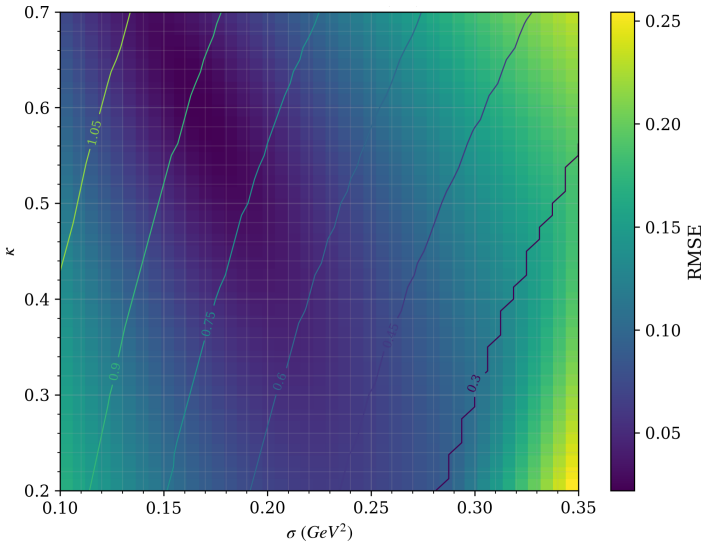
The spin-averaged B_c spectrum is obtained in a naive Cornell framework treating the meson as a nonrelativistic system in a spin-independent potential. The Cornell parameters are calibrated directly to the spin-averaged B_c tower by anchoring the 1S centroid and scanning a grid in (σ, κ), with the additive constant V0 fixed at each point by the experimental ground state mass. The spectrum is obtained with a two-stage Monte Carlo approach. Variational Monte Carlo provides optimized radial trial states with the desired nodal pattern. Fixed-node Green's function Monte Carlo then projects the corresponding ground-state energies for each (n, ℓ) channel. Controlled scans identify plateau regions.
What carries the argument
Two-stage Monte Carlo procedure in which Variational Monte Carlo supplies optimized radial trial states carrying the required nodal pattern and fixed-node Green's function Monte Carlo projects the ground-state energies for each (n, ℓ) channel.
If this is right
- The same calibration and projection procedure yields energies for all low-lying (n, ℓ) channels once the potential parameters are chosen.
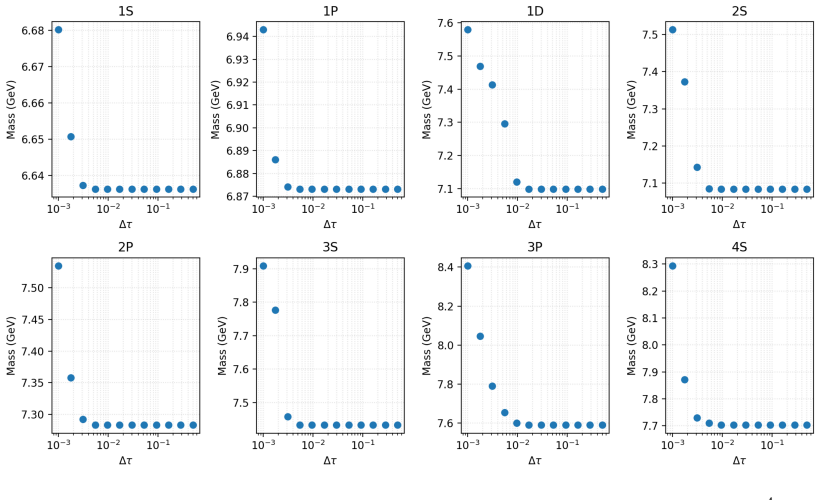
- Quantitative control of discretization and projection errors is achieved by identifying plateau regions in time-step, projection-time, walker-population, and radial-grid scans.
- The fitted values of σ and κ lie inside the range obtained from canonical heavy-quarkonium analyses.
- The method supplies a controlled baseline against which spin-dependent corrections can later be added.
Where Pith is reading between the lines
- The same anchoring-plus-scan procedure could be repeated for any other heavy or exotic meson for which a few experimental centroids are known.
- Because the low-RMSE valley is two-dimensional rather than a single point, the calculation naturally supplies a range of acceptable potentials rather than a unique set of parameters.
- Adding relativistic or finite-mass corrections on top of this nonrelativistic baseline would test how far the simple Cornell form remains reliable for the B_c system.
Load-bearing premise
The Cornell parameters can be calibrated directly to the spin-averaged B_c tower by anchoring the 1S centroid and scanning a grid in (σ, κ), with the additive constant V0 fixed at each point by the experimental ground state mass.
What would settle it
A new experimental measurement of any higher spin-averaged B_c centroid (2S or 3S) lying more than roughly 50 MeV outside the low-RMSE valley found in the (σ, κ) scan.
Figures



read the original abstract
In this work, the spin-averaged $B_c$ spectrum is computed in a naive Cornell framework, treating the meson as a nonrelativistic system in a spin-independent potential. The Cornell parameters are calibrated directly to the spin-averaged $B_c$ tower by anchoring the $1S$ centroid and scanning a grid in $(\sigma,\kappa)$, with the additive constant $V_0$ fixed at each point by the experimental ground state mass. The spectrum is obtained with a two stage Monte Carlo approach. Variational Monte Carlo (VMC) provides optimized radial trial states with the desired nodal pattern. Fixed node Green's function Monte Carlo (GFMC) then projects the corresponding ground state energies for each $(n,\ell)$ channel. Controlled scans over the GFMC time step, projection time, walker population, and radial grid identify plateau regions where discretization and projection systematics are quantitatively under control. At a representative best point in the low-RMSE valley, the predicted spin-averaged masses agree with the experimental centroids at the level of a few tens of MeV, and the fitted Cornell parameters are consistent with canonical heavy quarkonium analyses.
Editorial analysis
A structured set of objections, weighed in public.
Referee Report
Summary. The manuscript computes the spin-averaged B_c meson spectrum in a spin-independent Cornell potential using a two-stage Monte Carlo procedure. Variational Monte Carlo (VMC) generates optimized radial trial wave functions with specified nodal structure, after which fixed-node Green's function Monte Carlo (GFMC) projects the ground-state energies in each (n, ℓ) channel. Potential parameters are calibrated by anchoring the additive constant V0 to the experimental 1S centroid and scanning a grid in string tension σ and Coulomb strength κ to minimize root-mean-square error against the full set of measured spin-averaged centroids; at a representative low-RMSE point the computed masses lie within tens of MeV of experiment and the fitted parameters are stated to be consistent with canonical heavy-quarkonium analyses.
Significance. The explicit scans over GFMC time step, projection time, walker population, and radial discretization provide quantitative control of numerical systematics, which is a clear methodological strength. The work supplies a concrete demonstration that VMC/GFMC can be applied to the B_c system once the potential is calibrated. However, because the calibration is performed directly against the same experimental tower later used for comparison, the reported agreement is the minimized residual of the fit rather than an independent prediction; this limits the strength of the validation claim.
major comments (2)
- [Abstract] Abstract and parameter-calibration description: V0 is fixed to the experimental 1S mass and (σ, κ) are chosen by minimizing RMSE to the entire experimental spin-averaged tower. Consequently the quoted agreement 'at the level of a few tens of MeV' is the post-fit residual, not an a-priori prediction. The central claim therefore requires explicit qualification that the comparison is internal to the calibration procedure.
- [Results / parameter determination] Consistency statement (abstract and results section): the assertion that the fitted Cornell parameters are 'consistent with canonical heavy quarkonium analyses' is not supported by a direct benchmark. No comparison is shown of the achieved RMSE (or of the resulting σ and κ values) against the residuals obtained when the identical Cornell form and fitting protocol are applied to the charmonium or bottomonium towers.
minor comments (1)
- [Method] Notation: the precise functional form of the trial radial functions (including how nodes are imposed for excited states) should be stated explicitly, together with the definition of the radial grid used in the VMC optimization.
Simulated Author's Rebuttal
We thank the referee for the careful reading of our manuscript and for the constructive comments. We appreciate the positive assessment of the numerical controls and the applicability of the VMC-GFMC method to the B_c system. We address each major comment below, indicating the revisions that will be incorporated.
read point-by-point responses
-
Referee: [Abstract] Abstract and parameter-calibration description: V0 is fixed to the experimental 1S mass and (σ, κ) are chosen by minimizing RMSE to the entire experimental spin-averaged tower. Consequently the quoted agreement 'at the level of a few tens of MeV' is the post-fit residual, not an a-priori prediction. The central claim therefore requires explicit qualification that the comparison is internal to the calibration procedure.
Authors: We agree that the procedure constitutes a calibration of the Cornell parameters directly to the experimental B_c spin-averaged centroids, with V0 anchored to the 1S state and (σ, κ) chosen to minimize the RMSE over the full tower. The reported agreement is therefore the post-fit residual rather than an independent prediction. In the revised manuscript we will explicitly qualify this in the abstract and in the parameter-determination section, stating that the masses are reproduced to within tens of MeV inside the calibration procedure. revision: yes
-
Referee: [Results / parameter determination] Consistency statement (abstract and results section): the assertion that the fitted Cornell parameters are 'consistent with canonical heavy quarkonium analyses' is not supported by a direct benchmark. No comparison is shown of the achieved RMSE (or of the resulting σ and κ values) against the residuals obtained when the identical Cornell form and fitting protocol are applied to the charmonium or bottomonium towers.
Authors: We acknowledge that a direct side-by-side benchmark applying the identical VMC-GFMC fitting protocol to the charmonium and bottomonium towers is not presented. The consistency claim rests on the fitted σ and κ values lying within the ranges commonly used in the literature for successful Cornell-potential descriptions of heavy quarkonia. A complete parallel re-analysis of those systems lies outside the scope of the present focused study. To address the concern we will add a clarifying sentence in the results section that references the typical literature ranges and qualifies the basis of the consistency statement. revision: partial
Circularity Check
Fitted Cornell parameters to B_c centroids make reported mass agreement the minimized fit residual
specific steps
-
fitted input called prediction
[Abstract]
"The Cornell parameters are calibrated directly to the spin-averaged B_c tower by anchoring the 1S centroid and scanning a grid in (σ,κ), with the additive constant V0 fixed at each point by the experimental ground state mass. ... At a representative best point in the low-RMSE valley, the predicted spin-averaged masses agree with the experimental centroids at the level of a few tens of MeV"
Parameters (σ, κ, V0) are chosen specifically to minimize RMSE to the experimental tower; the 'predicted' masses at the selected best point are therefore the fitted values whose deviation from experiment has already been minimized by construction, rendering the quoted agreement a report of the fit quality rather than an out-of-sample validation.
full rationale
The paper explicitly calibrates the potential parameters by anchoring to the experimental 1S mass and scanning (σ, κ) to minimize RMSE against the full set of measured spin-averaged centroids; the subsequent claim of agreement 'at the level of a few tens of MeV' at the best-fit point is therefore the residual of that same fit rather than an independent prediction from first principles. The VMC/GFMC numerics themselves are not at issue, but the validation loop is internal to the calibration procedure described in the abstract.
Axiom & Free-Parameter Ledger
free parameters (3)
- string tension σ
- Coulomb strength κ
- additive constant V0
axioms (2)
- domain assumption The B_c meson can be treated as a non-relativistic two-body system in a spin-independent potential.
- domain assumption The Cornell form (Coulomb plus linear) is an adequate effective potential for the spin-averaged spectrum.
Lean theorems connected to this paper
-
IndisputableMonolith/Cost/FunctionalEquation.leanwashburn_uniqueness_aczel unclear?
unclearRelation between the paper passage and the cited Recognition theorem.
The Cornell parameters are calibrated directly to the spin-averaged B_c tower by anchoring the 1S centroid and scanning a grid in (σ, κ), with the additive constant V0 fixed at each point by the experimental ground state mass.
-
IndisputableMonolith/Foundation/RealityFromDistinction.leanreality_from_one_distinction unclear?
unclearRelation between the paper passage and the cited Recognition theorem.
At a representative best point in the low-RMSE valley, the predicted spin-averaged masses agree with the experimental centroids at the level of a few tens of MeV
What do these tags mean?
- matches
- The paper's claim is directly supported by a theorem in the formal canon.
- supports
- The theorem supports part of the paper's argument, but the paper may add assumptions or extra steps.
- extends
- The paper goes beyond the formal theorem; the theorem is a base layer rather than the whole result.
- uses
- The paper appears to rely on the theorem as machinery.
- contradicts
- The paper's claim conflicts with a theorem or certificate in the canon.
- unclear
- Pith found a possible connection, but the passage is too broad, indirect, or ambiguous to say the theorem truly supports the claim.
Forward citations
Cited by 2 Pith papers
-
$\boldsymbol{B_c}$ Meson Spectroscopy from Bayesian MCMC: Probing Confinement and State Mixing
Bayesian MCMC sampling of Cornell and log-modified Cornell potentials reproduces known B_c states and supplies mass predictions for higher excitations with propagated uncertainties.
-
Relativistic effects in heavy mesons
A relativistic potential model with few parameters qualitatively reproduces heavy meson masses and radiative widths, remaining finite at zero light quark mass.
Reference graph
Works this paper leans on
-
[1]
Mesons in a relativized quark model with chromo- dynamics.Physical Review D, 32(1):189, 1985
Stephen Godfrey and Nathan Isgur. Mesons in a relativized quark model with chromo- dynamics.Physical Review D, 32(1):189, 1985
work page 1985
-
[2]
Stephen Godfrey. Spectroscopy of b c mesons in the relativized quark model.Physical Review D—Particles, Fields, Gravitation, and Cosmology, 70(5):054017, 2004
work page 2004
-
[3]
Dietmar Ebert, Rudolf N Faustov, and Vladimir O Galkin. Spectroscopy and regge trajectories of heavy quarkonia and b c mesons.The European Physical Journal C, 71(12):1825, 2011
work page 2011
-
[4]
Tarik Akan. Predictingb¯cmeson mass spectra using neural network with combined cornell and quadratic potentials.J. Nat. Appl. Sci., 29(2):426–433, 2025
work page 2025
-
[5]
Cornell potential: a neural network approach.Advances in High Energy Physics, 2019(1):3105373, 2019
Halil Mutuk. Cornell potential: a neural network approach.Advances in High Energy Physics, 2019(1):3105373, 2019
work page 2019
-
[6]
Benoˆ ıt Assi and Michael L Wagman. Baryons, multihadron systems, and composite dark matter in nonrelativistic QCD.Physical Review D, 108(9):096004, 2023
work page 2023
-
[7]
NR Soni, BR Joshi, RP Shah, HR Chauhan, and JN Pandya.Q ¯Q(Q∈ {b, c}) spec- troscopy using the cornell potential.The European Physical Journal C, 78(7):592, 2018
work page 2018
-
[8]
Observation of B_c Mesons in p-bar p Collisions at sqrt{s} = 1.8 TeV
CDF Collaboration et al. Observation ofB c mesons in p-bar p collisions at √s= 1.8 TeV.arXiv preprint hep-ex/9804014, 1998
work page internal anchor Pith review Pith/arXiv arXiv 1998
-
[9]
Measurement of the Bc meson mass in the exclusive decay Bc --> Jpsi Pi
V Abazov, D0 Collaboration, et al. Measurement of theB c meson mass in the exclusive decayB c →J/ψπ.arXiv preprint arXiv:0802.4258, 2008
work page internal anchor Pith review Pith/arXiv arXiv 2008
-
[10]
LHCb Collaboration et al. Measurement of the lifetime of theB + c meson using the B+ c →J/ψπ + decay mode.Physics Letters B, 742:29–37, 2015
work page 2015
-
[11]
R Aaij, B Adeva, M Adinolfi, Z Ajaltouni, S Akar, J Albrecht, F Alessio, M Alexander, Aa Albero, S Ali, et al. Measurement of the ratio of branching fractionsB(B + c → J/ψτ +ντ)/B(B + c →J/ψµ +νµ).Physical Review Letters, 120(12), 2018
work page 2018
-
[12]
Roel Aaij, Ahmed Sameh Wagih Abdelmotteleb, Carlos Abellan Beteta, F Abudin´ en, Thomas Ackernley, Bernardo Adeva, Marco Adinolfi, P Adlarson, Hossein Afsharnia, Christina Agapopoulou, et al. Study ofB + c meson decays to charmonia plus multihadron final states.Journal of High Energy Physics, 2023(7):1–26, 2023
work page 2023
-
[13]
Juerg Beringer, J-F Arguin, RM Barnett, K Copic, O Dahl, DE Groom, C-J Lin, J Lys, H Murayama, CG Wohl, et al. Review of particle physics.Physical Review D—Particles, Fields, Gravitation, and Cosmology, 86(1):010001, 2012
work page 2012
-
[14]
Review of particle physics, 2016-2017.Chin
Claudia Patrignani, P Richardson, OV Zenin, R-Y Zhu, A Vogt, S Pagan Griso, L Garren, DE Groom, M Karliner, DM Asner, et al. Review of particle physics, 2016-2017.Chin. Phys. C, 40:100001, 2016
work page 2016
-
[15]
D Ebert, RN Faustov, and VO Galkin. Properties of heavy quarkonia and b c mesons in the relativistic quark model.Physical Review D, 67(1):014027, 2003. 17
work page 2003
-
[16]
N Devlani, V Kher, and AK Rai. Masses and electromagnetic transitions of the bc mesons.The European Physical Journal A, 50(10):154, 2014
work page 2014
-
[17]
Cb spectrum and decay properties with coupled channel effects.Physical Review D, 95(5):054016, 2017
Antony Prakash Monteiro, Manjunath Bhat, and KB Vijaya Kumar. Cb spectrum and decay properties with coupled channel effects.Physical Review D, 95(5):054016, 2017
work page 2017
-
[18]
Raghav Chaturvedi and Ajay Kumar Rai.B c meson spectroscopy motivated by general features of pnrqcd.The European Physical Journal A, 58(11):228, 2022
work page 2022
-
[19]
Mass of the b c meson in three-flavor lattice qcd.Physical review letters, 94(17):172001, 2005
Ian F Allison, Christine TH Davies, Alan Gray, Andreas S Kronfeld, Paul B Mackenzie, James N Simone, and HPQCD, Fermilab Lattice, and UKQCD Collaborations. Mass of the b c meson in three-flavor lattice qcd.Physical review letters, 94(17):172001, 2005
work page 2005
-
[20]
Muyang Chen, Lei Chang, and Yu-xin Liu.B c meson spectrum via dyson-schwinger equation and bethe-salpeter equation approach.Physical Review D, 101(5), March 2020
work page 2020
-
[21]
Higher states of theB c meson family.Physical Review D, 108(3):034019, 2023
Ting-Yan Li, Long Tang, Zheng-Yuan Fang, Chao-Hui Wang, and Cheng-Qun Pang. Higher states of theB c meson family.Physical Review D, 108(3):034019, 2023
work page 2023
-
[22]
Xue-Jian Li, Yu-Shuai Li, Fu-Lai Wang, and Xiang Liu. Spectroscopic survey of higher- lying states ofB c meson family.The European Physical Journal C, 83(11):1080, 2023
work page 2023
-
[23]
E Eichten, K Gottfried, T Kinoshita, KD Lane, and T-M Yan. Charmonium: the model. Physical review D, 17(11):3090, 1978
work page 1978
-
[24]
Charmonium: comparison with experiment.Physical review D, 21(1):203, 1980
Estia Eichten, K Gottfried, T Kinoshita, KD Lane, and Tung-Mow Yan. Charmonium: comparison with experiment.Physical review D, 21(1):203, 1980
work page 1980
-
[25]
Mesons with beauty and charm: Spectroscopy.Physical Review D, 49(11):5845, 1994
Estia J Eichten and Chris Quigg. Mesons with beauty and charm: Spectroscopy.Physical Review D, 49(11):5845, 1994
work page 1994
-
[26]
Timofey Solomko. Cornell potential from soft wall holographic aapproach to QCD.Acta Physica Polonica B, Proceedings Supplement, 16(8):A3, 2023
work page 2023
-
[27]
Krishna Kingkar Pathak, Satyadeep Bhattacharya, and Tapashi Das. Parameterisation space for cornell potential in a QCD potential model.The European Physical Journal C, 82(11):1081, 2022
work page 2022
-
[28]
Mass spectroscopy of charmonium using cornell plus exponential potential
M Sreelakshmi and Akhilesh Ranjan. Mass spectroscopy of charmonium using cornell plus exponential potential. InProceedings of the DAE-BRNS symposium on nuclear physics. V. 66, pages 2–2, 2022
work page 2022
-
[29]
Charmonium spectrum and its decay properties.The European Physical Journal A, 61(9):200, 2025
Zaki Ahmad, Ishrat Asghar, Bilal Masud, and M Atif Sultan. Charmonium spectrum and its decay properties.The European Physical Journal A, 61(9):200, 2025
work page 2025
-
[30]
Tetraquarks made of sufficiently unequal-mass heavy quarks are bound in QCD, 2024
Benoˆ ıt Assi and Michael L Wagman. Tetraquarks made of sufficiently unequal-mass heavy quarks are bound in QCD, 2024
work page 2024
-
[31]
Sandro Sorella. Green function monte carlo with stochastic reconfiguration.Physical review letters, 80(20):4558, 1998
work page 1998
-
[32]
Hakan Ciftci, Richard L Hall, and Nasser Saad. Asymptotic iteration method for eigen- value problems.Journal of Physics A: Mathematical and General, 36(47):11807, 2003. 18
work page 2003
-
[33]
Ramesh Kumar and Fakir Chand. Asymptotic study to the n-dimensional radial schr¨ odinger equation for the quark-antiquark system.Communications in Theoretical Physics, 59(5):528, 2013
work page 2013
-
[34]
S. Navas et al. Review of particle physics.Phys. Rev. D, 110(3):030001, 2024. 19
work page 2024
discussion (0)
Sign in with ORCID, Apple, or X to comment. Anyone can read and Pith papers without signing in.