Pulsation of quantum walk between two arbitrary graphs with weakly connected bridge
Pith reviewed 2026-05-17 22:32 UTC · model grok-4.3
The pith
For small bridge strengths, a quantum walker on two graphs pulsates periodically between them with timing set only by edge counts.
A machine-rendered reading of the paper's core claim, the machinery that carries it, and where it could break.
Core claim
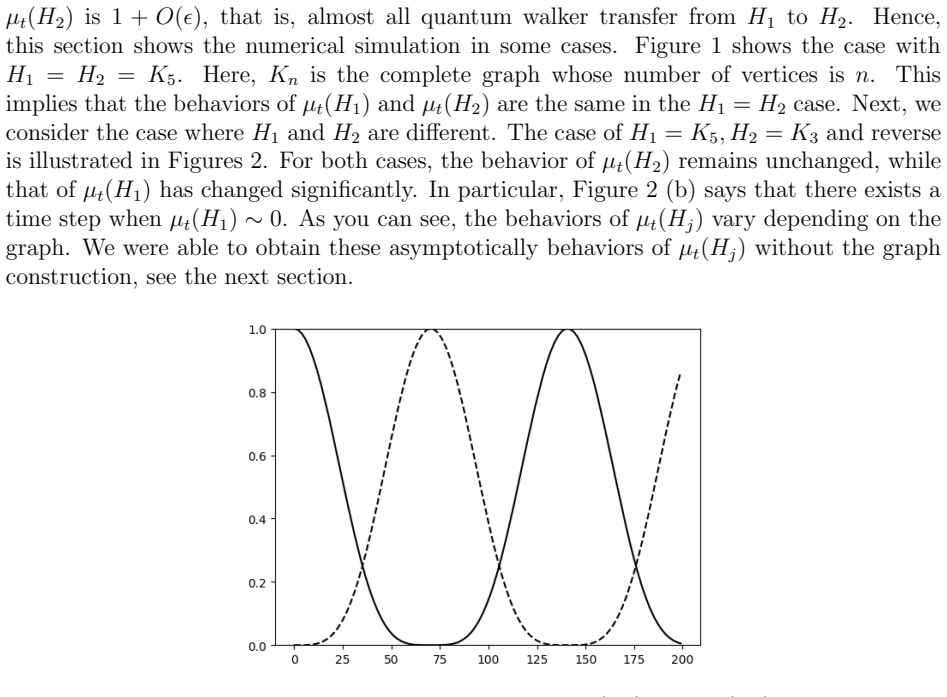
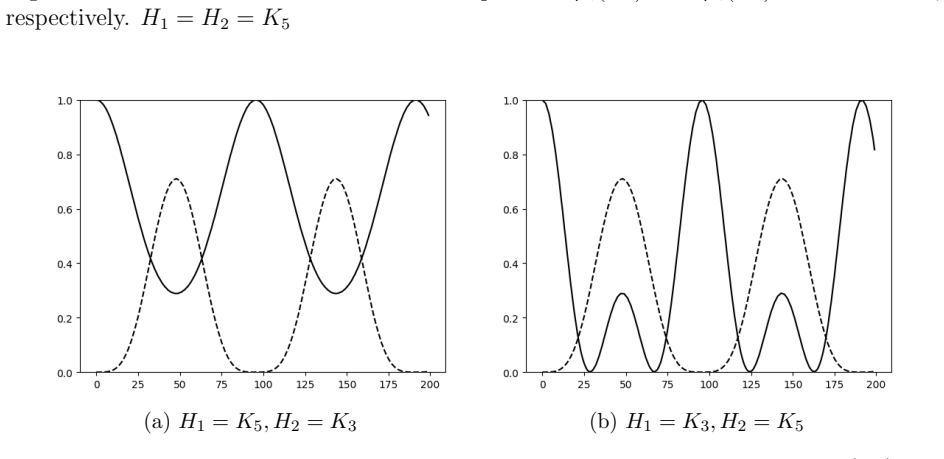
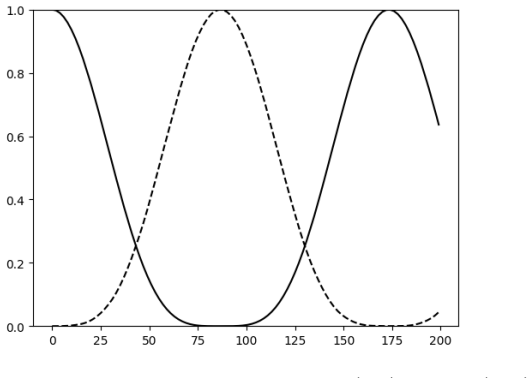
We show that for sufficiently small values of ε, a phenomenon called pulsation occurs. An asymptotic expression with respect to small ε for the probability of finding the walker on either of the two graphs is derived. This expression reveals that the pulsation depends solely on the number of edges in each graph, regardless of their structure. The quantum walker is transferred periodically between the two graphs, with a period of order O(ε^{-1/2}). Furthermore, when the number of edges of two graphs is equal, the quantum walker is almost completely transferred.
What carries the argument
Asymptotic expansion of the time-evolution operator for the Grover walk on the bridged graph, isolating the slow inter-graph dynamics induced by the weak bridge.
If this is right
- The pulsation period is independent of the specific connectivity inside each graph.
- Nearly complete periodic transfer occurs whenever the two graphs have the same number of edges.
- The probability of finding the walker in one graph or the other oscillates with an amplitude fixed exclusively by the edge counts.
- The phenomenon is expected for any pair of finite connected simple graphs joined by the bridge.
Where Pith is reading between the lines
- The edge-count dependence suggests an effective two-state model in which each graph acts as a single site whose coupling strength is set by its size.
- This mechanism could be exploited to route quantum information periodically across subnetworks by tuning only the bridge and the relative sizes of the components.
- Analogous slow pulsation might appear in continuous-time quantum walks or in open quantum systems with similar weak links.
Load-bearing premise
That ε is small enough for the leading asymptotic terms to dominate the long-time dynamics and that the graphs are finite, simple, and linked only by the single parameterized bridge.
What would settle it
Numerical simulation of the time-dependent probability for a concrete pair of graphs at small fixed ε (for example ε=0.01), checking whether the observed oscillation period scales as predicted with ε and remains unchanged when the internal edges are rearranged while keeping edge counts fixed.
Figures
read the original abstract
We consider the Grover walk on a finite graph composed of two arbitrary simple graphs connected by one edge, referred to as a bridge. The parameter $\epsilon>0$ assigned at the bridge represents the strength of connectivity: if $\epsilon=0$, then the graph is completely separated. We show that for sufficiently small values of $\epsilon$, a phenomenon called pulsation occurs. The pulsation is characterized by the periodic transfer of the quantum walker between the two graphs. An asymptotic expression with respect to small $\epsilon$ for the probability of finding the walker on either of the two graphs is derived. This expression reveals that the pulsation depends solely on the number of edges in each graph, regardless of their structure. In addition, we obtain that the quantum walker is transferred periodically between the two graphs, with a period of order $O(\epsilon^{-1/2})$. Furthermore, when the number of edges of two graphs is equal, the quantum walker is almost completely transferred.
Editorial analysis
A structured set of objections, weighed in public.
Referee Report
Summary. The paper examines the Grover quantum walk on a finite graph formed by two arbitrary simple connected graphs joined by a single bridge edge of strength ε. For sufficiently small ε it derives an asymptotic expression for the probability of finding the walker on either subgraph and shows that this probability exhibits pulsation: periodic transfer between the two subgraphs with period scaling as O(ε^{-1/2}). The leading-order behavior depends only on the number of edges in each subgraph; when these numbers are equal the transfer is nearly complete.
Significance. If the perturbative analysis is correct, the result isolates a simple, structure-independent mechanism for controlled quantum transport across weakly linked graphs. The explicit dependence on edge counts alone and the O(ε^{-1/2}) period furnish falsifiable predictions that could guide experimental realizations on photonic or superconducting lattices.
major comments (2)
- [§3.2] §3.2, around Eq. (12): the reduction of the composite unitary to an effective two-level system for small ε relies on a spectral gap assumption between the bridge mode and the rest of the spectrum; the manuscript should supply an explicit lower bound on this gap in terms of the two graphs' adjacency spectra to justify that the O(ε) perturbation remains valid uniformly.
- [Theorem 4.1] Theorem 4.1: the claimed O(ε^{-1/2}) period is obtained from the imaginary part of the perturbed eigenvalue; the error term in the asymptotic probability is stated as o(1) but no explicit remainder estimate (e.g., O(ε^{1/2})) is given, which is needed to confirm that the pulsation remains visible for any fixed finite graphs when ε is small but nonzero.
minor comments (3)
- [§2] Notation: the symbol for the number of edges in each subgraph is introduced late; define m_1 and m_2 immediately after the graph construction in §2.
- [Figure 2] Figure 2: the plotted probability curves for unequal edge counts should include the analytic asymptotic curve for direct visual comparison.
- [Introduction] The statement that the graphs are 'arbitrary' should be qualified by the standing assumptions (finite, simple, connected) already used in the proof.
Simulated Author's Rebuttal
We thank the referee for the careful reading, positive assessment, and recommendation for minor revision. We address each major comment below and will incorporate the suggested clarifications and estimates in the revised manuscript.
read point-by-point responses
-
Referee: [§3.2] §3.2, around Eq. (12): the reduction of the composite unitary to an effective two-level system for small ε relies on a spectral gap assumption between the bridge mode and the rest of the spectrum; the manuscript should supply an explicit lower bound on this gap in terms of the two graphs' adjacency spectra to justify that the O(ε) perturbation remains valid uniformly.
Authors: We agree that an explicit bound strengthens the argument. In the revision we will add a lower bound derived from the spectra of the individual graphs: the unperturbed operator is block diagonal, the bridge mode eigenvalue is isolated from the rest of the spectrum by a positive distance controlled by the minimal gap in the normalized adjacency spectra of the two graphs (minus possible overlap), which is strictly positive for any fixed finite connected graphs. This justifies uniform validity of the O(ε) perturbation for sufficiently small ε. revision: yes
-
Referee: [Theorem 4.1] Theorem 4.1: the claimed O(ε^{-1/2}) period is obtained from the imaginary part of the perturbed eigenvalue; the error term in the asymptotic probability is stated as o(1) but no explicit remainder estimate (e.g., O(ε^{1/2})) is given, which is needed to confirm that the pulsation remains visible for any fixed finite graphs when ε is small but nonzero.
Authors: We concur that an explicit remainder improves rigor. Using standard analytic perturbation theory for isolated eigenvalues, the error between the exact probability and the leading two-level asymptotic is bounded by C ε^{1/2} where C depends only on the fixed graphs, the gap, and the initial state. We will insert this O(ε^{1/2}) estimate into the statement and proof of Theorem 4.1 to confirm visibility of the pulsation for small but positive ε. revision: yes
Circularity Check
No significant circularity; derivation is self-contained perturbative analysis
full rationale
The paper performs a direct asymptotic expansion of the Grover walk unitary operator on the composite graph for small bridge strength ε. The pulsation period O(ε^{-1/2}) and the probability expression depending only on edge counts are obtained by spectral analysis and powers of the evolution operator on the finite graph. No load-bearing step reduces to a fitted parameter renamed as prediction, nor to a self-citation chain; the central claims follow from the standard definition of the Grover walk and explicit perturbation for the given bridge setup. The analysis is self-contained against the finite-graph assumptions stated in the paper.
Axiom & Free-Parameter Ledger
axioms (2)
- standard math Grover walk is defined via the standard coin and shift operators on the line graph of a simple undirected graph
- domain assumption The composite graph is finite, simple, and connected solely by one bridge edge whose weight is ε
Reference graph
Works this paper leans on
- [1]
-
[2]
A. Ambainis, E. Bach, A. Nayak, A. Vishwanath, and J. Watrous. One-dimensional quantum walks.Proc. 33rd Annual ACM Symp. Theory of Computing, pages 37–49, 2001
work page 2001
-
[3]
L. Grover. A fast quantum search mechanical algorithm for database search.Proceedings of the 28th annual ACM symposium on theory of computing, page 212–219, 1996
work page 1996
-
[4]
F. D. Nicola, L. Sansoni, A. Crespiand R. Ramponi, R. Osellame, V. Giovannetti, R. Fazioand P. Mataloni, and F. Sciarrino. Quantum simulation of bosonic-fermionic noninteracting particles in disordered systems via a quantum walk.Physical Review A, 89(3):032322, 2014
work page 2014
-
[5]
C. Vlachou, J. Rodrigues, P. Mateus, N. Paunkovi´c, and A. Souto. Quantum walk public-key cryptographic system.International Journal of Quantum Information, 13(7):1550050, 2015
work page 2015
-
[6]
N. Inui and N. Konno. Localization of multi-state quantum walk in one dimension. Physica A: Statistical Mechanics and its Applications, (1):133–144, 2005
work page 2005
-
[7]
N. Inui, N. Konno, and E. Segawa. One-dimensional three-state quantum walk.Physical Review E, (5):056112, 2005
work page 2005
- [8]
-
[9]
N. Konno. Quantum random walks in one dimension.Quantum Infformation Processing, 1:345–354, 2002
work page 2002
-
[10]
A. Panda and C. Benjamin. Order from chaos in quantum walks on cyclic graphs. Physical Review A, page 012204, 2021
work page 2021
- [11]
-
[12]
Yu. Higuchi, N. Konno, I. Sato, and E. Segawa. Periodicity of the discrete-time quantum walk on a finite graph.Interdisciplinary Information Sciences, pages 75–86, 2017. 12
work page 2017
-
[13]
Portugal.Quantum Walk and Search Algorithm, 2nd Ed.Springer Nature Switzer- land, 2018
R. Portugal.Quantum Walk and Search Algorithm, 2nd Ed.Springer Nature Switzer- land, 2018
work page 2018
-
[14]
C. Godsil. State transfer on graphs.Discrete Math, (1):129–147, 2012
work page 2012
-
[15]
Y. Aharonov, L. Davidovich, and N. Zagury. Quantum random walks.Physical Review A, 48(2):1690–1993, 1993
work page 1993
-
[16]
A. Ambainis, A. Gily´ en, J. Jeffery, and M. Kokainis. Quadratic speedup for finding marked vertices by quantum walks.Proceedings of the 52nd Annual ACM SIGACT Symposium on Theory of Computing, 19:412–424, 2020
work page 2020
-
[17]
C. Godsil. When can perfect state transfer occur?The Electronic Journal of Linear Algebra, page 877–890, 2012
work page 2012
- [18]
-
[19]
S. Kubotaand K. Yoshino. Circulant graphs with valency up to 4 that admit perfect state transfer in grover walks.Journal of Combinatorial Theory, Series A, (106064), 2025
work page 2025
-
[20]
S. Skoup´ y M.ˇStefaˇ n´ ak. Quantum walk state transfer on a hypercube.Physica Scripta, (104003), 2023
work page 2023
-
[21]
T. Hosaka and E. Segawa. Pulsation of quantum walk on johnson graph. arXiv:2411.01468, 2024
-
[22]
Kato.A Short Introduction to Perturbation Theory for Linear Operator
T. Kato.A Short Introduction to Perturbation Theory for Linear Operator. Springer- Verlag, New York, 1982
work page 1982
-
[23]
Yu. Higuchi, N. Konno, I. Sato, and E. Segawa. Spectral and asymptotic properties of grover walks on crystal lattices.Journal of Functional Analysis, 267:4197–4235, 2014
work page 2014
-
[24]
D. Bohm.Quantum Theory. Dover Books on Physics Series. Dover Publications, 1951
work page 1951
-
[25]
M. Davis and E. Heller. Quantum dynamical tunneling in bound states.The Journal of Chemical Physics, 75:246, 1981
work page 1981
-
[26]
R. Alicki and M. Fannes. Entanglement boost for extractable work from ensembles of quantum batteries.Physical Review E, 87, 2013. 13
work page 2013
discussion (0)
Sign in with ORCID, Apple, or X to comment. Anyone can read and Pith papers without signing in.