REVIEW 3 major objections 6 minor 40 references
A conditional generative model that samples all white-matter streamlines in parallel achieves 2.1× higher precision than the next-best tractography method, and an order of magnitude more under noise.
Reviewed by Pith at T0; open to challenge. T0 means a machine referee read the full paper against a public rubric. the ladder, T0–T4 →
T0 review · deepseek-v4-flash
2026-08-03 21:51 UTC pith:CH4CNQZP
load-bearing objection GenTract offers a genuinely new global-generative twist on tractography with large reported precision gains, but the design isn't yet clean enough to separate conditioning from bundle-prior memorization. the 3 major comments →
GenTract: Generative Global Tractography
The pith
A machine-rendered reading of the paper's core claim, the machinery that carries it, and where it could break.
Core claim
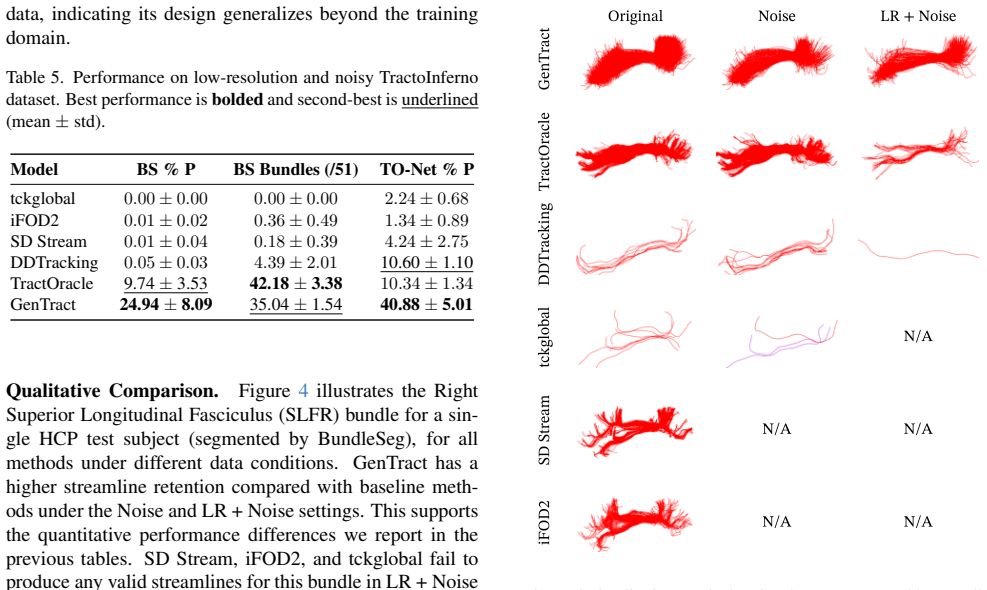
GenTract learns to sample streamlines directly from a conditional distribution over whole-brain fiber orientation data. A Transformer, conditioned on a learned embedding of the spherical-harmonic coefficients of the dMRI signal, generates the 3D coordinates of all points on a streamline in parallel, producing complete tractograms without any seeding mask. On an independent atlas-based precision metric, it reaches 61.95% versus 28.93% for the next-best baseline, and under low-resolution plus noise it retains 15.73% versus 1.12%, while recovering fewer of the 51 canonical bundles (36.6 vs 48.2). The authors attribute the precision gain to global conditioning and parallel generation, which avoi
What carries the argument
The central object is a conditional generative model: a Transformer that takes a learned embedding of the entire dMRI volume and a noise vector, and outputs the coordinates of all streamline points simultaneously. The conditioning tensor is built from per-coefficient autoencoders over spherical-harmonic fiber orientation volumes, fused by a shared class-conditioned encoder, and the Transformer uses self-attention over points along a streamline and cross-attention over the global context. This replaces the stepwise error propagation of local tracking and the energy optimization of classical global tractography with a single parallel sampling process, and removes the need for a seeding mask.
Load-bearing premise
The training target is a filtered tractogram restricted to 24 atlas bundles, so the model's high precision is measured against the same type of filtering and may exaggerate biological accuracy if that filtering omits genuine white-matter pathways.
What would settle it
Generate a tractogram on real clinical low-field data and have an independent anatomical expert mark false positives; if GenTract's precision falls to the same level as stepwise methods when scored against a 100-bundle atlas or expert consensus, the reported advantage is an artifact of the restricted training/filtering distribution.
If this is right
- Whole-brain tractograms can be generated in one forward pass, making global tractography fast enough for clinical use.
- Precision on noisy, low-resolution scans is an order of magnitude above the best existing baseline, suggesting connectivity mapping is feasible on routine clinical dMRI.
- Eliminating the seeding mask removes a major source of operator-dependent variability, improving reproducibility across sites and operators.
- Because both diffusion and flow-matching objectives work, the architecture can absorb advances in generative modeling without requiring a new tractography-specific design.
- The precision-versus-bundle-recall trade-off points to the training distribution as the limiting factor, not the generative formulation itself.
Where Pith is reading between the lines
- The reported precision gain likely reflects a strong prior over anatomically plausible bundles learned from the filtered 24-bundle training set; training on a broader, less filtered distribution would test whether the gain survives.
- The method's resilience to synthetic noise and resolution loss suggests it captures geometric priors rather than local signal patterns, which may transfer to other dMRI acquisition artifacts such as subject motion.
- The same global-conditioning design could be adapted to other streamline-like structure inference problems, such as vascular or neuronal reconstruction.
- A decisive validation would be a comparison on real low-field clinical scans, since synthetic degradation may not fully reproduce the characteristics of true clinical noise and blurring.
Editorial analysis
A structured set of objections, weighed in public.
Referee Report
Summary. The manuscript presents GenTract, a conditional generative model for whole-brain tractography. Diffusion-weighted MRI is represented as per-coefficient SH volumes, compressed by per-coefficient VAEs and a class-conditioned encoder into a latent tensor z; a transformer then generates streamline coordinates in parallel, trained with either a diffusion or flow-matching objective. The authors evaluate on HCP test subjects and an external TractoInferno dataset under original, noisy, and low-resolution+noisy conditions, comparing against classical local (iFOD2, SD Stream), RL-based (TractOracle), deep generative local (DDTracking), and classical global (tckglobal) baselines. They report that GenTract achieves substantially higher precision (BundleSeg and TO-Net) at the cost of lower bundle recall, and shows less degradation in low-quality settings.
Significance. The paper introduces a genuinely new paradigm—treating tractography as a single conditional generation step rather than local sequential tracking—and the empirical evaluation is more careful than typical in this area: the main comparison uses two independent evaluation tools (BundleSeg and TO-Net) that were not used to construct training targets, and it includes an external multi-site dataset. If the conditional-generation mechanism is shown to be genuinely driven by the dMRI conditioning, the work would be an important advance in robustness for tractography. The reported precision margins (2.1x over TractOracle on original HCP, order-of-magnitude under LR+noise) are striking. However, the missing conditioning ablation and the constrained training distribution are significant gaps that must be addressed before the central claims can be accepted.
major comments (3)
- [§4.2 and §5.3] The manuscript does not demonstrate that the anatomical conditioning tensor z actually drives the generated streamlines. All experiments condition on z; no ablation with zeroed, shuffled, or subject-mismatched z is reported. Because the training set itself is a strongly constrained distribution (PyAFQ-filtered 24-bundle tractograms), a model that ignores z and merely samples from the training prior could still score high BS % P in Table 2, since BundleSeg rewards bundle-like, atlas-aligned streamlines. This is load-bearing for the central claim of a 'conditional generative model' and 'direct mapping from dMRI to streamlines.' Please add an unconditional or mis-conditioned baseline (e.g., z=0, z from a different subject) and report the same metrics; without it, the reader cannot distinguish true conditioning from prior memorization.
- [§5.1, Table 2, §6] The abstract and Introduction describe the output as 'complete, anatomically plausible streamlines' and 'whole-brain tractograms,' but the training targets are PyAFQ-filtered tractograms restricted to 24 atlas bundles, and Table 2 shows GenTract recovers only 36.6/51 bundles on the BundleSeg atlas versus 48.2 for TractOracle. The Discussion (Section 6) correctly acknowledges a 'constrained bundle distribution,' but this contradicts the whole-brain framing. Please revise the claims to reflect the limited bundle coverage, or retrain/evaluate on an unfiltered or more complete training target.
- [§4.1] The conditioning encoder is a central component, but its output z is never validated. No reconstruction quality, latent-space analysis, or evidence that z encodes subject-specific anatomical information is provided. Without such validation, the reader cannot assess whether the global conditioning is meaningful or whether the VAE latents are effectively noise. At minimum, please report reconstruction metrics and show that z varies across subjects and correlates with known anatomy (e.g., bundle presence).
minor comments (6)
- [Abstract] The phrase '1.8x and 2.1x higher than the next-best methods, DDTracking and TractOracle, respectively' is inconsistent with Table 2: DDTracking's BS % P is 0.49 against GenTract's 61.95, a factor of ~126. Please correct this numerical error.
- [§5.2] The definition of precision as the percentage of streamlines retained by a filtering tool is acknowledged as a proxy, but the term 'True Positive' is somewhat misleading when no ground-truth tract exists; suggest renaming to 'retained' to avoid implying a biological ground truth.
- [§5.1] The text states that 'all streamline coordinates are min-max scaled to [-1,1] using statistics computed from the training set,' but it is not clear whether the same affine transformation is applied independently per subject; please clarify.
- [General] The paper repeatedly refers to the Supplementary Material for implementation details and statistical tests, but no supplementary material is included in the arXiv submission. Please ensure the supplementary is provided.
- [Table 2] DDTracking's bundle count (9.30) is much lower than other methods; since DDTracking is a deep generative local method, it may not be designed for whole-brain tractography. A sentence explaining this low recall would help.
- [§5.3] Model selection is performed on AFQ % P, which is the same filter used for training. Using an independent metric for configuration selection would strengthen the claim that the chosen architecture is not overfit to the training filter.
Circularity Check
Internal model selection is circular via the PyAFQ-only metric; the headline BS/TO-Net precision remains externally evaluated.
specific steps
-
self definitional
[Section 5.3, Table 1 (Internal Model Comparison Study); cf. Section 5.1]
"For the internal model comparisons, we evaluate tractograms using the PyAFQ filtering mechanism [16]. This is the same filtering mechanism used to filter the supervised training data, and we use this tool to calculate both precision (AFQ % P) and number of recovered bundles (AFQ Bundles, up to 24)."
Section 5.1 constructs the supervised target with the PyAFQ pipeline, so every training streamline is by definition a PyAFQ-retained streamline. The internal selection metric (AFQ % P) is the retention rate of that same filter. A model that memorizes the 24-bundle PyAFQ training distribution will score near 100% AFQ % P on in-distribution test subjects, making the metric a measure of reproducing the training filter rather than of dMRI-conditioned anatomical inference. The architecture choice in Table 1 is therefore selected to match the PyAFQ prior, and this selection propagates to all subsequent experiments.
full rationale
GenTract's central SOTA precision claim is not reduced to its training input by equation: Section 5.4 deliberately evaluates BS % P and TO-Net % P with tools not used to build the training targets (BundleSeg and TO-Net), and the Discussion acknowledges that no biological ground truth exists and that proxy evaluation tools can introduce their own biases. I find no load-bearing self-citation: the only author-overlapping reference ([4], a handbook chapter) is used for background, not to justify GenTract's design choices or uniqueness. However, there is one genuine circular step in the internal selection: Section 5.3 ranks architectures by AFQ % P, which is exactly the PyAFQ filtering mechanism that generated the supervised training distribution in Section 5.1. On in-distribution test subjects, reproducing the PyAFQ-filtered 24-bundle prior yields high AFQ % P by construction, so the selected Diffusion M=8 n=256 configuration is partly chosen to fit the training filter rather than by independent anatomical evidence. The headline results use independent metrics, so the circularity is partial and limited to model selection; the residual risk that BundleSeg and TO-Net reward the same canonical-bundle geometry the model was trained on is a construct-overlap limitation rather than a strict definitional reduction.
Axiom & Free-Parameter Ledger
free parameters (3)
- Model configuration (M=8 transformer layers, n=256 embedding, 10 DDIM steps) =
M=8, n=256, 10 steps
- Synthetic degradation parameters (Rician noise σ=0.005, 3mm isotropic downsampling) =
σ=0.005, 3mm
- SH Lmax=6 (m=28 coefficients) =
28 coefficients
axioms (5)
- standard math The SH expansion f(θ,ϕ) ≈ Σ α_lk Y_l^k (Eq 1) adequately represents the fiber orientation distribution
- standard math Diffusion and flow matching objectives (Eqs 2,3) learn the conditional streamline distribution
- domain assumption PyAFQ-filtered tractograms restricted to 24 bundles are a valid supervision target for white-matter anatomy
- domain assumption BundleSeg and TO-Net are valid independent proxies for streamline plausibility
- ad hoc to paper The VAE latent z and fused tensor z (Section 4.1) preserve dMRI information sufficient for tractography
read the original abstract
Tractography is the process of inferring the trajectories of white-matter pathways in the brain from diffusion magnetic resonance imaging (dMRI). Local tractography methods, which construct streamlines by following local fiber orientation estimates stepwise through an image, are prone to error accumulation and high false positive rates, particularly on noisy or low-resolution data. In contrast, global methods, which attempt to optimize a collection of streamlines to maximize compatibility with underlying fiber orientation estimates, are computationally expensive. To address these challenges, we introduce GenTract, the first generative model for global tractography. We frame tractography as a generative task, learning a direct mapping from dMRI to complete, anatomically plausible streamlines. We compare both diffusion-based and flow matching paradigms and evaluate GenTract's performance against state-of-the-art baselines. Notably, GenTract achieves precision 1.8x and 2.1x higher than the next-best methods, DDTracking and TractOracle, respectively. This advantage becomes even more pronounced in challenging low-resolution and noisy settings, where it outperforms the closest competitor by a factor of 3.5. By producing tractograms with high precision on research-grade data while also maintaining reliability on imperfect, lower-resolution data, GenTract represents a promising solution for global tractography.
Figures



Reference graph
Works this paper leans on
-
[1]
Nvidia hopper h100 gpu: Scaling perfor- mance.IEEE Micro, 43(3), 2023
Jack Choquette. Nvidia hopper h100 gpu: Scaling perfor- mance.IEEE Micro, 43(3), 2023. 4
2023
-
[2]
Global tractogra- phy of multi-shell diffusion-weighted imaging data using a multi-tissue model.NeuroImage, 123, 2015
Daan Christiaens, Marco Reisert, Thijs Dhollander, Stefan Sunaert, Paul Suetens, and Frederik Maes. Global tractogra- phy of multi-shell diffusion-weighted imaging data using a multi-tissue model.NeuroImage, 123, 2015. 2, 3, 6
2015
-
[3]
Dipy, a library for the analysis of diffusion MRI data.Frontiers in Neuroinformatics, 8, 2014
Dipy Contributors, Eleftherios Garyfallidis, Matthew Brett, Bagrat Bagrat Amirbekian, Ariel Rokem, Stefan van der Walt, Maxime Descoteaux, and Ian Nimmo-Smith. Dipy, a library for the analysis of diffusion MRI data.Frontiers in Neuroinformatics, 8, 2014. 5
2014
-
[4]
Global tractogra- phy
Alessandro Daducci, Simona Schiavi, Daan Christiaens, Robert Smith, and Daniel C Alexander. Global tractogra- phy. InHandbook of Diffusion MR Tractography. Elsevier,
-
[5]
Deterministic and probabilistic trac- tography based on complex fibre orientation distributions
Maxime Descoteaux, Rachid Deriche, Thomas R Knosche, and Alfred Anwander. Deterministic and probabilistic trac- tography based on complex fibre orientation distributions. IEEE Transactions on Medical Imaging, 28(2), 2008. 1, 2, 6
2008
-
[6]
The early development of brain white matter: a review of imaging studies in fetuses, newborns and infants
Jessica Dubois, Ghislaine Dehaene-Lambertz, Sofya Ku- likova, Cyril Poupon, Petra S H ¨uppi, and Lucie Hertz- Pannier. The early development of brain white matter: a review of imaging studies in fetuses, newborns and infants. Neuroscience, 276, 2014. 1
2014
-
[7]
White matter in learning, cognition and psychiatric disorders.Trends in Neurosciences, 31(7), 2008
R Douglas Fields. White matter in learning, cognition and psychiatric disorders.Trends in Neurosciences, 31(7), 2008. 1
2008
-
[8]
A novel global tractography algorithm based on an adaptive spin glass model
Pierre Fillard, Cyril Poupon, and Jean-Franc ¸ois Mangin. A novel global tractography algorithm based on an adaptive spin glass model. InProceedings of the 12th International Conference on Medical Image Computing and Computer- Assisted Intervention. Springer, 2009. 2
2009
-
[9]
White matter and cognition: making the connection.Journal of Neuro- physiology, 116(5), 2016
Christopher M Filley and R Douglas Fields. White matter and cognition: making the connection.Journal of Neuro- physiology, 116(5), 2016. 1
2016
-
[10]
James Gholam, Phil Schmid, Joshua Ametepe, Alix Plum- ley, Leandro Beltrachini, Francesco Padormo, Rui Teixeira, Rafael OHalloran, Kaloian Petkov, Klaus Engel, et al. Diffu- sion Tensor MRI and Spherical-Deconvolution-Based Trac- tography on an Ultra-Low Field Portable MRI System.arXiv preprint arXiv:2506.04473, 2025. 5
Pith/arXiv arXiv 2025
-
[11]
Maisi: Medi- cal ai for synthetic imaging
Pengfei Guo, Can Zhao, Dong Yang, Ziyue Xu, Vish- wesh Nath, Yucheng Tang, Benjamin Simon, Mason Belue, Stephanie Harmon, Baris Turkbey, et al. Maisi: Medi- cal ai for synthetic imaging. InProceedings of the 2025 IEEE/CVF Winter Conference on Applications of Computer Vision. IEEE, 2025. 3, 4
2025
-
[12]
Denoising diffu- sion probabilistic models.Advances in Neural Information Processing Systems, 33, 2020
Jonathan Ho, Ajay Jain, and Pieter Abbeel. Denoising diffu- sion probabilistic models.Advances in Neural Information Processing Systems, 33, 2020. 3
2020
-
[13]
A bayesian framework for global tractography
Saad Jbabdi, Mark W Woolrich, Jesper LR Andersson, and TEJ Behrens. A bayesian framework for global tractography. NeuroImage, 37(1), 2007. 2
2007
-
[14]
Diffusion MRI Fiber Tractography of the Brain.NMR in Biomedicine, 32(4), 2019
Ben Jeurissen, Maxime Descoteaux, Susumu Mori, and Alexander Leemans. Diffusion MRI Fiber Tractography of the Brain.NMR in Biomedicine, 32(4), 2019. 2
2019
-
[15]
Advancements in diffusion MRI tractography for neuro- surgery.Investigative Radiology, 59(1), 2024
Koji Kamagata, Christina Andica, Wataru Uchida, Kaito Takabayashi, Yuya Saito, Matthew Lukies, Akifumi Hagi- wara, Shohei Fujita, Toshiaki Akashi, Akihiko Wada, et al. Advancements in diffusion MRI tractography for neuro- surgery.Investigative Radiology, 59(1), 2024. 1
2024
-
[16]
Evaluating the reliability of human brain white matter trac- tometry.Aperture Neuro, 1(1), 2021
John Kruper, Jason D Yeatman, Adam Richie-Halford, David Bloom, Mareike Grotheer, Sendy Caffarra, Gregory Kiar, Iliana I Karipidis, Ethan Roy, Bramsh Q Chandio, et al. Evaluating the reliability of human brain white matter trac- tometry.Aperture Neuro, 1(1), 2021. 2, 5
2021
-
[17]
Filtering in tractography using autoen- coders (FINTA).Medical Image Analysis, 72, 2021
Jon Haitz Legarreta, Laurent Petit, Franc ¸ois Rheault, Guil- laume Theaud, Carl Lemaire, Maxime Descoteaux, and Pierre-Marc Jodoin. Filtering in tractography using autoen- coders (FINTA).Medical Image Analysis, 72, 2021. 5
2021
-
[18]
Yijie Li, Wei Zhang, Xi Zhu, Ye Wu, Yogesh Rathi, Lau- ren J O’Donnell, and Fan Zhang. DDTracking: A Deep Generative Framework for Diffusion MRI Tractography with Streamline Local-Global Spatiotemporal Modeling.arXiv preprint arXiv:2508.04568, 2025. 1, 2, 6
arXiv 2025
-
[19]
Flow Matching for Generative Modeling.arXiv preprint arXiv:2210.02747, 2022
Yaron Lipman, Ricky TQ Chen, Heli Ben-Hamu, Maxim- ilian Nickel, and Matt Le. Flow Matching for Generative Modeling.arXiv preprint arXiv:2210.02747, 2022. 3
Pith/arXiv arXiv 2022
-
[20]
Aging of cerebral white matter.Ageing Research Reviews, 34, 2017
Huan Liu, Yuanyuan Yang, Yuguo Xia, Wen Zhu, Rehana K Leak, Zhishuo Wei, Jianyi Wang, and Xiaoming Hu. Aging of cerebral white matter.Ageing Research Reviews, 34, 2017. 1
2017
-
[21]
The challenge of mapping the human con- nectome based on diffusion tractography.Nature Communi- cations, 8(1), 2017
Klaus H Maier-Hein, Peter F Neher, Jean-Christophe Houde, Marc-Alexandre Cˆot´e, Eleftherios Garyfallidis, Jidan Zhong, Maxime Chamberland, Fang-Cheng Yeh, Ying-Chia Lin, Qing Ji, et al. The challenge of mapping the human con- nectome based on diffusion tractography.Nature Communi- cations, 8(1), 2017. 1, 2
2017
-
[22]
A framework based on spin glass models for the inference of anatomical connec- tivity from diffusion-weighted MR data–a technical review
Jean-Franc ¸ois Mangin, Cyril Poupon, Yann Cointepas, De- nis Rivi`ere, Dimitri Papadopoulos-Orfanos, Chris A Clark, Jean R ´egis, and Denis Lrke Bihan. A framework based on spin glass models for the inference of anatomical connec- tivity from diffusion-weighted MR data–a technical review. NMR in Biomedicine: An International Journal Devoted to the Develo...
2002
-
[23]
Toward global tractography.NeuroImage, 80, 2013
Jean-Franc ¸ois Mangin, Pierre Fillard, Yann Cointepas, Denis Le Bihan, Vincent Frouin, and Cyril Poupon. Toward global tractography.NeuroImage, 80, 2013. 1
2013
-
[24]
Fiber tractography using machine learning.NeuroImage, 158,
Peter F Neher, Marc-Alexandre C ˆot´e, Jean-Christophe Houde, Maxime Descoteaux, and Klaus H Maier-Hein. Fiber tractography using machine learning.NeuroImage, 158,
-
[25]
Scalable diffusion models with transformers
William Peebles and Saining Xie. Scalable diffusion models with transformers. InProceedings of the IEEE/CVF Interna- tional Conference on Computer Vision, 2023. 4
2023
-
[26]
Walter HL Pinaya, Mark S Graham, Eric Kerfoot, Petru- Daniel Tudosiu, Jessica Dafflon, Virginia Fernandez, Pedro Sanchez, Julia Wolleb, Pedro F Da Costa, Ashay Patel, et al. Generative AI for medical imaging: extending the MONAI framework.arXiv preprint arXiv:2307.15208, 2023. 4
Pith/arXiv arXiv 2023
-
[27]
TractoInferno-A large-scale, open-source, multi-site database for machine learning dMRI tractography
Philippe Poulin, Guillaume Theaud, Francois Rheault, Eti- enne St-Onge, Arnaud Bore, Emmanuelle Renauld, Louis de Beaumont, Samuel Guay, Pierre-Marc Jodoin, and Maxime Descoteaux. TractoInferno-A large-scale, open-source, multi-site database for machine learning dMRI tractography. Scientific Data, 9(1), 2022. 5
2022
-
[28]
Global fiber reconstruction becomes practical.NeuroImage, 54(2), 2011
Marco Reisert, Irina Mader, Constantin Anastasopoulos, Matthias Weigel, Susanne Schnell, and Valerij Kiselev. Global fiber reconstruction becomes practical.NeuroImage, 54(2), 2011. 2
2011
-
[29]
Current challenges and opportunities for tractography
Francois Rheault, Philippe Poulin, Alex Valcourt Caron, Etienne St-Onge, Kurt G Schilling, Laurent Petit, Flavio Dell’Acqua, Alexander Leemans, and Maxime Descoteaux. Current challenges and opportunities for tractography. Handbook of Diffusion MR Tractography, 2025. 2, 3
2025
-
[30]
Prevalence of white matter pathways com- ing into a single white matter voxel orientation: The bottle- neck issue in tractography.Human Brain Mapping, 43(4),
Kurt G Schilling, Chantal MW Tax, Francois Rheault, Ben- nett A Landman, Adam W Anderson, Maxime Descoteaux, and Laurent Petit. Prevalence of white matter pathways com- ing into a single white matter voxel orientation: The bottle- neck issue in tractography.Human Brain Mapping, 43(4),
-
[31]
Sift: Spherical-deconvolution in- formed filtering of tractograms.NeuroImage, 67, 2013
Robert E Smith, Jacques-Donald Tournier, Fernando Cala- mante, and Alan Connelly. Sift: Spherical-deconvolution in- formed filtering of tractograms.NeuroImage, 67, 2013. 6
2013
-
[32]
Bundleseg: A versatile, reliable and reproducible approach to white matter bundle segmentation
Etienne St-Onge, Kurt G Schilling, and Francois Rheault. Bundleseg: A versatile, reliable and reproducible approach to white matter bundle segmentation. InInternational Work- shop on Computational Diffusion MRI. Springer, 2023. 5
2023
-
[33]
Track-to-learn: A general framework for tractography with deep reinforcement learn- ing.Medical Image Analysis, 72, 2021
Antoine Th ´eberge, Christian Desrosiers, Maxime De- scoteaux, and Pierre-Marc Jodoin. Track-to-learn: A general framework for tractography with deep reinforcement learn- ing.Medical Image Analysis, 72, 2021. 2, 5
2021
-
[34]
TractOracle: towards an anatomically-informed re- ward function for RL-based tractography
Antoine Th ´eberge, Maxime Descoteaux, and Pierre-Marc Jodoin. TractOracle: towards an anatomically-informed re- ward function for RL-based tractography. InProceedings of the International Conference on Medical Image Computing and Computer-Assisted Intervention. Springer, 2024. 1, 2, 6
2024
-
[35]
Improved probabilistic streamlines tractography by 2nd order integration over fibre orientation distributions
J Donald Tournier, Fernando Calamante, Alan Connelly, et al. Improved probabilistic streamlines tractography by 2nd order integration over fibre orientation distributions. In Proceedings of the International Society for Magnetic Reso- nance in Medicine. Stockholm, 2010. 1, 2, 6
2010
-
[36]
Mrtrix3: A fast, flexible and open software framework for medical image processing and visualisation.NeuroImage, 202, 2019
J Donald Tournier, Robert Smith, David Raffelt, Rami Tab- bara, Thijs Dhollander, Maximilian Pietsch, Daan Christi- aens, Ben Jeurissen, Chun-Hung Yeh, and Alan Connelly. Mrtrix3: A fast, flexible and open software framework for medical image processing and visualisation.NeuroImage, 202, 2019. 6
2019
-
[37]
The WU-Minn Human Con- nectome Project: an Overview.NeuroImage, 80, 2013
David C Van Essen, Stephen M Smith, Deanna M Barch, Timothy EJ Behrens, Essa Yacoub, Kamil Ugurbil, Wu- Minn HCP Consortium, et al. The WU-Minn Human Con- nectome Project: an Overview.NeuroImage, 80, 2013. 5
2013
-
[38]
Attention is all you need.Advances in Neural Information Processing Systems, 30, 2017
Ashish Vaswani, Noam Shazeer, Niki Parmar, Jakob Uszko- reit, Llion Jones, Aidan N Gomez, Łukasz Kaiser, and Illia Polosukhin. Attention is all you need.Advances in Neural Information Processing Systems, 30, 2017. 4
2017
-
[39]
Noise reduction in magni- tude diffusion-weighted images using spatial similarity and diffusion redundancy.Magnetic Resonance Imaging, 118,
Liming Yang and Yuanjun Wang. Noise reduction in magni- tude diffusion-weighted images using spatial similarity and diffusion redundancy.Magnetic Resonance Imaging, 118,
-
[40]
Think deep in the trac- tography game: deep learning for tractography computing and analysis.Brain Structure and Function, 230(6), 2025
Fan Zhang, Antoine Th ´eberge, Pierre-Marc Jodoin, Maxime Descoteaux, and Lauren J O’Donnell. Think deep in the trac- tography game: deep learning for tractography computing and analysis.Brain Structure and Function, 230(6), 2025. 2 10
2025
discussion (0)
Sign in with ORCID, Apple, or X to comment. Anyone can read and Pith papers without signing in.