REVIEW 4 major objections 6 minor 8 cited by
Distribution Matching Distillation Meets Reinforcement Learning
T0 review · 4 major / 6 minor · reviewed 2026-08-03 · deepseek-v4-flash
Pith's one-line read Jointly optimizing distribution-matching distillation and reinforcement learning lets a four-step image generator outperform the multi-step teacher it was distilled from.
desk verdict A genuinely useful DMD+RL recipe with a real evaluation-design flaw: the headline HP metric is also a training reward, so the 'surpass the teacher' claim needs held-out verification. read the letter →
The pith
A machine-rendered reading of the paper's core claim, the machinery that carries it, and where it could break.
The reading
What carries the argument
The load-bearing mechanism is the joint loss L = L_DMD + L_RL, where L_DMD is the time-averaged KL divergence between the student's synthetic distribution and the teacher's real distribution, written as the difference of two learned score functions, and L_RL is any differentiable or policy-gradient reward loss. The DMD term does two jobs at once: it distills the teacher's distribution into the few-step student and, during RL, it constantly re-anchors the student to the teacher's distribution, which is the proposed antidote to reward hacking. The RL term reshapes which modes the DMD process covers. The cold-start tools are DynaDG, a LoRA injected into the real-score estimator whose scale deca
What would settle it
Evaluate the trained four-step models with a human preference study or a reward model that was never used during training; if the preference advantage over the multi-step teacher shrinks to noise or images show collapse under the new judge, the mutual-benefit story is not confirmed. A second check: run the same RL branch without the DMD term but with standard regularization and compare reward curves and final image quality.
Extended reading notes
Core claim
The paper's central claim is that DMD and RL are not competing post-training stages but complementary objectives. RL supplies supervision the teacher does not contain, letting the few-step student land in higher-reward regions of image space and reshaping low-probability modes so they are not dropped during distillation; DMD, in turn, acts as a regularizer by pulling the student back toward the teacher's broad distribution at every joint-training step, which the paper argues is stronger protection against reward hacking than the pretrain or KL anchors used in conventional RL. The framework, DMDR, combines the standard DMD gradient—the difference of real and fake score functions—with a plug-a
Load-bearing premise
The argument assumes that the score model used to guide training also measures real quality, even though the same model reports the headline preference score.
Editorial extensions
If this is right
- Four-step DMDR models score above their multi-step teacher on DPG-Bench overall (e.g., 74.65 to 76.44 for SDXL-Base) and on GenEval (e.g., 0.62 to 0.64 for SD3-Medium) across all three base models.
- DMDR works with denoising-based and flow-based teachers and with three RL algorithms (ReFL, DPO, GRPO), so the joint-training recipe is not tied to one architecture or reward method.
- The approach is image-free: it needs no external real-image data or GAN discriminator, avoiding a data dependency and the instability of adversarial training.
- Using DMD loss as RL regularization yields more stable reward curves and visible resistance to reward hacking—e.g., no rasterized artifacts—compared with RL alone.
Reading between the lines
- A stricter test the paper leaves implicit: measure the trained four-step models with a preference model or human raters never used in training; the paper's headline HP Score comes from HPSv2.1, the same reward model that supplies the training signal.
- The DMD-as-regularizer idea may transfer beyond few-step distillation: any alignment pipeline whose reference distribution is weak or corrupted could use a live distribution-matching term against a strong teacher instead of a frozen reference model.
- If the reported gains hold under held-out rewards, the RL branch could substitute for the GAN branch in existing DMD2-style pipelines, giving an image-free route to teacher-surpassing few-step generation without adversarial instability.
- The quality-diversity trade-off the paper acknowledges suggests the same training recipe may need a diversity-aware reward or an explicit diversity regularizer before it can be applied to online RL methods that depend on diverse sample groups.
Editorial analysis
A structured set of objections, weighed in public.
Referee Report
Summary. The paper introduces DMDR, a training framework that combines Distribution Matching Distillation (DMD) with reinforcement learning (RL) for few-step text-to-image generation. It consists of two stages: a cold-start stage using vanilla DMD with two dynamic strategies (DynaDG and DynaRS), followed by joint DMD and RL optimization. The authors claim that RL provides supervision signals beyond the teacher model, allowing the few-step student to surpass the teacher, while DMD loss serves as a more effective regularizer than traditional RL regularizers, mitigating reward hacking. Experiments on SDXL-Base, SD3-Medium, and SD3.5-Large report state-of-the-art few-step performance on CLIP, Aesthetic, Pick, and HP scores, as well as overall improvements over the teacher on DPG-Bench and GenEval.
Significance. If validated, the contribution is significant: it offers an image-free route to few-step students that exceed their multi-step teacher, avoids GAN training instability, and demonstrates compatibility with different backbones and RL algorithms (ReFL, DPO, GRPO). The public code link and the ablations in Table 5 are assets. However, the current evidence is not fully convincing because the headline HP metric is also a training reward and all comparisons lack error bars and significance testing. The core idea of using the teacher distribution as a live regularizer during RL is plausible and worth developing, but the support would need to be strengthened for the claims to stand.
major comments (4)
- [§4.1, Table 1, Table 5] HPSv2.1 is used both as a training reward in the ReFL branch (§4.1) and as the HP Score metric reported in Table 1 and Table 5. The large HP gains (e.g., 32.87 vs 28.57 for SDXL 4-step) could be dominated by reward overfitting rather than general preference improvement. The paper's own Figure 9 shows reward-hacking artifacts for RL-only training, so the distinction matters. Please validate on a reward model not used in training (e.g., PickScore or human ratings), or at least report HP for a variant trained without HPSv2.1.
- [Tables 2-3, §5] All quantitative results are single-run point estimates with no error bars or significance tests. GenEval overall improvements are small (0.55→0.56, 0.62→0.64, 0.71→0.72) and several sub-metrics decline (e.g., SDXL-Base Color 0.85→0.84 and Position 0.15→0.11; SD3-Medium Count 0.63→0.54). The claim that DMDR 'consistently outperforms' the teacher is therefore not established beyond noise. The limitation section acknowledges these declines, but the abstract/conclusion state the stronger claim. Please provide multiple seeds and, ideally, confidence intervals.
- [§3.3, Eq. (2), Table 4] The two dynamic strategies are central to the cold start, but their schedules are only described qualitatively ('gradually weakens', 'progressively reduced'). The LoRA scale schedule, the renoise-bias schedule, and the loss coefficient between L_dmd and L_rl in Eq. (2) are not specified. Without these, the method cannot be reproduced or ablated by others. Please give concrete schedule equations or parameter values, and report the coefficient.
- [§3.2, Table 5, Figure 10] The mutual-benefit mechanism is supported only indirectly. Table 5 shows joint training improves over RL-only and distill-only, but does not isolate the regularization effect of DMD from simply having a larger total gradient. Figure 10 reports reward variance without quantitative statistics, and Table 6 shows reduced LPIPS diversity, which is not directly tied to reward hacking. A controlled comparison (same RL algorithm, matched update count, with and without DMD loss) would strengthen the central claim. Alternatively, temper the mechanistic conclusion.
minor comments (6)
- [Eq. (1)] The notation is garbled: `sreal(Ft)` and `sfake(Ft)` should be written as s_real(F_t) and s_fake(F_t). Please fix the equation formatting.
- [Figure 4] The figure labels are hard to parse, and the text 'which neglect' appears incomplete. Please revise the figure caption and labels for clarity.
- [Figure 10] The caption appears to label the two panels inconsistently with the text (the text says the DMD-regularized run has greater variance). Please clarify which panel corresponds to which condition.
- [Table 5] Please state which reward model(s) are used for the DPO and GRPO rows; presumably HPSv2.1, but it should be explicit.
- [Table 4 caption] There is a missing space: 'vanillaDMD' should be 'vanilla DMD'.
- [Abstract/Conclusion] Given the acknowledged sub-metric declines in §5, the 'surpass the teacher' claim should be qualified as metric-specific rather than stated globally.
Circularity Check
HPSv2.1 is both the RL training reward and the reported HP Score, so a headline evaluation metric is partly optimized by construction; the central claim still has independent benchmark support.
-
fitted input called prediction
[Section 4.1 (Experimental Setup), Section 4.2 (Table 1), Section 4.3 (Table 5); Eq. (2)]
"we use ReFL [55] with DFN-CLIP [13] and HPSv2.1 [53] as reward models by default. ... we report CLIP Score [17], Aesthetic Score [45], Pick Score [20], and Human Preference (HP) Score [53]."
HPSv2.1 is explicitly used as a reward model inside the RL branch that is jointly optimized with DMD (L = L_dmd + L_rl), and the same HPSv2.1 is then reported as the HP Score in Table 1 and used to support the claim of state-of-the-art human preference and of surpassing the multi-step teacher. The large HP gains (e.g., 32.87 vs 28.57 for SDXL 4-step) are therefore partly a direct consequence of optimizing that exact metric, not independent evidence of general preference improvement. The claim retains some independent content because DPG-Bench, GenEval, CLIP, Aesthetic, and Pick scores are not the HPSv2.1 training reward, but the HP-based part of the headline result is evaluation-circular.
full rationale
The paper's central methodological claim — that joint DMD+RL training is mutually beneficial — is supported by ablations and by benchmarks that are not identical to the training reward (DPG-Bench, GenEval, CLIP, Aesthetic, Pick). DMD and RL are combined through a genuine extra loss term, and the mutual-benefit argument is not definitionally forced. The only concrete circularity I can exhibit is evaluation-side: HPSv2.1 is both the default RL reward and the reported HP metric, so the prominent HP-score improvements and the associated 'state-of-the-art human preference' statements are partly produced by optimizing the evaluation function itself. This is a real reduction by construction for one headline metric, but it is not the whole derivation chain, and independent benchmarks partially ground the central claim. I therefore set the score below the threshold for central-claim circularity, but above a clean no-circularity score.
Assumptions & free parameters
free parameters (5)
- DynaDG LoRA scale schedule =
Not specified numerically
- DynaRS renoise bias schedule =
Not specified numerically
- Loss coefficient between L_dmd and L_rl =
Not specified
- Cold-start duration =
2K iterations in ablations
- Reward-model choice (DFN-CLIP, HPSv2.1) =
DFN-CLIP + HPSv2.1
assumptions (4)
- domain assumption The DMD gradient in Eq. (1), computed as the difference of two learned score estimators, is a valid approximation of the KL divergence between the fake and real distributions.
- domain assumption The pre-trained real score estimator and the online fake score estimator remain accurate enough during joint RL training for the DMD gradient to act as a regularizer.
- ad hoc to paper Injecting LoRA into the real score estimator (DynaDG) preserves a meaningful score-difference signal while pulling Preal toward Pfake.
- domain assumption Reward model scores (HPSv2.1 and DFN-CLIP) are reliable proxies for human preference at the few-step generation distribution.
Cite this review
Pith. "Pith review of Distribution Matching Distillation Meets Reinforcement Learning." pith.science (2026). https://pith.science/paper/R6H35SOK
@misc{pith2026251113649,
  author       = {Pith},
  title        = {Pith review of: Distribution Matching Distillation Meets Reinforcement Learning},
  year         = {2026},
  howpublished = {\url{https://pith.science/paper/R6H35SOK}},
  note         = {Machine review of arXiv:2511.13649}
}
read the original abstract
Distribution Matching Distillation (DMD) facilitates efficient inference by distilling multi-step diffusion models into few-step variants. Concurrently, Reinforcement Learning (RL) has emerged as a vital tool for aligning generative models with human preferences. While both represent critical post-training stages for large-scale diffusion models, existing studies typically treat them as independent, sequential processes, leaving a systematic framework for their unification largely unexplored. In this work, we demonstrate that jointly optimizing these two objectives yields mutual benefits: RL enables more preference-aware and controllable distillation rather than uniformly compressing the full data distribution, while DMD serves as an effective regularizer to mitigate reward hacking during RL training. Building on these insights, we propose DMDR, a unified framework that incorporates Reward-Tilted Distribution Matching optimization alongside two dynamic distillation training strategies in the initial stage, followed by the joint DMD and RL optimization in the second stage. Extensive experiments demonstrate that DMDR achieves state-of-the-art visual quality and prompt adherence among few-step generation methods, even surpassing the performance of its multi-step teacher model.
Figures
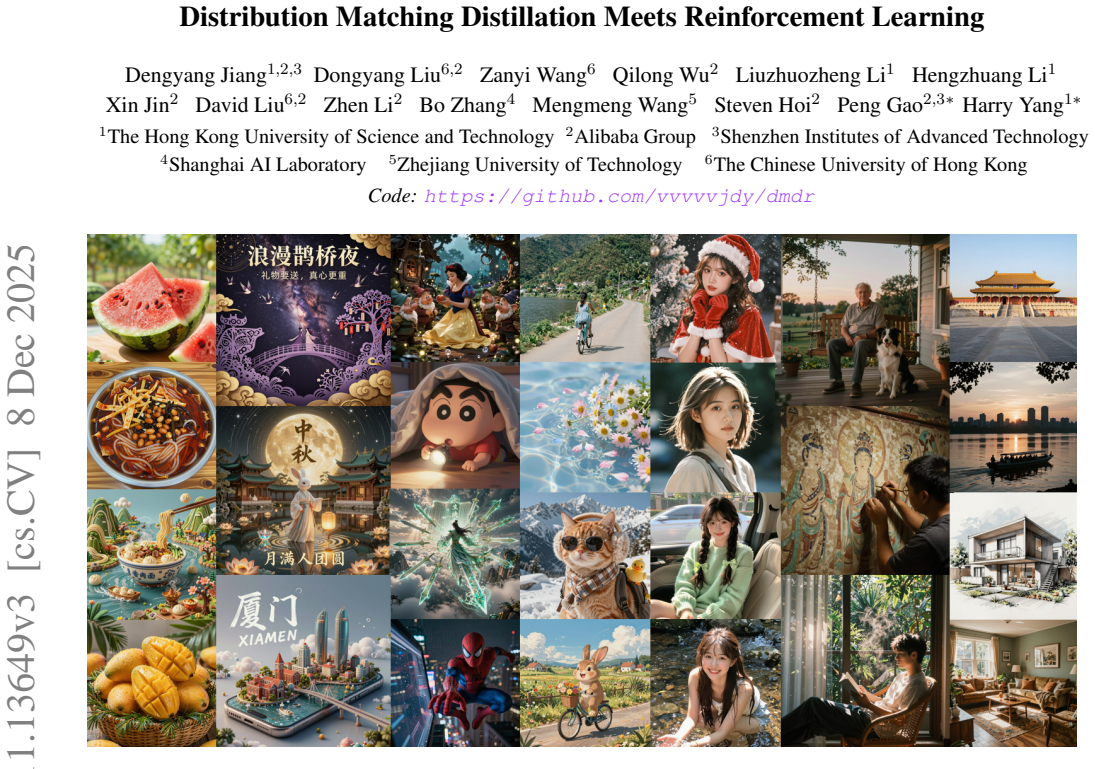


Figures from the paper (9 more)


Forward citations
Cited by 8 Pith papers
-
RL-Native Distillation: Exploiting Scored Trajectories for Few-Step Image Generation
REST co-trains a few-step, CFG-free student on the reward-scored rollout trajectories of an RL diffusion teacher, using advantage-weighted imitation to preserve reward gains.
-
DUET: A Diversity-Quality Duet of Distillation Experts for Two-Step Video Generation
DUET relays between an sCM expert at the high-noise step and a DMD expert at the low-noise step, obtaining both diversity and quality in two-step video generation, and DUET+ adds RL-based adaptation.
-
ScaleResfusion: Residual Rectified Flow based on Residual Vector Field
ScaleResfusion modifies rectified flow to start from a noisy low-quality image and learn only a residual velocity field, enabling 4-step image restoration with LoRA fine-tuning of billion-scale text-to-image models.
-
Twins: Learn to Predict Unified Representations with Focal Loss
Channel-wise concatenation of SigLIP2 and Flux VAE features into one token, trained with a focal-style flow-matching loss, yields a unified representation with 1.59 gFID on ImageNet 256 and VAE-level reconstruction.
-
Reward Lightning: Fast Video Generation via Homologous Preference Distillation
Homologous preference distillation evaluates adversarial distillation and latent reward alignment on identical latent features, yielding 1–4-step video generators that improve VBench by 2.1% while leading text, motion...
-
Cross-Resolution Distribution Matching for Diffusion Distillation
Cross-resolution distribution matching with logSNR timestep alignment and predicted-noise re-injection enables high-fidelity few-step multi-resolution cascaded diffusion distillation.
-
Z-Image: An Efficient Image Generation Foundation Model with Single-Stream Diffusion Transformer
Z-Image is an efficient 6B-parameter foundation model for image generation that rivals larger commercial systems in photorealism and bilingual text rendering through a new single-stream diffusion transformer and strea...
-
Optimizing Few-Step Generation with Adaptive Matching Distillation
Adaptive Matching Distillation uses reward-model scores to reweight teacher and fake-teacher gradients, improving few-step diffusion distillation on image and video benchmarks.
Reference graph
Works this paper leans on
-
[1]
Sd3.5.https : / / github
Stability AI. Sd3.5.https : / / github . com / Stability-AI/sd3.5, 2024. 6
2024
-
[2]
Martin Arjovsky and L ´eon Bottou. Towards principled methods for training generative adversarial networks.arXiv preprint arXiv:1701.04862, 2017. 2
arXiv 2017
-
[3]
Hmrishav Bandyopadhyay, Rahim Entezari, Jim Scott, Reshinth Adithyan, Yi-Zhe Song, and Varun Jampani. Sd3. 5-flash: Distribution-guided distillation of generative flows. arXiv preprint arXiv:2509.21318, 2025. 2
arXiv 2025
-
[4]
Training diffusion models with reinforce- ment learning.arXiv preprint arXiv:2305.13301, 2023
Kevin Black, Michael Janner, Yilun Du, Ilya Kostrikov, and Sergey Levine. Training diffusion models with reinforce- ment learning.arXiv preprint arXiv:2305.13301, 2023. 2
arXiv 2023
-
[5]
Flash diffusion: Accelerating any conditional diffusion model for few steps image generation
Clement Chadebec, Onur Tasar, Eyal Benaroche, and Ben- jamin Aubin. Flash diffusion: Accelerating any conditional diffusion model for few steps image generation. InProceed- ings of the AAAI Conference on Artificial Intelligence, pages 15686–15695, 2025. 2, 7
2025
-
[6]
Hansheng Chen, Kai Zhang, Hao Tan, Leonidas Guibas, Gordon Wetzstein, and Sai Bi. pi-flow: Policy-based few- step generation via imitation distillation.arXiv preprint arXiv:2510.14974, 2025. 2, 13
arXiv 2025
-
[7]
Junying Chen, Zhenyang Cai, Pengcheng Chen, Shunian Chen, Ke Ji, Xidong Wang, Yunjin Yang, and Benyou Wang. Sharegpt-4o-image: Aligning multimodal mod- els with gpt-4o-level image generation.arXiv preprint arXiv:2506.18095, 2025. 6, 7, 9
arXiv 2025
-
[8]
Junsong Chen, Shuchen Xue, Yuyang Zhao, Jincheng Yu, Sayak Paul, Junyu Chen, Han Cai, Song Han, and Enze Xie. Sana-sprint: One-step diffusion with continuous-time con- sistency distillation.arXiv preprint arXiv:2503.09641, 2025. 13
arXiv 2025
Show all 64 references
-
[9]
Pose: Phased one-step adversarial equilibrium for video diffusion models.arXiv preprint arXiv:2508.21019, 2025
Jiaxiang Cheng, Bing Ma, Xuhua Ren, Hongyi Jin, Kai Yu, Peng Zhang, Wenyue Li, Yuan Zhou, Tianxiang Zheng, and Qinglin Lu. Pose: Phased one-step adversarial equilibrium for video diffusion models.arXiv preprint arXiv:2508.21019, 2025. 13
2025
-
[10]
text-to-image-2m.https:// huggingface.co/datasets/jackyhate/text- to-image-2M, 2024
Hugging Face Open Data. text-to-image-2m.https:// huggingface.co/datasets/jackyhate/text- to-image-2M, 2024. 6
2024
-
[11]
Scaling recti- fied flow transformers for high-resolution image synthesis
Patrick Esser, Sumith Kulal, Andreas Blattmann, Rahim Entezari, Jonas M ¨uller, Harry Saini, Yam Levi, Dominik Lorenz, Axel Sauer, Frederic Boesel, et al. Scaling recti- fied flow transformers for high-resolution image synthesis. InForty-first international conference on machi...
-
[12]
Noise hypernetworks: Amortizing test-time compute in diffusion models.arXiv preprint arXiv:2508.09968, 2025
Luca Eyring, Shyamgopal Karthik, Alexey Dosovitskiy, Nataniel Ruiz, and Zeynep Akata. Noise hypernetworks: Amortizing test-time compute in diffusion models.arXiv preprint arXiv:2508.09968, 2025. 6
2025 arXiv
-
[13]
Data fil- tering networks.arXiv preprint arXiv:2309.17425, 2023
Alex Fang, Albin Madappally Jose, Amit Jain, Ludwig Schmidt, Alexander Toshev, and Vaishaal Shankar. Data fil- tering networks.arXiv preprint arXiv:2309.17425, 2023. 6
2023 arXiv
-
[14]
One step diffusion via shortcut models.arXiv preprint arXiv:2410.12557, 2024
Kevin Frans, Danijar Hafner, Sergey Levine, and Pieter Abbeel. One step diffusion via shortcut models.arXiv preprint arXiv:2410.12557, 2024. 13
2024 arXiv
-
[15]
Geneval: An object-focused framework for evaluating text- to-image alignment.Advances in Neural Information Pro- cessing Systems, 36:52132–52152, 2023
Dhruba Ghosh, Hannaneh Hajishirzi, and Ludwig Schmidt. Geneval: An object-focused framework for evaluating text- to-image alignment.Advances in Neural Information Pro- cessing Systems, 36:52132–52152, 2023. 6, 7
2023
-
[16]
Generative adversarial nets.Advances in neural information processing systems, 27, 2014
Ian Goodfellow, Jean Pouget-Abadie, Mehdi Mirza, Bing Xu, David Warde-Farley, Sherjil Ozair, Aaron Courville, and Yoshua Bengio. Generative adversarial nets.Advances in neural information processing systems, 27, 2014. 2, 13
2014
-
[17]
Clipscore: A reference-free evaluation met- ric for image captioning.arXiv preprint arXiv:2104.08718,
Jack Hessel, Ari Holtzman, Maxwell Forbes, Ronan Le Bras, and Yejin Choi. Clipscore: A reference-free evaluation met- ric for image captioning.arXiv preprint arXiv:2104.08718,
-
[18]
Lora: Low-rank adaptation of large language models.ICLR, 1(2):3, 2022
Edward J Hu, Yelong Shen, Phillip Wallis, Zeyuan Allen- Zhu, Yuanzhi Li, Shean Wang, Lu Wang, Weizhu Chen, et al. Lora: Low-rank adaptation of large language models.ICLR, 1(2):3, 2022. 5
2022
-
[19]
Ella: Equip diffusion models with llm for enhanced semantic alignment.arXiv preprint arXiv:2403.05135, 2024
Xiwei Hu, Rui Wang, Yixiao Fang, Bin Fu, Pei Cheng, and Gang Yu. Ella: Equip diffusion models with llm for enhanced semantic alignment.arXiv preprint arXiv:2403.05135, 2024. 6, 7
2024 arXiv
-
[20]
Pick-a-pic: An open dataset of user preferences for text-to-image generation.Ad- vances in neural information processing systems, 36:36652– 36663, 2023
Yuval Kirstain, Adam Polyak, Uriel Singer, Shahbuland Ma- tiana, Joe Penna, and Omer Levy. Pick-a-pic: An open dataset of user preferences for text-to-image generation.Ad- vances in neural information processing systems, 36:36652– 36663, 2023. 6
2023
-
[21]
Flux.https://github.com/ black-forest-labs/flux, 2024
Black Forest Labs. Flux.https://github.com/ black-forest-labs/flux, 2024. 1
2024
-
[22]
Animatediff-lightning: Cross-model diffusion distillation.arXiv preprint arXiv:2403.12706, 2024
Shanchuan Lin and Xiao Yang. Animatediff-lightning: Cross-model diffusion distillation.arXiv preprint arXiv:2403.12706, 2024. 13
2024 arXiv
-
[23]
Sdxl- lightning: Progressive adversarial diffusion distillation
Shanchuan Lin, Anran Wang, and Xiao Yang. Sdxl- lightning: Progressive adversarial diffusion distillation. arXiv preprint arXiv:2402.13929, 2024. 7
2024 arXiv
-
[24]
Diffusion adversarial post-training for one-step video generation.arXiv preprint arXiv:2501.08316,
Shanchuan Lin, Xin Xia, Yuxi Ren, Ceyuan Yang, Xuefeng Xiao, and Lu Jiang. Diffusion adversarial post-training for one-step video generation.arXiv preprint arXiv:2501.08316,
-
[25]
Autoregressive adversarial post-training for real-time inter- active video generation.arXiv preprint arXiv:2506.09350,
Shanchuan Lin, Ceyuan Yang, Hao He, Jianwen Jiang, Yuxi Ren, Xin Xia, Yang Zhao, Xuefeng Xiao, and Lu Jiang. Autoregressive adversarial post-training for real-time inter- active video generation.arXiv preprint arXiv:2506.09350,
-
[26]
Flow-grpo: Training flow matching models via on- line rl.arXiv preprint arXiv:2505.05470, 2025
Jie Liu, Gongye Liu, Jiajun Liang, Yangguang Li, Jiaheng Liu, Xintao Wang, Pengfei Wan, Di Zhang, and Wanli Ouyang. Flow-grpo: Training flow matching models via on- line rl.arXiv preprint arXiv:2505.05470, 2025. 2, 4, 5, 8
2025 arXiv
-
[27]
Simplifying, stabilizing and scaling continuous-time consistency models.arXiv preprint arXiv:2410.11081, 2024
Cheng Lu and Yang Song. Simplifying, stabilizing and scaling continuous-time consistency models.arXiv preprint arXiv:2410.11081, 2024. 13
2024 arXiv
-
[28]
Adversarial distribution matching for diffusion distil- lation towards efficient image and video synthesis.arXiv preprint arXiv:2507.18569, 2025
Yanzuo Lu, Yuxi Ren, Xin Xia, Shanchuan Lin, Xing Wang, Xuefeng Xiao, Andy J Ma, Xiaohua Xie, and Jian-Huang Lai. Adversarial distribution matching for diffusion distil- lation towards efficient image and video synthesis.arXiv preprint arXiv:2507.18569, 2025. 2, 6
2025 arXiv
-
[29]
Hyper-bagel: A unified acceleration framework for multimodal understand- ing and generation.arXiv preprint arXiv:2509.18824, 2025
Yanzuo Lu, Xin Xia, Manlin Zhang, Huafeng Kuang, Jian- bin Zheng, Yuxi Ren, and Xuefeng Xiao. Hyper-bagel: A unified acceleration framework for multimodal understand- ing and generation.arXiv preprint arXiv:2509.18824, 2025. 6
2025
-
[30]
Knowledge distillation in iterative generative models for improved sampling speed
Eric Luhman and Troy Luhman. Knowledge distillation in iterative generative models for improved sampling speed. arXiv preprint arXiv:2101.02388, 2021. 13
2021 arXiv
-
[31]
Latent consistency models: Synthesizing high- resolution images with few-step inference.arXiv preprint arXiv:2310.04378, 2023
Simian Luo, Yiqin Tan, Longbo Huang, Jian Li, and Hang Zhao. Latent consistency models: Synthesizing high- resolution images with few-step inference.arXiv preprint arXiv:2310.04378, 2023. 2, 7, 13
2023 arXiv
-
[32]
Diff-instruct++: Training one-step text-to- image generator model to align with human preferences
Weijian Luo. Diff-instruct++: Training one-step text-to- image generator model to align with human preferences. arXiv preprint arXiv:2410.18881, 2024. 6
2024 arXiv
-
[33]
Diff-instruct: A universal approach for transferring knowledge from pre-trained diffu- sion models.Advances in Neural Information Processing Systems, 36:76525–76546, 2023
Weijian Luo, Tianyang Hu, Shifeng Zhang, Jiacheng Sun, Zhenguo Li, and Zhihua Zhang. Diff-instruct: A universal approach for transferring knowledge from pre-trained diffu- sion models.Advances in Neural Information Processing Systems, 36:76525–76546, 2023. 2
2023
-
[34]
Learning few-step diffusion models by trajectory distribution matching.arXiv preprint arXiv:2503.06674,
Yihong Luo, Tianyang Hu, Jiacheng Sun, Yujun Cai, and Jing Tang. Learning few-step diffusion models by trajectory distribution matching.arXiv preprint arXiv:2503.06674,
-
[35]
Which training methods for gans do actually converge? In International conference on machine learning, pages 3481–
Lars Mescheder, Andreas Geiger, and Sebastian Nowozin. Which training methods for gans do actually converge? In International conference on machine learning, pages 3481–
-
[36]
Scalable diffusion models with transformers
William Peebles and Saining Xie. Scalable diffusion models with transformers. InProceedings of the IEEE/CVF inter- national conference on computer vision, pages 4195–4205,
-
[37]
Sdxl: Improving latent diffusion mod- els for high-resolution image synthesis.arXiv preprint arXiv:2307.01952, 2023
Dustin Podell, Zion English, Kyle Lacey, Andreas Blattmann, Tim Dockhorn, Jonas M ¨uller, Joe Penna, and Robin Rombach. Sdxl: Improving latent diffusion mod- els for high-resolution image synthesis.arXiv preprint arXiv:2307.01952, 2023. 1, 6
2023 arXiv
-
[38]
Dreamfusion: Text-to-3d using 2d diffusion.arXiv preprint arXiv:2209.14988, 2022
Ben Poole, Ajay Jain, Jonathan T Barron, and Ben Milden- hall. Dreamfusion: Text-to-3d using 2d diffusion.arXiv preprint arXiv:2209.14988, 2022. 2
2022 arXiv
-
[39]
Lumina-image 2.0: A unified and efficient image generative framework.arXiv preprint arXiv:2503.21758, 2025
Qi Qin, Le Zhuo, Yi Xin, Ruoyi Du, Zhen Li, Bin Fu, Yit- ing Lu, Xinyue Li, Dongyang Liu, Xiangyang Zhu, et al. Lumina-image 2.0: A unified and efficient image generative framework.arXiv preprint arXiv:2503.21758, 2025. 1
2025 arXiv
-
[40]
Hyper-sd: Trajectory segmented consistency model for efficient image synthesis
Yuxi Ren, Xin Xia, Yanzuo Lu, Jiacheng Zhang, Jie Wu, Pan Xie, Xing Wang, and Xuefeng Xiao. Hyper-sd: Trajectory segmented consistency model for efficient image synthesis. arXiv preprint arXiv:2404.13686, 2024. 2, 5, 6, 7, 13
2024 arXiv
-
[41]
Stabilizing training of generative adver- sarial networks through regularization.Advances in neural information processing systems, 30, 2017
Kevin Roth, Aurelien Lucchi, Sebastian Nowozin, and Thomas Hofmann. Stabilizing training of generative adver- sarial networks through regularization.Advances in neural information processing systems, 30, 2017. 13
2017
-
[42]
Improved techniques for training gans.Advances in neural information processing systems, 29, 2016
Tim Salimans, Ian Goodfellow, Wojciech Zaremba, Vicki Cheung, Alec Radford, and Xi Chen. Improved techniques for training gans.Advances in neural information processing systems, 29, 2016. 2, 13
2016
-
[43]
Fast high- resolution image synthesis with latent adversarial diffusion distillation
Axel Sauer, Frederic Boesel, Tim Dockhorn, Andreas Blattmann, Patrick Esser, and Robin Rombach. Fast high- resolution image synthesis with latent adversarial diffusion distillation. InSIGGRAPH Asia 2024 Conference Papers, pages 1–11, 2024. 6, 7, 13
2024
-
[44]
Adversarial diffusion distillation
Axel Sauer, Dominik Lorenz, Andreas Blattmann, and Robin Rombach. Adversarial diffusion distillation. InEuropean Conference on Computer Vision, pages 87–103. Springer,
-
[45]
Laion-5b: An open large-scale dataset for training next generation image-text models.Advances in neural in- formation processing systems, 35:25278–25294, 2022
Christoph Schuhmann, Romain Beaumont, Richard Vencu, Cade Gordon, Ross Wightman, Mehdi Cherti, Theo Coombes, Aarush Katta, Clayton Mullis, Mitchell Worts- man, et al. Laion-5b: An open large-scale dataset for training next generation image-text models.Advances in neural in- fo...
2022
-
[46]
Seedream 4.0: Toward next- generation multimodal image generation.arXiv preprint arXiv:2509.20427, 2025
Team Seedream, Yunpeng Chen, Yu Gao, Lixue Gong, Meng Guo, Qiushan Guo, Zhiyao Guo, Xiaoxia Hou, Weilin Huang, Yixuan Huang, et al. Seedream 4.0: Toward next- generation multimodal image generation.arXiv preprint arXiv:2509.20427, 2025. 2
2025 arXiv
-
[47]
Directly aligning the full diffusion tra- jectory with fine-grained human preference.arXiv preprint arXiv:2509.06942, 2025
Xiangwei Shen, Zhimin Li, Zhantao Yang, Shiyi Zhang, Yingfang Zhang, Donghao Li, Chunyu Wang, Qinglin Lu, and Yansong Tang. Directly aligning the full diffusion tra- jectory with fine-grained human preference.arXiv preprint arXiv:2509.06942, 2025. 2, 5, 9
2025 arXiv
-
[48]
Score-based generative modeling through stochastic differential equa- tions.arXiv preprint arXiv:2011.13456, 2020
Yang Song, Jascha Sohl-Dickstein, Diederik P Kingma, Ab- hishek Kumar, Stefano Ermon, and Ben Poole. Score-based generative modeling through stochastic differential equa- tions.arXiv preprint arXiv:2011.13456, 2020. 2
2011 arXiv
-
[49]
Z-image: An efficient image generation foundation model with single-stream diffusion transformer
Z-Image Team. Z-image: An efficient image generation foundation model with single-stream diffusion transformer. arXiv preprint arXiv:2511.22699, 2025. 1, 3
2025 arXiv
-
[50]
Diffusion model align- ment using direct preference optimization
Bram Wallace, Meihua Dang, Rafael Rafailov, Linqi Zhou, Aaron Lou, Senthil Purushwalkam, Stefano Ermon, Caiming Xiong, Shafiq Joty, and Nikhil Naik. Diffusion model align- ment using direct preference optimization. InProceedings of the IEEE/CVF Conference on Computer Vision an...
2024
-
[51]
Prolificdreamer: High-fidelity and diverse text-to-3d generation with variational score distilla- tion.Advances in neural information processing systems, 36: 8406–8441, 2023
Zhengyi Wang, Cheng Lu, Yikai Wang, Fan Bao, Chongxuan Li, Hang Su, and Jun Zhu. Prolificdreamer: High-fidelity and diverse text-to-3d generation with variational score distilla- tion.Advances in neural information processing systems, 36: 8406–8441, 2023. 2
2023
-
[52]
Rewarddance: Reward scaling in visual generation.arXiv preprint arXiv:2509.08826, 2025
Jie Wu, Yu Gao, Zilyu Ye, Ming Li, Liang Li, Hanzhong Guo, Jie Liu, Zeyue Xue, Xiaoxia Hou, Wei Liu, et al. Rewarddance: Reward scaling in visual generation.arXiv preprint arXiv:2509.08826, 2025. 9
2025 arXiv
-
[53]
Human preference score v2: A solid benchmark for evaluating human preferences of text-to-image synthesis.arXiv preprint arXiv:2306.09341,
Xiaoshi Wu, Yiming Hao, Keqiang Sun, Yixiong Chen, Feng Zhu, Rui Zhao, and Hongsheng Li. Human preference score v2: A solid benchmark for evaluating human preferences of text-to-image synthesis.arXiv preprint arXiv:2306.09341,
-
[54]
Deep reward supervisions for tuning text-to-image diffusion models
Xiaoshi Wu, Yiming Hao, Manyuan Zhang, Keqiang Sun, Zhaoyang Huang, Guanglu Song, Yu Liu, and Hongsheng Li. Deep reward supervisions for tuning text-to-image diffusion models. InEuropean Conference on Computer Vision, pages 108–124. Springer, 2024. 9
2024
-
[55]
Imagere- ward: Learning and evaluating human preferences for text- to-image generation.Advances in Neural Information Pro- cessing Systems, 36:15903–15935, 2023
Jiazheng Xu, Xiao Liu, Yuchen Wu, Yuxuan Tong, Qinkai Li, Ming Ding, Jie Tang, and Yuxiao Dong. Imagere- ward: Learning and evaluating human preferences for text- to-image generation.Advances in Neural Information Pro- cessing Systems, 36:15903–15935, 2023. 2, 4, 5, 6, 8, 9
2023
-
[56]
One-step diffu- sion models withf-divergence distribution matching.arXiv preprint arXiv:2502.15681, 2025
Yilun Xu, Weili Nie, and Arash Vahdat. One-step diffu- sion models withf-divergence distribution matching.arXiv preprint arXiv:2502.15681, 2025. 2
2025 arXiv
-
[57]
Dancegrpo: Unleashing grpo on visual generation.arXiv preprint arXiv:2505.07818, 2025
Zeyue Xue, Jie Wu, Yu Gao, Fangyuan Kong, Lingting Zhu, Mengzhao Chen, Zhiheng Liu, Wei Liu, Qiushan Guo, Weilin Huang, et al. Dancegrpo: Unleashing grpo on visual generation.arXiv preprint arXiv:2505.07818, 2025. 2
2025 arXiv
-
[58]
Magic 1-for-1: Generating one minute video clips within one minute.arXiv preprint arXiv:2502.07701, 2025
Hongwei Yi, Shitong Shao, Tian Ye, Jiantong Zhao, Qingyu Yin, Michael Lingelbach, Li Yuan, Yonghong Tian, Enze Xie, and Daquan Zhou. Magic 1-for-1: Generating one minute video clips within one minute.arXiv preprint arXiv:2502.07701, 2025. 4, 5
2025 arXiv
-
[59]
Im- proved distribution matching distillation for fast image syn- thesis.Advances in neural information processing systems, 37:47455–47487, 2024
Tianwei Yin, Micha ¨el Gharbi, Taesung Park, Richard Zhang, Eli Shechtman, Fredo Durand, and Bill Freeman. Im- proved distribution matching distillation for fast image syn- thesis.Advances in neural information processing systems, 37:47455–47487, 2024. 2, 4, 6, 7, 9
2024
-
[60]
One-step diffusion with distribution matching distillation
Tianwei Yin, Micha ¨el Gharbi, Richard Zhang, Eli Shecht- man, Fredo Durand, William T Freeman, and Taesung Park. One-step diffusion with distribution matching distillation. In Proceedings of the IEEE/CVF conference on computer vi- sion and pattern recognition, pages 6613–6623...
2024
-
[61]
The unreasonable effectiveness of deep features as a perceptual metric
Richard Zhang, Phillip Isola, Alexei A Efros, Eli Shecht- man, and Oliver Wang. The unreasonable effectiveness of deep features as a perceptual metric. InProceedings of the IEEE conference on computer vision and pattern recogni- tion, pages 586–595, 2018. 9
2018
-
[62]
Prospect: Prompt spectrum for attribute-aware personalization of diffusion models.ACM Transactions on Graphics (TOG), 42(6):1–14, 2023
Yuxin Zhang, Weiming Dong, Fan Tang, Nisha Huang, Haibin Huang, Chongyang Ma, Tong-Yee Lee, Oliver Deussen, and Changsheng Xu. Prospect: Prompt spectrum for attribute-aware personalization of diffusion models.ACM Transactions on Graphics (TOG), 42(6):1–14, 2023. 6
2023
-
[63]
Towards highly realistic artistic style transfer via stable diffusion with step-aware and layer-aware prompt.arXiv preprint arXiv:2404.11474, 2024
Zhanjie Zhang, Quanwei Zhang, Huaizhong Lin, Wei Xing, Juncheng Mo, Shuaicheng Huang, Jinheng Xie, Guangyuan Li, Junsheng Luan, Lei Zhao, et al. Towards highly realistic artistic style transfer via stable diffusion with step-aware and layer-aware prompt.arXiv preprint arXiv:24...
2024 arXiv
-
[64]
Large scale diffusion distillation via score-regularized continuous-time consistency.arXiv preprint arXiv:2510.08431, 2025
Kaiwen Zheng, Yuji Wang, Qianli Ma, Huayu Chen, Jin- tao Zhang, Yogesh Balaji, Jianfei Chen, Ming-Yu Liu, Jun Zhu, and Qinsheng Zhang. Large scale diffusion distillation via score-regularized continuous-time consistency.arXiv preprint arXiv:2510.08431, 2025. 13 Appendix A. Mor...
2025 arXiv
Reviewed August 3, 2026 · model on record in the stance chip above.
Discussion (0). Continue with ORCID to comment.