REVIEW 3 major objections 5 minor 64 references
Scoring preferences and distillation on the same latent features lets video models stay aligned while cutting sampling to 1–4 steps.
Reviewed by Pith at T0; open to challenge. T0 means a machine referee read the full paper against a public rubric. the ladder, T0–T4 →
T0 review · grok-4.5
2026-07-11 22:43 UTC pith:WK2ZSWUG
load-bearing objection Solid engineering fix for joint preference+distillation in video diffusion: shared latent backbone + dual heads + adaptive λ actually moves the numbers, with the usual closed-stack caveats. the 3 major comments →
Reward Lightning: Fast Video Generation via Homologous Preference Distillation
The pith
A machine-rendered reading of the paper's core claim, the machinery that carries it, and where it could break.
Core claim
When preference alignment and adversarial distillation are both evaluated on identical latent features through a shared backbone (structural and space homology), their gradients become sufficiently aligned that a single multi-objective update can produce few-step generators that remain both high-fidelity and human-aligned, rather than forcing a trade-off.
What carries the argument
Homologous Preference Distillation (HPD): a frozen latent reward backbone plus parallel reward and discriminator heads that score the same intermediate flow state; an adaptive weight then gates the preference loss so it only activates once the generator is already realistic.
Load-bearing premise
That a frozen latent reward model, trained once on multi-margin pairs that include few-step samples, continues to supply reliable preference gradients throughout distillation without online re-training or pixel-space checks.
What would settle it
Train the same generator with a pixel-space reward on identical data and steps; if the cosine similarity of the two gradients stays near zero or negative and the 1–4-step VBench scores fail to exceed pure-distillation baselines by the claimed margin, the homology claim fails.
If this is right
- Few-step (1–4 NFE) video generators can match or exceed multi-step baselines on text alignment, motion quality, and visual quality without a separate preference stage.
- Latent-space reward models become preferable to pixel-space ones for joint acceleration and alignment because they eliminate VAE decoding cost and keep gradients on one manifold.
- Adaptive preference weighting that waits for structural realism can replace fixed linear combinations of distillation and reward losses.
- The same shared-backbone pattern can be dropped onto other distillation recipes (consistency models, distribution matching) to raise their preference scores.
Where Pith is reading between the lines
- If homology is the real bottleneck, any future multi-objective diffusion post-training (safety, style, multi-modal) should default to shared latent features rather than cross-space linear sums.
- The need for few-step augmentation in the reward dataset implies that reward models trained only on multi-step samples will systematically mis-score aggressive distillation trajectories.
- Cross-VAE latent incompatibility noted by the authors suggests a latent-space converter could turn one trained LRM into a universal preference oracle for many generators.
Editorial analysis
A structured set of objections, weighed in public.
Referee Report
Summary. The paper proposes Reward Lightning, a framework for joint preference alignment and few-step distillation of video diffusion (flow-matching) models. Its central idea is homology: both the adversarial distillation objective and the preference (ReFL-style) objective are evaluated on identical latent features extracted by a shared backbone. A Latent Reward Model (LRM) is first trained on a multi-margin preference dataset (intra-model, inter-model, real-synthetic, and few-step-augmented pairs) with a time-modulated attention head and Bradley-Terry-with-Ties loss plus dynamic margin clipping. Homologous Preference Distillation (HPD) then freezes this LRM, initializes a discriminator head from the reward head, and jointly optimizes a few-step generator with an adaptive preference weight that gates ReFL by discriminator loss. Experiments on Wan2.2-14B report LRM preference accuracy gains of ~11–14.7% on OOD benchmarks and 1–4 NFE generators that improve average VBench by ~2.1% while leading text alignment, motion quality, and visual quality, with supporting gradient-cosine, ablation, and human-preference results.
Significance. If the results hold, the work offers a practical and conceptually clean route to simultaneous acceleration and human alignment for large video generators, an open and industrially relevant problem. The explicit framing of structural and space homology as an implicit gradient regularizer, the latent-space reward design that avoids VAE decoding, the multi-margin dataset with few-step augmentation, and the adaptive λ schedule are concrete engineering contributions. Strengths include extensive ablations (dataset composition, head architecture, regularization, head initialization, adaptive weight), gradient-conflict measurements (cosine similarity rising to +0.41 under homology), human preference votes, and a cross-backbone check on HYVideo1.5. These elements make the paper a useful reference for joint RLHF–distillation pipelines even if some mechanistic claims require tighter validation.
major comments (3)
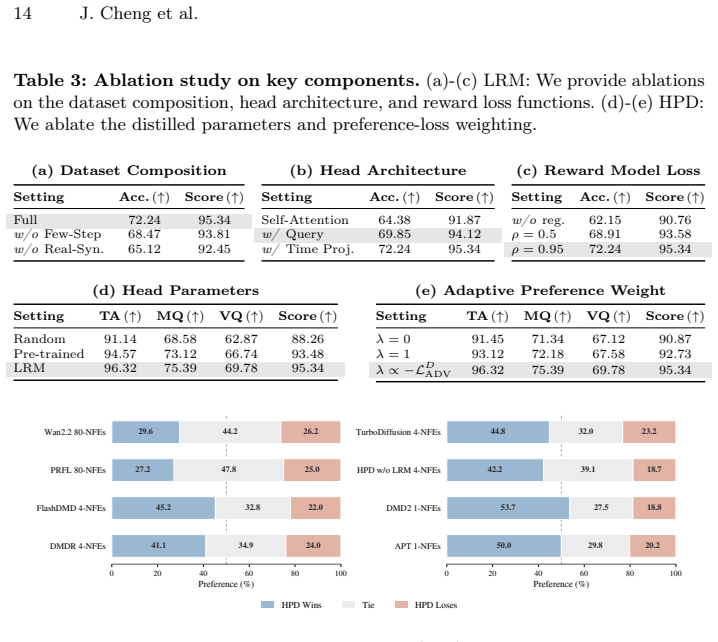
- The central homology claim (§3.3, Alg. 1 lines 14–18, Eqs. 8–10, Tab. 4-a) rests on a frozen LRM continuing to supply correctly ordered, non-hackable preference gradients for every intermediate state the generator produces under 1–4 NFE sampling. The paper shows high static OOD accuracy (Tab. 1) and final VBench gains (Tab. 2), but does not report online reward-ranking fidelity, reward-vs-step curves, or correlation between LRM scores and human judgments on the evolving generator distribution. Without such diagnostics, it remains possible that the observed gains are driven mainly by the adversarial term (or by the few-step augmentation acting as a distillation regularizer) rather than by sustained preference gradients, which would weaken the causal attribution to homology.
- Quantitative claims lack uncertainty quantification. Tables 1–4 and the human evaluation (Fig. 5) report point estimates only; no standard deviations across seeds, confidence intervals, or multiple independent runs are given for preference accuracy, VBench dimensions, cosine similarity, or win rates. Given the free parameters (λ schedule, BTT k=5, EMA ρ=0.95, learning rates, 2000-step budget) and the known variance of video generation metrics, the reported +2.1% average and leadership on TA/MQ/VQ cannot be assessed for statistical reliability.
- The comparison set for joint preference+distillation methods is narrow and partially self-reproduced (DMDR, FlashDMD on Wan2.2; TurboDiffusion is the main external few-step baseline). Sequential ablations (Tab. 7) are useful but still leave open whether a carefully tuned two-stage pipeline with the same LRM would close most of the gap. A stronger external joint baseline or a controlled sequential-vs-joint experiment with matched compute and the identical frozen LRM would better isolate the contribution of simultaneous homologous training.
minor comments (5)
- Notation for the adaptive weight is inconsistent: Eq. (10) writes LHPD = LG_ADV + λ · LReFL while Alg. 1 line 18 writes LG_ADV − λ · LReFL; the sign of LReFL (defined as −R) should be clarified once and used uniformly.
- Fig. 2 is dense; the multi-margin dataset panel and the dual-head routing would benefit from a clearer legend and larger type so that the homology (shared Ft) is immediately visible.
- The BTT formulation and the value k=5.0 are deferred to the appendix; a short statement of the three-outcome probabilities and the chosen k in the main text (near Eq. 7) would help readers without forcing a jump.
- Limitations (Appendix E) correctly note VAE-specific latent spaces; a brief forward pointer in the main conclusion would set expectations for cross-architecture use.
- Typos and minor wording: “VisionRewrd” in Tab. 1; occasional missing spaces around citations; “w/o reg.” vs “ρ=0.5” formatting in Tab. 3-c.
Circularity Check
No significant circularity: LRM is trained once on an independent multi-margin preference set (with few-step domain coverage) then frozen; HPD and all reported metrics are evaluated against external OOD benchmarks and VBench.
full rationale
The paper is a standard empirical methods contribution. LRM is optimized via BTT + margin-clipping on a curated preference collection (intra-/inter-model, real-synthetic, and 5 k few-step pairs) and then frozen (Sec. 3.2, Eq. 7). HPD re-uses the frozen backbone + a weight-initialized discriminator head for joint ADV + ReFL losses under an adaptive schedule (Alg. 1, Eqs. 8–10); the generator is trained on unpaired real videos. Preference accuracy is measured on held-out VideoGen-RewardBench / GenAI-Bench; generation quality on VBench, FVD and human votes. Gradient-cosine measurements (Tab. 4-a) and ablations are post-hoc diagnostics, not inputs re-labeled as outputs. The few-step augmentation pairs are generated from the same model family later distilled, which is ordinary domain adaptation rather than a self-definitional or fitted-input-as-prediction loop. No uniqueness theorem, ansatz, or load-bearing self-citation forces the central claim. Score 1 only for the mild same-family data overlap; the derivation chain itself is non-circular and externally falsifiable.
Axiom & Free-Parameter Ledger
free parameters (4)
- adaptive preference weight λ (half-Gaussian squash + EMA)
- BTT tie parameter k=5.0
- EMA decay ρ=0.95 for margin clipping
- learning rates, weight decays, batch size 64, 2000 steps, EMA 0.995
axioms (4)
- domain assumption Flow-matching / rectified-flow ODE formulation (zt = (1−t)z0 + t z1) is a valid generative process for video latents.
- ad hoc to paper A frozen latent reward model trained on multi-margin human preferences supplies unbiased preference gradients for generator updates.
- ad hoc to paper Structural homology (identical architecture + weight init of discriminator from reward head) plus space homology (shared backbone features) is sufficient to act as an implicit gradient regularizer.
- ad hoc to paper Bradley-Terry-with-Ties loss with dynamic margin clipping prevents reward hacking on large-margin pairs.
invented entities (3)
-
Latent Reward Model (LRM) with time-modulated attention head
no independent evidence
-
Homologous Preference Distillation (HPD) dual-head architecture
no independent evidence
-
Multi-margin preference dataset with few-step augmentation
no independent evidence
read the original abstract
Achieving simultaneous preference alignment and distillation acceleration in video diffusion models remains an open challenge. Existing methods optimize the two objectives over mismatched representation spaces, where improving one objective often compromises the other. To overcome this, we propose Reward Lightning, a unified framework that aligns and accelerates a video diffusion model within a single shared representation. Its central principle is homology: both objectives are evaluated on identical latent features, which mitigates the gradient conflicts that arise when they are optimized over disjoint representations. As a foundational component, we first introduce a latent reward model (LRM) that scores videos directly in the latent space, without decoding back to the pixel space. Building on the LRM, homologous preference distillation (HPD) reuses this shared backbone to perform adversarial distillation and preference alignment jointly, yielding few-step generators that remain faithful and well aligned. Extensive experiments demonstrate that the LRM surpasses pixel-level and latent-level reward baselines by $11.0\%$ and $14.7\%$ in preference accuracy, and that Reward Lightning generates high-fidelity videos in merely $1$ to $4$ steps, improving the average VBench score by $2.1\%$ while leading in text alignment, motion quality, and visual quality. Project page: https://reward-lightning.github.io.
Figures




Reference graph
Works this paper leans on
-
[1]
Bai, Y., Jones, A., Ndousse, K., Askell, A., Chen, A., DasSarma, N., Drain, D., Fort, S., Ganguli, D., Henighan, T., et al.: Training a helpful and harmless assistant withreinforcementlearningfromhumanfeedback.arXivpreprintarXiv:2204.05862 (2022)
Pith/arXiv arXiv 2022
-
[2]
In: The Twelfth International Conference on Learning Representations (2024),https://openreview.net/forum?id=YCWjhGrJFD
Black, K., Janner, M., Du, Y., Kostrikov, I., Levine, S.: Training diffusion models with reinforcement learning. In: The Twelfth International Conference on Learning Representations (2024),https://openreview.net/forum?id=YCWjhGrJFD
2024
-
[3]
In: Proceedings of the IEEE/CVF conference on computer vision and pattern recognition
Blattmann, A., Rombach, R., Ling, H., Dockhorn, T., Kim, S.W., Fidler, S., Kreis, K.: Align your latents: High-resolution video synthesis with latent diffusion mod- els. In: Proceedings of the IEEE/CVF conference on computer vision and pattern recognition. pp. 22563–22575 (2023)
2023
-
[4]
the method of paired comparisons
Bradley, R.A., Terry, M.E.: Rank analysis of incomplete block designs: I. the method of paired comparisons. Biometrika39(3/4), 324–345 (1952),http://www. jstor.org/stable/2334029
arXiv 1952
-
[5]
arXiv preprint arXiv:2511.20549 (2025)
Chen, G., Huang, S., Liu, K., Zhu, J., Qu, X., Chen, P., Cheng, Y., Sun, Y.: Flash- dmd: Towards high-fidelity few-step image generation with efficient distillation and joint reinforcement learning. arXiv preprint arXiv:2511.20549 (2025)
arXiv 2025
-
[6]
In: Proceedings of the AAAI Conference on Artificial Intelligence
Cheng, J., Ma, B., Ren, X., Jin, H.H., Yu, K., Zhang, P., Li, W., Zhou, Y., Zheng, T., Lu, Q.: Phased one-step adversarial equilibrium for video diffusion models. In: Proceedings of the AAAI Conference on Artificial Intelligence. vol. 40, pp. 3237– 3245 (2026)
2026
-
[7]
Advances in neural information processing systems30(2017)
Christiano, P.F., Leike, J., Brown, T., Martic, M., Legg, S., Amodei, D.: Deep reinforcement learning from human preferences. Advances in neural information processing systems30(2017)
2017
-
[8]
In: Proceedings of the IEEE/CVF International Conference on Computer Vision
Ding, Z., Jin, C., Liu, D., Zheng, H., Singh, K.K., Zhang, Q., Kang, Y., Lin, Z., Liu, Y.: Dollar: Few-step video generation via distillation and latent reward optimiza- tion. In: Proceedings of the IEEE/CVF International Conference on Computer Vision. pp. 17961–17971 (2025)
2025
-
[9]
In: The Thirty-ninth Annual Conference on Neural Information Processing Systems (2025),https: //openreview.net/forum?id=DbzREoPwmM
Eyring, L., Karthik, S., Dosovitskiy, A., Ruiz, N., Akata, Z.: Noise hypernet- works: Amortizing test-time compute in diffusion models. In: The Thirty-ninth Annual Conference on Neural Information Processing Systems (2025),https: //openreview.net/forum?id=DbzREoPwmM
2025
-
[10]
Trends in cogni- tive sciences3(4), 128–135 (1999)
French, R.M.: Catastrophic forgetting in connectionist networks. Trends in cogni- tive sciences3(4), 128–135 (1999)
1999
-
[11]
In: The Thirty-ninth Annual Conference on Neural Information Processing Systems (2025),https://openreview.net/forum?id=uWj4s7rMnR
Geng, Z., Deng, M., Bai, X., Kolter, J.Z., He, K.: Mean flows for one-step gen- erative modeling. In: The Thirty-ninth Annual Conference on Neural Information Processing Systems (2025),https://openreview.net/forum?id=uWj4s7rMnR
2025
-
[12]
In: The Twelfth International Conference on Learning Representations (2024),https://openreview.net/forum?id=Fx2SbBgcte
Guo, Y., Yang, C., Rao, A., Liang, Z., Wang, Y., Qiao, Y., Agrawala, M., Lin, D., Dai, B.: Animatediff: Animate your personalized text-to-image diffusion models without specific tuning. In: The Twelfth International Conference on Learning Representations (2024),https://openreview.net/forum?id=Fx2SbBgcte
2024
-
[13]
In: Proceedings of the 2024 Conference on Empirical Methods in Natural Language Processing
He, X., Jiang, D., Zhang, G., Ku, M., Soni, A., Siu, S., Chen, H., Chandra, A., Jiang, Z., Arulraj, A., et al.: Videoscore: Building automatic metrics to simulate fine-grained human feedback for video generation. In: Proceedings of the 2024 Conference on Empirical Methods in Natural Language Processing. pp. 2105–2123 (2024)
2024
-
[14]
Advances in neural information processing systems33, 6840–6851 (2020) Reward Lightning 17
Ho, J., Jain, A., Abbeel, P.: Denoising diffusion probabilistic models. Advances in neural information processing systems33, 6840–6851 (2020) Reward Lightning 17
2020
-
[15]
Advances in neural information processing systems35, 8633– 8646 (2022)
Ho, J., Salimans, T., Gritsenko, A., Chan, W., Norouzi, M., Fleet, D.J.: Video diffusion models. Advances in neural information processing systems35, 8633– 8646 (2022)
2022
-
[16]
In: Proceedings of the IEEE/CVF Conference on Computer Vision and Pattern Recognition
Huang, Z., He, Y., Yu, J., Zhang, F., Si, C., Jiang, Y., Zhang, Y., Wu, T., Jin, Q., Chanpaisit, N., et al.: Vbench: Comprehensive benchmark suite for video gener- ative models. In: Proceedings of the IEEE/CVF Conference on Computer Vision and Pattern Recognition. pp. 21807–21818 (2024)
2024
-
[17]
Jacobs, S.A., Tanaka, M., Zhang, C., Zhang, M., Song, S.L., Rajbhandari, S., He, Y.: Deepspeed ulysses: System optimizations for enabling training of extreme long sequence transformer models (2023),https://arxiv.org/abs/2309.14509
Pith/arXiv arXiv 2023
-
[18]
arXiv preprint arXiv:2511.13649 (2025)
Jiang, D., Liu, D., Wang, Z., Wu, Q., Li, L., Li, H., Jin, X., Liu, D., Li, Z., Zhang, B., et al.: Distribution matching distillation meets reinforcement learning. arXiv preprint arXiv:2511.13649 (2025)
Pith/arXiv arXiv 2025
-
[19]
Advances in Neural Information Processing Systems37, 79889–79908 (2024)
Jiang, D., Ku, M., Li, T., Ni, Y., Sun, S., Fan, R., Chen, W.: Genai arena: An open evaluation platform for generative models. Advances in Neural Information Processing Systems37, 79889–79908 (2024)
2024
-
[20]
In: The Twelfth International Conference on Learning Rep- resentations (2024),https://openreview.net/forum?id=ymjI8feDTD
Kim, D., Lai, C.H., Liao, W.H., Murata, N., Takida, Y., Uesaka, T., He, Y., Mitsu- fuji, Y., Ermon, S.: Consistency trajectory models: Learning probability flow ODE trajectory of diffusion. In: The Twelfth International Conference on Learning Rep- resentations (2024),https://openreview.net/forum?id=ymjI8feDTD
2024
-
[21]
arXiv.org (2014)
Kingma, D.P., Welling, M.: Auto-encoding variational bayes. arXiv.org (2014)
2014
-
[22]
Proceedings of the national academy of sciences114(13), 3521–3526 (2017)
Kirkpatrick, J., Pascanu, R., Rabinowitz, N., Veness, J., Desjardins, G., Rusu, A.A., Milan, K., Quan, J., Ramalho, T., Grabska-Barwinska, A., et al.: Overcoming catastrophic forgetting in neural networks. Proceedings of the national academy of sciences114(13), 3521–3526 (2017)
2017
-
[23]
Advances in neural information processing systems36, 36652–36663 (2023)
Kirstain,Y.,Polyak,A.,Singer,U.,Matiana,S.,Penna,J.,Levy,O.:Pick-a-pic:An open dataset of user preferences for text-to-image generation. Advances in neural information processing systems36, 36652–36663 (2023)
2023
-
[24]
arXiv preprint arXiv:2412.03603 (2024)
Kong, W., Tian, Q., Zhang, Z., Min, R., Dai, Z., Zhou, J., Xiong, J., Li, X., Wu, B., Zhang, J., et al.: Hunyuanvideo: A systematic framework for large video generative models. arXiv preprint arXiv:2412.03603 (2024)
Pith/arXiv arXiv 2024
-
[25]
arXiv preprint arXiv:2302.12192 (2023)
Lee, K., Liu, H., Ryu, M., Watkins, O., Du, Y., Boutilier, C., Abbeel, P., Ghavamzadeh, M., Gu, S.S.: Aligning text-to-image models using human feedback. arXiv preprint arXiv:2302.12192 (2023)
Pith/arXiv arXiv 2023
-
[26]
arXiv preprint arXiv:2402.13929 (2024)
Lin, S., Wang, A., Yang, X.: Sdxl-lightning: Progressive adversarial diffusion dis- tillation. arXiv preprint arXiv:2402.13929 (2024)
Pith/arXiv arXiv 2024
-
[27]
In: International Conference on Machine Learning
Lin, S., Xia, X., Ren, Y., Yang, C., Xiao, X., Jiang, L.: Diffusion adversarial post- training for one-step video generation. In: International Conference on Machine Learning. pp. 37959–37974. PMLR (2025)
2025
-
[28]
arXiv preprint arXiv:2506.05343 (2025)
Lin, W., Chen, R., Liu, B., Yan, S., Feng, R., Wei, J., Zhang, Y., Zhou, Y., Feng, C., Ran, J., et al.: Contentv: Efficient training of video generation models with limited compute. arXiv preprint arXiv:2506.05343 (2025)
Pith/arXiv arXiv 2025
-
[29]
arXiv preprint arXiv:2501.16612 (2025)
Lin, W., Wei, J., Liu, B., Zhang, Y., Yan, S., Guo, M.: Cascadev: An im- plementation of wurstchen architecture for video generation. arXiv preprint arXiv:2501.16612 (2025)
Pith/arXiv arXiv 2025
-
[30]
In: The Eleventh International Conference on Learning Representations (2023),https://openreview.net/forum?id=PqvMRDCJT9t
Lipman, Y., Chen, R.T.Q., Ben-Hamu, H., Nickel, M., Le, M.: Flow matching for generative modeling. In: The Eleventh International Conference on Learning Representations (2023),https://openreview.net/forum?id=PqvMRDCJT9t
2023
-
[31]
Cheng et al
Liu, J., Liu, G., Liang, J., Yuan, Z., Liu, X., Zheng, M., Wu, X., Wang, Q., Xia, M., Wang, X., Liu, X., Yang, F., Wan, P., ZHANG, D., Gai, K., Yang, 18 J. Cheng et al. Y., Ouyang, W.: Improving video generation with human feedback. In: The Thirty-ninth Annual Conference on Neural Information Processing Systems (2025), https://openreview.net/forum?id=nHkg4yc7SP
2025
-
[32]
In: The Eleventh International Conference on Learning Representations (2023),https://openreview.net/forum?id=XVjTT1nw5z
Liu, X., Gong, C., qiang liu: Flow straight and fast: Learning to generate and trans- fer data with rectified flow. In: The Eleventh International Conference on Learning Representations (2023),https://openreview.net/forum?id=XVjTT1nw5z
2023
-
[33]
In: International Conferenceon LearningRepresentations(2019),https://openreview.net/forum? id=Bkg6RiCqY7
Loshchilov, I., Hutter, F.: Decoupled weight decay regularization. In: International Conferenceon LearningRepresentations(2019),https://openreview.net/forum? id=Bkg6RiCqY7
2019
-
[34]
arXiv preprint arXiv:2310.04378 (2023)
Luo, S., Tan, Y., Huang, L., Li, J., Zhao, H.: Latent consistency mod- els: Synthesizing high-resolution images with few-step inference. arXiv preprint arXiv:2310.04378 (2023)
Pith/arXiv arXiv 2023
-
[35]
In: Proceedings of the IEEE/CVF confer- ence on computer vision and pattern recognition
Meng, C., Rombach, R., Gao, R., Kingma, D., Ermon, S., Ho, J., Salimans, T.: On distillation of guided diffusion models. In: Proceedings of the IEEE/CVF confer- ence on computer vision and pattern recognition. pp. 14297–14306 (2023)
2023
-
[36]
arXiv preprint arXiv:2511.21541 (2025)
Mi, X., Yu, W., Lian, J., Jie, S., Zhong, R., Liu, Z., Zhang, G., Zhou, Z., Xu, Z., Zhou, Y., Lu, Q., Tang, F.: Video generation models are good latent reward models. arXiv preprint arXiv:2511.21541 (2025)
arXiv 2025
-
[37]
In: International Conference on Learning Repre- sentations (2018),https://openreview.net/forum?id=B1QRgziT-
Miyato, T., Kataoka, T., Koyama, M., Yoshida, Y.: Spectral normalization for generative adversarial networks. In: International Conference on Learning Repre- sentations (2018),https://openreview.net/forum?id=B1QRgziT-
2018
-
[38]
Advances in neural information processing sys- tems35, 27730–27744 (2022)
Ouyang, L., Wu, J., Jiang, X., Almeida, D., Wainwright, C., Mishkin, P., Zhang, C., Agarwal, S., Slama, K., Ray, A., et al.: Training language models to follow instructions with human feedback. Advances in neural information processing sys- tems35, 27730–27744 (2022)
2022
-
[39]
Advances in neural information processing systems36, 53728–53741 (2023)
Rafailov, R., Sharma, A., Mitchell, E., Manning, C.D., Ermon, S., Finn, C.: Direct preference optimization: Your language model is secretly a reward model. Advances in neural information processing systems36, 53728–53741 (2023)
2023
-
[40]
Raffel, C., Shazeer, N., Roberts, A., Lee, K., Narang, S., Matena, M., Zhou, Y., Li, W., Liu, P.J.: Exploring the limits of transfer learning with a unified text-to-text transformer. J. Mach. Learn. Res.21(1) (Jan 2020)
2020
-
[41]
In: Proceedings of the IEEE/CVF conference on computer vision and pattern recognition
Rombach, R., Blattmann, A., Lorenz, D., Esser, P., Ommer, B.: High-resolution image synthesis with latent diffusion models. In: Proceedings of the IEEE/CVF conference on computer vision and pattern recognition. pp. 10684–10695 (2022)
2022
-
[42]
In: International Conference on Learning Representations (2022),https: //openreview.net/forum?id=TIdIXIpzhoI
Salimans, T., Ho, J.: Progressive distillation for fast sampling of diffusion mod- els. In: International Conference on Learning Representations (2022),https: //openreview.net/forum?id=TIdIXIpzhoI
2022
-
[43]
In: SIGGRAPH Asia 2024 Conference Papers
Sauer, A., Boesel, F., Dockhorn, T., Blattmann, A., Esser, P., Rombach, R.: Fast high-resolution image synthesis with latent adversarial diffusion distillation. In: SIGGRAPH Asia 2024 Conference Papers. pp. 1–11 (2024)
2024
-
[44]
In: European Conference on Computer Vision
Sauer, A., Lorenz, D., Blattmann, A., Rombach, R.: Adversarial diffusion distilla- tion. In: European Conference on Computer Vision. pp. 87–103. Springer (2024)
2024
-
[45]
In: The Eleventh International Con- ference on Learning Representations (2023),https://openreview.net/forum?id= nJfylDvgzlq
Singer, U., Polyak, A., Hayes, T., Yin, X., An, J., Zhang, S., Hu, Q., Yang, H., Ashual, O., Gafni, O., Parikh, D., Gupta, S., Taigman, Y.: Make-a-video: Text- to-video generation without text-video data. In: The Eleventh International Con- ference on Learning Representations (2023),https://openreview.net/forum?id= nJfylDvgzlq
2023
-
[46]
In: Krause, A., Brunskill, E., Cho, K., Engelhardt, B., Sabato, S., Scarlett, J
Song, Y., Dhariwal, P., Chen, M., Sutskever, I.: Consistency models. In: Krause, A., Brunskill, E., Cho, K., Engelhardt, B., Sabato, S., Scarlett, J. (eds.) Proceedings of the 40th International Conference on Machine Learning. Proceedings of Machine Reward Lightning 19 Learning Research, vol. 202, pp. 32211–32252. PMLR (23–29 Jul 2023),https: //proceeding...
2023
-
[47]
In: Interna- tional Conference on Learning Representations (2021),https://openreview.net/ forum?id=PxTIG12RRHS
Song, Y., Sohl-Dickstein, J., Kingma, D.P., Kumar, A., Ermon, S., Poole, B.: Score- based generative modeling through stochastic differential equations. In: Interna- tional Conference on Learning Representations (2021),https://openreview.net/ forum?id=PxTIG12RRHS
2021
-
[48]
In: Proceedings of the IEEE/CVF Conference on Computer Vision and Pattern Recognition
Wallace, B., Dang, M., Rafailov, R., Zhou, L., Lou, A., Purushwalkam, S., Ermon, S., Xiong, C., Joty, S., Naik, N.: Diffusion model alignment using direct preference optimization. In: Proceedings of the IEEE/CVF Conference on Computer Vision and Pattern Recognition. pp. 8228–8238 (2024)
2024
-
[49]
arXiv preprint arXiv:2503.20314 (2025)
Wan, T., Wang, A., Ai, B., Wen, B., Mao, C., Xie, C.W., Chen, D., Yu, F., Zhao, H., Yang, J., et al.: Wan: Open and advanced large-scale video generative models. arXiv preprint arXiv:2503.20314 (2025)
Pith/arXiv arXiv 2025
-
[50]
Advances in neural information processing systems37, 83951–84009 (2024)
Wang, F.Y., Huang, Z., Bergman, A., Shen, D., Gao, P., Lingelbach, M., Sun, K., Bian, W., Song, G., Liu, Y., et al.: Phased consistency models. Advances in neural information processing systems37, 83951–84009 (2024)
2024
-
[51]
arXiv preprint arXiv:2409.12191 (2024)
Wang, P., Bai, S., Tan, S., Wang, S., Fan, Z., Bai, J., Chen, K., Liu, X., Wang, J., Ge, W., et al.: Qwen2-vl: Enhancing vision-language model’s perception of the world at any resolution. arXiv preprint arXiv:2409.12191 (2024)
Pith/arXiv arXiv 2024
-
[52]
In: Proceedings of the IEEE/CVF Conference on Computer Vision and Pattern Recognition (CVPR)
Wang, Q., Shi, Y., Ou, J., Chen, R., Lin, K., Wang, J., Jiang, B., Yang, H., Zheng, M., Tao, X., Yang, F., Wan, P., Zhang, D.: Koala-36m: A large-scale video dataset improving consistency between fine-grained conditions and video content. In: Proceedings of the IEEE/CVF Conference on Computer Vision and Pattern Recognition (CVPR). pp. 8428–8437 (June 2025)
2025
-
[53]
arXiv preprint arXiv:2412.04814 (2024)
Wang, Y., Tan, Z., Wang, J., Yang, X., Jin, C., Li, H.: Lift: Leveraging human feed- back for text-to-video model alignment. arXiv preprint arXiv:2412.04814 (2024)
Pith/arXiv arXiv 2024
-
[54]
In: Proceedings of the IEEE/CVF International Conference on Computer Vision
Wu, X., Sun, K., Zhu, F., Zhao, R., Li, H.: Human preference score: Better aligning text-to-image models with human preference. In: Proceedings of the IEEE/CVF International Conference on Computer Vision. pp. 2096–2105 (2023)
2096
-
[55]
arXiv preprint arXiv:2412.21059 (2024)
Xu, J., Huang, Y., Cheng, J., Yang, Y., Xu, J., Wang, Y., Duan, W., Yang, S., Jin, Q., Li, S., et al.: Visionreward: Fine-grained multi-dimensional human preference learning for image and video generation. arXiv preprint arXiv:2412.21059 (2024)
Pith/arXiv arXiv 2024
-
[56]
Advances in Neural Information Processing Systems36, 15903–15935 (2023)
Xu, J., Liu, X., Wu, Y., Tong, Y., Li, Q., Ding, M., Tang, J., Dong, Y.: Imagere- ward: Learning and evaluating human preferences for text-to-image generation. Advances in Neural Information Processing Systems36, 15903–15935 (2023)
2023
-
[57]
In: Proceedings of the IEEE/CVF Conference on Computer Vision and Pattern Recognition
Yang, K., Tao, J., Lyu, J., Ge, C., Chen, J., Shen, W., Zhu, X., Li, X.: Using human feedback to fine-tune diffusion models without any reward model. In: Proceedings of the IEEE/CVF Conference on Computer Vision and Pattern Recognition. pp. 8941–8951 (2024)
2024
-
[58]
Advances in neural information processing systems37, 47455–47487 (2024)
Yin, T., Gharbi, M., Park, T., Zhang, R., Shechtman, E., Durand, F., Freeman, B.: Improved distribution matching distillation for fast image synthesis. Advances in neural information processing systems37, 47455–47487 (2024)
2024
-
[59]
2024 ieee
Yin, T., Gharbi, M., Zhang, R., Shechtman, E., Durand, F., Freeman, W.T., Park, T.: One-step diffusion with distribution matching distillation. 2024 ieee. In: CVF Conference on Computer Vision and Pattern Recognition (CVPR). pp. 6613–6623 (2023)
2024
-
[60]
Advances in Neural Information Processing Systems37, 67355–67382 (2024) 20 J
Zhang, J., Wu, J., Ren, Y., Xia, X., Kuang, H., Xie, P., Li, J., Xiao, X., Huang, W., Wen, S., et al.: Unifl: Improve latent diffusion model via unified feedback learning. Advances in Neural Information Processing Systems37, 67355–67382 (2024) 20 J. Cheng et al
2024
-
[61]
arXiv preprint arXiv:2512.16093 (2025)
Zhang, J., Zheng, K., Jiang, K., Wang, H., Stoica, I., Gonzalez, J.E., Chen, J., Zhu, J.: Turbodiffusion: Accelerating video diffusion models by 100-200 times. arXiv preprint arXiv:2512.16093 (2025)
arXiv 2025
-
[62]
Zhao,Y.,Gu,A.,Varma,R.,Luo,L.,Huang,C.C.,Xu,M.,Wright,L.,Shojanazeri, H., Ott, M., Shleifer, S., Desmaison, A., Balioglu, C., Damania, P., Nguyen, B., Chauhan, G., Hao, Y., Mathews, A., Li, S.: Pytorch fsdp: Experiences on scaling fully sharded data parallel (2023),https://arxiv.org/abs/2304.11277
Pith/arXiv arXiv 2023
-
[63]
arXiv preprint arXiv:2510.08431 (2025)
Zheng, K., Wang, Y., Ma, Q., Chen, H., Zhang, J., Balaji, Y., Chen, J., Liu, M.Y., Zhu, J., Zhang, Q.: Large scale diffusion distillation via score-regularized continuous-time consistency. arXiv preprint arXiv:2510.08431 (2025)
Pith/arXiv arXiv 2025
-
[64]
Zheng, K., Wang, Y., Ma, Q., Chen, H., Zhang, J., Balaji, Y., Chen, J., Liu, M.Y., Zhu, J., Zhang, Q.: Large scale diffusion distillation via score- regularized continuous-time consistency. In: The Fourteenth International Con- ference on Learning Representations (2026),https://openreview.net/forum?id= 2uNlM353RI Reward Lightning 21 Reward Lightning: Fast...
arXiv 2026
discussion (0)
Sign in with ORCID, Apple, or X to comment. Anyone can read and Pith papers without signing in.