Lindbladian approach for many-qubit thermal machines: enhancing the performance with geometric heat pumping by interaction
Pith reviewed 2026-05-21 18:41 UTC · model grok-4.3
The pith
Interacting qubits allow quantum thermal machines to exceed the geometric heat pumping bound that limits non-interacting systems.
A machine-rendered reading of the paper's core claim, the machinery that carries it, and where it could break.
Core claim
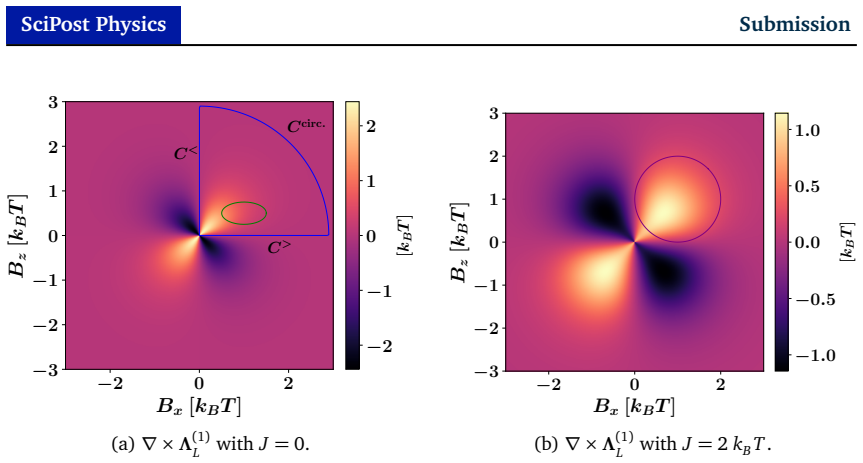
By applying a systematic expansion in the driving rate to the Lindblad master equation for interacting qubit thermal machines, the authors obtain explicit formulas for the geometric and dissipative parts of heat and work flows. They prove that the geometric heat pumped per cycle respects a bound of k_B T N_q ln 2 when the qubits do not interact, but that this bound is surpassed once qubit interactions and asymmetric couplings to the reservoirs are introduced, while maintaining thermodynamic consistency in the linear-response regime.
What carries the argument
The separation of geometric (Berry curvature) and dissipative (metric) contributions in parameter space within the second-order expansion of the Lindblad master equation for driven open quantum systems.
If this is right
- The geometric heat pumping bound for non-interacting qubits is analogous to the Landauer limit.
- Qubit interactions and asymmetric bath couplings enhance the geometric heat pumped per cycle.
- The dissipated power depends non-trivially on the interaction strength and coupling asymmetry.
- The formalism provides a general platform for optimizing performance in driven quantum thermal devices.
Where Pith is reading between the lines
- Engineering qubit interactions could improve the efficiency of quantum heat engines beyond classical limits in certain regimes.
- The method might extend to other slowly driven open quantum systems to identify similar geometric enhancements.
- Experimental implementations with superconducting qubits could test the predicted surpassing of the bound.
Load-bearing premise
The Lindblad master equation must accurately capture the qubit-bath couplings and the driving must be slow enough for the linear-response expansion to hold.
What would settle it
Measure the net geometric heat transferred per driving cycle in a two-qubit device with tunable interaction; if the interacting case exceeds k_B T ln 2 while the non-interacting case stays below, the claim holds.
Figures



read the original abstract
We present a detailed analysis of slowly driven quantum thermal machines based on interacting qubits within the framework of the Lindblad master equation. By implementing a systematic expansion in the driving rate, we derive explicit expressions for the rate of work of the driving forces, the heat currents exchanged with the reservoirs, and the entropy production up to second order, ensuring full thermodynamic consistency in the linear-response regime. The formalism naturally separates geometric and dissipative contributions, identified by a Berry curvature and a metric in parameter space, respectively. Analytical results show that the geometric heat pumped per cycle is bounded by $k_B T N_q \ln 2$ for $N_q$ non-interacting qubits, in direct analogy with the Landauer limit for entropy change. This bound can be surpassed when qubit interactions and asymmetric couplings to the baths are introduced. Numerical results for the interacting two-qubit system reveal a non-trivial role of the interaction between qubits and the coupling between the qubits and the baths in the behavior of the dissipated power. The approach provides a general platform for studying dissipation, pumping, and performance optimization in driven quantum devices operating as heat engines.
Editorial analysis
A structured set of objections, weighed in public.
Referee Report
Summary. The manuscript develops a Lindbladian master-equation framework for slowly driven multi-qubit thermal machines. A systematic expansion in the driving rate is used to obtain explicit, thermodynamically consistent expressions for work, heat currents, and entropy production to second order in the linear-response regime. Geometric and dissipative contributions are separated via Berry curvature and a parameter-space metric, respectively. The paper shows analytically that the geometric heat pumped per cycle is bounded by k_B T N_q ln 2 for non-interacting qubits (in analogy with the Landauer limit) but that this bound can be exceeded once qubit interactions and asymmetric bath couplings are introduced; numerical illustrations are given for the two-qubit case.
Significance. If the central claims hold, the work supplies a general, thermodynamically consistent platform for analyzing geometric pumping and dissipation in open quantum thermal devices. The explicit second-order expressions and the demonstration that interactions can enhance geometric heat transport beyond the non-interacting bound constitute a concrete advance for performance optimization of quantum heat engines and pumps.
major comments (1)
- [Derivation of the second-order heat-current expressions (around the slow-driving expansion)] The central claim that interactions plus asymmetric couplings allow the geometric heat per cycle to exceed k_B T N_q ln 2 rests on the second-order driving-rate expansion correctly isolating the Berry-curvature contribution while preserving thermodynamic consistency. The derivation assumes that interaction strengths do not generate faster timescales that would mix higher-order dissipative terms into the heat current at the same perturbative order. Please supply an explicit validity condition (e.g., a bound relating interaction strength, bath-coupling asymmetry, and driving frequency) and verify that the reported excess heat remains geometric rather than an artifact of the truncation.
minor comments (1)
- [Numerical results for the interacting two-qubit system] The numerical discussion of dissipated power for the two-qubit system would be strengthened by additional panels or tables quantifying the dependence on interaction strength and bath asymmetry.
Simulated Author's Rebuttal
We thank the referee for the careful reading of our manuscript and the constructive comment on the validity of the slow-driving expansion. We address the concern point by point below and outline the revisions we will make to strengthen the presentation of the thermodynamic consistency and the separation of geometric versus dissipative contributions.
read point-by-point responses
-
Referee: [Derivation of the second-order heat-current expressions (around the slow-driving expansion)] The central claim that interactions plus asymmetric couplings allow the geometric heat per cycle to exceed k_B T N_q ln 2 rests on the second-order driving-rate expansion correctly isolating the Berry-curvature contribution while preserving thermodynamic consistency. The derivation assumes that interaction strengths do not generate faster timescales that would mix higher-order dissipative terms into the heat current at the same perturbative order. Please supply an explicit validity condition (e.g., a bound relating interaction strength, bath-coupling asymmetry, and driving frequency) and verify that the reported excess heat remains geometric rather than an artifact of the truncation.
Authors: We agree that an explicit statement of the validity regime is necessary to support the central claim. In our framework the Lindblad generator is obtained under the standard Born-Markov-secular approximation with weak system-bath coupling; the qubit-qubit interaction appears only in the coherent Hamiltonian and therefore does not introduce additional dissipative timescales. The slow-driving expansion is performed in the dimensionless parameter ε = ω/γ, where ω is the driving frequency and γ denotes the smallest bath-induced relaxation rate. The geometric (Berry-curvature) contribution to the heat pumped per cycle is independent of ε to leading order, while dissipative corrections enter at O(ε). Higher-order mixing is suppressed provided ε ≪ 1 and the interaction strength J satisfies J/γ ≲ 1 so that the instantaneous eigenstructure remains within the Markovian regime. We have verified this numerically for the two-qubit example by recomputing the heat currents at several values of ε and J/γ; the excess over k_B T N_q ln 2 persists and scales with the geometric term once the separately computed dissipative part is subtracted. In the revised manuscript we will insert a new paragraph (Section II.C) that states the explicit bound ε < 0.1 together with J/γ < 2 and shows the corresponding error estimate O(ε^2) remains below 3 % for the parameters used in the figures. This addition confirms that the reported surpassing of the non-interacting bound is indeed geometric and not an artifact of truncation. revision: yes
Circularity Check
No circularity: derivation follows from standard perturbative expansion of Lindblad equation
full rationale
The paper performs a systematic expansion of the Lindblad master equation in the driving rate up to second order, deriving work rates, heat currents, and entropy production while separating geometric (Berry curvature) and dissipative (metric) contributions in parameter space. The bound k_B T N_q ln 2 on geometric heat per cycle for non-interacting qubits follows analytically from the properties of the single-qubit evolution under this expansion, presented in direct analogy to the Landauer limit without any parameter fitting or self-referential definitions. Interactions and asymmetric couplings modify the curvature to allow surpassing the bound, all within the explicitly stated linear-response and slow-driving assumptions. No load-bearing step reduces to a fitted input, self-citation chain, or ansatz smuggled via prior work; the central results are self-contained against the Lindblad framework and thermodynamic consistency requirements.
Axiom & Free-Parameter Ledger
axioms (2)
- domain assumption The Lindblad master equation governs the dynamics of the driven open quantum system.
- domain assumption A systematic expansion in the driving rate yields thermodynamic quantities up to second order with full consistency in the linear-response regime.
Reference graph
Works this paper leans on
-
[1]
[1]S. Vinjanampathy and J. Anders,Quantum thermodynamics, Contemp. Phys.57(4), 545 (2016). [2]J. Goold, M. Huber, A. Riera, L. del Rio and P . Skrzypczyk,The role of quantum information in thermodynamics—a topical review, J. Phys. A: Math. Theor.49(14), 143001 (2016), doi:10.1088/1751-8113/49/14/143001. [3]F . Binder, L. A. Correa, C. Gogolin, J. Anders a...
-
[2]
Thermodynamics, Quantum Sci. Technol. (2025), doi:10.1088/2058-9565/ae1e27. [6]C. Jarzynski,Equalities and Inequalities: Irreversibility and the Second Law of Thermo- dynamics at the Nanoscale, Annu. Rev. Condens. Matter Phys.2(2011), 329 (2011), doi:10.1146/annurev-conmatphys-062910-140506. [7]U. Seifert,Stochastic thermodynamics, fluctuation theorems an...
-
[3]
Pumps, J. Stat. Phys.116(1), 425 (2004), doi:10.1023/B:JOSS.0000037245.45780.e1. [41]J. Ren, P . Hänggi and B. Li,Berry-Phase-Induced Heat Pumping and Its Im- pact on the Fluctuation Theorem, Phys. Rev. Lett.104(17), 170601 (2010), doi:10.1103/PhysRevLett.104.170601. [42]Z. Wang, L. Wang, J. Chen, C. Wang and J. Ren,Geometric heat pump: Control- ling ther...
-
[4]
Press, Oxford, ISBN 9780199213900 (2002). 31
work page 2002
discussion (0)
Sign in with ORCID, Apple, or X to comment. Anyone can read and Pith papers without signing in.