Quantum theory of electrically levitated nanoparticle-ion systems: Motional dynamics and sympathetic cooling
Pith reviewed 2026-05-22 12:12 UTC · model grok-4.3
The pith
Coulomb coupling to Doppler-cooled ions allows sympathetic cooling of a levitated nanoparticle to sub-kelvin temperatures in a Paul trap.
A machine-rendered reading of the paper's core claim, the machinery that carries it, and where it could break.
Core claim
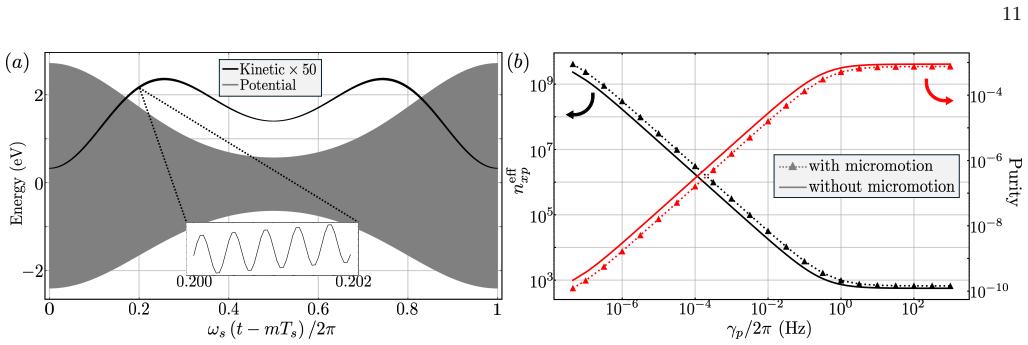
The paper establishes that motional cooling of the nanoparticle down to sub-kelvin temperatures is achievable in current experiments even without motional feedback and in the presence of micromotion, with the cooling rate increasing linearly with the number of ions and reaching tenths of millikelvin for ensembles.
What carries the argument
The quantum master equation derived for the ion-nanoparticle system, which incorporates the Coulomb coupling and models the sympathetic cooling process.
If this is right
- Cooling to sub-kelvin temperatures becomes possible without additional motional feedback.
- The cooling rate scales linearly with the number of ions N.
- Motional cooling can reach tenths of millikelvin in existing setups.
- This provides a method to prepare non-Gaussian motional states of levitated nanoparticles using ion assistance.
Where Pith is reading between the lines
- Such systems might allow quantum superposition states of macroscopic objects if combined with other control techniques.
- The approach could be extended to other hybrid quantum systems involving charged particles and levitated objects.
- Experimental verification could involve comparing observed cooling rates with the predicted linear dependence on ion number.
Load-bearing premise
The Coulomb coupling between the nanoparticle and the ions must be strong enough for the quantum master equation to remain valid despite micromotion and without additional unmodeled decoherence channels.
What would settle it
An experiment that measures the nanoparticle's motional temperature after coupling to one or more Doppler-cooled ions and checks whether it drops below one kelvin without feedback or additional cooling mechanisms.
Figures




read the original abstract
We develop the theory describing the quantum coupled dynamics of the center-of-mass motion of a nanoparticle and an ensemble of ions co-trapped in a dual-frequency linear Paul trap. We first derive analytical expressions for the motional frequencies and classical trajectories of both nanoparticle and ions. We then derive a quantum master equation for the ion-nanoparticle system and quantify the sympathetic cooling of the nanoparticle motion enabled by its Coulomb coupling to a continuously Doppler-cooled ion. We predict that motional cooling down to sub-kelvin temperatures is achievable in state-of-the-art experiments even in the absence of motional feedback and in the presence of micromotion. We then extend our analysis to an ensemble of $N$ ions, predicting a linear increase of the cooling rate as a function of $N$ and motional cooling of the nanoparticle down to tenths of millikelvin in current experimental platforms. Our work establishes the theoretical toolbox needed to explore the ion-assisted preparation of non-Gaussian motional states of levitated nanoparticles.
Editorial analysis
A structured set of objections, weighed in public.
Referee Report
Summary. The manuscript develops a quantum theory for the coupled center-of-mass dynamics of an electrically levitated nanoparticle and co-trapped ions in a dual-frequency linear Paul trap. It first derives analytical expressions for motional frequencies and classical trajectories of both the nanoparticle and ions, then constructs a quantum master equation for the open-system dynamics. The central results are quantitative predictions of sympathetic cooling of the nanoparticle motion via Coulomb coupling to continuously Doppler-cooled ions, including sub-kelvin temperatures achievable without motional feedback even in the presence of micromotion, and a linear increase in cooling rate with ion number N that enables cooling to tenths of millikelvin.
Significance. If the central predictions hold, the work supplies a useful theoretical toolbox for ion-assisted preparation of non-Gaussian motional states in levitated nanoparticles. The analytical classical-trajectory results and the explicit scaling with ensemble size N constitute clear strengths that could guide future experiments in hybrid trapped-ion and levitated-optomechanics platforms.
major comments (1)
- [§4] §4 (quantum master equation, following the classical-trajectory analysis): the derivation invokes a time-independent effective description of the Coulomb interaction after the secular approximation. No Magnus-expansion or Floquet error bound is supplied to quantify the residual time-dependent micromotion contributions when the RF drive amplitude is comparable to the secular motion or when the coupling is not deeply perturbative. This approximation is load-bearing for the abstract claim of cooling “in the presence of micromotion” without additional feedback.
minor comments (2)
- [§3] The definition of the effective coupling strength after time-averaging should be stated explicitly with its dependence on the ion-nanoparticle separation and charge product.
- [Figure 4] Figure captions for the cooling-rate versus N plots should include the precise parameter values used (trap frequencies, laser detuning, etc.) so that the linear scaling can be reproduced from the text alone.
Simulated Author's Rebuttal
We thank the referee for the positive and constructive report. The assessment of the work's significance is appreciated. We address the single major comment below and will revise the manuscript to incorporate additional quantitative justification for the secular approximation.
read point-by-point responses
-
Referee: [§4] §4 (quantum master equation, following the classical-trajectory analysis): the derivation invokes a time-independent effective description of the Coulomb interaction after the secular approximation. No Magnus-expansion or Floquet error bound is supplied to quantify the residual time-dependent micromotion contributions when the RF drive amplitude is comparable to the secular motion or when the coupling is not deeply perturbative. This approximation is load-bearing for the abstract claim of cooling “in the presence of micromotion” without additional feedback.
Authors: We agree that an explicit error estimate would strengthen the justification of the time-independent effective Coulomb interaction. In the revised manuscript we will add a dedicated paragraph (or short subsection) that uses the already-derived analytical classical trajectories (which retain the full time-dependent micromotion) to bound the residual oscillating terms after secular averaging. For the parameter regime of current experiments—RF frequency much larger than secular frequencies and Coulomb coupling weak compared with trap frequencies—the leading correction scales as the ratio of micromotion amplitude to secular frequency and is typically ≪ 0.01. This bound is obtained by a first-order Magnus expansion over one RF period and confirms that the time-averaged master equation remains accurate on the Doppler-cooling timescale. The claim of sympathetic cooling in the presence of micromotion is therefore restricted to this experimentally relevant regime; we will make that scope explicit. revision: yes
Circularity Check
Derivation chain is self-contained from standard potentials with no circular reductions
full rationale
The paper begins from standard linear Paul trap potentials and Coulomb interactions to derive analytical motional frequencies, classical trajectories, and a quantum master equation for the nanoparticle-ion system. Cooling rates and steady-state temperatures are computed as outputs of this open-system dynamics rather than being fitted to data or presupposed by definition. No self-citations are used as load-bearing premises for the central claims, and the predictions for sub-kelvin cooling (with or without micromotion) follow directly from the derived master equation without reducing to the inputs by construction. The analysis is therefore independent and self-contained against external benchmarks.
Axiom & Free-Parameter Ledger
axioms (2)
- standard math Standard quantum mechanics and Lindblad master-equation formalism for open systems
- domain assumption Coulomb interaction dominates the coupling and remains valid under micromotion in the dual-frequency Paul trap
Lean theorems connected to this paper
-
IndisputableMonolith/Cost/FunctionalEquation.leanwashburn_uniqueness_aczel unclear?
unclearRelation between the paper passage and the cited Recognition theorem.
We first derive analytical expressions for the motional frequencies and classical trajectories of both nanoparticle and ions. We then derive a quantum master equation for the ion-nanoparticle system
-
IndisputableMonolith/Foundation/DimensionForcing.leanreality_from_one_distinction unclear?
unclearRelation between the paper passage and the cited Recognition theorem.
dual-frequency linear Paul trap... two-tone Mathieu equation
What do these tags mean?
- matches
- The paper's claim is directly supported by a theorem in the formal canon.
- supports
- The theorem supports part of the paper's argument, but the paper may add assumptions or extra steps.
- extends
- The paper goes beyond the formal theorem; the theorem is a base layer rather than the whole result.
- uses
- The paper appears to rely on the theorem as machinery.
- contradicts
- The paper's claim conflicts with a theorem or certificate in the canon.
- unclear
- Pith found a possible connection, but the passage is too broad, indirect, or ambiguous to say the theorem truly supports the claim.
Reference graph
Works this paper leans on
-
[1]
Secular frequencies We first start by determining the secular frequencies. Note that, to trap objects with such different charge- to-mass ratios as an ion and a∼100 nm nanoparticle, the two RF frequencies must be very different [38], i.e., ωs ≪ω f, or equivalentlyl≪1. We make use of the modified Lindstedt-Poincar´ e method [52, 53] to compute the secular ...
-
[2]
M −1 i 13×3 03×3 03×3 M −1 p 13×3 # ,(37) and the generalised potential matrix ¯V≡
Displacement functions The Lindstedt-Poincar´ e method is especially suited to compute secular frequencies, as it allows to capture terms of all orders in the perturbative parameterq f (see e.g. Eq. (9)). This is not true for the computed displace- ment functionR(τ), which remains a finite-order expan- sion and thus less accurate than the Floquet solution...
-
[3]
Stability and coupling rates The potential matrix Eq. (38) is in general not di- agonal, resulting in coupling between the motional de- grees of freedom. The diagonal terms of ¯Vdescribe the new motional frequencies, which are renormalised due to Coulomb interaction. These new frequencies read Ω ′2 jσ ≡Ω 2 jσ + QiQp 4πε0MσD3 3(dji −d jp)2 D2 −1 .(40) Both...
-
[4]
for each value ofNusing SciPy’s root-finding func- tion. We perform a two-step search for multiple equi- librium positions: first, forN≤8, we run the solver 5000 +N! times, each with different seed values for the 3N+ 3 spatial coordinates of all the objects. At each run, the seed values are drawn randomly within a cubic box of size 200µm×200µm×200µm cente...
- [5]
-
[6]
C. Gonzalez-Ballestero, M. Aspelmeyer, L. Novotny, R. Quidant, and O. Romero-Isart, Science374, eabg3027 (2021)
work page 2021
-
[7]
U. Deli´ c, M. Reisenbauer, K. Dare, D. Grass, V. Vuleti´ c, N. Kiesel, and M. Aspelmeyer, Science367, 892 (2020)
work page 2020
-
[8]
F. Tebbenjohanns, M. L. Mattana, M. Rossi, M. Frim- mer, and L. Novotny, Nature595, 378 (2021)
work page 2021
-
[9]
L. Magrini, P. Rosenzweig, C. Bach, A. Deutschmann- Olek, S. G. Hofer, S. Hong, N. Kiesel, A. Kugi, and M. Aspelmeyer, Nature595, 373 (2021)
work page 2021
- [10]
-
[11]
A. Ranfagni, K. Børkje, F. Marino, and F. Marin, Phys. Rev. Res.4, 033051 (2022)
work page 2022
-
[12]
J. Piotrowski, D. Windey, J. Vijayan, C. Gonzalez- Ballestero, A. de los R´ ıos Sommer, N. Meyer, R. Quidant, O. Romero-Isart, R. Reimann, and L. Novotny, Nature Physics19, 1009 (2023)
work page 2023
- [13]
- [14]
- [15]
-
[16]
V. Jain, J. Gieseler, C. Moritz, C. Dellago, R. Quidant, and L. Novotny, Phys. Rev. Lett.116, 243601 (2016)
work page 2016
-
[17]
O. Romero-Isart, A. C. Pflanzer, F. Blaser, R. Kaltenbaek, N. Kiesel, M. Aspelmeyer, and J. I. 17 Cirac, Phys. Rev. Lett.107, 020405 (2011)
work page 2011
- [18]
-
[19]
J. Bateman, S. Nimmrichter, K. Hornberger, and H. Ul- bricht, Nature Communications5, 4788 (2014)
work page 2014
-
[20]
L. Neumeier, M. A. Ciampini, O. Romero-Isart, M. As- pelmeyer, and N. Kiesel, Proceedings of the National Academy of Sciences121, e2306953121 (2024)
work page 2024
-
[21]
M. Roda-Llordes, A. Riera-Campeny, D. Candoli, P. T. Grochowski, and O. Romero-Isart, Phys. Rev. Lett.132, 023601 (2024)
work page 2024
-
[22]
S. Casulleras, P. T. Grochowski, and O. Romero-Isart, Phys. Rev. A110, 033511 (2024)
work page 2024
-
[23]
O. Romero-Isart, L. Clemente, C. Navau, A. Sanchez, and J. I. Cirac, Phys. Rev. Lett.109, 147205 (2012)
work page 2012
- [24]
-
[25]
P. Z. G. Fonseca, E. B. Aranas, J. Millen, T. S. Monteiro, and P. F. Barker, Phys. Rev. Lett.117, 173602 (2016)
work page 2016
-
[26]
B. R. Slezak, C. W. Lewandowski, J.-F. Hsu, and B. D’Urso, New Journal of Physics20, 063028 (2018)
work page 2018
-
[27]
G. P. Conangla, R. A. Rica, and R. Quidant, Nano Let- ters20, 6018 (2020)
work page 2020
-
[28]
D. S. Bykov, M. Meusburger, L. Dania, and T. E. Northup, Review of scientific instruments93(2022)
work page 2022
-
[29]
M. Gutierrez Latorre, G. Higgins, A. Paradkar, T. Bauch, and W. Wieczorek, Phys. Rev. Appl.19, 054047 (2023)
work page 2023
- [30]
-
[31]
B. Melo, M. T. Cuairan, G. F. M. Tomassi, N. Meyer, and R. Quidant, Nature Nanotechnology19, 1270 (2024)
work page 2024
- [32]
- [33]
-
[34]
J. J. Hansen, S. Minniberger, D. Ilk, P. Asenbaum, G. Higgins, R. G. Povey, P. Schmidt, J. Hofer, R. Claessen, M. Aspelmeyer, and M. Trupke, arXiv preprint (2025)
work page 2025
-
[35]
D. S. Bykov, P. Mestres, L. Dania, L. Schm¨ oger, and T. E. Northup, Applied Physics Letters115(2019)
work page 2019
-
[36]
D. Goldwater, B. A. Stickler, L. Martinetz, T. E. Northup, K. Hornberger, and J. Millen, Quantum Sci- ence and Technology4, 024003 (2019)
work page 2019
- [37]
-
[38]
N. P. Bullier, A. Pontin, and P. F. Barker, Journal of Physics D: Applied Physics53, 175302 (2020)
work page 2020
-
[39]
L. Martinetz, K. Hornberger, J. Millen, M. S. Kim, and B. A. Stickler, npj Quantum Information6, 101 (2020)
work page 2020
- [40]
- [41]
-
[42]
D. S. Bykov, L. Dania, F. Goschin, and T. E. Northup, Phys. Rev. Lett.135, 213602 (2025)
work page 2025
-
[43]
T. Seberson, P. Ju, J. Ahn, J. Bang, T. Li, and F. Ro- bicheaux, J. Opt. Soc. Am. B37, 3714 (2020)
work page 2020
-
[44]
T. W. Penny, A. Pontin, and P. F. Barker, Phys. Rev. Res.5, 013070 (2023)
work page 2023
-
[45]
D. S. Bykov, L. Dania, F. Goschin, and T. E. Northup, Optica10, 438 (2023)
work page 2023
-
[46]
A. C. Pflanzer, O. Romero-Isart, and J. I. Cirac, Phys. Rev. A88, 033804 (2013)
work page 2013
- [47]
-
[48]
M. Schut and V. Scarani, Proposal for macroscopic delocalisation of a large mass in a rf trap (2025), arXiv:2509.17081 [quant-ph]
- [49]
- [50]
- [51]
- [52]
-
[53]
I. Pogorelov, T. Feldker, C. D. Marciniak, L. Postler, G. Jacob, O. Krieglsteiner, V. Podlesnic, M. Meth, V. Negnevitsky, M. Stadler, B. H¨ ofer, C. W¨ achter, K. Lakhmanskiy, R. Blatt, P. Schindler, and T. Monz, PRX Quantum2, 020343 (2021)
work page 2021
-
[54]
D. Leibfried, R. Blatt, C. Monroe, and D. Wineland, Rev. Mod. Phys.75, 281 (2003)
work page 2003
-
[55]
D. J. Berkeland, J. D. Miller, J. C. Bergquist, W. M. Itano, and D. J. Wineland, Journal of Applied Physics 83, 5025 (1998)
work page 1998
- [56]
-
[57]
V. Saxena and K. Shah, IEEE Transactions on Plasma Science46, 474 (2018)
work page 2018
-
[58]
Note that Eq. (8) has two solutions forβ 2. Here we choose the solution that recovers the known behavior in the limit of a single-frequency trap, namely Eq. (9)
-
[59]
P. K. Ghosh,Ion Traps(Oxford University Press, Ox- ford, 1995)
work page 1995
-
[60]
Lanchares, Monograf´ ıas Matem´ aticas Garc´ ıa de Galdeano39, 155 (2014)
V. Lanchares, Monograf´ ıas Matem´ aticas Garc´ ıa de Galdeano39, 155 (2014)
work page 2014
-
[61]
K. Kustura, C. C. Rusconi, and O. Romero-Isart, Phys. Rev. A99, 022130 (2019)
work page 2019
-
[62]
Di´ osi, Europhysics Letters30, 63 (1995)
L. Di´ osi, Europhysics Letters30, 63 (1995)
work page 1995
-
[63]
C. Gonzalez-Ballestero, P. Maurer, D. Windey, L. Novotny, R. Reimann, and O. Romero-Isart, Phys. Rev. A100, 013805 (2019)
work page 2019
-
[64]
T. Li, S. Kheifets, and M. G. Raizen, Nature Physics7, 527 (2011)
work page 2011
-
[65]
S. A. Beresnev, V. G. Chernyak, and G. A. Fomyagin, Journal of Fluid Mechanics219, 405–421 (1990)
work page 1990
- [66]
-
[67]
J. Eschner, G. Morigi, F. Schmidt-Kaler, and R. Blatt, J. Opt. Soc. Am. B20, 1003 (2003)
work page 2003
-
[68]
Note that in regards to experiment Ref. [38], this choice ofζleads to an overestimation of the heating rate, as it assumes a probe beam propagating exactly along the motional axis
-
[69]
V. A. Iakubovich and V. M. Starzhinski˘ ı,Linear differen- tial equations with periodic coefficients(Wiley and Israel Program for Scientific Translations, 1975). 18
work page 1975
-
[70]
J. Slane and S. Tragesser, Nonlinear Dynamics and Sys- tems Theory11, 183 (2011)
work page 2011
-
[71]
T. Barthel and Y. Zhang, Journal of Statistical Mechan- ics: Theory and Experiment2022, 113101 (2022)
work page 2022
-
[72]
M. G. A. Paris, F. Illuminati, A. Serafini, and S. De Siena, Phys. Rev. A68, 012314 (2003)
work page 2003
-
[73]
For certain values ofNadditional stable solutions ap- peared in less than 0.01% of the runs. These solutions were discarded as they would correspond to weakly sta- ble minima occupying a very small volume in coordinate space, and thus unlikely to confine the objects under the influence of small – e.g. thermal – fluctuations
-
[74]
D. F. V. James, Applied Physics B66, 181 (1998)
work page 1998
discussion (0)
Sign in with ORCID, Apple, or X to comment. Anyone can read and Pith papers without signing in.