REVIEW 2 major objections 4 minor 1 cited by
The Boundary Time Crystal as a light source for collectively enhanced sensing
T0 review · 2 major / 4 minor · reviewed 2026-08-03 · deepseek-v4-flash
Pith's one-line read This paper proposes using a boundary time crystal — a driven, dissipative collection of N two-level emitters — as a light source for optical phase estimation, and argues that in its time-crystal phase the temporal correlations of the emitte
desk verdict The N^4 QFI result is solid and worth citing; the beyond-Heisenberg protocol exponent is an extrapolation from three small-N points at fixed phase offsets, so treat it as provisional. read the letter →
The pith
A machine-rendered reading of the paper's core claim, the machinery that carries it, and where it could break.
The reading
What carries the argument
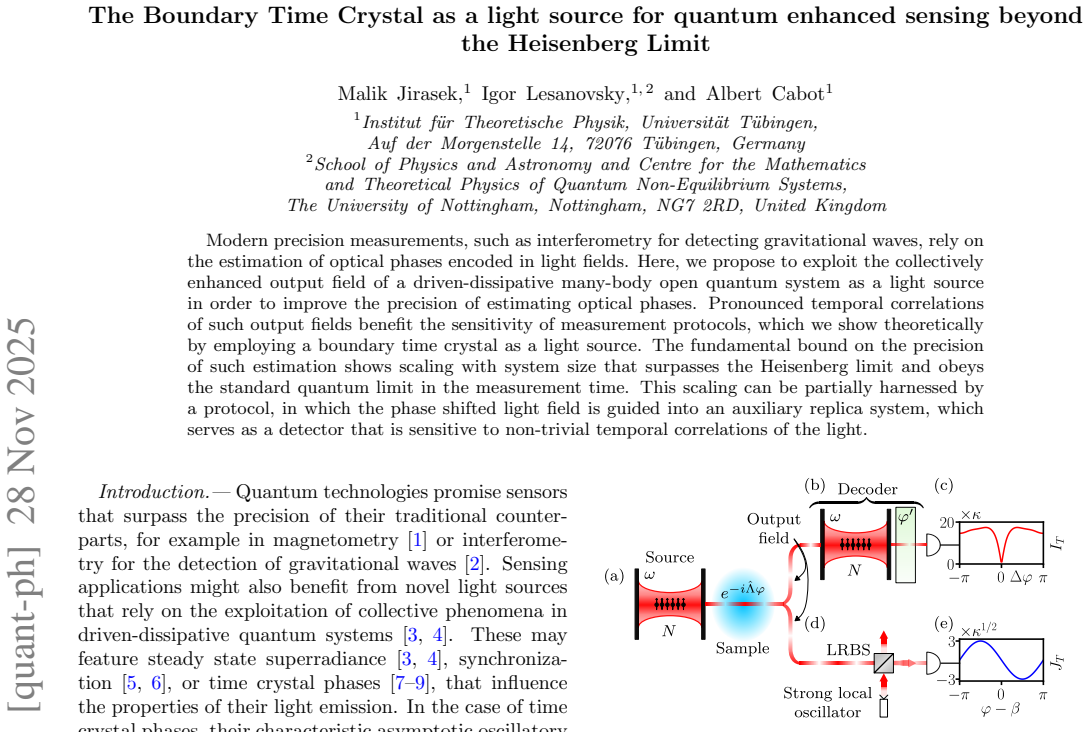
The key object is the boundary time crystal (BTC): N two-level emitters with collective resonant driving at Rabi frequency ω and collective dissipation at rate κ, described by a master equation; for ω > Nκ/2 it enters a time-crystal phase with persistent oscillations. The resource is the two-time intensity correlation C(τ) of its output field, which the quantum Fisher information rate is essentially the time integral of. The matching mechanism is the perfect absorber protocol: a replica BTC with a tunable phase φ′ coupled unidirectionally to the source, whose dark state at Δφ=φ−φ′=0 makes the decoder an ideal detector for temporal correlations; the estimation error is extracted from the time
What would settle it
Compute the perfect-absorber estimation error for N = 30, 40, and 50 at Δφ = 0.005 with ω/ω_c = 4 by exact diagonalization of the tilted cascaded master equation: if the fitted exponent α drops to 1 or below, the claimed N^{-1.222} scaling is a small-system artifact. Alternatively, add a finite photon-detection efficiency η < 1 and check whether the exponent α falls below 1.
Extended reading notes
Core claim
The central claim is that, in the boundary time crystal's time-crystal phase, the quantum Fisher information rate for phase estimation is f_φ,∞ ≈ κ N(N+2)[(N-1)(N+3)/135 + 2/3], scaling as N^4 for large N and linear in measurement time T, computed via the superspin method in the strong-driving limit and benchmarked numerically. This exceeds the Heisenberg scaling f_φ ∝ N^2 found in the stationary regime by a bosonic large-displacement expansion. The information is carried by the emitted light's temporal correlations, specifically the two-time intensity correlation C(τ). The paper further claims that a detection protocol in which the phase-shifted output is unidirectionally guided into an ide
Load-bearing premise
The beyond-Heisenberg scaling rests on fitting a power law through exact results at only N = 6, 10, and 20 at hand-chosen phase offsets, alongside the ideal assumption of a lossless unidirectional cascade and perfect detection efficiency; if finite-size corrections bend the curve or losses enter, the protocol may not exceed the Heisenberg limit in the asymptotic sense.
Editorial extensions
If this is right
- In the time-crystal regime, the quantum Fisher information rate for phase estimation scales as N^4 and linearly with measurement time T, so the ultimate precision per unit time grows much faster with emitter number than the N^2 scaling of the stationary regime.
- The perfect absorber protocol (a replica BTC as decoder) reaches phase-estimation errors δφ ∝ N^{-1.222} at Δφ=0.005 and ω/ω_c=4, a scaling that exceeds the Heisenberg limit.
- The average-homodyne-current protocol saturates the quantum Fisher information bound in the stationary regime, giving Heisenberg scaling, but does not exploit the time-crystal correlations.
- Both measurement protocols obey the standard quantum limit in time, δφ ∝ 1/√T, so the system-size enhancement is independent of integration time.
- The QFI rate expression f_φ,∞ = κ N(N+2)[(N-1)(N+3)/135 + 2/3] is exact in the limit ω/ω_c → ∞ and is benchmarked numerically at finite ratios, so the N^4 scaling is a property of the model, not of a specific measurement.
Reading between the lines
- The asymptotic exponent α≈1.222 is inferred from exact points at N=6, 10, 20; extending the numerics to larger N or finding an analytic large-N expansion would test whether this is the true asymptotic scaling or a finite-size crossover.
- The ideal lossless unidirectional cascade and unit-efficiency detection are load-bearing idealizations; the paper itself lists finite detection efficiency and local decay as open issues, and either will likely degrade the demonstrated exponent.
- The replica-as-perfect-absorber idea suggests a general recipe for extracting multi-time correlation resources from other driven-dissipative light sources, and the paper's outlook proposes testing other time-crystal platforms with non-collective dissipation.
- If the scaling survives practical losses, the boundary time crystal would supply quantum-enhanced phase sensitivity without needing externally prepared squeezed or entangled probe states.
Editorial analysis
A structured set of objections, weighed in public.
Referee Report
Summary. The paper proposes using the output field of a boundary time crystal (BTC) as a resource for optical phase estimation. The authors derive the quantum Fisher information (QFI) rate for phase imprinted on the emitted light, finding f_φ ≈ κ N(N+2)[(N−1)(N+3)/135 + 2/3] ∝ N^4 in the deep time-crystal limit (Eq. 4), which exceeds the N^2 Heisenberg scaling of the stationary regime. They then analyze two measurement protocols: an average homodyne current protocol, which saturates the QCRB only in the stationary regime, and a 'perfect absorber' protocol in which the phase-shifted light is injected into a replica BTC acting as a decoder. For the perfect absorber protocol in the time-crystal regime, they report an estimation error scaling δφ ∝ N^{−1.222} at Δφ=0.005 (and N^{−1.04} at Δφ=0.01), claiming beyond-Heisenberg sensitivity. The QFI derivation is supported by analytic superspin calculations and exact numerics; the protocol claim rests on power-law fits through three small-system points.
Significance. If fully established, the N^4 QFI rate for a driven-dissipative light source would be a notable result: it shows that the temporal correlations of a time-crystal output can be a metrological resource beyond what N independent emitters provide. The paper is careful in benchmarking the analytic QFI expression against exact diagonalization (Figs. S1–S3), and it makes code and data publicly available. However, the advertised 'beyond Heisenberg' protocol scaling is currently supported only by a three-point numerical fit at hand-selected phase offsets, without an analytic explanation of the N-dependence. The QFI contribution itself is sound and valuable, but the protocol claim needs substantially stronger evidence before the title-level conclusion can be accepted.
major comments (2)
- [Perfect absorber protocol, Fig. 4(b)] The claimed beyond-Heisenberg exponent α=1.222±0.018 is obtained by fitting a power law through N=6,10,20 at a fixed working point Δφ=0.005 (α=1.04±0.04 at Δφ=0.01). This cannot support an asymptotic scaling claim. Fig. 4(c) shows that |∂_φ I_T| has a maximum whose position moves toward Δφ=0 as N increases, so the optimal operating offset Δφ*(N) depends on N. The three plotted values are not evaluated at the per-N optimum; the fitted α therefore mixes the N-scaling of the minimal error with the N-scaling of the optimal offset. To establish δφ∝N^{−α}, the authors should either optimize Δφ for each N and show the optimized errors obey a power law, or supply an analytic argument for the N-dependence at fixed Δφ. Without this, the protocol claim is not established.
- [Fig. 4(b), comparison to QFI] The green dotted line shows f_{φ,∞}^{−1/2}∝N^{−2}, the ω/ω_c→∞ limit of Eq. (4), but the numerical protocol points are computed at ω/ω_c=4. At finite ω/ω_c the exact QFI rate is below f_{φ,∞}, so the plot overstates the proximity of the protocol to the fundamental bound. The text should quantify the finite-frequency QFI bound (e.g., by diagonalizing the tilted master equation at ω/ω_c=4) and quote the ratio δφ/(1/√f_φ) at the working point.
minor comments (4)
- [Eq. (3)] The expression writes f_φ with a 1/T factor inside, although f_φ is defined as a long-time rate. Please clarify that the integral is understood in the T→∞ limit, or write f_φ = lim_{T→∞} (1/T) [ ... ].
- [Fig. 3 caption / text after Eq. (8)] The cascaded critical frequency ω_{c,casc} is used extensively but defined only implicitly. State its definition explicitly in the main text.
- [Introduction / homodyne protocol] The text says both protocols saturate the QCRB in the stationary regime, but for the homodyne protocol this is true only at φ−β=0 and for the perfect absorber only in the limit Δφ→0. Please state these conditions explicitly in the summary of results.
- [Fig. 4(a)] The numerical points in Fig. 4(a) are shown without error bars or markers indicating the finite-size/trajectory uncertainty. Adding them would help assess the reliability of the apparent saturation.
Circularity Check
No significant circularity: the QFI scaling and protocol exponents are derived analytically or extracted from exact numerics, not recycled from fitted inputs or self-citations.
full rationale
The central derivations are self-contained and benchmarked. The QFI-rate formula Eq. (3) is rederived in the Supplemental Material (Eqs. S4-S8) from a cMPS/MPS state, and the N^4 scaling in Eq. (4) follows from an explicit first-order superspin calculation (Eqs. S10-S22) of the two-time correlation C(τ), with the only input being the BTC Liouvillian, not the target QFI. This analytic result is checked against exact diagonalization in Figs. S1-S3. The perfect-absorber protocol's dark state is quoted from Ref. [42], but the protocol is then evaluated directly from the cascaded master equation (Eq. 8) and its exact/numerical steady-state properties (Figs. 3-4); no uniqueness or optimality claim is imported to force the central result. The claimed exponent δφ ∝ N^{-1.222} is obtained by a power-law fit through exact finite-N data (Fig. 4b), so it is an output of the simulation rather than a recycled input. The fixed-Δφ fitting caveat and the finite-efficiency/loss caveats noted in the paper are scientific validity concerns, not definitional circularity. Minor self-citations ([8], [42], [48]) provide tools or known results but are not load-bearing reductions that make the derivation equivalent to its inputs.
Assumptions & free parameters
free parameters (2)
- Scaling exponent α for protocol estimation error =
α = 1.222 ± 0.018 (Δφ=0.005); α = 1.04 ± 0.04 (Δφ=0.01)
- Operating phase offset Δφ =
0.005 and 0.01
assumptions (5)
- domain assumption Phase shift on emitted light is equivalent to transforming the jump operator L → e^{-iφ}L
- domain assumption Long-time QFI rate is obtained by replacing ρ(t) → ρ_ss in Eq. (3)
- domain assumption Superspin first-order perturbation with ρ_ss ≈ 1/(N+1) is exact as ω/ω_c → ∞
- domain assumption Cascaded source-decoder dynamics is described by Eq. (8) with perfect unidirectional coupling and no additional losses
- standard math Large-deviation functions θ_c(s,Δφ) and θ_h(s,φ−β) describe long-time statistics of photon counting and homodyne current
invented entities (1)
-
Replica BTC decoder (perfect absorber)
Cite this review
Pith. "Pith review of The Boundary Time Crystal as a light source for collectively enhanced sensing." pith.science (2026). https://pith.science/paper/H6N7EEAG
@misc{pith2026251123416,
  author       = {Pith},
  title        = {Pith review of: The Boundary Time Crystal as a light source for collectively enhanced sensing},
  year         = {2026},
  howpublished = {\url{https://pith.science/paper/H6N7EEAG}},
  note         = {Machine review of arXiv:2511.23416}
}
abstract
Modern precision measurements, such as interferometry for detecting gravitational waves, rely on the estimation of optical phases encoded in light fields. Here, we propose to exploit the collectively enhanced output field of a driven-dissipative many-body quantum system as a light source in order to improve the precision of estimating optical phases. Pronounced temporal correlations of such output fields benefit the sensitivity of measurement protocols, which we show theoretically by employing a boundary time crystal as a light source. The fundamental bound on the precision of such estimation shows scaling with the number of constituents $N$ of the many-body system as $N^4$ while scaling linearly with the measurement time $T$. We discuss this scaling both from a perspective of the resources employed to build the light source and of the resources produced by the light source, namely the number of emitted photons and their correlations. We show that a protocol, in which the phase shifted light field is guided into an auxiliary replica system, which serves as a detector that is sensitive to non-trivial temporal correlations of light, can saturate the fundamental bound on precision at an optimal operating point.
Figures


Figures from the paper (1 more)

Forward citations
Cited by 1 Pith paper
-
Intermittency and metastable dark states as a resource for continuous sensing
Intermittent emission and dark states in few-level systems enhance continuous sensing with performance depending on detection efficiency, quantified via Fisher information.
Reference graph
Works this paper leans on
-
[1]
Budker and M
D. Budker and M. Romalis, Optical magnetometry, Na- ture Phys.3, 227 (2007)
2007
-
[2]
A. J, J. Abadie, B. P. Abbott, R. Abbott, T. D. Ab- bott, M. R. Abernathy, C. Adams, T. Adams, P. Ad- desso, R. X. Adhikari,et al., Enhanced sensitivity of the ligo gravitational wave detector by using squeezed states of light, Nature Photon.7, 613 (2013)
2013
-
[3]
Meiser, J
D. Meiser, J. Ye, D. R. Carlson, and M. J. Holland, Prospects for a millihertz-linewidth laser, Phys. Rev. Lett.102, 163601 (2009)
2009
-
[4]
Meiser and M
D. Meiser and M. J. Holland, Intensity fluctuations in steady-state superradiance, Phys. Rev. A81, 063827 (2010)
2010
-
[5]
M. Xu, D. A. Tieri, E. C. Fine, J. K. Thompson, and M. J. Holland, Synchronization of two ensembles of atoms, Phys. Rev. Lett.113, 154101 (2014)
2014
-
[6]
Xu and M
M. Xu and M. J. Holland, Conditional ramsey spec- troscopy with synchronized atoms, Phys. Rev. Lett.114, 103601 (2015)
2015
-
[7]
Iemini, A
F. Iemini, A. Russomanno, J. Keeling, M. Schir` o, M. Dal- monte, and R. Fazio, Boundary time crystals, Phys. Rev. Lett.121, 035301 (2018)
2018
-
[8]
Cabot, L
A. Cabot, L. S. Muhle, F. Carollo, and I. Lesanovsky, Quantum trajectories of dissipative time crystals, Phys. Rev. A108, L041303 (2023)
2023
Show all 91 references
-
[9]
Keßler, P
H. Keßler, P. Kongkhambut, C. Georges, L. Mathey, J. G. Cosme, and A. Hemmerich, Observation of a dissi- pative time crystal, Phys. Rev. Lett.127, 043602 (2021)
2021
-
[10]
Sacha and J
K. Sacha and J. Zakrzewski, Time crystals: a review, Rep. Prog. Phys.81, 016401 (2017)
2017
-
[11]
D. V. Else, C. Monroe, C. Nayak, and N. Y. Yao, Discrete time crystals, Annu. Rev. Condens. Matter Phys.11, 467 (2020)
2020
-
[12]
M. P. Zaletel, M. Lukin, C. Monroe, C. Nayak, F. Wilczek, and N. Y. Yao, Colloquium: Quantum and classical discrete time crystals, Rev. Mod. Phys.95, 031001 (2023)
2023
-
[13]
H. J. Carmichael, Analytical and numerical results for the steady state in cooperative resonance fluorescence, J. Phys. B: Atom. Mol. Phys.13, 3551 (1980)
1980
-
[14]
D. V. Else, B. Bauer, and C. Nayak, Floquet time crys- tals, Phys. Rev. Lett.117, 090402 (2016)
2016
-
[15]
Khemani, A
V. Khemani, A. Lazarides, R. Moessner, and S. L. Sondhi, Phase structure of driven quantum systems, Phys. Rev. Lett.116, 250401 (2016)
2016
-
[16]
Z. Gong, R. Hamazaki, and M. Ueda, Discrete time- crystalline order in cavity and circuit qed systems, Phys. Rev. Lett.120, 040404 (2018). 6
2018
-
[17]
N. Y. Yao, A. C. Potter, I.-D. Potirniche, and A. Vish- wanath, Discrete time crystals: Rigidity, criticality, and realizations, Phys. Rev. Lett.118, 030401 (2017)
2017
-
[18]
R. R. W. Wang, B. Xing, G. G. Carlo, and D. Poletti, Period doubling in period-one steady states, Phys. Rev. E97, 020202 (2018)
2018
-
[19]
F. M. Gambetta, F. Carollo, M. Marcuzzi, J. P. Gar- rahan, and I. Lesanovsky, Discrete time crystals in the absence of manifest symmetries or disorder in open quan- tum systems, Phys. Rev. Lett.122, 015701 (2019)
2019
-
[20]
Lazarides, S
A. Lazarides, S. Roy, F. Piazza, and R. Moessner, Time crystallinity in dissipative floquet systems, Phys. Rev. Res.2, 022002 (2020)
2020
-
[21]
Riera-Campeny, M
A. Riera-Campeny, M. Moreno-Cardoner, and A. San- pera, Time crystallinity in open quantum systems, Quan- tum4, 270 (2020)
2020
-
[22]
B. Zhu, J. Marino, N. Y. Yao, M. D. Lukin, and E. A. Demler, Dicke time crystals in driven-dissipative quantum many-body systems, New J. Phys.21, 073028 (2019)
2019
-
[23]
Chinzei and T
K. Chinzei and T. N. Ikeda, Time crystals protected by floquet dynamical symmetry in hubbard models, Phys. Rev. Lett.125, 060601 (2020)
2020
-
[24]
R. J. L. Tuquero, J. Skulte, L. Mathey, and J. G. Cosme, Dissipative time crystal in an atom-cavity system: Influ- ence of trap and competing interactions, Phys. Rev. A 105, 043311 (2022)
2022
-
[25]
Sarkar and Y
S. Sarkar and Y. Dubi, Signatures of discrete time- crystallinity in transport through an open fermionic chain, Commun. Phys.5, 155 (2022)
2022
-
[26]
Cabot, F
A. Cabot, F. Carollo, and I. Lesanovsky, Metastable dis- crete time-crystal resonances in a dissipative central spin system, Phys. Rev. B106, 134311 (2022)
2022
-
[27]
Carollo and I
F. Carollo and I. Lesanovsky, Exact solution of a bound- ary time-crystal phase transition: Time-translation sym- metry breaking and non-markovian dynamics of correla- tions, Phys. Rev. A105, L040202 (2022)
2022
-
[28]
Tucker, B
K. Tucker, B. Zhu, R. J. Lewis-Swan, J. Marino, F. Jimenez, J. G. Restrepo, and A. M. Rey, Shattered time: can a dissipative time crystal survive many-body correlations?, New J. Phys.20, 123003 (2018)
2018
-
[29]
Lled´ o and M
C. Lled´ o and M. H. Szyma´ nska, A dissipative time crystal with or without z2 symmetry breaking, New J. Phys.22, 075002 (2020)
2020
-
[30]
Buˇ ca and D
B. Buˇ ca and D. Jaksch, Dissipation induced nonstation- arity in a quantum gas, Phys. Rev. Lett.123, 260401 (2019)
2019
-
[31]
Buˇ ca, J
B. Buˇ ca, J. Tindall, and D. Jaksch, Non-stationary coher- ent quantum many-body dynamics through dissipation, Nat. Commun.10, 1730 (2019)
2019
-
[32]
Booker, B
C. Booker, B. Buˇ ca, and D. Jaksch, Non-stationarity and dissipative time crystals: spectral properties and finite- size effects, New J. Phys.22, 085007 (2020)
2020
-
[33]
Buonaiuto, F
G. Buonaiuto, F. Carollo, B. Olmos, and I. Lesanovsky, Dynamical phases and quantum correlations in an emitter-waveguide system with feedback, Phys. Rev. Lett.127, 133601 (2021)
2021
-
[34]
L. F. d. Prazeres, L. d. S. Souza, and F. Iemini, Boundary time crystals in collectived-level systems, Phys. Rev. B 103, 184308 (2021)
2021
-
[35]
Piccitto, M
G. Piccitto, M. Wauters, F. Nori, and N. Shammah, Sym- metries and conserved quantities of boundary time crys- tals in generalized spin models, Phys. Rev. B104, 014307 (2021)
2021
-
[36]
A. C. Louren¸ co, L. F. d. Prazeres, T. O. Maciel, F. Iem- ini, and E. I. Duzzioni, Genuine multipartite correlations in a boundary time crystal, Phys. Rev. B105, 134422 (2022)
2022
-
[37]
Hajduˇ sek, P
M. Hajduˇ sek, P. Solanki, R. Fazio, and S. Vinjanampa- thy, Seeding crystallization in time, Phys. Rev. Lett.128, 080603 (2022)
2022
-
[38]
Krishna, P
M. Krishna, P. Solanki, M. Hajduˇ sek, and S. Vinjanam- pathy, Measurement-induced continuous time crystals, Phys. Rev. Lett.130, 150401 (2023)
2023
-
[39]
Mattes, I
R. Mattes, I. Lesanovsky, and F. Carollo, Entangled time-crystal phase in an open quantum light-matter sys- tem, Phys. Rev. A108, 062216 (2023)
2023
-
[40]
Ferioli, A
G. Ferioli, A. Glicenstein, I. Ferrier-Barbut, and A. Browaeys, A non-equilibrium superradiant phase tran- sition in free space, Nat. Phys.19, 1345 (2023)
2023
-
[41]
Montenegro, M
V. Montenegro, M. G. Genoni, A. Bayat, and M. G-A- Paris, Quantum metrology with boundary time crystals, Commun. Phys.6, 304 (2023)
2023
-
[42]
Cabot, F
A. Cabot, F. Carollo, and I. Lesanovsky, Continuous sensing and parameter estimation with the boundary time crystal, Phys. Rev. Lett.132, 050801 (2024)
2024
-
[43]
Cabot, F
A. Cabot, F. Carollo, and I. Lesanovsky, Quantum en- hanced parameter estimation with monitored quantum nonequilibrium systems using inefficient photo detection (2025), arXiv:2503.21753 [quant-ph]
2025
-
[44]
Mattes, A
R. Mattes, A. Cabot, F. Carollo, and I. Lesanovsky, De- signing open spin-boson models for enabling quantum en- hanced sensing through classical measurements (2025), arXiv:2505.08756 [quant-ph]
2025
-
[45]
O’Connor, V
E. O’Connor, V. Montenegro, F. Albarelli, M. G. A. Paris, A. Bayat, and M. G. Genoni, Quantum-enhanced parameter estimation in continuously monitored bound- ary time crystals (2025), arXiv:2508.15448 [quant-ph]
2025 arXiv
-
[46]
Gribben, A
D. Gribben, A. Sanpera, R. Fazio, J. Marino, and F. Iem- ini, Boundary time crystals as ac sensors: Enhancements and constraints, SciPost Phys.18, 100 (2025)
2025
-
[47]
Gammelmark and K
S. Gammelmark and K. Mølmer, Fisher information and the quantum cram´ er-rao sensitivity limit of continuous measurements, Phys. Rev. Lett.112, 170401 (2014)
2014
-
[48]
Macieszczak, M
K. Macieszczak, M. Gut ¸˘ a, I. Lesanovsky, and J. P. Gar- rahan, Dynamical phase transitions as a resource for quantum enhanced metrology, Phys. Rev. A93, 022103 (2016)
2016
-
[49]
Ilias, D
T. Ilias, D. Yang, S. F. Huelga, and M. B. Plenio, Criticality-enhanced quantum sensing via continuous measurement, PRX Quantum3, 010354 (2022)
2022
-
[50]
Gambetta and H
J. Gambetta and H. M. Wiseman, State and dynamical parameter estimation for open quantum systems, Phys. Rev. A64, 042105 (2001)
2001
-
[51]
Catana, M
C. Catana, M. van Horssen, and M. Guta, Asymptotic in- ference in system identification for the atom maser, Phil. Trans. R. Soc. A (2012)
2012
-
[52]
Gammelmark and K
S. Gammelmark and K. Mølmer, Bayesian parameter in- ference from continuously monitored quantum systems, Phys. Rev. A87, 032115 (2013)
2013
-
[53]
A. H. Kiilerich and K. Mølmer, Estimation of atomic interaction parameters by photon counting, Phys. Rev. A89, 052110 (2014)
2014
-
[54]
Albarelli, M
F. Albarelli, M. A. C. Rossi, M. G. A. Paris, and M. G. Genoni, Ultimate limits for quantum magnetometry via time-continuous measurements, New J. Phys.19, 123011 (2017)
2017
-
[55]
Albarelli, M
F. Albarelli, M. A. C. Rossi, D. Tamascelli, and M. G. 7 Genoni, Restoring Heisenberg scaling in noisy quantum metrology by monitoring the environment, Quantum2, 110 (2018)
2018
-
[56]
Shankar, G
A. Shankar, G. P. Greve, B. Wu, J. K. Thompson, and M. Holland, Continuous real-time tracking of a quan- tum phase below the standard quantum limit, Phys. Rev. Lett.122, 233602 (2019)
2019
-
[57]
Albarelli, M
F. Albarelli, M. A. C. Rossi, and M. G. Genoni, Quantum frequency estimation with conditional states of continu- ously monitored independent dephasing channels, Int. J. Quantum. Inform.18, 1941013 (2020)
2020
-
[58]
M. A. C. Rossi, F. Albarelli, D. Tamascelli, and M. G. Genoni, Noisy quantum metrology enhanced by continu- ous nondemolition measurement, Phys. Rev. Lett.125, 200505 (2020)
2020
-
[59]
Amor´ os-Binefa and J
J. Amor´ os-Binefa and J. Ko lody´ nski, Noisy atomic mag- netometry in real time, New J. Phys.23, 123030 (2021)
2021
-
[60]
H. I. Nurdin and M. Gut ¸ˇ a, Parameter estimation and system identification for continuously-observed quantum systems, Annu. Rev. Control54, 295 (2022)
2022
-
[61]
Radaelli, J
M. Radaelli, J. A. Smiga, G. T. Landi, and F. C. Binder, Parameter estimation for quantum jump unrav- eling (2024), arXiv:2402.06556 [quant-ph]
2024
-
[62]
Amor´ os-Binefa and J
J. Amor´ os-Binefa and J. Ko lody´ nski, Noisy atomic mag- netometry with kalman filtering and measurement-based feedback, PRX Quantum6, 030331 (2025)
2025
-
[63]
D. Yang, S. F. Huelga, and M. B. Plenio, Efficient infor- mation retrieval for sensing via continuous measurement, Phys. Rev. X13, 031012 (2023)
2023
-
[64]
Godley and M
A. Godley and M. Gut ¸˘ a, Adaptive measurement fil- ter: efficient strategy for optimal estimation of quantum Markov chains, Quantum7, 973 (2023)
2023
-
[65]
C. W. Gardiner and P. Zoller,Quantum Noise(Springer- Verlag, Berlin, 2004)
2004
-
[66]
See Supplemental Material for details on the representa- tion of the system and environment state, the analytical and numerical calculations of the QFI and estimation er- ror, and on the mean-field dynamics of the sensor-decoder setup
-
[67]
Cram´ er,Mathematical Methods of Statistics(Prince- ton University Press, Princeton, 1946)
H. Cram´ er,Mathematical Methods of Statistics(Prince- ton University Press, Princeton, 1946)
1946
-
[68]
S. L. Braunstein and C. M. Caves, Statistical distance and the geometry of quantum states, Phys. Rev. Lett. 72, 3439 (1994)
1994
-
[69]
H. M. Wiseman and G. J. Milburn,Quantum Measure- ment and Control(Cambridge University Press, Cam- bridge, 2009)
2009
-
[70]
Nemeth, A
D. Nemeth, A. Principi, and A. Nazir, Solving bound- ary time crystals via the superspin method (2025), arXiv:2507.06998 [quant-ph]
2025
-
[71]
J. M. Hickey, S. Genway, I. Lesanovsky, and J. P. Garra- han, Thermodynamics of quadrature trajectories in open quantum systems, Phys. Rev. A86, 063824 (2012)
2012
-
[72]
Stannigel, P
K. Stannigel, P. Rabl, and P. Zoller, Driven-dissipative preparation of entangled states in cascaded quantum- optical networks, New J. Phys.14, 063014 (2012)
2012
-
[73]
J. P. Garrahan and I. Lesanovsky, Thermodynamics of quantum jump trajectories, Phys. Rev. Lett.104, 160601 (2010)
2010
-
[74]
Carollo, J
F. Carollo, J. P. Garrahan, I. Lesanovsky, and C. P´ erez- Espigares, Making rare events typical in markovian open quantum systems, Phys. Rev. A98, 010103 (2018)
2018
-
[75]
Russo and T
F. Russo and T. Pohl, Quantum dissipative continuous time crystals, Phys. Rev. Lett.135, 110404 (2025)
2025
-
[76]
Z. Wang, R. Gao, X. Wu, B. Buˇ ca, K. Mølmer, L. You, and F. Yang, Boundary time crystals induced by local dissipation and long-range interactions (2025), 2503.20761 [quant-ph]
2025
-
[77]
Jirasek, I
M. Jirasek, I. Lesanovsky, and A. Cabot, Code and data of ”the boundary time crystal as a source of light for quantum enhanced sensing beyond the heisenberg limit” (2025), https://github.com/malikjirasek/The- Boundary-Time-Crystal-as-a-source-of-light-for- quantum-enhanced-sen...
2025
-
[78]
Johansson, P
J. Johansson, P. Nation, and F. Nori, Qutip: An open- source python framework for the dynamics of open quan- tum systems, Comput. Phys. Commun.183, 1760 (2012)
2012
-
[79]
Johansson, P
J. Johansson, P. Nation, and F. Nori, Qutip 2: A python framework for the dynamics of open quantum systems, Comput. Phys. Commun.184, 1234 (2013)
2013
-
[80]
Lambert, E
N. Lambert, E. Gigu` ere, P. Menczel, B. Li, P. Hopf, G. Su´ arez, M. Gali, J. Lishman, R. Gadhvi, R. Agarwal, A. Galicia, N. Shammah, P. Nation, J. R. Johansson, S. Ahmed, S. Cross, A. Pitchford, and F. Nori, Qutip 5: The quantum toolbox in python (2024), 2412.04705
2024 arXiv
-
[81]
Verstraete and J
F. Verstraete and J. I. Cirac, Continuous matrix product states for quantum fields, Phys. Rev. Lett.104, 190405 (2010)
2010
-
[82]
Haegeman, J
J. Haegeman, J. I. Cirac, T. J. Osborne, and F. Ver- straete, Calculus of continuous matrix product states, Phys. Rev. B88, 085118 (2013)
2013
-
[83]
Puri and S
R. Puri and S. Lawande, Exact steady-state density op- erator for a collective atomic system in an external field, Phys. Lett. A72, 200 (1979)
1979
-
[84]
Hannukainen and J
J. Hannukainen and J. Larson, Dissipation-driven quan- tum phase transitions and symmetry breaking, Phys. Rev. A98, 042113 (2018)
2018
-
[85]
Zoller, M
P. Zoller, M. Marte, and D. F. Walls, Quantum jumps in atomic systems, Phys. Rev. A35, 198 (1987)
1987
-
[86]
Ciccarello, S
F. Ciccarello, S. Lorenzo, V. Giovannetti, and G. M. Palma, Quantum collision models: Open system dynam- ics from repeated interactions, Phys. Rep.954, 1 (2022)
2022
-
[87]
Pezz` e, M
L. Pezz` e, M. A. Ciampini, N. Spagnolo, P. C. Humphreys, A. Datta, I. A. Walmsley, M. Barbieri, F. Sciarrino, and A. Smerzi, Optimal measurements for simultaneous quantum estimation of multiple phases, Phys. Rev. Lett. 119, 130504 (2017)
2017
-
[88]
J. Liu, H. Yuan, X.-M. Lu, and X. Wang, Quantum fisher information matrix and multiparameter estimation, J. Phys. A: Math. Theor.53, 023001 (2019)
2019
-
[89]
Pezz` e and A
L. Pezz` e and A. Smerzi, Quantum Theory of Phase Es- timation, inProceedings of the International School of Physics ”Enrico Fermi”, Vol. 188 (IOS Press, Amster- dam, 2014)
2014
-
[90]
Benatti, F
F. Benatti, F. Carollo, R. Floreanini, and H. Narnhofer, Quantum spin chain dissipative mean-field dynamics, J. Phys. A: Math. Theor.51, 325001 (2018)
2018
-
[91]
O. E. Lanford and D. Ruelle, Observables at infinity and states with short range correlations in statistical mechan- ics, Commun. Math. Phys.13, 194 (1969). 1 SUPPLEMENTAL MATERIAL Quantum Sensing beyond the Heisenberg Limit with the Boundary Time Crystal Malik Jirasek1, Igor ...
1969
Reviewed August 3, 2026 · model on record in the stance chip above.
Discussion (0). Continue with ORCID to comment.