REVIEW 2 major objections 2 minor 102 references
Metastable emission dynamics in few-level systems improve continuous quantum sensing depending on detection efficiency.
Reviewed by Pith at T0; open to challenge. T0 means a machine referee read the full paper against a public rubric. the ladder, T0–T4 →
T0 review · grok-4.3
2026-06-29 17:02 UTC pith:TQW7B4XN
load-bearing objection Intermittency gives sensing robustness to low detection efficiency while dark states only win at perfect efficiency but fail with losses. the 2 major comments →
Intermittency and metastable dark states as a resource for continuous sensing
The pith
A machine-rendered reading of the paper's core claim, the machinery that carries it, and where it could break.
Core claim
In few-level systems where coherent couplings compete with dissipative processes, the resulting metastable dynamics—characterized by emission intermittency with long bright and dark periods or by the emergence of a dark state—can be exploited for continuous sensing. Intermittent emission provides robustness with respect to inefficient detection and dephasing, while dark states yield significantly higher sensitivity at unit detection efficiency, although they are highly susceptible to losses. The classical Fisher information extracted from the emission record quantifies this performance, which is benchmarked against the ultimate sensitivity in the joint system-environment state, and maximum-l
What carries the argument
Metastable dynamics from competition between coherent couplings and dissipative processes, manifesting as emission intermittency or dark states, quantified via classical Fisher information of the emission record.
Load-bearing premise
Few-level systems can be realized in which coherent couplings and dissipative processes compete to produce controllable metastable dynamics of intermittency or dark states.
What would settle it
An experiment measuring classical Fisher information from emission records at varying detection efficiencies that checks whether intermittency sustains higher information than dark states at low efficiency and the reverse at unit efficiency.
If this is right
- Intermittent emission enables sensing that remains effective even with inefficient detectors and in the presence of dephasing.
- Dark states achieve higher sensitivity than intermittent cases when every emitted quantum is detected, but performance drops sharply with any losses.
- Maximum-likelihood estimators applied to the emission record can closely approach the sensitivity limit set by the full quantum state.
- The approach applies to trapped-ion systems and extends to other platforms exhibiting similar emission dynamics.
Where Pith is reading between the lines
- Designing sensors to operate in the intermittent regime could allow reliable parameter estimation in environments with high photon loss, such as in vivo biological measurements.
- Exploring hybrid protocols that switch between intermittency and dark-state regimes based on real-time detection efficiency estimates might optimize performance dynamically.
- The results suggest potential for using similar metastable features in other quantum information tasks like state preparation or error mitigation.
Editorial analysis
A structured set of objections, weighed in public.
Referee Report
Summary. The paper examines few-level open quantum systems where coherent couplings compete with dissipation to produce either emission intermittency (alternating long bright/dark periods) or a metastable dark state. It claims that intermittency confers robustness to inefficient detection and dephasing for continuous sensing, while dark states yield higher sensitivity only at unit detection efficiency but degrade rapidly with losses. Performance is quantified via the classical Fisher information extracted from the observed emission record, benchmarked against the ultimate sensitivity available from the joint system-environment state; maximum-likelihood estimators are shown to approach this bound. The analysis is specialized to trapped-ion realizations but stated to generalize.
Significance. If the central claims hold, the work supplies a concrete, experimentally relevant distinction between two classes of metastable dynamics as resources for realistic continuous sensing under lossy detection. The explicit use of the classical Fisher information on the emission trajectory, together with the direct benchmark to the joint-state quantum limit and the demonstration that standard maximum-likelihood estimators saturate it, constitutes a strength; these are standard but cleanly executed tools that make the robustness claims falsifiable.
major comments (2)
- [§4.2, Eq. (17)] §4.2, Eq. (17): the classical Fisher information for the intermittent regime is computed under an effective two-state telegraph model; the paper does not quantify the separation-of-timescales condition (ratio of bright/dark dwell times to the inverse detection rate) required for the approximation to remain accurate when detection efficiency drops below ~0.3, which is load-bearing for the robustness claim.
- [§5, Fig. 4] §5, Fig. 4: the comparison of sensitivity versus detection efficiency shows the dark-state advantage disappearing below η≈0.8, yet the dephasing robustness for the intermittent case is demonstrated only for a single dephasing rate; a systematic scan over dephasing strength relative to the coherent coupling would be needed to substantiate the stated superiority under realistic trapped-ion conditions.
minor comments (2)
- [§2 and §4] The notation for the emission record (binary bright/dark versus photon-counting) is introduced inconsistently between §2 and §4; a single definition with explicit mapping to the detection efficiency η would improve readability.
- [Table 1] Table 1 lists the master-equation parameters for the trapped-ion example but omits the numerical values of the coherent Rabi frequencies used in the intermittency regime; these should be stated explicitly to allow reproduction.
Simulated Author's Rebuttal
We thank the referee for the careful reading and constructive comments. We address the two major points below and will revise the manuscript to incorporate the requested clarifications and additional analysis.
read point-by-point responses
-
Referee: [§4.2, Eq. (17)] §4.2, Eq. (17): the classical Fisher information for the intermittent regime is computed under an effective two-state telegraph model; the paper does not quantify the separation-of-timescales condition (ratio of bright/dark dwell times to the inverse detection rate) required for the approximation to remain accurate when detection efficiency drops below ~0.3, which is load-bearing for the robustness claim.
Authors: We agree that an explicit statement of the separation-of-timescales condition is needed to support the robustness claim at low detection efficiency. In the revised version we will add a paragraph in §4.2 that derives the required ratio of bright/dark dwell times to the inverse detection rate for the telegraph approximation to remain accurate (within a stated error tolerance) down to η ≈ 0.3. A short numerical validation confirming the regime of validity will also be included. revision: yes
-
Referee: [§5, Fig. 4] §5, Fig. 4: the comparison of sensitivity versus detection efficiency shows the dark-state advantage disappearing below η≈0.8, yet the dephasing robustness for the intermittent case is demonstrated only for a single dephasing rate; a systematic scan over dephasing strength relative to the coherent coupling would be needed to substantiate the stated superiority under realistic trapped-ion conditions.
Authors: The dephasing rate used in the original Fig. 4 is representative of current trapped-ion experiments, but we acknowledge that a broader scan would strengthen the comparison. We will add a new panel (or supplementary figure) in §5 that systematically varies the dephasing strength relative to the coherent coupling for both the intermittent and dark-state regimes, thereby confirming the claimed superiority across the relevant experimental range. revision: yes
Circularity Check
No significant circularity detected
full rationale
The paper's derivation chain consists of standard open-quantum-system calculations: the classical Fisher information extracted from the photon emission record, its comparison to the ultimate sensitivity encoded in the joint system-environment state, and the performance of maximum-likelihood estimators. These quantities are defined and computed directly from the Lindblad master equation and the observed jump process without any fitted parameters being renamed as predictions, without self-definitional loops, and without load-bearing self-citations. The metastability (intermittency or dark states) is obtained from competing coherent and dissipative terms in few-level systems, which is an independent dynamical feature rather than an input that is redefined as output. No step reduces by construction to its own inputs.
Axiom & Free-Parameter Ledger
read the original abstract
Quanta emitted by an open quantum system carry information about intrinsic parameters, enabling their estimation via continuous monitoring. In practice, however, only a fraction of the emitted quanta is detected, reducing the achievable sensitivity. Here, we consider few-level systems in which coherent couplings and dissipative processes compete, producing metastable dynamics characterized by emission intermittency or by the emergence of a dark state. We show that both phenomena can be beneficial for sensing but their relative performance depends strongly on the achievable detection efficiencies. Intermittent emission, marked by long alternating bright and dark periods, allows to achieve robustness with respect to inefficient detection and dephasing, whereas dark states yield significantly higher sensitivity at unit detection efficiency. Yet the latter are highly susceptible to losses. We quantify the impact of inefficient detection through the classical Fisher information of the emission record and benchmark it against the ultimate sensitivity encoded in the joint system-environment state. Finally, we demonstrate that maximum-likelihood estimators based on the observed emission record can effectively approach this sensitivity. We focus here on trapped-ion systems, however, the results extend to other quantum platforms in which similar emission dynamics can be observed.
Figures




Reference graph
Works this paper leans on
-
[1]
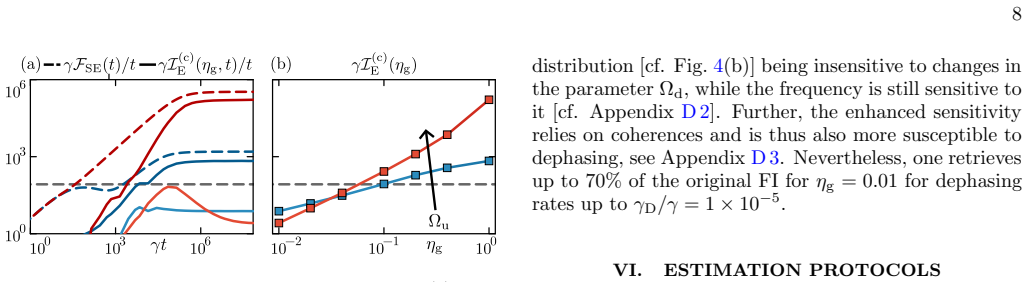
The relevant parameter regime for us is Ω d ≪Ω e, γg, while we also assume the strongly fluorescent transition to be far from saturation such that Ω e < γg/4
Unit detection efficiency Beginning with the case of unit detection efficiency, it is sufficient to consider the effective Hamiltonian Heff =H−i γg 2 |e⟩⟨e|,(B3) which we study using perturbation theory. The relevant parameter regime for us is Ω d ≪Ω e, γg, while we also assume the strongly fluorescent transition to be far from saturation such that Ω e < ...
-
[2]
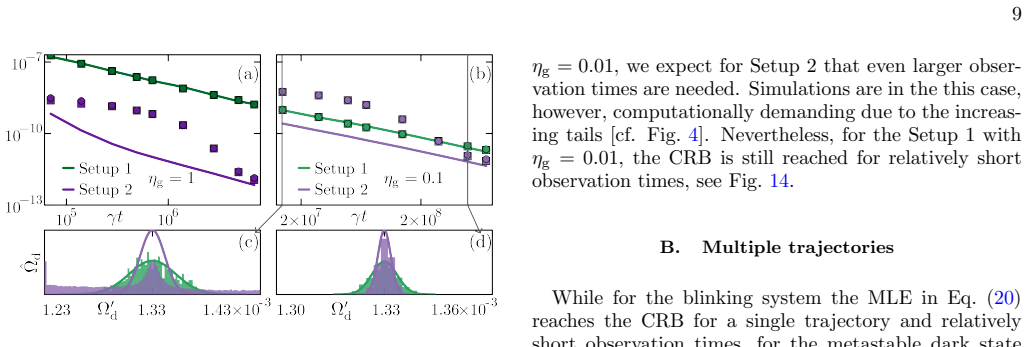
Nevertheless, as we show below, the results ofη g = 1 are still useful in help- ing us to build an accurate ansatz forW(τ)
Inefficient detection In the case ofη g <1 we are not able to pursue a systematic perturbative expansion. Nevertheless, as we show below, the results ofη g = 1 are still useful in help- ing us to build an accurate ansatz forW(τ). In order to do so, we first compute numericallyW(τ) and analyze its behavior as we decreaseη g and for Ω d/Ωe = 0.0025, see Fig...
-
[3]
Unit detection efficiency in both channels Analog to the blinking system (Setup 1) we make use of a non-Hermitian perturbation theory in order to find analytical expressions for the characteristic features of the WTD observed before, see Sec. V A. In contrast to the case studied in Appendix B we explicitly have to consider all decay channels and assumeη g...
-
[4]
Waiting time distribution In the following section, we will firstly discuss differ- ences betweenW ′(τ) (η g =η u = 1) and the waiting time distributionW(τ) (η g = 1, ηu = 0) [cf. Fig. 10(b)]. In a second step we study howW(τ) changes with inefficient detectionη g ≪1, see Fig. 4(b). 16 FIG. 11.Spectral decomposition ofL 0 for Setup 2. (a) Eigenvalues of t...
-
[5]
Dephasing In this section, we present and discuss the impact of dephasing to the enhanced sensitivity observed in the case of Setup 2. The results derived in the context of the perturbation ansatz show that the oscillations emerging on an interme- diate timescale rely on coherences between the dark state |D⟩and the|d⟩-level. Thus, the latter and consequen...
-
[6]
J. G. Bohnet, Z. Chen, J. M. Weiner, D. Meiser, M. J. Holland, and J. K. Thompson, A steady-state superradi- ant laser with less than one intracavity photon, Nature 484, 78 (2012)
2012
-
[7]
Ferioli, A
G. Ferioli, A. Glicenstein, I. Ferrier-Barbut, and A. Browaeys, A non-equilibrium superradiant phase tran- sition in free space, Nat. Phys.19, 1345 (2023)
2023
-
[8]
T. E. Lee, H. H¨ affner, and M. C. Cross, Collective quan- tum jumps of Rydberg atoms, Phys. Rev. Lett.108, 023602 (2012)
2012
-
[9]
C. Ates, B. Olmos, J. P. Garrahan, and I. Lesanovsky, Dynamical phases and intermittency of the dissipative quantum Ising model, Phys. Rev. A85, 043620 (2012)
2012
-
[10]
D.-S. Ding, H. Busche, B.-S. Shi, G.-C. Guo, and C. S. Adams, Phase diagram and self-organizing dynamics in a thermal ensemble of strongly interacting Rydberg atoms, Phys. Rev. X10, 021023 (2020)
2020
-
[11]
Liu, K.-H
Z.-K. Liu, K.-H. Sun, A. Cabot, F. Carollo, J. Zhang, Z.- Y. Zhang, L.-H. Zhang, B. Liu, T.-Y. Han, Q. Li, Y. Ma, H.-C. Chen, I. Lesanovsky, D.-S. Ding, and B.-S. Shi, Emergence of subharmonics in a microwave driven dissi- pative Rydberg gas, Phys. Rev. Res.6, L032069 (2024)
2024
-
[12]
Kongkhambut, J
P. Kongkhambut, J. Skulte, L. Mathey, J. G. Cosme, A. Hemmerich, and H. Keßler, Observation of a continu- ous time crystal, Science377, 670 (2022)
2022
-
[13]
Solanki, M
P. Solanki, M. Krishna, M. Hajduˇ sek, C. Bruder, and S. Vinjanampathy, Exotic synchronization in continuous time crystals outside the symmetric subspace, Phys. Rev. Lett.133, 260403 (2024)
2024
-
[14]
Russo and T
F. Russo and T. Pohl, Quantum dissipative continuous time crystals, Phys. Rev. Lett.135, 110404 (2025)
2025
-
[15]
Z. Wang, R. Gao, X. Wu, B. Buˇ ca, K. Mølmer, L. You, and F. Yang, Boundary time crystals induced by local dissipation and long-range interactions, Phys. Rev. Lett. 135, 230401 (2025)
2025
-
[16]
Montenegro, C
V. Montenegro, C. Mukhopadhyay, R. Yousefjani, S. Sarkar, U. Mishra, M. G. Paris, and A. Bayat, Re- view: Quantum metrology and sensing with many-body systems, Phys. Rep.1134, 1 (2025)
2025
-
[17]
Macieszczak, M
K. Macieszczak, M. Gut ¸˘ a, I. Lesanovsky, and J. P. Gar- rahan, Dynamical phase transitions as a resource for quantum enhanced metrology, Phys. Rev. A93, 022103 (2016)
2016
-
[18]
Ilias, D
T. Ilias, D. Yang, S. F. Huelga, and M. B. Plenio, Criticality-enhanced quantum sensing via continuous measurement, PRX Quantum3, 010354 (2022)
2022
-
[19]
Montenegro, M
V. Montenegro, M. G. Genoni, A. Bayat, and M. G. Paris, Quantum metrology with boundary time crystals, Commun. Phys.6, 304 (2023)
2023
-
[20]
Di Candia, F
R. Di Candia, F. Minganti, K. Petrovnin, G. Paraoanu, and S. Felicetti, Critical parametric quantum sensing, npj Quantum Inf.9, 23 (2023)
2023
-
[21]
V. P. Pavlov, D. Porras, and P. A. Ivanov, Quantum metrology with critical driven-dissipative collective spin system, Phys. Scr.98, 095103 (2023)
2023
-
[22]
Cabot, F
A. Cabot, F. Carollo, and I. Lesanovsky, Exploiting nonequilibrium phase transitions and strong symmetries for continuous measurement of collective observables, Phys. Rev. A110, L060601 (2024)
2024
-
[23]
Xu and M
M. Xu and M. J. Holland, Conditional ramsey spec- troscopy with synchronized atoms, Phys. Rev. Lett.114, 103601 (2015)
2015
-
[24]
G. L. Giorgi, F. Galve, and R. Zambrini, Probing the spectral density of a dissipative qubit via quantum syn- chronization, Phys. Rev. A94, 052121 (2016)
2016
-
[25]
Cabot, F
A. Cabot, F. Carollo, and I. Lesanovsky, Continuous sensing and parameter estimation with the boundary time crystal, Phys. Rev. Lett.132, 050801 (2024)
2024
-
[26]
Iemini, R
F. Iemini, R. Fazio, and A. Sanpera, Floquet time crys- tals as quantum sensors of ac fields, Phys. Rev. A109, L050203 (2024)
2024
-
[27]
Gribben, A
D. Gribben, A. Sanpera, R. Fazio, J. Marino, and F. Iem- ini, Boundary time crystals as AC sensors: Enhance- ments and constraints, SciPost Phys.18, 100 (2025)
2025
-
[28]
Yousefjani, K
R. Yousefjani, K. Sacha, and A. Bayat, Discrete time crystal phase as a resource for quantum-enhanced sens- ing, Phys. Rev. B111, 125159 (2025)
2025
-
[29]
Attaining Quantum Sensing Enhancement from Monitored Dissipative Time Crystals
E. O’Connor, V. Montenegro, F. Albarelli, M. G. A. Paris, A. Bayat, and M. G. Genoni, Attaining quantum sensing enhancement from monitored dissipative time crystals (2026), arXiv:2508.15448 [quant-ph]
work page internal anchor Pith review Pith/arXiv arXiv 2026
-
[30]
H. M. Wiseman and G. J. Milburn,Quantum measure- ment and control(Cambridge university press, 2009)
2009
-
[31]
Catana, M
C. Catana, M. van Horssen, and M. Guta, Asymptotic in- ference in system identification for the atom maser, Phil. Trans. R. Soc. A (2012). 19
2012
-
[32]
Gammelmark and K
S. Gammelmark and K. Mølmer, Bayesian parameter in- ference from continuously monitored quantum systems, Phys. Rev. A87, 032115 (2013)
2013
-
[33]
Gammelmark and K
S. Gammelmark and K. Mølmer, Fisher information and the quantum Cram´ er-Rao sensitivity limit of continuous measurements, Phys. Rev. Lett.112, 170401 (2014)
2014
-
[34]
A. H. Kiilerich and K. Mølmer, Estimation of atomic interaction parameters by photon counting, Phys. Rev. A89, 052110 (2014)
2014
-
[35]
A. H. Kiilerich and K. Mølmer, Bayesian parameter es- timation by continuous homodyne detection, Phys. Rev. A94, 032103 (2016)
2016
-
[36]
Cortez, A
L. Cortez, A. Chantasri, L. P. Garc´ ıa-Pintos, J. Dressel, and A. N. Jordan, Rapid estimation of drifting param- eters in continuously measured quantum systems, Phys. Rev. A95, 012314 (2017)
2017
-
[37]
Albarelli, M
F. Albarelli, M. A. C. Rossi, D. Tamascelli, and M. G. Genoni, Restoring Heisenberg scaling in noisy quantum metrology by monitoring the environment, Quantum2, 110 (2018)
2018
-
[38]
Shankar, G
A. Shankar, G. P. Greve, B. Wu, J. K. Thompson, and M. Holland, Continuous real-time tracking of a quan- tum phase below the standard quantum limit, Phys. Rev. Lett.122, 233602 (2019)
2019
-
[39]
Amor´ os-Binefa and J
J. Amor´ os-Binefa and J. Ko lody´ nski, Noisy atomic mag- netometry in real time, New J. Phys.23, 123030 (2021)
2021
-
[40]
D. Yang, S. F. Huelga, and M. B. Plenio, Efficient infor- mation retrieval for sensing via continuous measurement, Phys. Rev. X13, 031012 (2023)
2023
-
[41]
Godley and M
A. Godley and M. Guta, Adaptive measurement fil- ter: efficient strategy for optimal estimation of quantum Markov chains, Quantum7, 973 (2023)
2023
-
[42]
Ilias, D
T. Ilias, D. Yang, S. F. Huelga, and M. B. Plenio, Criticality-enhanced electric field gradient sensor with single trapped ions, npj Quantum Inf.10, 36 (2024)
2024
-
[43]
Mattes, A
R. Mattes, A. Cabot, F. Carollo, and I. Lesanovsky, De- signing open quantum systems for enabling quantum- enhanced sensing through classical measurements, Phys. Rev. Lett.135, 230402 (2025)
2025
-
[44]
A. Khan, F. Albarelli, and A. Datta, Tensor network approach to sensing quantum light-matter interactions, PRX Quantum6, 040343 (2025)
2025
-
[45]
Girotti, A
F. Girotti, A. Godley, and M. Guta, Estimating quantum Markov chains using coherent absorber post-processing and pattern counting estimator, Quantum9, 1835 (2025)
2025
- [46]
-
[47]
The Boundary Time Crystal as a light source for collectively enhanced sensing
M. Jirasek, I. Lesanovsky, and A. Cabot, The boundary time crystal as a light source for quantum enhanced sens- ing beyond the Heisenberg limit (2025), arXiv:2511.23416 [quant-ph]
work page internal anchor Pith review Pith/arXiv arXiv 2025
-
[48]
D. Yang, M. Ketkar, K. Audenaert, S. F. Huelga, and M. B. Plenio, Quantum Cram´ er-Rao precision limit of noisy continuous sensing, Phys. Rev. Lett.136, 070802 (2026)
2026
-
[49]
Radaelli, J
M. Radaelli, J. A. Smiga, G. T. Landi, and F. C. Binder, Parameter estimation for quantum jump unrav- eling, Quantum10, 1993 (2026)
1993
-
[50]
Vivas-Via˜ na and C
A. Vivas-Via˜ na and C. S´ anchez Mu˜ noz, Quantum metrol- ogy through spectral measurements in quantum optics, PRX Quantum7, 010346 (2026)
2026
-
[51]
K. C. Cox, G. P. Greve, J. M. Weiner, and J. K. Thomp- son, Deterministic squeezed states with collective mea- surements and feedback, Phys. Rev. Lett.116, 093602 (2016)
2016
-
[52]
A. P. VanDevender, Y. Colombe, J. Amini, D. Leibfried, and D. J. Wineland, Efficient fiber optic detection of trapped ion fluorescence, Phys. Rev. Lett.105, 023001 (2010)
2010
-
[53]
Ghadimi, V
M. Ghadimi, V. Bl¯ ums, B. G. Norton, P. M. Fisher, S. C. Connell, J. M. Amini, C. Volin, H. Hayden, C.-S. Pai, D. Kielpinski, M. Lobino, and E. W. Streed, Scalable ion– photon quantum interface based on integrated diffractive mirrors, npj Quantum Inf3, 4 (2017)
2017
-
[54]
F. W. Knollmann, S. M. Corsetti, E. R. Clements, R. Swint, A. D. Leu, M. E. Kim, P. T. Callahan, D. Kharas, T. Mahony, C. Sorace-Agaskar, R. Mc- Connell, C. D. Bruzewicz, I. L. Chuang, J. Notaros, and J. Chiaverini, Collection of fluorescence from an ion using trap-integrated photonics, Light Sci Appl15, 95 (2026)
2026
-
[55]
Glicenstein, G
A. Glicenstein, G. Ferioli, L. Brossard, Y. R. P. Sor- tais, D. Barredo, F. Nogrette, I. Ferrier-Barbut, and A. Browaeys, Preparation of one-dimensional chains and dense cold atomic clouds with a high numerical aperture four-lens system, Phys. Rev. A103, 043301 (2021)
2021
-
[56]
Demkowicz-Dobrza´ nski, J
R. Demkowicz-Dobrza´ nski, J. Czajkowski, and P. Sekatski, Adaptive quantum metrology under general markovian noise, Phys. Rev. X7, 041009 (2017)
2017
-
[57]
Y. L. Len, T. Gefen, A. Retzker, and J. Ko lody´ nski, Quantum metrology with imperfect measurements, Nat. Commun.13, 6971 (2022)
2022
-
[58]
R. J. Cook and H. J. Kimble, Possibility of direct ob- servation of quantum jumps, Phys. Rev. Lett.54, 1023 (1985)
1985
-
[59]
H. J. Kimble, R. J. Cook, and A. L. Wells, Intermittent atomic fluorescence, Phys. Rev. A34, 3190 (1986)
1986
-
[60]
Zoller, M
P. Zoller, M. Marte, and D. F. Walls, Quantum jumps in atomic systems, Phys. Rev. A35, 198 (1987)
1987
-
[61]
Schenzle and R
A. Schenzle and R. G. Brewer, Macroscopic quantum jumps in a single atom, Phys. Rev. A34, 3127 (1986)
1986
-
[62]
M. S. Kim and P. L. Knight, Quantum-jump telegraph noise and macroscopic intensity fluctuations, Phys. Rev. A36, 5265 (1987)
1987
-
[63]
J. C. Bergquist, R. G. Hulet, W. M. Itano, and D. J. Wineland, Observation of quantum jumps in a single atom, Phys. Rev. Lett.57, 1699 (1986)
1986
-
[64]
Sauter, W
T. Sauter, W. Neuhauser, R. Blatt, and P. E. Toschek, Observation of quantum jumps, Phys. Rev. Lett.57, 1696 (1986)
1986
-
[65]
Nagourney, J
W. Nagourney, J. Sandberg, and H. Dehmelt, Shelved op- tical electron amplifier: Observation of quantum jumps, Phys. Rev. Lett.56, 2797 (1986)
1986
-
[66]
M. B. Plenio and P. L. Knight, The quantum-jump ap- proach to dissipative dynamics in quantum optics, Rev. Mod. Phys.70, 101 (1998)
1998
-
[67]
Gleyzes, S
S. Gleyzes, S. Kuhr, C. Guerlin, J. Bernu, S. Del´ eglise, U. Busk Hoff, M. Brune, J.-M. Raimond, and S. Haroche, Quantum jumps of light recording the birth and death of a photon in a cavity, Nature446, 297 (2007)
2007
-
[68]
J. P. Garrahan and I. Lesanovsky, Thermodynamics of quantum jump trajectories, Phys. Rev. Lett.104, 160601 (2010)
2010
-
[69]
Lesanovsky, M
I. Lesanovsky, M. van Horssen, M. Gut ¸˘ a, and J. P. Garra- han, Characterization of dynamical phase transitions in quantum jump trajectories beyond the properties of the 20 stationary state, Phys. Rev. Lett.110, 150401 (2013)
2013
-
[70]
D. C. Rose, K. Macieszczak, I. Lesanovsky, and J. P. Gar- rahan, Metastability in an open quantum Ising model, Phys. Rev. E94, 052132 (2016)
2016
-
[71]
M. Cech, M. Cea, M. C. Ba˜ nuls, I. Lesanovsky, and F. Carollo, Space-time correlations in monitored kineti- cally constrained discrete-time quantum dynamics, Phys. Rev. Lett.134, 230403 (2025)
2025
-
[72]
W. M. Itano, J. C. Bergquist, R. G. Hulet, and D. J. Wineland, Radiative decay rates in Hg + from observa- tions of quantum jumps in a single ion, Phys. Rev. Lett. 59, 2732 (1987)
1987
-
[73]
P. A. Barton, C. J. S. Donald, D. M. Lucas, D. A. Stevens, A. M. Steane, and D. N. Stacey, Measurement of the lifetime of the 3d 2D5/2 state in 40Ca+, Phys. Rev. A62, 032503 (2000)
2000
-
[74]
Staanum, I
P. Staanum, I. S. Jensen, R. G. Martinussen, D. Voigt, and M. Drewsen, Lifetime measurement of the metastable 3d 2D5/2 state in the 40Ca+ ion using the shelving technique on a few-ion string, Phys. Rev. A69, 032503 (2004)
2004
-
[75]
Fleischhauer, A
M. Fleischhauer, A. Imamoglu, and J. P. Marangos, Elec- tromagnetically induced transparency: Optics in coher- ent media, Rev. Mod. Phys.77, 633 (2005)
2005
-
[76]
Donarini, M
A. Donarini, M. Niklas, M. Schafberger, N. Paradiso, C. Strunk, and M. Grifoni, Coherent population trapping by dark state formation in a carbon nanotube quantum dot, Nat. Commun.10, 381 (2019)
2019
-
[77]
K. N. Tolazzi, B. Wang, C. Ianzano, J. Neumeier, C. J. Villas-Boas, and G. Rempe, Continuous quantum light from a dark atom, Commun. Phys.4, 57 (2021)
2021
-
[78]
Morigi, J
G. Morigi, J. Eschner, and C. H. Keitel, Ground state laser cooling using electromagnetically induced trans- parency, Phys. Rev. Lett.85, 4458 (2000)
2000
-
[79]
Y. Lin, J. P. Gaebler, T. R. Tan, R. Bowler, J. D. Jost, D. Leibfried, and D. J. Wineland, Sympathetic electromagnetically-induced-transparency laser cooling of motional modes in an ion chain, Phys. Rev. Lett.110, 153002 (2013)
2013
-
[80]
Lechner, C
R. Lechner, C. Maier, C. Hempel, P. Jurcevic, B. P. Lanyon, T. Monz, M. Brownnutt, R. Blatt, and C. F. Roos, Electromagnetically-induced-transparency ground-state cooling of long ion strings, Phys. Rev. A 93, 053401 (2016)
2016
discussion (0)
Sign in with ORCID, Apple, or X to comment. Anyone can read and Pith papers without signing in.