Brachistochrone-ruled timelike surfaces in Newtonian and relativistic spacetimes
Pith reviewed 2026-05-16 23:45 UTC · model grok-4.3
The pith
The paper introduces brachistochrone-ruled timelike surfaces in Newtonian and relativistic spacetimes, with rulings as time-minimizing trajectories, and gives explicit constructions in Minkowski spacetime (straight lines, totally geodesic surfaces) and Schwarzschild spacetime (via Jacobi metrics and
A machine-rendered reading of the paper's core claim, the machinery that carries it, and where it could break.
Core claim
We introduce and study brachistochrone-ruled timelike surfaces in Newtonian and relativistic spacetimes... relativistic brachistochrones arise as geodesics of an associated Finsler structure, and brachistochrone-ruled timelike surfaces are timelike surfaces ruled by these time-minimizing worldlines.
Load-bearing premise
The reduction of arrival-time functionals to Finsler- or Jacobi-type length functionals on a spatial manifold holds for stationary Lorentzian spacetimes, as stated in the generalization step.
Figures
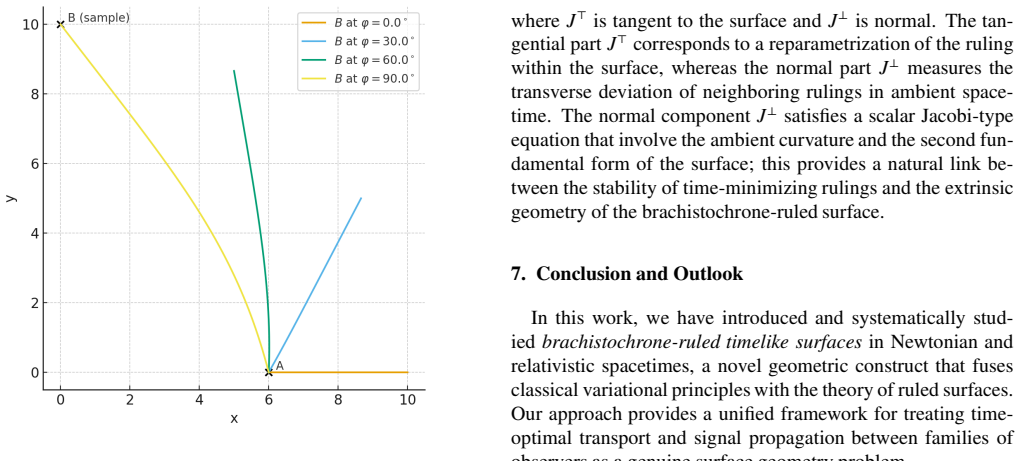
read the original abstract
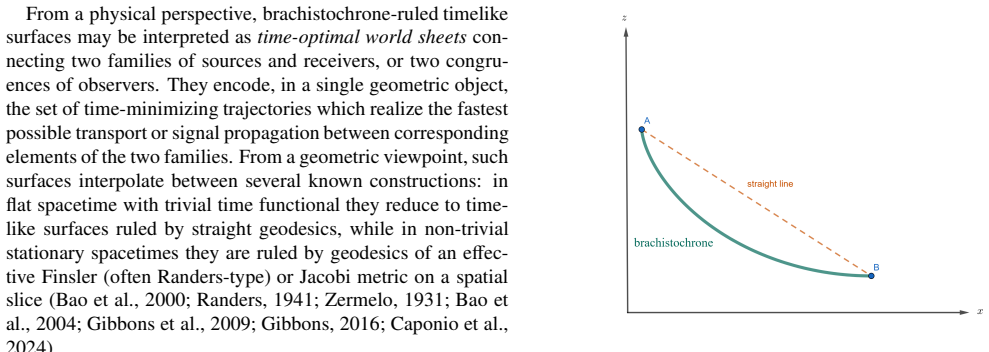
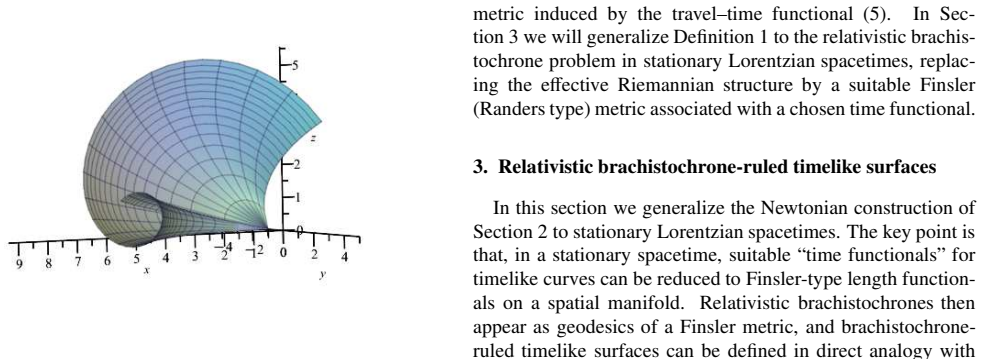
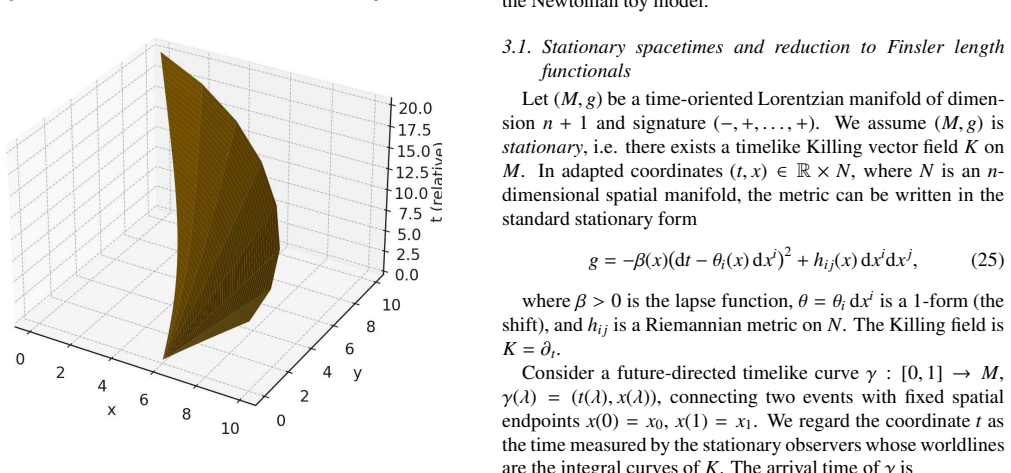
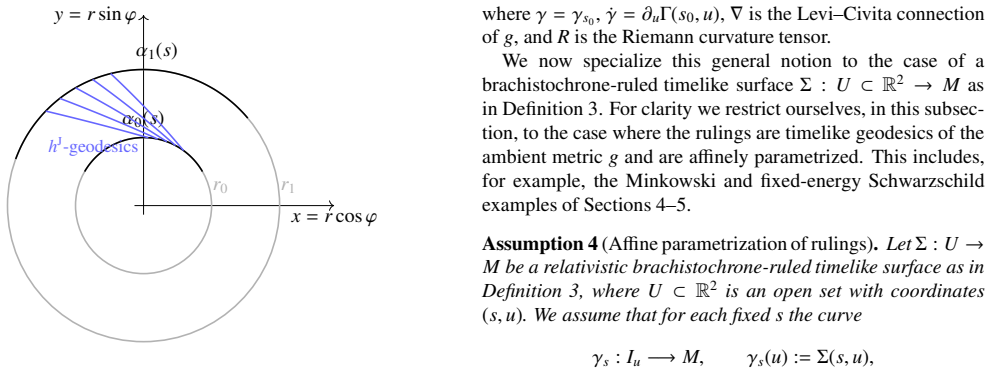
We introduce and study \emph{brachistochrone-ruled timelike surfaces} in Newtonian and relativistic spacetimes. Starting from the classical cycloidal brachistochrone in a constant gravitational field, we construct a Newtonian ``brachistochrone-ruled worldsheet'' whose rulings are time-minimizing trajectories between pairs of endpoints. We then generalize this construction to stationary Lorentzian spacetimes by exploiting the reduction of arrival-time functionals to Finsler- or Jacobi-type length functionals on a spatial manifold. In this framework, relativistic brachistochrones arise as geodesics of an associated Finsler structure, and brachistochrone-ruled timelike surfaces are timelike surfaces ruled by these time-minimizing worldlines. We work out explicit examples in Minkowski spacetime and in the Schwarzschild exterior: in the flat case, for a bounded-speed time functional, the brachistochrones are straight timelike lines and a simple family of brachistochrone-ruled surfaces turns out to be totally geodesic; in the Schwarzschild case, we show how coordinate-time minimization at fixed energy reduces to geodesics of a Jacobi metric on the spatial slice, and outline a numerical scheme for constructing brachistochrone-ruled timelike surfaces. Finally, we discuss basic geometric properties of such surfaces and identify natural Jacobi fields along the rulings.
Editorial analysis
A structured set of objections, weighed in public.
Referee Report
Summary. The manuscript introduces brachistochrone-ruled timelike surfaces in Newtonian and relativistic spacetimes. It constructs a Newtonian version from the classical cycloidal brachistochrone whose rulings are time-minimizing trajectories, then generalizes the construction to stationary Lorentzian spacetimes by reducing arrival-time functionals to Finsler- or Jacobi-type length functionals on a spatial manifold. Relativistic brachistochrones are thereby realized as geodesics of an associated Finsler structure, and the ruled surfaces are timelike surfaces generated by these worldlines. Explicit examples are developed in Minkowski spacetime (bounded-speed time functional yields straight timelike rulings and a family of totally geodesic surfaces) and in the Schwarzschild exterior (coordinate-time minimization at fixed energy reduces to Jacobi-metric geodesics, with an outlined numerical construction scheme). The paper closes with a discussion of basic geometric properties and natural Jacobi fields along the rulings.
Significance. If the constructions are valid, the work supplies a coherent geometric framework that links classical brachistochrones to ruled timelike surfaces in both Newtonian gravity and general relativity. The explicit Minkowski case (straight rulings, totally geodesic family) and the Schwarzschild reduction to a Jacobi metric with numerical scheme constitute concrete, verifiable illustrations. The reliance on standard Finsler/Jacobi reductions for stationary metrics is a methodological strength that keeps the central constructions within established techniques while extending them to a new class of surfaces.
minor comments (3)
- [Minkowski section] In the Minkowski example, the precise form of the 'bounded-speed time functional' is invoked to obtain straight timelike rulings; a short explicit expression or reference to its definition would remove any ambiguity for readers.
- [Schwarzschild section] The numerical scheme for constructing the Schwarzschild surfaces is described at a high level; adding a brief pseudocode outline or convergence criterion would enhance reproducibility without altering the geometric content.
- [Generalization paragraph] Notation for the effective spatial metric and the associated Finsler structure is introduced in the generalization step; a single consolidated table comparing the Newtonian, Minkowski, and Schwarzschild cases would improve readability.
Simulated Author's Rebuttal
We thank the referee for the positive and constructive assessment of our manuscript on brachistochrone-ruled timelike surfaces. We appreciate the recognition of the explicit constructions in Minkowski spacetime (straight timelike rulings and totally geodesic surfaces) and the reduction to Jacobi metrics in the Schwarzschild exterior, as well as the methodological use of standard Finsler/Jacobi techniques. The recommendation for minor revision is noted; we will incorporate improvements to clarity and presentation in the revised version.
Circularity Check
No significant circularity detected
full rationale
The paper's central construction defines brachistochrone-ruled timelike surfaces by applying the standard reduction of arrival-time functionals to Finsler/Jacobi length functionals on spatial slices in stationary Lorentzian spacetimes, then works out explicit examples (Minkowski straight rulings, Schwarzschild Jacobi geodesics) and geometric properties. This reduction is invoked as a known technique rather than derived internally or via self-citation chains; no equations reduce by construction to fitted parameters, no uniqueness theorems are imported from the authors' prior work, and no predictions are statistically forced from subsets of the same data. The derivation chain consists of definitions and direct applications of established projections, remaining self-contained against external benchmarks.
Axiom & Free-Parameter Ledger
axioms (1)
- domain assumption Stationary Lorentzian spacetimes admit a reduction of arrival-time functionals to Finsler or Jacobi length functionals on the spatial slice
Lean theorems connected to this paper
-
IndisputableMonolith/Foundation/AlexanderDuality.lean; IndisputableMonolith/Cost/FunctionalEquation.leanreality_from_one_distinction; washburn_uniqueness_aczel unclear?
unclearRelation between the paper passage and the cited Recognition theorem.
We generalize this construction to stationary Lorentzian spacetimes by exploiting the reduction of arrival-time functionals to Finsler- or Jacobi-type length functionals on a spatial manifold... relativistic brachistochrones arise as geodesics of an associated Finsler structure
-
IndisputableMonolith/Foundation/DimensionForcing.leanD3_admits_circle_linking unclear?
unclearRelation between the paper passage and the cited Recognition theorem.
in the flat case, for a bounded-speed time functional, the brachistochrones are straight timelike lines and a simple family of brachistochrone-ruled surfaces turns out to be totally geodesic
What do these tags mean?
- matches
- The paper's claim is directly supported by a theorem in the formal canon.
- supports
- The theorem supports part of the paper's argument, but the paper may add assumptions or extra steps.
- extends
- The paper goes beyond the formal theorem; the theorem is a base layer rather than the whole result.
- uses
- The paper appears to rely on the theorem as machinery.
- contradicts
- The paper's claim conflicts with a theorem or certificate in the canon.
- unclear
- Pith found a possible connection, but the passage is too broad, indirect, or ambiguous to say the theorem truly supports the claim.
Reference graph
Works this paper leans on
- [1]
-
[2]
Gelfand, I. M., & Fomin, S. V . 1963, Calculus of V ariations (Englewood Cliffs, NJ: Prentice–Hall) do Carmo, M. P . 1992, Riemannian Geometry (Boston, MA: Birkhäuser)
work page 1963
-
[3]
2011, Riemannian Geometry and Geometric Analysis , 6th ed
Jost, J. 2011, Riemannian Geometry and Geometric Analysis , 6th ed. (Berlin: Springer) O’Neill, B. 1983, Semi-Riemannian Geometry with Applica- tions to Relativity (New Y ork: Academic Press)
work page 2011
-
[4]
Landau, L. D., & Lifshitz, E. M. 1975, The Classical Theory of Fields, 4th ed. (Oxford: Butterworth–Heinemann)
work page 1975
-
[5]
2000, An Introduction to Riemann–Finsler Geometry (New Y ork: Springer)
Bao, D., Chern, S.-S., & Shen, Z. 2000, An Introduction to Riemann–Finsler Geometry (New Y ork: Springer)
work page 2000
- [6]
-
[7]
Zermelo, E. 1931, Z. Angew. Math. Mech., 11, 114
work page 1931
-
[8]
Bao, D., Robles, C., & Shen, Z. 2004, J. Di ff. Geom., 66, 377
work page 2004
- [9]
-
[10]
Perlick, V . 1991 J. Math. Phys., 1 32 (11), 1991
work page 1991
-
[11]
2000,Ray Optics, Fermat’s Principle, and Applica- tions to General Relativity (Berlin: Springer)
Perlick, V . 2000,Ray Optics, Fermat’s Principle, and Applica- tions to General Relativity (Berlin: Springer)
work page 2000
-
[12]
Fortunato, D., Giannoni, F., & Masiello, A. 1995, J. Geom. Phys., 15, 159
work page 1995
-
[13]
Giannoni, F., Masiello, A., & Piccione, P . 1997, J. Math. Phys., 43, 563
work page 1997
-
[14]
Caponio, E., Javaloyes, M. Á., & Masiello, A. 2011, Math. Ann., 351, 365
work page 2011
-
[15]
Caponio, E., Javaloyes, M. Á., & Sánchez, M. 2011, Rev. Mat. Iberoam., 27, 919
work page 2011
-
[16]
Gibbons, G. W ., Herdeiro, C. A. R., Warnick, C. M., & Werner, M. C. 2009, Phys. Rev. D, 79, 044022
work page 2009
-
[17]
Gibbons, G. W . 2016, Class. Quantum Grav., 33, 025004
work page 2016
-
[18]
Caponio, E., Javaloyes, M. Á., & Sánchez, M. 2024, Mem. Am. Math. Soc., 300, no. 1501
work page 2024
-
[19]
Goldstein, H. F., Bender, C.M., 1986, J. Math. Phys. 27 (2) 19
work page 1986
discussion (0)
Sign in with ORCID, Apple, or X to comment. Anyone can read and Pith papers without signing in.