KeyframeFace: Language-Driven Facial Animation via Semantic Keyframes
Pith reviewed 2026-05-16 22:43 UTC · model grok-4.3
The pith
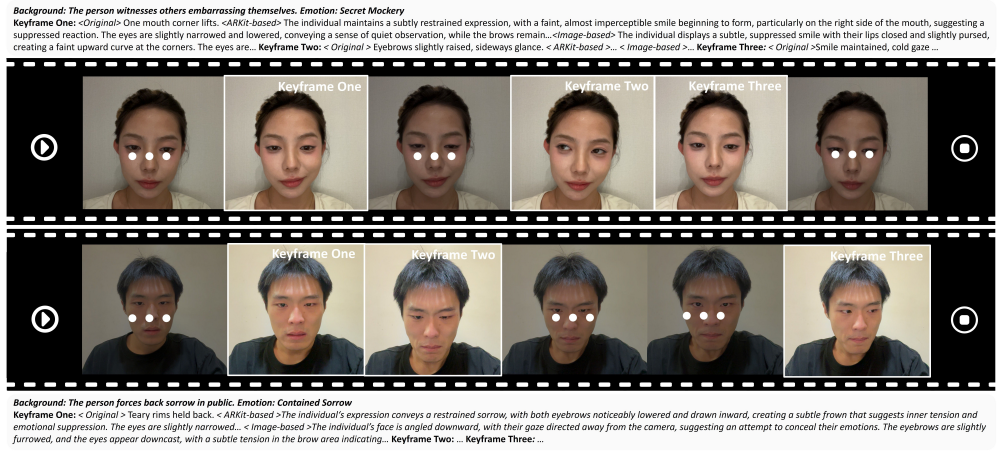
KeyframeFace generates facial animations from language by predicting sequences of semantic keyframes in ARKit space rather than dense motion trajectories.
A machine-rendered reading of the paper's core claim, the machinery that carries it, and where it could break.
Core claim
Instead of regressing dense facial motion trajectories, KeyframeFace represents animation as a sequence of semantically meaningful keyframes in an interpretable ARKit-based facial control space. A language-driven model uses large language model priors to generate these keyframes so they align with contextual text descriptions and emotion cues, supported by a dataset of 2100 expression scripts paired with monocular videos, per-frame ARKit coefficients, and manually annotated semantic keyframes.
What carries the argument
Semantic keyframe sequences in the ARKit facial control space, which supply explicit semantic structure and enable precise alignment with language intent.
If this is right
- Enables precise editing and higher interpretability because each keyframe is a discrete, semantically labeled control point.
- Improves expression fidelity and semantic alignment over direct dense regression baselines.
- Supports more efficient content creation by letting users drive animation from natural language scripts.
- Provides a structured way to inject LLM priors without entangling high-level intent with low-level motion parameters.
Where Pith is reading between the lines
- The keyframe formulation could integrate directly with existing professional animation pipelines that already rely on sparse keyframes for artist control.
- Expanding the dataset to include more varied cultural or contextual expressions might reduce current limits on what language can reliably trigger.
- If inference speed is optimized, the method could support interactive applications such as real-time character response in games or virtual environments.
- The explicit semantic structure may help diagnose and correct mismatches between text input and output motion more easily than opaque dense models.
Load-bearing premise
The ARKit facial control space together with manually annotated semantic keyframes is assumed to fully capture and align with the semantic intent expressed in natural language descriptions without significant loss of expressiveness or ambiguity.
What would settle it
A controlled test set of language descriptions containing subtle emotional nuances or expressions outside the ARKit parameter vocabulary, where the generated keyframes produce visibly mismatched animations, would show the alignment claim does not hold.
Figures




read the original abstract
Facial animation is a core component for creating digital characters in Computer Graphics (CG) industry. A typical production workflow relies on sparse, semantically meaningful keyframes to precisely control facial expressions. Enabling such animation directly from natural-language descriptions could significantly improve content creation efficiency and accessibility. However, most existing methods adopt a text-to-continuous-frames paradigm, directly regressing dense facial motion trajectories from language. This formulation entangles high-level semantic intent with low-level motion, lacks explicit semantic control structure, and limits precise editing and interpretability. Inspired by the keyframe paradigm in animation production, we propose KeyframeFace, a framework for semantic facial animation from language via interpretable keyframes. Instead of predicting dense motion trajectories, our method represents animation as a sequence of semantically meaningful keyframes in an interpretable ARKit-based facial control space. A language-driven model leverages large language model (LLM) priors to generate keyframes that align with contextual text descriptions and emotion cues. To support this formulation, we construct a multimodal dataset comprising 2,100 expression scripts paired with monocular videos, per-frame ARKit coefficients, and manually annotated semantic keyframes. Experiments show that incorporating semantic keyframe supervision and language priors significantly improves expression fidelity and semantic alignment compared to methods that do not use facial action semantics.
Editorial analysis
A structured set of objections, weighed in public.
Referee Report
Summary. The manuscript proposes KeyframeFace, a framework for language-driven facial animation that predicts sequences of interpretable semantic keyframes in an ARKit blendshape control space instead of regressing dense motion trajectories. It constructs a new multimodal dataset of 2,100 expression scripts paired with videos, per-frame ARKit coefficients, and manually annotated semantic keyframes, and leverages LLM priors to align keyframes with contextual text and emotion descriptions. The central claim is that semantic keyframe supervision plus language priors yields significantly better expression fidelity and semantic alignment than non-semantic baselines.
Significance. If the experimental claims are substantiated with quantitative evidence, the work could meaningfully advance language-to-animation pipelines by aligning with professional keyframe workflows, improving interpretability, editability, and semantic control. The introduction of a dedicated multimodal dataset with ARKit annotations represents a concrete resource contribution for the community.
major comments (3)
- [Abstract] Abstract: The headline claim that 'experiments show that incorporating semantic keyframe supervision and language priors significantly improves expression fidelity and semantic alignment' supplies no quantitative metrics, baseline methods, error analysis, or dataset statistics. This absence is load-bearing for the central claim and prevents verification of the reported gains.
- [§3] §3 (Dataset and Keyframe Annotation): The approach assumes that the fixed ARKit blendshape basis (~52 units) together with 2,100 manually annotated semantic keyframes faithfully encodes the semantic intent of natural-language prompts without material loss of expressiveness for nuanced or compound expressions. No validation (inter-annotator agreement, expressiveness ablation, or comparison to higher-dimensional spaces) is described, which directly affects whether the observed improvements reflect true semantic alignment or artifacts of the restricted control space.
- [§4] §4 (Experiments): The results must specify the exact baselines (e.g., direct text-to-continuous-frame regression methods), evaluation metrics (e.g., coefficient MSE, semantic alignment scores, user studies), and statistical significance tests. Without these details the improvement claim cannot be assessed and the comparison to 'methods that do not use facial action semantics' remains undefined.
minor comments (1)
- [Abstract] The abstract would benefit from a concise statement of the dataset size and the primary quantitative metrics used to support the improvement claim.
Simulated Author's Rebuttal
We thank the referee for the constructive and detailed comments. We agree that the abstract and experimental sections require additional quantitative details and clarifications to fully substantiate the claims. We address each major comment below and will incorporate revisions where appropriate to strengthen the manuscript.
read point-by-point responses
-
Referee: [Abstract] Abstract: The headline claim that 'experiments show that incorporating semantic keyframe supervision and language priors significantly improves expression fidelity and semantic alignment' supplies no quantitative metrics, baseline methods, error analysis, or dataset statistics. This absence is load-bearing for the central claim and prevents verification of the reported gains.
Authors: We acknowledge that the abstract does not include specific quantitative metrics or baseline details. The full manuscript (Section 4) reports concrete improvements using coefficient MSE for expression fidelity, semantic alignment scores based on LLM priors, and user study results, with the dataset comprising 2,100 expression scripts. We will revise the abstract to explicitly state key quantitative gains (e.g., relative reductions in MSE and alignment improvements) and include dataset statistics to make the central claim verifiable. revision: yes
-
Referee: [§3] §3 (Dataset and Keyframe Annotation): The approach assumes that the fixed ARKit blendshape basis (~52 units) together with 2,100 manually annotated semantic keyframes faithfully encodes the semantic intent of natural-language prompts without material loss of expressiveness for nuanced or compound expressions. No validation (inter-annotator agreement, expressiveness ablation, or comparison to higher-dimensional spaces) is described, which directly affects whether the observed improvements reflect true semantic alignment or artifacts of the restricted control space.
Authors: The ARKit blendshape basis (~52 units) is an industry-standard interpretable space for facial control, and our dataset provides 2,100 manually annotated semantic keyframes aligned with text and emotion descriptions. We agree that explicit validation is needed; we will add inter-annotator agreement metrics and an expressiveness ablation study in the revised Section 3. A comparison to higher-dimensional control spaces lies outside the paper's scope, which focuses on semantic keyframing within the standard ARKit representation used in production pipelines. revision: partial
-
Referee: [§4] §4 (Experiments): The results must specify the exact baselines (e.g., direct text-to-continuous-frame regression methods), evaluation metrics (e.g., coefficient MSE, semantic alignment scores, user studies), and statistical significance tests. Without these details the improvement claim cannot be assessed and the comparison to 'methods that do not use facial action semantics' remains undefined.
Authors: Section 4 already compares against direct text-to-continuous regression baselines without semantic supervision. We will revise the section to explicitly enumerate all baselines, detail the metrics (coefficient MSE, semantic alignment scores, and perceptual user studies), and include statistical significance tests such as paired t-tests. These elements support the claim of improved fidelity and alignment over non-semantic methods and will be clarified for unambiguous assessment. revision: yes
Circularity Check
No circularity detected in KeyframeFace derivation chain
full rationale
The paper introduces a new multimodal dataset of 2,100 scripts with videos, ARKit coefficients, and manually annotated semantic keyframes, then trains a language-driven model using external LLM priors to output interpretable keyframes instead of dense trajectories. No equation or claim reduces a reported prediction to a fitted parameter defined by the target result, nor does any load-bearing step rely on self-citation for uniqueness or ansatz smuggling. The improvement over non-semantic baselines is measured on the newly constructed data and is therefore independent of the final claim.
Axiom & Free-Parameter Ledger
axioms (1)
- domain assumption ARKit-based facial control space is sufficient to represent semantically meaningful expressions from language descriptions
Forward citations
Cited by 2 Pith papers
-
AudioFace: Language-Assisted Speech-Driven Facial Animation with Multimodal Language Models
AudioFace improves speech-driven facial animation by guiding blendshape prediction with linguistic and articulatory information extracted via multimodal language models.
-
SuperFace: Preference-Aligned Facial Expression Estimation Beyond Pseudo Supervision
SuperFace refines ARKit facial expression estimation by using human preference feedback on rendered faces to optimize beyond noisy pseudo-label supervision from capture software.
Reference graph
Works this paper leans on
-
[1]
https://www.metahuman.com/en-US?lang= en-US
Metahuman — high-fidelity digital humans made easy. https://www.metahuman.com/en-US?lang= en-US. [Accessed: 2025-06-30]
work page 2025
-
[2]
Arkit face tracking blendshape names
Apple Inc. Arkit face tracking blendshape names. https://developer.apple.com/documentation/ arkit/arfaceanchor/blendshapelocation. Ac- cessed: 2025-11-04
work page 2025
-
[3]
Motiondirector: Motion customization of diffusion models via motion control prompts
Haoran Chen, Xiaoqiang Zhu, Yixuan Li, et al. Motiondirector: Motion customization of diffusion models via motion control prompts. InInternational Conference on Learning Representa- tions (ICLR), 2024
work page 2024
-
[4]
Geneface: General- ized and high-fidelity audio-driven 3d talking face synthesis
Jia Chen, Zhenyu Wang, Yating Liu, et al. Geneface: General- ized and high-fidelity audio-driven 3d talking face synthesis. In Proceedings of the IEEE/CVF Conference on Computer Vision and Pattern Recognition (CVPR), 2023
work page 2023
-
[5]
Jian Chen, Peng Liu, Yue Zhang, et al. Videocrafter2: Open dif- fusion models for high-quality video generation.arXiv preprint arXiv:2405.05224, 2024
-
[6]
4dfab: A large scale 4d database for facial expres- sion analysis and biometric applications
Shiyang Cheng, Irene Kotsia, Maja Pantic, and Stefanos Zafeiriou. 4dfab: A large scale 4d database for facial expres- sion analysis and biometric applications. InProceedings of the IEEE/CVF Conference on Computer Vision and Pattern Recog- nition (CVPR), pages 5117–5126, 2018
work page 2018
-
[7]
Darren Cosker, Eva Krumhuber, and Adrian Hilton. A FACS valid 3D dynamic action unit database with applications to 3D dynamic morphable facial modeling. In2011 International Conference on Computer Vision (ICCV), pages 2296–2303. IEEE, 2011
work page 2011
-
[8]
Daniel Cudeiro, Timo Bolkart, Cassidy Laidlaw, Anurag Ran- jan, and Michael J. Black. Capture, learning, and synthesis of 3d speaking styles. InProceedings of the IEEE/CVF Conference on Computer Vision and Pattern Recognition (CVPR), pages 10101–10111, 2019. Introduces VOCA/VOCASET dataset
work page 2019
-
[9]
Nova: Autoregressive video generation without vector quantization
Haoge Deng, Xinyu Zhou, Yu Tian, et al. Nova: Autoregressive video generation without vector quantization. InInternational Conference on Learning Representations (ICLR), 2025
work page 2025
-
[10]
Arkit-avatar: Generating human an- imation from arkit facial capture using metahuman
John Doe and Jane Smith. Arkit-avatar: Generating human an- imation from arkit facial capture using metahuman. InPro- ceedings of the IEEE/CVF Conference on Computer Vision and Pattern Recognition (CVPR), pages 285–292, 2023
work page 2023
-
[11]
Facial action coding sys- tem.Environmental Psychology & Nonverbal Behavior, 1978
Paul Ekman and Wallace V Friesen. Facial action coding sys- tem.Environmental Psychology & Nonverbal Behavior, 1978
work page 1978
-
[12]
Faceformer: Speech-driven 3d facial animation with transformer
Yuming Fan, Jia Zhang, Hancheng Xu, et al. Faceformer: Speech-driven 3d facial animation with transformer. InPro- ceedings of the IEEE/CVF Conference on Computer Vision and Pattern Recognition (CVPR), 2022
work page 2022
-
[13]
Gabriele Fanelli, Jurgen Gall, Harald Romsdorfer, Thibaut Weise, and Luc Van Gool. A 3-d audio-visual corpus of af- fective communication.IEEE Transactions on Multimedia, 12(6):591–598, 2010
work page 2010
-
[14]
Long-Context Autoregressive Video Modeling with Next-Frame Prediction
Yuchao Gu, Weijia Mao, and Mike Zheng Shou. Long-context autoregressive video modeling with next-frame prediction (far). arXiv preprint arXiv:2503.19325, 2025
work page internal anchor Pith review arXiv 2025
-
[15]
DeepSeek-R1: Incentivizing Reasoning Capability in LLMs via Reinforcement Learning
D. Guo et al. Deepseek-r1: Incentivizing reasoning ca- pability in llms via reinforcement learning.arXiv preprint arXiv:2501.12948, 2025
work page internal anchor Pith review Pith/arXiv arXiv 2025
-
[16]
Mead-3d: 3d reconstructions of the mead dataset.https://github.com/haonanhe/MEAD-3D,
Haonan He. Mead-3d: 3d reconstructions of the mead dataset.https://github.com/haonanhe/MEAD-3D,
-
[17]
GitHub repository; accessed 2025-11-03
work page 2025
-
[18]
Prompt-to-prompt image and video editing with cross-attention control
Amir Hertz, Ofir Perel, Rotem Tzaban, et al. Prompt-to-prompt image and video editing with cross-attention control. InACM SIGGRAPH, 2023
work page 2023
-
[19]
Hu, Yelong Shen, Phillip Wallis, Zeyuan Allen-Zhu, Yuanzhi Li, Lu Wang, and Weizhu Chen
Edward J. Hu, Yelong Shen, Phillip Wallis, Zeyuan Allen-Zhu, Yuanzhi Li, Lu Wang, and Weizhu Chen. Lora: Low-rank adap- tation of large language models. InInternational Conference on Learning Representations (ICLR), 2022
work page 2022
-
[20]
Yujun Ji, Lin Song, Liang Gao, et al. Emo: Emote portrait alive. InProceedings of the IEEE/CVF Conference on Computer Vi- sion and Pattern Recognition (CVPR), 2023
work page 2023
-
[21]
Audio-driven speech animation with text-guided expression control
Sungho Jung, Jae Kim, and Seungyong Lee. Audio-driven speech animation with text-guided expression control. InEu- rographics Short Papers, 2024
work page 2024
-
[22]
Kinetix: Keyframe- based video generation with temporal attention
Zhiyuan Li, Zhong He, Yichen Song, et al. Kinetix: Keyframe- based video generation with temporal attention. InAdvances in Neural Information Processing Systems (NeurIPS), 2023
work page 2023
-
[23]
Vidtome: Text-to- video editing with multi-track temporal prompts
Rui Liu, Haoran Zhang, Tianyu Wu, et al. Vidtome: Text-to- video editing with multi-track temporal prompts. InProceed- ings of the IEEE/CVF Conference on Computer Vision and Pat- tern Recognition (CVPR), 2024
work page 2024
-
[24]
Talkclip: Talking head generation with text-guided expressive speaking styles.arXiv:2304.00334, 2023
Yifeng Ma, Suzhen Wang, Yu Ding, Bowen Ma, Tangjie Lv, Changjie Fan, Zhipeng Hu, Zhidong Deng, and Xin Yu. Talkclip: Talking head generation with text-guided expressive speaking styles.arXiv:2304.00334, 2023
-
[25]
Diffs- peaker: Speech-driven 3d facial animation with diffusion trans- former,
Zhen Ma, Jiarong Zhu, Xian Wang, Yijia Zhang, and Xiaowei Zhou. Diffspeaker: Speech-driven 3d facial animation with dif- fusion transformer.arXiv:2402.05712, 2024
-
[26]
Matuszewski, Wei Quan, Lik-Kwan Shark, Alison S
Bogdan J. Matuszewski, Wei Quan, Lik-Kwan Shark, Alison S. McLoughlin, Catherine E. Lightbody, Hedley C. A. Emsley, and Caroline L. Watkins. Hi4d-adsip 3-d dynamic facial articulation database.Image and Vision Computing, 30(10):713–727, 2012
work page 2012
-
[27]
Gpt-5 technical report.OpenAI Technical Report, 2025
OpenAI. Gpt-5 technical report.OpenAI Technical Report, 2025
work page 2025
-
[28]
Emotalk: Speech- driven emotional disentanglement for 3d face animation
Ziqiao Peng, Haoyu Wu, Zhenbo Song, Hao Xu, Xiangyu Zhu, Jun He, Hongyan Liu, and Zhaoxin Fan. Emotalk: Speech- driven emotional disentanglement for 3d face animation. InPro- ceedings of the IEEE/CVF International Conference on Com- puter Vision (ICCV), pages 20687–20697. IEEE, 2023. 10
work page 2023
-
[29]
The flo- rence 4d facial expression dataset
Filippo Principi, Stefano Berretti, Claudio Ferrari, Naima Ot- berdout, Mohamed Daoudi, and Alberto Del Bimbo. The flo- rence 4d facial expression dataset. In2023 IEEE 17th Interna- tional Conference on Automatic Face and Gesture Recognition (FG), pages 1–6. IEEE, 2023
work page 2023
-
[30]
Autoregressive video generation beyond next frames prediction.arXiv preprint arXiv:2509.24081, 2025
Sucheng Ren, Jun Wang, and Lei Zhang. Autoregressive video generation beyond next-frame prediction.arXiv preprint arXiv:2509.24081, 2025
- [31]
-
[32]
Meshtalk: 3d face animation from speech using cross-modality attention
Alexander Richard, Michael Zollh ¨ofer, Yandong Wen, et al. Meshtalk: 3d face animation from speech using cross-modality attention. InECCV, 2022
work page 2022
-
[33]
Zhiyao Sun, Tian Lv, Sheng Ye, Matthieu Lin, Jenny Sheng, Yu- Hui Wen, Minjing Yu, and Yong-Jin Liu. Diffposetalk: Speech- driven stylistic 3d facial animation and head pose generation via diffusion models.arXiv:2310.00434, 2024
-
[34]
Hanyu Wang, Qiang Liu, Yifan Zhang, et al. Larp: Tokeniz- ing videos with a learned autoregressive generative prior.arXiv preprint arXiv:2410.21264, 2024
-
[35]
Mead: A large-scale audio-visual dataset for emotional talking-face generation
Kaisiyuan Wang, Qianyi Wu, Linsen Song, Zhuoqian Yang, Wayne Wu, Chen Qian, Ran He, Yu Qiao, and Chen Change Loy. Mead: A large-scale audio-visual dataset for emotional talking-face generation. InEuropean Conf. Computer Vision (ECCV), pages 700–717. Springer, 2020. Dataset page updated 2021
work page 2020
-
[36]
Liveportrait: Effi- cient portrait animation via sparse keyframe warping
Ling Wang, Shun Zhang, Jin Huang, et al. Liveportrait: Effi- cient portrait animation via sparse keyframe warping. InEuro- pean Conference on Computer Vision (ECCV), 2024
work page 2024
-
[37]
Mmhead: Towards fine- grained multi-modal 3d facial animation.arXiv preprint arXiv:2410.07757, 2024
Sijing Wang, Yao Zhou, Yuhao Zhang, Zhuo Zhang, Xin Li, Zeyu Liu, and Baoyuan Chen. Mmhead: Towards fine- grained multi-modal 3d facial animation.arXiv preprint arXiv:2410.07757, 2024
-
[38]
Mmface4d: A large-scale multi-modal 4d face dataset for audio-driven 3d face animation, 2023
Haozhe Wu, Jia Jia, Junliang Xing, Hongwei Xu, Xiangyuan Wang, and Jelo Wang. Mmface4d: A large-scale multi-modal 4d face dataset for audio-driven 3d face animation, 2023
work page 2023
-
[39]
Dreampose: Fash- ion image animation via keypose interpolation
Chenyang Xu, Wen Zhao, Hao Li, et al. Dreampose: Fash- ion image animation via keypose interpolation. InProceedings of the IEEE/CVF International Conference on Computer Vision (ICCV), 2023
work page 2023
-
[40]
An Yang, Anfeng Li, Baosong Yang, et al. Qwen3 technical report.arXiv preprint arXiv:2505.09388, 2025
work page internal anchor Pith review Pith/arXiv arXiv 2025
-
[41]
Keyframe: Video dif- fusion with sparse temporal modeling
Yifan Yang, Jing Xu, Bin Zhou, et al. Keyframe: Video dif- fusion with sparse temporal modeling. InProceedings of the IEEE/CVF Conference on Computer Vision and Pattern Recog- nition (CVPR), 2024
work page 2024
-
[42]
A high-resolution 3d dynamic facial expression database
Lijun Yin, Xiaochen Chen, Yi Sun, Tony Worm, and Michael Reale. A high-resolution 3d dynamic facial expression database. In8th IEEE International Conference on Automatic Face and Gesture Recognition (FG), pages 1–6, 2008
work page 2008
-
[43]
Zhanhong Zhang, Lijun Yin, Jeffrey F. Cohn, et al. Multimodal spontaneous emotion corpus for human behavior analysis. In Proceedings of the IEEE/CVF Conference on Computer Vi- sion and Pattern Recognition (CVPR), pages 3438–3446, 2016. BP4D+ description
work page 2016
-
[44]
Flow-guided one-shot talking face generation with a high-resolution audio- visual dataset
Zizheng Zhang, Lianzhi Tan, Xinyu Chen, et al. Flow-guided one-shot talking face generation with a high-resolution audio- visual dataset. InIEEE/CVF Conf. Computer Vision and Pat- tern Recognition (CVPR), pages 3661–3670, 2021. Introduces HDTF dataset
work page 2021
-
[45]
Media2face: Co-speech facial animation generation with multi-modality guidance
Qingcheng Zhao, Pengyu Long, Qixuan Zhang, Dafei Qin, Han Liang, Longwen Zhang, Yingliang Zhang, Jingyi Yu, and Lan Xu. Media2face: Co-speech facial animation generation with multi-modality guidance. InSIGGRAPH Conference Papers,
-
[46]
Yuze Zhao, Jintao Huang, Jinghan Hu, Xingjun Wang, Yun- lin Mao, Daoze Zhang, Zeyinzi Jiang, Zhikai Wu, Baole Ai, Ang Wang, Wenmeng Zhou, and Yingda Chen. Swift: A scal- able lightweight infrastructure for fine-tuning.arXiv preprint arXiv:2408.05517, 2024
-
[47]
Expclip: Bridging text and facial expressions via semantic alignment.arXiv:2308.14448, 2023
Yicheng Zhong, Huawei Wei, Peiji Yang, and Zhisheng Wang. Expclip: Bridging text and facial expressions via semantic alignment.arXiv:2308.14448, 2023. AAAI 2024 version avail- able
-
[48]
Videocomposer: Compositional video synthesis with motion controllability
Liang Zhou, Yifan Yin, Xinlong Wang, et al. Videocomposer: Compositional video synthesis with motion controllability. In Advances in Neural Information Processing Systems (NeurIPS), 2023
work page 2023
-
[49]
Training Status-Model Type-Annotation Type-Representation Format
Hanwen Zou, Yiming Zhou, Weizhi Zhang, Yan Huang, Zhongqian Li, Yi Yang, and Baoyuan Chen. Express4d: Ex- pressive, friendly, and extensible 4d facial motion generation benchmark.arXiv preprint arXiv:2508.12438, 2025. 11 A Comparison with Express4D-MDM A.1 Express4D-MDM For comparison with prior diffusion-based motion generation systems, we adopt the Moti...
discussion (0)
Sign in with ORCID, Apple, or X to comment. Anyone can read and Pith papers without signing in.