Charged Higgs Pairs at the LHC: A NLO Analysis
Pith reviewed 2026-05-16 22:08 UTC · model grok-4.3
The pith
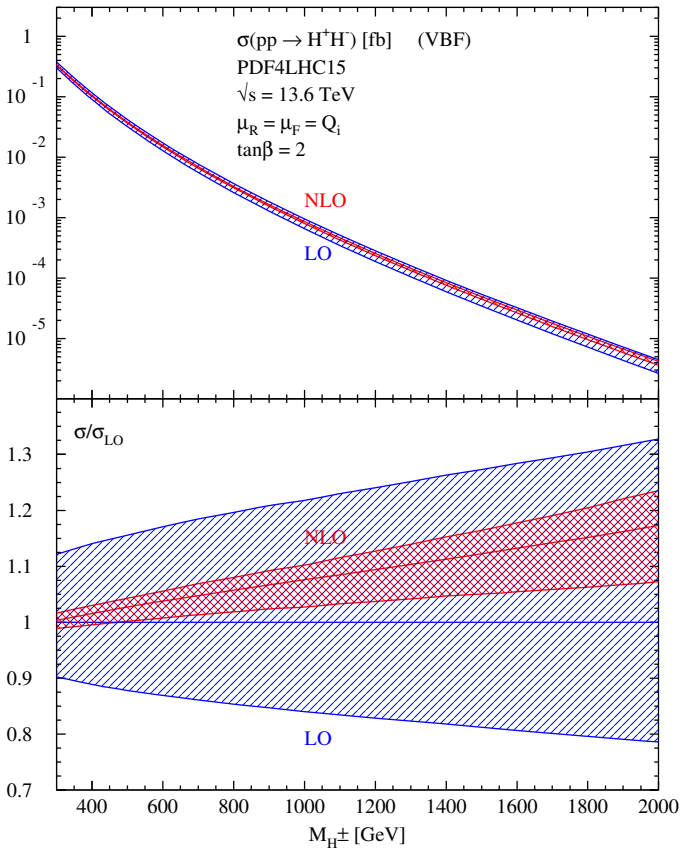
Next-to-leading order QCD corrections reduce scale uncertainties for charged Higgs pair production at the LHC
A machine-rendered reading of the paper's core claim, the machinery that carries it, and where it could break.
Core claim
In the type-I 2HDM we obtain next-to-leading order QCD predictions for charged-Higgs pair production that include all three main channels: Drell-Yan-like production, gluon fusion, and vector-boson fusion. The QCD corrections lead to a significant reduction of the relative scale dependences, while uncertainties from parton densities and the strong coupling are also quantified at the LHC.
What carries the argument
Next-to-leading-order QCD corrections applied uniformly to Drell-Yan, gluon-fusion, and vector-boson-fusion channels for H^+ H^- production, which dampen the dependence on unphysical scales.
If this is right
- The improved NLO predictions allow quantitative comparison with LHC data if charged Higgs states are observed.
- Scale uncertainties shrink across Drell-Yan-like, gluon-fusion, and vector-boson-fusion production modes.
- Uncertainties from parton densities and the strong coupling can be evaluated at the same perturbative order.
- The results hold for a range of charged-Higgs masses and tan-beta values within the model.
Where Pith is reading between the lines
- The same NLO framework could be applied to other 2HDM types or to supersymmetric models containing charged Higgs bosons.
- Experimental searches could translate the reduced theoretical uncertainty into tighter limits on charged-Higgs parameters.
- Neutral Higgs-pair production rates could be computed at the same order for cross-checks within the same model.
Load-bearing premise
The calculation assumes the type-I 2HDM is realized in nature and that perturbative QCD remains valid and sufficient at the relevant LHC energies and scales.
What would settle it
An LHC measurement of the H^+ H^- production rate that displays a scale variation at NLO comparable to or larger than the LO variation would falsify the claim that the corrections produce a significant reduction.
Figures




read the original abstract
Charged Higgs-boson pair production at hadron colliders yields information about the trilinear couplings involving charged Higgs fields in extensions of the Standard Model (SM). We consider the type-I two-Higgs doublet model (2HDM) extension and obtain next-to-leading order QCD predictions for the charged-Higgs pair production ($H^+H^-$ production). All production modes, i.e. Drell--Yan-like production, gluon fusion and vector-boson fusion are included in the analysis. We determine uncertainties originating from the scale dependence, the parton-density functions and strong coupling $\alpha_s$ at the LHC. We observe that the QCD corrections lead to a significant reduction of the relative scale dependences. These improved predictions will allow for a quantitative interpretation of experimental measurements, in case that charged Higgs states will be observed.
Editorial analysis
A structured set of objections, weighed in public.
Referee Report
Summary. The manuscript computes next-to-leading-order (NLO) QCD corrections to charged Higgs pair production (H^+ H^-) in the type-I two-Higgs-doublet model at the LHC. It includes Drell-Yan-like production, gluon fusion, and vector-boson fusion channels, determines uncertainties from renormalization/factorization scale variations, parton distribution functions, and α_s, and reports that the NLO corrections lead to a significant reduction in relative scale dependence.
Significance. If the results hold, the work supplies more reliable theoretical predictions for a process that probes trilinear Higgs couplings in a well-motivated BSM scenario. The reduction of scale uncertainty is the standard perturbative improvement expected from a consistent NLO calculation and directly enhances the interpretability of potential LHC signals.
minor comments (2)
- The abstract states that uncertainties from scale dependence, PDFs, and α_s are determined, but the manuscript should explicitly tabulate or plot the individual contributions of each uncertainty source at representative values of m_{H^±} and tan β to allow readers to assess their relative sizes.
- A short statement on the numerical implementation (e.g., which code or library is used for the NLO matrix elements and how the three channels are combined) would improve reproducibility.
Simulated Author's Rebuttal
We thank the referee for the positive summary and recommendation of minor revision. Our work provides NLO QCD predictions for H^+ H^- production in the type-I 2HDM at the LHC across Drell-Yan, gluon-fusion and vector-boson-fusion channels, with quantified uncertainties from scales, PDFs and alpha_s, showing the expected reduction in scale dependence.
Circularity Check
No significant circularity detected
full rationale
The paper performs a standard NLO QCD calculation for H^+ H^- production in type-I 2HDM by combining established Drell-Yan, gluon-fusion and VBF channels with conventional perturbative expansions, parton luminosities and scale-variation estimates. The observed reduction in scale dependence follows directly from the inclusion of higher-order terms in the usual way and does not reduce to any self-defined quantity, fitted parameter renamed as prediction, or load-bearing self-citation. All inputs (tan β, m_{H^±}, PDFs, α_s) are external; the derivation chain is self-contained against external QCD benchmarks.
Axiom & Free-Parameter Ledger
free parameters (2)
- tan beta
- charged Higgs mass
axioms (2)
- domain assumption Perturbative QCD is valid and sufficient for the process at LHC energies
- domain assumption Type-I 2HDM correctly describes the extended Higgs sector
Lean theorems connected to this paper
-
IndisputableMonolith/Cost/FunctionalEquationwashburn_uniqueness_aczel unclear?
unclearRelation between the paper passage and the cited Recognition theorem.
We consider the type-I two-Higgs doublet model (2HDM) extension and obtain next-to-leading order QCD predictions for the charged-Higgs pair production... All production modes... We observe that the QCD corrections lead to a significant reduction of the relative scale dependences.
-
IndisputableMonolith/Foundation/BranchSelectionbranch_selection unclear?
unclearRelation between the paper passage and the cited Recognition theorem.
The two scenarios of the 2HDM type I we use... tan β = 2 ... tan β = 20 ... MH± varied between 300 GeV and 2 TeV
What do these tags mean?
- matches
- The paper's claim is directly supported by a theorem in the formal canon.
- supports
- The theorem supports part of the paper's argument, but the paper may add assumptions or extra steps.
- extends
- The paper goes beyond the formal theorem; the theorem is a base layer rather than the whole result.
- uses
- The paper appears to rely on the theorem as machinery.
- contradicts
- The paper's claim conflicts with a theorem or certificate in the canon.
- unclear
- Pith found a possible connection, but the passage is too broad, indirect, or ambiguous to say the theorem truly supports the claim.
Forward citations
Cited by 1 Pith paper
-
When Two Loops Matter: Electroweak Precision in the SMEFT
A modification to the top-Higgs Yukawa coupling in SMEFT induces a two-loop shift in the W mass through a large anomalous dimension, providing a new indirect probe via electroweak precision observables.
Reference graph
Works this paper leans on
- [1]
-
[2]
P. W. Higgs, Phys. Lett. 12 (1964) 132, Phys. Rev. Lett. 13 (1964) 508 and Phys. Rev. 145 (1966) 1156; F. Englert and R. Brout, Phys. Rev. Lett. 13 (1964) 321; G. S. Guralnik, C. R. Hagen and T. W. Kibble, Phys. Rev. Lett. 13 (1964) 585; T. W. B. Kibble, Phys. Rev. 155 (1967) 1554
work page 1964
- [3]
-
[4]
G. ’t Hooft, Nucl. Phys. B 35 (1971) 167; G. ’t Hooft and M. J. G. Veltman, Nucl. Phys. B 44 (1972) 189
work page 1971
-
[5]
T. D. Lee, Phys. Rev. D 8 (1973), 1226-1239
work page 1973
-
[6]
G. C. Branco, P. M. Ferreira, L. Lavoura, M. N. Rebelo, M. Sher and J. P. Silva, Phys. Rept. 516 (2012), 1-102
work page 2012
- [7]
- [8]
- [9]
- [10]
-
[11]
S. L. Glashow and S. Weinberg, Phys. Rev. D 15 (1977) 1958. 26
work page 1977
-
[12]
S. Kanemura, Y. Okada, E. Senaha and C. P. Yuan, Phys. Rev. D 70 (2004) 115002
work page 2004
-
[13]
R. Coimbra, M. O. P. Sampaio and R. Santos, Eur. Phys. J. C 73 (2013) 2428; M. M¨ uhlleitner, M. O. P. Sampaio, R. Santos and J. Wittbrodt, Eur. Phys. J. C 82 (2022) no.3, 198
work page 2013
-
[14]
H. Bahl, T. Biek¨ otter, S. Heinemeyer, C. Li, S. Paasch, G. Weig lein and J. Wittbrodt, Comput. Phys. Commun. 291 (2023), 108803
work page 2023
-
[15]
E. Eichten, I. Hinchliffe, K. D. Lane and C. Quigg, Rev. Mod. Phys . 56 (1984), 579-707
work page 1984
-
[16]
G. Altarelli, R. K. Ellis and G. Martinelli, Nucl. Phys. B 157 (1979) 461-497; J. Kubar- Andre and F. E. Paige, Phys. Rev. D 19 (1979) 221
work page 1979
- [17]
- [18]
-
[19]
J. Butterworth, S. Carrazza, A. Cooper-Sarkar, A. De Roe ck, J. Feltesse, S. Forte, J. Gao, S. Glazov, J. Huston and Z. Kassabov, et al. J. Phys. G 43 (2016) 023001
work page 2016
- [20]
-
[21]
A. Djouadi, M. Spira and P. M. Zerwas, Phys. Lett. B 264 (1991), 440-446; S. Dawson, Nucl. Phys. B 359 (1991), 283-300; M. Spira, A. Djouadi, D. Graudenz and P. M. Zer was, Nucl. Phys. B 453 (1995), 17-82
work page 1991
- [22]
-
[23]
S. Borowka, N. Greiner, G. Heinrich, S. P. Jones, M. Kerner, J . Schlenk, U. Schubert and T. Zirke, Phys. Rev. Lett. 117 (2016) no.1, 012001 Erratum: [Phys. Rev. Lett. 117 (2016) no.7, 079901]; S. Borowka, N. Greiner, G. Heinrich, S. P. Jo nes, M. Kerner, J. Schlenk and T. Zirke, JHEP 1610 (2016) 107; J. Baglio, F. Campanario, S. Glaus, M. M¨ uhlleitner, ...
work page 2016
-
[24]
G. C. Cho, K. Hagiwara, J. Kanzaki, T. Plehn, D. Rainwater and T . Stelzer, Phys. Rev. D 73 (2006) 054002. 27
work page 2006
-
[25]
Gutzwiller, Diploma thesis, ETH Zurich, 2008
S. Gutzwiller, Diploma thesis, ETH Zurich, 2008
work page 2008
- [26]
-
[27]
Cridge [PDF4LHC21 combination group], SciPost Phys
T. Cridge [PDF4LHC21 combination group], SciPost Phys. Proc. 8 (2022), 101. 28
work page 2022
discussion (0)
Sign in with ORCID, Apple, or X to comment. Anyone can read and Pith papers without signing in.