Efficient Monte Carlo sampling of metastable systems using non-local collective variable updates
Pith reviewed 2026-05-16 21:04 UTC · model grok-4.3
The pith
Non-local collective variable updates extend to non-linear CVs and underdamped Langevin dynamics while preserving reversibility and improving sampling efficiency for metastable molecular systems.
A machine-rendered reading of the paper's core claim, the machinery that carries it, and where it could break.
Core claim
We generalize these approaches and explicitly spell out an algorithm for non-linear CVs and underdamped Langevin dynamics. We prove reversibility of the resulting scheme and demonstrate its performance on several numerical examples, observing a substantial performance increase compared to methods based on overdamped Langevin dynamics as considered previously. Advances in generative machine-learning-based proposal samplers now enable efficient sampling in CV spaces of intermediate dimensionality (tens to hundreds of variables), and our results extend their applicability toward more realistic molecular systems.
What carries the argument
Generalized non-local Metropolis-Hastings proposal scheme in collective variable space, adapted for non-linear mappings and underdamped Langevin dynamics while enforcing reversibility.
If this is right
- The scheme applies to non-linear collective variables without loss of reversibility.
- Detailed balance is satisfied, so the sampled distribution matches the target Boltzmann measure.
- Numerical examples exhibit substantially faster exploration of metastable states than overdamped counterparts.
- The method directly leverages efficient high-dimensional CV proposals from current generative models.
- It remains valid for underdamped dynamics, allowing velocity information to be incorporated in the updates.
Where Pith is reading between the lines
- The same non-local CV framework could be paired with parallel tempering or other global moves to tackle even higher barriers.
- Performance gains may scale to larger biomolecular systems where CV spaces reach hundreds of dimensions.
- The reversibility proof technique might adapt to other stochastic integrators such as those with position-dependent friction.
- Direct comparison on a protein-folding benchmark would test whether the speedup persists when the CV space is learned rather than hand-crafted.
Load-bearing premise
Generative machine-learning-based samplers can now efficiently generate proposals in collective variable spaces of intermediate dimensionality for realistic molecular systems.
What would settle it
Apply the algorithm to a metastable test system with known equilibrium distribution and measure either a deviation from that distribution or no reduction in mixing time relative to standard overdamped Langevin updates.
Figures




read the original abstract
Monte Carlo simulations are widely used to simulate complex molecular systems, but standard approaches suffer from metastability. Lately, the use of non-local proposal updates in a collective-variable (CV) space has been proposed in several works. Here, we generalize these approaches and explicitly spell out an algorithm for non-linear CVs and underdamped Langevin dynamics. We prove reversibility of the resulting scheme and demonstrate its performance on several numerical examples, observing a substantial performance increase compared to methods based on overdamped Langevin dynamics as considered previously. Advances in generative machine-learning-based proposal samplers now enable efficient sampling in CV spaces of intermediate dimensionality (tens to hundreds of variables), and our results extend their applicability toward more realistic molecular systems.
Editorial analysis
A structured set of objections, weighed in public.
Referee Report
Summary. The manuscript generalizes non-local collective-variable (CV) proposal updates from prior overdamped Langevin work to non-linear CV maps s(q) and underdamped Langevin dynamics. It spells out an explicit algorithm, proves reversibility of the resulting scheme, and reports substantial performance gains on several numerical examples relative to overdamped baselines. The work is motivated by recent generative ML samplers that can handle intermediate-dimensional CV spaces.
Significance. If the reversibility proof is complete and the reported speed-ups are reproducible, the method would meaningfully extend efficient CV-based Monte Carlo sampling to more realistic molecular dynamics, allowing use of underdamped integrators while retaining non-local proposals.
major comments (1)
- [Reversibility proof] Reversibility proof (section detailing the underdamped generalization): the argument must explicitly construct the Metropolis-Hastings acceptance probability that incorporates the full phase-space measure, including the Jacobian of the non-linear CV map s(q) and the kinetic-energy term ½pᵀM⁻¹p after momentum resampling. The current sketch appears to address only position-space reversibility; without the combined ratio the stationary distribution is not guaranteed to be the correct canonical measure.
minor comments (2)
- [Algorithm description] Algorithm 1 (or equivalent pseudocode): add explicit steps for momentum resampling and the full acceptance ratio computation, including how the kinetic factor is evaluated.
- [Numerical results] Numerical examples: report effective sample sizes or integrated autocorrelation times rather than raw wall-clock speed-ups to allow direct comparison with overdamped baselines.
Simulated Author's Rebuttal
We thank the referee for their careful reading and constructive feedback on our manuscript. We address the single major comment below and have revised the manuscript to strengthen the presentation of the reversibility argument.
read point-by-point responses
-
Referee: [Reversibility proof] Reversibility proof (section detailing the underdamped generalization): the argument must explicitly construct the Metropolis-Hastings acceptance probability that incorporates the full phase-space measure, including the Jacobian of the non-linear CV map s(q) and the kinetic-energy term ½pᵀM⁻¹p after momentum resampling. The current sketch appears to address only position-space reversibility; without the combined ratio the stationary distribution is not guaranteed to be the correct canonical measure.
Authors: We agree that the original presentation of the reversibility argument was too concise and did not make the full phase-space ratio explicit. In the revised manuscript we have expanded the derivation in the underdamped section to construct the Metropolis-Hastings acceptance probability step by step. The new text explicitly includes (i) the Jacobian determinant of the non-linear map s(q) arising from the change of variables in the position update and (ii) the ratio of the kinetic-energy factors ½pᵀM⁻¹p evaluated before and after independent momentum resampling from the Maxwell-Boltzmann distribution. The resulting acceptance probability is shown to satisfy detailed balance with respect to the full canonical measure exp(−βH(q,p)) on phase space. We believe this revision removes any ambiguity and confirms that the correct stationary distribution is preserved. revision: yes
Circularity Check
No significant circularity detected
full rationale
The paper generalizes prior CV-based Monte Carlo proposals to non-linear collective variables and underdamped Langevin dynamics, then supplies an explicit algorithm whose reversibility is established by a direct proof and whose efficiency gain is shown via independent numerical tests on concrete systems. No equation or claim reduces by construction to a fitted parameter renamed as a prediction, nor does any load-bearing step rest on a self-citation whose content is itself unverified within the paper. The derivation chain is therefore self-contained against external benchmarks (mathematical proof plus separate simulation results) and receives the default non-circularity finding.
Axiom & Free-Parameter Ledger
axioms (1)
- standard math The non-local proposal updates preserve detailed balance when combined with the acceptance step for the generalized CV and dynamics
Forward citations
Cited by 1 Pith paper
-
The critical slowing down in diffusion models
Diffusion models on the Gaussian O(n) model exhibit critical slowing down with shallow networks that deeper local score approximations can reduce to logarithmic training-time scaling.
Reference graph
Works this paper leans on
-
[1]
Introducing notation This subsection largely uses tools and results from Ref. 39. Let us introduce a number of quantities which we will need later on. A central quantity of interest is the free energyF : Rℓ → R associated with the target measureν and the collective variableξ, defined as (see (II.2) for the definition ofΣ(z)) F (z) = − 1 β log Z Σ(z) Z −1 ...
-
[2]
Properties of the steered dynamics In this section, we state a number of properties of the RATTLE scheme introduced in (II.17)-(II.19). Since we follow dynamics for the energy modified by the Fixman term, in principle we would need to put a tilde on all associated measures and quantities, but we omit it here for the sake of readability and just consider t...
-
[3]
1 ∧ exp(−βWn+1) ρ(eZn+1, Zn) ρ(Zn,eZn+1) !#! + E φ(Qn, Qn)
Proof of reversibility We are now in a position to prove Theorem II.4, namely that the algorithm presented in Section IIB is reversible with respect to the target probability measureν. Assume thatQn is distributed according toν. The aim is to prove that (Qn, Qn+1) has the same law as(Qn+1, Qn). In order to study the law of(Qn, Qn+1), let us consider a bou...
-
[4]
Overdamped limit For the choiceγ = 2and M = ∆t 2 (and thereforeσ = 2√β), the forward dynamics (D.1)-(D.3) simplify to overdamped Langevin dynamics qk+1 CV = z(tk+1) qk+1 ⊥ = qk ⊥ + s 2∆t β Gk ⊥ − ∆t∇⊥V (qk). (D.4) In terms of the parameters of the normalized algorithm introduce in Section IID, this parameter choice corresponds to setting α1 = 1....
-
[5]
Deterministic limit In the deterministic limit, we haveγ = σ = 0. The forward dynamics then simplify to qk+1 CV = z(tk+1) qk+1 ⊥ = qk ⊥ + ∆t M pk ⊥ − ∆t2 2M ∇⊥V (qk) pk+1 CV = M vz(tk+1) pk+1 ⊥ = pk ⊥ − ∆t 2 ∇⊥V (qk) + ∇⊥V (qk+1) . (D.5) This corresponds to the deterministic dynamics for the CV coordinate and Verlet integration for t...
-
[6]
Computation of the Fixman term Recall that we use the reaction coordinate defined in (III.6): ξ(q) = |q1 − q2| − r0 2w . We write the gradient of the reaction coordinate∇ξ(q) ∈ Rd×1 in the form ∇ξ(q) = 1 2w q1 − q2 |q1 − q2| − q1 − q2 |q1 − q2| 0 ... 0 = 1 2w e12 −e12 0 ... 0 with the normalized vectore12 = q1−q2 ...
-
[7]
Lagrange multiplier for position constraint From (II.18), the enforcement of the position constraint can be rewritten as ( qk+1 = ˜qk+1 + ∆t M −1∇ξ(qk)λk+1/2, ξ(qk+1) = z(tk+1), (Cq) 25 with ˜qk+1 = qk + ∆t M −1pk+1/4 − M −1 ∆t2 2 ∇eV (qk). Inserting the first equation into the second and using the definition (III.6) ofξ leads to a quadratic equation forλ...
-
[8]
Free Dimer not interacting with solvent particles Considering the dimer model and the collective variable introduced in Section IIIC, the free energy can be computed analytically for the special case when the solvent particles do not interact with the dimer. We have F (z) = − 1 β log Z e−βV (q)δξ(q)−z(dq) = − 1 β log Z e−βV (q)|∇ξ(q)|−1σM Σ(z)(dq) = − 1 β...
-
[9]
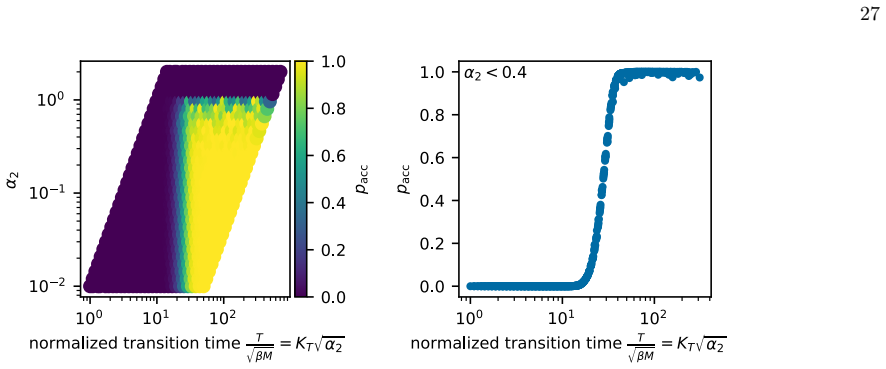
Gaussian tunnel To illustrate the optimal choice of parameters when running the algorithm on the example of the Gaussian tunnel from Section IIIA, we show the inverse mode jump cost (introduced in the main text) for different parameter values in Fig. 13. The optimal value ofα2 is roughly the same for all choices ofα1, whereas the optimal number of interme...
-
[10]
With the same underlying probability distribution, we consider the CVξ(z) = tanh z b · b tanh(1)
Gaussian tunnel with a non-linear collective variable We consider here a version of the Gaussian tunnel introduced in Section IIIA in dimensiond = 10 with a non-linear collective variable. With the same underlying probability distribution, we consider the CVξ(z) = tanh z b · b tanh(1). Using the push-forward of the probability densityνCV(z) under this tra...
-
[11]
ϕ4 Model To complement the results shown in Fig. 4 we ran the algorithm on theϕ4 model from Section IIIB for additional values of α1 and show the associated mode-jump cost in Fig. 16. 102 103 104 KT(2 * ) 10 5 10 4 10 3 10 2 2 Deterministic 1 = 0.00 102 103 104 KT(2 * ) 1 = 0.05 102 103 104 KT(2 * ) 1 = 0.25 102 103 104 KT(2 * ) 1 = 0.50 102 103 104 KT(2 ...
-
[12]
8, we ran the algorithm on the dimer model for additional values ofα1
Dimer in a solvent In addition to Fig. 8, we ran the algorithm on the dimer model for additional values ofα1. The associated inverse mode-jump cost is shown in Fig. 17. Apart from the deterministic algorithm (α1 = 0), almost no mode switches were observed within the computational budget. 102 103 1/v 10 6 10 4 2 Deterministic 1 = 0.00 102 103 1/v 1 = 0.25 ...
discussion (0)
Sign in with ORCID, Apple, or X to comment. Anyone can read and Pith papers without signing in.