Under pressure: poroelastic regulation of flow in espresso brewing
Pith reviewed 2026-05-16 20:01 UTC · model grok-4.3
The pith
Interplay of elasticity and porosity in the coffee puck governs long-time espresso flow rate and solubles concentration.
A machine-rendered reading of the paper's core claim, the machinery that carries it, and where it could break.
Core claim
The central claim is that the interplay between elasticity and porosity governs the long-time flow rate during espresso extraction and, consequently, the concentration of solubles in the final beverage. Using controlled experiments on a café-grade machine the authors show that a minimal model capturing the non-linear pressure-flow relationship, driven by dissolution-induced changes in the puck, reproduces the time-dependent behaviour of the brewing process.
What carries the argument
A minimal poroelastic model of the coffee puck in which permeability and elastic moduli evolve through dissolution under pressure.
If this is right
- The long-time flow rate is set by the evolving poroelastic state of the puck rather than by a fixed permeability value.
- Solubles concentration in the beverage is determined by the time-integrated flow under this poroelastic regulation.
- The model reproduces the full temporal evolution of flow observed during extraction.
- Dissolution dynamics are the central driver of changes in flow rate over time.
Where Pith is reading between the lines
- Varying pressure profiles during extraction could exploit the elastic response to reach targeted concentrations.
- The same poroelastic regulation may operate in other pressure-driven flows through dissolving porous materials.
- Direct measurements of puck deformation during brewing would provide an independent check on the elastic component.
Load-bearing premise
The coffee puck can be treated as a homogeneous poroelastic medium whose permeability and elastic moduli evolve primarily through dissolution in a way captured by a minimal model.
What would settle it
A measured flow-rate curve under constant pressure that deviates substantially from the minimal model's prediction, or direct imaging showing that local heterogeneity rather than bulk poroelastic evolution dominates the regulation.
Figures


read the original abstract
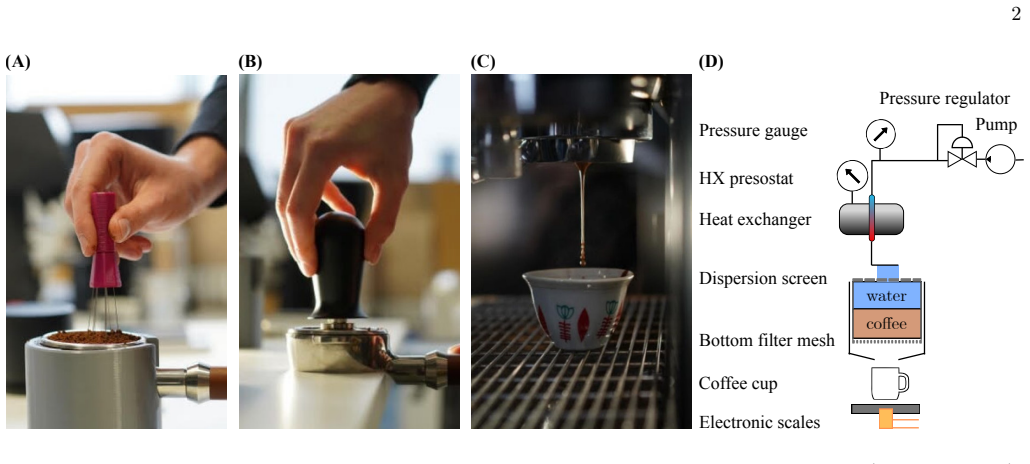
The sensory richness of coffee is widely recognised and arises from the complex chemistry and immersion in cultural practices of coffee preparation. In contrast, the physical complexity of espresso has received less attention. The multiphase reactive flow through a dissolving, elastic porous medium remains challenging to describe. Using a controlled experimental setup based on a caf\'e-grade espresso machine, we demonstrate that the interplay between elasticity and porosity governs the long-time flow rate during espresso extraction and, consequently, the concentration of solubles in the final beverage. We introduce a minimal model that captures the resulting non-linear pressure-flow relationship and propose a methodology capable of reproducing the time-dependent behaviour of the espresso brewing process. Finally, we show that dissolution dynamics play a central role in determining the temporal evolution of flow during extraction.
Editorial analysis
A structured set of objections, weighed in public.
Referee Report
Summary. The manuscript reports experiments on a café-grade espresso machine showing that long-time flow rate during extraction is regulated by the interplay of elasticity and porosity in the coffee puck, with dissolution driving the evolution. A minimal poroelastic model is introduced that reproduces the observed non-linear pressure-flow relationship and the time-dependent flow behavior, attributing the dynamics primarily to dissolution effects on permeability and elastic properties.
Significance. If the central claim is substantiated, the work supplies a physically motivated minimal model linking poroelastic mechanics to espresso flow regulation and solute extraction, which could inform reproducible brewing protocols and beverage quality control. The emphasis on a simple, dissolution-coupled description is a positive feature, though its value hinges on demonstrating that the model is not merely descriptive of the fitted data.
major comments (2)
- [Abstract and model description] The minimal model parameters (effective elastic modulus and permeability evolution rate) are constrained exclusively by the same pressure-flow time series used to support the central claim. No independent measurements of k(t) or E (e.g., via permeability cells or uniaxial compression on extracted pucks) are reported, leaving open whether the non-linear relation arises from the posited elasticity-porosity coupling or from unmodeled effects such as particle rearrangement or fines migration.
- [Experimental setup and model] The assumption that the coffee puck behaves as a homogeneous poroelastic medium whose permeability and elastic moduli evolve primarily through dissolution is load-bearing for the claim that dissolution dynamics govern long-time flow. The manuscript provides no controls or auxiliary data to rule out competing mechanisms, and the model equations are not shown to be predictive rather than fitted post hoc to the observed curves.
minor comments (2)
- [Abstract] The abstract states that the model 'captures' the non-linear relationship but does not indicate whether the governing equations are solved analytically, numerically, or via fitting; adding a brief outline of the solution procedure would improve clarity.
- [Model description] Notation for the time-dependent permeability k(t) and elastic modulus E should be defined explicitly when first introduced, including any functional forms assumed for their dissolution-driven evolution.
Simulated Author's Rebuttal
We thank the referee for the detailed and constructive report. The comments highlight important aspects of model validation and experimental controls that we address point by point below. We agree that further clarification on parameter determination and discussion of alternative mechanisms will improve the manuscript.
read point-by-point responses
-
Referee: [Abstract and model description] The minimal model parameters (effective elastic modulus and permeability evolution rate) are constrained exclusively by the same pressure-flow time series used to support the central claim. No independent measurements of k(t) or E (e.g., via permeability cells or uniaxial compression on extracted pucks) are reported, leaving open whether the non-linear relation arises from the posited elasticity-porosity coupling or from unmodeled effects such as particle rearrangement or fines migration.
Authors: We acknowledge that the effective elastic modulus and permeability evolution rate are obtained by fitting the minimal model to the measured pressure-flow time series. This is inherent to the construction of a minimal model intended to isolate the essential poroelastic-dissolution coupling with the smallest number of parameters. Independent measurements of instantaneous permeability or modulus during active extraction are technically difficult because the puck properties change continuously under flow and pressure. We will revise the manuscript to include an expanded section on the fitting procedure, sensitivity analysis, and explicit discussion of how competing mechanisms (particle rearrangement, fines migration) could produce similar phenomenology, thereby clarifying the scope of the claim. revision: partial
-
Referee: [Experimental setup and model] The assumption that the coffee puck behaves as a homogeneous poroelastic medium whose permeability and elastic moduli evolve primarily through dissolution is load-bearing for the claim that dissolution dynamics govern long-time flow. The manuscript provides no controls or auxiliary data to rule out competing mechanisms, and the model equations are not shown to be predictive rather than fitted post hoc to the observed curves.
Authors: The homogeneous poroelastic description is adopted as the simplest framework that couples elasticity, porosity, and dissolution to reproduce the observed non-linear pressure-flow relation and the temporal evolution of flow rate. While auxiliary controls that isolate particle rearrangement or fines migration are not reported, the model’s ability to capture both the steady-state non-linearity and the transient flow behavior with a single set of dissolution-driven parameters provides evidence that these effects are dominant on the timescales of interest. To address the post-hoc fitting concern, we will add cross-validation by withholding portions of the time series for forward prediction and will include a brief discussion of possible heterogeneities in the revised text. revision: partial
Circularity Check
No significant circularity detected
full rationale
The paper introduces a minimal poroelastic model to describe the interplay of elasticity and porosity in espresso flow, fitted to pressure-flow time series from a commercial machine. No load-bearing step reduces by construction to its inputs: the model equations are derived from Darcy flow coupled to poroelastic constitutive relations and a dissolution ODE, with parameters constrained by data but not shown to be tautological renamings or self-citations. The central claim that dissolution dynamics govern long-time flow rests on physical assumptions and experimental reproduction rather than self-definition or fitted-input predictions. The derivation chain remains self-contained against external benchmarks.
Axiom & Free-Parameter Ledger
free parameters (1)
- effective elastic modulus and permeability evolution rate
axioms (1)
- domain assumption coffee puck behaves as a homogeneous poroelastic medium whose properties change primarily via dissolution
Lean theorems connected to this paper
-
IndisputableMonolith/Cost/FunctionalEquation.leanwashburn_uniqueness_aczel unclear?
unclearRelation between the paper passage and the cited Recognition theorem.
We combine equations (2) and (3) to arrive at a separable equation... Q = K(P) A / (μ h0)
-
IndisputableMonolith/Foundation/AlexanderDuality.leanalexander_duality_circle_linking unclear?
unclearRelation between the paper passage and the cited Recognition theorem.
the interplay between elasticity and porosity governs the long-time flow rate
What do these tags mean?
- matches
- The paper's claim is directly supported by a theorem in the formal canon.
- supports
- The theorem supports part of the paper's argument, but the paper may add assumptions or extra steps.
- extends
- The paper goes beyond the formal theorem; the theorem is a base layer rather than the whole result.
- uses
- The paper appears to rely on the theorem as machinery.
- contradicts
- The paper's claim conflicts with a theorem or certificate in the canon.
- unclear
- Pith found a possible connection, but the passage is too broad, indirect, or ambiguous to say the theorem truly supports the claim.
Reference graph
Works this paper leans on
-
[1]
used time-resolved CT to track the infiltration front of the water into the dry coffee bed, and proposed a one- dimensional unsaturated porous medium flow model to explain the dynamics of initial wetting. Since the preparation of an espresso in a pressurised container requires a consolidated bed of finely ground coffee, an intuitive modelling choice to qu...
work page 2000
-
[2]
Farah, Coffee constituents, inCoffee(John Wiley & Sons, Ltd, 2012) Chap
A. Farah, Coffee constituents, inCoffee(John Wiley & Sons, Ltd, 2012) Chap. 2, pp. 21–58
work page 2012
-
[3]
J.Morris,MakingItalianEspresso, MakingEspressoItal- ian, Food and History8, 155–183 (2010)
work page 2010
-
[4]
J. Morris, Why espresso? explaining changes in euro- pean coffee preferences from a production of culture per- spective,EuropeanReviewofHistory: Revueeuropéenne d’histoire20, 881–901 (2013)
work page 2013
-
[5]
A. N. Gloess, B. Schönbächler, B. Klopprogge, L. D‘Ambrosio, K. Chatelain, A. Bongartz, A. Strittmat- ter, M. Rast, and C. Yeretzian, Comparison of nine com- moncoffeeextractionmethods: instrumentalandsensory analysis, European Food Research and Technology236, 607–627 (2013)
work page 2013
-
[6]
Hoffmann,The World Atlas of Coffee(Octopus Pub- lishing Group, 2018)
J. Hoffmann,The World Atlas of Coffee(Octopus Pub- lishing Group, 2018)
work page 2018
-
[7]
M. I. Cameron, D. Morisco, D. Hofstetter, E. Uman, J. Wilkinson, Z. C. Kennedy, S. A. Fontenot, W. T. Lee, C. H. Hendon, and J. M. Foster, Systematically improv- ing espresso: Insights from mathematical modeling and experiment, Matter2, 631 (2020)
work page 2020
-
[8]
W. T. Lee, A. Smith, and A. Arshad, Uneven ex- traction in coffee brewing, Physics of Fluids35, 10.1063/5.0138998 (2023)
-
[9]
S. Andueza, L. Maeztu, B. Dean, M. P. de Peña, J. Bello, and C. Cid, Influence of water pressure on the final qual- ity of arabica espresso coffee. application of multivariate analysis, Journal of Agricultural and Food Chemistry50, 7426–7431 (2002)
work page 2002
-
[10]
L. Navarini and D. Rivetti, Water quality for espresso coffee, Food Chemistry122, 424–428 (2010)
work page 2010
-
[11]
S. Andueza, L. Maeztu, L. Pascual, C. Ibáñez, M. P. de Peña, and C. Cid, Influence of extraction tempera- ture on the final quality of espresso coffee, Journal of the Science of Food and Agriculture83, 240–248 (2003)
work page 2003
-
[12]
C. A. Salamanca, N. Fiol, C. González, M. Saez, and I. Villaescusa, Extraction of espresso coffee by using gra- dient of temperature. effect on physicochemical and sen- sorial characteristics of espresso, Food Chemistry214, 622–630 (2017)
work page 2017
-
[13]
K. Moroney, W. Lee, F. Suijver, J. Marra,et al., Mod- elling of coffee extraction during brewing using multiscale methods: An experimentally validated model, Chemical Engineering Science137, 216 (2015)
work page 2015
-
[14]
S. Smrke, A. Eiermann, and C. Yeretzian, The role of fines in espresso extraction dynamics, Scientific Reports 14, 10.1038/s41598-024-55831-x (2024)
-
[15]
World Coffee Research, Sensory lexicon,https://worl dcoffeeresearch.org/resources/sensory-lexicon (2017)
work page 2017
-
[16]
Fasman, Defining the ever-changing espresso, 25 Mag- azine3(2018)
D. Fasman, Defining the ever-changing espresso, 25 Mag- azine3(2018)
work page 2018
-
[17]
M. Spencer, E. Sage, M. Velez, and J. Guinard, Using single free sorting and multivariate exploratory methods to design a new coffee taster’s flavor wheel, Journal of Food Science81, 10.1111/1750-3841.13555 (2016). 12
- [18]
-
[19]
A. F. V. Matias, D. F. Valente-Matias, N. R. Neng, J. M. F. Nogueira, J. S. Andrade, R. C. V. Coelho, and N. A. M. Araújo, Continuum model for extraction and retention in porous media, Physics of Fluids35, 10.1063/5.0176273 (2023)
-
[20]
A. Mahadevan, A. V. Orpe, A. Kudrolli, and L. Mahade- van, Flow-induced channelization in a porous medium, EPL (Europhysics Letters)98, 58003 (2012)
work page 2012
-
[21]
J. Giacomini, G. Khamitova, P. Maponi, S. Vittori, and L. Fioretti, Water flow and transport in porous media for in-silico espresso coffee, International Journal of Mul- tiphase Flow126, 103252 (2020)
work page 2020
-
[22]
C. Mo, R. Johnston, L. Navarini, F. S. Liverani, and M. Ellero, Exploring the link between coffee matrix mi- crostructure and flow properties using combined x-ray microtomography and smoothed particle hydrodynamics simulations, Scientific Reports13, 16374 (2023)
work page 2023
-
[23]
C. Mo, R. Johnston, L. Navarini, and M. Ellero, Model- ing the effect of flow-induced mechanical erosion during coffee filtration, Physics of Fluids33, 10.1063/5.0059707 (2021)
-
[24]
A. F. Matias, R. C. Coelho, J. S. Andrade, and N. A. Araújo, Flow through time–evolving porous media: Swelling and erosion, Journal of Computational Science 53, 101360 (2021)
work page 2021
-
[25]
K. M. Moroney, K. O’Connell, P. Meikle-Janney, S. B. O’Brien, G. M. Walker, and W. T. Lee, Analysing ex- traction uniformity from porous coffee beds using math- ematicalmodellingandcomputationalfluiddynamicsap- proaches, PLoS One14, e0219906 (2019)
work page 2019
-
[26]
J. Foster, W. Lee, K. Moroney, D. Prjamkov, M. Sala- mon, A.Smith, J.Petrassem-deSousa,andM.Vynnycky, Dynamics of liquid infiltration into an espresso bed us- ing time-resolved micro-computed tomography: Insights from experiment and modeling, Physics of Fluids37, 10.1063/5.0245167 (2025)
-
[27]
B. R. Corrochano, J. Melrose, A. Bentley, P. Fryer, and S. Bakalis, A new methodology to estimate the steady- state permeability of roast and ground coffee in packed beds, J. Food Eng.150, 106 (2015)
work page 2015
-
[28]
C. Gianino, Experimental analysis of the italian coffee pot “moka”, American Journal of Physics75, 43 (2007)
work page 2007
-
[29]
W. D. King, The physics of a stove-top espresso machine, American Journal of Physics76, 558–565 (2008)
work page 2008
-
[30]
L. Navarini, E. Nobile, F. Pinto, A. Scheri, and F. Suggi- Liverani, Experimental investigation of steam pressure coffee extraction in a stove-top coffee maker, Applied Thermal Engineering29, 998–1004 (2009)
work page 2009
-
[31]
Hedrick, This changes everything
L. Hedrick, This changes everything... (Wdt, Autocomb, Moonraker, NCD, etc),https://www.youtube.com/wa tch?v=OyUaCuoqYWc&t=8s(2024)
work page 2024
-
[32]
L. Hedrick, How I Brew Tasty Coffee: My Espresso Ob- session Observed,https://youtu.be/eUc3lvF8mHM?si= cPBzma9w1T2XEnJi(2024)
work page 2024
-
[33]
Gagné,The physics of espresso(Scott Rao, 2025)
J. Gagné,The physics of espresso(Scott Rao, 2025)
work page 2025
-
[34]
A. J. Ladd and P. Szymczak, Reactive flows in porous media: Challenges in theoretical and numerical methods, Annual review of chemical and biomolecular engineering 12, 543 (2021)
work page 2021
-
[35]
Illy,Espresso coffee: the science of quality(Elsevier, 2004)
A. Illy,Espresso coffee: the science of quality(Elsevier, 2004)
work page 2004
-
[36]
D. R. Hewitt, J. S. Nijjer, M. G. Worster, and J. A. Neufeld, Flow-induced compaction of a deformable porous medium, Phys. Rev. E93, 023116 (2016)
work page 2016
-
[37]
V. Guerriero and S. Mazzoli, Theory of effective stress in soil and rock and implications for fracturing processes: a review, Geosciences11, 119 (2021)
work page 2021
-
[38]
L. S. Bennethum, M. Murad, and J. Cushman, Modified darcy’s law, terzaghi’s effective stress principle and fick’s law for swelling clay soils, Computers and Geotechnics 20, 245 (1997)
work page 1997
-
[39]
P. C. Carman, Fluid flow through granular beds, Trans. Inst. Chem. Eng. London15, 150 (1937)
work page 1937
-
[40]
W. L. McCabe, J. C. Smith, and P. Harriott,Unit oper- ations of chemical engineering, Vol. 5 (McGraw-hill New York, 1967)
work page 1967
-
[41]
C. Mo, L. Navarini, F. S. Liverani, and M. Ellero, Modeling swelling effects during coffee extraction with smoothed particle hydrodynamics, Physics of Fluids34, 10.1063/5.0086897 (2022)
-
[42]
C. Tien and B. V. Ramarao, Can filter cake porosity be estimated based on the kozeny–carman equation?, Pow- der Technology237, 233–240 (2013)
work page 2013
-
[43]
Z. R. Lindsey, J. R. Williams, J. S. Burgess, N. T. Moore, and P. M. Splichal, Caffeine content in filter coffee brews as a function of degree of roast and extraction yield, Sci- entific Reports14, 10.1038/s41598-024-80385-3 (2024)
-
[44]
H. G. Severin and B. Lindemann, Elasticity of coffee beans: A novel approach to understanding the roasting process, J. Food Eng.383, 112212 (2024)
work page 2024
-
[45]
B. Zanoni, E.Pagliarini, andC. Peri, Modelling the aque- ous extraction of soluble substances from ground roasted coffee, Journal of the Science of Food and Agriculture58, 275–279 (1992)
work page 1992
-
[46]
M. Spiro, Modelling the aqueous extraction of soluble substances from ground roast coffee, Journal of the Sci- ence of Food and Agriculture61, 371–372 (1993)
work page 1993
-
[47]
R. Waszkiewicz, F. Myck, Ł. Białas, M. Puciata- Mroczynska, M. Dzikowski, P. Szymczak, and M. Lisicki, Under pressure: Poroelastic regulation of flow in espresso brewing, GitHub repository (2025)
work page 2025
-
[48]
R. Waszkiewicz, F. Myck, Ł. Białas, M. Puciata- Mroczynska, M. Dzikowski, P. Szymczak, and M. Lisicki, Under pressure: Poroelastic regulation of flow in espresso brewing, Zenodo (2025)
work page 2025
discussion (0)
Sign in with ORCID, Apple, or X to comment. Anyone can read and Pith papers without signing in.