Recognition: 2 theorem links
· Lean TheoremQuasiparticle Dynamics in the 4d-4f Ising-like Double Perovskite Ba2DyRuO6 studied using Neutron Scattering and Machine-Learning Framework
Pith reviewed 2026-05-16 18:48 UTC · model grok-4.3
The pith
Long-range antiferromagnetic order emerges at 47 K in Ba2DyRuO6 with Ru5+ and Dy3+ moments ordering simultaneously through 4d-4f exchange.
A machine-rendered reading of the paper's core claim, the machinery that carries it, and where it could break.
Core claim
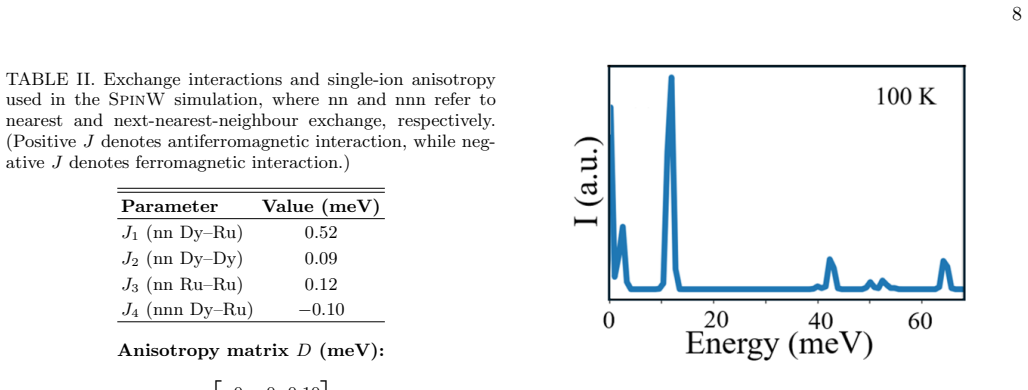
Long-range antiferromagnetic order emerges at TN approximately 47 K primarily driven by 4d-4f Ru5+–Dy3+ exchange interactions, where both Dy and Ru moments start to order simultaneously, forming a collinear antiferromagnet with Ising character carrying ordered moments of 1.6(1) muB for Ru and 5.1(1) muB for Dy at 1.5 K. Low-temperature inelastic neutron scattering shows well-defined magnon excitations below 10 meV that are accounted for by SpinW modeling of complex exchange interactions together with magnetic anisotropy; crystal-electric-field levels of Dy3+ at 46.5 and 71.8 meV are reproduced by point-charge calculations consistent with Oh symmetry.
What carries the argument
SpinW modeling of the inelastic neutron scattering spectra that incorporates fitted inter-sublattice exchange interactions and magnetic anisotropy to reproduce the observed magnon dispersion.
If this is right
- Both magnetic sublattices order at a single transition temperature unlike most other A2RRuO6 family members.
- The ground state is governed by inter-sublattice 4d-4f exchange rather than intra-sublattice interactions alone.
- Well-defined magnon excitations below 10 meV are shaped by the Ising anisotropy.
- Dy3+ crystal-electric-field levels sit at 46.5 and 71.8 meV and are consistent with octahedral point-charge symmetry.
- Machine-learning separation of phonon and magnon spectral weight clarifies the origin of low-energy excitations.
Where Pith is reading between the lines
- Strong 4d-4f coupling may stabilize simultaneous ordering in other double perovskites containing both 4d and 4f ions.
- The same INS-plus-machine-learning workflow could separate overlapping excitations in related materials where phonon and magnon branches cross.
- The Ising character opens the possibility of field-tuned transitions or anisotropic spin dynamics that remain untested in this compound.
Load-bearing premise
The fitted SpinW Hamiltonian with exchange parameters and anisotropy fully accounts for the magnon spectrum without significant phonon-magnon coupling or higher-order terms.
What would settle it
A mismatch between the measured magnon dispersion at additional wave vectors or temperatures and the SpinW prediction that cannot be removed by refitting parameters would falsify the model's completeness.
Figures




read the original abstract
Double perovskites containing 4d--4f interactions provide a platform to study complex magnetic phenomena in correlated systems. Here, we investigate the magnetic ground state and quasiparticle excitations of the fascinating double perovskite system, Ba$_2$DyRuO$_6$, through Time of flight (TOF) neutron diffraction (TOF), inelastic neutron scattering (INS), and theoretical modelling. The compound Ba$_2$DyRuO$_6$ is reported to exhibit a single magnetic transition, in sharp contrast to most of the other rare-earth (R) members in this family, A$_2$RRuO$_6$ (A = Ca/Sr/Ba), which typically show magnetic ordering of the Ru ions, followed by R-ion ordering. Our neutron diffraction results confirm that long-range antiferromagnetic order emerges at $T_\mathrm{N} \approx 47$~K, primarily driven by 4d--4f Ru$^{5+}$--Dy$^{3+}$ exchange interactions, where both Dy and Ru moments start to order simultaneously. The ordered ground state is a collinear antiferromagnet with Ising character, carrying ordered moments of $\mu_{\mathrm{Ru}} = 1.6(1)~\mu_\mathrm{B}$ and $\mu_{\mathrm{Dy}} = 5.1(1)~\mu_\mathrm{B}$ at 1.5~K. Low-temperature INS reveals well-defined magnon excitations below 10~meV. SpinW modelling of the INS spectra evidences complex exchange interactions and the presence of magnetic anisotropy, which governs the Ising ground state and accounts for the observed magnon spectrum. Combined INS and Raman spectroscopy reveal crystal-electric-field (CEF) excitations of Dy$^{3+}$ at 46.5 and 71.8~meV in the paramagnetic region. The observed CEF levels are reproduced by point-charge calculations consistent with the $O_h$ symmetry of Dy$^{3+}$. A complementary machine-learning approach is used to analyse the phonon spectrum and compare with INS data. Together, these results clarify the origin of phonon and magnon excitations and their role in the ground-state magnetism of Ba$_2$DyRuO$_6$.
Editorial analysis
A structured set of objections, weighed in public.
Referee Report
Summary. The manuscript reports neutron diffraction, inelastic neutron scattering (INS), Raman spectroscopy, and theoretical modeling (SpinW and machine-learning phonon analysis) on the double perovskite Ba₂DyRuO₆. It claims that long-range collinear antiferromagnetic order with Ising character emerges at T_N ≈ 47 K via simultaneous ordering of Ru^{5+} (μ = 1.6(1) μ_B) and Dy^{3+} (μ = 5.1(1) μ_B) moments, driven primarily by 4d–4f exchange interactions. Low-energy magnons (<10 meV) are modeled with SpinW using fitted exchange constants and anisotropy; CEF levels at 46.5 and 71.8 meV are reproduced by point-charge calculations consistent with O_h symmetry; a complementary ML approach separates phonon contributions.
Significance. If the SpinW-derived parameters and simultaneous-ordering interpretation hold after addressing fitting circularity, the work would clarify how 4d–4f interactions can stabilize a single magnetic transition in this family, contrasting with sequential ordering in other A₂RRuO₆ compounds, and illustrate the value of combining INS with ML for excitation disentanglement in correlated oxides.
major comments (2)
- [SpinW modelling of the INS spectra] SpinW modelling section: exchange constants J_ij and the magnetic anisotropy term are fitted directly to the same low-energy INS magnon spectra used to claim that the model accounts for the observed excitations; this introduces moderate circularity that weakens the attribution of the T_N = 47 K ordering as 'primarily driven by' 4d–4f interactions without independent constraints (e.g., from high-field magnetization or specific-heat analysis).
- [Abstract and INS/Raman analysis] Abstract and INS/Raman analysis: the manuscript notes separate ML phonon analysis and Raman CEF data but provides no explicit checks (e.g., intensity borrowing, dispersion anomalies, or avoided crossings) for possible phonon–magnon hybridization near the 46.5 meV CEF level, which could bias the extracted low-energy parameters and the purely magnonic interpretation of the spectrum below 10 meV.
minor comments (2)
- [Methods] Methods section: limited detail is given on INS data reduction, background subtraction, and fitting constraints; explicit description of these steps and any imposed bounds on the SpinW parameters would improve reproducibility.
- [ML phonon analysis] Figure captions and text: the ML phonon analysis is mentioned but the specific algorithm, training data, and validation metrics are not described; adding these would clarify how phonons are separated from magnetic scattering.
Simulated Author's Rebuttal
We thank the referee for the careful and constructive review of our manuscript. We address the two major comments point by point below, indicating where revisions have been made to the text.
read point-by-point responses
-
Referee: [SpinW modelling of the INS spectra] SpinW modelling section: exchange constants J_ij and the magnetic anisotropy term are fitted directly to the same low-energy INS magnon spectra used to claim that the model accounts for the observed excitations; this introduces moderate circularity that weakens the attribution of the T_N = 47 K ordering as 'primarily driven by' 4d–4f interactions without independent constraints (e.g., from high-field magnetization or specific-heat analysis).
Authors: We acknowledge the moderate circularity inherent in fitting the SpinW exchange parameters and anisotropy directly to the low-energy INS spectra. The magnetic propagation vector and collinear structure are, however, independently fixed by the neutron diffraction data, which already establish simultaneous ordering of the Ru and Dy sublattices at the same T_N. The fitted parameters are further required to reproduce the observed magnon bandwidth and the overall energy scale consistent with the measured ordering temperature. In the revised manuscript we have expanded the SpinW section to explicitly describe this two-step procedure and to clarify that the primary evidence for 4d–4f-driven simultaneous ordering rests on the diffraction results rather than on the model alone. High-field magnetization and specific-heat data that could provide additional independent constraints were not collected in the present study. revision: partial
-
Referee: [Abstract and INS/Raman analysis] Abstract and INS/Raman analysis: the manuscript notes separate ML phonon analysis and Raman CEF data but provides no explicit checks (e.g., intensity borrowing, dispersion anomalies, or avoided crossings) for possible phonon–magnon hybridization near the 46.5 meV CEF level, which could bias the extracted low-energy parameters and the purely magnonic interpretation of the spectrum below 10 meV.
Authors: We thank the referee for highlighting this point. In the revised manuscript we have added an explicit check for possible phonon–magnon hybridization near the 46.5 meV Dy^{3+} CEF level. Inspection of the INS spectra shows no dispersion anomalies, intensity borrowing, or avoided crossings at that energy; the ML phonon decomposition further confirms that the phonon branches remain well separated from the low-energy magnon band. We have updated the abstract and the INS/Raman discussion to include this analysis, reinforcing that the excitations below 10 meV are purely magnonic. revision: yes
Circularity Check
SpinW fit to INS spectra reproduces magnon data by construction; diffraction ordering claim remains independent
specific steps
-
fitted input called prediction
[Abstract]
"SpinW modelling of the INS spectra evidences complex exchange interactions and the presence of magnetic anisotropy, which governs the Ising ground state and accounts for the observed magnon spectrum."
The SpinW Hamiltonian parameters (exchange constants and anisotropy) are adjusted to reproduce the measured INS magnon branches; the subsequent claim that the model 'accounts for the observed magnon spectrum' is therefore a direct consequence of the fitting procedure rather than an a-priori prediction or external validation.
full rationale
Neutron diffraction independently establishes TN≈47 K and simultaneous ordering of Ru and Dy moments, supporting the 4d-4f driven collinear Ising state without reference to the model. The only load-bearing step with circular character is the SpinW analysis: exchange parameters and anisotropy are fitted directly to the low-energy INS magnon spectrum, after which the paper states that the model 'accounts for the observed magnon spectrum.' This reproduction is forced by the fit rather than an independent test. No self-citation chains, uniqueness theorems, or ansatz smuggling appear in the provided text. CEF point-charge calculations and ML phonon analysis are presented as separate and do not carry the central magnetic-order claim. The result is partial circularity (score 4) confined to the excitation modeling.
Axiom & Free-Parameter Ledger
free parameters (2)
- exchange constants Jij
- magnetic anisotropy term
axioms (2)
- domain assumption Dy3+ experiences Oh point symmetry for CEF calculation
- standard math Linear spin-wave theory applies to the ordered state
Lean theorems connected to this paper
-
IndisputableMonolith/Cost/FunctionalEquation.leanwashburn_uniqueness_aczel unclear?
unclearRelation between the paper passage and the cited Recognition theorem.
SpinW modelling of the INS spectra evidences complex exchange interactions and the presence of magnetic anisotropy... H = J Σ Si·Sj + D Σ (Sz_i)^2
-
IndisputableMonolith/Foundation/RealityFromDistinction.leanreality_from_one_distinction unclear?
unclearRelation between the paper passage and the cited Recognition theorem.
The observed CEF levels are reproduced by point-charge calculations consistent with the Oh symmetry of Dy3+
What do these tags mean?
- matches
- The paper's claim is directly supported by a theorem in the formal canon.
- supports
- The theorem supports part of the paper's argument, but the paper may add assumptions or extra steps.
- extends
- The paper goes beyond the formal theorem; the theorem is a base layer rather than the whole result.
- uses
- The paper appears to rely on the theorem as machinery.
- contradicts
- The paper's claim conflicts with a theorem or certificate in the canon.
- unclear
- Pith found a possible connection, but the passage is too broad, indirect, or ambiguous to say the theorem truly supports the claim.
Reference graph
Works this paper leans on
-
[1]
Giant magneto-elastic coupling in multiferroic hexagonal manganites,
S. Lee, A. Pirogov, M. Kang, K. H. Jang, M. Yonemura, T. Kamiyama, S.-W. Cheong, F. Gozzo, N. Shin, H. Kimura, and Y. Noda, “Giant magneto-elastic coupling in multiferroic hexagonal manganites,”Nature451, 805 (2008)
work page 2008
-
[2]
J. Hwang, E. S. Choi, F. Ye, C. R. Dela Cruz, Y. Xin, H. D. Zhou, and P. Schlottmann, “Successive mag- netic phase transitions and multiferroicity in the spin-one triangular-lattice antiferromagnet Ba 3NiNb2O9,”Phys. Rev. Lett.109, 257205 (2012)
work page 2012
-
[4]
Peierls transition driven ferroelasticity in the two-dimensional d–f hybrid magnets,
H. You, Y. Zhang, J. Chen, N. Ding, M. An, L. Miao, and S. Dong, “Peierls transition driven ferroelasticity in the two-dimensional d–f hybrid magnets,”Phys. Rev. B 103, L161408 (2021)
work page 2021
-
[5]
A. D¨ onni, V. Y. Pomjakushin, K. Yamaura, and A. A. Belik, “Cycloidal spiral magnetic structures in the spin- chain compounds BaRFeO4 (R = Yb and Tm): Ordered Yb versus partly ordered Tm,”Phys. Rev. B107, 134412 (2023)
work page 2023
-
[6]
Evidence of Dirac quan- tum spin liquid in YbZn 2GaO5,
R. Bag, S. Xu, N. E. Sherman, L. Yadav, A. I. Kolesnikov, A. A. Podlesnyak, E. S. Choi, I. Da Silva, J. E. Moore, and S. Haravifard, “Evidence of Dirac quan- tum spin liquid in YbZn 2GaO5,”Phys. Rev. Lett.133, 266703 (2024)
work page 2024
-
[7]
Unconventional magnetization processes and thermal runaway in spin-ice Dy 2Ti2O7,
D. Slobinsky, C. Castelnovo, R. A. Borzi, A. S. Gibbs, A. P. Mackenzie, R. Moessner, and S. A. Grigera, “Unconventional magnetization processes and thermal runaway in spin-ice Dy 2Ti2O7,”Phys. Rev. Lett.105, 267205 (2010)
work page 2010
-
[8]
Giant magnetoresistance by ex- change springs in DyFe2/YFe2 superlattices,
S. N. Gordeev, J.-M. Beaujour, G. J. Bowden, B. D. Rainford, P. A. J. de Groot, R. C. C. Ward, M. R. Wells, and A. G. M. Jansen, “Giant magnetoresistance by ex- change springs in DyFe2/YFe2 superlattices,”Phys. Rev. Lett.87, 186808 (2001)
work page 2001
-
[9]
Anisotropy of 4f states in 3d–4f single-molecule magnets,
A. Rauguth, A. Alhassanat, H. Elnaggar, A. A. Athana- sopoulou, C. Luo, H. Ryll, F. Radu, T. Mashoff, F. M. de Groot, E. Rentschler, and H. J. Elmers, “Anisotropy of 4f states in 3d–4f single-molecule magnets,”Phys. Rev. B105, 134415 (2022). 12
work page 2022
-
[10]
A hard molecular nanomagnet from confined paramagnetic 3d–4f spins inside a fullerene cage,
C. Huang, R. Sun, L. Bao, X. Tian, C. Pan, M. Li, W. Shen, K. Guo, B. Wang, X. Lu, and S. Gao, “A hard molecular nanomagnet from confined paramagnetic 3d–4f spins inside a fullerene cage,”Nat. Commun.14, 8443 (2023)
work page 2023
-
[11]
T. Basu, V. Caignaert, F. Damay, T. W. Heitmann, B. Raveau, and X. Ke, “Cooperative Ru(4d)–Ho(4f) mag- netic ordering and phase coexistence in the 6H per- ovskite multiferroic Ba 3HoRu2O9,”Phys. Rev. B102, 020409(R) (2020)
work page 2020
-
[12]
E. Kushwaha, G. Roy, A. M. dos Santos, M. Kumar, S. Ghosh, T. Heitmann, and T. Basu, “Unconventional S-orbital state of Tb and cooperative Ru(4d)–Tb(4f) spin ordering in the strongly correlated 4d–4f system Ba3TbRu2O9,”J. Mater. Chem. C13, 15384 (2025)
work page 2025
-
[13]
D. Ziat, A. A. Aczel, R. Sinclair, Q. Chen, H. D. Zhou, T. J. Williams, M. B. Stone, A. Verrier, and J. A. Quil- liam, “Frustrated spin- 1 2 molecular magnetism in the mixed-valence antiferromagnets Ba 3MRu2O9 (M = In, Y, Lu),”Phys. Rev. B95, 184424 (2017)
work page 2017
-
[14]
E. Granado, J. W. Lynn, R. F. Jardim, and M. S. Torikachvili, “Two-dimensional magnetic correlations and partial long-range order in geometrically frustrated Sr2YRuO6,”Phys. Rev. Lett.110, 017202 (2013)
work page 2013
-
[15]
Magnetic properties of ruthenium pyrochlores R 2Ru2O7 (R = rare earth),
N. Taira, M. Wakeshima, and Y. Hinatsu, “Magnetic properties of ruthenium pyrochlores R 2Ru2O7 (R = rare earth),”J. Phys.: Condens. Matter11, 6983 (1999)
work page 1999
-
[16]
Strong spin-phonon coupling in the ge- ometrically frustrated pyrochlore Y 2Ru2O7,
J. S. Lee, T. W. Noh, J. S. Bae, I. S. Yang, T. Takeda, and R. Kanno, “Strong spin-phonon coupling in the ge- ometrically frustrated pyrochlore Y 2Ru2O7,”Phys. Rev. B69, 214428 (2004)
work page 2004
-
[17]
Ferromagnetic fragmented ground state in the pyrochlore Ho 2Ru2O7,
F. Museur, J. Robert, F. Morineau, V. Simonet, E. Pa- choud, A. Hadj-Azzem, C. Colin, P. Manuel, J. R. Stew- art, P. C. W. Holdsworth, and E. Lhotel, “Ferromagnetic fragmented ground state in the pyrochlore Ho 2Ru2O7,” arXiv:2411.10078 (2024)
-
[18]
T. Basu, V. Caignaert, S. Ghara, X. Ke, A. Pautrat, S. Krohns, A. Loidl, and B. Raveau, “Enhancement of mag- netodielectric coupling in 6H-perovskites Ba 3R Ru 2O9 for heavier rare-earth cations (R = Ho, Tb),”Phys. Rev. Mater.3, 114401 (2019)
work page 2019
-
[19]
E. Kushwaha, G. Roy, M. Kumar, A. M. dos Santos, S. Ghosh, D. T. Adroja, V. Caignaert, O. Perez, A. Pau- trat, and T. Basu, “Origin of spin-driven ferroelectricity and effect of external pressure on the complex magnetism of the 6H perovskite Ba 3HoRu2O9,”Phys. Rev. B109, 224418 (2024)
work page 2024
-
[20]
M. S. Senn, S. A. J. Kimber, A. M. Arevalo Lopez, A. H. Hill, and J. P. Attfield, “Spin orders and lattice distortions of geometrically frustrated 6H-perovskites Ba3B′(Ru2O9) (B′ = La3+, Nd3+, and Y3+),”Phys. Rev. B87, 134402 (2013)
work page 2013
-
[21]
Room-temperature magnetoresistance in an oxide material with an ordered double-perovskite structure,
K. I. Kobayashi, T. Kimura, H. Sawada, K. Terakura, and Y. Tokura, “Room-temperature magnetoresistance in an oxide material with an ordered double-perovskite structure,”Nature395, 677 (1998)
work page 1998
-
[22]
Ba 2YIrO6: A cubic dou- ble perovskite material with Ir5+ ions,
T. Dey, A. Maljuk, D. V. Efremov, O. Kataeva, S. Gass, C. G. F. Blum, F. Steckel, D. Gruner, T. Ritschel, A. U. B. Wolter, and J. Geck, “Ba 2YIrO6: A cubic dou- ble perovskite material with Ir5+ ions,”Phys. Rev. B93, 014434 (2016)
work page 2016
-
[23]
Mag- netic order and multipoles in the 5d2 rhenium double per- ovskite Ba2YReO6,
G. J. Nilsen, C. M. Thompson, C. Marjerrison, D. I. Badrtdinov, A. A. Tsirlin, and J. E. Greedan, “Mag- netic order and multipoles in the 5d2 rhenium double per- ovskite Ba2YReO6,”Phys. Rev. B103, 104430 (2021)
work page 2021
-
[24]
Magnetic be- havior of 5d 1 Re-based double perovskite Sr 2ZnReO6,
M. M. Isah, B. Dalal, X. Kang, D. F. Mosca, I. J. Onuorah, V. Scagnoli, P. Bonf` a, R. De Renzi, A. A. Belik, C. Franchini, and K. Yamaura, “Magnetic be- havior of 5d 1 Re-based double perovskite Sr 2ZnReO6,” arXiv:2509.04071 (2025)
-
[25]
V. da Cruz Pinha Barbosa, D. D. Maharaj, Z. W. Cronkright, Y. Wang, R. Cong, E. Garcia, A. P. Reyes, J. Yan, C. Ritter, V. F. Mitrovi´ c, and B. D. Gaulin, “Exploring the links between structural distortions, or- bital ordering, and multipolar magnetic ordering in dou- ble perovskites containing Re(VI) and Os(VII),”Chem. Mater.36, 11478 (2024)
work page 2024
-
[26]
Ferromagnetism in the Mott insulator Ba 2NaOsO6,
A. S. Erickson, S. Misra, G. J. Miller, R. R. Gupta, Z. Schlesinger, W. A. Harrison, J. M. Kim, and I. R. Fisher, “Ferromagnetism in the Mott insulator Ba 2NaOsO6,” Phys. Rev. Lett.99, 016404 (2007)
work page 2007
-
[27]
Hid- den orders in spin–orbit-entangled correlated insulators,
L. V. Pourovskii, D. Fiore Mosca, L. Celiberti, S. Khmelevskyi, A. Paramekanti, and C. Franchini, “Hid- den orders in spin–orbit-entangled correlated insulators,” Nat. Rev. Mater.(2025)
work page 2025
-
[28]
Y. Hinatsu and Y. Doi, “Structures and magnetic proper- ties of double perovskites A 2LnMO6 and 6H-perovskites Ba3LnRu2O9 (A = Sr, Ba; Ln = Y, lanthanides; M = Nb, Ta, Ru),”Bull. Chem. Soc. Jpn.76, 1093 (2003)
work page 2003
-
[29]
Magnetization and heat capacity stud- ies of double perovskite compounds Ba 2SmRuO6 and Ba2DyRuO6,
R. Kumar, C. V. Tomy, R. Nagarajan, P. L. Paulose, and S. K. Malik, “Magnetization and heat capacity stud- ies of double perovskite compounds Ba 2SmRuO6 and Ba2DyRuO6,”Physica B404, 2369 (2009)
work page 2009
-
[30]
Studies on magnetic and calorimetric properties of double per- ovskites Ba 2HoRuO6 and Ba 2HoIrO6,
Y. Hinatsu, Y. Izumiyama, Y. Doi, A. Alemi, M. Wakeshima, A. Nakamura, and Y. Morii, “Studies on magnetic and calorimetric properties of double per- ovskites Ba 2HoRuO6 and Ba 2HoIrO6,”J. Solid State Chem.177, 38 (2004)
work page 2004
-
[31]
T., Ritter, C., Kockelmann, W., Hillier, A
Sannigrahi, J., Adroja, D. T., Ritter, C., Kockelmann, W., Hillier, A. D., Knight, K. S., Boothroyd, A. T., Wakeshima, M., Hinatsu, Y., Mosselmans, J. F. W., and Ramos, S., 2019. First-order valence transition: Neutron diffraction, inelastic neutron scattering, and x- ray absorption investigations on the double perovskite Ba2PrRu0.9Ir0.1O6.Phys. Rev. B99, 184440
work page 2019
- [32]
-
[33]
Parkinson, N. G., Hatton, P. D., Howard, J. A., Ritter, C., Ibberson, R. M., and Wu, M. K., 2004. Variable tem- perature neutron powder diffraction study to determine the magnetic interactions in Sr 2LnRuO6 (Ln = Ho and Tb).J. Phys.: Condens. Matter16, 7611
work page 2004
-
[34]
T., Sharma, S., Ritter, C., Hillier, A
Adroja, D. T., Sharma, S., Ritter, C., Hillier, A. D., Le, D., Tomy, C. V., Singh, R., Smith, R. I., Koza, M., Sun- daresan, A., and Langridge, S., 2020. Muon spin rotation and neutron scattering investigations of the B-site or- dered double perovskite Sr 2DyRuO6.Phys. Rev. B101, 094413
work page 2020
-
[35]
S´ aez-Puche, R., Climent-Pascual, E., Ruiz-Bustos, R., Alario-Franco, M. A., and Fern´ andez-D´ ıaz, M. T., 2007. Non-collinear magnetic structure of the Sr 2ErRuO6 dou- ble perovskite.Prog. Solid State Chem.35, 211–219
work page 2007
-
[36]
E., Ning, F., Imai, T., Michaelis, V., Kroeker, S., Zhou, H., Wiebe, C
Aharen, T., Greedan, J. E., Ning, F., Imai, T., Michaelis, V., Kroeker, S., Zhou, H., Wiebe, C. R., and Cranswick, L. M., 2009. Magnetic properties of theS= 3/2 geo- metrically frustrated double perovskites La 2LiRuO6 and Ba2YRuO6.Phys. Rev. B80, 134423. 13
work page 2009
-
[37]
T., Ritter, C., Khalyavin, D., Manuel, P., Stenning, G
Sharma, S., Adroja, D. T., Ritter, C., Khalyavin, D., Manuel, P., Stenning, G. B., Sundaresan, A., Hillier, A. D., Deen, P. P., Khomskii, D. I., and Langridge, S., 2020. Magnetic ground state of the ordered double perovskite Sr2YbRuO6: Two magnetic transitions.Phys. Rev. B 102, 134412
work page 2020
-
[38]
Linear spin wave theory for single-Qincommensurate magnetic structures.J
T´ oth, S., and Lake, B., 2015. Linear spin wave theory for single-Qincommensurate magnetic structures.J. Phys.: Condens. Matter27, 166002
work page 2015
-
[39]
Rodr´ ıguez-Carvajal, J., 1993. Recent advances in mag- netic structure determination by neutron powder diffrac- tion.Physica B192, 55–69
work page 1993
-
[40]
Chapon, L. C., Manuel, P., Radaelli, P. G., Benson, C., Perrott, L., Ansell, S., Rhodes, N. J., Raspino, D., Duxbury, D., Spill, E., and Norris, J., 2011. WISH: The new powder and single-crystal magnetic diffractometer on the second target station.Neutron News22, 22–25
work page 2011
-
[41]
Rodr´ ıguez-Carvajal, J.,BASIREPS: A program for cal- culating irreducible representations of space groups and basis functions for axial and polar vector properties.Part of the FullProf Suite, available athttp://www.ill.eu/ sites/fullprof/
-
[42]
VESTA 3 for three- dimensional visualization of crystal, volumetric and mor- phology data.J
Momma, K., and Izumi, F., 2011. VESTA 3 for three- dimensional visualization of crystal, volumetric and mor- phology data.J. Appl. Cryst.44, 1272–1276
work page 2011
-
[43]
J. M. Perez-Mato, S. V. Gallego, E. S. Tasci, L. Elcoro, G. de la Flor, and M. I. Aroyo, Annu. Rev. Mater. Res. 45, 217 (2015)
work page 2015
-
[44]
D., Guidi, T., Bewley, R., Stewart, J
Le, M. D., Guidi, T., Bewley, R., Stewart, J. R., Schoon- eveld, E. M., Raspino, D., Pooley, D. E., Boxall, J., Gas- coyne, K. F., Rhodes, N. J., and Moorby, S. R., 2023. Upgrade of the MARI spectrometer at ISIS.Nucl. In- strum. Methods Phys. Res. A1056, 168646
work page 2023
-
[45]
H., Sharma, A., Vacchi, A., Besch, H
Menk, R. H., Sharma, A., Vacchi, A., Besch, H. J., and Walenta, A., 2003.Nucl. Instrum. Methods Phys. Res. A, 508, 478–483
work page 2003
-
[46]
Azuah, R. T., Kneller, L. R., Qiu, Y., Tregenna-Piggott, P. L., Brown, C. M., Copley, J. R., and Dimeo, R. M.,
-
[47]
DAVE: A comprehensive software suite for the re- duction, visualization, and analysis of low energy neutron spectroscopic data.J. Res. Natl. Inst. Stand. Technol. 114, 341–358
-
[48]
Yang, H., Hu, C., Zhou, Y., Liu, X., Shi, Y., Li, J., Li, G., Chen, Z., Chen, S., Zeni, C., and Horton, M.,
-
[49]
MatterSim: A deep learning atomistic model across elements, temperatures and pressures.arXiv:2405.04967
work page internal anchor Pith review arXiv
-
[50]
Cheng, Y., Wu, G., Pajerowski, D. M., Stone, M. B., Savici, A. T., Li, M., and Ramirez-Cuesta, A. J., 2023. Direct prediction of inelastic neutron scattering spectra from the crystal structure.Mach. Learn.: Sci. Technol. 4, 015010
work page 2023
-
[51]
I., Orobengoa, D., de la Flor, G., Tasci, E
Aroyo, M. I., Orobengoa, D., de la Flor, G., Tasci, E. S., Perez-Mato, J. M., and Wondratschek, H., 2014. Brillouin-zone database on the Bilbao Crystallographic Server.Acta Crystallogr. A70, 126–137
work page 2014
-
[52]
Perez-Mato, J. M., Gallego, S. V., Tasci, E. S., Elcoro, L., de la Flor, G., and Aroyo, M. I., 2015. Symmetry- based computational tools for magnetic crystallography. Annu. Rev. Mater. Res.45, 217–248
work page 2015
-
[53]
A., Gukasov, A., Chi, M., Ni, N., and Cao, H., 2021
Ding, L., Hu, C., Feng, E., Jiang, C., Kibalin, I. A., Gukasov, A., Chi, M., Ni, N., and Cao, H., 2021. Neutron diffraction study of magnetism in van der Waals layered MnBi2Te3n+1.J. Phys. D: Appl. Phys.54, 174003
work page 2021
-
[54]
Kushwaha, E., Ghosh, S., Sannigrahi, J., Roy, G., Ku- mar, M., Cottrell, S., Stone, M. B., Fang, Y., Adroja, D. T., Ke, X., and Basu, T., 2025. Interplay between trimer structure and magnetic ground state in Ba 5Ru3O12 probed by neutron andµSR techniques.Phys. Rev. B 112, 094410
work page 2025
-
[56]
R., 1991.Rare Earth Mag- netism: Structures and Excitations.Oxford University Press, Oxford
Jensen, J., and Mackintosh, A. R., 1991.Rare Earth Mag- netism: Structures and Excitations.Oxford University Press, Oxford
work page 1991
-
[57]
Lea, K. R., Leask, M. J. M., and Wolf, W. P., 1962. The raising of angular momentum degeneracy of f-electron terms by cubic crystal fields.J. Phys. Chem. Solids23, 1381–1405
work page 1962
-
[58]
Passos, F. D. A., Nilsen, G. J., Patrick, C. E., Le, M. D., Balakrishnan, G., Kumar, S., Thamizhavel, A., Cornejo, D. R., and Jim´ enez, J. L., 2023. Inelastic neutron scatter- ing investigation of the crystal field excitations of NdCo5. Phys. Rev. B108, 174409
work page 2023
-
[59]
Kroumova, E., Aroyo, M. I., Perez-Mato, J. M., Kirov, A., Capillas, C., Ivantchev, S., and Wondratschek, H.,
-
[60]
Bilbao Crystallographic Server: Useful databases and tools for phase-transition studies.Phase Transitions 76, 155–170
discussion (0)
Sign in with ORCID, Apple, or X to comment. Anyone can read and Pith papers without signing in.