Context Matters: Peer-Aware Student Behavioral Engagement Measurement via VLM Action Parsing and LLM Sequence Classification
Pith reviewed 2026-05-16 15:43 UTC · model grok-4.3
The pith
Peer context in action sequences lets an LLM classify student engagement from VLM-parsed classroom videos.
A machine-rendered reading of the paper's core claim, the machinery that carries it, and where it could break.
Core claim
Student engagement can be identified by few-shot fine-tuning a vision-language model to assign action labels to sliding-window segments of each student's video, forming action sequences that a large language model then classifies as engaged or disengaged when the sequences are supplied together with the classroom peer actions.
What carries the argument
Three-stage pipeline that runs few-shot VLM action parsing on sliding-window segments, assembles per-student action sequences, and applies LLM classification conditioned on peer context.
If this is right
- Engagement labels become feasible from short student videos without requiring large proprietary training sets.
- Peer actions supply context that changes how the same individual action sequence is interpreted.
- Sliding windows handle the continuous and unpredictable flow of student behavior within each clip.
- The full pipeline demonstrates measurable gains in identifying engaged versus disengaged students on the evaluated videos.
Where Pith is reading between the lines
- The same structure could be tested on group activities outside traditional classrooms, such as workshops or collaborative projects, to see whether peer sequences remain informative.
- If the action sequences are retained, later analysis might isolate recurring patterns that precede disengagement and support targeted interventions.
- Cross-classroom experiments with different age groups or cultural settings would reveal how robust the few-shot adaptation remains when action vocabularies shift.
Load-bearing premise
A vision-language model fine-tuned on only a few examples will reliably label the full range of student actions, and the language model will correctly read engagement from those sequences once peer actions are added.
What would settle it
Apply the trained system to a fresh collection of classroom videos that have been independently labeled for engagement by human observers and check whether its accuracy drops to the level of a baseline that ignores peer context or uses random labels.
Figures


read the original abstract
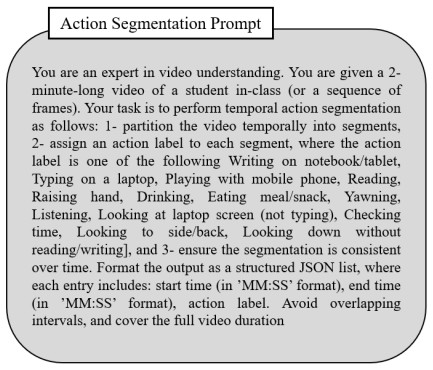
Understanding student behavior in the classroom is essential to improve both pedagogical quality and student engagement. Existing methods for predicting student engagement typically require substantial annotated data to model the diversity of student behaviors, yet privacy concerns often restrict researchers to their own proprietary datasets. Moreover, the classroom context, represented in peers' actions, is ignored. To address the aforementioned limitation, we propose a novel three-stage framework for video-based student engagement measurement. First, we explore the few-shot adaptation of the vision-language model for student action recognition, which is fine-tuned to distinguish among action categories with a few training samples. Second, to handle continuous and unpredictable student actions, we utilize the sliding temporal window technique to divide each student's 2-minute-long video into non-overlapping segments. Each segment is assigned an action category via the fine-tuned VLM model, generating a sequence of action predictions. Finally, we leverage the large language model to classify this entire sequence of actions, together with the classroom context, as belonging to an engaged or disengaged student. The experimental results demonstrate the effectiveness of the proposed approach in identifying student engagement. The source code will be available at https://github.com/ahmed-nady/context_aware_student_engagement.
Editorial analysis
A structured set of objections, weighed in public.
Referee Report
Summary. The manuscript proposes a three-stage framework for video-based student engagement measurement. It uses few-shot adaptation of a vision-language model (VLM) to recognize student actions from classroom videos, applies sliding temporal windows to generate action sequences from 2-minute clips, and employs a large language model (LLM) to classify the sequences as engaged or disengaged while incorporating peer context. The authors assert that experimental results demonstrate the effectiveness of this approach in identifying student engagement.
Significance. If the quantitative results hold, the work could be significant for developing privacy-preserving tools for classroom analysis that leverage pre-trained VLMs and LLMs, reducing the need for large annotated datasets and accounting for peer interactions, which are often overlooked in engagement prediction.
major comments (2)
- [Abstract] Abstract: The assertion that 'the experimental results demonstrate the effectiveness of the proposed approach' is unsupported by any quantitative metrics, baselines, dataset sizes, ablation results, or per-stage accuracies. Without these, the central claim of effectiveness cannot be verified.
- [Method] Method (VLM adaptation and sequence generation stages): The framework relies on few-shot VLM action recognition producing sufficiently accurate sequences for the downstream LLM classifier to be meaningful, yet no VLM top-1 accuracy, confusion matrices, or analysis of action vocabulary on held-out segments is reported. If accuracy falls below typical few-shot thresholds (~65-70%), peer-context inclusion cannot salvage the classification.
minor comments (1)
- [Abstract] The source code link is provided but the text supplies no details on specific VLM/LLM models used, number of shots, action categories, or hyperparameters needed for reproducibility.
Simulated Author's Rebuttal
We thank the referee for the constructive and detailed feedback. The comments highlight important gaps in the presentation of our experimental results and validation of intermediate stages. We address each point below and will revise the manuscript accordingly.
read point-by-point responses
-
Referee: [Abstract] Abstract: The assertion that 'the experimental results demonstrate the effectiveness of the proposed approach' is unsupported by any quantitative metrics, baselines, dataset sizes, ablation results, or per-stage accuracies. Without these, the central claim of effectiveness cannot be verified.
Authors: We agree that the abstract claim is insufficiently supported in its current form. In the revised manuscript we will expand the abstract to include the key quantitative results from our experiments, specifically the overall engagement classification accuracy, comparisons against relevant baselines, the size of the evaluation dataset, and summary ablation findings. This will allow readers to directly assess the strength of the evidence for the proposed approach. revision: yes
-
Referee: [Method] Method (VLM adaptation and sequence generation stages): The framework relies on few-shot VLM action recognition producing sufficiently accurate sequences for the downstream LLM classifier to be meaningful, yet no VLM top-1 accuracy, confusion matrices, or analysis of action vocabulary on held-out segments is reported. If accuracy falls below typical few-shot thresholds (~65-70%), peer-context inclusion cannot salvage the classification.
Authors: We acknowledge that the reliability of the VLM stage is a prerequisite for the rest of the pipeline. Although the manuscript currently emphasizes end-to-end performance, we will add a dedicated subsection in the revised version reporting the few-shot VLM top-1 accuracy on held-out video segments, the corresponding confusion matrix across action categories, and a brief analysis of the action vocabulary coverage. These additions will demonstrate that the generated action sequences meet the necessary quality threshold before being passed to the LLM classifier. revision: yes
Circularity Check
No significant circularity detected in the pipeline
full rationale
The paper presents an empirical three-stage framework relying on external pre-trained VLM and LLM models with few-shot adaptation and standard sliding-window segmentation. No equations, derivations, or load-bearing self-citations appear in the provided text that reduce any prediction or result to the authors' own inputs by construction. The central claim rests on experimental effectiveness rather than analytical self-definition or fitted-parameter renaming, rendering the approach self-contained against external benchmarks.
Axiom & Free-Parameter Ledger
axioms (2)
- domain assumption A vision-language model can be fine-tuned with only a few samples to distinguish classroom student action categories
- domain assumption A large language model can classify student engagement from an action sequence when classroom peer context is provided
Reference graph
Works this paper leans on
-
[1]
Ahmed Abdelkawy, Asem Ali, and Aly Farag. Epam-net: An efficient pose-driven attention-guided multimodal network for video action recognition.Neurocomputing, 633:129781,
-
[2]
Ahmed Abdelkawy, Aly Farag, Islam Alkabbany, Asem Ali, Chris Foreman, Thomas Tretter, and Nicholas Hindy. Mea- suring student behavioral engagement using histogram of ac- tions.Pattern Recognition Letters, 186:337–344, 2024. 2, 3, 5, 7
work page 2024
-
[3]
Edusense: Practical classroom sensing at scale.Proc
Karan Ahuja, Dohyun Kim, Franceska Xhakaj, Virag Varga, Anne Xie, Stanley Zhang, Jay Eric Townsend, Chris Har- rison, Amy Ogan, and Yuvraj Agarwal. Edusense: Practical classroom sensing at scale.Proc. on Inter., Mobile, Wearable and Ubiquitous Tech., 3, 2019. 2, 3
work page 2019
-
[4]
Valentina Rita Andolfi, Chiara Di Nuzzo, and Alessandro Antonietti. Opening the mind through the body: The ef- fects of posture on creative processes.Thinking Skills and Creativity, 24:20–28, 2017. 1
work page 2017
-
[5]
James J Appleton, Sandra L Christenson, and Michael J Fur- long. Student engagement with school: Critical conceptual and methodological issues of the construct.Psychology in the Schools, 45(5):369–386, 2008. 1
work page 2008
-
[6]
Vivit: A video vision transformer
Anurag Arnab, Mostafa Dehghani, Georg Heigold, Chen Sun, Mario Lu ˇci´c, and Cordelia Schmid. Vivit: A video vision transformer. InProceedings of the IEEE/CVF inter- national conference on computer vision, pages 6836–6846,
-
[7]
Is space-time attention all you need for video understanding? InIcml, volume 2, page 4, 2021
Gedas Bertasius, Heng Wang, and Lorenzo Torresani. Is space-time attention all you need for video understanding? InIcml, volume 2, page 4, 2021. 4
work page 2021
-
[8]
Brandon M Booth, Nigel Bosch, and Sidney K D’Mello. Engagement detection and its applications in learning: a tutorial and selective review.Proceedings of the IEEE, 111(10):1398–1422, 2023. 1
work page 2023
-
[9]
Tom Brown, Benjamin Mann, Nick Ryder, Melanie Sub- biah, Jared D Kaplan, Prafulla Dhariwal, Arvind Neelakan- tan, Pranav Shyam, Girish Sastry, Amanda Askell, et al. Lan- guage models are few-shot learners.Advances in neural in- formation processing systems, 33:1877–1901, 2020. 4, 7
work page 1901
-
[10]
Quo vadis, action recognition? a new model and the kinetics dataset
Joao Carreira and Andrew Zisserman. Quo vadis, action recognition? a new model and the kinetics dataset. Inpro- ceedings of the IEEE Conference on Computer Vision and Pattern Recognition, pages 6299–6308, 2017. 3
work page 2017
-
[11]
The icap framework: Linking cognitive engagement to active learning outcomes
Michelene TH Chi and Ruth Wylie. The icap framework: Linking cognitive engagement to active learning outcomes. Educational psychologist, 49(4), 2014. 1, 2
work page 2014
-
[12]
Tempo- ral action segmentation: An analysis of modern techniques
Guodong Ding, Fadime Sener, and Angela Yao. Tempo- ral action segmentation: An analysis of modern techniques. IEEE Transactions on Pattern Analysis and Machine Intelli- gence, 46(2):1011–1030, 2023. 6
work page 2023
-
[13]
The llama 3 herd of models.arXiv e-prints, pages arXiv–2407,
Abhimanyu Dubey, Abhinav Jauhri, Abhinav Pandey, Ab- hishek Kadian, Ahmad Al-Dahle, Aiesha Letman, Akhil Mathur, Alan Schelten, Amy Yang, Angela Fan, et al. The llama 3 herd of models.arXiv e-prints, pages arXiv–2407,
-
[14]
Toward a quantitative engagement monitor for stem education
Aly A Farag, Asem Ali, Islam Alkabbany, James Christopher Foreman, Tom Tretter, Marci S DeCaro, and Nicholas Carl Hindy. Toward a quantitative engagement monitor for stem education. In2021 ASEE Annual Conference Content Ac- cess, 2021. 1
work page 2021
-
[15]
X3d: Expanding architectures for efficient video recognition
Christoph Feichtenhofer. X3d: Expanding architectures for efficient video recognition. InProceedings of the IEEE/CVF conference on computer vision and pattern recognition, pages 203–213, 2020. 4
work page 2020
-
[16]
Slowfast networks for video recognition
Christoph Feichtenhofer, Haoqi Fan, Jitendra Malik, and Kaiming He. Slowfast networks for video recognition. In Proceedings of the IEEE/CVF international conference on computer vision, pages 6202–6211, 2019. 3
work page 2019
-
[17]
Benjamin Filtjens, Bart Vanrumste, and Peter Slaets. Skeleton-based action segmentation with multi-stage spatial- temporal graph convolutional neural networks.IEEE Trans- actions on Emerging Topics in Computing, 12:202–212, 1
-
[18]
Jennifer A Fredricks, Phyllis C Blumenfeld, and Alison H Paris. School engagement: Potential of the concept, state of the evidence.Review of educational research, 74(1):59–109,
-
[19]
Leveraging temporal contextualization for video action recognition
Minji Kim, Dongyoon Han, Taekyung Kim, and Bohyung Han. Leveraging temporal contextualization for video action recognition. InEuropean Conference on Computer Vision, pages 74–91. Springer, 2024. 6
work page 2024
-
[20]
Erin S Lane and Sara E Harris. A new tool for measuring stu- dent behavioral engagement in large university classes.Jour- nal of College Science Teaching, 44(6):83–91, 2015. 1, 5
work page 2015
-
[21]
Sleep gesture detection in classroom monitor system
Wen Li, Fei Jiang, and Ruimin Shen. Sleep gesture detection in classroom monitor system. InICASSP 2019-2019 IEEE International Conference on Acoustics, Speech and Signal Processing (ICASSP), pages 7640–7644. IEEE, 2019. 1
work page 2019
-
[22]
Feng-Cheng Lin, Huu-Huy Ngo, Chyi-Ren Dow, Ka-Hou Lam, and Hung Linh Le. Student behavior recognition system for the classroom environment based on skeleton pose estimation and person detection.Sensors, 21(16):5314,
-
[23]
Expanding language-image pretrained models for gen- eral video recognition
Bolin Ni, Houwen Peng, Minghao Chen, Songyang Zhang, Gaofeng Meng, Jianlong Fu, Shiming Xiang, and Haibin Ling. Expanding language-image pretrained models for gen- eral video recognition. InEuropean conference on computer vision, pages 1–18. Springer, 2022. 4, 6
work page 2022
-
[24]
Fine-tuned clip models are efficient video learners
Hanoona Rasheed, Muhammad Uzair Khattak, Muhammad Maaz, Salman Khan, and Fahad Shahbaz Khan. Fine-tuned clip models are efficient video learners. InProceedings of the IEEE/CVF conference on computer vision and pattern recognition, pages 6545–6554, 2023. 2, 4, 5, 6 9
work page 2023
-
[25]
Amir Shahroudy, Jun Liu, Tian Tsong Ng, and Gang Wang. Ntu rgb+d: A large scale dataset for 3d human activity anal- ysis.Proceedings of the IEEE Computer Society Confer- ence on Computer Vision and Pattern Recognition, 2016- December:1010–1019, 12 2016. 3
work page 2016
-
[26]
Xiaojing Sheng, Suqiang Li, and Sixian Chan. Real-time classroom student behavior detection based on improved yolov8s.Scientific Reports, 15:1–11, 12 2025. 3
work page 2025
-
[27]
Karen Simonyan and Andrew Zisserman. Two-stream con- volutional networks for action recognition in videos.Ad- vances in neural information processing systems, 27, 2014. 3
work page 2014
-
[28]
Ellen A Skinner and Michael J Belmont. Motivation in the classroom: Reciprocal effects of teacher behavior and stu- dent engagement across the school year.Journal of educa- tional psychology, 85(4):571, 1993. 1
work page 1993
-
[29]
Michelle K Smith, Francis HM Jones, Sarah L Gilbert, and Carl E Wieman. The classroom observation protocol for un- dergraduate stem (copus): A new instrument to characterize university stem classroom practices.CBE—Life Sciences Ed- ucation, 12(4):618–627, 2013. 1
work page 2013
-
[30]
Multimodal engagement analysis from facial videos in the classroom
¨Omer S¨umer, Patricia Goldberg, Sidney D’Mello, Peter Ger- jets, Ulrich Trautwein, and Enkelejda Kasneci. Multimodal engagement analysis from facial videos in the classroom. IEEE Transactions on Affective Computing, 14(2):1012– 1027, 2021. 1
work page 2021
-
[31]
Bo Sun, Yong Wu, Kaijie Zhao, Jun He, Lejun Yu, Huanqing Yan, and Ao Luo. Student class behavior dataset: a video dataset for recognizing, detecting, and captioning students’ behaviors in classroom scenes.Neural Comp. & App., 33,
-
[32]
Gemma 2: Improving Open Language Models at a Practical Size
Gemma Team, Morgane Riviere, Shreya Pathak, Pier Giuseppe Sessa, Cassidy Hardin, Surya Bhupati- raju, L´eonard Hussenot, Thomas Mesnard, Bobak Shahriari, Alexandre Ram´e, et al. Gemma 2: Improving open language models at a practical size.arXiv preprint arXiv:2408.00118,
work page internal anchor Pith review Pith/arXiv arXiv
-
[33]
A closer look at spatiotemporal convolutions for action recognition
Du Tran, Heng Wang, Lorenzo Torresani, Jamie Ray, Yann LeCun, and Manohar Paluri. A closer look at spatiotemporal convolutions for action recognition. InProceedings of the IEEE conference on Computer Vision and Pattern Recogni- tion, pages 6450–6459, 2018. 4
work page 2018
-
[34]
Temporal segment net- works: Towards good practices for deep action recognition
Limin Wang, Yuanjun Xiong, Zhe Wang, Yu Qiao, Dahua Lin, Xiaoou Tang, and Luc Van Gool. Temporal segment net- works: Towards good practices for deep action recognition. InEuropean conference on computer vision, pages 20–36. Springer, 2016. 3
work page 2016
-
[35]
Action- CLIP: A New Paradigm for Video Action Recognition.arXiv preprint arXiv:2109.08472, 2021
Mengmeng Wang, Jiazheng Xing, and Yong Liu. Actionclip: A new paradigm for video action recognition.arXiv preprint arXiv:2109.08472, 2021. 4
-
[36]
From raw video to pedagogical insights: A uni- fied framework for student behavior analysis
Zefang Yu, Mingye Xie, Jingsheng Gao, Ting Liu, and Yuzhuo Fu. From raw video to pedagogical insights: A uni- fied framework for student behavior analysis. InProceedings of the AAAI Conference on Artificial Intelligence, volume 38, pages 23241–23249, 2024. 2, 4
work page 2024
-
[37]
Zefang Yu, Mingye Xie, Jingsheng Gao, Ting Liu, and Yuzhuo Fu. From raw video to pedagogical insights: A uni- fied framework for student behavior analysis.Proceedings of the AAAI Conference on Artificial Intelligence, 38:23241– 23249, 3 2024. 3
work page 2024
-
[38]
Intelligent student behavior analysis system for real classrooms
Rui Zheng, Fei Jiang, and Ruimin Shen. Intelligent student behavior analysis system for real classrooms. InICASSP 2020-2020 IEEE International Conference on Acoustics, Speech and Signal Processing (ICASSP), pages 9244–9248. IEEE, 2020. 1 A. Appendix A.1. LLM Prompts In this section, we present the LLM prompts used for: • Context-free engagement classifica...
work page 2020
discussion (0)
Sign in with ORCID, Apple, or X to comment. Anyone can read and Pith papers without signing in.