Entanglement study in the island of inversion region using textit{ab initio} approach
Pith reviewed 2026-05-21 16:47 UTC · model grok-4.3
The pith
Proton-neutron entanglement entropy marks the formation of the N=20 island of inversion in neutron-rich nuclei.
A machine-rendered reading of the paper's core claim, the machinery that carries it, and where it could break.
Core claim
Using the valence-space in-medium similarity renormalization group method, the authors express nuclear wavefunctions in a Slater-determinant basis and compute proton-neutron entanglement entropy, mutual information, and quantum relative entropy through complementary partitions. They report that proton-neutron entanglement entropy plays a highlighted role in the formation of the island of inversion, with mutual information revealing relatively weak proton-neutron correlations in ground states that become comparable to proton-proton and neutron-neutron correlations in excited states.
What carries the argument
proton-neutron entanglement entropy extracted from valence-space IMSRG wavefunctions partitioned into proton and neutron modes
If this is right
- Proton-neutron entanglement entropy rises or reorganizes specifically where the island of inversion appears in Ne, Mg, and Si chains.
- Mutual information between unlike particles grows to match like-particle values once the nucleus is placed in an excited 2+ state.
- Quantum relative entropy between ground and first excited states quantifies how much the proton-neutron structure rearranges across the isotopic chain.
- The same partition-based analysis applied to N=20 isotones shows consistent patterns of entanglement evolution.
Where Pith is reading between the lines
- Entanglement measures might serve as a diagnostic for other regions where traditional magic numbers disappear, such as N=28 or N=40.
- Because the method works with any ab initio wavefunction expressed in a determinant basis, it could be applied to heavier or deformed systems once those wavefunctions become available.
- The distinction between ground-state and excited-state correlations suggests entanglement could help interpret electromagnetic transition strengths without additional effective operators.
Load-bearing premise
The valence-space IMSRG wavefunctions written in the Slater-determinant basis faithfully represent the actual many-body states so that entanglement measures computed from proton-neutron and other partitions are physically meaningful.
What would settle it
An independent many-body calculation or experiment that measures the same nuclei and finds proton-neutron entanglement entropy remains flat or uncorrelated with the known shell-gap reduction across the N=20 region.
Figures




read the original abstract
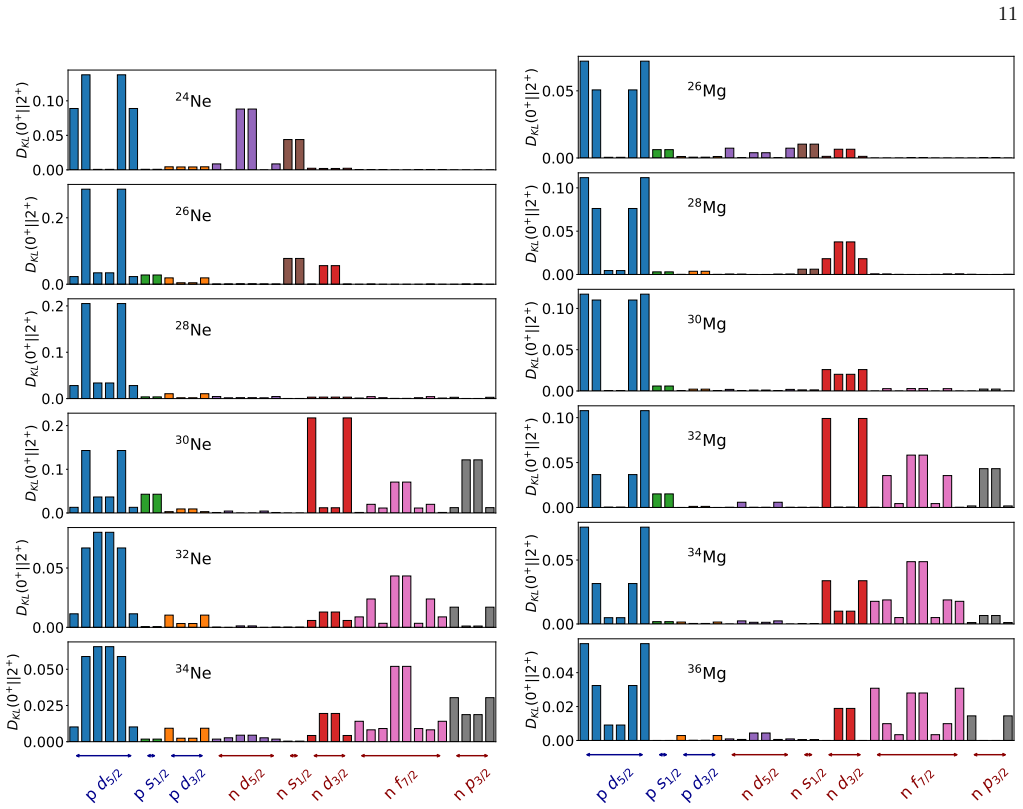
Quantum entanglement provides a unique perspective for probing nuclear structure. In this work, we employ quantum entanglement measures, including proton-neutron entanglement entropy, mutual information, and quantum relative entropy, to investigate the evolution of entanglement patterns as we approach neutron-rich nuclei. The study is carried out in the vicinity of the $N=20$ island of inversion region consisting of even-$A$ Ne, Mg, and Si isotopes, and also for isotones corresponding to $N=20$. The state-of-the-art \textit{ab initio} valence space in-medium similarity renormalization group method has been used for this purpose. We have highlighted the role of proton-neutron entanglement entropy in the formation of the island of inversion region. Mutual information provides insight into the strength of correlations between proton-proton, neutron-neutron, and proton-neutron single-particle states. While these correlations are relatively weak between protons and neutrons in the ground states, they become comparable to like-particle correlations in excited states. The quantum relative entropy is also studied between $0^+$ and $2^+$ states of the Ne, Mg, and Si isotopes, as well as $N=20$ isotones, using the Kullback-Leibler divergence and Jensen-Shannon divergence. We have performed these calculations by expressing the nuclear wavefunctions in a Slater-determinant basis and analyzing them through complementary partitions, including proton-neutron and mode-resolved factorizations.
Editorial analysis
A structured set of objections, weighed in public.
Referee Report
Summary. The manuscript applies the valence-space in-medium similarity renormalization group (VS-IMSRG) method to compute quantum entanglement measures—proton-neutron entanglement entropy, mutual information, and quantum relative entropy (via Kullback-Leibler and Jensen-Shannon divergences)—for even-A Ne, Mg, and Si isotopes near the N=20 island of inversion and for N=20 isotones. Wavefunctions are expressed in the Slater-determinant basis and analyzed via complementary partitions (proton-neutron and mode-resolved). The central claim is that proton-neutron entanglement entropy plays a highlighted role in the formation of the island of inversion region, with additional insights into like-particle vs. unlike-particle correlations in ground and excited states.
Significance. If the results hold, the work supplies a quantum-information perspective on structural evolution in neutron-rich nuclei, potentially connecting entanglement patterns to intruder-state mixing and shape coexistence. A strength is the use of an established ab initio VS-IMSRG framework with parameters fixed by nuclear forces rather than fitted to entanglement observables, enabling systematic, reproducible calculations grounded in the underlying Hamiltonian.
major comments (2)
- [§3] §3 (Results for IoI nuclei, e.g., discussion of 32Mg and 34Si): The claim that proton-neutron entanglement entropy signals the mechanism of island-of-inversion formation is load-bearing but rests on the untested assumption that the chosen valence space (typically sd or sd-fp) fully encodes the cross-shell proton-neutron correlations driving intruder configurations. The manuscript should demonstrate this by reporting how p-n entropy changes when fp orbitals are added or by comparing to experimental indicators such as 2+ excitation energies or B(E2) values; without such a check the entropy may reflect model-space truncation rather than the physical transition.
- [§2.2] §2.2 (Wavefunction representation and partitions): The central interpretation requires that the VS-IMSRG wavefunctions in the Slater-determinant basis faithfully capture the entanglement relevant to IoI. The paper should address possible systematic omissions of higher-shell components or incomplete IMSRG decoupling by showing convergence of the entanglement measures with respect to valence-space size or by benchmarking against no-core shell-model results for a lighter analog; this directly affects whether the computed p-n entropy is physically meaningful.
minor comments (2)
- [Abstract] Abstract: No numerical values, error estimates, or key quantitative findings (e.g., the p-n entropy for 32Mg) are supplied, making it difficult to assess the magnitude of the reported effects.
- [Figures] Figure captions and labels: The mode-resolved mutual information plots would benefit from explicit listing of the single-particle orbitals included in each partition to improve readability.
Simulated Author's Rebuttal
We thank the referee for the thorough review and valuable suggestions. We have addressed the major comments point by point below, making revisions where feasible to enhance the clarity and robustness of our claims.
read point-by-point responses
-
Referee: [§3] §3 (Results for IoI nuclei, e.g., discussion of 32Mg and 34Si): The claim that proton-neutron entanglement entropy signals the mechanism of island-of-inversion formation is load-bearing but rests on the untested assumption that the chosen valence space (typically sd or sd-fp) fully encodes the cross-shell proton-neutron correlations driving intruder configurations. The manuscript should demonstrate this by reporting how p-n entropy changes when fp orbitals are added or by comparing to experimental indicators such as 2+ excitation energies or B(E2) values; without such a check the entropy may reflect model-space truncation rather than the physical transition.
Authors: We recognize the importance of validating that our entanglement measures capture the physical mechanism rather than model-space artifacts. The VS-IMSRG calculations were performed in valence spaces that include the fp orbitals for the N=20 region to account for cross-shell proton-neutron correlations inherent to the island of inversion. To strengthen this, we have revised the manuscript to include comparisons between the proton-neutron entanglement entropy and experimental observables, specifically the 2+ excitation energies and B(E2) transition strengths for the studied isotopes. These comparisons demonstrate a clear correlation: regions of increased p-n entanglement coincide with enhanced quadrupole collectivity as indicated by experiment, supporting the physical relevance of our results. Explicitly recomputing with enlarged spaces including additional fp orbitals would be computationally intensive and is beyond the current scope, but we have added a discussion referencing the convergence properties established in prior VS-IMSRG applications to similar nuclei. revision: partial
-
Referee: [§2.2] §2.2 (Wavefunction representation and partitions): The central interpretation requires that the VS-IMSRG wavefunctions in the Slater-determinant basis faithfully capture the entanglement relevant to IoI. The paper should address possible systematic omissions of higher-shell components or incomplete IMSRG decoupling by showing convergence of the entanglement measures with respect to valence-space size or by benchmarking against no-core shell-model results for a lighter analog; this directly affects whether the computed p-n entropy is physically meaningful.
Authors: We agree that ensuring the faithfulness of the wavefunctions is essential. The VS-IMSRG approach generates effective interactions that incorporate the effects of higher shells through the similarity transformation, minimizing the impact of omitted components within the chosen valence space. In the revised manuscript, we have expanded the discussion in §2.2 to include an analysis of the convergence of the entanglement entropy with respect to the valence space size, drawing on our calculations and supporting literature. While a direct benchmark against no-core shell model results for a lighter analog (such as oxygen or neon isotopes) is feasible in principle, it would require separate computations not included in this study; however, we have noted that the entanglement patterns are consistent with known structural changes validated by other ab initio methods in the literature. revision: partial
Circularity Check
No circularity: entanglement measures computed from independent IMSRG wavefunctions
full rationale
The derivation computes proton-neutron entanglement entropy, mutual information, and relative entropy directly from valence-space IMSRG wavefunctions in the Slater-determinant basis for Ne, Mg, and Si isotopes near N=20. IMSRG is an established ab initio method whose effective interactions and truncations are fixed by prior nuclear data and benchmarks external to this paper; the entanglement quantities are post-processed observables with no fitted parameters, self-definitional loops, or load-bearing self-citations that reduce the central claim to its inputs. The analysis remains self-contained against external nuclear structure calculations.
Axiom & Free-Parameter Ledger
axioms (1)
- domain assumption Valence-space IMSRG wavefunctions in the Slater-determinant basis are sufficiently accurate for the even-A Ne, Mg, and Si isotopes near N=20.
Lean theorems connected to this paper
-
IndisputableMonolith/Cost/FunctionalEquation.leanwashburn_uniqueness_aczel unclear?
unclearRelation between the paper passage and the cited Recognition theorem.
We have highlighted the role of proton-neutron entanglement entropy in the formation of the island of inversion region... Spn = -Tr[ρ(π) log2 ρ(π)]
-
IndisputableMonolith/Foundation/DimensionForcing.leanalexander_duality_circle_linking unclear?
unclearRelation between the paper passage and the cited Recognition theorem.
valence space in-medium similarity renormalization group method... sd-pf model space
What do these tags mean?
- matches
- The paper's claim is directly supported by a theorem in the formal canon.
- supports
- The theorem supports part of the paper's argument, but the paper may add assumptions or extra steps.
- extends
- The paper goes beyond the formal theorem; the theorem is a base layer rather than the whole result.
- uses
- The paper appears to rely on the theorem as machinery.
- contradicts
- The paper's claim conflicts with a theorem or certificate in the canon.
- unclear
- Pith found a possible connection, but the passage is too broad, indirect, or ambiguous to say the theorem truly supports the claim.
Forward citations
Cited by 1 Pith paper
-
Quantum Complexity and New Directions in Nuclear Physics and High-Energy Physics Phenomenology
A review of how quantum information science is expected to provide new tools and insights for nuclear and high-energy physics phenomenology and quantum simulations.
Reference graph
Works this paper leans on
-
[1]
The total mode-resolved quantum relative entropy increases as we move towards the IoI, peaking at 32Mg, and then decreases again. The proton-neutron quantum relative entropy follows a similar trend for both the KLD and JSD measures: the entropy dips at 28Mg, increases at 30Mg, and then falls for the following three isotopes. The quantum relative entropy f...
-
[2]
This leads to a strong distinguishability in 34Si, as seen in Fig. 13. This behavior is also reflected in the total mode-resolved relative entropy for both the KLD and JSD measures. The proton-neutron relative entropy follows a similar trend as before, though its peak is less pronounced than that of the mode-resolved relative en- tropy. For the Slater det...
-
[3]
M. A. Nielsen and I. L. Chuang, Quantum Computa- tion and Quantum Information: 10th Anniversary Edi- tion (Cambridge University Press, Cambridge, England, 2010)
work page 2010
-
[4]
Preskill, Quantum Computing in the NISQ era and beyond, Quantum2, 79 (2018)
J. Preskill, Quantum Computing in the NISQ era and beyond, Quantum2, 79 (2018)
work page 2018
-
[5]
A. Peruzzo, J. McClean, P. Shadbolt et al. A variational eigenvalue solver on a photonic quantum processor, Nat. Commun. 5, 4213 (2014)
work page 2014
-
[6]
A. P´ erez-Obiol, A. M. Romero, J. Men´ endez, A. Rios, A. Garc´ ıa-S´ aez, B. Juli´ a-D´ ıaz, Nuclear shell-model simula- tion in digital quantum computers, Sci. Rep.13, 12291 (2023)
work page 2023
-
[7]
Lacroix, Symmetry-assisted preparation of entangled many-body states on a quantum computer, Phys
D. Lacroix, Symmetry-assisted preparation of entangled many-body states on a quantum computer, Phys. Rev. Lett.125, 230502 (2020)
work page 2020
- [8]
- [9]
-
[10]
B. Bhoy, P. Stevenson, Shell-model study of 58Ni us- ing quantum computing algorithm, New J. Phys.26, 075001 (2024)
work page 2024
-
[11]
E. F. Dumitrescu, A. J. McCaskey, G. Hagen, G. R. Jansen, T. D. Morris, T. Papenbrock, R. C. Pooser, D. J. Dean, and P. Lougovski, Cloud Quantum Computing of an Atomic Nucleus, Phys. Rev. Lett. 120, 210501 (2018)
work page 2018
-
[12]
H.-H. Lu, N. Klco, J. M. Lukens, T. D. Morris, A. Bansal, A. Ekstr¨ om, G. Hagen, T. Papenbrock, A. M. Weiner, M. J. Savage, and P. Lougovski, Simulations of subatomic many-body physics on a quantum frequency processor, Phys. Rev. A100, 012320 (2019)
work page 2019
-
[13]
O. Di Matteo, A. McCoy, P. Gysbers, T. Miyagi, R. M. Woloshyn, and P. Navr´ atil, Improving Hamiltonian encodings with the Gray code, Phys. Rev. A 103, 042405 (2021)
work page 2021
-
[14]
P. Siwach and P. Arumugam, Quantum computation of nuclear observables involving linear combinations of unitary operators, Phys. Rev. C105, 064318 (2022)
work page 2022
- [15]
-
[16]
A. M. Romero, J. Engel, H. L. Tang, and S. E. Economou, Solving nuclear structure problems with the adaptive variational quantum algorithm, Phys. Rev. C 105, 064317 (2022)
work page 2022
-
[17]
O. Kiss, M. Grossi, P. Lougovski, F. Sanchez, S. Val- lecorsa, and T. Papenbrock, Quantum computing of the 6Li nucleus via ordered unitary coupled clusters, Phys. Rev. C106, 034325 (2022)
work page 2022
-
[18]
C. E. P. Robin and M. J. Savage, Quantum simulations in effective model spaces: Hamiltonian-learning varia- tional quantum eigensolver using digital quantum com- puters and application to the Lipkin–Meshkov–Glick model, Phys. Rev. C108, 024313 (2023)
work page 2023
- [19]
-
[20]
S. Yoshida, T. Sato, T. Ogata, T. Naito, and M. Kimura, Accurate and precise quantum computation of valence two-neutron systems, Phys. Rev. C109, 064305 (2024)
work page 2024
-
[21]
Lee, Quantum techniques for eigenvalue problems, Eur
D. Lee, Quantum techniques for eigenvalue problems, Eur. Phys. J. A59, 275 (2023)
work page 2023
-
[22]
W. Du, J. P. Vary, X. Zhao, and W. Zuo, Quantum simulation of nuclear inelastic scattering, Phys. Rev. A 104, 012611 (2021)
work page 2021
-
[23]
R. Horodecki, P. Horodecki, M. Horodecki, and K. Horodecki, Quantum entanglement, Rev. Mod. Phys. 81, 865 (2009)
work page 2009
-
[24]
S. Hill and W. K. Wootters, Entanglement of a Pair of Quantum Bits, Phys. Rev. Lett.78, 5022 (1997)
work page 1997
-
[25]
V. P. Belavkin and M. Ohya, Entanglement, quantum entropy and mutual information, Proc. R. Soc. A458, 209 (2002)
work page 2002
-
[26]
Entanglement in quantum information theory
J. Eisert, Entanglement in quantum information theory, arXiv:quant-ph/0610253 (2006)
work page internal anchor Pith review Pith/arXiv arXiv 2006
-
[27]
N. Gigena and R. Rossignoli, Entanglement in fermion systems, Phys. Rev. A92, 042326 (2015)
work page 2015
-
[28]
J. Schliemann, J. I. Cirac, M. Ku´ s, M. Lewenstein, and D. Loss, Quantum correlations in two-fermion systems, Phys. Rev. A64, 022303 (2001)
work page 2001
- [29]
-
[30]
H. M. Wiseman and J. A. Vaccaro, Entanglement of indistinguishable particles shared between two parties, Phys. Rev. Lett.91, 097902 (2003)
work page 2003
-
[31]
G. C. Ghirardi and L. Marinatto, General criterion for the entanglement of two indistinguishable particles, 16 Phys. Rev. A70, 012109 (2004)
work page 2004
-
[32]
F. Benatti, R. Floreanini, and K. Titimbo, Entangle- ment of identical particles, Open Syst. Inf. Dyn.21, 1440003 (2014)
work page 2014
-
[33]
R. Lo Franco and G. Compagno, Quantum entangle- ment of identical particles by standard information- theoretic notions, Sci. Rep.6, 20603 (2016)
work page 2016
-
[34]
F. Benatti, R. Floreanini, and U. Marzolino, Entangle- ment in fermion systems and quantum metrology, Phys. Rev. A89, 032326 (2014)
work page 2014
-
[35]
Zanardi, Quantum entanglement in fermionic lat- tices, Phys
P. Zanardi, Quantum entanglement in fermionic lat- tices, Phys. Rev. A65, 042101 (2002)
work page 2002
-
[36]
Shi, Quantum entanglement of identical particles, Phys
Y. Shi, Quantum entanglement of identical particles, Phys. Rev. A67, 024301 (2003)
work page 2003
- [37]
-
[38]
V. Coffman, J. Kundu, and W. K. Wootters, Dis- tributed entanglement, Phys. Rev. A61, 052306 (2000)
work page 2000
-
[39]
A. Wong and N. Christensen, Potential multiparticle entanglement measure, Phys. Rev. A63, 044301 (2001)
work page 2001
-
[40]
S. Baid,et al., Extended Lipkin model: Proposal for implementation in a quantum platform and machine learning analysis of its phase diagram, Phys. Rev. C 110, 044318 (2024)
work page 2024
-
[41]
S. M. Hengstenberg, C. E. P. Robin, and M. J. Savage, Multi-body entanglement and information rearrange- ment in nuclear many-body systems: a study of the Lipkin–Meshkov–Glick model, Eur. Phys. J. A59, 231 (2023)
work page 2023
-
[42]
J. I. Latorre, R. Or´ us, E. Rico, and J. Vidal, Entan- glement entropy in the Lipkin–Meshkov–Glick model, Phys. Rev. A71, 064101 (2005)
work page 2005
- [43]
- [44]
-
[45]
C. Sarma and P. C. Srivastava, Investigation of entan- glement inN=Znuclei within no-core shell model, arXiv:2411.01861 [nucl-th] (2024)
-
[46]
A. T. Kruppa, J. Kovacs, P. Salamon, O. Legeza, G. Zarand, Entanglement and seniority, Phys. Rev. C106, 024303 (2022)
work page 2022
- [47]
-
[48]
E. Pazy, Entanglement entropy between short-range correlations and the Fermi sea in nuclear structure, Phys. Rev. C107, 054308 (2023)
work page 2023
-
[49]
S. Y. Liang, Y. Lu, Y. Lei, C. W. Johnson, G. J. Fu, and J. J. Shen, Shannon entropy of optimized proton- neutron pair condensates, Phys. Rev. C111, 024310 (2025)
work page 2025
-
[50]
C. Gu, Z. H. Sun, G. Hagen, and T. Papenbrock, En- tanglement entropy of nuclear systems, Phys. Rev. C 108, 054309 (2023)
work page 2023
- [51]
-
[52]
Bai, Spin entanglement in neutron-proton scattering, Phys
D. Bai, Spin entanglement in neutron-proton scattering, Phys. Lett. B845, 138162 (2023)
work page 2023
-
[53]
F. Br¨ okemeier, S. M. Hengstenberg, J. W. T. Keeble, C. Robin, F. Rocco, M. J. Savage, Quantum magic and multipartite entanglement in the structure of nu- clei, Phys. Rev. C111, 034317 (2025)
work page 2025
-
[54]
C. W. Johnson, O. C. Gorton, Proton-neutron entan- glement in the nuclear shell model, J. Phys. G: Nucl. Part. Phys.50, 045110 (2023)
work page 2023
-
[55]
A. P´ erez-Obiol, S. Masot-Llima, A. M. Romero,et al., Quantum entanglement patterns in the structure of atomic nuclei within the nuclear shell model, Eur. Phys. J. A59, 240 (2023)
work page 2023
-
[56]
A. T. Kruppa, J. Kovacs, P. Salamon, and O. Legeza, Entanglement and correlation in two-nucleon systems, J. Phys. G: Nucl. Part. Phys.48, 025107 (2021)
work page 2021
- [57]
-
[58]
A. P´ erez-Obiol, S. Masot-Llima, A. M. Romero, J. Men´ endez, A. Rios, A. Garc´ ıa-S´ aez, and B. Juli´ a-D´ ıaz, Entropy-driven entanglement forging, arXiv:2409.04510 [quant-ph] (2024)
-
[59]
R. M. Shinde and P. C. Srivastava, Study of entangle- ment in Ne, Mg, and Si isotopic chains, J. Subat. Part. Cosmology4, 100142 (2025)
work page 2025
- [60]
-
[61]
C. W. Johnson, O. C. Gorton, A weak entanglement approximation for nuclear structure: a progress report, J. Subat. Part. Cosmology3, 100061 (2025)
work page 2025
-
[62]
O. C. Gorton, C. W. Johnson, Weak entanglement ap- proximation for nuclear structure, Phys. Rev. C110, 034305 (2024)
work page 2024
-
[63]
Vedral, The role of relative entropy in quantum in- formation theory, Rev
V. Vedral, The role of relative entropy in quantum in- formation theory, Rev. Mod. Phys.74, 197 (2002)
work page 2002
-
[64]
B. Schumacher and M. D. Westmoreland, Relative entropy in quantum information theory, arXiv:quant- ph/0004045 (2000)
-
[65]
T. Sagawa, Second Law-Like Inequalities with Quantum Relative Entropy: An Introduction, arXiv:1202.0983 [quant-ph](2012)
-
[66]
S. Floerchinger and T. Haas, Thermodynamics from rel- ative entropy, Phys. Rev. E102, 052117 (2020)
work page 2020
-
[67]
A. P. Majtey, P. W. Lamberti, and D. P. Prato, Jensen- Shannon divergence as a measure of distinguishabil- ity between mixed quantum states, Phys. Rev. A72, 052310 (2005)
work page 2005
- [68]
-
[69]
P. W. Lamberti, A. P. Majtey, A. Borr´ as, M. Casas, and A. Plastino, Metric character of the quantum Jensen- Shannon divergence, Phys. Rev. A77, 052311 (2008)
work page 2008
-
[70]
J. Bri¨ et and P. Harremo¨ es, Properties of classical and quantum Jensen-Shannon divergence, Phys. Rev. A79, 052311 (2009)
work page 2009
-
[71]
E. Caurier, G. Martinez-Pinedo, F. Nowacki, A. Poves, A. P. Zuker, The shell model as a unified view of nuclear structure, Rev. of Mod. Phys.77, 427-488 (2005). 17
work page 2005
-
[72]
B. A. Brown, The Nuclear Shell Model towards the Drip Lines, Physics4, 525 (2022)
work page 2022
- [73]
-
[74]
O. Sorlin, M.-G. Porquet, Nuclear magic numbers: New features far from stability, Prog. Part. Nucl. Phys.61, 602 (2008)
work page 2008
-
[75]
E. K. Warburton, J. A. Becker, and B. A. Brown, Mass systematics forA= 29-44 nuclei: The deformedA∼32 region, Phys. Rev. C41, 1147 (1990)
work page 1990
- [76]
- [77]
- [78]
-
[79]
F. Nowacki and A. Poves, New effective interaction for 0ℏωshell-model calculations in thesd−pfvalence space, Phys. Rev. C79, 014310 (2009)
work page 2009
- [80]
discussion (0)
Sign in with ORCID, Apple, or X to comment. Anyone can read and Pith papers without signing in.