Nonadiabatic theory for subcycle ionic dynamics in multielectron tunneling ionization
Pith reviewed 2026-05-16 15:10 UTC · model grok-4.3
The pith
A nonadiabatic theory based on the strong field approximation describes subcycle ionic dynamics during multielectron tunneling ionization and shows equivalence between wave function and density matrix approaches.
A machine-rendered reading of the paper's core claim, the machinery that carries it, and where it could break.
Core claim
The paper establishes that multielectron tunneling ionization under the strong field approximation admits a consistent treatment of ionic coherence formation. Wave-function and density-matrix routes are formally equivalent for subcycle ionic dynamics. An accurate subcycle nonadiabatic ionization rate is obtained and incorporated to enhance quantitative predictions, allowing the theory to account for observed laser-induced ionic coherence in N2 and CO2.
What carries the argument
The strong field approximation extended to multiple bound electrons, together with the formal equivalence of wave-function and density-matrix descriptions of subcycle ionic evolution and the derived accurate nonadiabatic ionization rate.
If this is right
- Laser parameters can be chosen to control the degree of ionic coherence produced during tunneling ionization.
- The same framework can be applied to other molecules to predict coherence-driven lasing thresholds.
- Quantitative modeling of subcycle ionic motion becomes feasible without full ab initio propagation.
- The equivalence result allows density-matrix techniques to be used interchangeably with wave-function methods for coherence calculations.
Where Pith is reading between the lines
- The rate expression may allow simpler inclusion of decoherence channels when the theory is extended to dense media.
- Testing the predicted coherence phase evolution against pump-probe data in additional molecules would provide a direct experimental check.
- The approach suggests that subcycle ionic dynamics could be engineered to steer subsequent electron recollision trajectories in high-harmonic generation.
Load-bearing premise
The strong field approximation remains valid when applied to multielectron systems and the derived nonadiabatic rate correctly captures subcycle ionic dynamics.
What would settle it
Time-resolved measurements on N2 or CO2 that show ionic coherence amplitudes or phases differing substantially from those calculated with the derived nonadiabatic rate would contradict the central claim.
Figures
read the original abstract
Multielectron tunneling ionization creates ionic coherence crucial for lasing and driving electron motion in molecules. While tunneling is well understood as a single active electron process, less emphasis has been placed on theoretical descriptions of bound electrons during tunneling. This work systematically investigates multielectron tunneling ionization based on the strong field approximation, establishing a theoretical foundation and demonstrating the equivalence of wave function and density matrix approaches for subcycle ionic dynamics. An accurate subcycle nonadiabatic ionization rate is also derived and incorporated into the theory to improve its quantitative accuracy. Applying the theory to N$_{2}$ and CO$_{2}$, this work showcases how an intense laser field can induce ionic coherence in molecules as observed in previous experiments. These findings encourage future investigations into multielectron tunneling ionization and its applications in lasing and in controlling chemical reactions.
Editorial analysis
A structured set of objections, weighed in public.
Referee Report
Summary. The paper develops a nonadiabatic theory for subcycle ionic dynamics during multielectron tunneling ionization within the strong-field approximation (SFA). It establishes a formal equivalence between wave-function and density-matrix formulations for the ionic coherence, derives an improved subcycle nonadiabatic ionization rate, and applies the framework to N2 and CO2 to reproduce laser-induced ionic coherence observed in prior experiments.
Significance. If the central derivations hold, the work supplies a practical theoretical bridge between single-active-electron SFA models and multielectron ionic dynamics, with potential utility for interpreting lasing and coherent control experiments. The explicit demonstration of wave-function/density-matrix equivalence under the stated approximations is a clear organizational contribution.
major comments (2)
- [Theory and derivation of nonadiabatic rate] The extension of the single-active-electron SFA (Volkov continuum and saddle-point amplitude) to multielectron systems rests on a frozen-core ansatz that neglects core polarization and electron correlation on the subcycle timescale. No quantitative error bound or direct comparison to ab initio benchmarks (TDDFT or MCTDHF) is supplied for the derived nonadiabatic rate, so the claim of improved quantitative accuracy remains unverified.
- [Numerical results and applications] In the applications to N2 and CO2, the reported ionic coherence is stated to match previous experiments, yet the manuscript contains no tabulated comparison of predicted versus measured coherence amplitudes or phase, nor any sensitivity analysis to the frozen-core parameters.
minor comments (1)
- [Notation and definitions] Notation for the ionic density matrix and the effective nonadiabatic rate should be introduced with explicit definitions in a single location to avoid later ambiguity.
Simulated Author's Rebuttal
We thank the referee for the careful reading of our manuscript and the constructive comments. We address each major point below and indicate the revisions incorporated into the revised version.
read point-by-point responses
-
Referee: The extension of the single-active-electron SFA (Volkov continuum and saddle-point amplitude) to multielectron systems rests on a frozen-core ansatz that neglects core polarization and electron correlation on the subcycle timescale. No quantitative error bound or direct comparison to ab initio benchmarks (TDDFT or MCTDHF) is supplied for the derived nonadiabatic rate, so the claim of improved quantitative accuracy remains unverified.
Authors: The frozen-core ansatz is the standard starting point for extending the SFA to multielectron tunneling while isolating subcycle ionic dynamics; it is explicitly stated in the derivation of the nonadiabatic rate via the time-dependent saddle-point condition. Within this controlled approximation the rate improves upon the adiabatic SFA result by incorporating the ionic Hamiltonian evolution during the tunneling window, and this improvement is manifested in the better reproduction of measured ionic coherence in N2 and CO2. We agree that no direct TDDFT or MCTDHF benchmarks or quantitative error bounds are supplied. We have added a dedicated paragraph discussing the expected range of validity of the frozen-core approximation on attosecond timescales and have clarified that full ab initio validation lies beyond the present scope. revision: partial
-
Referee: In the applications to N2 and CO2, the reported ionic coherence is stated to match previous experiments, yet the manuscript contains no tabulated comparison of predicted versus measured coherence amplitudes or phase, nor any sensitivity analysis to the frozen-core parameters.
Authors: We have revised the applications section to include a new table that tabulates the calculated coherence amplitudes and phases against the experimental values reported in the cited works. We have also added a supplementary figure and accompanying text that present a sensitivity analysis with respect to the frozen-core parameters, confirming that the principal features of the ionic coherence remain stable under reasonable variations of these parameters. revision: yes
- Direct quantitative error bounds or comparisons to ab initio calculations (TDDFT or MCTDHF) for the nonadiabatic ionization rate
Circularity Check
No circularity: derivation chain is self-contained under SFA
full rationale
The paper builds a multielectron extension of the strong-field approximation, demonstrates formal equivalence between wave-function and density-matrix formulations for subcycle ionic dynamics, and derives a nonadiabatic ionization rate from the same framework. No quoted step reduces by construction to a fitted parameter, self-citation, or renamed input; the central results follow from the stated SFA ansatz and saddle-point methods without self-referential closure. The applications to N2 and CO2 serve as illustrations rather than load-bearing validation loops.
Axiom & Free-Parameter Ledger
axioms (1)
- domain assumption Strong field approximation holds for multielectron tunneling ionization
Lean theorems connected to this paper
-
IndisputableMonolith/Cost/FunctionalEquation.leanwashburn_uniqueness_aczel unclear?
unclearRelation between the paper passage and the cited Recognition theorem.
We partition the full Hamiltonian... SFA... saddle point method... subcycle nonadiabatic ionization rate... DM-SFI theory... Γij(t)=ρ0(t) BiB∗j / |Bi||Bj| √(wi(t)wj(t))
-
IndisputableMonolith/Foundation/ArithmeticFromLogic.leanembed_injective unclear?
unclearRelation between the paper passage and the cited Recognition theorem.
zero birth delay approximation... birth time delay... negligible
What do these tags mean?
- matches
- The paper's claim is directly supported by a theorem in the formal canon.
- supports
- The theorem supports part of the paper's argument, but the paper may add assumptions or extra steps.
- extends
- The paper goes beyond the formal theorem; the theorem is a base layer rather than the whole result.
- uses
- The paper appears to rely on the theorem as machinery.
- contradicts
- The paper's claim conflicts with a theorem or certificate in the canon.
- unclear
- Pith found a possible connection, but the passage is too broad, indirect, or ambiguous to say the theorem truly supports the claim.
Reference graph
Works this paper leans on
-
[1]
The population accounts for the two-fold degeneracy of the Π states
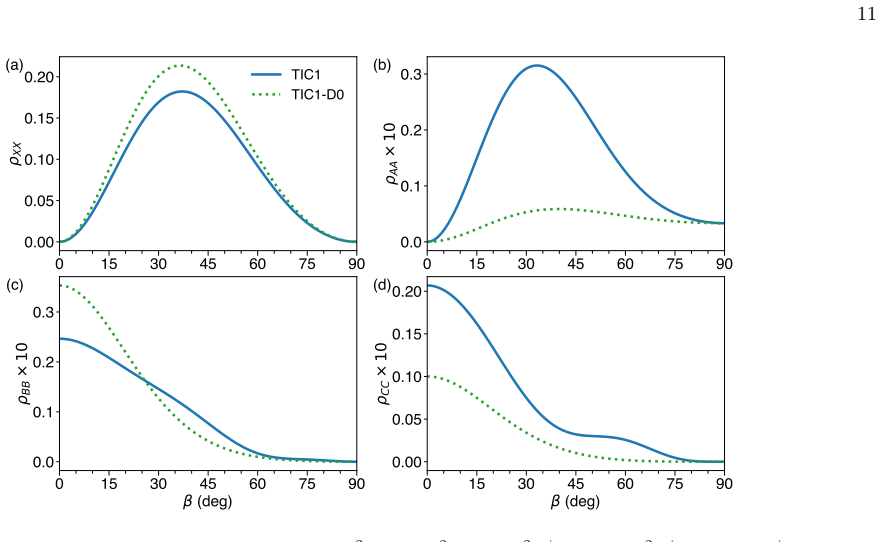
Excited state population Figure 6 compares alignment dependence on the final population ofX,A,B, andCstates of CO + 2 , calculated using the TIC1 and TIC1-D0 models with the nonadi- abatic rates. The population accounts for the two-fold degeneracy of the Π states. Each excited state popula- tion is about an order of magnitude smaller than that of theXstat...
-
[2]
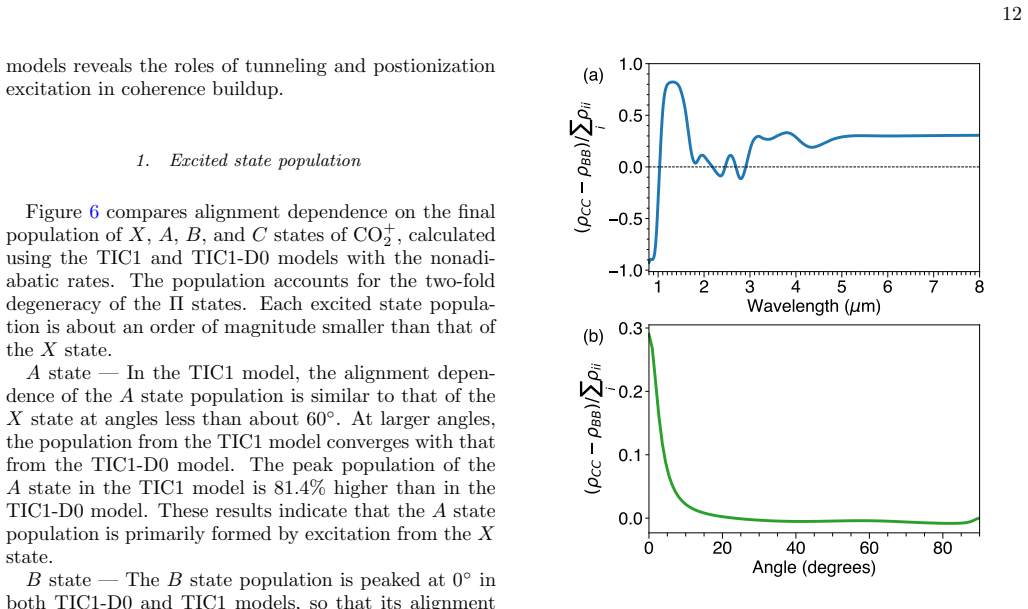
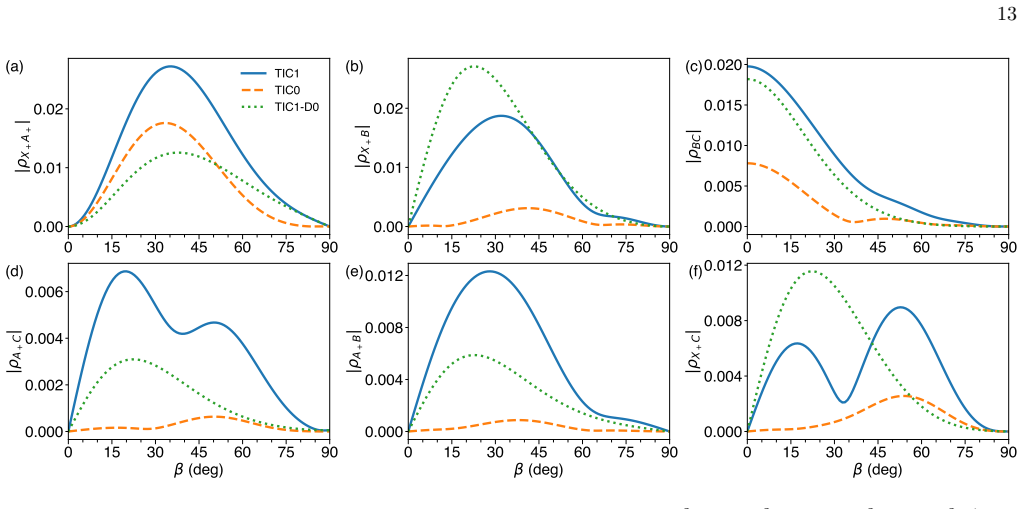
Ionic coherence To understand the buildup of ionic coherence among different states of CO + 2 , in Fig. 8, we compare the align- ment dependence of the magnitude of the ionic coherence using the TIC1-D0, TIC0, and TIC1 models. The coher- ence buildup mechanism is more complex than the popu- lation buildup because it involves two contributions: tun- nel io...
-
[3]
The simulation box is a sphere with radius 30a 0 and a spacing of 0.3a 0
N 2 The bond length of N2 is set to 1.10 ˚A. The simulation box is a sphere with radius 30a 0 and a spacing of 0.3a 0. The LDA norm-conserving pseudo-potential was used
-
[4]
The simulation box is a sphere with radius 20a 0 and a spacing of 0.3a 0
CO 2 The CO bond length is set to 1.16 ˚A. The simulation box is a sphere with radius 20a 0 and a spacing of 0.3a 0. The LDA norm-conserving pseudo-potential was used. The transition dipole moments between differ- ent CO + 2 states were calculated using the software OpenMolcas[102] using the state-averaged complete ac- tive space self-consistent field met...
-
[5]
L. V. Keldysh, Sov. Phys. JETP20, 1307 (1965)
work page 1965
- [6]
- [7]
-
[8]
B. K. McFarland, J. P. Farrell, P. H. Bucksbaum, and M. Guhr, Science322, 1232 (2008)
work page 2008
-
[9]
O. Smirnova, Y. Mairesse, S. Patchkovskii, N. Du- dovich, D. Villeneuve, P. Corkum, and M. Y. Ivanov, Nature460, 972 (2009)
work page 2009
- [10]
-
[11]
S. Haessler, J. Caillat, W. Boutu, C. Giovanetti- Teixeira, T. Ruchon, T. Auguste, Z. Diveki, P. Breger, A. Maquet, B. Carr´ e, R. Ta¨ ıeb, and P. Sali` eres, Nat. Phys.6, 200 (2010)
work page 2010
-
[12]
J. P. Farrell, S. Petretti, J. F¨ orster, B. K. McFarland, L. S. Spector, Y. V. Vanne, P. Decleva, P. H. Bucks- baum, A. Saenz, and M. G¨ uhr, Phys. Rev. Lett.107, 083001 (2011)
work page 2011
-
[13]
S. De, M. Magrakvelidze, I. A. Bocharova, D. Ray, W. Cao, I. Znakovskaya, H. Li, Z. Wang, G. Laurent, U. Thumm, M. F. Kling, I. V. Litvinyuk, I. Ben-Itzhak, and C. L. Cocke, Phys. Rev. A84, 043410 (2011)
work page 2011
-
[14]
A. E. Boguslavskiy, J. Mikosch, A. Gijsbertsen, M. Spanner, S. Patchkovskii, N. Gador, M. J. J. Vrakking, and A. Stolow, Science335, 1336 (2012)
work page 2012
-
[15]
J. Wu, L. P. H. Schmidt, M. Kunitski, M. Meckel, S. Voss, H. Sann, H. Kim, T. Jahnke, A. Czasch, and R. D¨ orner, Phys. Rev. Lett.108, 183001 (2012)
work page 2012
- [16]
-
[17]
P. M. Kraus, B. Mignolet, D. Baykusheva, A. Ru- penyan, L. Horn` y, E. F. Penka, G. Grassi, O. I. Tol- stikhin, J. Schneider, F. Jensen,et al., Science350, 790 (2015)
work page 2015
-
[18]
Y. Kobayashi, D. M. Neumark, and S. R. Leone, Phys. Rev. A102, 051102(R) (2020)
work page 2020
-
[19]
Y. Kobayashi, K. F. Chang, S. M. Poullain, V. Scutel- nic, T. Zeng, D. M. Neumark, and S. R. Leone, Phys. 18 Rev. A101, 063414 (2020)
work page 2020
-
[20]
H. Lei, J. Yao, J. Zhao, H. Xie, F. Zhang, H. Zhang, N. Zhang, G. Li, Q. Zhang, X. Wang, Y. Yang, L. Yuan, Y. Cheng, and Z. Zhao, Nat. Commun.13, 4080 (2022)
work page 2022
-
[21]
C. Kleine, M.-O. Winghart, Z.-Y. Zhang, M. Richter, M. Ekimova, S. Eckert, M. J. J. Vrakking, E. T. J. Nib- bering, A. Rouz´ ee, and E. R. Grant, Phys. Rev. Lett. 129, 123002 (2022)
work page 2022
-
[22]
L. He, S. Sun, P. Lan, Y. He, B. Wang, P. Wang, X. Zhu, L. Li, W. Cao, P. Lu, and C. D. Lin, Nat. commun.13, 1 (2022)
work page 2022
-
[23]
Z. Shu, H. Liang, Y. Wang, S. Hu, S. Chen, H. Xu, R. Ma, D. Ding, and J. Chen, Phys. Rev. Lett.128, 183202 (2022)
work page 2022
-
[24]
Y. Chen, H. Lei, Q. Wang, H. Xie, H. Zhang, X. Lu, N. Zhang, S. Huang, Y. Wu, J. Liu, Q. Zhang, Y. Liu, Z. Zhao, J. Zhao, and J. Yao, Phys. Rev. Lett.133, 113201 (2024)
work page 2024
-
[25]
J. Gao, H. Liang, M. Hasan, C.-H. Yuen, M.-S. Tsai, M.-C. Chen, C.-D. Lin, K. Ueda, H. J. W¨ orner, and M. Han, Nat. Commun.16, 9654 (2025)
work page 2025
-
[26]
J. Gao, H. Liang, M.-S. Tsai, M.-C. Chen, H. J. W¨ orner, and M. Han, Phys. Rev. Lett.135, 223802 (2025)
work page 2025
-
[27]
Y. Mairesse, J. Higuet, N. Dudovich, D. Shafir, B. Fabre, E. M´ evel, E. Constant, S. Patchkovskii, Z. Walters, M. Y. Ivanov, and O. Smirnova, Phys. Rev. Lett.104, 213601 (2010)
work page 2010
-
[28]
L. He, Y. He, S. Sun, E. Goetz, A.-T. Le, X. Zhu, P. Lan, P. Lu, and C.-D. Lin, Adv. Photon.5, 056001 (2023)
work page 2023
-
[29]
F. L´ epine, M. Y. Ivanov, and M. J. Vrakking, Nat. Pho- tonics8, 195 (2014)
work page 2014
-
[30]
I. C. D. Merritt, D. Jacquemin, and M. Vacher, J. Phys. Chem. Lett.12, 8404 (2021)
work page 2021
- [31]
-
[32]
J. Yao, B. Zeng, H. Xu, G. Li, W. Chu, J. Ni, H. Zhang, S. L. Chin, Y. Cheng, and Z. Xu, Phys. Rev. A84, 051802 (2011)
work page 2011
-
[33]
Y. Liu, Y. Brelet, G. Point, A. Houard, and A. Mysy- rowicz, Opt. Express21, 22791 (2013)
work page 2013
-
[34]
Y. Liu, P. Ding, G. Lambert, A. Houard, V. Tikhonchuk, and A. Mysyrowicz, Phys. Rev. Lett.115, 133203 (2015)
work page 2015
-
[35]
H. Xu, E. L¨ otstedt, A. Iwasaki, and K. Yamanouchi, Nat. Commun.6, 8347 (2015)
work page 2015
-
[36]
J. Yao, S. Jiang, W. Chu, B. Zeng, C. Wu, R. Lu, Z. Li, H. Xie, G. Li, C. Yu,et al., Phys. Rev. Lett.116, 143007 (2016)
work page 2016
-
[37]
X. Lu, S. He, P. Xue, Y. Chen, N. Zhang, Y. Wen, Z. Li, Q. Wang, and J. Yao, Sci. Adv.11, eady7458 (2025)
work page 2025
-
[38]
G. L. Yudin and M. Y. Ivanov, Phys. Rev. A64, 013409 (2001)
work page 2001
-
[39]
O. I. Tolstikhin, T. Morishita, and L. B. Madsen, Phys. Rev. A84, 053423 (2011)
work page 2011
-
[40]
X.-M. Tong, Z. X. Zhao, and C.-D. Lin, Phys. Rev. A 66, 033402 (2002)
work page 2002
- [41]
-
[42]
L. Xu, Q. Lu, V. T. Tikhonchuk, B. Zhou, R. Yang, Q. Liang, F. He, R. Danylo, A. Houard, A. Mysyrowicz, and Y. Liu, Opt. Express30, 38481 (2022)
work page 2022
- [43]
- [44]
-
[45]
E. Goulielmakis, Z.-H. Loh, A. Wirth, R. Santra, N. Rohringer, V. S. Yakovlev, S. Zherebtsov, T. Pfeifer, A. M. Azzeer, M. F. Kling, S. Leone, and F. Krausz, Nature466, 739 (2010)
work page 2010
-
[46]
M. V. Ammosov, N. B. Delone, and V. P. Krainov, Sov. Phys. JETP64, 1191 (1986)
work page 1986
-
[47]
A. N. Pfeiffer, S. G. Sayres, and S. R. Leone, Mol. Phys. 111, 2283 (2013)
work page 2013
-
[48]
Y. Kobayashi, M. Reduzzi, K. F. Chang, H. Timmers, D. M. Neumark, and S. R. Leone, Phys. Rev. Lett.120, 233201 (2018)
work page 2018
- [49]
-
[50]
C. H. Yuen and C. D. Lin, Phys. Rev. A106, 023120 (2022)
work page 2022
-
[51]
Y.-W. Jia, C. H. Yuen, W.-Q. Jing, Z.-Y. Zhou, C. D. Lin, and S.-F. Zhao, Phys. Rev. A110, 023112 (2024)
work page 2024
- [52]
-
[53]
C. H. Yuen, P. Modak, Y. Song, S.-F. Zhao, and C. D. Lin, Phys. Rev. A107, 013112 (2023)
work page 2023
-
[54]
S. Voss, A. S. Alnaser, X. M. Tong, C. Maharjan, P. Ranitovic, B. Ulrich, B. Shan, Z. Chang, C. D. Lin, and C. L. Cocke, J. Phys. B: At. Mol. Opt. Phys.37, 4239 (2004)
work page 2004
-
[55]
Z. Wu, C. Wu, X. Liu, Y. Deng, Q. Gong, D. Song, and H. Su, J Phys Chem A114, 6751 (2010)
work page 2010
-
[56]
Z. Wu, C. Wu, X. Liu, Y. Liu, Y. Deng, and Q. Gong, Opt. Express18, 10395 (2010)
work page 2010
-
[57]
C. H. Yuen and C. D. Lin, Phys. Rev. A109, L011101 (2024)
work page 2024
-
[58]
E. Weckwerth, A. J. Howard, C. Cheng, I. Gabalski, A. M. Ghrist, S. A. Mohideen, C.-D. Lin, C.-H. Yuen, and P. H. Bucksbaum, Phys. Rev. A112, 043113 (2025)
work page 2025
-
[59]
C. H. Yuen and C. D. Lin, Phys. Rev. A108, 023123 (2023)
work page 2023
-
[60]
C. H. Yuen and C. D. Lin, Phys. Rev. A109, 033108 (2024)
work page 2024
-
[61]
M. Y. Ivanov, M. Spanner, and O. Smirnova, J. of Mod. Opt.52, 165 (2005)
work page 2005
- [62]
-
[63]
L. Torlina, F. Morales, J. Kaushal, I. Ivanov, A. Kheifets, A. Zielinski, A. Scrinzi, H. G. Muller, S. Sukiasyan, M. Ivanov, and O. Smirnova, Nat. Phys. 11, 503 (2015)
work page 2015
-
[64]
M. Han, P. Ge, Y. Fang, X. Yu, Z. Guo, X. Ma, Y. Deng, Q. Gong, and Y. Liu, Phys. Rev. Lett.123, 073201 (2019)
work page 2019
-
[65]
U. S. Sainadh, H. Xu, X. Wang, A. Atia-Tul-Noor, W. C. Wallace, N. Douguet, A. Bray, I. Ivanov, K. Bartschat, A. Kheifets, R. T. Sang, and I. V. Litvinyuk, Nature568, 75 (2019)
work page 2019
- [66]
- [67]
- [68]
-
[69]
S. V. Popruzhenko, V. D. Mur, V. S. Popov, and 19 D. Bauer, Phys. Rev. Lett.101, 193003 (2008)
work page 2008
-
[70]
C. Z. Bisgaard and L. B. Madsen, Am. J. Phys.72, 249 (2004)
work page 2004
- [71]
-
[72]
S.-F. Zhao, A.-T. Le, C. Jin, X. Wang, and C. D. Lin, Phys. Rev. A93, 023413 (2016)
work page 2016
- [73]
- [74]
-
[75]
L. Torlina, M. Ivanov, Z. B. Walters, and O. Smirnova, Phys. Rev. A86, 043409 (2012)
work page 2012
-
[76]
O. I. Tolstikhin, L. B. Madsen, and T. Morishita, Phys. Rev. A89, 013421 (2014)
work page 2014
- [77]
- [78]
-
[79]
A. N. Pfeiffer, C. Cirelli, A. S. Landsman, M. Smolarski, D. Dimitrovski, L. B. Madsen, and U. Keller, Phys. Rev. Lett.109, 083002 (2012)
work page 2012
-
[80]
I. A. Ivanov, A. S. Kheifets, A. Schimmoller, A. S. Landsman, and K. T. Kim, Phys. Rev. Res.6, 023049 (2024)
work page 2024
discussion (0)
Sign in with ORCID, Apple, or X to comment. Anyone can read and Pith papers without signing in.