Covariant interpretation of proper infall times in Kerr spacetime
Pith reviewed 2026-05-16 12:43 UTC · model grok-4.3
The pith
Kerr black hole spin can lengthen or shorten proper infall times compared to Schwarzschild depending on orbit direction and energy.
A machine-rendered reading of the paper's core claim, the machinery that carries it, and where it could break.
Core claim
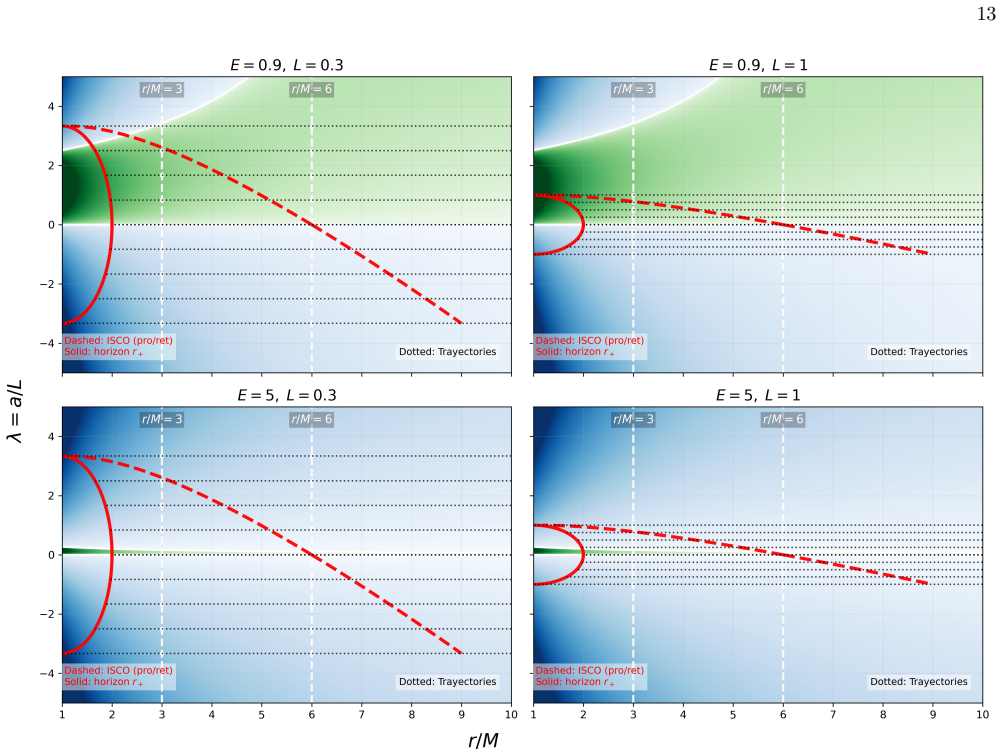
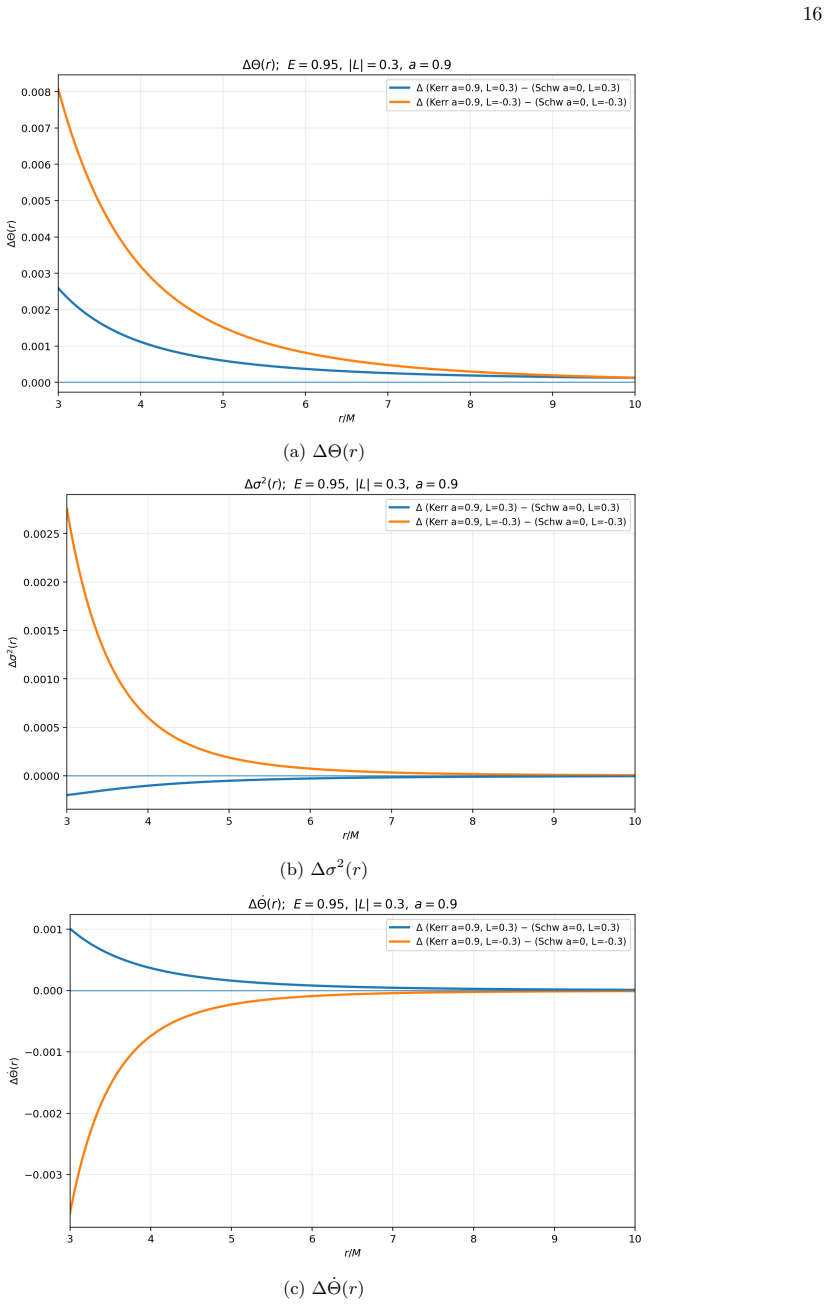
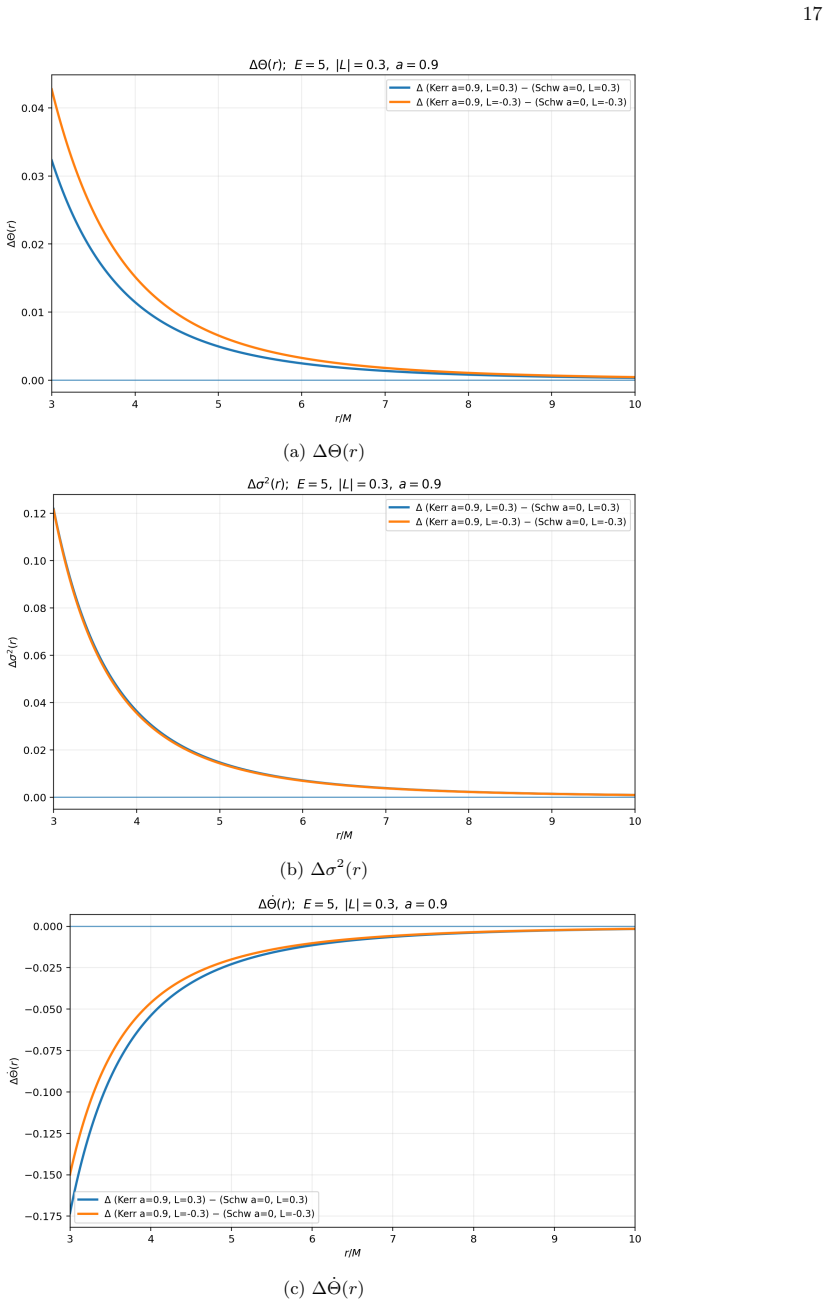
Within the equal circumferential-radius prescription for equatorial timelike geodesics, the Kerr angular momentum a produces longer or shorter integrated proper infall times relative to the Schwarzschild case, depending on the orbital configuration and energy regime. These differences are encoded in the corresponding Raychaudhuri time integrand, which reflects a competition between the radial evolution of the expansion and the nonlinear focusing contribution driven by expansion and shear; black-hole rotation modifies both effects systematically, leading to distinct behaviors for prograde and retrograde infall.
What carries the argument
Equal circumferential-radius prescription applied to equatorial timelike geodesics, with differences interpreted via the 1+3 covariant formalism through the Raychaudhuri equation governing expansion and shear of the geodesic congruence.
If this is right
- Kerr angular momentum systematically modifies the radial evolution of expansion in the Raychaudhuri integrand.
- The nonlinear focusing term driven by expansion and shear receives distinct corrections for prograde versus retrograde configurations.
- Integrated proper times therefore vary with spin parameter a in a manner that depends on both orbital direction and energy regime.
- The covariant 1+3 analysis isolates the competition between expansion evolution and shear-enhanced focusing as the source of the Kerr-Schwarzschild difference.
Where Pith is reading between the lines
- Frame-dragging induced by rotation changes the rate at which nearby geodesics converge or diverge in a direction-dependent way.
- The same mechanism may influence the duration of signals emitted by matter spiraling inward from the equatorial plane.
- Extensions beyond the equatorial plane could reveal whether polar components of spin alter the focusing balance further.
Load-bearing premise
The equal circumferential-radius prescription for comparing rotating and non-rotating black holes in the equatorial plane provides a geometrically consistent basis for the difference in proper times.
What would settle it
A numerical integration of proper time along an equatorial geodesic with fixed E and L from a chosen circumferential radius down to the horizon in Kerr spacetime that yields exactly the same value as the corresponding Schwarzschild integration at identical starting radius would falsify the claimed spin dependence.
Figures
read the original abstract
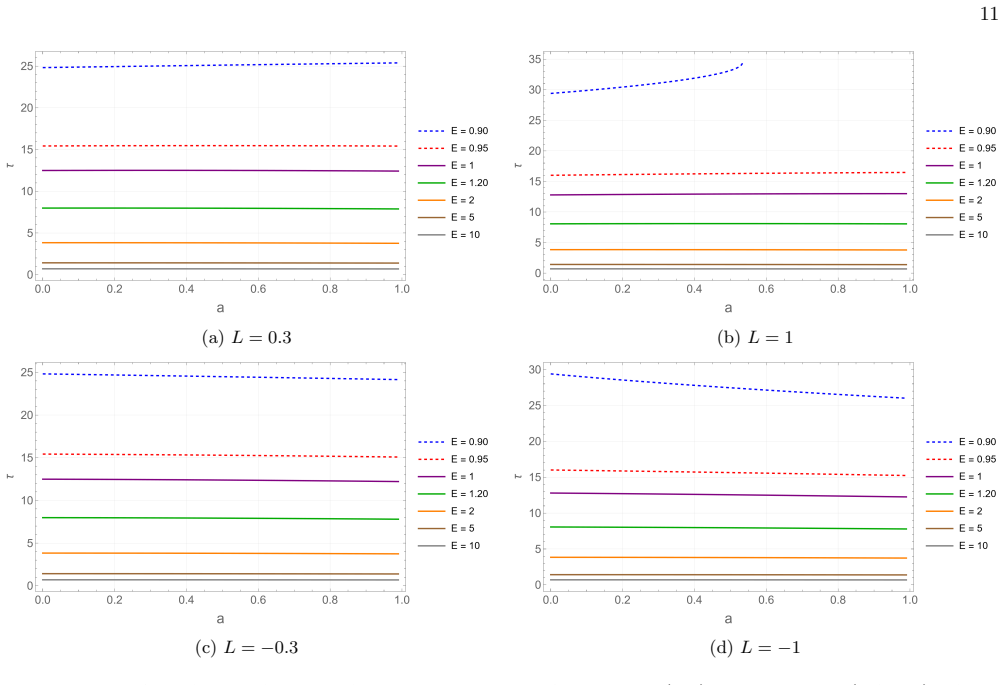
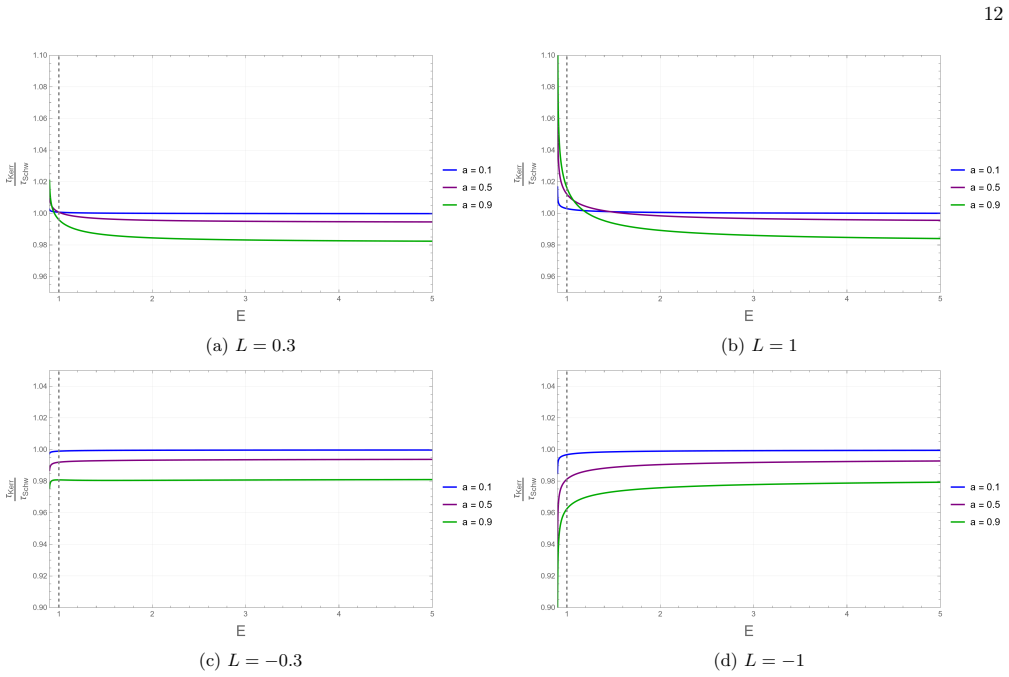
We investigate proper infall times in the Schwarzschild and Kerr spacetimes from a covariant perspective, focusing on the role of black--hole rotation in the focusing properties of timelike geodesic congruences.To perform a geometrically consistent comparison between rotating and non--rotating black holes, we analyse infall trajectories between surfaces of equal circumferential radius in the equatorial plane. Using equatorial timelike geodesics in the test--particle limit, we compute and compare the corresponding proper infall times for different values of the specific energy $E$, specific angular momentum $L$, and black--hole spin parameter $a$. Within the equal circumferential-radius prescription adopted here, we show that Kerr angular momentum $a$ can produce longer or shorter integrated proper infall times relative to the Schwarzschild case, depending on the orbital configuration and energy regime considered. We then interpret these results within the covariant $1+3$ formalism of general relativity, in terms of the expansion, shear, and Raychaudhuri evolution of timelike congruences. Our analysis shows that the Kerr--Schwarzschild differences in proper infall times are encoded in the corresponding Raychaudhuri time integrand, which reflects a competition between the radial evolution of the expansion and the nonlinear focusing contribution driven by expansion and shear. Black--hole rotation modifies both effects in a systematic way, leading to distinct behaviours for prograde and retrograde infall configurations.
Editorial analysis
A structured set of objections, weighed in public.
Referee Report
Summary. The paper investigates proper infall times along equatorial timelike geodesics in Kerr and Schwarzschild spacetimes from a covariant viewpoint. It adopts surfaces of equal circumferential radius (defined via √g_φφ at θ=π/2) for comparison, computes integrated proper times for varying specific energy E, angular momentum L, and spin a, and finds that a can yield either longer or shorter infall times than the Schwarzschild case depending on orbital configuration and energy regime. These differences are then interpreted in the 1+3 formalism as arising from the Raychaudhuri integrand, reflecting competition between the radial evolution of the expansion scalar and nonlinear focusing terms involving expansion and shear, with rotation modifying both contributions systematically for prograde and retrograde cases.
Significance. If the central comparison holds, the work provides a covariant link between proper-time differences and the focusing properties of geodesic congruences, showing how black-hole spin alters the Raychaudhuri evolution in a quantifiable way. This could inform studies of particle dynamics near rotating black holes and the geometric origin of spin-dependent infall effects. The analysis employs standard GR tools (geodesic equations and 1+3 decomposition) and explores parameter space, offering concrete numerical comparisons that could be tested against more invariant radial measures.
major comments (2)
- [§2] §2 (comparison prescription): The equal-circumferential-radius identification (√g_φφ = constant at θ=π/2) maps to different Boyer-Lindquist coordinate intervals for Kerr versus Schwarzschild because the Kerr circumferential radius includes explicit a-dependent terms (r² + a² + 2Ma²/r). This makes the starting and ending surfaces non-equivalent under a coordinate-independent geometric quantity such as proper radial distance from the horizon or the area radius of the 2-sphere. Consequently the reported sign changes in Δτ may partly reflect this mapping rather than a pure effect of the Raychaudhuri integrand; an explicit check against an invariant radial coordinate is needed to confirm the claim.
- [§4] §4 (Raychaudhuri interpretation): The statement that Kerr-Schwarzschild differences are 'encoded in the corresponding Raychaudhuri time integrand' requires an explicit decomposition showing how the integrand (involving θ, σ, and their radial derivatives) differs term-by-term with a. Without the full derivation or tabulated integrand values at fixed circumferential radius, it is unclear whether the competition between expansion evolution and nonlinear focusing is demonstrated independently of the coordinate choice.
minor comments (2)
- [Abstract] Abstract and §1: The phrase 'geometrically consistent comparison' should be qualified by noting that the prescription is coordinate-dependent; a brief justification or reference to prior literature on circumferential-radius comparisons would clarify the choice.
- [Figures] Figure captions (e.g., those showing Δτ vs. a): Labels should explicitly state the fixed circumferential radius value used for each curve and whether E and L are held constant in the Kerr or Schwarzschild frame.
Simulated Author's Rebuttal
We thank the referee for the detailed review and constructive comments. We address each major point below, clarifying our choice of comparison surfaces and strengthening the explicit link to the Raychaudhuri integrand.
read point-by-point responses
-
Referee: [§2] §2 (comparison prescription): The equal-circumferential-radius identification (√g_φφ = constant at θ=π/2) maps to different Boyer-Lindquist coordinate intervals for Kerr versus Schwarzschild because the Kerr circumferential radius includes explicit a-dependent terms (r² + a² + 2Ma²/r). This makes the starting and ending surfaces non-equivalent under a coordinate-independent geometric quantity such as proper radial distance from the horizon or the area radius of the 2-sphere. Consequently the reported sign changes in Δτ may partly reflect this mapping rather than a pure effect of the Raychaudhuri integrand; an explicit check against an invariant radial coordinate is needed to confirm the claim.
Authors: We agree that the equal-√g_φφ surfaces correspond to different Boyer-Lindquist r intervals because g_φφ carries explicit a dependence. Nevertheless, √g_φφ itself is the proper circumferential length of the equatorial circle and is therefore a coordinate-invariant geometric quantity. This prescription was chosen precisely to compare infall from surfaces of equal proper circumference, which provides a geometrically natural and covariant notion of “same radial location” for the purpose of contrasting rotating and non-rotating black holes. To address the referee’s concern directly, we will add in the revision an explicit comparison performed at fixed proper radial distance from the horizon (computed via the integral of the spatial metric along equatorial radial geodesics). This supplementary check will confirm that the qualitative sign changes in Δτ persist under the alternative invariant measure. revision: partial
-
Referee: [§4] §4 (Raychaudhuri interpretation): The statement that Kerr-Schwarzschild differences are 'encoded in the corresponding Raychaudhuri time integrand' requires an explicit decomposition showing how the integrand (involving θ, σ, and their radial derivatives) differs term-by-term with a. Without the full derivation or tabulated integrand values at fixed circumferential radius, it is unclear whether the competition between expansion evolution and nonlinear focusing is demonstrated independently of the coordinate choice.
Authors: The manuscript already derives the 1+3 Raychaudhuri equation for the timelike congruence and identifies the modifications to θ and σ induced by the Kerr metric. To make the term-by-term competition fully explicit, we will insert in the revised §4 a direct decomposition of the integrand evaluated at fixed circumferential radius. For representative values of a, E and L we will tabulate the separate contributions of dθ/dr, θ²/3 and σ_{ab}σ^{ab} and show how the spin parameter a systematically alters each piece for prograde versus retrograde orbits. This will demonstrate that the observed Δτ differences arise from the modified focusing dynamics independently of the particular radial coordinate label. revision: yes
Circularity Check
No significant circularity in the claimed derivation
full rationale
The paper computes proper infall times directly from the standard geodesic equations for equatorial timelike geodesics in the Kerr and Schwarzschild metrics, integrated between surfaces of equal circumferential radius as an explicit modeling choice. These results are then interpreted using the standard 1+3 covariant formalism and the Raychaudhuri equation applied to the computed expansion and shear. No parameters are fitted to subsets of data and then relabeled as predictions. No self-citations are invoked to establish uniqueness theorems or to smuggle in ansatze. The derivation chain is self-contained against the Einstein equations and does not reduce any central claim to its own inputs by construction.
Axiom & Free-Parameter Ledger
axioms (2)
- standard math Timelike geodesics in Kerr and Schwarzschild spacetimes obey the standard geodesic equation derived from the metric.
- standard math The 1+3 covariant decomposition yields the Raychaudhuri equation for the expansion and shear of timelike congruences.
Lean theorems connected to this paper
-
IndisputableMonolith/Cost/FunctionalEquation.leanwashburn_uniqueness_aczel unclear?
unclearRelation between the paper passage and the cited Recognition theorem.
We then interpret these results within the covariant 1+3 formalism... in terms of the expansion, shear, and Raychaudhuri evolution of timelike congruences.
-
IndisputableMonolith/Foundation/AlphaCoordinateFixation.leanJ_uniquely_calibrated_via_higher_derivative unclear?
unclearRelation between the paper passage and the cited Recognition theorem.
The radial equation... ˙r² = (E²−1) + 2M/r + a²(E²−1)−L²/r² + 2M(aE−L)²/r³
What do these tags mean?
- matches
- The paper's claim is directly supported by a theorem in the formal canon.
- supports
- The theorem supports part of the paper's argument, but the paper may add assumptions or extra steps.
- extends
- The paper goes beyond the formal theorem; the theorem is a base layer rather than the whole result.
- uses
- The paper appears to rely on the theorem as machinery.
- contradicts
- The paper's claim conflicts with a theorem or certificate in the canon.
- unclear
- Pith found a possible connection, but the passage is too broad, indirect, or ambiguous to say the theorem truly supports the claim.
Reference graph
Works this paper leans on
-
[1]
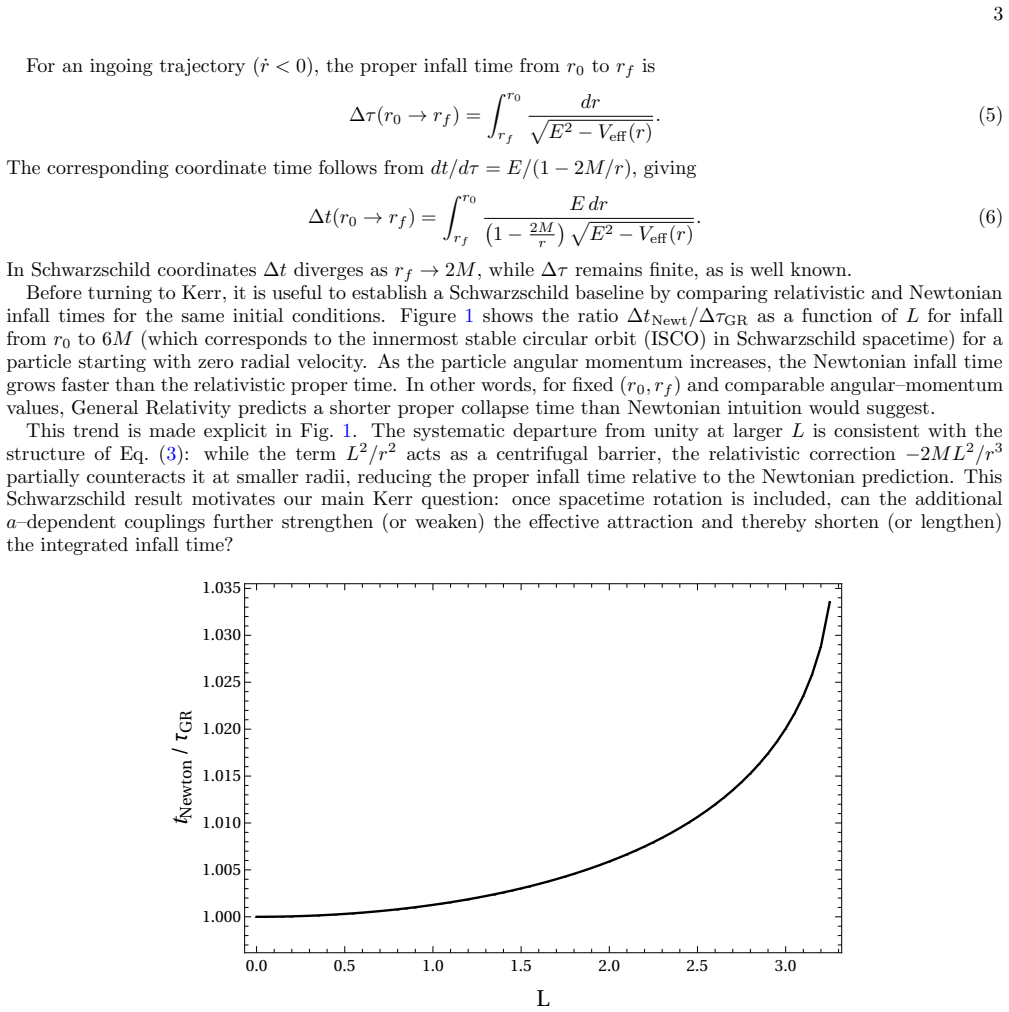
Schwarzschild black hole (a= 0) In the absence of rotation, the effective potential reduces to Veff(r;M, L, a= 0, E) =− M r + L2 2r2 − M L2 r3 .(16) In this case, the particle’s angular momentum does not only act as a centrifugal barrier (the termL 2/(2r2)), but also contributes to gravitational attraction through the term−M L 2/r3, which is reflected in ...
-
[2]
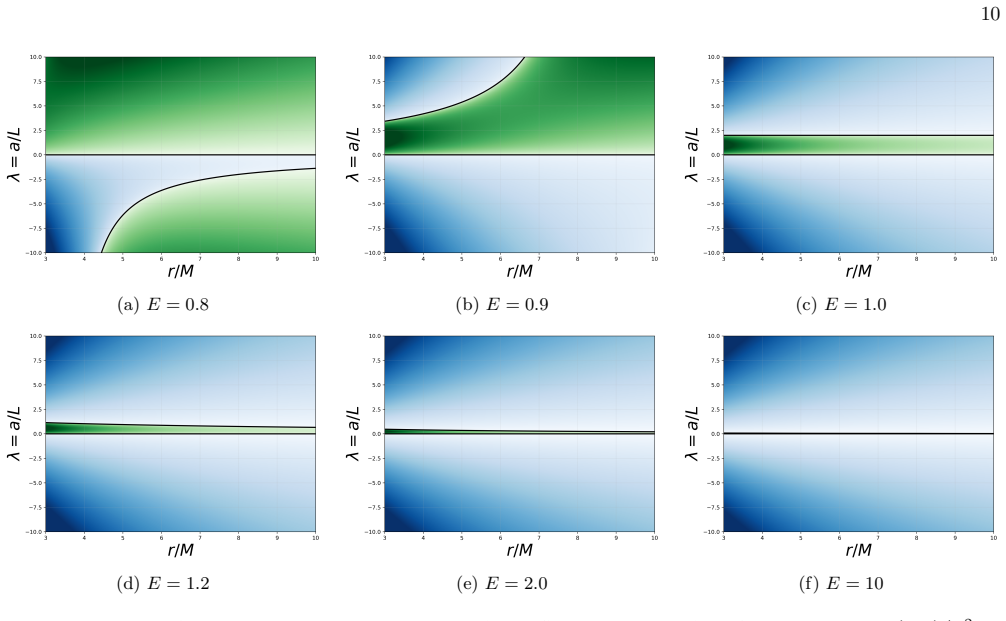
Particle with no intrinsic angular momentum (L= 0) A particle with vanishing intrinsic angular momentum moves under the effective potential Veff(r;M, L= 0, a, E) =− M r + a2(1−E 2) 2r2 − M a2E2 r3 .(18) In addition to the Newtonian term−M/r, two purely relativistic contributions appear. The term proportional to M a2E2/r3 is negative and therefore always i...
-
[3]
ForE > E a(r) the spin-induced relativistic contribution (V a) is net attractive
Critically bound motion (E= 1) For a particle with critically bound energy (E= 1), the effective potential reduces to Veff(r;M, L, a, E= 1) =− M r + L2 2r2 − M(L−a) 2 r3 .(23) 7 Table I: Values of the critical energyE a(r) = p r/(r+ 2M) for different radii (withM= 1). ForE > E a(r) the spin-induced relativistic contribution (V a) is net attractive. r/M E ...
-
[4]
P. J. E. Peebles,The large-scale structure of the universe(1980)
work page 1980
-
[5]
C. W. Misner, K. S. Thorne, and J. A. Wheeler,Gravitation(W. H. Freeman, 1973)
work page 1973
-
[6]
R. M. Wald,General Relativity(University of Chicago Press, 1984)
work page 1984
-
[7]
S. M. Carroll,Spacetime and Geometry: An Introduction to General Relativity(Cambridge University Press, 2019)
work page 2019
-
[8]
J. B. Hartle,Gravity : an introduction to Einstein’s general relativity(2003)
work page 2003
-
[9]
K. Filippou and C. G. Tsagas, Astrophysics and Space Science366, 10.1007/s10509-020-03912-4 (2021)
-
[10]
E. Tsaprazi and C. G. Tsagas, The European Physical Journal C80, 10.1140/epjc/s10052-020-8312-0 (2020)
-
[11]
K. Schwarzschild, Sitzungsberichte der K¨ oniglich Preussischen Akademie der Wissenschaften , 189 (1916)
work page 1916
-
[12]
R. P. Kerr, Phys. Rev. Lett.11, 237 (1963)
work page 1963
-
[13]
R. H. Boyer and R. W. Lindquist, Journal of Mathematical Physics8, 265 (1967)
work page 1967
- [14]
-
[15]
Chandrasekhar,The Mathematical Theory of Black Holes(Oxford University Press, 1983)
S. Chandrasekhar,The Mathematical Theory of Black Holes(Oxford University Press, 1983)
work page 1983
- [16]
-
[17]
Boylan-Kolchin, Stress testing ΛCDM with high-redshift galaxy candidates, Nature Astron
M. Boylan-Kolchin, Nature Astronomy7, 731 (2023), arXiv:2208.01611
-
[18]
C. A. Mason, M. Trenti, and T. Treu, Monthly Notices of the Royal Astronomical Society521, 497 (2023)
work page 2023
-
[19]
J. M. Bardeen, W. H. Press, and S. A. Teukolsky, The Astrophysical Journal178, 347 (1972)
work page 1972
- [20]
-
[21]
E. Poisson,A Relativist’s Toolkit: The Mathematics of Black-Hole Mechanics(Cambridge University Press, 2009)
work page 2009
-
[22]
A. K. Raychaudhuri, Phys. Rev.98, 1123 (1955)
work page 1955
-
[23]
G. F. R. Ellis, R. Maartens, and M. A. H. MacCallum,Relativistic Cosmology(Cambridge University Press, 2012)
work page 2012
-
[24]
N. I. Shakura and R. A. Sunyaev, Astronomy and Astrophysics24, 337 (1973)
work page 1973
-
[25]
I. D. Novikov and K. S. Thorne, inBlack Holes (Les Astres Occlus), edited by C. DeWitt and B. S. DeWitt (Gordon and Breach, 1973) pp. 343–450
work page 1973
- [26]
-
[27]
M. A. Abramowicz, X.-M. Chen, M. Granath, and J.-P. Lasota, The Astrophysical Journal471, 762 (1996)
work page 1996
-
[28]
M. C. Begelman, M. Volonteri, and M. J. Rees, Monthly Notices of the Royal Astronomical Society370, 289 (2006)
work page 2006
- [29]
-
[30]
M. A. Latif and A. Ferrara, Publications of the Astronomical Society of Australia33, e051 (2016)
work page 2016
-
[31]
Volonteri, Astronomy and Astrophysics Review18, 279 (2010)
M. Volonteri, Astronomy and Astrophysics Review18, 279 (2010)
work page 2010
- [32]
-
[33]
P. Amaro-Seoane, J. R. Gair, M. Freitag, and et al., Classical and Quantum Gravity24, R113 (2007). 21
work page 2007
-
[34]
S. Weinberg,Gravitation and Cosmology: Principles and Applications of the General Theory of Relativity(Wiley, 1972)
work page 1972
-
[35]
C. G. Tsagas, Physical Review D84, 10.1103/physrevd.84.063503 (2011)
discussion (0)
Sign in with ORCID, Apple, or X to comment. Anyone can read and Pith papers without signing in.