Uniqueness and stability in bottom detection through surface measurements of water waves
Pith reviewed 2026-05-16 11:50 UTC · model grok-4.3
The pith
The sea bottom shape inside a bounded domain is uniquely determined by free-surface elevation, its time derivative, and velocity potential at one fixed instant, plus boundary bottom data.
A machine-rendered reading of the paper's core claim, the machinery that carries it, and where it could break.
Core claim
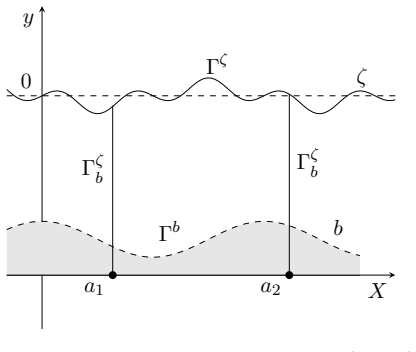
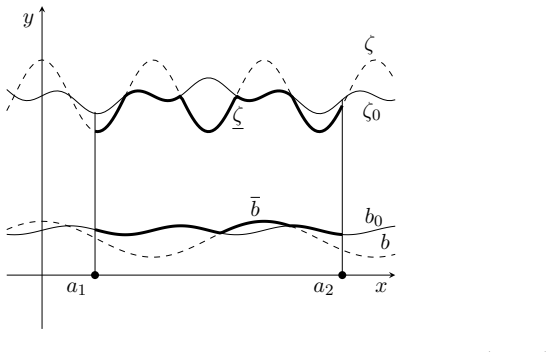
We establish uniqueness and derive logarithmic stability estimates in the determination of the bathymetry on any fixed smooth, bounded, open domain O subset R^d, d=1,2, from the knowledge of the free surface, its first time derivative, and the trace of the velocity potential on the free surface, at a given instant t0 within O, together with the knowledge of the bottom along partial O. No further assumptions are required for uniqueness. For stability, we impose only a local fatness condition on the region between the bottom profiles, allowing us to adapt the size estimates method.
What carries the argument
The general water-waves system restricted to the bounded subdomain O, combined with the size-estimates method under a local fatness condition on the region between candidate bottom profiles.
If this is right
- The bathymetry inside O is fixed uniquely by the given single-time surface data and boundary information.
- Logarithmic stability guarantees that small perturbations in the surface measurements produce only controlled errors in the recovered bottom shape.
- The uniqueness result applies directly in both one and two horizontal dimensions without additional restrictions.
- Only boundary values of the bottom are needed; interior surface data at one time complete the determination.
Where Pith is reading between the lines
- Numerical experiments could test the method by generating synthetic surface data from known bottoms and checking whether the inversion recovers the profile up to the predicted logarithmic rate.
- The single-time snapshot approach suggests sensor designs that capture a brief surface measurement rather than continuous monitoring.
- Similar uniqueness techniques might apply to other free-boundary inverse problems where only partial interior data are available.
- If the fatness condition can be verified or enforced in practice, the stability result would support reconstruction algorithms for real shallow-water bathymetry mapping.
Load-bearing premise
The local fatness condition on the region between possible bottom profiles must hold for the stability estimates, and the water-waves system must be valid on the bounded subdomain with interior measurements available.
What would settle it
Two distinct smooth bottom profiles inside O that agree on the boundary of O, satisfy the local fatness condition, and produce identical free-surface elevation, time derivative, and velocity-potential traces at the same instant t0 would falsify the stability claim.
Figures
read the original abstract
This paper investigates the geometric inverse problem of recovering the bottom shape from surface measurements of water waves. Using the general water-waves system on a bounded subdomain of the fluid domain, we address this inverse problem, focusing on the identifiability and the stability issues. We establish uniqueness and derive logarithmic stability estimates in the determination of the bathymetry on any fixed smooth, bounded, open domain ${\mathcal O}\subset {\mathbb R} ^d$, $d=1,2$, from the knowledge of the free surface, its first time derivative, and the trace of the velocity potential on the free surface, at a given instant $t_0$ within $\mathcal O $, together with the knowledge of the bottom along $\partial \mathcal O$. No further assumptions are required for uniqueness. For stability, we impose only a \textit{local fatness} condition on the region between the bottom profiles, allowing us to adapt the size estimates method.
Editorial analysis
A structured set of objections, weighed in public.
Referee Report
Summary. The paper claims to prove uniqueness (without further assumptions) and logarithmic stability estimates for recovering the bathymetry b on any fixed smooth bounded open domain O subset R^d (d=1,2) from surface data consisting of the free surface elevation η, its first time derivative, and the trace of the velocity potential φ at a single instant t0 inside O, together with knowledge of b on ∂O. The argument uses the general water-waves system restricted to a bounded fluid subdomain, unique continuation for the velocity potential (harmonic between the known surface and unknown bottom), and an adaptation of the size-estimates method under a local fatness condition on the region between two candidate bottoms.
Significance. If the central claims hold, the work supplies a mathematically rigorous uniqueness and stability result for an inverse problem in water-wave bathymetry detection that requires only single-time surface measurements plus boundary data on ∂O. The adaptation of the size-estimates technique to the water-waves setting under the stated geometric hypothesis is a clear technical contribution; the absence of machine-checked proofs or parameter-free derivations is noted but does not diminish the potential utility for related elliptic inverse problems.
major comments (2)
- [§3] §3 (uniqueness proof): the reduction to unique continuation for the velocity potential relies on deriving Neumann-type boundary conditions on the free surface from the given data (∂t η and φ); the manuscript should explicitly verify that these boundary conditions are compatible with the harmonic extension inside the fluid domain when the bottom is unknown, citing the precise trace theorem or regularity result used.
- [§4] §4 (stability estimates): the logarithmic modulus of continuity is obtained by adapting the size-estimates method under the local fatness condition; the paper must supply the explicit dependence of the stability constant on the fatness parameter and on the a-priori bounds for the bottoms, because the abstract states that only this geometric hypothesis is imposed.
minor comments (2)
- Notation for the fluid domain and the restriction to the subdomain O should be introduced uniformly in the introduction and used consistently in all statements of the main theorems.
- The abstract and introduction should clarify whether the water-waves system is assumed to hold exactly on the bounded subdomain or whether an approximation error is controlled.
Simulated Author's Rebuttal
We thank the referee for the positive evaluation and the precise comments, which will improve the clarity and rigor of the manuscript. We address each major comment below and will revise the paper accordingly.
read point-by-point responses
-
Referee: [§3] §3 (uniqueness proof): the reduction to unique continuation for the velocity potential relies on deriving Neumann-type boundary conditions on the free surface from the given data (∂t η and φ); the manuscript should explicitly verify that these boundary conditions are compatible with the harmonic extension inside the fluid domain when the bottom is unknown, citing the precise trace theorem or regularity result used.
Authors: We agree that an explicit verification strengthens the presentation. In the revised manuscript we will add a short paragraph in §3 deriving the Neumann boundary condition on the free surface directly from the kinematic condition (involving ∂t η) and the dynamic condition (involving φ), then invoke the standard trace theorem for the Sobolev space H^1(Ω) → H^{1/2}(Γ) (where Ω is the fluid domain and Γ the free surface) to confirm that the resulting boundary data are compatible with the harmonic extension, independently of the unknown bottom. We will cite Grisvard, Elliptic Problems in Nonsmooth Domains, Theorem 1.5.1.3, for the trace result. revision: yes
-
Referee: [§4] §4 (stability estimates): the logarithmic modulus of continuity is obtained by adapting the size-estimates method under the local fatness condition; the paper must supply the explicit dependence of the stability constant on the fatness parameter and on the a-priori bounds for the bottoms, because the abstract states that only this geometric hypothesis is imposed.
Authors: We thank the referee for this observation. While the dependence is already encoded in the quantitative unique-continuation constants of the size-estimates argument, we will make it fully explicit in the revised §4. In particular, we will add a remark after the main stability theorem stating that the constant C in the logarithmic estimate depends on the local fatness parameter δ, the a-priori C^{1,α} bound M on the candidate bottoms, the diameter of O, and the fixed time t0. This dependence follows directly from the constants appearing in the Carleman-type estimates used to control the size of the difference of two harmonic functions. revision: yes
Circularity Check
No significant circularity detected in derivation chain
full rationale
The paper establishes uniqueness via unique continuation for the harmonic velocity potential (satisfying Laplace equation in the fluid domain between known surface η(t0) and unknown bottom b, with Neumann condition on b and data-derived Dirichlet/Neumann conditions on the surface from ∂tη and φ) localized to O, together with known b on ∂O. Logarithmic stability is obtained by adapting the size-estimates method under the local fatness condition on the region between two bottoms; this is a standard geometric hypothesis from the inverse-problems literature and does not reduce to a self-definition, fitted parameter, or self-citation chain. No step equates a prediction to its input by construction, and the central claims rest on standard elliptic PDE theory rather than any load-bearing self-reference. The derivation is therefore self-contained.
Axiom & Free-Parameter Ledger
axioms (2)
- domain assumption The general water-waves system holds on a bounded subdomain of the fluid domain
- standard math The domain O is smooth and bounded and the bottom profiles satisfy sufficient regularity
Lean theorems connected to this paper
-
IndisputableMonolith/Foundation/AbsoluteFloorClosure.leanreality_from_one_distinction unclear?
unclearRelation between the paper passage and the cited Recognition theorem.
uniqueness follows from unique continuation for the velocity potential (harmonic in the fluid domain between known surface η(t0) and unknown bottom b, with Neumann condition on bottom)
-
IndisputableMonolith/Cost/FunctionalEquation.leanwashburn_uniqueness_aczel unclear?
unclearRelation between the paper passage and the cited Recognition theorem.
logarithmic stability estimates … adapt the size estimates method under the stated local fatness condition
What do these tags mean?
- matches
- The paper's claim is directly supported by a theorem in the formal canon.
- supports
- The theorem supports part of the paper's argument, but the paper may add assumptions or extra steps.
- extends
- The paper goes beyond the formal theorem; the theorem is a base layer rather than the whole result.
- uses
- The paper appears to rely on the theorem as machinery.
- contradicts
- The paper's claim conflicts with a theorem or certificate in the canon.
- unclear
- Pith found a possible connection, but the passage is too broad, indirect, or ambiguous to say the theorem truly supports the claim.
Reference graph
Works this paper leans on
-
[1]
R. J. Adrian and R. J. Westerweel.Particle Image Velocimetry. Cambridge University Press, Cambridge, UK, 2011. 23
work page 2011
-
[2]
T. Alazard, N. Burq, and C. Zuily.Cauchy theory for the gravity water waves system with non-localized initial data. Annales de l’Institut Henri Poincar´ e C, Analyse non lin´ eaire, 33(2):337–395, 2016
work page 2016
-
[3]
G. Alessandrini, E. Rosset, and J. K. Seo.Optimal size estimates for the inverse conductivity problem with one measurement. Proceedings of the American Mathematical Society, 128(1):53–64, 2000
work page 2000
-
[4]
G. Alessandrini, A. Morassi, and E. Rosset.Detecting cavities by electrostatic boundary measurements. Inverse Problems, 18(5):1333, 2002
work page 2002
-
[5]
G. Alessandrini, A. Morassi, and E. Rosset.Size estimates. In G. Alessandrini and G. Uhlmann, editors,In- verse Problems: Theory and Applications, volume 333 ofContemporary Mathematics, pages 1–33. American Mathematical Society, Providence, RI, 2003
work page 2003
- [6]
-
[7]
T. B. Benjamin and J. C. Scott.Gravity-capillary waves with edge constraints. Journal of Fluid Mechanics, 92(2):241–267, 1979
work page 1979
-
[8]
E. Beretta, C. Cavaterra, J. H. Ortega, and S. Zamorano.Size estimates of an obstacle in a stationary Stokes fluid. Inverse Problems, 33(2):025008, 2017
work page 2017
-
[9]
V. I. Bogachev.Measure Theory, volume 1. Springer, Berlin, 2007
work page 2007
-
[10]
E. Rosset and G. Alessandrini.The inverse conductivity problem with one measurement: bounds on the size of the unknown object. SIAM Journal on Applied Mathematics, 58(4):1060–1071, 1998
work page 1998
-
[11]
L. Bourgeois and J. Dard´ e.About stability and regularization of ill-posed elliptic Cauchy problems: the case of Lipschitz domains. Applicable Analysis, 89(11):1745–1768, 2010
work page 2010
-
[12]
M. Brocchini.A reasoned overview on Boussinesq-type models: the interplay between physics, mathematics and numerics. Proceedings of the Royal Society A: Mathematical, Physical and Engineering Sciences, 469(2160):20130496, 2013
work page 2013
-
[13]
Choulli.New global logarithmic stability results on the Cauchy problem for elliptic equations
M. Choulli.New global logarithmic stability results on the Cauchy problem for elliptic equations. Bulletin of the Australian Mathematical Society, 101(1):141–145, 2020
work page 2020
-
[14]
W. Craig and C. S. Sulem.Numerical simulation of gravity waves. Journal of Computational Physics, 108(1):73–83, 1993
work page 1993
-
[15]
J. A. Cunge, F. M. Holly, and A. Verwey.Practical Aspects of Computational River Hydraulics. Pitman Publishing, London, 1980
work page 1980
-
[16]
Ding.A proof of the trace theorem of Sobolev spaces on Lipschitz domains
Z. Ding.A proof of the trace theorem of Sobolev spaces on Lipschitz domains. Proceedings of the American Mathematical Society, 124(2):591–600, 1996
work page 1996
-
[17]
M. A. Fontelos, R. Lecaros, J. C. L´ opez-R´ ıos, and J. H. Ortega.Bottom detection through surface measure- ments on water waves. SIAM Journal on Control and Optimization, 55(6):3890–3907, 2017
work page 2017
-
[18]
A. F. Gessese, M. Sellier, E. Van Houten and G. Smart.Reconstruction of river bed topography from free surface data using a direct numerical approach in one-dimensional shallow water flow. Inverse Problems, 27(2):025001, 2011
work page 2011
-
[19]
S. T. Grilli, R. Subramanya, I. A. Svendsen, and J. Veeramony.Shoaling of solitary waves on plane beaches. Journal of Waterway, Port, Coastal, and Ocean Engineering, 120(6):609–628, 1994
work page 1994
-
[20]
Grisvard.Elliptic Problems in Nonsmooth Domains
P. Grisvard.Elliptic Problems in Nonsmooth Domains. Volume 69, Society for Industrial and Applied Mathematics, Philadelphia, PA, 2011
work page 2011
-
[21]
A. Henrot and M. Pierre.Variation et optimisation de formes: une analyse g´ eom´ etrique. Volume 48, Springer, New York, 2005
work page 2005
-
[22]
R. C. Hilldale and D. Raff.Assessing the ability of airborne LiDAR to map river bathymetry. Earth Surface Processes and Landforms, 33(5):773–783, 2008. 24
work page 2008
-
[23]
J. L. Irish and W. J. Lillycrop.Scanning laser mapping of the coastal zone: the SHOALS system. ISPRS Journal of Photogrammetry and Remote Sensing, 54(2-3):123–129, 1999
work page 1999
-
[24]
H. Kang, J. K. Seo, and D. Sheen.The inverse conductivity problem with one measurement: stability and estimation of size. SIAM Journal on Mathematical Analysis, 28(6):1389–1405, 1997
work page 1997
-
[25]
C. E. Kenig.Harmonic Analysis Techniques for Second Order Elliptic Boundary Value Problems, volume 83 American Mathematical Society, Providence, RI, 1994
work page 1994
-
[26]
N. Lamsahel, C. Manni, A. Ratnani, S. Serra-Capizzano, and H. Speleers,Outlier-free isogeometric dis- cretizations for Laplace eigenvalue problems: closed-form eigenvalue and eigenvector expressions. Nu- merische Mathematik, 157(4): 1397–1448, 2025
work page 2025
-
[27]
N. Lamsahel, C. Rosier.A Direct Approach for Detection of Bottom Topography in Shallow Water. arXiv:2510.03505, 2025
-
[28]
Lannes.The water-waves problem: mathematical analysis and asymptotics, volume 188
D. Lannes.The water-waves problem: mathematical analysis and asymptotics, volume 188. American Mathematical Society, Providence RI, 2013
work page 2013
-
[29]
V. Lecours, M. F. J. Dolan, A. Micallef, and V. L. Lucieer.A review of marine geomorphometry: the quantitative study of the seafloor. Hydrology and Earth System Sciences, 20(8):3207–3244, 2016
work page 2016
-
[30]
R. Lecaros, J. L´ opez-R´ ıos, J. H. Ortega, and S. Zamorano.The stability for an inverse problem of bottom recovering in water-waves. Inverse Problems, 36(11):115002, 2020
work page 2020
-
[31]
K. Marks and P. Bates.Integration of high-resolution topographic data with floodplain flow models. Hydro- logical Processes, 14(11-12):2109–2122, 2000
work page 2000
-
[32]
M. Montardini, S. Takacs, M.Tani.The Isogeometric Fast Fourier-based Diagonalization method. arXiv:2512.20269 , 2025
-
[33]
A. Morassi, E. Rosset, and S. Vessella.Size estimates for inclusions in an elastic plate by boundary mea- surements. Indiana University Mathematics Journal, 56(5):2325–2384, 2007
work page 2007
-
[34]
Neˇ cas.Direct Methods in the Theory of Elliptic Equations
J. Neˇ cas.Direct Methods in the Theory of Elliptic Equations. Springer, Berlin, 2011
work page 2011
-
[35]
D. P. Nicholls and M. Taber.Joint analyticity and analytic continuation of Dirichlet–Neumann operators on doubly perturbed domains. Journal of Mathematical Fluid Mechanics, 10(2):238–271, 2008
work page 2008
-
[36]
D. P. Nicholls and M. Taber.Detection of ocean bathymetry from surface wave measurements. European Journal of Mechanics – B/Fluids, 28(2):224–233, 2009
work page 2009
- [37]
-
[38]
Sellier.Inverse problems in free surface flows: a review
M. Sellier.Inverse problems in free surface flows: a review. Acta Mechanica, 227(3):913–935, 2016
work page 2016
-
[39]
G. M. Smart, J. Bind, and M. J. Duncan.River bathymetry from conventional LiDAR using water surface returns. InProceedings of the 18th World IMACS / MODSIM Congress, 2009
work page 2009
-
[40]
W. H. F. Smith and D. T. Sandwell.Conventional bathymetry, bathymetry from space, and geodetic altimetry. Oceanography, 17(1):8–23, 2004
work page 2004
-
[41]
C. E. Synolakis.The run-up of solitary waves. Journal of Fluid Mechanics, 185:523–545, 1987
work page 1987
-
[42]
C. E. Synolakis.Green’s law and the evolution of solitary waves. Physics of Fluids A: Fluid Dynamics, 3(3):490–491, 1991
work page 1991
-
[43]
V. Vasan and B. Deconinck.The inverse water wave problem of bathymetry detection. Journal of Fluid Mechanics, 714:562–590, 2013
work page 2013
-
[44]
V. E. Zakharov.Stability of periodic waves of finite amplitude on the surface of a deep fluid. Journal of Applied Mechanics and Technical Physics, 9(2):190–194, 1968. 25
work page 1968
discussion (0)
Sign in with ORCID, Apple, or X to comment. Anyone can read and Pith papers without signing in.