REVIEW 2 major objections 4 minor 69 references
A general periodic flux drive can jointly optimize a fluxonium qubit's relaxation and dephasing lifetimes, pushing dephasing past 7 ms while establishing a fundamental ceiling on relaxation.
Reviewed by Pith at T0; open to challenge. T0 means a machine referee read the full paper against a public rubric. the ladder, T0–T4 →
Optimized arbitrary periodic flux waveforms yield Pareto-optimal T1/Tphi trade-offs and an upper bound on T1 for superconducting fluxonium qubits.
T0 review reviewed 2026-08-03 challenge →
load-bearing objection Useful and novel Pareto-front engineering framework for fluxonium DSSs, but the advertised fundamental bound (Theorem 1, T_UB^(2)) is not proven as stated—a repair or downgrade is needed. the 2 major comments →
Pareto Front Engineering of Dynamical Sweet Spots in Superconducting Qubits
The pith
A machine-rendered reading of the paper's core claim, the machinery that carries it, and where it could break.
The reading
Core claim
Under the most general periodic flux drive, formulated as an arbitrary Fourier series in the external flux, the paper shows that a multi-objective search over drive waveforms maps out a Pareto front between the relaxation rate γ1 and the pure-dephasing rate γz. Points on this front are dynamical sweet spots, where first-order sensitivity to low-frequency flux noise vanishes; a segment is a double-DSS, also insensitive to AC flux amplitude. The headline numerical claim is a dephasing lifetime of 7398 µs at a point where T1 remains 553 µs, and the structural claim is Theorem 1: T1 ≤ T_UB^(1) for every periodic drive, with the stronger closed-form T1 ≤ T_UB^(2) at a DSS (Eqs. (18)–(19)). The th
What carries the argument
The engine is the Floquet decomposition of the qubit's noise sensitivity. The coupling σz(t) is expanded in harmonics with weights g_z^(k) and g_±^(k), so that the dephasing and relaxation rates become weighted sums of the noise spectral density at the Bohr frequencies kωd and kωd ∓ Ω. The waveform enters through the Fourier coefficients p_n of the periodic flux drive, turning coherence engineering into a population-based multi-objective optimization problem with a normalization constraint on the g-weights. That constraint is what creates the trade-off and what ultimately feeds the upper-bound theorem.
Load-bearing premise
All quantitative claims rest on the assumed 1/f flux-noise plus dielectric-loss spectrum of Eq. (12) inside a second-order time-convolutionless Floquet master equation; if that model misses real device behavior the coherence gains and the T1 bound do not transfer, and the proof of Theorem 1 currently relies on an inequality in the supplement whose constant appears incorrect.
What would settle it
Calibrate Af and Ad on a fluxonium device, hold it at one of the reported Pareto points, and measure T1 and Tφ: if T1 exceeds the universal T_UB^(1) of Eq. (18), or if Tφ does not reach the predicted 3–5x improvement, the central claims fail. Independently, checking the inequality in Supplemental Eq. (S2) numerically for the relevant frequency range would settle whether the proof of Theorem 1 is valid as written.
If this is right
- Any periodic flux waveform, not just single- or two-tone drives, is subject to a fundamental ceiling on energy relaxation; the DSS version of Theorem 1 gives a closed-form benchmark for device design.
- The optimized waveforms deliver Tφ three to five times longer than previous dynamical-sweet-spot strategies while T1 stays in the hundreds of microseconds, so the gains do not come at the cost of relaxation.
- The double-DSS bands are first-order insensitive to both DC and AC flux, giving experimenters operating regions that should be stable against slow drifts in either bias.
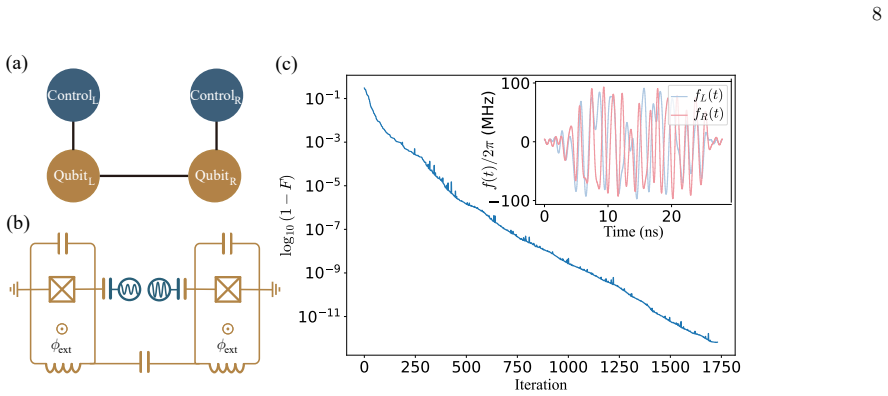
- Fast control is compatible with the long coherence times: an X gate in 10 ns and a √iSWAP gate in 28 ns reach simulated open-system fidelities of 99.9993% and 99.995% at the optimized points.
Where Pith is reading between the lines
- If the universal bound survives scrutiny, further T1 improvement at a dynamical sweet spot must come from reducing noise amplitudes Af and Ad or changing materials, not from smarter waveforms — a testable consequence of the theorem.
- The double-DSS criterion Σk p_k g_z^(k) ≈ 0 offers a cheap experimental check: measure how the transition frequency shifts with AC drive amplitude in any single- or two-tone device, without running the full Pareto optimization.
- The n=5 Fourier-truncation results in the supplement show lower Tφ than n=4, which the authors attribute to incomplete convergence; running the same search with more generations would reveal whether the true Pareto front extends beyond 7398 µs or whether the headline value is a truncation artifact.
- The closed-form DSS bound T_UB^(2) could be inverted before optimization to choose drive frequencies that permit the largest possible T1, a design step the paper does not explicitly exploit.
Editorial analysis
A structured set of objections, weighed in public.
Referee Report
Summary. The paper develops a multi-objective optimization framework for fluxonium qubits under general periodic flux modulation, treating the Fourier coefficients of the drive as tunable parameters and optimizing the energy relaxation rate γ1 and pure dephasing rate γz with evolutionary algorithms. It reports a Pareto front with Tφ up to 7398 μs while maintaining T1 above 500 μs, identifies single- and double-DSS operating regions, and demonstrates high-fidelity X and √iSWAP gates under open-system dynamics. The paper also states Theorem 1, claiming a universal upper bound on T1 for arbitrary periodic drives and a closed-form, modulation-independent DSS upper bound. The proof is relegated to the Supplemental Material.
Significance. If the result holds, the Pareto-front method would be a practical design tool for coherence optimization, and Theorem 1 would establish a fundamental limit on T1 under periodic flux modulation. The manuscript contains substantial numerical work: explicit device and noise parameters, convergence checks for Floquet truncation (Fig. S3), aggregation of several multi-objective algorithms, and comparison rows reproducing earlier DSS results. The main advertised fundamental-limit claim, however, rests on a proof gap in the Supplement that must be repaired before the theorem can be accepted.
major comments (2)
- [Supplemental §IX, Eq. (S16)–(S17); main Eq. (19)] The transition from Eq. (S16) to Eq. (S17) replaces |1−Σ| in the denominator of Eq. (S7) by |1−U| with U=π²Δ²/(3ω_d²). This is valid only if U≤1. The proof establishes only Σ≤U; if U>1, the required inequality |1−Σ|≥|1−U| is false, e.g. for U=3.29 and Σ=0.5 one has 0.5<2.29. The allowed drive range ω_d∈[0.5Ω_ge,1.5Ω_ge] in §III.A does not exclude U>1 (for ω_d=Ω_ge/2 and Δ≈Ω_ge, U≈13.2). Consequently Theorem 1's closed-form DSS bound T_UB^(2) is not rigorously established. The theorem needs an explicit condition such as 3ω_d²≥π²Δ², or a different argument that also works when U>1; otherwise the claim of a modulation-independent fundamental limit should be qualified accordingly.
- [Main Eq. (18) and §III.B] The universal bound T_UB^(1) has denominator Σ_k|g_+^k|², so it does not by itself exclude arbitrarily long T1: if the filter weights vanish, the bound diverges. The text in §III.B says that a lower bound on S̃(ω) 'imposes an upper bound on T1', but a useful upper bound also requires a lower bound on the filter weights. For DSSs this is exactly what the argument leading to Eq. (S17) is supposed to supply, so the gap described above affects the advertised conclusion that the relaxation rate cannot be reduced arbitrarily close to zero. Please clarify the logical role of the DSS condition and state explicitly what additional assumption is needed.
minor comments (4)
- [Supplemental Eq. (S2)] AM–GM applied to the two terms of S̃(ω) gives 2/√π A_f(A_d|ω|)^{1/2}, not 2√π A_f(A_d|ω|)^{1/2}. The final T_UB^(1) in Eq. (S6)/(18) is unchanged after carrying the corrected constant, but the displayed inequality is false as written.
- [Supplemental Eq. (S20); main Eq. (20)] Using the definition g_z^k = (1/(2T))∫ Tr[σ_z τ_z(t)] e^{ikω_d t}dt in Eq. (10), the first-order perturbation result is δΩ/δA = 2Σ_k p_k g_z^k, not Σ_k p_k g_z^k. The factor 2 does not change the threshold-based double-DSS criterion, but the displayed formula should be corrected for consistency.
- [§III.A and Fig. S2] The PF is obtained from heuristic evolutionary algorithms with a fixed 2000-iteration stopping rule, and Fig. S2 shows that the n=5 PF is less complete than n=4. The wording 'maximal values' and 'optimal working points' should be softened to 'approximate Pareto front' unless a convergence certificate or a more systematic multi-start study is provided.
- [References] References [67] and [68] duplicate Refs. [60] and [62]. Please consolidate to avoid duplicate entries.
Circularity Check
No significant circularity: coherence times are optimization outputs, not fitted inputs; the Theorem 1 proof gap is a correctness issue, not a circular reduction.
full rationale
The paper's central derivation is self-contained within a stated Floquet-plus-noise model. The optimized Fourier coefficients p_n are free parameters; the reported T1 and Tphi values are computed from the decoherence rates (Eqs. (13)-(14)) evaluated at those optimized parameters, so the coherence times are outputs of the optimization, not fitted inputs or hidden calibration constants. The normalization condition in Eq. (17) is a mathematical identity used in the proof, not an imported target. The upper bound T_UB^(1) follows from a lower bound on the noise spectral density and is not constructed from the numerical coherence times; the closed-form T_UB^(2) is intended as an analytic consequence of that bound plus a bound on the Floquet filter weights. The skeptic-identified flaw in the proof of Theorem 1 (Supplemental Eqs. (S16) to (S17) replacing |1-Sigma| by |1-U| requires U <= 1, a condition not stated in the theorem) is an error in an inequality, which is a correctness risk rather than a circularity: the conclusion is not an input to its own derivation. No load-bearing self-citation or imported uniqueness theorem is present. The references to earlier DSS work ([40,43]) are external, independently published baselines, and the only co-author self-citation ([69]) is not load-bearing in the derivation. Reusing the same noise model both to define the optimization objectives and to report final coherence times is ordinary design optimization under an explicit model, not a 'prediction' obtained from a fitted subset of the same data. Therefore no circular step is exhibited.
Axiom & Free-Parameter Ledger
free parameters (4)
- Fourier coefficients p_0..p_4 of periodic flux waveform =
DSS-1/DSS-2/DSS-3 sets in Supplement Table I
- Drive frequency ω_d =
0.99–1.13 Ω_ge for the three working points
- Fourier truncation order n =
n=4
- DSS and double-DSS numerical thresholds =
|g_z^0|<10^-4; |Σ p_k g_z^k|<0.1
axioms (4)
- domain assumption Second-order time-convolutionless (TCL) Floquet master equation and secular rate expressions (Eq. (8)–(13))
- domain assumption Two-level qubit-subspace truncation of fluxonium to {|g>,|e>} (Eq. (3))
- domain assumption 1/f flux noise plus dielectric-loss spectral density with 1 Hz and 3 GHz cutoffs (Eq. (12))
- domain assumption First-order perturbation equivalence ∂Ω/∂φ_dc ∝ |g_z^0| as established in Ref. [40]
Cite this review
Pith. "Pith review of Pareto Front Engineering of Dynamical Sweet Spots in Superconducting Qubits." pith.science (2026). https://pith.science/paper/ZH6NXQYQ
@misc{pith2026260119209,
  author       = {Pith},
  title        = {Pith review of: Pareto Front Engineering of Dynamical Sweet Spots in Superconducting Qubits},
  year         = {2026},
  howpublished = {\url{https://pith.science/paper/ZH6NXQYQ}},
  note         = {Machine review of arXiv:2601.19209}
}
read the original abstract
Operating superconducting qubits at dynamical sweet spots (DSSs) suppresses decoherence from low-frequency flux noise. A key open question is how long coherence can be extended under this strategy and what fundamental limits constrain it. Here we introduce a fully parameterized, multi-objective periodic-flux modulation framework that simultaneously optimizes energy relaxation $T_1$ and pure dephasing $T_\phi$, thereby quantifying the tradeoff between them. For fluxonium qubits with realistic noise spectra, our method enhances $T_\phi$ by a factor of 3-5 compared with existing DSS strategies while maintaining $T_1$ in the hundred-microsecond range. We further prove that, although DSSs eliminate first-order sensitivity to low-frequency noise, relaxation rate cannot be reduced arbitrarily close to zero, establishing an upper bound on achievable $T_1$. At the optimized working points, we identify double-DSS regions that are insensitive to both DC and AC flux, providing robust operating bands for experiments. As applications, we design single- and two-qubit control protocols at these operating points and numerically demonstrate high-fidelity gate operations. These results establish a general and useful framework for Pareto-front engineering of DSSs that substantially improves coherence and gate performance in superconducting qubits.
Figures


Reference graph
Works this paper leans on
-
[1]
Nakamura, Y
Y. Nakamura, Y. A. Pashkin, and J. Tsai, nature398, 786 (1999)
1999
-
[2]
J. E. Mooij, T. P. Orlando, L. Levitov, L. Tian, C. H. van der Wal, and S. Lloyd, Science285, 1036 (1999)
1999
-
[3]
Wallraff, D
A. Wallraff, D. I. Schuster, A. Blais, L. Frunzio, R.-S. Huang, J. Majer, S. Kumar, S. M. Girvin, and R. J. Schoelkopf, Nature431, 162 (2004)
2004
-
[4]
Blais, R.-S
A. Blais, R.-S. Huang, A. Wallraff, S. M. Girvin, and R. J. Schoelkopf, Phys. Rev. A69, 062320 (2004)
2004
-
[5]
Schuster, A
D. Schuster, A. A. Houck, J. Schreier, A. Wallraff, J. Gambetta, A. Blais, L. Frunzio, J. Majer, B. John- son, M. Devoret,et al., Nature445, 515 (2007)
2007
-
[7]
A. A. Houck, H. E. T¨ ureci, and J. Koch, Nature Physics 8, 292 (2012)
2012
-
[8]
Riste, M
D. Riste, M. Dukalski, C. Watson, G. De Lange, M. Tiggelman, Y. M. Blanter, K. W. Lehnert, R. Schouten, and L. DiCarlo, Nature502, 350 (2013)
2013
-
[9]
Gong, M.-C
M. Gong, M.-C. Chen, Y. Zheng, S. Wang, C. Zha, H. Deng, Z. Yan, H. Rong, Y. Wu, S. Li, F. Chen, Y. Zhao, F. Liang, J. Lin, Y. Xu, C. Guo, L. Sun, J. Clark, H. Wang, C. Peng, C.-Y. Lu, X. Zhu, and J.-W. Pan, Phys. Rev. Lett.122, 110501 (2019)
2019
-
[10]
Arute, K
F. Arute, K. Arya, R. Babbush, D. Bacon, J. C. Bardin, R. Barends, R. Biswas, S. Boixo, F. G. Brandao, D. A. Buell,et al., Nature574, 505 (2019)
2019
-
[11]
Blais, A
A. Blais, A. L. Grimsmo, S. M. Girvin, and A. Wallraff, Rev. Mod. Phys.93, 025005 (2021)
2021
-
[12]
Wu, W.-S
Y. Wu, W.-S. Bao, S. Cao, F. Chen, M.-C. Chen, X. Chen, T.-H. Chung, H. Deng, Y. Du, D. Fan, M. Gong, C. Guo, C. Guo, S. Guo, L. Han, L. Hong, H.-L. Huang, Y.-H. Huo, L. Li, N. Li, S. Li, Y. Li, F. Liang, C. Lin, J. Lin, H. Qian, D. Qiao, H. Rong, H. Su, L. Sun, L. Wang, S. Wang, D. Wu, Y. Xu, K. Yan, W. Yang, Y. Yang, Y. Ye, J. Yin, C. Ying, J. Yu, C. Zh...
2021
-
[13]
Z. Ni, S. Li, X. Deng, Y. Cai, L. Zhang, W. Wang, Z.- B. Yang, H. Yu, F. Yan, S. Liu,et al., Nature616, 56 (2023)
2023
-
[14]
Y. Kim, A. Eddins, S. Anand, K. X. Wei, E. Van Den Berg, S. Rosenblatt, H. Nayfeh, Y. Wu, M. Zale- tel, K. Temme,et al., Nature618, 500 (2023)
2023
-
[15]
Bravyi, A
S. Bravyi, A. W. Cross, J. M. Gambetta, D. Maslov, P. Rall, and T. J. Yoder, Nature627, 778 (2024)
2024
-
[16]
Nature638, 920 (2025)
2025
-
[17]
Putterman, K
H. Putterman, K. Noh, C. T. Hann, G. S. MacCabe, S. Aghaeimeibodi, R. N. Patel, M. Lee, W. M. Jones, H. Moradinejad, R. Rodriguez,et al., Nature638, 927 (2025)
2025
-
[18]
V. E. Manucharyan, J. Koch, L. I. Glazman, and M. H. Devoret, Science326, 113 (2009). 10
2009
-
[20]
L. B. Nguyen, G. Koolstra, Y. Kim, A. Morvan, T. Chis- tolini, S. Singh, K. N. Nesterov, C. J¨ unger, L. Chen, Z. Pedramrazi, B. K. Mitchell, J. M. Kreikebaum, S. Puri, D. I. Santiago, and I. Siddiqi, PRX Quantum 3, 037001 (2022)
2022
-
[21]
B. M. Terhal, Rev. Mod. Phys.87, 307 (2015)
2015
-
[22]
A. G. Fowler, M. Mariantoni, J. M. Martinis, and A. N. Cleland, Phys. Rev. A86, 032324 (2012)
2012
-
[23]
Preskill, Quantum2, 79 (2018)
J. Preskill, Quantum2, 79 (2018)
2018
-
[24]
Temme, S
K. Temme, S. Bravyi, and J. M. Gambetta, Phys. Rev. Lett.119, 180509 (2017)
2017
-
[25]
Yoshihara, K
F. Yoshihara, K. Harrabi, A. O. Niskanen, Y. Nakamura, and J. S. Tsai, Phys. Rev. Lett.97, 167001 (2006)
2006
-
[26]
J. M. Martinis, K. B. Cooper, R. McDermott, M. Steffen, M. Ansmann, K. D. Osborn, K. Cicak, S. Oh, D. P. Pap- pas, R. W. Simmonds, and C. C. Yu, Phys. Rev. Lett. 95, 210503 (2005)
2005
-
[27]
Ithier, E
G. Ithier, E. Collin, P. Joyez, P. J. Meeson, D. Vion, D. Esteve, F. Chiarello, A. Shnirman, Y. Makhlin, J. Schriefl, and G. Sch¨ on, Phys. Rev. B72, 134519 (2005)
2005
-
[28]
J. Koch, T. M. Yu, J. Gambetta, A. A. Houck, D. I. Schuster, J. Majer, A. Blais, M. H. Devoret, S. M. Girvin, and R. J. Schoelkopf, Phys. Rev. A76, 042319 (2007)
2007
-
[29]
L. B. Nguyen, Y.-H. Lin, A. Somoroff, R. Mencia, N. Grabon, and V. E. Manucharyan, Phys. Rev. X9, 041041 (2019)
2019
-
[30]
Zhang, S
H. Zhang, S. Chakram, T. Roy, N. Earnest, Y. Lu, Z. Huang, D. K. Weiss, J. Koch, and D. I. Schuster, Phys. Rev. X11, 011010 (2021)
2021
-
[31]
E. A. Sete, M. J. Reagor, N. Didier, and C. T. Rigetti, Phys. Rev. Appl.8, 024004 (2017)
2017
-
[32]
Viola, E
L. Viola, E. Knill, and S. Lloyd, Phys. Rev. Lett.82, 2417 (1999)
1999
-
[33]
Khodjasteh and D
K. Khodjasteh and D. A. Lidar, Phys. Rev. Lett.95, 180501 (2005)
2005
-
[34]
Cywi´ nski, R
L. Cywi´ nski, R. M. Lutchyn, C. P. Nave, and S. Das Sarma, Phys. Rev. B77, 174509 (2008)
2008
-
[35]
G. S. Uhrig, Phys. Rev. Lett.98, 100504 (2007)
2007
-
[36]
Pokharel, N
B. Pokharel, N. Anand, B. Fortman, and D. A. Lidar, Phys. Rev. Lett.121, 220502 (2018)
2018
-
[37]
C. Wang, C. Axline, Y. Y. Gao, T. Brecht, Y. Chu, L. Frunzio, M. H. Devoret, and R. J. Schoelkopf, Applied Physics Letters107, 162601 (2015)
2015
-
[38]
Didier, E
N. Didier, E. A. Sete, J. Combes, and M. P. da Silva, Phys. Rev. Appl.12, 054015 (2019)
2019
-
[39]
J. A. Valery, S. Chowdhury, G. Jones, and N. Didier, PRX Quantum3, 020337 (2022)
2022
-
[40]
Huang, P
Z. Huang, P. S. Mundada, A. Gyenis, D. I. Schuster, A. A. Houck, and J. Koch, Phys. Rev. Appl.15, 034065 (2021)
2021
-
[41]
P. S. Mundada, A. Gyenis, Z. Huang, J. Koch, and A. A. Houck, Phys. Rev. Appl.14, 054033 (2020)
2020
-
[42]
Gandon, C
A. Gandon, C. Le Calonnec, R. Shillito, A. Petrescu, and A. Blais, Phys. Rev. Appl.17, 064006 (2022)
2022
-
[43]
Cheng, Y.-C
J.-M. Cheng, Y.-C. Zhang, X.-F. Zhou, and Z.-W. Zhou, New Journal of Physics24, 123034 (2022)
2022
-
[44]
J. Lauwens, K. Moors, and B. Sor´ ee, Optimization of floquet fluxonium qubits with commensurable two-tone drives (2025), arXiv:2506.06002 [cond-mat.mes-hall]
arXiv 2025
-
[45]
Frees, S
A. Frees, S. Mehl, J. K. Gamble, M. Friesen, and S. Cop- persmith, npj Quantum Information5, 73 (2019)
2019
-
[46]
Guo, S.-B
Q. Guo, S.-B. Zheng, J. Wang, C. Song, P. Zhang, K. Li, W. Liu, H. Deng, K. Huang, D. Zheng,et al., Physical review letters121, 130501 (2018)
2018
-
[47]
Pirkkalainen, S
J.-M. Pirkkalainen, S. Cho, J. Li, G. Paraoanu, P. Hako- nen, and M. Sillanp¨ a¨ a, Nature494, 211 (2013)
2013
-
[48]
D. D. Brise˜ no-Colunga, B. Bhandari, D. Das, L. B. Nguyen, Y. Kim, D. I. Santiago, I. Siddiqi, A. N. Jordan, and J. Dressel, Dynamical sweet and sour re- gions in bichromatically driven floquet qubits (2025), arXiv:2505.22606 [quant-ph]
Pith/arXiv arXiv 2025
-
[49]
V. E. Manucharyan, J. Koch, L. I. Glazman, and M. H. Devoret, Science326, 113 (2009)
2009
-
[50]
Kohler, T
S. Kohler, T. Dittrich, and P. H¨ anggi, Phys. Rev. E55, 300 (1997)
1997
-
[51]
Creffield, Phys
C. Creffield, Phys. Rev. B67, 165301 (2003)
2003
-
[52]
G. Su´ arez and M. Horodecki, Making non-markovian master equations accessible with approximate environ- ments (2025), arXiv:2506.22346 [quant-ph]
Pith/arXiv arXiv 2025
-
[53]
V. E. Manucharyan, N. A. Masluk, A. Kamal, J. Koch, L. I. Glazman, and M. H. Devoret, Phys. Rev. B85, 024521 (2012)
2012
-
[54]
P. V. Klimov, J. Kelly, Z. Chen, M. Neeley, A. Megrant, B. Burkett, R. Barends, K. Arya, B. Chiaro, Y. Chen, A. Dunsworth, A. Fowler, B. Foxen, C. Gidney, M. Giustina, R. Graff, T. Huang, E. Jeffrey, E. Lucero, J. Y. Mutus, O. Naaman, C. Neill, C. Quintana, P. Roushan, D. Sank, A. Vainsencher, J. Wenner, T. C. White, S. Boixo, R. Babbush, V. N. Smelyanski...
2018
-
[55]
Groszkowski, A
P. Groszkowski, A. Di Paolo, A. L. Grimsmo, A. Blais, D. I. Schuster, A. A. Houck, and J. Koch, New Journal of Physics20, 043053 (2018)
2018
-
[56]
A. Kou, W. C. Smith, U. Vool, R. T. Brierley, H. Meier, L. Frunzio, S. M. Girvin, L. I. Glazman, and M. H. De- voret, Phys. Rev. X7, 031037 (2017)
2017
-
[57]
K. Deb, A. Pratap, S. Agarwal, and T. Meyarivan, IEEE Transactions on Evolutionary Computation6, 182 (2002)
2002
-
[58]
Zitzler, M
E. Zitzler, M. Laumanns, and L. Thiele, TIK report103 (2001)
2001
-
[59]
K. Li, R. Chen, G. Fu, and X. Yao, IEEE Transactions on Evolutionary Computation23, 303 (2018)
2018
-
[60]
Zitzler and S
E. Zitzler and S. K¨ unzli, inParallel Problem Solving from Nature - PPSN VIII(Springer Berlin Heidelberg, Berlin, Heidelberg, 2004) pp. 832–842
2004
-
[61]
Bader and E
J. Bader and E. Zitzler, Evolutionary computation19, 45 (2011)
2011
-
[62]
Zhang and H
Q. Zhang and H. Li, Trans. Evol. Comp11, 712–731 (2007)
2007
-
[63]
S.-Z. Zhao, P. N. Suganthan, and Q. Zhang, IEEE Trans- actions on Evolutionary Computation16, 442 (2012)
2012
-
[64]
ColaLab, Emoc: Evolutionary multi-objective optimiza- tion in c++
-
[65]
Krantz, M
P. Krantz, M. Kjaergaard, F. Yan, T. P. Orlando, S. Gus- tavsson, and W. D. Oliver, Applied Physics Reviews6, 021318 (2019)
2019
-
[66]
K. N. Nesterov, C. Wang, V. E. Manucharyan, and M. G. Vavilov, Phys. Rev. Appl.18, 034063 (2022)
2022
-
[67]
Zitzler and S
E. Zitzler and S. K¨ unzli, inProc. of the 8th Interna- tional Conference on Parallel Problem Solving from Na- ture (PPSN VIII)(2004) pp. 832–842. 11
2004
-
[68]
Zhang and H
Q. Zhang and H. Li, IEEE Transactions on Evolutionary Computation11, 712 (2007)
2007
-
[69]
Y. Song, J. Li, Y.-J. Hai, Q. Guo, and X.-H. Deng, Phys. Rev. A105, 012616 (2022)
2022
-
[70]
N. Didier, Flux control of superconducting qubits at dy- namical sweet spots (2019), arXiv:1912.09416 [quant-ph]
Pith/arXiv arXiv 2019
-
[71]
Thibodeau, A
M. Thibodeau, A. Kou, and B. K. Clark, PRX Quantum 5, 040314 (2024). Supplemental Material for Pareto-Front Engineering of Dynamical Sweet Spots in Superconducting Qubits VI. P ARETO FRONTS The PFs obtained with four different selection strategies are shown in Fig. S1; these correspond to Fig. 1(a) in the main text. In regionC 1, SPEA2 and tDEA achieve th...
2024
This paper was first reviewed by deepseek-v4-flash on August 3, 2026.
discussion (0)
Sign in with ORCID, Apple, or X to comment. Anyone can read and Pith papers without signing in.