Diverse via bounded Agreement: Geometric Regularization for Multimodal Fusion
Pith reviewed 2026-05-16 09:57 UTC · model grok-4.3
The pith
Regularizing multimodal representation geometry mitigates modality trade-offs.
A machine-rendered reading of the paper's core claim, the machinery that carries it, and where it could break.
Core claim
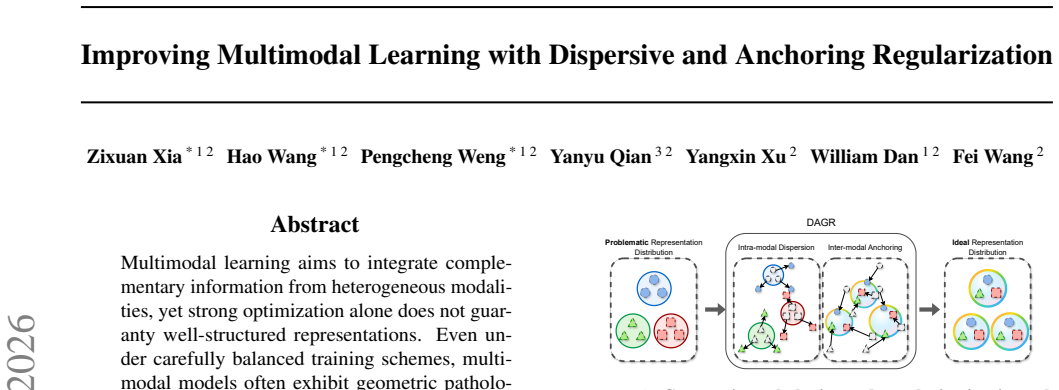
The paper claims that applying an intra-modal dispersive regularizer to promote representation diversity together with an inter-modal anchoring regularizer to limit cross-modal sample drift on intermediate embeddings reduces the geometric pathologies that limit performance, yielding consistent gains in both multimodal and unimodal tasks without architectural modifications.
What carries the argument
The dispersive-and-anchoring regularization framework, which adds an intra-modal dispersive term promoting diversity and an inter-modal anchoring term bounding cross-modal drift to the training objective.
If this is right
- Consistent gains appear in both multimodal accuracy and unimodal robustness on multiple benchmarks.
- Modality trade-offs are reduced because each modality retains useful structure.
- The method works as a lightweight addition compatible with existing training paradigms.
- No architectural changes are needed, so the regularizers can be inserted into current models.
Where Pith is reading between the lines
- The same geometric constraints might transfer to other multi-view or multi-task settings where representation collapse occurs.
- Adaptive weighting of the two regularizer terms could further improve results when modalities have different strengths.
- The approach suggests that explicit geometry control may become a standard add-on comparable to common regularizers like dropout in multimodal pipelines.
Load-bearing premise
That intra-modal collapse and cross-modal inconsistency are the main geometric issues limiting multimodal performance and that the proposed regularizers can be added without new optimization instabilities.
What would settle it
An experiment that applies the regularizers to a well-tuned multimodal model on a standard benchmark and observes no gain or a clear drop in both multimodal and unimodal metrics would falsify the central claim.
Figures




read the original abstract
Multimodal fusion is often treated as an optimization-balancing problem, where training signals are adjusted to prevent one modality from dominating the others. However, balanced optimization does not fully determine the geometry of intermediate representations. Supervised multimodal models may still learn low-diversity modality-specific embeddings or allow paired cross-modal observations to drift excessively apart, weakening both unimodal robustness and multimodal fusion. We introduce \regName, a lightweight plug-and-play geometric regularization framework for multimodal representation learning. Rather than enforcing rigid cross-modal alignment, \regName follows a bounded-agreement principle: preserve modality-specific diversity while softly constraining only the portion of paired cross-modal drift that exceeds an admissible agreement band. Operationally, \regName combines a dispersion term that mitigates spectral concentration with an agreement-band anchoring term that controls excessive paired drift, requiring no architectural modification or inference-time overhead. Experiments across audio-visual, image-text, and RF-based benchmarks show that \regName consistently improves multimodal performance and often strengthens unimodal representations. These results suggest that explicitly regulating representation geometry is an effective complement to optimization balancing, and provide evidence that geometry-aware regularization can improve multimodal learning across diverse architectures and domains.
Editorial analysis
A structured set of objections, weighed in public.
Referee Report
Summary. The paper identifies intra-modal representation collapse and sample-level cross-modal inconsistency as geometric pathologies in multimodal learning that persist even under balanced optimization. It proposes a lightweight, plug-and-play regularization framework (dispersive intra-modal and anchoring inter-modal terms) that enforces representation diversity and bounds cross-modal drift without rigid alignment or architectural changes, claiming consistent gains in both multimodal fusion and unimodal robustness across benchmarks.
Significance. If the central claim holds under proper controls, the work would supply a simple additional axis for controlling embedding geometry in multimodal models, potentially reducing modality trade-offs without extra capacity or retuning. The plug-and-play design and compatibility with existing paradigms would make the contribution broadly usable if the geometry-specific mechanism is isolated from generic regularization effects.
major comments (2)
- [Experiments] Experiments section: the manuscript reports consistent improvements but supplies no ablation replacing the dispersive/anchoring terms with non-geometric regularizers of matched effective strength (e.g., isotropic noise or additional L2 penalty). Without this isolation, gains cannot be attributed specifically to geometry regulation rather than generic auxiliary-loss effects, which directly undermines the central claim that 'explicitly regulating representation geometry' is the operative mechanism.
- [Abstract] Abstract and results: no quantitative numbers, standard deviations, or failure-mode analysis are supplied for the claimed 'consistent improvements,' leaving the magnitude, reliability, and scope of the gains unassessable and making the soundness of the empirical support low.
minor comments (2)
- [Abstract] Abstract: 'guaranty' should be 'guarantee'.
- [Method] Notation: the symbol for the proposed regularizer is introduced as 'regName' without an explicit definition or expansion in the provided text; a clear equation or pseudocode block would improve clarity.
Simulated Author's Rebuttal
We thank the referee for the constructive and insightful comments. We address each major point below and will revise the manuscript to strengthen the empirical isolation of our geometric mechanism and the quantitative presentation of results.
read point-by-point responses
-
Referee: [Experiments] Experiments section: the manuscript reports consistent improvements but supplies no ablation replacing the dispersive/anchoring terms with non-geometric regularizers of matched effective strength (e.g., isotropic noise or additional L2 penalty). Without this isolation, gains cannot be attributed specifically to geometry regulation rather than generic auxiliary-loss effects, which directly undermines the central claim that 'explicitly regulating representation geometry' is the operative mechanism.
Authors: We agree that isolating the contribution of geometry regulation from generic regularization effects is essential to support our central claim. Although our current results show consistent gains across benchmarks under the proposed terms, the manuscript does not yet contain the requested controls. In the revised version we will add ablations that replace the dispersive and anchoring regularizers with non-geometric alternatives of matched effective strength (isotropic noise injection and additional L2 penalties on the same embeddings). These experiments will quantify whether the geometry-specific constraints yield distinct improvements over generic auxiliary losses, thereby directly addressing the concern. revision: yes
-
Referee: [Abstract] Abstract and results: no quantitative numbers, standard deviations, or failure-mode analysis are supplied for the claimed 'consistent improvements,' leaving the magnitude, reliability, and scope of the gains unassessable and making the soundness of the empirical support low.
Authors: We acknowledge that the abstract currently lacks specific numerical results and that the results section would benefit from explicit reliability measures. In the revision we will update the abstract to report key quantitative gains (average improvements with standard deviations across the main benchmarks) and will add a concise failure-mode analysis in the experiments section to better characterize the scope and limitations of the observed benefits. revision: yes
Circularity Check
No circularity: regularizers imposed as external constraints, not derived from inputs
full rationale
The manuscript introduces dispersive intra-modal and anchoring inter-modal regularization terms as additive, plug-and-play losses on intermediate embeddings. No equations, self-referential definitions, or fitted-parameter predictions appear in the provided text; the geometry constraints are stated as independent controls rather than quantities obtained by construction from the training objective or prior self-citations. Experimental gains are reported on external benchmarks without any reduction of the claimed mechanism to a renaming or tautological fit of the same data. The derivation chain therefore remains self-contained and non-circular.
Axiom & Free-Parameter Ledger
free parameters (1)
- dispersive and anchoring regularization coefficients
axioms (1)
- domain assumption Multimodal models exhibit intra-modal representation collapse and sample-level cross-modal inconsistency that degrade performance even under balanced training.
Lean theorems connected to this paper
-
IndisputableMonolith/Cost/FunctionalEquation.leanwashburn_uniqueness_aczel (J-cost uniqueness) unclear?
unclearRelation between the paper passage and the cited Recognition theorem.
intra-modal dispersive regularization … Ld = log(1/B(B−1) ∑ exp(−t‖z̃mi − z̃mj‖²)) … inter-modal anchoring La = 1/B ∑ (‖z̃mi − z̃ni‖² − τ)²₊
-
IndisputableMonolith/Foundation/ArithmeticFromLogic.leanembed_strictMono_of_one_lt unclear?
unclearRelation between the paper passage and the cited Recognition theorem.
Theorem 3.2 … Rényi-2 entropy … effective rank reff(Σ) = (tr Σ)² / tr(Σ²)
What do these tags mean?
- matches
- The paper's claim is directly supported by a theorem in the formal canon.
- supports
- The theorem supports part of the paper's argument, but the paper may add assumptions or extra steps.
- extends
- The paper goes beyond the formal theorem; the theorem is a base layer rather than the whole result.
- uses
- The paper appears to rely on the theorem as machinery.
- contradicts
- The paper's claim conflicts with a theorem or certificate in the canon.
- unclear
- Pith found a possible connection, but the passage is too broad, indirect, or ambiguous to say the theorem truly supports the claim.
discussion (0)
Sign in with ORCID, Apple, or X to comment. Anyone can read and Pith papers without signing in.