Recognition: no theorem link
Toward claiming a detection of gravitational memory
Pith reviewed 2026-05-16 09:15 UTC · model grok-4.3
The pith
A physically meaningful time-dependent gravitational memory signal requires separating high-frequency waves from the lower-frequency memory buildup.
A machine-rendered reading of the paper's core claim, the machinery that carries it, and where it could break.
Core claim
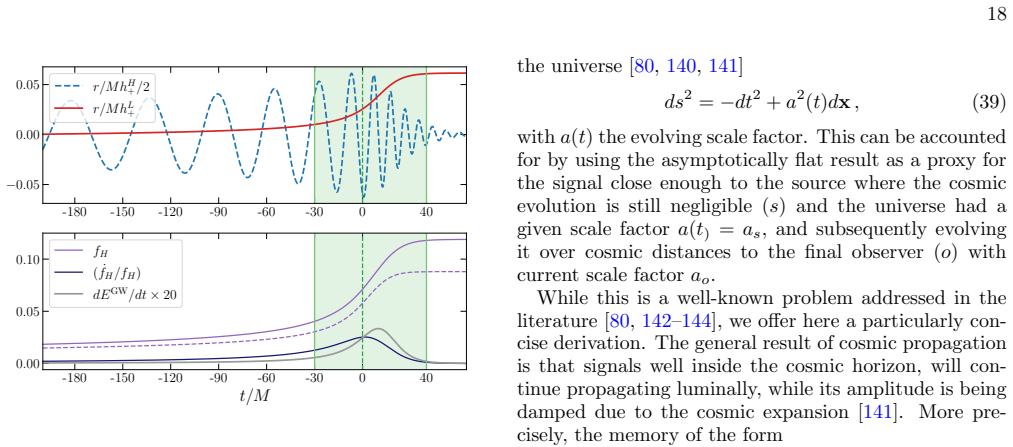
The Bondi-van der Burg-Metzner-Sachs balance laws rigorously establish the total memory offset, yet a robust definition of the observable memory rise requires an additional physical input: a separation of scales between high-frequency gravitational waves and the lower-frequency buildup of memory, which is formulated using the Isaacson description of gravitational wave energy momentum. This separation supports a theoretical framework for defining and modeling the time-dependent memory rise in compact binary coalescences, with emphasis on supermassive black hole binaries for space-based detectors such as LISA.
What carries the argument
The separation of scales between high-frequency gravitational waves and lower-frequency memory buildup, formulated via the Isaacson description of gravitational wave energy-momentum.
If this is right
- Enables explicit modeling of the time-dependent memory rise during compact binary coalescences.
- Supports statistical hypothesis tests that distinguish memory-containing signals from purely oscillatory radiation.
- Identifies supermassive black hole binary mergers as the leading candidates for a first single-event memory detection with LISA.
- Supplies quantitative estimates of detection prospects once the scale separation is adopted in data analysis.
Where Pith is reading between the lines
- The same scale separation could be applied to memory signals from other sources such as core-collapse supernovae if their waveforms are sufficiently broadband.
- Ground-based detectors might benefit from the framework if low-frequency sensitivity improves enough to capture memory transitions.
- Data-analysis pipelines could embed this model to re-examine existing events for previously undetected memory contributions.
Load-bearing premise
A clear separation of scales must exist between the high-frequency oscillations of gravitational waves and the slower buildup of the memory effect to define a unique time-dependent memory signal.
What would settle it
Detection of a binary merger in which the frequency spectrum of the memory rise overlaps substantially with the oscillatory waves, rendering the two components indistinguishable by frequency content alone.
Figures




read the original abstract
Gravitational memory is a zero-frequency effect associated with a permanent change in the asymptotic spacetime metric induced by radiation. Although its universal manifestation is a net change in the proper distances between freely falling test masses, gravitational wave detectors are intrinsically insensitive to the final offset and can only probe the transition. A central challenge for any detection claim is therefore to define a physically meaningful and operationally robust model of the time-dependent signal that is uniquely attributable to gravitational memory and distinguishable from purely oscillatory radiation. We show that while the Bondi-van der Burg-Metzner-Sachs balance laws rigorously establish the total memory offset, a robust definition of the observable memory rise requires an additional physical input: a separation of scales between high-frequency gravitational waves and the lower-frequency buildup of memory. We formulate this separation using the Isaacson description of gravitational wave energy momentum. Motivated by this observation, we develop a theoretical framework for defining and modeling the time-dependent memory rise, building on a self-contained review of gravitational memory and focusing on compact binary coalescences. Specializing to space-based detectors, we analyze the LISA response to gravitational radiation including memory, with emphasis on mergers of supermassive black hole binaries, which offer the most promising prospects for a first single-event detection. The framework provides the theoretical foundation for statistically well-defined hypothesis testing between memory-free and memory-full radiation and enables quantitative assessments of detection prospects. These results establish a principled pathway toward a future observational claim of gravitational memory.
Editorial analysis
A structured set of objections, weighed in public.
Referee Report
Summary. The manuscript argues that while the Bondi-van der Burg-Metzner-Sachs (BvBMS) balance laws rigorously fix the net gravitational memory offset, a physically meaningful and operationally robust definition of the time-dependent memory rise requires an additional physical input: an explicit separation of scales between high-frequency oscillatory gravitational waves and the lower-frequency memory buildup. This separation is formulated via the Isaacson effective stress-energy tensor. The authors develop a theoretical framework for modeling the time-dependent memory signal in compact binary coalescences, review gravitational memory, and specialize to the LISA response for supermassive black hole binary mergers to enable statistically well-defined hypothesis testing between memory-free and memory-inclusive models.
Significance. If the proposed scale-separation framework holds and is validated, the work would supply a principled basis for defining an observable memory signal distinguishable from oscillatory radiation, which is a necessary step toward any credible single-event detection claim. The emphasis on LISA and SMBH binaries targets a high-priority target for space-based detectors, and the provision of a hypothesis-testing framework could directly inform future data-analysis pipelines.
major comments (2)
- [Abstract] Abstract and the section formulating the scale separation: the central claim that Isaacson high-frequency averaging supplies the required separation of scales is load-bearing for the entire framework, yet the manuscript provides no explicit check on whether this averaging remains valid when the memory ramp occurs over only a few orbital periods during SMBH coalescence, where instantaneous frequencies span a broad band and the high-frequency assumption may break down.
- [Framework development section] The development of the time-dependent memory model (following the Isaacson input): without reported derivations of the resulting waveform, error budgets, or injection-recovery tests on simulated LISA data, it is unclear whether the constructed signal is sufficiently distinguishable from other low-frequency effects to support the claimed hypothesis-testing procedure.
minor comments (2)
- [Abstract] The abstract would be strengthened by a single sentence indicating the functional form adopted for the memory rise (e.g., a smoothed step or integrated flux) and any order-of-magnitude estimate for the LISA signal-to-noise ratio of the memory component.
- Notation for the memory offset versus the time-dependent rise should be introduced once and used consistently; the current abstract alternates between “total memory offset” and “memory rise” without an explicit equation linking them.
Simulated Author's Rebuttal
We thank the referee for their careful reading of the manuscript and for the constructive comments, which help clarify the scope and limitations of the proposed framework. We address each major comment below and indicate the corresponding revisions.
read point-by-point responses
-
Referee: [Abstract] Abstract and the section formulating the scale separation: the central claim that Isaacson high-frequency averaging supplies the required separation of scales is load-bearing for the entire framework, yet the manuscript provides no explicit check on whether this averaging remains valid when the memory ramp occurs over only a few orbital periods during SMBH coalescence, where instantaneous frequencies span a broad band and the high-frequency assumption may break down.
Authors: We agree that the validity of the Isaacson high-frequency averaging must be verified explicitly in the SMBH coalescence regime. In the revised manuscript we will add a dedicated subsection that quantifies the scale-separation condition by comparing the memory-buildup timescale against the instantaneous orbital periods and frequency content during the final few orbits. This analysis will use the known chirp evolution of SMBH binaries to demonstrate that the high-frequency assumption remains sufficiently accurate for defining an observable memory rise, thereby supporting the central claim. revision: yes
-
Referee: [Framework development section] The development of the time-dependent memory model (following the Isaacson input): without reported derivations of the resulting waveform, error budgets, or injection-recovery tests on simulated LISA data, it is unclear whether the constructed signal is sufficiently distinguishable from other low-frequency effects to support the claimed hypothesis-testing procedure.
Authors: The manuscript is primarily a theoretical work that constructs the time-dependent memory model via the Isaacson input and embeds it in the LISA response to enable hypothesis testing. In the revision we will supply the explicit waveform derivations and a quantitative error-budget analysis within the framework section. Full injection-recovery tests on simulated LISA data lie beyond the present scope; however, we will add a discussion that uses the derived scale separation to estimate the expected distinguishability from other low-frequency contributions, thereby strengthening the justification for the proposed hypothesis-testing procedure. revision: partial
Circularity Check
No significant circularity; derivation relies on external physical input
full rationale
The paper states that BvBMS balance laws fix the net memory offset while a usable time-dependent signal requires an additional scale-separation assumption formulated with the Isaacson effective stress-energy tensor. This input is invoked as an independent physical requirement rather than derived from the offset or obtained by fitting parameters to the target observable. No equation reduces the memory rise to a self-referential definition, no prediction is statistically forced by a prior fit, and no load-bearing step collapses to a self-citation chain or imported uniqueness theorem. The framework therefore remains self-contained against external benchmarks.
Axiom & Free-Parameter Ledger
axioms (1)
- domain assumption Separation of scales between high-frequency gravitational waves and lower-frequency memory buildup using the Isaacson description
Forward citations
Cited by 1 Pith paper
-
Probing soft signals of gravitational-wave memory with space-based interferometers
Space-based detectors can measure soft displacement-memory signals from gravitational waves at SNR greater than or equal to 10.
Reference graph
Works this paper leans on
-
[1]
A BMS balance law at each angle Another way of rewriting the BMS balance laws is in terms of a relation that is valid at each angular direction as described in Sec. II A 2, such that [Eq. (16)] Re[ð2∆h(u)] = 1 r 16πG Z u u0 du′ [Fh +F m]−4∆M(u) . (A14) In vacuum, and in a post-Newtonian Bondi frame, in which lim u0→−∞ h(u0) = 0 (A15) this can be rewritten...
-
[2]
Gravitational memory as a finite BMS supertranslation Finally, we want to explicitly show that the permanent gravitational memory effect admits a natural interpreta- tion in terms of the asymptotic symmetries of asymptoti- cally flat spacetimes. In particular, the two vacuum con- figurations before and after the burst in a given angular direction are dire...
-
[3]
The Isaacson assumptions. The definition of gravitational waves on an arbitrary background spacetime requires two central assumptions: (1) We require the existence of an exact solution ¯g µν about which we define perturbations. (2) We assume the existence of a physical separation of characteristic scales of variation between a slowly varying background co...
-
[4]
Leading order equations of motion. Like in the main text, for simplicity, we will restrict ourselves to consider the vacuum Einstein equations. A more general treatment can be found in Refs. [18, 80]. The assumed exact solution ¯gµν therefore satisfies Gµν[¯g] = 0,(B7) withG µν the Einstein tensor. The goal is now to identify the leading order equations o...
-
[5]
Leading order asymptotic equations Within the Isaacson approach, assuming asymptotic flatness implies the choice the a particular exact solution of Minkowski spacetime, about which we are expanding 34 We want to mention here that Isaacson’s original analysis [69] assumedα∼f L/fH, which misses out on the perturbative per- turbative version of the low-frequ...
-
[6]
Solving the leading order Isaacson equations While Eq. (B23) results in a description of gravita- tional waves identified as the high-frequency perturba- tions in terms of a superposition plane-waves in a given radially outward direction, the emission of such GWs in- evitably sources a corresponding low-frequency pertur- bation through Eq. (B24) whose gen...
-
[7]
In this context it is useful to define a transverse- traceless (T T) projector through [Eq
Spacial orthonormal radiation basis Given a source-centered spherical coordinate system {t, r,Ω = (θ, ϕ)}, the unit radial vector reads n(Ω) = (sinθcosϕ,sinθsinϕ,cosθ).(D1) The associated transverse space of a given directionn(Ω) can then be described through the basis vectors in the 37 natural directions of the azimuthal and polar angles, re- spectively ...
-
[8]
Spin-weighted spherical harmonics Spin-weighted spherical harmonics (SWSHs) can be generated from ordinary spherical harmonics by repeated application of angular derivative operators. Explicitly, they are defined as sYℓm(θ, ϕ) = q (ℓ−s)! (ℓ+s)! ðsYℓm(θ, ϕ), ℓ≥s≥0 (−1)s q (ℓ+s)! (ℓ−s)! ¯ð−sYℓm(θ, ϕ),0> s≥ −ℓ 0,|s|> ℓ (D9) where the angular deriva...
-
[9]
Derivation of the reflection-symmetry identity In this appendix, we provide a direct derivation of the symmetry relation stated in Eq. (34), hH ℓm = (−1)ℓ hH∗ ℓ,−m .(D31) The result follows from the reflection symmetry of non- precessing binary systems when described in a frame in which the orbital plane coincides with thex–yplane. In such a frame, the hi...
-
[10]
Solving the low-frequency Isaacson equation In this subsection, we explicitly extract the radia- tive contribution within the general solution to the low- frequency Isaacson equations in Eq. (B26), reproduced here for convenience hL µν(x) =−16πG Z d4x′ G(x−x ′)t µν(x′).(D35) Here, the retarded Green’s function of the wave equation reads G(x−x ′) =− δ(tr −...
-
[11]
(28) starting from the general equation in terms of the TT metric perturbations [Eq
SWSH expansion of memory formula To complete this appendix, we explicitly derive the SWSH expanded form of the memory formula in Eq. (28) starting from the general equation in terms of the TT metric perturbations [Eq. (22)] hTT ijL = 4G r Z u du′ Z dΩ′ dE du′dΩ′ h n′ in′ j 1−⃗ n′ ·⃗ n iTT ,(D44) where TT denotes projection onto the transverse-traceless mo...
-
[12]
Radiation of gravitational waves by a cluster of superdense stars,
Y. B. Zel’dovich and A. G. Polnarev, “Radiation of gravitational waves by a cluster of superdense stars,” Sov. Astron.18(1974) 17
work page 1974
-
[13]
Gravitational radiation from point-masses in unbound orbits: Newtonian results,
M. Turner, “Gravitational radiation from point-masses in unbound orbits: Newtonian results,”Astrophysical Journal216(1977) 610–619
work page 1977
-
[14]
Kinematic Resonance and Memory Effect in Free Mass Gravitational Antennas,
V. B. Braginsky and L. P. Grishchuk, “Kinematic Resonance and Memory Effect in Free Mass Gravitational Antennas,”Sov. Phys. JETP62(1985) 427–430
work page 1985
-
[15]
Gravitational-wave bursts with memory and experimental prospects,
V. Braginsky and K. Thorne, “Gravitational-wave bursts with memory and experimental prospects,” Nature327(1987) 123–125
work page 1987
-
[16]
Nonlinear nature of gravitation 42 and gravitational wave experiments,
D. Christodoulou, “Nonlinear nature of gravitation 42 and gravitational wave experiments,”Phys. Rev. Lett. 67(1991) 1486–1489
work page 1991
-
[17]
M. Ludvigsen, “Geodesic deviation at null infinity and the physical effects of very long wave gravitational radiation,”General Relativity and Gravitation21 (1989) 1205–1212
work page 1989
-
[18]
Hereditary effects in gravitational radiation,
L. Blanchet and T. Damour, “Hereditary effects in gravitational radiation,”Phys. Rev. D46(1992) 4304–4319
work page 1992
-
[19]
Gravitational-wave bursts with memory: The Christodoulou effect,
K. S. Thorne, “Gravitational-wave bursts with memory: The Christodoulou effect,”Phys. Rev. D45 no. 2, (1992) 520–524
work page 1992
-
[20]
Christodoulou’s nonlinear gravitational-wave memory: Evaluation in the quadrupole approximation,
A. G. Wiseman and C. M. Will, “Christodoulou’s nonlinear gravitational-wave memory: Evaluation in the quadrupole approximation,”Phys. Rev. D44 (Nov, 1991) R2945–R2949
work page 1991
-
[21]
M. Favata, “Post-Newtonian corrections to the gravitational-wave memory for quasi-circular, inspiralling compact binaries,”Phys. Rev. D80(2009) 024002,arXiv:0812.0069 [gr-qc]
work page internal anchor Pith review Pith/arXiv arXiv 2009
-
[22]
Nonlinear gravitational-wave memory from binary black hole mergers
M. Favata, “Nonlinear gravitational-wave memory from binary black hole mergers,”Astrophys. J. Lett. 696(2009) L159–L162,arXiv:0902.3660 [astro-ph.SR]
work page internal anchor Pith review Pith/arXiv arXiv 2009
-
[23]
The gravitational-wave memory effect
M. Favata, “The gravitational-wave memory effect,” Class. Quant. Grav.27(2010) 084036, arXiv:1003.3486 [gr-qc]
work page internal anchor Pith review Pith/arXiv arXiv 2010
-
[24]
Symmetries of asymptotically flat 4 dimensional spacetimes at null infinity revisited
G. Barnich and C. Troessaert, “Symmetries of asymptotically flat 4 dimensional spacetimes at null infinity revisited,”Phys. Rev. Lett.105(2010) 111103, arXiv:0909.2617 [gr-qc]
work page internal anchor Pith review Pith/arXiv arXiv 2010
-
[25]
A perturbative and gauge invariant treatment of gravitational wave memory
L. Bieri and D. Garfinkle, “Perturbative and gauge invariant treatment of gravitational wave memory,” Phys. Rev. D89no. 8, (2014) 084039, arXiv:1312.6871 [gr-qc]
work page internal anchor Pith review Pith/arXiv arXiv 2014
-
[26]
S. Pasterski, A. Strominger, and A. Zhiboedov, “New Gravitational Memories,”JHEP12(2016) 053, arXiv:1502.06120 [hep-th]
work page internal anchor Pith review Pith/arXiv arXiv 2016
-
[27]
Spin memory effect for compact binaries in the post-Newtonian approximation
D. A. Nichols, “Spin memory effect for compact binaries in the post-Newtonian approximation,”Phys. Rev. D95no. 8, (2017) 084048,arXiv:1702.03300 [gr-qc]
work page internal anchor Pith review Pith/arXiv arXiv 2017
-
[28]
Gravitational wave memory and the wave equation,
D. Garfinkle, “Gravitational wave memory and the wave equation,”Class. Quant. Grav.39no. 13, (2022) 135010,arXiv:2201.05543 [gr-qc]
-
[29]
J. Zosso,Probing Gravity - Fundamental Aspects of Metric Theories and their Implications for Tests of General Relativity. PhD thesis, Zurich, ETH, 2024. arXiv:2412.06043 [gr-qc]
-
[30]
Infrared Photons and Gravitons,
S. Weinberg, “Infrared Photons and Gravitons,”Phys. Rev.140(Oct, 1965) B516–B524
work page 1965
-
[31]
Gravitational waves in general relativity. 7. Waves from axisymmetric isolated systems,
H. Bondi, M. G. J. van der Burg, and A. W. K. Metzner, “Gravitational waves in general relativity. 7. Waves from axisymmetric isolated systems,”Proc. Roy. Soc. Lond. A269(1962) 21–52
work page 1962
-
[32]
R. K. Sachs, “Gravitational waves in general relativity
-
[33]
Waves in asymptotically flat space-times,”Proc. Roy. Soc. Lond. A270(1962) 103–126
work page 1962
-
[34]
J. Frauendiener, “Note on the memory effect,”Class. Quant. Grav.9(06, 1992) 1639–1641
work page 1992
-
[35]
Geometry and Physics of Null Infinity
A. Ashtekar, “Geometry and physics of null infinity,” Surveys Diff. Geom.20no. 1, (2015) 99–122, arXiv:1409.1800 [gr-qc]
work page internal anchor Pith review Pith/arXiv arXiv 2015
-
[36]
The Poincar´ e and BMS flux-balance laws with application to binary systems,
G. Comp` ere, R. Oliveri, and A. Seraj, “The Poincar´ e and BMS flux-balance laws with application to binary systems,”JHEP10(2020) 116,arXiv:1912.03164 [gr-qc]
-
[37]
Gravitational Waves in Full, Non-Linear General Relativity,
F. D’Ambrosio, S. D. B. Fell, L. Heisenberg, D. Maibach, S. Zentarra, and J. Zosso, “Gravitational Waves in Full, Non-Linear General Relativity,” arXiv:2201.11634 [gr-qc]
-
[38]
B. Goncharov, L. Donnay, and J. Harms, “Inferring Fundamental Spacetime Symmetries with Gravitational-Wave Memory: From LISA to the Einstein Telescope,”Phys. Rev. Lett.132no. 24, (2024) 241401,arXiv:2310.10718 [gr-qc]
-
[39]
A review of gravitational memory and BMS frame fixing in numerical relativity,
K. Mitmanet al., “A review of gravitational memory and BMS frame fixing in numerical relativity,”Class. Quant. Grav.41no. 22, (2024) 223001, arXiv:2405.08868 [gr-qc]
-
[40]
Gravitational memory and soft theorems: The local perspective,
V. De Luca, J. Khoury, and S. S. C. Wong, “Gravitational memory and soft theorems: The local perspective,”Phys. Rev. D112no. 2, (2025) L021502, arXiv:2412.01910 [gr-qc]
-
[41]
Gravitational Memory, BMS Supertranslations and Soft Theorems
A. Strominger and A. Zhiboedov, “Gravitational Memory, BMS Supertranslations and Soft Theorems,” JHEP01(2016) 086,arXiv:1411.5745 [hep-th]
work page internal anchor Pith review Pith/arXiv arXiv 2016
-
[42]
Lectures on the Infrared Structure of Gravity and Gauge Theory
A. Strominger, “Lectures on the Infrared Structure of Gravity and Gauge Theory,”arXiv:1703.05448 [hep-th]
work page internal anchor Pith review Pith/arXiv arXiv
-
[43]
An electromagnetic analog of gravitational wave memory
L. Bieri and D. Garfinkle, “An electromagnetic analogue of gravitational wave memory,”Class. Quant. Grav.30(2013) 195009,arXiv:1307.5098 [gr-qc]
work page internal anchor Pith review Pith/arXiv arXiv 2013
-
[44]
New Symmetries of Massless QED
T. He, P. Mitra, A. P. Porfyriadis, and A. Strominger, “New Symmetries of Massless QED,”JHEP10(2014) 112,arXiv:1407.3789 [hep-th]
work page internal anchor Pith review Pith/arXiv arXiv 2014
-
[45]
Asymptotic symmetries of QED and Weinberg's soft photon theorem
M. Campiglia and A. Laddha, “Asymptotic symmetries of QED and Weinberg’s soft photon theorem,”JHEP07(2015) 115,arXiv:1505.05346 [hep-th]
work page internal anchor Pith review Pith/arXiv arXiv 2015
-
[46]
Asymptotic Symmetries and Electromagnetic Memory,
S. Pasterski, “Asymptotic Symmetries and Electromagnetic Memory,”JHEP09(2017) 154, arXiv:1505.00716 [hep-th]
-
[47]
D. Kapec, M. Pate, and A. Strominger, “New Symmetries of QED,”Adv. Theor. Math. Phys.21 (2017) 1769–1785,arXiv:1506.02906 [hep-th]
work page internal anchor Pith review Pith/arXiv arXiv 2017
-
[48]
Enhancement of Electromagnetic Memory Effects,
J. Zosso, “Enhancement of Electromagnetic Memory Effects,”Phys. Rev. Lett.135no. 20, (2025) 201602, arXiv:2507.09555 [gr-qc]
-
[49]
A. M. Grant and D. A. Nichols, “Outlook for detecting the gravitational-wave displacement and spin memory effects with current and future gravitational-wave detectors,”Phys. Rev. D107no. 6, (2023) 064056, arXiv:2210.16266 [gr-qc]. [Erratum: Phys.Rev.D 108, 029901 (2023)]
-
[50]
Detecting gravitational-wave memory with LIGO: implications of GW150914
P. D. Lasky, E. Thrane, Y. Levin, J. Blackman, and Y. Chen, “Detecting gravitational-wave memory with LIGO: implications of GW150914,”Phys. Rev. Lett. 117no. 6, (2016) 061102,arXiv:1605.01415 [astro-ph.HE]
work page internal anchor Pith review Pith/arXiv arXiv 2016
-
[51]
Gravitational Waves from Orphan Memory
L. O. McNeill, E. Thrane, and P. D. Lasky, “Detecting Gravitational Wave Memory without Parent Signals,” Phys. Rev. Lett.118no. 18, (2017) 181103, arXiv:1702.01759 [astro-ph.IM]
work page internal anchor Pith review Pith/arXiv arXiv 2017
-
[52]
Prospects of detecting the nonlinear gravitational wave memory
A. D. Johnson, S. J. Kapadia, A. Osborne, A. Hixon, and D. Kennefick, “Prospects of detecting the nonlinear gravitational wave memory,”Phys. Rev. D 99no. 4, (2019) 044045,arXiv:1810.09563 [gr-qc]. 43
work page internal anchor Pith review Pith/arXiv arXiv 2019
-
[53]
Testing Gravitational Memory Generation with Compact Binary Mergers
H. Yang and D. Martynov, “Testing Gravitational Memory Generation with Compact Binary Mergers,” Phys. Rev. Lett.121no. 7, (2018) 071102, arXiv:1803.02429 [gr-qc]
work page internal anchor Pith review Pith/arXiv arXiv 2018
-
[54]
Measuring gravitational-wave memory in the first LIGO/Virgo gravitational-wave transient catalog,
M. H¨ ubner, C. Talbot, P. D. Lasky, and E. Thrane, “Measuring gravitational-wave memory in the first LIGO/Virgo gravitational-wave transient catalog,” Phys. Rev. D101no. 2, (2020) 023011, arXiv:1911.12496 [astro-ph.HE]
-
[55]
Prospects for Memory Detection with Low-Frequency Gravitational Wave Detectors
K. Islo, J. Simon, S. Burke-Spolaor, and X. Siemens, “Prospects for Memory Detection with Low-Frequency Gravitational Wave Detectors,”arXiv:1906.11936 [astro-ph.HE]. [44]NANOGravCollaboration, K. Aggarwalet al., “The NANOGrav 11 yr Data Set: Limits on Gravitational Wave Memory,”Astrophys. J.889(2020) 38, arXiv:1911.08488 [astro-ph.HE]
work page internal anchor Pith review Pith/arXiv arXiv 1906
-
[56]
Climbing up the memory staircase: Equatorial zoom-whirl orbits,
L. M. Burko and G. Khanna, “Climbing up the memory staircase: Equatorial zoom-whirl orbits,” Phys. Rev. D102no. 8, (2020) 084035, arXiv:2007.12545 [gr-qc]
-
[57]
Forecasts for detecting the gravitational-wave memory effect with Advanced LIGO and Virgo,
O. M. Boersma, D. A. Nichols, and P. Schmidt, “Forecasts for detecting the gravitational-wave memory effect with Advanced LIGO and Virgo,”Phys. Rev. D101no. 8, (2020) 083026,arXiv:2002.01821 [astro-ph.HE]
-
[58]
Survey of gravitational wave memory in intermediate mass ratio binaries,
T. Islam, S. E. Field, G. Khanna, and N. Warburton, “Survey of gravitational wave memory in intermediate mass ratio binaries,”arXiv:2109.00754 [gr-qc]
-
[59]
Memory remains undetected: Updates from the second LIGO/Virgo gravitational-wave transient catalog,
M. H¨ ubner, P. Lasky, and E. Thrane, “Memory remains undetected: Updates from the second LIGO/Virgo gravitational-wave transient catalog,” Phys. Rev. D104no. 2, (2021) 023004, arXiv:2105.02879 [gr-qc]
-
[60]
Detecting the gravitational wave memory effect with TianQin,
S. Sun, C. Shi, J.-d. Zhang, and J. Mei, “Detecting the gravitational wave memory effect with TianQin,” Phys. Rev. D107no. 4, (2023) 044023, arXiv:2207.13009 [gr-qc]
-
[61]
Can gravitational-wave memory help constrain binary black-hole parameters? A LISA case study,
S. Gasparotto, R. Vicente, D. Blas, A. C. Jenkins, and E. Barausse, “Can gravitational-wave memory help constrain binary black-hole parameters? A LISA case study,”Phys. Rev. D107no. 12, (2023) 124033, arXiv:2301.13228 [gr-qc]
-
[62]
Detection of the gravitational memory effect in LISA using triggers from ground-based detectors,
S. Ghosh, A. Weaver, J. Sanjuan, P. Fulda, and G. Mueller, “Detection of the gravitational memory effect in LISA using triggers from ground-based detectors,”Phys. Rev. D107no. 8, (2023) 084051, arXiv:2302.04396 [gr-qc]. [52]NANOGravCollaboration, G. Agazieet al., “The NANOGrav 12.5 yr Data Set: Search for Gravitational Wave Memory,”Astrophys. J.963no. 1, ...
-
[63]
S. Y. Cheung, P. D. Lasky, and E. Thrane, “Does spacetime have memories? Searching for gravitational-wave memory in the third LIGO-Virgo-KAGRA gravitational-wave transient catalogue,”Class. Quant. Grav.41no. 11, (2024) 115010,arXiv:2404.11919 [gr-qc]
-
[64]
S. Hou, Z.-C. Zhao, Z. Cao, and Z.-H. Zhu, “Space-Borne Interferometers to Detect Thousands of Memory Signals Emitted by Stellar-Mass Binary Black Holes,”Chin. Phys. Lett.42no. 10, (2025) 101101, arXiv:2411.18053 [gr-qc]
-
[65]
Measuring gravitational wave memory with LISA,
H. Inchausp´ e, S. Gasparotto, D. Blas, L. Heisenberg, J. Zosso, and S. Tiwari, “Measuring gravitational wave memory with LISA,”Phys. Rev. D111no. 4, (2025) 044044,arXiv:2406.09228 [gr-qc]
-
[66]
The NANOGrav 15 yr Data Set: Search for Gravitational-wave Memory,
G. Agazieet al., “The NANOGrav 15 yr Data Set: Search for Gravitational-wave Memory,”Astrophys. J. 987no. 1, (2025) 5,arXiv:2502.18599 [gr-qc]
-
[67]
Laser Interferometer Space Antenna
P. Amaro-Seoaneet al., “Laser Interferometer Space Antenna,”arXiv:1702.00786 [astro-ph.IM]. [58]LISACollaboration, M. Colpiet al., “LISA Definition Study Report,”arXiv:2402.07571 [astro-ph.CO]
work page internal anchor Pith review Pith/arXiv arXiv
-
[68]
LISA Rosetta Stone: Conventions document (LISA-DDPC-SEG-TN-007),
L. D. C. W. Group, “LISA Rosetta Stone: Conventions document (LISA-DDPC-SEG-TN-007),” 2025
work page 2025
-
[69]
E. Barausse, I. Dvorkin, M. Tremmel, M. Volonteri, and M. Bonetti, “Massive Black Hole Merger Rates: The Effect of Kiloparsec Separation Wandering and Supernova Feedback,”The Astrophysical Journal904 no. 1, (Nov., 2020) 16
work page 2020
-
[70]
E. Barausse and A. Lapi,Massive Black-Hole Mergers, p. 1–33. Springer, Singapore, 2021. https://link.springer.com/rwe/10.1007/ 978-981-15-4702-7_18-1. [62]LIGO ScientificCollaboration, J. Aasiet al., “Advanced LIGO,”Class. Quant. Grav.32(2015) 074001,arXiv:1411.4547 [gr-qc]. [63]VIRGOCollaboration, F. Acerneseet al., “Advanced Virgo: a second-generation i...
work page internal anchor Pith review Pith/arXiv arXiv 2021
-
[71]
Cosmic Explorer: The U.S. Contribution to Gravitational-Wave Astronomy beyond LIGO
D. Reitzeet al., “Cosmic Explorer: The U.S. Contribution to Gravitational-Wave Astronomy beyond LIGO,”Bull. Am. Astron. Soc.51no. 7, (2019) 035,arXiv:1907.04833 [astro-ph.IM]. [66]ETCollaboration, A. Abacet al., “The Science of the Einstein Telescope,”arXiv:2503.12263 [gr-qc]. [67]NANOGravCollaboration, G. Agazieet al., “The NANOGrav 15 yr Data Set: Evide...
work page internal anchor Pith review Pith/arXiv arXiv 2019
-
[72]
R. A. Isaacson, “Gravitational Radiation in the Limit of High Frequency. I. The Linear Approximation and Geometrical Optics,”Phys. Rev.166(Feb, 1968) 1263–1271
work page 1968
-
[73]
R. A. Isaacson, “Gravitational Radiation in the Limit of High Frequency. II. Nonlinear Terms and the Effective Stress Tensor,”Phys. Rev.166(Feb, 1968) 1272–1280
work page 1968
-
[74]
Gravitational wave memory beyond general relativity,
L. Heisenberg, N. Yunes, and J. Zosso, “Gravitational wave memory beyond general relativity,”Phys. Rev. D 108no. 2, (2023) 024010,arXiv:2303.02021 [gr-qc]
-
[75]
J. Zosso, “Continuing Isaacson’s Legacy: A general metric theory perspective on gravitational memory and the non-linearity of gravity,” in59th Rencontres de Moriond on Gravitation: Moriond 2025 Gravitation. 5, 2025.arXiv:2505.17603 [gr-qc]. 44
-
[76]
Detectability of Gravitational-Wave Memory with LISA: A Bayesian Approach,
Cogez, Adrien and Gasparotto, Silvia and Zosso, Jann and Inchausp´ e, Henri and Pitte, Chantal and Maga˜ na Zertuche, Lorena and Petiteau, Antoine and Besancon, Marc, “Detectability of Gravitational-Wave Memory with LISA: A Bayesian Approach,”(in prep)(2026)
work page 2026
-
[77]
C. W. Misner, K. S. Thorne, and J. A. Wheeler, Gravitation. W. H. Freeman, San Francisco, 1973
work page 1973
-
[78]
Multipole Expansions of Gravitational Radiation,
K. S. Thorne, “Multipole Expansions of Gravitational Radiation,”Rev. Mod. Phys.52(1980) 299–339
work page 1980
-
[79]
Weinberg,Gravitation and Cosmology: Principles and Applications of the General Theory of Relativity
S. Weinberg,Gravitation and Cosmology: Principles and Applications of the General Theory of Relativity. Wiley, 1972
work page 1972
-
[80]
R. M. Wald,General Relativity. Chicago Univ. Pr., Chicago, USA, 1984
work page 1984
discussion (0)
Sign in with ORCID, Apple, or X to comment. Anyone can read and Pith papers without signing in.