REVIEW 2 major objections 4 minor 2 cited by
Learning Credal Ensembles via Distributionally Robust Optimization
T0 review · 2 major / 4 minor · reviewed 2026-08-03 · deepseek-v4-flash
Pith's one-line read CreDRO trains an ensemble with varied degrees of i.i.d. relaxation so epistemic uncertainty reflects potential train–test shifts, not just random initialization.
desk verdict A useful empirical recipe for credal ensembles, but the central mechanism — the spread of δ_i — is never isolated by a fixed-δ control experiment. read the letter →
The pith
A machine-rendered reading of the paper's core claim, the machinery that carries it, and where it could break.
The reading
What carries the argument
The load-bearing object is the truncation schedule δ_i = (1−δ_G)/(M−1)·(i−1)+δ_G applied inside the adversarially reweighted learning objective. For each batch, samples are sorted by loss and only the top δ_i fraction is backpropagated; this is the paper's pragmatic stand-in for group DRO, with δ parameterizing the degree of assumed train–test divergence. The second ingredient is the box credal set K_B = {p : p_k ∈ [min_i p_{i,k}, max_i p_{i,k}], Σ p_k = 1}, built from the ensemble's softmax outputs. Epistemic uncertainty is then the difference H(K_B) − H(K_B), computable by two constrained entropy optimizations whose cost depends on the number of classes, not the ensemble size.
What would settle it
Run CreDRO with the δ_i assignment shuffled across members (or reversed) while keeping the same multiset of δ values; if OOD detection AUROC is unchanged, the explanatory story—ordered degrees of i.i.d. relaxation—is not what drives the gains. Additionally, train a variant that replaces top-δ truncation with exact sample reweighting from an explicit divergence ball; large performance differences would show the heuristic, not DRO, is responsible.
Extended reading notes
Core claim
The central claim is that disagreement between models trained under different relaxations of the i.i.d. assumption is a more meaningful source of epistemic uncertainty than disagreement from random initialization. The paper formalizes this by assigning each ensemble member a different truncation fraction δ_i in an adversarially reweighted DRO objective: during each batch, only the top δ_i fraction of samples by loss are used for backpropagation, which implicitly upweights hard-to-learn examples and simulates a hypothesized distribution shift. The δ_i are spread uniformly from a user-chosen worst-case δ_G (default 0.5) to 1 (vanilla ERM). The resulting softmax probabilities are converted to a
Load-bearing premise
The whole construction rests on the assumption that keeping the top-δ highest-loss samples in a batch behaves like a true DRO reweighting and that the uniform grid of δ values covers the plausible train–test shifts; if either fails, the ensemble diversity is arbitrary and the epistemic uncertainty is not really about distribution shift.
Editorial extensions
If this is right
- Epistemic uncertainty now reflects potential distribution shift, so OOD and shifted-domain samples receive higher uncertainty, improving out-of-distribution detection when uncertainty is used as the score.
- Selective classification in a realistic medical domain shift (histopathology from unseen scanners) improves, enabling safer abstention based on shift-induced disagreement.
- The method requires no change to network architecture—only per-member top-δ loss truncation during training—so it can wrap existing deep ensembles and loss functions.
- Performance is stable across the choice of δ_G because the ensemble spans a range of δ values; smaller δ_G produces wider probability intervals, consistent with more pessimistic shift assumptions.
- DRO-trained ensembles alone, without credal post-processing, also outperform standard deep ensembles, locating part of the benefit in the training procedure rather than in the credal representation.
Reading between the lines
- If the mechanism is really the ordering of members by shift sensitivity, then a direct test is to shuffle or reverse the δ_i assignment across members: the OOD detection gain should degrade, since the ensemble would no longer span meaningful shift levels.
- The less competitive performance of a closely related method that uses a single fixed DRO parameter suggests that the diversity of δ values, not DRO alone, is what matters; a reader could isolate this by training a single DRO model and perturbing it with different top-δ schedules.
- A natural extension the paper only sketches is regression, where Gaussian predictions would form a credal set of mixtures; one could test whether the same shift-derived disagreement transfers to continuous targets.
- Because the paper offers no theoretical link between δ and a conventional divergence measure, the interpretation of δ as a 'degree of distribution shift' remains a heuristic; connecting δ to, say, a chi-square or KL ball would make the method's semantics testable.
Signed reviews
Editorial analysis
A structured set of objections, weighed in public.
Referee Report
Summary. The paper proposes CreDRO, a deep-ensemble method in which each member is trained under a different degree of i.i.d.-assumption relaxation, implemented via batch-wise truncation to the top-δ high-loss samples. The resulting softmax predictions are converted to a box credal set, and epistemic uncertainty is quantified as the upper-minus-lower entropy of that set. The authors claim that CreDRO captures distribution-shift-related epistemic uncertainty, and they report consistent gains over deep-ensemble and state-of-the-art credal baselines across OOD detection benchmarks and a medical selective-classification task.
Significance. The central idea—defining epistemic uncertainty as disagreement among models trained under different plausible train–test shift scenarios rather than only under random initialization—is timely and conceptually appealing. If the mechanism is validated, the paper would offer a practical way to inject distribution-shift awareness into credal ensembles with no architectural change. The experimental effort is extensive: multiple OOD benchmarks, corrupted-data tests, selective classification on Camelyon17, and ablations for ensemble size, δG, credal-set construction, and member accuracy. The plan to release code is a positive for reproducibility. However, the paper's central claim about the source of the EU quality is not yet isolated experimentally, and the interpretation of δ as a level of distribution shift is heuristic rather than derived.
major comments (2)
- [§3.1, Eq. (6); Table 1; Table 4; Table 7] The paper attributes CreDRO's EU quality to 'disagreement among models trained with varying relaxations of the i.i.d. assumption' (Abstract; §3.1). No experiment isolates the variation mechanism. EN-DRO also uses the δ_i grid of Eq. (6), so the DE-vs-EN-DRO comparison does not control for the spread; CreDE uses a fixed DRO level but changes the architecture and loss. The δG ablation (Table 4) always keeps the spread to 1.0, so it cannot reveal whether the spread matters. Table 7 shows per-member accuracy improves from ≈94.3% (CreWra) to ≈95.4% (CreDRO), so the AUROC gains could plausibly be explained by better per-member predictions. I request an ablation in which all M members train with the same δ (e.g., δ=0.5, 0.75, 0.9), while keeping architecture, schedule, and credal construction identical. If a fixed-δ ensemble matches CreDRO, the central claim reduces to 'hard-example reweighting
- [§3.1, Eq. (4)–(6)] The top-δ truncation is presented as a 'flexible approximation' of adversarially reweighted learning, but no derivation connects the truncation to a distribution-shift neighborhood in Eq. (2) or (4). The interpretation of δ_i as a 'degree of relaxation of the i.i.d. assumption' is therefore a heuristic. This matters because the conceptual contribution is precisely that the ensemble disagreement reflects distribution-shift uncertainty. Please either (a) provide a formal characterization of the induced reweighting (e.g., as a CVaR/divergence-ball maximization with a known δ), or (b) soften the causal claim to describe the method as an empirically useful heuristic. The fixed-δ control from the previous comment would also help distinguish the effect of varying δ from the effect of DRO training per se.
minor comments (4)
- [§4.1] Clarify the hyperparameter selection for CreRL and CreEns. 'Report their best results' is too vague; state whether α was selected on a validation split and provide the sensitivity of the baselines to α in an appendix or table.
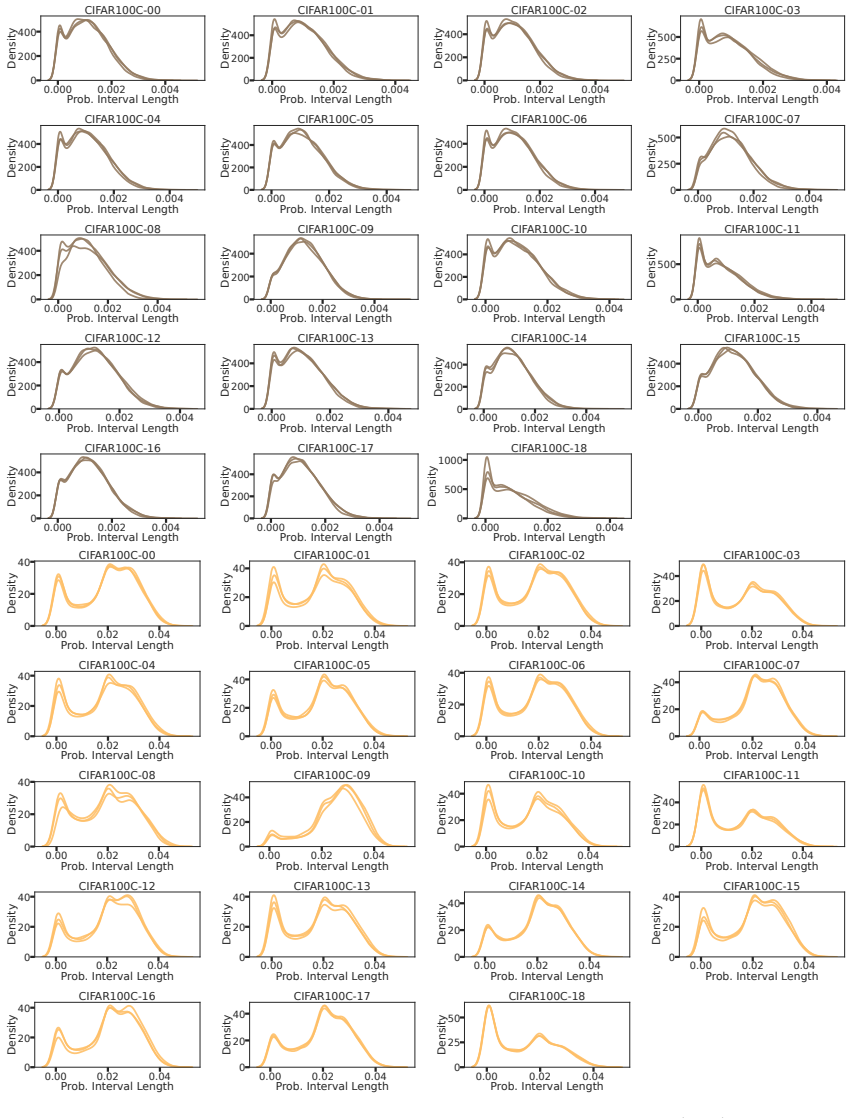
- [Figure 4 / §4.5] CreDE is missing for CIFAR100 vs CIFAR100-C; the explanation is in Appendix C but should be summarized in the caption or main text so the reader is not left puzzled by the absent curve.
- [Algorithm 1] The last step says 'Minimize' but does not explicitly state that this defines the per-batch loss for an optimizer update; please clarify notation and connect Step 5 to the standard SGD/backprop update.
- [Table 1] Some advantages are within 1–2 standard deviations (e.g., Places: CreDRO 92.7±0.1 vs CreRL 91.8±0.2); consider reporting paired significance tests or effect sizes, and specify whether runs share seeds across methods for fairer comparisons.
Circularity Check
No significant circularity: CreDRO's central claim is evaluated against external benchmarks, and its δ-grid is a design choice rather than a fitted or self-referential prediction.
full rationale
CreDRO's derivation chain is self-contained in the relevant sense. The training procedure (Algorithm 1; Eq. 6) fixes member-specific DRO levels via a user-chosen δ_G and a uniform interpolation formula; no parameter is fitted to the OOD/selective-classification targets and then renamed as a prediction. The resulting box credal set (Eqs. 7–8) and its EU measure (upper-lower entropy, Eq. 10) are applied to these trained members, and performance is scored on external benchmarks (SVHN, Places365, CIFAR100, FMNIST, ImageNet, CIFAR-C, Camelyon17). This is an empirical evaluation of an explicit design, not a reduction of the output to the input by construction. The paper cites the authors' prior credal frameworks (CreDE, CreWra) as baselines and background, but the central mechanism—varying δ_i to produce distribution-shift-related disagreement—does not reduce to those prior results. The paper itself flags the subjective nature of the weight set and the absence of a rigorous theoretical link ('The predefined set of weight vectors W is a subjective design choice...'; 'a rigorous theoretical analysis... left for future work'), and the lack of a fixed-δ control is a potential confound; these are correctness/experimental-design concerns rather than circularity. No specific equation or fitted quantity is identical to another by construction, so no circular step is established.
Assumptions & free parameters
free parameters (1)
- δG (global DRO truncation hyperparameter) =
0.5 (default; searched over {0.5,0.6,0.7,0.8,0.9} in ablation)
assumptions (5)
- domain assumption Top-δ high-loss sample truncation approximates adversarially reweighted group DRO and simulates potential domain shifts.
- domain assumption Uniform interpolation of δi between δG and 1 spans the range of plausible train–test distribution shifts.
- domain assumption The box credal set built from per-class min/max softmax probabilities is a valid representation of predictive epistemic uncertainty.
- domain assumption Upper–lower entropy difference H(KB)−H(KB) is an appropriate measure of epistemic uncertainty for credal predictions.
- domain assumption OOD-detection AUROC and selective-classification AUC are valid proxies for epistemic-uncertainty quality.
Cite this review
Pith. "Pith review of Learning Credal Ensembles via Distributionally Robust Optimization." pith.science (2026). https://pith.science/paper/SOE6I2WR
@misc{pith2026260208470,
  author       = {Pith},
  title        = {Pith review of: Learning Credal Ensembles via Distributionally Robust Optimization},
  year         = {2026},
  howpublished = {\url{https://pith.science/paper/SOE6I2WR}},
  note         = {Machine review of arXiv:2602.08470}
}
read the original abstract
Credal predictors are models that are aware of epistemic uncertainty and produce a convex set of probabilistic predictions. They offer a principled way to quantify predictive epistemic uncertainty (EU) and have been shown to improve model robustness in various settings. However, most state-of-the-art methods mainly define EU as disagreement caused by random training initializations, which mostly reflects sensitivity to optimization randomness rather than uncertainty from deeper sources. To address this, we define EU as disagreement among models trained with varying relaxations of the i.i.d. assumption between training and test data. Based on this idea, we propose CreDRO, which learns an ensemble of plausible models through distributionally robust optimization. As a result, CreDRO captures EU not only from training randomness but also from meaningful disagreement due to potential distribution shifts between training and test data. Empirical results show that CreDRO consistently outperforms existing credal methods on tasks such as out-of-distribution detection across multiple benchmarks and selective classification in medical applications.
Figures


Figures from the paper (9 more)




Forward citations
Cited by 2 Pith papers
-
Unification and Optimization of Robust Supervised Learning
Unifies robust learning methods into a design space of sequential stages and stances, enabling joint hyperparameter optimization that matches best single-method baselines on tabular, image, and reward benchmarks.
-
Set-based v.s. Distribution-based Representations of Epistemic Uncertainty: A Comparative Study
Built from identical predictive distributions, distribution-based and credal-set uncertainty representations are comparable, but their rankings depend heavily on the chosen uncertainty measure and downstream task.
Reference graph
Works this paper leans on
-
[4]
Additionally, Wang et al
CreBNN represents weights and predictions as credal sets and has demonstrated robustness; however, the setting of credal set prior still relies on random initialization and its computational cost is comparable to that of Bayesian neural network ensembles, significantly limiting practical applicability. Additionally, Wang et al. [2025c] introduces credal-s...
2021
-
[5]
!') #' %(
δG Individuals’{δ i}5 i=1 per Member Number of Selected TopδSamples per Batch 0.5 0.50, 0.625, 0.75, 0.875, 1.00 64, 80, 96, 112, 128 0.7 0.70, 0.775, 0.85, 0.925, 1.00 89, 99, 108, 118, 128 0.9 0.90, 0.925, 0.95, 0.975, 1.00 115, 118, 121, 124, 128 A smaller value ofδG, which reflects a more pessimistic belief about potential distribution divergence, may...
2025
-
[6]
Specifically, WSIs from centers 0, 1, and 3, which use 3DHistech scanners, make up the ID training and validation set
To convey a strong domain shift scenario [Mehrtens et al., 2023], the dataset is split so that the test set only contains images from scanners not present in the in-distribution (ID) training data, introducing an additional technological variation. Specifically, WSIs from centers 0, 1, and 3, which use 3DHistech scanners, make up the ID training and valid...
2023
-
[7]
Shiori Sagawa, Pang Wei Koh, Tatsunori B Hashimoto, and Percy Liang. Distributionally robust neural networks for group shifts: On the importance of regularization for worst-case generalization. arXiv preprint arXiv:1911.08731,
arXiv 1911
-
[8]
ISSN 0925-2312. doi: 10.1016/j. neucom.2024.127929. URLhttp://dx.doi.org/10.1016/j.neucom.2024.127929. Rui Tuo and Wenjia Wang. Uncertainty quantification for Bayesian optimization. In Gustau Camps- Valls, Francisco J. R. Ruiz, and Isabel Valera, editors,Proceedings of The 25th International Conference on Artificial Intelligence and Statistics, volume 151...
arXiv 2024
-
[9]
Credal ensemble distillation for uncertainty quantification.arXiv preprint arXiv:2511.13766, 2025a
Kaizheng Wang, Fabio Cuzzolin, David Moens, and Hans Hallez. Credal ensemble distillation for uncertainty quantification.arXiv preprint arXiv:2511.13766, 2025a. Kaizheng Wang, Fabio Cuzzolin, Keivan Shariatmadar, David Moens, and Hans Hallez. Credal wrapper of model averaging for uncertainty estimation in classification. InThe Thirteenth International Con...
-
[10]
""deffun(x: np.ndarray) -> np.ndarray:return-entropy(x, base=base)x0=probs.mean(axis=1)constraints={
Table 10:Summary of computational complexities for entropy optimization.TB,TC denote the number of iterations of the numerical optimizer. Quantity Problem Size Complexity per Instance BoxK B upper entropyCvariablesO(T B·C) BoxK B lower entropyCvariablesO(T B·C) Convex hullK C upper entropyMvariablesO(T C·M·C) Convex hullK C lower entropy trivialO(M·C) imp...
arXiv 2025
-
[17]
For the training configurations, we follow the official GitHub repositoryhttps://github.com/ DBO-DKFZ/uncertainty-benchmark to train the deep ensemble (DE) model (M = 5), using the approach outlined in Mehrtens et al. [2023]. We then adjust the training of CreDRO and CreDE by setting the training hyperparameter to0.5, as suggested in the original work, to...
arXiv 2023
Show all 19 references
-
[128]
All experiments are conducted on a single Nvidia A100-SXM4-80GB GPU
A cosine annealing learning rate scheduler is applied to gradually decay the learning rate during training. All experiments are conducted on a single Nvidia A100-SXM4-80GB GPU. Expected calibration error (ECE) evaluation.Within the ECE framework, a single proba- 21 bilistic pr...
2023
-
[2002]
Wide residual networks.arXiv preprint arXiv:1605.07146,
Sergey Zagoruyko and Nikos Komodakis. Wide residual networks.arXiv preprint arXiv:1605.07146,
-
[2009]
Bayesian hypernetworks.ArXiv Preprint ArXiv:1710.04759,
David Krueger, Chin-Wei Huang, Riashat Islam, Ryan Turner, Alexandre Lacoste, and Aaron Courville. Bayesian hypernetworks.ArXiv Preprint ArXiv:1710.04759,
-
[2012]
19 A Extended related work Credal sets have recently gained growing interest within the broader machine learning community for epistemic uncertainty (EU) quantification, even prior to their application in deep learning [Wang et al., 2024, Nguyen et al., 2025, Wang et al., 2025...
2024
-
[2013]
On second-order scoring rules for epistemic uncertainty quantification
Viktor Bengs, Eyke Hüllermeier, and Willem Waegeman. On second-order scoring rules for epistemic uncertainty quantification. InProceedings of the Fortieth International Conference on Machine Learning, volume 202 ofProceedings of Machine Learning Research, pages 2078–2091. PMLR...
-
[2018]
18 Dengyong Zhou, Sumit Basu, Yi Mao, and John Platt
doi: 10.1109/TPAMI.2017.2723009. 18 Dengyong Zhou, Sumit Basu, Yi Mao, and John Platt. Learning from the wisdom of crowds by minimax entropy.Advances in Neural Information Processing Systems, 25,
2017
-
[2019]
A unified evaluation framework for epistemic predictions
16 Shireen Kudukkil Manchingal, Muhammad Mubashar, Kaizheng Wang, and Fabio Cuzzolin. A unified evaluation framework for epistemic predictions. InInternational Conference on Artificial Intelligence and Statistics, pages 2017–2025. PMLR, 2025a. Shireen Kudukkil Manchingal, Muha...
2017
-
[2021]
Benchmarking uncertainty disentanglement: Specialized uncertainties for specialized tasks.arXiv preprint arXiv:2402.19460,
Bálint Mucsányi, Michael Kirchhof, and Seong Joon Oh. Benchmarking uncertainty disentanglement: Specialized uncertainties for specialized tasks.arXiv preprint arXiv:2402.19460,
-
[2024]
Isaac Levi.The enterprise of knowledge: An essay on knowledge, credal probability, and chance
URLhttps://arxiv.org/abs/2410.03390. Isaac Levi.The enterprise of knowledge: An essay on knowledge, credal probability, and chance. MIT press,
-
[2025]
Yonatan Oren, Shiori Sagawa, Tatsunori B Hashimoto, and Percy Liang
ISSN 1573-0565. Yonatan Oren, Shiori Sagawa, Tatsunori B Hashimoto, and Percy Liang. Distributionally robust language modeling.arXiv preprint arXiv:1909.02060,
1909 arXiv
-
[2026]
Yeming Wen, Dustin Tran, and Jimmy Ba
doi: 10.1109/TPAMI.2025.3626645. Yeming Wen, Dustin Tran, and Jimmy Ba. Batchensemble: an alternative approach to efficient ensemble and lifelong learning.arXiv preprint arXiv:2002.06715,
2025
Reviewed August 3, 2026 · model on record in the stance chip above.
Discussion (0). Continue with ORCID to comment.