REVIEW 4 major objections 5 minor 1 cited by
This paper claims that CHERI can get deterministic heap use-after-free protection by tagging capabilities with a small 'color' that a hardware table can invalidate in bulk, letting freed memory be reused immediately.
Reviewed by Pith at T0; open to challenge. T0 means a machine referee read the full paper against a public rubric. the ladder, T0–T4 →
T0 review · deepseek-v4-flash
2026-08-03 03:01 UTC pith:CROOXXDS
load-bearing objection Genuinely new CHERI temporal-safety idea with a real implementation and credible numbers, but the determinism claim hinges on a fence in the free path that the paper never shows; worth serious refereeing. the 4 major comments →
PICASSO: Scaling CHERI Use-After-Free Protection to Millions of Allocations using Colored Capabilities
The pith
A machine-rendered reading of the paper's core claim, the machinery that carries it, and where it could break.
Core claim
The central claim is that CHERI's lack of indirection, not lack of a revocation mechanism, is what makes temporal safety expensive. Colored capabilities add a controlled indirection: a capability carries a provenance identifier (a 'color') in its object-type field, and the hardware maintains a per-process provenance-validity table (PVT) indexed by that identifier. Any load or store through a colored capability checks the one-bit validity entry, and a free() simply clears the bit, so all capabilities with that provenance become undereferenceable at once. The color space is about 2 million identifiers on the prototype, so a full revocation sweep is deferred until the identifier pool nears exha
What carries the argument
The provenance-validity table (PVT) plus the colored capability's embedded provenance identifier. A 1-bit validity entry per identifier says whether capabilities with that color may be dereferenced; hardware checks it on every load and store, a small PVT buffer makes the check near-free by keying on the virtual address of the bit, and a dedicated translation structure handles address translation only on misses. This is what converts per-capability revocation into bulk retraction.
Load-bearing premise
The guarantee collapses if any load can see a stale 'valid' bit for a color whose free() already cleared it; correctness relies on fences accompanying PVT updates, and on an out-of-order core a fence is exactly the costly operation the PVT buffer was designed to avoid.
What would settle it
Instrument the system so that free() clears a PVB and then a subsequent load through the same colored capability completes before any fence is executed; if even one such load succeeds, the freshness premise is violated and the determinism claim fails.
If this is right
- Freed heap memory can be returned to the allocator immediately, so applications never see quarantine-induced memory bloat or allocation delays.
- The gap between free and revocation disappears: a dangling pointer to a reused object faults at dereference because its color was invalidated, so use-after-reallocation is blocked as well as use-after-free.
- Revocation sweeps become rare and non-urgent; they only need to reclaim colors before reuse, so they can run asynchronously in the background.
- The same free-path check that clears the validity bit detects double-free deterministically, independent of the allocator's behavior.
- Because the mechanism is architectural, no compiler instrumentation or pointer analysis is needed to catch heap use-after-free bugs.
Where Pith is reading between the lines
- If the freshness assumption can be made robust, the design suggests that CHERI's 'no indirection' principle can be relaxed selectively: indirection only for provenance, not for every capability access.
- A testable extension would be to apply the same PVT mechanism to kernel heap objects or to persistent memory, where sweep frequency is even more costly and quarantine is unacceptable.
- The 21-bit color space implies that extremely long-running single-process servers will eventually exhaust colors; the paper's own data (one revocation per 66,000 pgbench transactions) suggests this is a policy question about when to sweep, not whether.
- A possible scale-up is to use pointer-masking bits to widen the identifier space, but the PVT grows linearly, so a dynamically sized PVT would be needed; the paper flags this as future work rather than a claim.
Editorial analysis
A structured set of objections, weighed in public.
Referee Report
Summary. The paper introduces "colored capabilities," an extension to CHERI that repurposes the capability's otype field as a provenance identifier and adds a hardware-managed provenance-validity table (PVT) with one validity bit per identifier. Loads/stores through colored capabilities check the PVT and fault if the provenance has been invalidated on free, thereby retracting all capabilities to a freed allocation at once. This is claimed to eliminate the quarantine buffer, allow immediate memory reuse, and drastically reduce revocation-sweep frequency. The design is implemented in the CHERI-Toooba out-of-order FPGA softcore and in QEMU, integrated into CheriBSD and LLVM, and evaluated against Juliet CWE-415/416, SPEC CPU2006 INT, SQLite, pgbench, and gRPC.
Significance. If the central guarantee holds, this is a substantial step for CHERI temporal safety: it would give deterministic use-after-free/use-after-reallocation prevention without quarantine, with measured overheads of about 5% on SPEC and lower tail latencies than Cornucopia. The paper ships a real hardware implementation and external-benchmark evidence rather than simulation-only results, and the reduction in revocation frequency is quantified across several workloads. However, the main security claim depends on two unproven architectural assumptions: coherence of the PVT cache with respect to free-path writes, and completeness of the asynchronous revocation sweep before identifier reuse. These are load-bearing for G1 and G3, respectively. The OTYPETH-based coexistence with CHERI sealing is also left underspecified.
major comments (4)
- [§6.1–§6.2, Figure 9] The deterministic guarantee stated in §5.2 — that an invalidated provenance identifier makes all corresponding capabilities non-dereferenceable — relies on every subsequent colored load/store observing the cleared PVB. Section 6.1 introduces a PVT buffer and states: "To maintain coherence, all buffer entries are invalidated on fence instructions; correctness relies on fences accompanying page-table updates and writes to the PVT." However, the free() path in §6.2 and Figure 9 invalidates the PVB via an ordinary store (step ❸) and no fence is described on that path. Since the PVT buffer is only invalidated by fences and is checked combinationally before the cache, a stale PVB=1 can remain in the buffer and permit a later dereference of a freed colored capability. On an out-of-order core this is exactly the scenario the buffer creates. This is not a microarchitectural optimization detail; i
- [§5.2, §6.2] The paper claims that revocation "does not require capability sweeps to be atomic" because invalidated provenance identifiers already prevent dereference, and that "a revocation pass for a given provenance identifier has to simply complete before that identifier is returned to the pool." The paper does not show how this completeness is guaranteed for capabilities held in live registers or written to memory after the concurrent sweep snapshot. Cornucopia Reloaded needed atomic epochs and register-file scans precisely to avoid this hole. If a stale capability survives in a register or in memory that the sweep has already visited, and then the identifier is re-validated and reused for a new allocation, the stale capability becomes dereferenceable again, reopening UAF/UAR. Figure 10 shows the kernel clearing PVT bits and releasing IDs after revocation, but no mechanism is described that ensu
- [§6.1, OTYPETH design] The coexistence of colored and sealed capabilities via the OTYPETH CSR is underspecified. The rule maps every otype below OTYPETH to colored, and every otype above to sealed. To obtain the advertised 2^21 color space, OTYPETH must be at least 2^21. But CHERI software uses small positive otypes for sealing (e.g., compartment IDs and unsealing keys). If OTYPETH is set high, all of those become colored capabilities and sealing breaks; if set low, the color space shrinks and the revocation-frequency claims are weakened. The claim in §5.3 that "other system software not using colored capabilities do not require modification" therefore needs justification. Please describe how OTYPETH is chosen, how existing sealed capabilities are kept above the threshold, and what happens to software that relies on arbitrary otype values.
- [§7.1] The Juliet validation demonstrates functional detection of simpler use-after-free patterns, but it does not exercise the cache-coherence timing on which the central guarantee depends. Specifically, the 1,385 bad cases may free and immediately reallocate without stressing the PVT-buffer stale-entry condition, so passing Juliet is not evidence that the free-path fence/ordering question is resolved. Please report the hardware count of PVT-buffer hits and any stress test that deliberately creates a stale PVB in the buffer, or otherwise make the test conditions explicit.
minor comments (5)
- [Abstract] The abstract reads "NIST Juliet test cases, , real-world CVEs," with a stray comma, and it claims evaluation against real-world CVEs, but no CVE evaluation appears in the paper. Please correct and either add the CVE evaluation or remove the claim.
- [Introduction] The introduction and abstract state ">2800 NIST Juliet test cases," but the evaluation covers 1,385 bad and 1,385 good cases, i.e., 2,770. Please reconcile the number.
- [Figure 3] The caption reads "CHERI+Memory Tagging" while the text describes memory versioning. Also, the term "Cornucupia" appears in the Figure 12 label.
- [Appendix A] Typo: "guest address tranhlation" should be "translation."
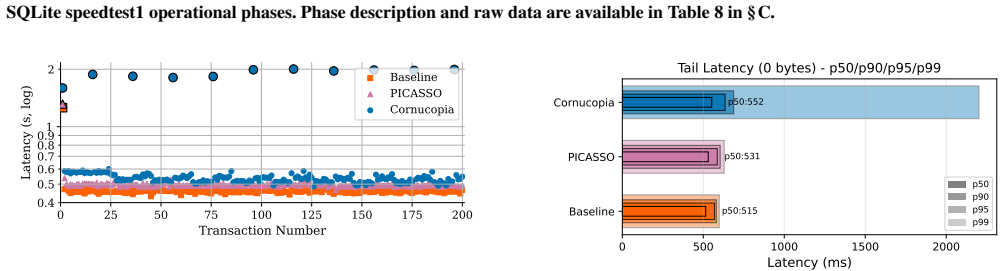
- [§7.2, Table 4] The pgbench p99 overhead for Cornucopia is reported as +305% in the text and +305.0% in the table; the gRPC text says "3.7× increase" while Table 7 reports +268.2% at p99. These are consistent with each other, but the narrative would benefit from a uniform percentage/multiple convention.
Circularity Check
No circular derivation found: PICASSO's guarantees are design-by-construction, and its security and performance results are measured against external benchmarks; the fence-coherence caveat is a correctness risk, not circularity.
full rationale
The paper's derivation chain is not circular. The central guarantee in §5.2 — 'Once a provenance identifier has been invalidated, the hardware ensures that all capabilities with that provenance identifier cannot be dereferenced' — restates the architectural definition in §6.1 that loads/stores via colored capabilities 'implicitly read the corresponding 1-bit PVT entry ... and fault if the PVB indicates the provenance is invalid.' That is the intended mechanism of the design, not a fitted prediction derived from an input that already contains the output. The paper's independent content is the implementation and the external evaluation: Juliet CWE-416/CWE-415 cases, SPEC CPU2006, SQLite, pgbench, and gRPC are all external benchmarks measured on the shipped design, and the revocation counts (e.g., PICASSO revoking once per 66,000 pgbench transactions vs. once per 20 for Cornucopia) are observed outcomes, not numbers forced by construction. The PVT-buffer geometry (64 words, 4-way) is an engineering optimization evaluated on bzip2, and bzip2 also appears in the SPEC aggregate; this is a mild evaluation-economy caveat, not a circular reduction. The one significant weakness is an omitted proof, not circularity: §6.1 states 'correctness relies on fences accompanying page-table updates and writes to the PVT,' while the MRS free() path in §6.2/Figure 9 invalidates the PVB without explicitly showing a fence, and the PVT buffer caches valid PVBs and is invalidated only on fences. If a stale PVB=1 were observable, the G1 guarantee would fail; Juliet does not exercise that microarchitectural timing. This is a correctness/completeness risk to flag, but it does not make any result equivalent to its input, so the circularity score is 0.
Axiom & Free-Parameter Ledger
free parameters (3)
- Revocation trigger threshold (provenance-ID low-water mark) =
<1% of ~2^21 unclaimed IDs (default)
- OTYPETH CSR threshold =
not stated
- PVT buffer geometry =
64 words, 4-way set-associative (~8K cached PVBs)
axioms (5)
- domain assumption CHERI spatial safety holds: capabilities cannot be forged or widened; bounds and permissions are monotonically non-increasing; allocator satisfies A1-A3.
- domain assumption A revocation sweep finds every surviving capability with a given provenance ID before that ID is reused.
- ad hoc to paper PVT-buffer coherence: every PVB write and relevant page-table update is accompanied by a fence that invalidates cached PVBs before subsequent colored accesses.
- ad hoc to paper All memory accesses that can touch heap data via a colored capability pass through the PVB-checking load/store path.
- ad hoc to paper Software does not rely on otype values in the colored range for sealing; OTYPETH cleanly separates colored from sealed capabilities.
invented entities (3)
-
Colored capability (provenance ID in otype field + ccsettype instruction)
no independent evidence
-
Provenance-validity table (PVT) with 1-bit PVBs
no independent evidence
-
OTYPETH CSR
no independent evidence
read the original abstract
While the CHERI instruction-set architecture extensions for capabilities enable strong spatial memory safety, CHERI lacks built-in temporal safety, particularly for heap allocations. Prior attempts to augment CHERI with temporal safety fall short in terms of scalability, memory overhead, and incomplete security guarantees due to periodical sweeps of the system's memory to individually revoke stale capabilities. We address these limitations by introducing colored capabilities that add a controlled form of indirection to CHERI's capability model. This enables provenance tracking of capabilities to their respective allocations via a hardware-managed provenance-validity table, allowing bulk retraction of dangling pointers without needing to quarantine freed memory. Colored capabilities significantly reduce the frequency of capability revocation sweeps while improving security. We realize colored capabilities in PICASSO, an extension of the CHERI-RISC-V architecture on a speculative out-of-order FPGA softcore (CHERI-Toooba). We also integrate colored-capability support into the CheriBSD OS and CHERI-enabled Clang/LLVM toolchain. Our evaluation shows effective mitigation of use-after-free and double-free bugs across all heap-based temporal memory-safety vulnerabilities in NIST Juliet test cases, , real-world CVEs, only a small performance overhead on SPEC CPU benchmarks (5% g.m.), less latency, and more consistent performance in long-running SQLite, PostgreSQL, and gRPC workloads compared to prior work.
Figures




Forward citations
Cited by 1 Pith paper
-
PoisonCap: Efficient Hierarchical Temporal Safety for CHERI
PoisonCap uses a new poison capability format to deliver strict use-after-free and initialization safety for CHERI systems with no fundamental overhead over Cornucopia baselines.
Reference graph
Works this paper leans on
-
[1]
[n. d.]. SPEC CPU 2006. https://www.spec.org/cpu2006/
2006
-
[2]
[n. d.]. SQLite Home Page. https://sqlite.org/
-
[3]
John Hennessy and David Patterson 2017 ACM A.M
2018. John Hennessy and David Patterson 2017 ACM A.M. Turing Award Lecture. https://www.youtube.com/watch?v=3LVeEjsn8Ts
2018
-
[4]
CTSRD-CHERI/Postgres
2023. CTSRD-CHERI/Postgres. Capability Hardware Enhanced RISC Instruc- tions. https://github.com/CTSRD-CHERI/postgres
2023
-
[5]
Junho Ahn, and others. 2024. BUDAlloc: Defeating Use-after-Free Bugs by Decoupling Virtual Address Management from Kernel. InUSENIX Security ’24. USENIX, 181–197. https://www.usenix.org/conference/usenixsecurity24/ presentation/ahn
2024
-
[7]
Thomas Aird, and others. 2025. "Svucrg" Extension, Version 1.0 for RV64Y (Stable State). https://riscv.github.io/riscv-cheri/#section_cheri_priv_crg_ext
2025
-
[8]
Thomas Aird, and others. 2025. "Svy" Extension, Version 1.0 for RV64Y (Stable State). https://riscv.github.io/riscv-cheri/#section_priv_cheri_vmem 13
2025
-
[9]
Periklis Akritidis. 2010. Cling: A Memory Allocator to Mitigate Dangling Pointers. InUSENIX Security ’10. USENIX, 12. https://www.usenix.org/conference/ usenixsecurity10/cling-memory-allocator-mitigate-dangling-pointers
2010
-
[10]
2023.CHERIoT: Rethinking Security for Low-Cost Embedded Systems
Saar Amar, and others. 2023.CHERIoT: Rethinking Security for Low-Cost Embedded Systems. Technical Report MSR-TR-2023-6. Mi- crosoft. https://www.microsoft.com/en-us/research/wp-content/uploads/2023/02/ cheriot-63e11a4f1e629.pdf
2023
-
[11]
Saar Amar, and others. 2023. CHERIoT: Complete Memory Safety for Embedded Devices. InMICRO ’23. ACM, 641–653. doi:10.1145/3613424.3614266
arXiv 2023
-
[12]
Emery D. Berger and Benjamin G. Zorn. 2006. DieHard: Probabilistic Memory Safety for Unsafe Languages. InPLDI ’06. ACM, 158–168. doi:10.1145/1133981. 1134000
doi:10.1145/1133981 2006
-
[13]
Tim Boland and Paul E. Black. 2012. Juliet 1.1 C/C++and Java Test Suite. Computer45, 10 (Oct. 2012), 88–90. doi:10.1109/MC.2012.345
-
[14]
Jacob Bramley, and others. 2023. Picking a CHERI Allocator: Security and Per- formance Considerations. InISMM 2023. ACM, 111–123. doi:10.1145/3591195. 3595278
-
[15]
Juan Caballero, and others. 2012. Undangle: Early Detection of Dangling Pointers in Use-after-Free and Double-Free Vulnerabilities. InISSTA ’12. ACM, 133–143. doi:10.1145/2338965.2336769
arXiv 2012
-
[16]
Paolo Carlini, and others. 2025. The Bitmap_allocator. https://gcc.gnu.org/ onlinedocs/gcc-15.2.0/libstdc++/manual/manual/bitmap_allocator.html
2025
-
[17]
David Chisnall, and others. 2017. CHERI JNI: Sinking the Java Security Model into the C. InASPLOS ’17. ACM, 569–583. doi:10.1145/3037697.3037725
arXiv 2017
-
[19]
Jim Chow, and others. 2005. Shredding Your Garbage: Reducing Data Lifetime Through Secure Deallocation. InUSENIX Security ’15. USENIX. https://www.usenix.org/conference/14th-usenix-security-symposium/ shredding-your-garbage-reducing-data-lifetime-through
2005
-
[20]
Thurston H. Y . Dang, Petros Maniatis, and David Wagner. 2017. Oscar: A Practical Page-Permissions-Based Scheme for Thwarting Dangling Pointers. In USENIX Security ’17. USENIX, 815–832. https://www.usenix.org/conference/ usenixsecurity17/technical-sessions/presentation/dang
2017
-
[21]
Jack B. Dennis and Earl C. Van Horn. 1966. Programming Semantics for Mul- tiprogrammed Computations.Commun. ACM9, 3 (March 1966), 143–155. doi:10.1145/365230.365252
arXiv 1966
-
[22]
Gregory J. Duck and Roland H. C. Yap. 2018. EffectiveSan: Type and Memory Error Detection Using Dynamically Typed C/C++. InPLDI ’18. ACM, 181–195. doi:10.1145/3192366.3192388
arXiv 2018
-
[23]
EEMBC. 2024. Eembc/Coremark. Embedded Microprocessor Benchmark Con- sortium. https://github.com/eembc/coremark
2024
-
[24]
Hossam ElAtali, and others. 2025. BLACKOUT: Data-Oblivious Computation with Blinded Capabilities. InCCS ’25. ACM, 2039–2053. doi:10.1145/3719027. 3765169
doi:10.1145/3719027 2025
-
[25]
Márton Erd˝os, Sam Ainsworth, and Timothy M. Jones. 2022. MineSweeper: A “Clean Sweep” for Drop-in Use-after-Free Prevention. InASPLOS ’22. ACM, 212–225. doi:10.1145/3503222.3507712
arXiv 2022
-
[26]
Reza Mirzazade Farkhani, Mansour Ahmadi, and Long Lu. 2021. PTAuth: Tem- poral Memory Safety via Robust Points-to Authentication. InUSENIX Security ’21. USENIX, 1037–1054. https://www.usenix.org/conference/usenixsecurity21/ presentation/mirzazade
2021
-
[27]
Nathaniel Filardo. 2024. For Discussion: MSR’s CHERI+MTE Composition. https://github.com/riscv/riscv-cheri/issues/340
2024
-
[28]
Nathaniel Wesley Filardo, and others. 2024. Cornucopia Reloaded: Load Barriers for CHERI Heap Temporal Safety. InASPLOS ’24. ACM, 251–268. doi:10.1145/ 3620665.3640416
arXiv 2024
-
[29]
Franz A. Fuchs, and others. 2024. Safe Speculation for CHERI. InICCD ’24. IEEE, 364–372. doi:10.1109/ICCD63220.2024.00063
arXiv 2024
-
[30]
Franz A Fuchs, and others. 2023. Architectural Contracts for Safe Speculation. doi:10.1109/ICCD58817.2023.00093
arXiv 2023
-
[31]
Aïna Linn Georges, and others. 2021. Efficient and Provable Local Capability Revocation Using Uninitialized Capabilities. InPOPL ’21. 6:1–6:30. doi:10.1145/ 3434287
2021
-
[32]
Richard Grisenthwaite. 2022. Arm Morello Evaluation Platform -Validating CHERI-based Security in a High-performance System. InHCS ’22. IEEE, 1–22. doi:10.1109/HCS55958.2022.9895591
arXiv 2022
-
[33]
PostgreSQL Global Development Group. 2026. PostgreSQL. https://www. postgresql.org/
2026
-
[34]
Merve Gülmez, and others. 2025. Mon CHÉRI: Mitigating Uninitialized Memory Access with Conditional Capabilities. InS&P ’15. IEEE, 829–847. doi:10.1109/ SP61157.2025.00133
arXiv 2025
-
[35]
2020.Security Analysis of CHERI ISA
Nicolas Joly, Saif ElSherei, and Saar Amar. 2020.Security Analysis of CHERI ISA. Technical Report. Microsoft Security Response Center. 42 pages. https: //msrc.microsoft.com/blog/2020/10/security-analysis-of-cheri-isa/
2020
-
[37]
Henry M. Levy. 1984.Capability-Based Computer Systems. Butterworth- Heinemann. https://homes.cs.washington.edu/~levy/capabook/
1984
-
[38]
Yuan Li, and others. 2022. PACMem: Enforcing Spatial and Temporal Memory Safety via ARM Pointer Authentication. InCCS ’22. ACM, 1901–1915. doi:10. 1145/3548606.3560598
arXiv 2022
-
[39]
Beichen Liu, Pierre Olivier, and Binoy Ravindran. 2019. SlimGuard: A Secure and Memory-Efficient Heap Allocator. InMiddleware ’19. ACM, 1–13. doi:10. 1145/3361525.3361532
arXiv 2019
-
[40]
Daiping Liu, Mingwei Zhang, and Haining Wang. 2018. A Robust and Efficient Defense against Use-after-Free Exploits via Concurrent Pointer Sweeping. InCCS ’18. ACM, 1635–1648. doi:10.1145/3243734.3243826
arXiv 2018
-
[41]
Alyssa Milburn, Herbert Bos, and Cristiano Giuffrida. 2017. SafeInit: Compre- hensive and Practical Mitigation of Uninitialized Read Vulnerabilities. Internet Society. doi:10.14722/ndss.2017.23183
arXiv 2017
-
[42]
MITRE. 2024. CWE-562: Return of Stack Variable Address (4.17). https: //cwe.mitre.org/data/definitions/562.html
2024
-
[43]
Santosh Nagarakatte, and others. 2010. CETS: Compiler Enforced Temporal Safety for C.SIGPLAN Not.45, 8 (June 2010), 31–40. doi:10.1145/1837855. 1806657
-
[44]
Gene Novark and Emery D. Berger. 2010. DieHarder: Securing the Heap. InCCS ’10. ACM, 573–584. doi:10.1145/1866307.1866371
arXiv 2010
-
[45]
Chanyoung Park and Hyungon Moon. 2024. Efficient Use-After-Free Prevention with Opportunistic Page-Level Sweeping. InNDSS 2024. Internet Society. doi:10. 14722/ndss.2024.24804
arXiv 2024
-
[46]
David D. Redell. 1974.Naming and Protection in Extendible Operating Systems. Technical Report MAC TR-140. Massachussets Institute of Technology. 169 pages. https://apps.dtic.mil/sti/tr/pdf/ADA001721.pdf
1974
-
[47]
2023.Efficient spatial and temporal safety for microcon- trollers and application-class processors
Peter David Rugg. 2023.Efficient spatial and temporal safety for microcon- trollers and application-class processors. Technical Report UCAM-CL-TR-984. University of Cambridge, Computer Laboratory. doi:10.48456/tr-984
-
[48]
Jerome H. Saltzer. 1974. Protection and the Control of Information Sharing in Multics.Commun. ACM17, 7 (July 1974), 388–402. doi:10.1145/361011.361067
arXiv 1974
-
[49]
2017.Pointer Authentication on ARMv8.3: Design and Analysis of the New Software Security Instructions
Qualcomm Product Security. 2017.Pointer Authentication on ARMv8.3: Design and Analysis of the New Software Security Instructions. Whitepaper. Qualcomm Technologies, Inc. 12 pages. https://www.qualcomm.com/content/dam/qcomm- martech/dm-assets/documents/pointer-auth-v7.pdf
2017
-
[50]
Ved Shanbhogue. 2024. "B" Extension for Bit Manipulation, Version 1.0.0 :: RISC- V Ratified Specifications Library. https://docs.riscv.org/reference/isa/unpriv/b-st- ext.html
2024
-
[51]
Sam Silvestro, and others. 2017. FreeGuard: A Faster Secure Heap Allocator. In CCS ’17. ACM, 2389–2403. doi:10.1145/3133956.3133957
arXiv 2017
-
[52]
Sam Silvestro, and others. 2018. Guarder: A Tunable Secure Allocator. In USENIX Security ’18. USENIX, 117–133. https://www.usenix.org/conference/ usenixsecurity18/presentation/silvestro
2018
-
[53]
GCC Team. 2025. Options to Request or Suppress Warnings: -Wno-return-local- addr. https://gcc.gnu.org/onlinedocs/gcc-15.2.0/gcc/Warning-Options.html# index-Wno-return-local-addr
2025
-
[54]
LLVM Team. 2025. Diagnostic Flags in Clang — Clang 22.0.0git Documen- tation. https://releases.llvm.org/20.1.0/tools/clang/docs/DiagnosticsReference. html#wreturn-stack-address
2025
-
[55]
LLVM Team. 2025. Scudo Hardened Allocator. https://releases.llvm.org/20.1.0/ docs/ScudoHardenedAllocator.html
2025
-
[56]
Craig Tiller, and others. 2025. gRPC. https://github.com/grpc/grpc/tree/v1.54.2
2025
-
[57]
Erik van der Kouwe, Vinod Nigade, and Cristiano Giuffrida. 2017. DangSan: Scalable Use-after-free Detection. InEuroSys ’17. ACM, 405–419. doi:10.1145/ 3064176.3064211
arXiv 2017
-
[58]
2019.An Introduction to CHERI
Robert N M Watson, and others. 2019.An Introduction to CHERI. Technical Report UCAM-CL-TR-941. Computer Laboratory, University of Cambridge. 43 pages pages. https://www.cl.cam.ac.uk/techreports/UCAM-CL-TR-941.pdf
2019
-
[59]
Robert N. M. Watson, and others. 2023.Capability Hardware Enhanced RISC Instructions: CHERI Instruction-Set Architecture (Version 9). Technical Report UCAM-CL-TR-987. Computer Laboratory, University of Cambridge. 523 pages pages. doi:10.48456/TR-987
doi:10.48456/tr-987 2023
-
[60]
Nathaniel Wesley Filardo, and others. 2020. Cornucopia: Temporal Safety for CHERI Heaps. InS&P ’20. IEEE, 608–625. doi:10.1109/SP40000.2020.00098
arXiv 2020
-
[61]
Brian Wickman, and others. 2021. Preventing Use-After-Free Attacks with Fast Forward Allocation. InUSENIX Security Symposium ’21. USENIX, 2453–2470. https://www.usenix.org/conference/usenixsecurity21/presentation/wickman
2021
-
[62]
Matthew Wilcox. 2025. ID Allocation. https://www.kernel.org/doc/html/v6.18/ core-api/idr.html#id-allocation
2025
-
[63]
Jonathan Woodruff, and others. 2019. CHERI Concentrate: Practical Compressed Capabilities.IEEE Trans. Comput.68, 10 (Oct. 2019), 1455–1469. doi:10.1109/ TC.2019.2914037
arXiv 2019
-
[64]
Yves Younan. 2015. FreeSentry: Protecting Against Use-After-Free Vulnerabilities Due to Dangling Pointers. InNDSS ’15. Internet Society. doi:10.14722/ndss.2015. 14 23190
-
[65]
claimed”, len=50}. To save memory, multiple small runs can be combined into one bitmap representation of a fixed size (in our case 512 bits), for example: {state=“claimed
Adam Zabrocki, and others. 2024. RISC-V Pointer Masking, Version 1.0 (Ratified). https://raw.githubusercontent.com/riscv/riscv-j-extension/master/zjpm-spec.pdf A QEMU Implementation We implemented a functional model of PICASSO in QEMU-system- CHERI128 to enable kernel development and functional validation prior to hardware development. The QEMU implementa...
2024
discussion (0)
Sign in with ORCID, Apple, or X to comment. Anyone can read and Pith papers without signing in.