Certifiable Factor Graph Optimization
Pith reviewed 2026-05-15 17:55 UTC · model grok-4.3
The pith
Certifiable estimators can be built directly from factor graphs because Shor's relaxation and Burer-Monteiro factorization preserve the original graph's connectivity.
A machine-rendered reading of the paper's core claim, the machinery that carries it, and where it could break.
Core claim
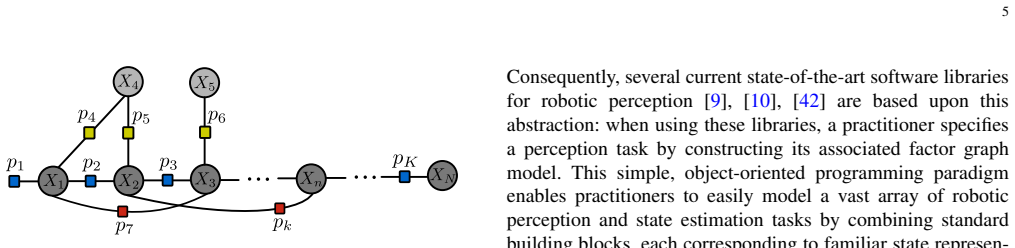
We show that the factor graph and certifiable estimation paradigms can be naturally synthesized into a unified framework for certifiable factor graph optimization. The key insight is that the core mathematical constructions used to develop certifiable estimators (Shor's relaxation and Burer-Monteiro factorization) inherit a factor graph structure from the original problem: applying these transformations to a QCQP-representable estimation task with an associated factor graph model yields a lifted problem with identical factor graph connectivity whose constituent variables and factors are simple one-to-one algebraic transformations of those appearing in the original QCQP's factor graph.
What carries the argument
The structure-preserving lift via Shor's relaxation and Burer-Monteiro factorization, which produces a lifted factor graph with exactly the same connectivity as the input QCQP factor graph.
If this is right
- Riemannian Staircase certifiable methods can be instantiated using existing mature factor graph libraries and workflows.
- Implementation effort for certifiable estimators drops from months of hand design to hours of library reuse.
- The resulting solvers are functionally equivalent to current state-of-the-art problem-specific certifiable methods on pose graph optimization, landmark SLAM, and range-aided SLAM benchmarks.
- A single unified framework now combines the modeling convenience of factor graphs with the optimality guarantees of certifiable estimation.
Where Pith is reading between the lines
- The same lifting argument might apply to other nonconvex problems that admit QCQP representations beyond the SLAM examples shown.
- Automated conversion routines could be built to generate the lifted factor graph directly from a standard factor graph description.
- Structure-preserving lifts may extend to additional convex relaxation techniques, such as higher-order SDP hierarchies.
Load-bearing premise
The estimation task must be representable as a QCQP whose factor graph connectivity is preserved exactly when the lifting operations are applied.
What would settle it
A concrete QCQP factor graph model in which applying Shor's relaxation or Burer-Monteiro factorization produces a lifted graph whose edges or variable-factor incidences differ from the original connectivity.
Figures


read the original abstract
We show that the factor graph and certifiable estimation paradigms, which have thus far been treated as essentially independent in the literature, can be naturally synthesized into a unified framework for certifiable factor graph optimization that combines the ease of use of the former with the strong performance guarantees of the latter. The key insight enabling our synthesis is that the core mathematical constructions used to develop certifiable estimators (Shor's relaxation and Burer-Monteiro factorization) inherit a factor graph structure from the original problem: applying these transformations to a QCQP-representable estimation task with an associated factor graph model yields a lifted problem with identical factor graph connectivity whose constituent variables and factors are simple one-to-one algebraic transformations (lifts) of those appearing in the original QCQP's factor graph. This correspondence enables the Riemannian Staircase methodology for certifiable estimation to be easily instantiated and deployed using the same mature, highly-performant factor graph libraries and workflows already ubiquitously employed throughout robotics and computer vision. Experimental evaluation on a variety of pose graph optimization, landmark SLAM, and range-aided SLAM benchmarks demonstrates that our certifiable factor graph optimization methodology enables the implementation of certifiable estimators that are functionally equivalent to current state-of-the-art hand-designed, problem-specific methods, while dramatically reducing the required implementation effort from the order of months to hours.
Editorial analysis
A structured set of objections, weighed in public.
Referee Report
Summary. The manuscript claims to synthesize the factor graph and certifiable estimation paradigms by proving that Shor's relaxation and Burer-Monteiro factorization inherit the factor graph structure from QCQP-representable problems, resulting in lifted problems with identical connectivity. This enables the application of Riemannian Staircase methods using standard factor graph libraries for tasks like pose graph optimization and SLAM, with experiments showing functional equivalence to specialized certifiable estimators while greatly reducing implementation effort.
Significance. This result, if correct, has high significance for the field as it combines the usability of factor graph models with the theoretical guarantees of certifiable optimization. The key strength is the structural preservation under lifting, which allows leveraging existing high-performance libraries. The benchmark evaluations provide evidence of practical equivalence, supporting the claim of dramatically reduced development time.
minor comments (2)
- [Abstract] The phrase 'functionally equivalent to current state-of-the-art hand-designed, problem-specific methods' should be supported by specific metrics in the experimental section to allow readers to assess the degree of equivalence.
- Consider adding a discussion on the limitations, such as which estimation problems are QCQP-representable and thus covered by this framework.
Simulated Author's Rebuttal
We thank the referee for their positive evaluation of our manuscript and for recommending minor revision. The referee's summary correctly identifies the core contribution: that Shor's relaxation and Burer-Monteiro factorization preserve the factor-graph connectivity of QCQP-representable problems, enabling the use of existing factor-graph libraries for certifiable estimation. We appreciate the recognition that this synthesis reduces implementation effort while maintaining functional equivalence to specialized methods.
Circularity Check
No significant circularity
full rationale
The paper's derivation rests on the algebraic observation that Shor's relaxation and Burer-Monteiro factorization preserve the exact factor-graph connectivity of any QCQP whose quadratic terms respect a given sparsity pattern. Each original term x_a^T M x_b lifts to trace(M X_ba) with X = Y Y^T, which depends only on the blocks Y_a and Y_b corresponding to the original edge; unary terms lift to unaries and the global PSD constraint is replaced by the factorization without introducing new edges. This structural invariance follows directly from the block-sparsity of Q and holds for any QCQP-representable problem; it is not obtained by fitting parameters, self-definition, or load-bearing self-citation. The abstract and skeptic analysis confirm the claim is a direct consequence of the lift operations rather than a renaming or imported uniqueness result.
Axiom & Free-Parameter Ledger
axioms (1)
- domain assumption Estimation tasks can be represented as QCQPs that possess an associated factor graph model
Reference graph
Works this paper leans on
- [1]
-
[2]
T. D. Barfoot,State Estimation for Robotics. Cambridge University Press, 2017
work page 2017
-
[3]
C. Cadena, L. Carlone, H. Carrillo, Y . Latif, D. Scaramuzza, J. Neira, I. Reid, and J. J. Leonard, “Past, present, and future of simultaneous localization and mapping: Toward the robust-perception age,”IEEE Transactions on Robotics, vol. 32, no. 6, pp. 1309–1332, 2016
work page 2016
-
[4]
Advances in inference and representation for simultaneous localization and mapping,
D. M. Rosen, K. J. Doherty, A. Ter ´an Espinoza, and J. J. Leonard, “Advances in inference and representation for simultaneous localization and mapping,”Annual Review of Control, Robotics, and Autonomous Systems, vol. 4, no. 1, pp. 215–242, 2021
work page 2021
-
[5]
Structure-from-motion revisited,
J. L. Schonberger and J.-M. Frahm, “Structure-from-motion revisited,” in IEEE Conference on Computer Vision and Pattern Recognition (CVPR), 2016, pp. 4104–4113
work page 2016
-
[6]
Factor graphs for robot perception,
F. Dellaert, M. Kaesset al., “Factor graphs for robot perception,” Foundations and Trends® in Robotics, vol. 6, no. 1-2, pp. 1–139, 2017
work page 2017
-
[7]
T. Cover and J. Thomas,Elements of Information Theory, 2nd ed. John Wiley & Sons, 2006
work page 2006
-
[8]
Factor graphs and GTSAM: A hands-on introduction,
F. Dellaert, “Factor graphs and GTSAM: A hands-on introduction,” Institute for Robotics & Intelligent Machines, Georgia Institute of Technology, Tech. Rep. GT-RIM-CP&R-2012-002, Sep. 2012
work page 2012
-
[9]
g2o: A general framework for graph optimization,
R. K ¨ummerle, G. Grisetti, H. Strasdat, K. Konolige, and W. Burgard, “g2o: A general framework for graph optimization,” inIEEE Interna- tional Conference on Robotics and Automation (ICRA). IEEE, 2011, pp. 3607–3613
work page 2011
-
[10]
Ceres solver: Tutorial & reference,
S. Agarwal, K. Mierleet al., “Ceres solver: Tutorial & reference,” Google Inc, vol. 2, no. 72, p. 8, 2012
work page 2012
-
[11]
Certifiably optimal solvers and theoretical properties of SLAM,
D. M. Rosen, K. Khosoussi, C. Holmes, G. Dissanayake, T. Barfoot, and L. Carlone, “Certifiably optimal solvers and theoretical properties of SLAM,” inSLAM Handbook: From Localization and Mapping to Spatial Intelligence, L. Carlone, A. Kim, T. Barfoot, D. Cremers, and F. Dellaert, Eds. Cambridge University Press
-
[12]
M. Todd, “Semidefinite optimization,”Acta Numerica, vol. 10, pp. 515– 560, 2001
work page 2001
-
[13]
Quadratic optimization problems,
N. Z. Shor, “Quadratic optimization problems,”Soviet Journal of Com- puter and Systems Sciences, vol. 25, pp. 1–11, 1987
work page 1987
-
[14]
A nonlinear programming algorithm for solving semidefinite programs via low-rank factorization,
S. Burer and R. D. Monteiro, “A nonlinear programming algorithm for solving semidefinite programs via low-rank factorization,”Mathematical Programming, vol. 95, no. 2, pp. 329–357, 2003
work page 2003
-
[15]
The non-convex Burer- Monteiro approach works on smooth semidefinite programs,
N. Boumal, V . V oroninski, and A. Bandeira, “The non-convex Burer- Monteiro approach works on smooth semidefinite programs,”Advances in Neural Information Processing Systems, vol. 29, 2016
work page 2016
-
[16]
Boumal,An introduction to optimization on smooth manifolds
N. Boumal,An introduction to optimization on smooth manifolds. Cambridge University Press, 2023
work page 2023
-
[17]
J. Nocedal and S. J. Wright,Numerical Optimization, 2nd ed., ser. Springer Series in Operations Research and Financial Engineering. New York: Springer, 2006
work page 2006
-
[18]
iSAM: Incremental smooth- ing and mapping,
M. Kaess, A. Ranganathan, and F. Dellaert, “iSAM: Incremental smooth- ing and mapping,”IEEE Transactions on Robotics, vol. 24, no. 6, pp. 1365–1378, 2008
work page 2008
-
[19]
iSAM2: Incremental smoothing and mapping using the bayes tree,
M. Kaess, H. Johannsson, R. Roberts, V . Ila, J. J. Leonard, and F. Dellaert, “iSAM2: Incremental smoothing and mapping using the bayes tree,”The International Journal of Robotics Research, vol. 31, no. 2, pp. 216–235, 2012
work page 2012
-
[20]
SE- Sync: A certifiably correct algorithm for synchronization over the special Euclidean group,
D. M. Rosen, L. Carlone, A. S. Bandeira, and J. J. Leonard, “SE- Sync: A certifiably correct algorithm for synchronization over the special Euclidean group,”The International Journal of Robotics Research, vol. 38, no. 2-3, pp. 95–125, 2019
work page 2019
-
[21]
ApS,The MOSEK optimization toolbox for MATLAB manual
M. ApS,The MOSEK optimization toolbox for MATLAB manual. Version 9.0., 2019. [Online]. Available: http://docs.mosek.com/9.0/ toolbox/index.html
work page 2019
-
[22]
Using SeDuMi 1.02, a MATLAB toolbox for optimization over symmetric cones,
J. Sturm, “Using SeDuMi 1.02, a MATLAB toolbox for optimization over symmetric cones,”Optimization Methods and Software, vol. 11, no. 1–4, pp. 625–653, 1999
work page 1999
-
[23]
SDPT3 – a MATLAB software package for semidefinite programming,
K. Toh, M. Todd, and R. T ¨ut¨unc¨u, “SDPT3 – a MATLAB software package for semidefinite programming,”Optimization Methods and Software, vol. 11, no. 1–4, pp. 545–581, 1999
work page 1999
-
[24]
Implementation and evaluation of SDPA 6.0 (semidefinite programming algorithm 6.0),
M. Yamashita, K. Fujisawa, and M. Kojima, “Implementation and evaluation of SDPA 6.0 (semidefinite programming algorithm 6.0),” Optimization Methods and Software, vol. 18, no. 4, pp. 491–505, Aug. 2003
work page 2003
-
[25]
A tutorial on graph-based SLAM,
G. Grisetti, R. K ¨ummerle, C. Stachniss, and W. Burgard, “A tutorial on graph-based SLAM,”IEEE Intelligent Transportation Systems Mag- azine, vol. 2, no. 4, pp. 31–43, 2011
work page 2011
-
[26]
Bundle adjustment in the large,
S. Agarwal, N. Snavely, S. M. Seitz, and R. Szeliski, “Bundle adjustment in the large,” inEuropean Conference on Computer Vision ECCV. Springer, 2010, pp. 29–42
work page 2010
-
[27]
A. Majumdar, G. Hall, and A. Ahmadi, “Recent scalability improve- ments for semidefinite programming with applications in machine learn- ing, control and robotics,”Annu. Rev. Control Robot. Auton. Syst., vol. 3, pp. 331–360, 2020
work page 2020
-
[28]
A. A. Ahmadi and A. Majumdar, “DSOS and SDSOS optimization: More tractable alternatives to sum of squares and semidefinite optimiza- tion,”SIAM Journal on Applied Algebra and Geometry, vol. 3, no. 2, pp. 193–230, 2019
work page 2019
-
[29]
Chordal graphs and semidefinite optimization,
L. Vandenberghe and M. Andersen, “Chordal graphs and semidefinite optimization,”Foundations and Trends in Optimization, vol. 1, no. 4, pp. 241–433, 2015
work page 2015
-
[30]
S. Boyd, N. Parikh, E. Chu, B. Peleato, and J. Eckstein, “Distributed optimization and statistical learning via the alternating direction method of multipliers,”Foundations and Trends in Machine Learning, vol. 3, no. 1, pp. 1–122, 2011
work page 2011
-
[31]
Scalable low-rank semidefinite programming for certi- fiably correct machine perception,
D. M. Rosen, “Scalable low-rank semidefinite programming for certi- fiably correct machine perception,” inInternational Workshop on the Algorithmic Foundations of Robotics. Springer, 2020, pp. 551–566. 20
work page 2020
-
[32]
Cartan-sync: Fast and global se (d)- synchronization,
J. Briales and J. Gonzalez-Jimenez, “Cartan-sync: Fast and global se (d)- synchronization,”IEEE Robotics and Automation Letters, vol. 2, no. 4, pp. 2127–2134, 2017
work page 2017
-
[33]
An efficient global optimality certificate for landmark-based SLAM,
C. Holmes and T. D. Barfoot, “An efficient global optimality certificate for landmark-based SLAM,”IEEE Robotics and Automation Letters, vol. 8, no. 3, pp. 1539–1546, 2023
work page 2023
-
[34]
T. Fan, H. Wang, M. Rubenstein, and T. Murphey, “CPL-SLAM: Effi- cient and certifiably correct planar graph-based SLAM using the com- plex number representation,”IEEE Transactions on Robotics, vol. 36, no. 6, pp. 1719–1737, 2020
work page 2020
-
[35]
Certifiably correct range-aided SLAM,
A. Papalia, A. Fishberg, B. W. O’Neill, J. P. How, D. M. Rosen, and J. J. Leonard, “Certifiably correct range-aided SLAM,”IEEE Transactions on Robotics, vol. 40, pp. 4265–4283, 2024
work page 2024
-
[36]
Distributed certifi- ably correct pose-graph optimization,
Y . Tian, K. Khosoussi, D. M. Rosen, and J. P. How, “Distributed certifi- ably correct pose-graph optimization,”IEEE Transactions on Robotics, vol. 37, no. 6, pp. 2137–2156, 2021
work page 2021
-
[37]
Building Rome with convex optimization,
H. Han and H. Yang, “Building Rome with convex optimization,” in Robotics: Science and Systems, Los Angeles, CA, USA, 2025
work page 2025
-
[38]
A. W ¨achter and L. Biegler, “On the implementation of an interior- point filter line-search algorithm for large-scale nonlinear programming,” Mathematical Programming, vol. 106, pp. 25–57, 2006
work page 2006
-
[39]
KNITRO: An integrated pack- age for nonlinear optimization,
R. H. Byrd, J. Nocedal, and R. A. Waltz, “KNITRO: An integrated pack- age for nonlinear optimization,” inLarge-Scale Nonlinear Optimization, G. di Pillo and M. Roma, Eds. Springer, 2006, pp. 35–59
work page 2006
- [40]
-
[41]
Shonan rotation averaging: Global optimality by surfingSO(p) n,
F. Dellaert, D. M. Rosen, J. Wu, R. Mahony, and L. Carlone, “Shonan rotation averaging: Global optimality by surfingSO(p) n,” inEuropean Conference on Computer Vision (ECCV), Aug. 2020
work page 2020
-
[42]
F. Dellaert and G. Contributors, “borglab/gtsam,” May 2022. [Online]. Available: https://github.com/borglab/gtsam
work page 2022
-
[43]
P. Huber,Robust Statistics. Hoboken, N.J.: John Wiley & Sons, 2004
work page 2004
-
[44]
Ferguson,A Course in Large Sample Theory
T. Ferguson,A Course in Large Sample Theory. Boca Raton, FL: Chapman & Hall/CRC, 1996
work page 1996
-
[45]
Rise: An incremental trust- region method for robust online sparse least-squares estimation,
D. M. Rosen, M. Kaess, and J. J. Leonard, “Rise: An incremental trust- region method for robust online sparse least-squares estimation,”IEEE Transactions on Robotics, vol. 30, no. 5, pp. 1091–1108, 2014
work page 2014
-
[46]
F. A. Potra and S. J. Wright, “Interior-point methods,”Journal of computational and applied mathematics, vol. 124, no. 1-2, pp. 281–302, 2000
work page 2000
-
[47]
On the local stability of semidefinite relaxations,
D. Cifuentes, S. Agarwal, P. A. Parrilo, and R. R. Thomas, “On the local stability of semidefinite relaxations,”Mathematical Programming, vol. 193, no. 2, pp. 629–663, 2022
work page 2022
-
[48]
S. P. Boyd and L. Vandenberghe,Convex optimization. Cambridge university press, 2004
work page 2004
-
[49]
N. Boumal, “A Riemannian low-rank method for optimization over semidefinite matrices with block-diagonal constraints,”arXiv preprint arXiv:1506.00575, 2015
work page internal anchor Pith review Pith/arXiv arXiv 2015
-
[50]
An overview of the Burer-Monteiro method for certifiable robot perception,
A. Papalia, Y . Tian, D. Rosen, J. How, and J. Leonard, “An overview of the Burer-Monteiro method for certifiable robot perception,”arXiv preprint arXiv:2410.00117, 2024
-
[51]
Manopt, a MATLAB toolbox for optimization on manifolds
N. Boumal, B. Mishra, P.-A. Absil, and R. Sepulchre, “Manopt, a MATLAB toolbox for optimization on manifolds.”Journal of Machine Learning Research, vol. 15, no. 1, pp. 1455–1459, 2014
work page 2014
-
[52]
The Riemannian elevator for certifiable distance-based localization,
T. Halsted and M. Schwager, “The Riemannian elevator for certifiable distance-based localization,”Preprint, 2022
work page 2022
-
[53]
J. E. Guivant and E. M. Nebot, “Optimization of the simultaneous localization and map-building algorithm for real-time implementation,” IEEE transactions on robotics and automation, vol. 17, no. 3, pp. 242– 257, 2002
work page 2002
-
[54]
Robust range-only beacon localization,
E. Olson, J. J. Leonard, and S. Teller, “Robust range-only beacon localization,”IEEE Journal of Oceanic Engineering, vol. 31, no. 4, pp. 949–958, 2007
work page 2007
-
[55]
Navigating with ranging radios: Five data sets with ground truth,
J. Djugash, B. Hamner, and S. Roth, “Navigating with ranging radios: Five data sets with ground truth,”Journal of Field Robotics, vol. 26, no. 9, pp. 689–695, 2009
work page 2009
-
[56]
The utias multi- robot cooperative localization and mapping dataset,
K. Y . Leung, Y . Halpern, T. D. Barfoot, and H. H. Liu, “The utias multi- robot cooperative localization and mapping dataset,”The International Journal of Robotics Research, vol. 30, no. 8, pp. 969–974, 2011
work page 2011
-
[57]
SCORE: A second-order conic initialization for range-aided SLAM,
A. Papalia, J. Morales, J. Doherty, D. Rosen, and J. Leonard, “SCORE: A second-order conic initialization for range-aided SLAM,” inIEEE Intl. Conf. on Robotics and Automation (ICRA), London, UK, May 2023, pp. 10 637–10 644
work page 2023
-
[58]
Accelerating certifiable estimation with preconditioned eigensolvers,
D. M. Rosen, “Accelerating certifiable estimation with preconditioned eigensolvers,”IEEE Robotics and Automation Letters, vol. 7, no. 4, pp. 12 507–12 514, 2022
work page 2022
discussion (0)
Sign in with ORCID, Apple, or X to comment. Anyone can read and Pith papers without signing in.