Fractional topology and multi-period re-quantization in open quantum systems
Pith reviewed 2026-05-15 17:18 UTC · model grok-4.3
The pith
Open quantum systems exhibit fractional topological winding numbers over one Brillouin zone that recover integer values when extended over multiple momentum periods.
A machine-rendered reading of the paper's core claim, the machinery that carries it, and where it could break.
Core claim
Under symmetry conditions that keep physical states single-valued in momentum space, the winding number remains integer throughout the time evolution of an open quantum system. Fractional topology arises once this single-valued condition is relaxed, either by restricting the sector or through a multi-branch structure, so that the winding number is no longer quantized over the fundamental Brillouin zone and varies continuously with parameters, with discontinuities at purity-gap closings. When the same winding is instead computed over multiple momentum periods, integer quantization is recovered.
What carries the argument
The winding number extracted from the momentum-space density matrix under Lindblad evolution, which becomes fractional due to restricted sectors or multi-branch structures but re-quantizes when extended over multiple periods.
If this is right
- The winding number remains integer during time evolution whenever the symmetry conditions hold.
- Fractional values vary continuously with system parameters and jump only at purity-gap closings.
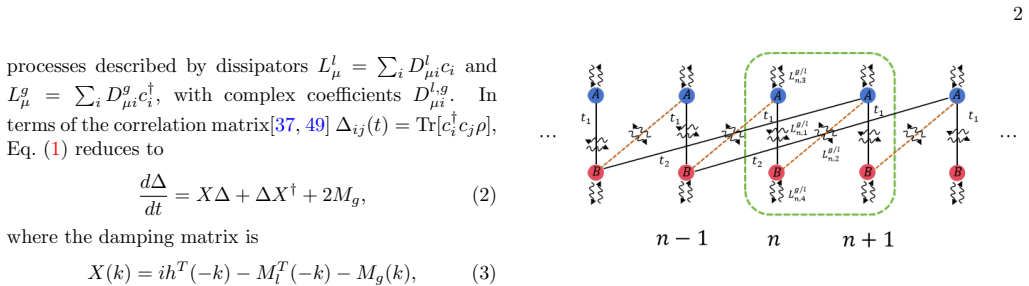
- The fractional topology appears in a Su-Schrieffer-Heeger chain with gain and loss.
- The effects can be probed via Bloch state tomography in long-range hopping photonic lattices with fractional fillings.
Where Pith is reading between the lines
- Multi-period re-quantization may offer a practical route to extract stable topological information from dissipative experiments.
- The same fractional-to-integer transition could occur in other open-system models that share the multi-branch structure.
- Photonic lattices with tunable gain and loss could serve as test beds to map how purity gaps control the appearance of fractional windings.
Load-bearing premise
Symmetry conditions must keep physical states single-valued in momentum space so that the winding number stays integer and constant during time evolution.
What would settle it
In a gain-loss Su-Schrieffer-Heeger chain, measure the winding number over one Brillouin zone and then over several periods to check whether fractional values appear and then return to integers, especially near purity-gap closings.
Figures


read the original abstract
We study fractional topological numbers in open quantum systems described by the Gorin--Kossakowski--Sudarsha--Lindblad master equation. Under symmetry conditions ensuring quantization, we show that single-valued physical states in momentum space give rise to integer winding numbers that remain integer during time evolution. Fractional values arise when this condition is effectively relaxed, such that the topology is evaluated over a restricted sector or exhibits an effective multi-branch structure. In these cases, the winding number is not quantized over the fundamental Brillouin zone and can depend continuously on system parameters, with discontinuities at purity-gap closings. However, when extended over multiple momentum periods, the winding recovers integer quantization. These effects are illustrated in a Su--Schrieffer--Heeger chain with gain and loss and can be probed in long-range hopping photonic lattices with fractional fillings via Bloch state tomography. Our results provide a unified framework for understanding fractional topology in open quantum systems.
Editorial analysis
A structured set of objections, weighed in public.
Referee Report
Summary. The manuscript examines fractional topological numbers in open quantum systems governed by the Gorin-Kossakowski-Sudarshan-Lindblad master equation. Under symmetry conditions that enforce quantization, single-valued physical states in momentum space yield integer winding numbers that remain invariant under time evolution. Fractional values appear when single-valuedness is relaxed over a restricted sector or multi-branch structure, rendering the winding non-quantized and parameter-dependent over the fundamental Brillouin zone, with discontinuities at purity-gap closings. The central claim is that extending the winding integral over multiple momentum periods restores exact integer quantization. The framework is illustrated via a Su-Schrieffer-Heeger chain with gain and loss and proposed for experimental probing in long-range hopping photonic lattices using Bloch state tomography.
Significance. If the multi-period re-quantization rule can be made explicit and shown to be consistent with the Lindblad steady state, the work would supply a unified account of how fractional topology arises and is regularized in dissipative systems. Strengths include the parameter-free character of the symmetry-protected integer case and the direct link to an experimentally accessible platform. However, the absence of derivations, explicit integral definitions, or numerical verification in the available text leaves the load-bearing claim unverifiable at present.
major comments (2)
- [Abstract] Abstract: The statement that 'when extended over multiple momentum periods, the winding recovers integer quantization' is load-bearing for the central claim yet supplies no explicit construction of the multi-period winding integral. It remains unclear whether the extension is defined by (i) periodic repetition of the Bloch Hamiltonian, (ii) analytic continuation across branch cuts, or (iii) a rescaled variable k' = k/N. Without this rule, consistency with the GKSL evolution and the absence of reappearing discontinuities cannot be checked.
- [Abstract] Abstract and SSH illustration: The claim that fractional winding is realized in the Su-Schrieffer-Heeger chain with gain and loss and that integer recovery occurs upon multi-period extension is asserted without reference to the steady-state solution of the master equation or to the explicit form of the winding integral. The text must demonstrate that the Lindblad evolution preserves the multi-period quantization once the extension rule is stated.
minor comments (1)
- [Abstract] The abstract refers to 'purity-gap closings' without a prior definition; a brief parenthetical or footnote linking this notion to the standard purity gap of the Lindblad steady state would improve readability.
Simulated Author's Rebuttal
We thank the referee for the careful reading and constructive comments on arXiv:2603.03854. We address the major concerns below by providing the explicit multi-period winding construction and demonstrating its consistency with the Lindblad steady state. The revised manuscript includes the requested derivations, explicit integral definitions, and numerical verification for the SSH model.
read point-by-point responses
-
Referee: [Abstract] Abstract: The statement that 'when extended over multiple momentum periods, the winding recovers integer quantization' is load-bearing for the central claim yet supplies no explicit construction of the multi-period winding integral. It remains unclear whether the extension is defined by (i) periodic repetition of the Bloch Hamiltonian, (ii) analytic continuation across branch cuts, or (iii) a rescaled variable k' = k/N. Without this rule, consistency with the GKSL evolution and the absence of reappearing discontinuities cannot be checked.
Authors: The multi-period winding is defined by extending the integration domain over N Brillouin zones via periodic repetition of the Bloch vector (option (i)), with N chosen so the multi-branch structure closes. The explicit integral is W_N = (1/(2π)) ∫_0^{2π N} dk (1/2i) Tr[ρ(k) ∂_k ρ(k)^{-1} - h.c.], where ρ(k) is the steady-state density matrix. This ensures the total phase is 2π times an integer and eliminates reappearing discontinuities because the extended loop is single-valued. The construction is invariant under GKSL evolution by construction of the steady state. We have added this definition, the choice of N, and the invariance proof to the revised manuscript. revision: yes
-
Referee: [Abstract] Abstract and SSH illustration: The claim that fractional winding is realized in the Su-Schrieffer-Heeger chain with gain and loss and that integer recovery occurs upon multi-period extension is asserted without reference to the steady-state solution of the master equation or to the explicit form of the winding integral. The text must demonstrate that the Lindblad evolution preserves the multi-period quantization once the extension rule is stated.
Authors: The revised manuscript now solves the GKSL equation explicitly for the SSH chain with gain and loss, yielding the steady-state ρ(k). Both the single-period (fractional, parameter-dependent) and multi-period (integer) windings are computed directly on this steady state. Numerical results confirm that the multi-period winding is exactly integer-valued, time-invariant, and free of discontinuities in the extended zone. The explicit integral and steady-state derivation are included in a new dedicated section. revision: yes
Circularity Check
No significant circularity detected
full rationale
The paper derives its claims about integer winding numbers under symmetry conditions and their recovery upon multi-period extension directly from the standard Gorin-Kossakowski-Sudarsha-Lindblad master equation together with explicit symmetry requirements for single-valued states. These steps reference external mathematical properties of the master equation and topological invariants rather than reducing any prediction to a fitted parameter, self-citation chain, or definitional tautology. The multi-period re-quantization is presented as a consequence of extending the integration contour, not as a redefinition of the input winding integral. No load-bearing self-citation or ansatz smuggling appears in the derivation chain; the SSH illustration is used only for illustration after the general argument. The result is therefore self-contained against standard open-system topology benchmarks.
Axiom & Free-Parameter Ledger
Lean theorems connected to this paper
-
IndisputableMonolith/Foundation/AlexanderDuality.leanalexander_duality_circle_linking unclear?
unclearRelation between the paper passage and the cited Recognition theorem.
when extended over multiple momentum periods, the winding recovers integer quantization... illustrated in a Su–Schrieffer–Heeger chain with gain and loss
-
IndisputableMonolith/Cost/FunctionalEquation.leanwashburn_uniqueness_aczel unclear?
unclearRelation between the paper passage and the cited Recognition theorem.
single-valued physical states in momentum space give rise to integer winding numbers that remain integer during time evolution
What do these tags mean?
- matches
- The paper's claim is directly supported by a theorem in the formal canon.
- supports
- The theorem supports part of the paper's argument, but the paper may add assumptions or extra steps.
- extends
- The paper goes beyond the formal theorem; the theorem is a base layer rather than the whole result.
- uses
- The paper appears to rely on the theorem as machinery.
- contradicts
- The paper's claim conflicts with a theorem or certificate in the canon.
- unclear
- Pith found a possible connection, but the passage is too broad, indirect, or ambiguous to say the theorem truly supports the claim.
Reference graph
Works this paper leans on
-
[1]
H.-P. Breuer and F. Petruccione,The theory of open quantum systems(OUP Oxford, 2002)
work page 2002
-
[2]
A. Altland and B. D. Simons,Condensed Matter Field Theory, 2nd ed. (Cambridge University Press, 2010)
work page 2010
-
[3]
D. Manzano, A short introduction to the Lind- blad master equation, AIP Advances10, 025106 (2020), https://pubs.aip.org/aip/adv/article- pdf/doi/10.1063/1.5115323/12881278/025106 1 online.pdf
-
[4]
T. Prosen, Third quantization: a general method to solve master equations for quadratic open fermi systems, New Journal of Physics10, 043026 (2008)
work page 2008
-
[5]
T. Prosen, Spectral theorem for the lindblad equation for quadratic open fermionic systems, Journal of Statis- tical Mechanics: Theory and Experiment2010, P07020 (2010)
work page 2010
-
[6]
B. Buˇ ca and T. Prosen, A note on symmetry reductions of the lindblad equation: transport in constrained open spin chains, New Journal of Physics14, 073007 (2012)
work page 2012
-
[7]
M. M¨ uller, S. Diehl, G. Pupillo, and P. Zoller, Engineered open systems and quantum simulations with atoms and ions, inAdvances in Atomic, Molecular, and Optical Physics, Advances In Atomic, Molecular, and Optical Physics, Vol. 61, edited by P. Berman, E. Arimondo, and C. Lin (Academic Press, 2012) pp. 1–80
work page 2012
-
[8]
M. H¨ oning, M. Moos, and M. Fleischhauer, Critical expo- nents of steady-state phase transitions in fermionic lattice models, Phys. Rev. A86, 013606 (2012)
work page 2012
-
[9]
J. M. Torres, Closed-form solution of lindblad master equations without gain, Phys. Rev. A89, 052133 (2014)
work page 2014
-
[10]
M. V. Medvedyeva, F. H. L. Essler, and T. c. v. Prosen, Exact bethe ansatz spectrum of a tight-binding chain with dephasing noise, Phys. Rev. Lett.117, 137202 (2016)
work page 2016
- [11]
-
[12]
S. Lieu, R. Belyansky, J. T. Young, R. Lundgren, V. V. Albert, and A. V. Gorshkov, Symmetry breaking and er- ror correction in open quantum systems, Phys. Rev. Lett. 125, 240405 (2020)
work page 2020
-
[13]
M. Nakagawa, N. Kawakami, and M. Ueda, Exact liouvil- lian spectrum of a one-dimensional dissipative hubbard model, Phys. Rev. Lett.126, 110404 (2021)
work page 2021
-
[14]
A. McDonald, R. Hanai, and A. A. Clerk, Nonequilib- rium stationary states of quantum non-hermitian lattice models, Phys. Rev. B105, 064302 (2022)
work page 2022
-
[15]
A. McDonald and A. A. Clerk, Exact solutions of inter- acting dissipative systems via weak symmetries, Phys. Rev. Lett.128, 033602 (2022)
work page 2022
-
[16]
E. C. King, J. N. Kriel, and M. Kastner, Universal cooling dynamics toward a quantum critical point, Phys. Rev. Lett.130, 050401 (2023)
work page 2023
-
[17]
K. Kawabata, R. Sohal, and S. Ryu, Lieb-schultz-mattis theorem in open quantum systems, Phys. Rev. Lett.132, 070402 (2024)
work page 2024
-
[18]
A. Jamio lkowski, Linear transformations which preserve trace and positive semidefiniteness of operators, Reports on Mathematical Physics3, 275 (1972)
work page 1972
-
[19]
G. Lindblad, On the generators of quantum dynamical semigroups, Communications in mathematical physics 48, 119 (1976)
work page 1976
- [20]
-
[21]
S. Lieu, M. McGinley, and N. R. Cooper, Tenfold way for quadratic lindbladians, Phys. Rev. Lett.124, 040401 (2020)
work page 2020
-
[22]
N. Okuma and M. Sato, Quantum anomaly, non- hermitian skin effects, and entanglement entropy in open systems, Phys. Rev. B103, 085428 (2021)
work page 2021
-
[23]
M. Kawasaki, K. Mochizuki, and H. Obuse, Topologi- cal phases protected by shifted sublattice symmetry in dissipative quantum systems, Phys. Rev. B106, 035408 (2022)
work page 2022
-
[24]
W. Nie, M. Antezza, Y.-x. Liu, and F. Nori, Dissipa- tive topological phase transition with strong system- environment coupling, Phys. Rev. Lett.127, 250402 (2021)
work page 2021
-
[25]
C. Gneiting, A. Koottandavida, A. V. Rozhkov, and F. Nori, Unraveling the topology of dissipative quantum systems, Phys. Rev. Res.4, 023036 (2022)
work page 2022
-
[26]
C. Leefmans, A. Dutt, J. Williams, L. Yuan, M. Parto, F. Nori, S. Fan, and A. Marandi, Topological dissipa- tion in a time-multiplexed photonic resonator network, Nature Physics18, 442 (2022)
work page 2022
-
[27]
F. Yang, Z. Wei, X. Tong, K. Cao, and S.-P. Kou, Sym- metry classes of dissipative topological insulators with edge dark states, Phys. Rev. B107, 165139 (2023)
work page 2023
-
[28]
L. S´ a, P. Ribeiro, and T. c. v. Prosen, Symmetry clas- sification of many-body lindbladians: Tenfold way and beyond, Phys. Rev. X13, 031019 (2023)
work page 2023
-
[29]
T. E. Lee, Anomalous edge state in a non-hermitian lat- tice, Phys. Rev. Lett.116, 133903 (2016)
work page 2016
- [30]
-
[31]
Y. Chen and H. Zhai, Hall conductance of a non- hermitian chern insulator, Phys. Rev. B98, 245130 (2018)
work page 2018
-
[32]
H. Shen, B. Zhen, and L. Fu, Topological band theory for non-hermitian hamiltonians, Phys. Rev. Lett.120, 146402 (2018)
work page 2018
- [33]
-
[34]
S. Yao, F. Song, and Z. Wang, Non-hermitian chern bands, Phys. Rev. Lett.121, 136802 (2018)
work page 2018
-
[35]
K. Yokomizo and S. Murakami, Non-bloch band theory of non-hermitian systems, Phys. Rev. Lett.123, 066404 (2019)
work page 2019
-
[36]
K. Kawabata, K. Shiozaki, M. Ueda, and M. Sato, Sym- metry and topology in non-hermitian physics, Phys. Rev. X9, 041015 (2019)
work page 2019
-
[37]
F. Song, S. Yao, and Z. Wang, Non-hermitian skin effect and chiral damping in open quantum systems, Phys. Rev. Lett.123, 170401 (2019)
work page 2019
-
[38]
T. Bessho and M. Sato, Nielsen-ninomiya theorem with bulk topology: Duality in floquet and non-hermitian sys- tems, Phys. Rev. Lett.127, 196404 (2021)
work page 2021
-
[39]
K. Ding, C. Fang, and G. Ma, Non-hermitian topol- ogy and exceptional-point geometries, Nature Reviews Physics4, 745 (2022)
work page 2022
-
[40]
Z. G. Yuto Ashida and M. Ueda, Non-hermitian physics, Advances in Physics69, 249 (2020), https://doi.org/10.1080/00018732.2021.1876991
-
[41]
A. Chaduteau, D. K. K. Lee, and F. Schindler, Lindbla- dian versus postselected non-hermitian topology, Phys. Rev. Lett.136, 016603 (2026)
work page 2026
-
[42]
H. Gao, K. Sun, D. Qu, K. Wang, L. Xiao, W. Yi, and P. Xue, Photonic chiral state transfer near the liouvillian exceptional point, Phys. Rev. Lett.134, 146602 (2025)
work page 2025
- [43]
-
[44]
O. Viyuela, A. Rivas, and M. A. Martin-Delgado, Uhlmann phase as a topological measure for one- dimensional fermion systems, Phys. Rev. Lett.112, 130401 (2014)
work page 2014
-
[45]
J. C. Budich and S. Diehl, Topology of density matrices, Phys. Rev. B91, 165140 (2015)
work page 2015
- [46]
-
[47]
L. Wawer and M. Fleischhauer, Chern number and berry curvature for gaussian mixed states of fermions, Phys. Rev. B104, 094104 (2021)
work page 2021
- [48]
-
[49]
Y. He and C.-C. Chien, Uhlmann holonomy against lind- blad dynamics of topological systems at finite tempera- tures, Phys. Rev. B106, 024310 (2022)
work page 2022
-
[50]
L. Mao, F. Yang, and H. Zhai, Symmetry-preserving quadratic lindbladian and dissipation driven topologi- cal transitions in gaussian states, Reports on Progress in Physics87, 070501 (2024)
work page 2024
-
[51]
W. Wang and W. Yi, Dynamic transition of the density- matrix topology under parity-time symmetry, Phys. Rev. B110, 155141 (2024)
work page 2024
- [52]
- [53]
- [54]
-
[55]
M. Aidelsburger, M. Atala, M. Lohse, J. T. Barreiro, B. Paredes, and I. Bloch, Realization of the hofstadter hamiltonian with ultracold atoms in optical lattices, Phys. Rev. Lett.111, 185301 (2013)
work page 2013
-
[56]
E. Alba, X. Fernandez-Gonzalvo, J. Mur-Petit, J. K. Pa- chos, and J. J. Garcia-Ripoll, Seeing topological order in time-of-flight measurements, Phys. Rev. Lett.107, 235301 (2011)
work page 2011
- [57]
-
[58]
N. Fl¨ aschner, B. S. Rem, M. Tarnowski, D. Vogel, D.-S. L¨ uhmann, K. Sengstock, and C. Weitenberg, Experimental reconstruction of the berry curva- ture in a floquet bloch band, Science352, 1091 (2016), https://www.science.org/doi/pdf/10.1126/science.aad4568
-
[59]
T. Li, L. Duca, M. Reitter, F. Grusdt, E. Dem- ler, M. Endres, M. Schleier-Smith, I. Bloch, and U. Schneider, Bloch state tomography us- ing wilson lines, Science352, 1094 (2016), https://www.science.org/doi/pdf/10.1126/science.aad5812
-
[60]
C. Yang, L. Li, and S. Chen, Dynamical topological in- variant after a quantum quench, Phys. Rev. B97, 060304 (2018)
work page 2018
-
[61]
C. Wang, P. Zhang, X. Chen, J. Yu, and H. Zhai, Scheme to measure the topological number of a chern insulator from quench dynamics, Phys. Rev. Lett.118, 185701 (2017)
work page 2017
-
[62]
X. Chen, C. Wang, and J. Yu, Linking invariant for the quench dynamics of a two-dimensional two-band chern insulator, Phys. Rev. A.101, 032104 (2020)
work page 2020
- [63]
-
[64]
H. Hu, C. Yang, and E. Zhao, Quench dynamics of hopf insulators, Phys. Rev. B101, 155131 (2020)
work page 2020
-
[65]
X. Wu, Z. Yang, and F. Li, Loop unitary and phase band topological invariant in generic multiband chern insula- tors, Phys. Rev. B110, 224304 (2024)
work page 2024
- [66]
- [67]
- [68]
-
[69]
X. Wu, P. Fang, and F. Li, Dynamical characterization of topological phases beyond the minimal models, Phys. Rev. A107, 052209 (2023)
work page 2023
-
[70]
P. Fang, Y.-X. Wang, and F. Li, Generic theory of charac- terizing topological phases under quantum slow dynam- ics, Phys. Rev. A106, 022219 (2022)
work page 2022
discussion (0)
Sign in with ORCID, Apple, or X to comment. Anyone can read and Pith papers without signing in.