Probing persistent spin textures through nonlinear magnetotransport
Pith reviewed 2026-05-22 11:41 UTC · model grok-4.3
The pith
Persistent spin textures isolate spin-rotation quantum geometry as the sole driver of nonlinear magnetotransport responses.
A machine-rendered reading of the paper's core claim, the machinery that carries it, and where it could break.
Core claim
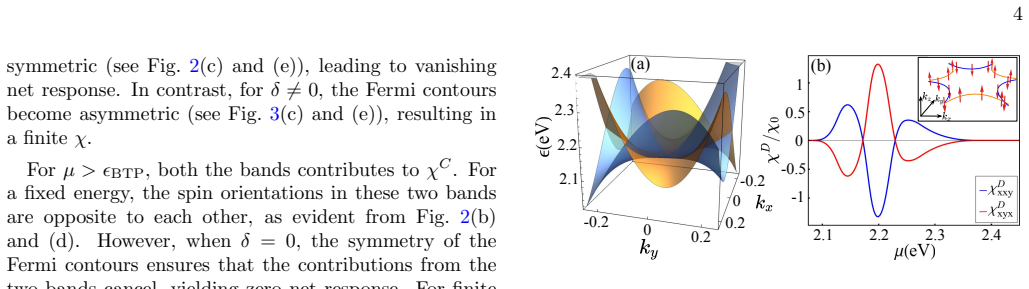
In persistent spin texture systems the conventional and Zeeman quantum-geometric contributions to nonlinear responses are suppressed, so that the spin-rotation quantum geometric tensor alone generates the nonvanishing nonlinear magnetic-current and spin-magnetization responses. These surviving components display identical, direction-independent dependence on chemical potential in both a fine-tuned Rashba-Dresselhaus two-dimensional electron gas and a symmetry-enforced cubic spin-splitting model. The same qualitative features remain visible when a cubic Dresselhaus term is added that breaks exact SU(2) symmetry.
What carries the argument
Spin-rotation quantum geometric tensor, which alone survives in PST and supplies the nonlinear responses while other contributions vanish.
If this is right
- Nonlinear magnetotransport measurements can identify the presence of PST without relying on spin lifetime data.
- The direction-independent chemical-potential dependence becomes a clear experimental fingerprint of the isolated spin-rotation geometry.
- The signatures remain observable even when weak symmetry-breaking terms are present, broadening the range of candidate materials.
- Spin-magnetization responses provide an additional observable channel that directly tracks the same tensor component.
Where Pith is reading between the lines
- Device designs aiming for long spin coherence could use these transport signatures to verify PST formation in situ.
- Similar nonlinear probes might distinguish spin-rotation geometry from other geometric contributions in systems lacking full PST symmetry.
- Extending the analysis to three-dimensional or interface PST candidates would test whether the same suppression mechanism operates beyond two-dimensional models.
Load-bearing premise
The fine-tuned Rashba-Dresselhaus and symmetry-enforced cubic models capture the essential physics of real PST systems so that spin-rotation quantum geometry dominates the nonlinear responses without other effects interfering.
What would settle it
Measure the nonlinear current and magnetization responses in a Rashba-Dresselhaus two-dimensional electron gas tuned exactly to the PST point and check whether all nonvanishing components collapse onto the same curve versus chemical potential regardless of current direction.
Figures


read the original abstract
Persistent spin textures (PST) are special spin configurations in spin-orbit-coupled systems in which the spin polarization acquires a symmetry-enforced momentum-independent orientation, leading to exceptionally long spin lifetimes and persistent spin helices. Identifying direct experimental probes of PST, however, remains challenging because conventional quantum-geometric responses are strongly suppressed in this regime. Here, we show that PST systems isolate spin-rotation quantum geometry, which manifests through distinctive nonlinear magnetotransport responses. Using both a fine-tuned Rashba-Dresselhaus two-dimensional electron gas and a symmetry-enforced cubic spin-splitting model realizing PST, we demonstrate that PST suppresses conventional and Zeeman quantum-geometric contributions, leaving the spin-rotation quantum geometric tensor as the sole source of nonlinear magnetic-current and spin-magnetization responses. Remarkably, the nonvanishing response components exhibit identical direction-independent behavior as a function of chemical potential, providing a distinctive signature of PST. We further show that, in the Rashba-Dresselhaus two-dimensional electron gas at the PST point, these qualitative signatures remain robust even in the presence of a cubic Dresselhaus term that breaks the exact SU(2) symmetry. Our results establish nonlinear magnetotransport as an experimentally accessible probe of PST and their underlying spin-rotation quantum geometry.
Editorial analysis
A structured set of objections, weighed in public.
Referee Report
Summary. The paper claims that persistent spin textures (PST) in spin-orbit-coupled systems suppress conventional and Zeeman quantum-geometric contributions to nonlinear magnetotransport, isolating the spin-rotation quantum geometric tensor as the source of distinctive nonlinear magnetic-current and spin-magnetization responses. Using a fine-tuned Rashba-Dresselhaus 2DEG model and a symmetry-enforced cubic spin-splitting Hamiltonian, the authors show that the nonvanishing response components exhibit identical, direction-independent dependence on chemical potential. These signatures remain robust to a weak cubic Dresselhaus perturbation that breaks exact SU(2) symmetry, establishing nonlinear magnetotransport as an experimental probe of PST.
Significance. If the central results hold, the work offers a concrete, experimentally accessible signature for PST systems and their spin-rotation quantum geometry, which are otherwise difficult to probe directly due to suppressed conventional responses. The explicit robustness check against a symmetry-breaking perturbation in the Rashba-Dresselhaus model is a notable strength, as is the demonstration of parameter-free, direction-independent behavior versus chemical potential in both models. This could meaningfully advance spintronics research by linking PST to falsifiable nonlinear transport predictions.
major comments (1)
- [§3.2] §3.2 (Rashba-Dresselhaus model at PST point): the suppression of Zeeman quantum-geometric terms is shown analytically for the exact SU(2) case, but the numerical evaluation of the nonlinear conductivity tensor (Eq. (12)) does not include a direct comparison to the magnitude of residual contributions when the cubic Dresselhaus term is added at finite strength; this leaves open whether the spin-rotation term remains dominant for experimentally relevant perturbation sizes.
minor comments (3)
- [§2.1] The definition of the spin-rotation quantum geometric tensor in §2.1 could be expanded with an explicit component-wise expression to aid readers unfamiliar with the decomposition.
- [Figure 4] Figure 4: the color scale for the response functions should include units and a note on the normalization used for the chemical-potential axis.
- [§5] A brief discussion of how the predicted direction-independent response would appear in a realistic device geometry (e.g., finite-size effects or contact resistance) would strengthen the experimental implications section.
Simulated Author's Rebuttal
We thank the referee for their positive evaluation and recommendation of minor revision. We address the major comment below.
read point-by-point responses
-
Referee: [§3.2] §3.2 (Rashba-Dresselhaus model at PST point): the suppression of Zeeman quantum-geometric terms is shown analytically for the exact SU(2) case, but the numerical evaluation of the nonlinear conductivity tensor (Eq. (12)) does not include a direct comparison to the magnitude of residual contributions when the cubic Dresselhaus term is added at finite strength; this leaves open whether the spin-rotation term remains dominant for experimentally relevant perturbation sizes.
Authors: We thank the referee for this observation. The manuscript analytically establishes suppression of Zeeman terms under exact SU(2) symmetry and demonstrates that the direction-independent signatures persist under a weak cubic Dresselhaus perturbation. However, we agree that the numerical results for Eq. (12) would benefit from an explicit magnitude comparison between the spin-rotation contribution and any residual terms at finite perturbation strengths. In the revised manuscript we will add such a comparison, selecting representative values of the cubic term to illustrate dominance of the spin-rotation quantum geometric tensor for experimentally plausible perturbation sizes. revision: yes
Circularity Check
No significant circularity; derivation follows from model Hamiltonians and symmetry
full rationale
The paper's central results on nonlinear responses in PST systems are obtained by direct computation in explicit model Hamiltonians (fine-tuned Rashba-Dresselhaus 2DEG and symmetry-enforced cubic spin-splitting). Conventional and Zeeman quantum-geometric terms are suppressed by the momentum-independent spin texture enforced in these models, leaving the spin-rotation term as the dominant contribution; this follows from the Hamiltonian structure and symmetry analysis rather than any fitted parameter or self-referential definition. The direction-independent chemical-potential dependence is a computed outcome, not an input. No load-bearing self-citations, ansatz smuggling, or renaming of known results appear in the derivation chain. The work is self-contained against the chosen models.
Axiom & Free-Parameter Ledger
axioms (2)
- domain assumption Symmetry-enforced momentum-independent spin polarization in PST systems
- domain assumption Suppression of conventional and Zeeman quantum-geometric contributions within the PST regime
Lean theorems connected to this paper
-
IndisputableMonolith/Cost/FunctionalEquation.leanwashburn_uniqueness_aczel unclear?
unclearRelation between the paper passage and the cited Recognition theorem.
at the PST point ... the spinor part of the Bloch eigenstates becomes entirely independent of the crystal momentum k. ... S ab ±∓ remain finite with a constant value of 1/2
-
IndisputableMonolith/Foundation/AlexanderDuality.leanalexander_duality_circle_linking unclear?
unclearRelation between the paper passage and the cited Recognition theorem.
the nonvanishing response components exhibit identical direction-independent behavior as a function of chemical potential
What do these tags mean?
- matches
- The paper's claim is directly supported by a theorem in the formal canon.
- supports
- The theorem supports part of the paper's argument, but the paper may add assumptions or extra steps.
- extends
- The paper goes beyond the formal theorem; the theorem is a base layer rather than the whole result.
- uses
- The paper appears to rely on the theorem as machinery.
- contradicts
- The paper's claim conflicts with a theorem or certificate in the canon.
- unclear
- Pith found a possible connection, but the passage is too broad, indirect, or ambiguous to say the theorem truly supports the claim.
Forward citations
Cited by 1 Pith paper
-
Giant Spin Magnetization from Quantum Geometry in Altermagnets
Centrosymmetric altermagnets exhibit giant magnetic-field-induced spin magnetization of order 10^{-2} μ_B nm^{-3} at ~10 mT, controlled solely by the spin-rotation quantum metric as the only symmetry-allowed linear qu...
Reference graph
Works this paper leans on
-
[1]
Since Σ commutes with the Hamiltonian, the eigenstates are diagonal in the Σ basis, yielding the eigenvalues withζ=±1: Eζ(k) = k2 2m + √ 2λζ|k x +k y|.(5) As a direct consequence, the spinor part of the Bloch eigenstates becomes entirely independent of the crystal momentumk. The Berry connection thus vanishes iden- tically, enforcing the strict suppressio...
work page 2023
-
[2]
Schliemann, Colloquium: Persistent spin textures in semiconductor nanostructures, Rev
J. Schliemann, Colloquium: Persistent spin textures in semiconductor nanostructures, Rev. Mod. Phys.89, 011001 (2017)
work page 2017
-
[3]
J. Schliemann and D. Loss, Anisotropic transport in a two-dimensional electron gas in the presence of spin-orbit coupling, Phys. Rev. B68, 165311 (2003)
work page 2003
-
[4]
B. A. Bernevig, J. Orenstein, and S.-C. Zhang, Exact su(2) symmetry and persistent spin helix in a spin-orbit coupled system, Phys. Rev. Lett.97, 236601 (2006)
work page 2006
-
[5]
H. J. Zhao, H. Nakamura, R. Arras, C. Paillard, P. Chen, J. Gosteau, X. Li, Y. Yang, and L. Bellaiche, Purely cubic spin splittings with persistent spin textures, Phys. Rev. Lett.125, 216405 (2020)
work page 2020
-
[6]
L. L. Tao and E. Y. Tsymbal, Persistent spin texture enforced by symmetry, Nature Communications9, 2763 6 (2018)
work page 2018
- [7]
-
[8]
J. P. Provost and G. Vallee, Riemannian structure on manifolds of quantum states, Communications in Math- ematical Physics76, 289 (1980)
work page 1980
-
[9]
M. V. Berry, Quantal phase factors accompanying adia- batic changes, Proceedings of the Royal Society A392, 45 (1984)
work page 1984
-
[10]
Mitscherling, Longitudinal and anomalous hall conduc- tivity of a general two-band model, Phys
J. Mitscherling, Longitudinal and anomalous hall conduc- tivity of a general two-band model, Phys. Rev. B102, 165151 (2020)
work page 2020
-
[11]
A. Avdoshkin, J. Mitscherling, and J. E. Moore, Multi- state geometry of shift current and polarization, Phys. Rev. Lett.135, 066901 (2025)
work page 2025
- [12]
-
[13]
J. Mitscherling and T. Holder, Bound on resistivity in flat-band materials due to the quantum metric, Phys. Rev. B105, 085154 (2022)
work page 2022
-
[14]
A. Postlewaite, A. Raj, S. Chaudhary, and G. A. Fi- ete, Quantum geometry and nonlinear optical responses in rhombohedral trilayer graphene, Phys. Rev. B110, 245122 (2024)
work page 2024
-
[15]
Quantum Geometric Origin of the Intrinsic Nonlinear Hall Effect
Y. Ulrich, J. Mitscherling, L. Classen, and A. P. Schny- der, Quantum geometric origin of the intrinsic nonlinear hall effect, arXiv preprint arXiv:2506.17386 (2025)
work page internal anchor Pith review Pith/arXiv arXiv 2025
-
[16]
A. Dey, Nonlinear hall responses in tunable nodal dirac semimetals (2025), arXiv:2511.20214 [cond-mat.mes- hall]
-
[17]
Symmetry-driven Intrinsic Nonlinear Pure Spin Hall Effect
S. Sarkar, S. Das, and A. Agarwal, Symmetry- driven intrinsic nonlinear pure spin hall effect (2025), arXiv:2502.18226 [cond-mat.mes-hall]
work page internal anchor Pith review Pith/arXiv arXiv 2025
-
[18]
S. Peotta and P. T¨ orm¨ a, Superfluidity in topologically nontrivial flat bands, Nature Communications6, 8944 (2015)
work page 2015
- [19]
- [20]
-
[21]
Quantum geometric map of magnetotransport
L. Xiang, J. Jia, F. Xu, and J. Wang, Classification of electromagnetic responses by quantum geometry (2025), arXiv:2510.02661 [cond-mat.mes-hall]
work page internal anchor Pith review Pith/arXiv arXiv 2025
- [22]
-
[23]
K. Hattori, H. Watanabe, and R. Arita, Nonlinear hall effect driven by spin-charge-coupled motive force, Phys. Rev. B111, 174416 (2025)
work page 2025
- [24]
-
[25]
N. Chakraborti, S. K. Ghosh, and S. Nandy, Zeeman quantum geometry as a probe of unconventional mag- netism (2025), arXiv:2508.14745 [cond-mat.mes-hall]
-
[26]
D. Xiao, M.-C. Chang, and Q. Niu, Berry phase effects on electronic properties, Rev. Mod. Phys.82, 1959 (2010)
work page 1959
- [27]
-
[28]
Y. Gao, S. A. Yang, and Q. Niu, Field induced positional shift of bloch electrons and its dynamical implications, Phys. Rev. Lett.112, 166601 (2014)
work page 2014
-
[29]
Z. Z. Du, H.-Z. Lu, and X. C. Xie, Nonlinear hall effects, Nature Reviews Physics3, 744 (2021)
work page 2021
-
[30]
N. Chakraborti, S. Nandy, and S. K. Ghosh, Gyrotropic fingerprints of magnetic topological insulator-unconventional magnet interfaces (2025), arXiv:2512.18621 [cond-mat.mes-hall]
- [31]
-
[32]
N. Chakraborti, S. Nandy, and S. K. Ghosh, Intrinsic nonlinear gyrotropic magnetic effect governed by spin- rotation quantum geometry (2026), arXiv:2601.22019 [cond-mat.mes-hall]
-
[33]
X. Cartoix` a, L.-W. Wang, D.-Y. Ting, and Y.-C. Chang, Higher-order contributions to rashba and dresselhaus ef- fects, Phys. Rev. B73, 205341 (2006)
work page 2006
-
[34]
Y. A. Bychkov and E. I. Rashba, Oscillatory effects and the magnetic susceptibility of carriers in inversion layers, J. Phys. C17, 6039 (1984)
work page 1984
-
[35]
Dresselhaus, Spin-orbit coupling effects in zinc blende structures, Phys
G. Dresselhaus, Spin-orbit coupling effects in zinc blende structures, Phys. Rev.100, 580 (1955)
work page 1955
-
[36]
Winkler,Spin–Orbit Coupling Effects in Two- Dimensional Electron and Hole Systems(Springer, 2003)
R. Winkler,Spin–Orbit Coupling Effects in Two- Dimensional Electron and Hole Systems(Springer, 2003)
work page 2003
-
[37]
A. Dey, A. K. Nandy, and K. Saha, Current-induced spin polarisation in rashba–dresselhaus systems under differ- ent point groups, New Journal of Physics27, 013024 (2025)
work page 2025
-
[38]
J. Schliemann, J. C. Egues, and D. Loss, Nonballistic spin-field-effect transistor, Physical Review Letters90, 146801 (2003)
work page 2003
-
[39]
S. D. Ganichev, V. V. Bel’kov, P. Schneider, E. L. Ivchenko, S. A. Tarasenko, W. Wegscheider, D. Weiss, and W. Prettl, Spin-galvanic effect, Physical Review Let- ters90, 136801 (2003)
work page 2003
-
[40]
D. A. B. Miller, D. S. Chemla, T. C. Damen, A. C. Gos- sard, W. Wiegmann, T. H. Wood, and C. A. Burrus, Band-edge electroabsorption in quantum well structures: The quantum-confined stark effect, Physical Review Let- ters53, 2173 (1984)
work page 1984
-
[41]
H. Ye, C. Hu, G. Wang, H. Zhao, H. Tian, W. Wang, and B. Liu, Anisotropic in-plane spin splitting in an asymmet- ric (001) gaas/algaas quantum well, Nanoscale Research Letters6, 520 (2011)
work page 2011
-
[42]
R. R. Binder, B. B. Gu, and N. H. Kwong, Quantum-confined strain gradient effect in semiconduc- tor nanomembranes, Physical Review B90, 195208 (2014)
work page 2014
-
[43]
P. S. Grigoryev, A. S. Kurdyubov, M. S. Kuznetsova, Y. P. Efimov, S. A. Eliseev, V. V. Petrov, V. A. Lovtcius, P. Y. Shapochkin, and I. V. Ignatiev, Excitons in asym- metric quantum wells, arXiv:1602.03720 (2016), arXiv preprint, 1602.03720
work page internal anchor Pith review Pith/arXiv arXiv 2016
-
[44]
Y.-J. Lin, K. Jim´ enez-Garc´ ıa, and I. B. Spielman, Spin– orbit-coupled bose–einstein condensates, Nature471, 83 (2011)
work page 2011
-
[45]
I. B. Spielman, Raman-induced spin-orbit coupling in ultracold fermi gases, Physical Review A79, 063613 (2009). 7
work page 2009
-
[46]
J. D. Koralek, C. P. Weber, J. Orenstein, B. A. Bernevig, S.-C. Zhang, S. Mack, and D. D. Awschalom, Emergence of the persistent spin helix in semiconductor quantum wells, Nature458, 610 (2009)
work page 2009
-
[47]
V. Gritsev and A. Polkovnikov, Nonequilibrium dynam- ics of quantum systems: Order parameter oscillations and quantum geometry, PNAS109, 6457 (2012)
work page 2012
-
[48]
M. Kolodrubetz, D. Sels, P. Mehta, and A. Polkovnikov, Geometry and non-adiabatic response in quantum and classical systems, Physics Reports697, 1 (2017)
work page 2017
-
[49]
P. Harvey-Collard, B. D’Anjou, M. Rudolph, N. T. Ja- cobson, J. Dominguez, G. A. Ten Eyck, J. R. Wendt, T. Pluym, M. P. Lilly, W. A. Coish, M. Pioro-Ladri` ere, and M. S. Carroll, High-fidelity single-shot readout for a spin qubit via an enhanced latching mechanism, Phys. Rev. X8, 021046 (2018)
work page 2018
- [50]
-
[51]
N. F. Ramsey, A molecular beam resonance method with separated oscillating fields, Physical Review78, 695 (1950)
work page 1950
- [52]
-
[53]
C. Godfrin, R. Ballou, E. Bonet, M. Ruben, S. Kly- atskaya, W. Wernsdorfer, and F. Balestro, Generalized ramsey interferometry explored with a single nuclear spin qudit, npj Quantum Information4, 53 (2018)
work page 2018
-
[54]
D. Hu, L. Niu, S. Jin, X. Chen, G. Dong, J. Schmied- mayer, and X. Zhou, Ramsey interferometry with trapped motional quantum states, Communications Physics1, 29 (2018)
work page 2018
-
[55]
X. Tan, D.-W. Zhang, Z. Yang, J. Chu, Y.-Q. Zhu, D. Li, X. Yang, S. Song, Z. Han, Z. Li, Y. Dong, H.-F. Yu, H. Yan, S.-L. Zhu, and Y. Yu, Experimental measure- ment of the quantum metric tensor and related topologi- cal phase transition with a superconducting qubit, Phys. Rev. Lett.122, 210401 (2019)
work page 2019
-
[56]
M. Yu, P. Yang, M. Gong, Q. Cao, Q. Lu, H. Liu, S. Zhang, M. B. Plenio, F. Jelezko, T. Ozawa, N. Gold- man, and J. Cai, Experimental measurement of the quan- tum geometric tensor using coupled qubits in diamond, National Science Review7, 254 (2019)
work page 2019
discussion (0)
Sign in with ORCID, Apple, or X to comment. Anyone can read and Pith papers without signing in.