The Grasshopper Problem on the Sphere
Pith reviewed 2026-05-15 14:31 UTC · model grok-4.3
The pith
The grasshopper problem on the sphere compares three lawn variants to find optimal local hidden variable models for quantum singlet correlations at fixed angles.
A machine-rendered reading of the paper's core claim, the machinery that carries it, and where it could break.
Core claim
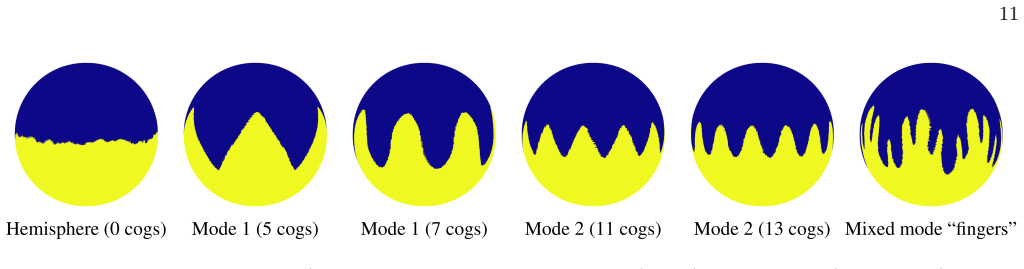
The paper claims that optimal lawn configurations for the three variants of the grasshopper problem exhibit distinct geometric structures that admit natural interpretation via spherical harmonics expansions, and that these structures depend on the chosen discretization of the sphere and on whether the lawns are required to be antipodal and complementary.
What carries the argument
Spherical harmonics expansion of the optimal lawn configurations, which extracts the symmetry properties that distinguish the three problem variants.
Load-bearing premise
The numerical solutions from the parallel paper accurately capture the global optima for the grasshopper problem under the chosen discretization and variant definitions.
What would settle it
An independent global optimization run on a substantially finer spherical mesh that produces a lawn configuration whose spherical-harmonics coefficients differ materially from the reported optima would falsify the claimed geometric structure.
Figures




read the original abstract
The spherical grasshopper problem is a geometric optimization problem that arises in the context of Bell inequalities and can be interpreted as identifying the best local hidden variable approximation to quantum singlet correlations for measurements along random axes separated by a fixed angle. In a parallel publication [arXiv:2504.20953], we presented numerical solutions for this problem and explained their significance for singlet simulation and testing. In this companion paper, we describe in detail the geometric and computational framework underlying these results. We examine the role of spherical discretization and compare three natural variants of the problem: antipodal complementary lawns, antipodal independent lawns, and non-antipodal complementary lawns. We analyze the geometric structure of the corresponding optimal lawn configurations and interpret it in terms of a spherical harmonics expansion. We also discuss connections to other physical models and to classical problems in geometric probability.
Editorial analysis
A structured set of objections, weighed in public.
Referee Report
Summary. This companion manuscript presents the geometric and computational framework for the spherical grasshopper problem, which seeks optimal 'lawn' configurations on the sphere to approximate quantum singlet correlations via local hidden variables. It details the role of spherical discretization, compares three variants (antipodal complementary lawns, antipodal independent lawns, and non-antipodal complementary lawns), analyzes the geometric structure of the corresponding optimal configurations, and interprets these via spherical harmonics expansions, while noting connections to other physical models and geometric probability problems. The numerical optima themselves are reported in the parallel paper arXiv:2504.20953.
Significance. If the numerical configurations are global optima, the framework supplies a systematic geometric and harmonic analysis that clarifies the structure of optimal approximations to Bell correlations and links the grasshopper problem to classical geometric probability. The spherical harmonics interpretation offers a reproducible language for classifying symmetries across variants, which could aid future analytic work on related optimization problems.
major comments (2)
- [§3] §3 (Discretization framework and variant definitions): The geometric analysis and optimality claims for all three lawn variants rest exclusively on numerical solutions imported from the companion paper. No convergence study with respect to discretization density, exhaustive enumeration for low-resolution cases, or independent global-optimality certificate is supplied here, leaving open the possibility that reported configurations are local minima or discretization artifacts.
- [§5] §5 (Spherical harmonics expansion): The expansion coefficients and symmetry interpretations are derived from the imported numerical optima. Without a quantitative bound on how much the harmonics would change under small perturbations or alternative near-optimal configurations, the claimed geometric structure cannot be asserted to characterize the true global solutions.
minor comments (2)
- [Abstract and §1] The abstract and introduction refer to the companion work only by arXiv number; a full bibliographic entry should be added to the reference list for standalone readability.
- [Throughout] Notation for the three variants is introduced descriptively but not consistently abbreviated; introducing short labels (e.g., ACC, AIC, NCC) would improve cross-referencing between sections and figures.
Simulated Author's Rebuttal
We thank the referee for the careful reading and constructive comments on this companion manuscript. We address each major comment below.
read point-by-point responses
-
Referee: [§3] §3 (Discretization framework and variant definitions): The geometric analysis and optimality claims for all three lawn variants rest exclusively on numerical solutions imported from the companion paper. No convergence study with respect to discretization density, exhaustive enumeration for low-resolution cases, or independent global-optimality certificate is supplied here, leaving open the possibility that reported configurations are local minima or discretization artifacts.
Authors: This manuscript is explicitly a companion to arXiv:2504.20953, which contains the full description of the numerical optimization procedures, convergence studies with respect to discretization density, and supporting evidence from multiple independent runs. The present work imports those validated configurations in order to develop the geometric framework, variant definitions, and harmonic analysis. We have revised §3 to add explicit cross-references to the companion paper’s convergence analysis and to clarify the division of content between the two papers. A rigorous mathematical certificate of global optimality is not provided in either manuscript. revision: partial
-
Referee: [§5] §5 (Spherical harmonics expansion): The expansion coefficients and symmetry interpretations are derived from the imported numerical optima. Without a quantitative bound on how much the harmonics would change under small perturbations or alternative near-optimal configurations, the claimed geometric structure cannot be asserted to characterize the true global solutions.
Authors: The spherical-harmonics expansions and symmetry interpretations are offered as a descriptive language for the structure of the numerically obtained optima. In the revised version we have added a short quantitative robustness check in §5 that examines the stability of the leading coefficients across the ensemble of near-optimal configurations reported in the companion paper. This supports the geometric reading while making clear that the analysis applies to the reported solutions. revision: yes
- A rigorous, independent mathematical certificate of global optimality for the numerical configurations.
Circularity Check
Minor self-citation to parallel paper for numerical inputs; geometric framework and spherical harmonics analysis remain independent
full rationale
The paper describes a discretization framework and interprets optimal lawn configurations via spherical harmonics expansions, citing the parallel arXiv:2504.20953 solely for the numerical solutions themselves. No equation or claim within this manuscript reduces a prediction, uniqueness result, or central quantity to a fitted parameter or self-defined input from the same text. The analysis rests on standard geometric and harmonic principles external to the numerics, qualifying as a normal companion description rather than a circular derivation chain.
Axiom & Free-Parameter Ledger
axioms (1)
- standard math Standard properties of the sphere and spherical harmonics expansion apply to optimal lawn configurations.
Lean theorems connected to this paper
-
IndisputableMonolith/Foundation/AlexanderDuality.leanalexander_duality_circle_linking echoes?
echoesECHOES: this paper passage has the same mathematical shape or conceptual pattern as the Recognition theorem, but is not a direct formal dependency.
p(θ) = 1/(2π) Σ bμ(1)_ℓm bμ(2)_ℓm* P_ℓ(cos θ) ... Funk-Hecke formula ... K_θ Y_ℓm = P_ℓ(cos θ) Y_ℓm
What do these tags mean?
- matches
- The paper's claim is directly supported by a theorem in the formal canon.
- supports
- The theorem supports part of the paper's argument, but the paper may add assumptions or extra steps.
- extends
- The paper goes beyond the formal theorem; the theorem is a base layer rather than the whole result.
- uses
- The paper appears to rely on the theorem as machinery.
- contradicts
- The paper's claim conflicts with a theorem or certificate in the canon.
- unclear
- Pith found a possible connection, but the passage is too broad, indirect, or ambiguous to say the theorem truly supports the claim.
Reference graph
Works this paper leans on
-
[1]
Optimal Local Simulations of a Quantum Singlet
D. Llamas, D. Chistikov, A. Kent, M. Paterson, and O. Goulko, Optimal local simulation of a quantum sin- glet, arXiv (2025), arXiv:2504.20953 [quant-ph]
work page internal anchor Pith review Pith/arXiv arXiv 2025
-
[2]
B. Hensen, H. Bernien, A. E. Dr´ eau, A. Reiserer, N. Kalb, M. S. Blok, J. Ruitenberg, R. F. L. Vermeulen, R. N. Schouten, C. Abell´ an, W. Amaya, V. Pruneri, M. W. Mitchell, M. Markham, D. J. Twitchen, D. Elkouss, S. Wehner, T. H. Taminiau, and R. Hanson, Loophole- free Bell inequality violation using electron spins sepa- rated by 1.3 kilometres, Nature5...
work page 2015
-
[3]
L. K. Shalm, E. Meyer-Scott, B. G. Christensen, P. Bier- horst, M. A. Wayne, M. J. Stevens, T. Gerrits, S. Glancy, D. R. Hamel, M. S. Allman, K. J. Coakley, S. D. Dyer, C. Hodge, A. E. Lita, V. B. Verma, C. Lam- brocco, E. Tortorici, A. L. Migdall, Y. Zhang, D. R. Kumor, W. H. Farr, F. Marsili, M. D. Shaw, J. A. Stern, C. Abell´ an, W. Amaya, V. Pruneri, ...
work page 2015
-
[4]
M. Giustina, M. A. M. Versteegh, S. Wengerowsky, J. Handsteiner, A. Hochrainer, K. Phelan, F. Steinlech- ner, J. Kofler, J.-A. Larsson, C. Abell´ an, W. Amaya, V. Pruneri, M. W. Mitchell, J. Beyer, T. Gerrits, A. E. Lita, L. K. Shalm, S. W. Nam, T. Scheidl, R. Ursin, B. Wittmann, and A. Zeilinger, Significant-loophole-free test of Bell’s theorem with enta...
work page 2015
-
[5]
Kent, Causal quantum theory and the collapse locality loophole, Phys
A. Kent, Causal quantum theory and the collapse locality loophole, Phys. Rev. A72, 012107 (2005)
work page 2005
-
[6]
Kent, Testing causal quantum theory, Proc
A. Kent, Testing causal quantum theory, Proc. R. Soc. A.474, 20180501 (2018)
work page 2018
-
[7]
Kent, Stronger tests of the collapse-locality loophole in Bell experiments, Phys
A. Kent, Stronger tests of the collapse-locality loophole in Bell experiments, Phys. Rev. A101, 012102 (2020). 24
work page 2020
-
[8]
J. S. Bell, On the Einstein-Podolsky-Rosen paradox, Physics1, 195 (1964), reprinted in [46], pages 14–21
work page 1964
-
[9]
J. F. Clauser, M. A. Horne, A. Shimony, and R. A. Holt, Proposed experiment to test local hidden-variable theo- ries, Phys. Rev. Lett.23, 880 (1969)
work page 1969
-
[10]
S. L. Braunstein and C. M. Caves, Wringing out better Bell inequalities, Annals of Physics202(1), 22 (1990)
work page 1990
-
[11]
A. Kent and D. Pital´ ua-Garc´ ıa, Bloch-sphere colorings and Bell inequalities, Phys. Rev. A90, 062124 (2014)
work page 2014
-
[12]
G. Cowperthwaite and A. Kent, Comparing singlet test- ing schemes, Entropy27, 10.3390/e27050515 (2025)
-
[13]
O. Goulko and A. Kent, The grasshopper problem, Proceedings of the Royal Society of London Series A 473, 20170494 (2017), arXiv:1705.07621 [cond-mat.stat- mech]
work page internal anchor Pith review Pith/arXiv arXiv 2017
- [14]
-
[15]
D. Chistikov, O. Goulko, A. Kent, and M. Paterson, Globe-hopping, Proceedings of the Royal Society of Lon- don Series A476, 20200038 (2020), arXiv:2001.06442 [quant-ph]
-
[16]
B. van Breugel, The Spherical Grasshopper Prob- lem, arXiv e-prints , arXiv:2307.05359 (2023), arXiv:2307.05359 [quant-ph]
-
[17]
K. Atkinson and W. Han,Spherical Harmonics and Ap- proximations on the Unit Sphere: An Introduction, Lec- ture Notes in Mathematics (Springer Berlin Heidelberg, 2012)
work page 2012
-
[18]
R. S. Womersley, Efficient spherical designs with good ge- ometric properties,https://web.maths.unsw.edu.au/ ~rsw/Sphere/EffSphDes/ss.html(2017)
work page 2017
-
[19]
R. S. Womersley, Efficient spherical designs with good geometric properties, inContemporary Computational Mathematics - A Celebration of the 80th Birthday of Ian Sloan, edited by J. Dick, F. Y. Kuo, and H. Wo´ zniakowski (Springer International Publishing, Cham, 2018) pp. 1243–1285, arXiv:1709.01624 [math.NA]
work page internal anchor Pith review Pith/arXiv arXiv 2018
-
[20]
K. M. G´ orski, E. Hivon, A. J. Banday, B. D. Wan- delt, F. K. Hansen, M. Reinecke, and M. Bartelmann, HEALPix: A Framework for High-Resolution Discretiza- tion and Fast Analysis of Data Distributed on the Sphere, Astrophys. J.622, 759 (2005)
work page 2005
- [21]
-
[22]
N. Teanby, An icosahedron-based method for even bin- ning of globally distributed remote sensing data, Com- puters & Geosciences32, 1442 (2006)
work page 2006
-
[23]
K. V. Laven, Grid sphere, MATLAB Central File Ex- change (2015)
work page 2015
-
[24]
C. S. Peskin, The immersed boundary method, Acta Nu- merica11, 479 (2002)
work page 2002
-
[25]
S. Kirkpatrick, C. D. Gelatt, and M. P. Vecchi, Optimiza- tion by simulated annealing, Science220, 671 (1983)
work page 1983
-
[26]
Buffon, Editor’s note concerning a lecture given 1733 by Mr
G. Buffon, Editor’s note concerning a lecture given 1733 by Mr. Le Clerc de Buffon to the Royal Academy of Sciences in Paris, Histoire de l’Acad. Roy. des Sci. , 43 (1733)
-
[27]
G. Buffon, Essai d’arithm´ etique morale, Histoire na- turelle, g´ en´ erale er particuli` ere, Suppl´ ement 4 , 46 (1777)
-
[28]
A. M. Mathai,An introduction to geometrical probabil- ity: Distributional aspects with applications, Statistical distributions and models with applications, Vol. 1 (Gor- don and Breach, 1999)
work page 1999
-
[29]
J. P. Boyd,Chebyshev and Fourier Spectral Methods (Dover Publications, 2001)
work page 2001
-
[30]
M. Seul and D. Andelman, Domain shapes and patterns: The phenomenology of modulated phases, Science267, 476 (1995)
work page 1995
-
[31]
D. Andelman and R. E. Rosensweig, Modulated phases: Review and recent results, J. Phys. Chem. B113, 3785 (2009)
work page 2009
-
[32]
M. K¨ ucken and A. C. Newell, Fingerprint formation, J Theor Biol235, 71 (2005)
work page 2005
- [33]
-
[34]
A. L. Krause, A. M. Burton, N. T. Fadai, and R. A. Van Gorder, Emergent structures in reaction-advection- diffusion systems on a sphere, Phys. Rev. E97, 042215 (2018)
work page 2018
-
[35]
M. F. Staddon, How the zebra got its stripes: Curvature- dependent diffusion orients Turing patterns on three- dimensional surfaces, Phys. Rev. E110, 034402 (2024)
work page 2024
-
[36]
H. S. Witsenhausen, Spherical sets without orthogonal point pairs, The American Mathematical Monthly81, 1101 (1974)
work page 1974
-
[37]
G. Kalai, How large can a spherical set without two orthogonal vectors be?, Combinatorics and more (blog) (2009)
work page 2009
-
[38]
G. Kalai, Some old and new problems in combinato- rial geometry I: Around Borsuk’s problem, inSurveys in Combinatorics 2015, London Mathematical Society Lec- ture Note Series, edited by A. Czumaj, A. Georgakopou- los, D. Kr´ al, V. Lozin, and O. Pikhurko (Cambridge University Press, 2015) p. 147–174, arXiv:1505.04952 [math.CO]
work page internal anchor Pith review Pith/arXiv arXiv 2015
-
[39]
Spherical sets avoiding a prescribed set of angles
E. DeCorte and O. Pikhurko, Spherical sets avoiding a prescribed set of angles, International Mathematics Research Notices2016, 6095 (2015), arXiv:1502.05030 [math.CO]
work page internal anchor Pith review Pith/arXiv arXiv 2015
-
[40]
E. DeCorte, F. M. d. O. Filho, and F. Vallentin, Com- plete positivity and distance-avoiding sets, Mathematical Programming191, 487 (2022)
work page 2022
- [41]
-
[42]
B. F. Toner and D. Bacon, Communication cost of sim- ulating bell correlations, Phys. Rev. Lett.91, 187904 (2003)
work page 2003
-
[43]
G. Brassard, R. Cleve, and A. Tapp, Cost of exactly sim- ulating quantum entanglement with classical communi- cation, Phys. Rev. Lett.83, 1874 (1999)
work page 1999
-
[44]
J. Hertkorn, J.-N. Schmidt, M. Guo, F. B¨ ottcher, K. S. H. Ng, S. D. Graham, P. Uerlings, T. Langen, M. Zwierlein, and T. Pfau, Pattern formation in quantum ferrofluids: From supersolids to superglasses, Phys. Rev. Research3, 033125 (2021)
work page 2021
-
[45]
M. Schmidt, L. Lassabli` ere, G. Qu´ em´ ener, and T. Lan- gen, Self-bound dipolar droplets and supersolids in molecular Bose-Einstein condensates, Physical Review Research4, 013235 (2022)
work page 2022
-
[46]
J. S. Bell,Speakable and unspeakable in quantum mechan- ics(Cambridge University Press, Cambridge, 1987)
work page 1987
discussion (0)
Sign in with ORCID, Apple, or X to comment. Anyone can read and Pith papers without signing in.