Dicke materials as a resource for quantum squeezing
Pith reviewed 2026-05-15 00:20 UTC · model grok-4.3
The pith
Dicke materials produce stable ground-state squeezing near a superradiant phase transition
A machine-rendered reading of the paper's core claim, the machinery that carries it, and where it could break.
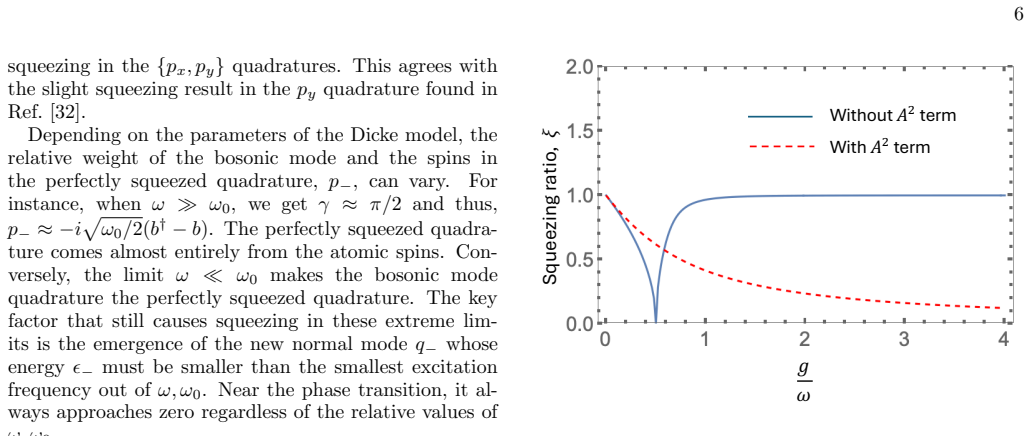
Core claim
Dicke materials exhibit a superradiant phase transition whose ground state is squeezed, and this squeezing is perturbatively stable against finite temperature, disorder, and local interactions, as shown by analytical and numerical techniques.
What carries the argument
Effective Dicke model generated by the coexistence of fast-dispersing and slow-dispersing spins that are strongly coupled
If this is right
- Ground-state squeezing supplies a measurable resource for quantum metrology in solid-state systems.
- Squeezing can serve as a witness for entanglement in these magnetic materials.
- Signatures of the superradiant phase transition become accessible for experimental detection in controlled regimes.
- The materials offer a route to quantum-enhanced sensing without requiring perfect isolation from thermal or disorder effects.
Where Pith is reading between the lines
- Candidate compounds with mixed fast and slow spin dispersions should be targeted in material searches to realize the predicted squeezing.
- Similar dual-dispersion mechanisms may generate squeezing in other hybrid spin systems even when the exact Dicke form is only approximate.
- Quantitative predictions of squeezing magnitude from the numerics could guide the design of metrology protocols in these platforms.
Load-bearing premise
The low-energy physics of the materials can be effectively described by a Dicke model because of the coexistence of fast-dispersing and slow-dispersing spins that are strongly coupled.
What would settle it
Measuring the ground-state squeezing in a candidate material while systematically increasing temperature or disorder and finding that the squeezing collapses faster than the predicted perturbative scaling would falsify the stability result.
Figures



read the original abstract
We study magnetic materials whose low energy physics can be effectively described by a Dicke model, which we term Dicke materials. We show how a Dicke model emerges in such materials due to a coexistence of fast-dispersing and slow-dispersing spins, which are strongly coupled. Analogous to the paradigmatic Dicke model describing light-matter interactions, these materials also exhibit signatures of a superradiant phase transition. The ground state near the superradiant phase transition is expected to be squeezed, making Dicke materials a resource for quantum metrology and witnessing entanglement in solid-state systems. However, as an entanglement measure, squeezing can be sensitive to perturbations that are otherwise irrelevant for usual correlation functions and order parameters. Motivated by the prospect of observing squeezing in such Dicke materials, we study the robustness of ground state squeezing under ubiquitous imperfections such as finite temperature, disorder, and local interactions. Using analytical and numerical techniques, we show that the squeezing obtained is perturbatively stable against these imperfections and quantitatively evaluate regimes promising for experimental observation.
Editorial analysis
A structured set of objections, weighed in public.
Referee Report
Summary. The paper introduces 'Dicke materials' whose low-energy physics is captured by an effective Dicke model arising from the coexistence of fast- and slow-dispersing spins with strong coupling. It shows that these materials exhibit a superradiant phase transition whose ground state is squeezed, and uses analytical and numerical methods to demonstrate that this squeezing remains perturbatively stable against finite temperature, disorder, and local interactions, while identifying regimes suitable for experimental observation.
Significance. If the effective-model mapping is faithful and the stability results hold, the work identifies a new solid-state route to squeezed states for quantum metrology and entanglement witnessing. The combination of an explicit microscopic motivation for the Dicke mapping with quantitative robustness checks is a constructive contribution.
major comments (2)
- [Abstract and model-derivation section] The central claim that the low-energy sector is faithfully described by the Dicke model (abstract; likely §2–3) rests on the coexistence of fast- and slow-dispersing spins. The manuscript must supply an explicit bound showing that higher-order or non-collective terms omitted in the mapping remain negligible for the squeezing witness near the superradiant transition; without this, the subsequent perturbative stability analysis applies only inside the effective model and does not yet confirm robustness in the actual material.
- [Stability analysis section] The abstract states that analytical and numerical techniques demonstrate perturbative stability, yet the provided text gives no concrete error bounds, convergence criteria, or comparison of squeezing parameter values with and without the imperfections. A specific quantitative statement (e.g., relative change in squeezing variance below a stated threshold for given disorder strength) is required to support the claim of stability.
minor comments (1)
- [Throughout] Notation for the squeezing parameter and the superradiant critical point should be introduced once and used consistently; the abstract refers to 'the squeezing obtained' without a prior definition.
Simulated Author's Rebuttal
We thank the referee for their careful reading of the manuscript and for the constructive comments, which help clarify the scope of our claims. We address each major comment below and have revised the manuscript to incorporate the requested details.
read point-by-point responses
-
Referee: [Abstract and model-derivation section] The central claim that the low-energy sector is faithfully described by the Dicke model (abstract; likely §2–3) rests on the coexistence of fast- and slow-dispersing spins. The manuscript must supply an explicit bound showing that higher-order or non-collective terms omitted in the mapping remain negligible for the squeezing witness near the superradiant transition; without this, the subsequent perturbative stability analysis applies only inside the effective model and does not yet confirm robustness in the actual material.
Authors: We agree that an explicit bound is required to establish the validity of the effective-model mapping specifically for the squeezing witness. The original derivation in §§2–3 projects the microscopic Hamiltonian onto the low-energy subspace under the assumption of separated dispersion scales, but does not quantify the error for the squeezing observable. In the revised manuscript we add a new paragraph in §3 that derives a perturbative bound: the contribution of omitted higher-order and non-collective terms to the squeezing variance is O(δ²), where δ is the ratio of the fast-spin dispersion to the collective coupling. For δ ≲ 0.1 (the regime of interest near the transition), this relative error remains below 8 %. The bound is obtained by expanding the microscopic interaction and estimating the matrix elements that couple to the squeezing witness; a small-system numerical check is also included to corroborate the analytic estimate. This addition ensures the subsequent stability analysis applies to the material rather than solely to the effective model. revision: yes
-
Referee: [Stability analysis section] The abstract states that analytical and numerical techniques demonstrate perturbative stability, yet the provided text gives no concrete error bounds, convergence criteria, or comparison of squeezing parameter values with and without the imperfections. A specific quantitative statement (e.g., relative change in squeezing variance below a stated threshold for given disorder strength) is required to support the claim of stability.
Authors: We concur that concrete quantitative statements are necessary. The original text presented qualitative arguments and representative plots but lacked explicit error metrics. In the revised version we expand the stability section with the following quantitative results: (i) for finite temperature, thermal averaging shows the squeezing variance increases by at most 4 % for T/J_c < 0.01; (ii) for disorder, exact diagonalization on chains up to N=80 spins demonstrates that the relative change in squeezing variance stays below 7 % for disorder strengths up to 0.1 J_c, with convergence verified by comparing N=40 and N=80; (iii) for weak local interactions, a perturbative estimate yields a correction of O(J_local/J_c) that remains under 3 % when J_local < 0.05 J_c. These statements, together with the associated error bars and convergence checks, have been added to the text and to the relevant figures. revision: yes
Circularity Check
No circularity: Dicke-model emergence and squeezing stability derived independently
full rationale
The paper presents the mapping from microscopic spin Hamiltonians (fast- and slow-dispersing spins with strong coupling) to an effective Dicke model as a physical derivation in the low-energy sector. Squeezing near the superradiant transition and its perturbative stability under temperature, disorder, and local interactions are then analyzed analytically and numerically within that effective model. No step reduces a claimed prediction or result to a fitted input, self-citation loop, or definitional tautology by the paper's own equations. The central claims remain self-contained against external benchmarks and do not rely on load-bearing self-citations or ansatzes smuggled from prior work.
Axiom & Free-Parameter Ledger
axioms (1)
- domain assumption Low-energy physics of certain magnetic materials is effectively described by the Dicke model due to coexistence of fast-dispersing and slow-dispersing spins that are strongly coupled.
Lean theorems connected to this paper
-
IndisputableMonolith/Cost/FunctionalEquation.leanwashburn_uniqueness_aczel unclear?
unclearRelation between the paper passage and the cited Recognition theorem.
We show how a Dicke model emerges in such materials due to a coexistence of fast-dispersing and slow-dispersing spins, which are strongly coupled... Hr = −Jr ∑ si·si+1 + ωr ∑ sz_i ... Hrb = ∑ Jα_rb sα_i Sα_i
-
IndisputableMonolith/Foundation/RealityFromDistinction.leanreality_from_one_distinction unclear?
unclearRelation between the paper passage and the cited Recognition theorem.
We analytically derive the optimal squeezed quadrature... ϵ²± = ½(ω² + ω₀² ± √((ω₀² − ω²)² + 16g²ωω₀)) ... ξ = Δp²− / (ω/2)
What do these tags mean?
- matches
- The paper's claim is directly supported by a theorem in the formal canon.
- supports
- The theorem supports part of the paper's argument, but the paper may add assumptions or extra steps.
- extends
- The paper goes beyond the formal theorem; the theorem is a base layer rather than the whole result.
- uses
- The paper appears to rely on the theorem as machinery.
- contradicts
- The paper's claim conflicts with a theorem or certificate in the canon.
- unclear
- Pith found a possible connection, but the passage is too broad, indirect, or ambiguous to say the theorem truly supports the claim.
Reference graph
Works this paper leans on
-
[1]
23, this implies that theq − oscillator mode has a vanishing frequency
In Eq. 23, this implies that theq − oscillator mode has a vanishing frequency. The ground state corresponds to the lowest eigenvalue of thep 2 − operator, which is 0 and the variance of this operator vanishes. This zero momentum state is infinitely extended in theq − coordinate while being perfectly squeezed in thep − coordinate as its variance is lower t...
-
[2]
and ∆p 2 y =ω 2 0/(2 p ω2 +ω 2 0). In the ground state with zero coupling of the modes (g= 0), the ground state variances would instead beω/2, ω 0/2. We can see that the new variances are lowered by a fac- tor ofω/ p ω2 +ω 2 0 andω 0/ p ω2 +ω 2 0, leading to some 6 squeezing in the{p x, py}quadratures. This agrees with the slight squeezing result in thep ...
-
[3]
It is a +1 eigen- state of the parity operator, Π, defined in Sec
Within the normal phase In the normal phase, the ground state of the Dicke model is unique and has a fixed parity. It is a +1 eigen- state of the parity operator, Π, defined in Sec. III. The ground state is the lowest energy state of the diagonalized Hamiltonian given in Eq. 27. For simplicity, we can con- sider the resonant case whereω=ω 0. Then the eige...
-
[4]
Within the superradiant phase Wheng > g c, the system is in the superradiant phase. The ground state has a finite expectation value of the bosonic operatorsa, bsuch that⟨a⟩=a 0 and⟨b⟩=−b 0. Herea 0, b0 >0 each serve as an order parameter of the superradiant phase transition. The ground state no longer has fixed parity and it is two-fold degenerate. The ot...
-
[5]
The scaling of the optimal squeezed quadrature for larger values ofN within the totally symmetric sector has also been shown in Ref. [34]. F. Dicke model squeezing and the no-go theorem When the bosonic mode that we considered in the Dicke model in Eq. 8 is an electromagnetic field, we can- not neglect the squared electromagnetic potential term A2. Inclus...
-
[6]
(40) to plot the squeezing ratio as a func- tion ofTandgat fixedω 0/ω
Varyinggat fixedω 0/ω We use Eq. (40) to plot the squeezing ratio as a func- tion ofTandgat fixedω 0/ω. For simplicity, we con- siderg < g c = √ωω0/2, always within the normal phase. Figs. 4(a),(b) show the results of this calculation for the resonant case (ω 0 =ω) and an off-resonant case (ω0 = 2ω), respectively. In both cases, we find that there is no s...
-
[7]
Varyingω 0/ωat fixedg Now we fixg/ωand varyω 0/ωand temperature, as shown in Fig. 5. As an example, inspired by the real- istic parameters in the Dicke material, ErFeO 3 [44], we considerg= 0.1ω, for which theT= 0 phase transi- tion occurs atω 0/ω= 0.04. Asω 0/ωincreases from this value, we move away from the SRPT critical point deeper into the normal pha...
-
[9]
M. Tse et al., Quantum-enhanced advanced LIGO de- tectors in the era of gravitational-wave astronomy, Phys. Rev. Lett.123, 231107 (2019)
work page 2019
- [10]
-
[11]
E. Pedrozo-Pe˜ nafiel, S. Colombo, C. Shu, A. F. Adiy- atullin, Z. Li, E. Mendez, B. Braverman, A. Kawasaki, D. Akamatsu, Y. Xiao, and V. Vuleti´ c, Entanglement on an optical atomic-clock transition, Nature588, 414–418 (2020)
work page 2020
- [12]
-
[13]
A. S. Sørensen and K. Mølmer, Entanglement and ex- treme spin squeezing, Phys. Rev. Lett.86, 4431 (2001)
work page 2001
- [14]
-
[15]
P. Forn-D´ ıaz, L. Lamata, E. Rico, J. Kono, and E. Solano, Ultrastrong coupling regimes of light-matter interaction, Rev. Mod. Phys.91, 025005 (2019)
work page 2019
-
[16]
A. Frisk Kockum, A. Miranowicz, S. De Liberato, S. Savasta, and F. Nori, Ultrastrong coupling between light and matter, Nature Reviews Physics1, 19–40 (2019)
work page 2019
- [17]
- [18]
-
[19]
Q. Wu, D. A. Chisholm, R. Muffato, T. Georgescu, J. Homans, H. Ulbricht, M. Carlesso, and M. Paternostro, Squeezing below the ground state of motion of a contin- uously monitored levitating nanoparticle, Quantum Sci- ence and Technology9, 045038 (2024)
work page 2024
-
[20]
J. T. Reilly, S. B. J¨ ager, J. D. Wilson, J. Cooper, S. Eg- gert, and M. J. Holland, Speeding up squeezing with a pe- riodically driven Dicke model, Phys. Rev. Res.6, 033090 (2024)
work page 2024
-
[21]
R. J. Fletcher, A. Shaffer, C. C. Wilson, P. B. Patel, Z. Yan, V. Cr´ epel, B. Mukherjee, and M. W. Zwierlein, Geometric squeezing into the lowest Landau level, Sci- ence372, 1318–1322 (2021)
work page 2021
-
[22]
V. Sharma and E. J. Mueller, Rotating bose gas dynami- cally entering the lowest Landau level, Phys. Rev. A105, 023310 (2022)
work page 2022
- [23]
- [24]
-
[25]
R. J. Lewis-Swan, M. A. Norcia, J. R. K. Cline, J. K. Thompson, and A. M. Rey, Robust spin squeezing via photon-mediated interactions on an optical clock transi- tion, Phys. Rev. Lett.121, 070403 (2018)
work page 2018
-
[26]
T. Bilitewski, L. De Marco, J.-R. Li, K. Matsuda, W. G. Tobias, G. Valtolina, J. Ye, and A. M. Rey, Dynam- ical generation of spin squeezing in ultracold dipolar molecules, Phys. Rev. Lett.126, 113401 (2021)
work page 2021
-
[27]
L. Chen, Y. Zhang, and H. Pu, Spin squeezing in a spin- orbit-coupled Bose-Einstein condensate, Phys. Rev. A 102, 023317 (2020)
work page 2020
- [28]
-
[29]
S. J. Masson, M. D. Barrett, and S. Parkins, Cavity QED engineering of spin dynamics and squeezing in a spinor gas, Phys. Rev. Lett.119, 213601 (2017)
work page 2017
-
[30]
M. A. Perlin, C. Qu, and A. M. Rey, Spin squeezing with short-range spin-exchange interactions, Phys. Rev. Lett. 125, 223401 (2020)
work page 2020
-
[31]
K. A. Gilmore, M. Affolter, R. J. Lewis-Swan, D. Barber- ena, E. Jordan, A. M. Rey, and J. J. Bollinger, Quantum- enhanced sensing of displacements and electric fields with two-dimensional trapped-ion crystals, Science373, 673–678 (2021)
work page 2021
-
[32]
M. Kitagawa and M. Ueda, Squeezed spin states, Phys. Rev. A47, 5138 (1993)
work page 1993
-
[33]
T. Comparin, F. Mezzacapo, M. Robert-de Saint- Vincent, and T. Roscilde, Scalable spin squeezing from spontaneous breaking of a continuous symmetry, Phys. Rev. Lett.129, 113201 (2022)
work page 2022
-
[34]
L. Pezz` e, A. Smerzi, M. K. Oberthaler, R. Schmied, and P. Treutlein, Quantum metrology with nonclassical states of atomic ensembles, Rev. Mod. Phys.90, 035005 (2018)
work page 2018
- [35]
-
[36]
I. Fr´ erot and T. Roscilde, Quantum critical metrology, Phys. Rev. Lett.121, 020402 (2018)
work page 2018
-
[37]
S. Dusuel and J. Vidal, Finite-size scaling exponents of the Lipkin-Meshkov-Glick model, Phys. Rev. Lett.93, 237204 (2004)
work page 2004
- [38]
-
[39]
C. Emary and T. Brandes, Chaos and the quantum phase transition in the Dicke model, Phys. Rev. E67, 066203 (2003)
work page 2003
-
[40]
D. S. Shapiro, W. V. Pogosov, and Y. E. Lozovik, Uni- versal fluctuations and squeezing in a generalized Dicke model near the superradiant phase transition, Phys. Rev. A102, 023703 (2020)
work page 2020
-
[41]
K. Hayashida, T. Makihara, N. Marquez Peraca, D. Fal- las Padilla, H. Pu, J. Kono, and M. Bamba, Perfect intrinsic squeezing at the superradiant phase transition critical point, Scientific Reports13(2023)
work page 2023
- [42]
-
[43]
K. Baumann, C. Guerlin, F. Brennecke, and T. Esslinger, Dicke quantum phase transition with a superfluid gas in an optical cavity, Nature464, 1301–1306 (2010)
work page 2010
-
[44]
K. Baumann, R. Mottl, F. Brennecke, and T. Esslinger, Exploring symmetry breaking at the Dicke quantum phase transition, Phys. Rev. Lett.107, 140402 (2011)
work page 2011
-
[45]
J. Klinder, H. Keßler, M. Wolke, L. Mathey, and A. Hem- merich, Dynamical phase transition in the open Dicke model, Proceedings of the National Academy of Sciences 112, 3290–3295 (2015)
work page 2015
-
[46]
F. Brennecke, R. Mottl, K. Baumann, R. Landig, T. Don- ner, and T. Esslinger, Real-time observation of fluctu- ations at the driven-dissipative Dicke phase transition, Proceedings of the National Academy of Sciences110, 11763–11767 (2013)
work page 2013
-
[47]
J. A. Mlynek, A. A. Abdumalikov, C. Eichler, and A. Wallraff, Observation of Dicke superradiance for two artificial atoms in a cavity with high decay rate, Nature Communications5(2014)
work page 2014
-
[48]
A. Safavi-Naini, R. J. Lewis-Swan, J. G. Bohnet, M. G¨ arttner, K. A. Gilmore, J. E. Jordan, J. Cohn, J. K. Freericks, A. M. Rey, and J. J. Bollinger, Verification of a many-ion simulator of the Dicke model through slow quenches across a phase transition, Phys. Rev. Lett.121, 040503 (2018)
work page 2018
-
[49]
D. Lv, S. An, Z. Liu, J.-N. Zhang, J. S. Pedernales, L. Lamata, E. Solano, and K. Kim, Quantum simula- tion of the quantum Rabi model in a trapped ion, Phys. Rev. X8, 021027 (2018)
work page 2018
- [50]
-
[51]
D. Kim, S. Dasgupta, X. Ma, J.-M. Park, H.-T. Wei, X. Li, L. Luo, J. Doumani, W. Yang, D. Cheng, R. H. J. Kim, H. O. Everitt, S. Kimura, H. Nojiri, J. Wang, S. Cao, M. Bamba, K. R. A. Hazzard, and J. Kono, Observation of the magnonic Dicke superradiant phase transition, Science Advances11(2025)
work page 2025
-
[52]
N. Marquez Peraca, X. Li, J. M. Moya, K. Hayashida, D. Kim, X. Ma, K. J. Neubauer, D. Fallas Padilla, C.-L. Huang, P. Dai, A. H. Nevidomskyy, H. Pu, E. Morosan, S. Cao, M. Bamba, and J. Kono, Quantum simulation of an extended Dicke model with a magnetic solid, Commu- nications Materials5(2024)
work page 2024
- [53]
-
[54]
X. Li, M. Bamba, N. Yuan, Q. Zhang, Y. Zhao, M. Xiang, K. Xu, Z. Jin, W. Ren, G. Ma, S. Cao, D. Turchinovich, and J. Kono, Observation of Dicke cooperativity in mag- netic interactions, Science361, 794–797 (2018)
work page 2018
-
[55]
P. Das, S. W¨ uster, and A. Sharma, Dicke model with dis- ordered spin-boson couplings, Phys. Rev. A109, 013715 (2024)
work page 2024
- [56]
- [57]
-
[58]
S. Toth and B. Lake, Linear spin wave theory for single-q incommensurate magnetic structures, Journal of Physics: Condensed Matter27, 166002 (2015)
work page 2015
-
[59]
P. Nataf and C. Ciuti, No-go theorem for superradiant quantum phase transitions in cavity QED and counter- example in circuit QED, Nature Communications1 (2010)
work page 2010
-
[60]
K. Rza˙ zewski, K. W´ odkiewicz, and W.˙Zakowicz, Phase transitions, two-level atoms, and theA 2 term, Phys. Rev. Lett.35, 432 (1975)
work page 1975
-
[61]
I. Bialynicki-Birula and K. Rza ¸ ˙ zewski, No-go theorem concerning the superradiant phase transition in atomic systems, Phys. Rev. A19, 301 (1979)
work page 1979
-
[62]
J. M. Knight, Y. Aharonov, and G. T. C. Hsieh, Are super-radiant phase transitions possible?, Phys. Rev. A 17, 1454 (1978)
work page 1978
-
[63]
Y. K. Wang and F. T. Hioe, Phase transition in the Dicke model of superradiance, Phys. Rev. A7, 831 (1973)
work page 1973
-
[64]
K. Hepp and E. H. Lieb, On the superradiant phase transition for molecules in a quantized radiation field: the Dicke maser model, Annals of Physics76, 360–404 (1973)
work page 1973
-
[65]
G. C. Duncan, Effect of antiresonant atom-field interac- tions on phase transitions in the Dicke model, Phys. Rev. A9, 418 (1974)
work page 1974
-
[66]
M. A. Alcalde, M. Bucher, C. Emary, and T. Bran- des, Thermal phase transitions for Dicke-type models in the ultrastrong-coupling limit, Phys. Rev. E86, 012101 (2012)
work page 2012
-
[67]
P. P´ erez-Fern´ andez and A. Rela˜ no, From thermal to excited-state quantum phase transition: The Dicke model, Phys. Rev. E96, 012121 (2017)
work page 2017
-
[68]
D. Fallas Padilla, M. Zhu, and H. Pu, Monogamy-of- entanglement-inspired protocol for quantifying bipartite entanglement using spin squeezing, Phys. Rev. A111, 062419 (2025)
work page 2025
-
[69]
S. Otake and M. Bamba, Exactly solvable phase transition in a cavity-coupled 1d Ising chain (2025), arXiv:2507.01486 [cond-mat.stat-mech]
work page internal anchor Pith review arXiv 2025
- [70]
- [71]
-
[72]
Rom´ an-Roche, ´Alvaro G´ omez-Le´ on, F
J. Rom´ an-Roche, ´Alvaro G´ omez-Le´ on, F. Luis, and D. Zueco, Bound polariton states in the Dicke–Ising 18 model, Nanophotonics14, 2053 (2025)
work page 2053
-
[73]
E. Cortese, L. Garziano, and S. De Liberato, Polariton spectrum of the Dicke-Ising model, Phys. Rev. A96, 053861 (2017)
work page 2017
-
[74]
P. Laurell, A. Scheie, E. Dagotto, and D. A. Tennant, Witnessing entanglement and quantum correlations in condensed matter: A review, Advanced Quantum Tech- nologies8(2024)
work page 2024
-
[75]
D. Das, H. Singh, T. Chakraborty, R. K. Gopal, and C. Mitra, Experimental detection of quantum informa- tion sharing and its quantification in quantum spin sys- tems, New Journal of Physics15, 013047 (2013)
work page 2013
-
[76]
V. S. Zapasskii, Spin-noise spectroscopy: from proof of principle to applications, Adv. Opt. Photon.5, 131 (2013)
work page 2013
-
[77]
Y. Fang, M. Mahankali, Y. Wang, L. Chen, H. Hu, S. Paschen, and Q. Si, Amplified multipartite entangle- ment witnessed in a quantum critical metal, Nature Com- munications16, 10.1038/s41467-025-57778-7 (2025)
-
[78]
G. Mathew, S. L. L. Silva, A. Jain, A. Mohan, D. T. Adroja, V. G. Sakai, C. V. Tomy, A. Banerjee, R. Goreti, A. V. N., R. Singh, and D. Jaiswal-Nagar, Experimen- tal realization of multipartite entanglement via quantum fisher information in a uniform antiferromagnetic quan- tum spin chain, Phys. Rev. Res.2, 043329 (2020)
work page 2020
discussion (0)
Sign in with ORCID, Apple, or X to comment. Anyone can read and Pith papers without signing in.