Provably Efficient Long-Time Exponential Decompositions of Non-Markovian Gaussian Baths
Pith reviewed 2026-05-15 00:15 UTC · model grok-4.3
The pith
Sums of exponentials can represent non-Markovian bath correlations over arbitrarily long times with complexity independent of T for broad classes of spectral densities.
A machine-rendered reading of the paper's core claim, the machinery that carries it, and where it could break.
Core claim
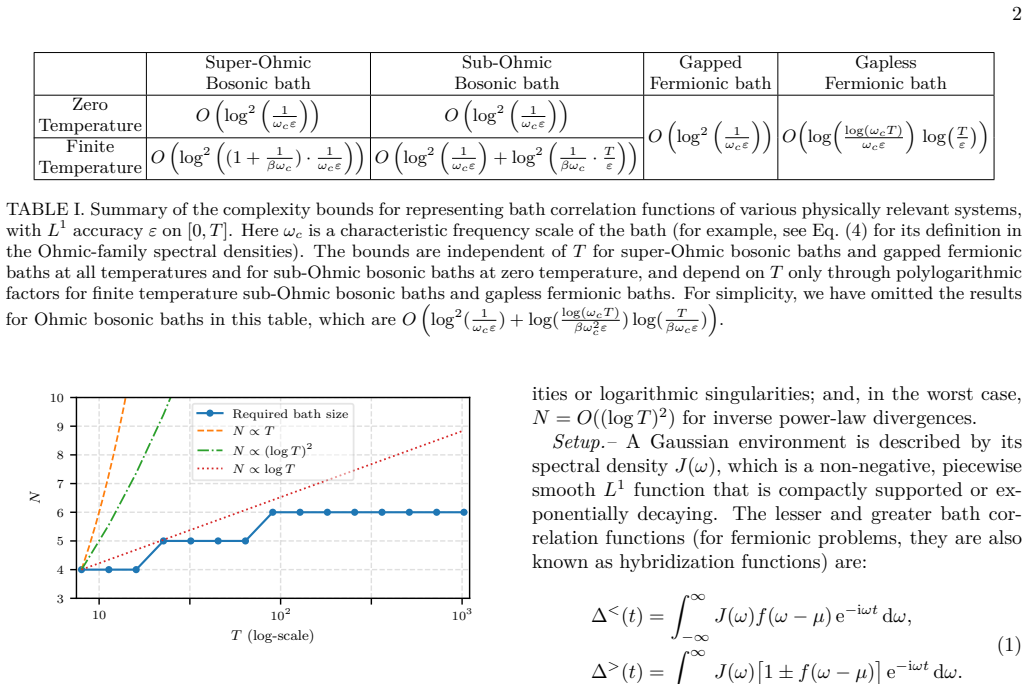
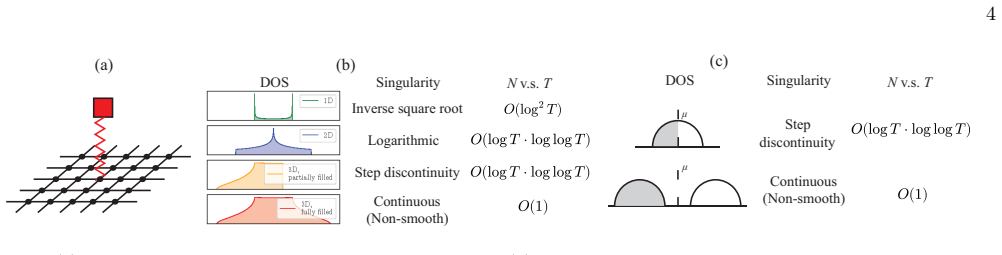
For a broad class of spectral densities the minimal number of complex exponentials needed to approximate the bath correlation function uniformly on the interval [0,T] is bounded independently of T; when the density contains step discontinuities or inverse power-law divergences the number grows at most polylogarithmically in T, while the temperature dependence is mild for bosonic baths and absent for fermionic ones.
What carries the argument
Rigorous upper bounds on the number of exponentials required to approximate the bath correlation function, derived from the type and strength of singularities in the effective spectral density.
If this is right
- Long-time simulation of non-Markovian open quantum systems via pseudomode or HEOM methods incurs no exponential cost growth with T for typical bath spectra.
- The computational bottleneck for extended simulations shifts from time duration to the presence and strength of sharp spectral features.
- Markovian embeddings of classical generalized Langevin equations with memory kernels inherit the same time-uniform complexity.
- Temperature scaling remains favorable or neutral, supporting simulations at low temperatures without added exponential overhead.
Where Pith is reading between the lines
- Similar bounds may apply to memory kernels in classical stochastic dynamics beyond Gaussian noise.
- Spectral densities could be engineered with controlled singularities to minimize simulation cost while preserving physical realism.
- The polylog T scaling suggests that adaptive or hierarchical exponential decompositions may achieve near-optimal performance without full a-priori knowledge of T.
Load-bearing premise
The spectral densities belong to a class whose nonanalytic features are limited to step discontinuities, inverse power-law divergences, or similar singularities of explicitly characterized type and strength.
What would settle it
A concrete spectral density with a step discontinuity or inverse power-law singularity for which the minimal number of exponentials needed on [0,T] grows faster than any polylog T would falsify the stated bounds.
Figures
read the original abstract
Gaussian baths are widely used to model non-Markovian environments, yet the cost of accurate simulation at long times remains poorly understood, especially when spectral densities exhibit nonanalytic behavior as in a range of realistic models. We rigorously bound the complexity of representing bath correlation functions on a time interval $[0,T]$ by sums of complex exponentials, as employed in recent variants of pseudomode and hierarchical equations of motion methods. These bounds make explicit the dependence on the maximal simulation time $T$, inverse temperature $\beta$, and the type and strength of singularities in an effective spectral density. For a broad class of spectral densities, the required number of exponentials is bounded independently of $T$, achieving time-uniform complexity. The $T$-dependence emerges only as polylogarithmic factors for spectral densities with strong singularities, such as step discontinuities and inverse power-law divergences. The temperature dependence is mild for bosonic environments and disappears entirely for fermionic environments. Thus, the true bottleneck for long-time simulation is not the simulation duration itself, but rather the presence of sharp nonanalytic features in the bath spectrum. Our results are instructive both for long-time simulation of non-Markovian open quantum systems, as well as for Markovian embeddings of classical generalized Langevin equations with memory kernels.
Editorial analysis
A structured set of objections, weighed in public.
Referee Report
Summary. The manuscript establishes rigorous upper bounds on the number of complex exponentials needed to approximate bath correlation functions of non-Markovian Gaussian baths over [0,T]. For spectral densities whose non-analyticities are limited to step discontinuities or inverse power-law singularities of explicitly characterized strength, the number of terms is independent of T (or grows only as polylog T); temperature dependence is mild for bosonic baths and vanishes for fermionic baths. The bounds are derived via contour-integral or Prony-type estimates and are presented as guiding the complexity of pseudomode and HEOM embeddings.
Significance. If the stated bounds hold, the work supplies a precise complexity theory for long-time exponential decompositions, showing that simulation duration itself is not the dominant cost once the singularity class is fixed. This directly informs practical choices in open-system simulation and classical generalized Langevin embeddings, and the explicit dependence on singularity type and temperature is a clear advance over heuristic exponential fits.
minor comments (3)
- [§2.2] §2.2: the definition of the effective spectral density J_eff(ω) should include an explicit statement of how the bosonic/fermionic factors are absorbed, to avoid ambiguity when the same bound is later invoked for both statistics.
- [Theorem 3.1] Theorem 3.1: the polylogarithmic factor for inverse-power singularities is stated with an implicit constant; making the dependence on the exponent α explicit (even as a remark) would strengthen the result for readers who must choose truncation orders.
- [Figure 1] Figure 1 caption: the plotted error curves are shown for a single T; adding a second panel or inset that varies T over two orders of magnitude would visually confirm the claimed T-independence.
Simulated Author's Rebuttal
We thank the referee for their positive assessment and recommendation to accept. The report accurately summarizes the main results on rigorous bounds for the number of complex exponentials needed to represent non-Markovian bath correlation functions.
Circularity Check
No significant circularity
full rationale
The derivation supplies explicit contour-integral and Prony-type estimates for the Laplace transform of the bath correlation function, with the T-dependence (or polylog-T) and singularity-strength dependence stated directly from those estimates. No step reduces a claimed bound to a fitted parameter, a self-citation chain, or a definition that presupposes the result; the central complexity claim is obtained from standard approximation theory applied to the explicitly characterized class of spectral densities.
Axiom & Free-Parameter Ledger
axioms (1)
- domain assumption Spectral densities exhibit nonanalytic behavior limited to specified types such as step discontinuities and inverse power-law divergences
Lean theorems connected to this paper
-
IndisputableMonolith/Cost/FunctionalEquation.leanwashburn_uniqueness_aczel unclear?
unclearRelation between the paper passage and the cited Recognition theorem.
We rigorously bound the complexity of representing bath correlation functions on a time interval [0,T] by sums of complex exponentials... For a broad class of spectral densities, the required number of exponentials is bounded independently of T, achieving time-uniform complexity. The T-dependence emerges only as polylogarithmic factors for spectral densities with strong singularities, such as step discontinuities and inverse power-law divergences.
-
IndisputableMonolith/Foundation/AlexanderDuality.leanalexander_duality_circle_linking unclear?
unclearRelation between the paper passage and the cited Recognition theorem.
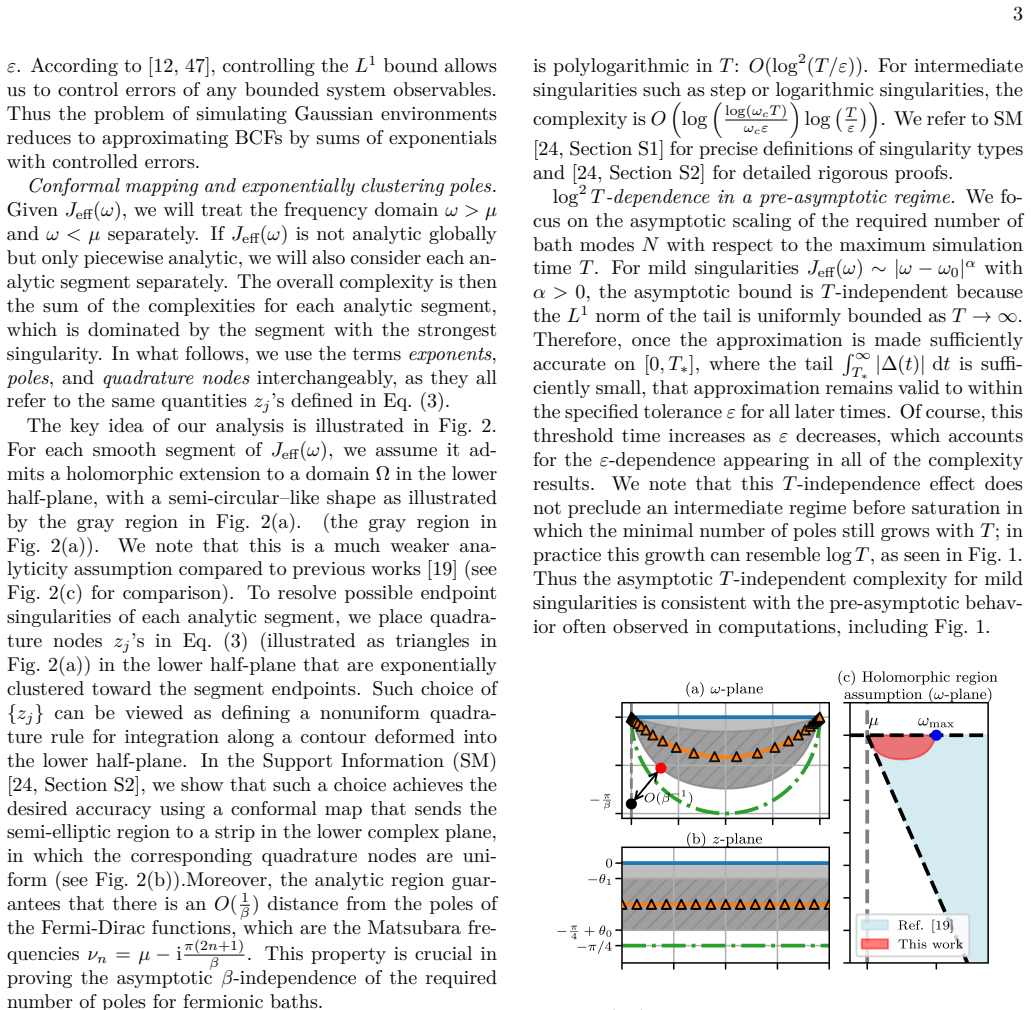
The key idea of our analysis is illustrated in Fig. 2. For each smooth segment of Jeff(ω), we assume it admits a holomorphic extension to a domain Ω in the lower half-plane... conformal map that sends the semi-elliptic region to a strip...
What do these tags mean?
- matches
- The paper's claim is directly supported by a theorem in the formal canon.
- supports
- The theorem supports part of the paper's argument, but the paper may add assumptions or extra steps.
- extends
- The paper goes beyond the formal theorem; the theorem is a base layer rather than the whole result.
- uses
- The paper appears to rely on the theorem as machinery.
- contradicts
- The paper's claim conflicts with a theorem or certificate in the canon.
- unclear
- Pith found a possible connection, but the passage is too broad, indirect, or ambiguous to say the theorem truly supports the claim.
Reference graph
Works this paper leans on
-
[1]
A. Rivas and S. F. Huelga, Open quantum systems , Vol. 10 (Springer, 2012)
work page 2012
-
[2]
P. Forn-Díaz, L. Lamata, E. Rico, J. Kono, and E. Solano, Reviews of Modern Physics 91, 025005 (2019)
work page 2019
-
[3]
A. Georges, G. Kotliar, W. Krauth, and M. J. Rozenberg, Reviews of modern physics 68, 13 (1996)
work page 1996
-
[4]
R. Haertle, G. Cohen, D. Reichman, and A. Millis, Phys- ical Review B 88, 235426 (2013)
work page 2013
- [5]
-
[6]
M. Tanaka and Y. Tanimura, Journal of the Physical Society of Japan 78, 073802 (2009)
work page 2009
-
[7]
Garraway, Physical Review A 55, 2290 (1997)
B. Garraway, Physical Review A 55, 2290 (1997)
work page 1997
- [8]
- [9]
-
[10]
M. P. Woods and M. B. Plenio, Journal of Mathematical Physics 57 (2016)
work page 2016
-
[11]
R. Rosenbach, J. Cerrillo, S. F. Huelga, J. Cao, and M. B. Plenio, New Journal of Physics 18, 023035 (2016)
work page 2016
-
[12]
F. Mascherpa, A. Smirne, S. F. Huelga, and M. B. Plenio, Physical review letters 118, 100401 (2017)
work page 2017
-
[13]
D. Tamascelli, A. Smirne, S. F. Huelga, and M. B. Plenio, Physical review letters 120, 030402 (2018)
work page 2018
-
[14]
D. Tamascelli, A. Smirne, J. Lim, S. F. Huelga, and M. B. Plenio, Physical review letters 123, 090402 (2019)
work page 2019
-
[15]
A. Nüßeler, I. Dhand, S. F. Huelga, and M. B. Plenio, Physical Review B 101, 155134 (2020)
work page 2020
-
[16]
Tanimura, The Journal of Chemical Physics 153, 020901 (2020)
Y. Tanimura, The Journal of Chemical Physics 153, 020901 (2020)
work page 2020
-
[17]
M. Xu, Y. Yan, Q. Shi, J. Ankerhold, and J. Stockburger, Physical Review Letters 129, 230601 (2022)
work page 2022
-
[18]
G. Park, Z. Huang, Y. Zhu, C. Yang, G. K.-L. Chan, and L. Lin, Physical Review B 110, 195148 (2024)
work page 2024
-
[19]
J. Thoenniss, I. Vilkoviskiy, and D. A. Abanin, arXiv preprint arXiv:2409.08816 (2024)
- [20]
- [21]
-
[22]
I. de Vega, U. Schollwöck, and F. A. Wolf, Physical Re- view B 92, 155126 (2015)
work page 2015
-
[23]
Van Hove, Physical Review 89, 1189 (1953)
L. Van Hove, Physical Review 89, 1189 (1953)
work page 1953
- [24]
-
[25]
J. Kaye, K. Chen, and O. Parcollet, Physical Review B 105, 155115 (2022)
work page 2022
-
[26]
Y. Nakatsukasa, O. Sète, and L. N. Trefethen, SIAM Journal on Scientific Computing 40, A1494 (2018)
work page 2018
-
[27]
C. Mejuto-Zaera, L. Zepeda-Núñez, M. Lindsey, N. Tub- man, B. Whaley, and L. Lin, Physical Review B 101, 035143 (2020)
work page 2020
- [28]
- [29]
-
[30]
Ying, Journal of Scientific Computing 92, 107 (2022)
L. Ying, Journal of Scientific Computing 92, 107 (2022)
work page 2022
-
[31]
J. Kaye, Z. Huang, H. U. R. Strand, and D. Golež, Phys- ical Review X 14, 031034 (2024)
work page 2024
- [32]
-
[33]
D. Gazizova, L. Zhang, E. Gull, and J. LeBlanc, Physical Review B 110, 075158 (2024)
work page 2024
-
[34]
D. Gazizova, R. Farid, B. D. E. McNiven, I. Assi, E. G. Armstrong, and J. P. F. LeBlanc, Phys. Rev. B 112, 035172 (2025)
work page 2025
- [35]
- [36]
-
[37]
L. Ying, J. Comput. Phys. 469, 111549 (2022)
work page 2022
-
[38]
A. Georges, G. Kotliar, W. Krauth, and M. J. Rozenberg, Rev. Mod. Phys. 68, 13 (1996)
work page 1996
- [39]
- [40]
- [41]
- [42]
-
[43]
F. A. Wolf, A. Go, I. P. McCulloch, A. J. Millis, and U. Schollwöck, Phys. Rev. X 5, 041032 (2015)
work page 2015
-
[44]
A. Valenti, I. Park, A. Georges, A. J. Millis, and O. Par- collet, Neural-network quantum embedding solvers for correlated materials (2026), arXiv:2603.15741 [cond- mat.str-el]
- [45]
- [46]
-
[47]
Z. Huang, L. Lin, G. Park, and Y. Zhu, arXiv preprint arXiv:2411.08741 (2024)
-
[48]
A. J. Leggett, S. Chakravarty, A. T. Dorsey, M. P. Fisher, A. Garg, and W. Zwerger, Reviews of Modern Physics 59, 1 (1987)
work page 1987
- [49]
-
[50]
Goychuk, Advances in Chemical Physics 150, 187 (2012)
I. Goychuk, Advances in Chemical Physics 150, 187 (2012)
work page 2012
-
[51]
Kupferman, Journal of statistical physics 114, 291 (2004)
R. Kupferman, Journal of statistical physics 114, 291 (2004)
work page 2004
-
[52]
B. A. Dalton, C. Ayaz, H. Kiefer, A. Klimek, L. Tepper, and R. R. Netz, Proceedings of the National Academy of Sciences 120, e2220068120 (2023)
work page 2023
-
[53]
G. Jung, M. Hanke, and F. Schmid, Journal of chemical theory and computation 13, 2481 (2017)
work page 2017
-
[54]
J. O. Daldrop, B. G. Kowalik, and R. R. Netz, Physical Review X 7, 041065 (2017)
work page 2017
-
[55]
I. Vilkoviskiy and D. A. Abanin, Physical Review B 109, 205126 (2024)
work page 2024
-
[56]
S. Adelman and J. D. Doll, The Journal of Chemical Physics 61, 4242 (1974)
work page 1974
-
[57]
Lutz, Physical Review E 64, 051106 (2001)
E. Lutz, Physical Review E 64, 051106 (2001)
work page 2001
- [58]
-
[59]
L. N. Trefethen and J. Weideman, SIAM review 56, 385 (2014). Support Information for Long-time simulation of general non-Markovian Gaussian environments at arbitrary temperature: theoretical analysis Zhen Huang 1, Zhiyan Ding 2, Ke Wang 2, Jason Kaye 3,4, Xiantao Li 5 and Lin Lin 1,6 1Department of Mathematics, University of California, Berkeley, CA 94720...
work page 2014
-
[60]
To pass from the endpoint bounds in Eq. ( S4) to a bound on Jeff (tanh z), note that Re(tanh(x − iy)) = sinh(2x) cosh(2x) + cos(2y) , so the sign of Re(tanh z) is the sign of x. Hence ω = tanh z lies in Ω+ for x ≥ 0 and in Ω− for x ≤ 0. Moreover, 1 − tanh z = e−z cosh z , 1 + tanh z = ez cosh z . Since 2−1/2 cosh x ≤ | cosh z| ≤ cosh x when |y| < π/ 4, fo...
discussion (0)
Sign in with ORCID, Apple, or X to comment. Anyone can read and Pith papers without signing in.