Geant4-IcyMoons: Simulating Electron Interaction Physics in Irradiated Astrophysical Ices
Pith reviewed 2026-05-13 20:55 UTC · model grok-4.3
The pith
Geant4-IcyMoons enables the first transport-ready Monte Carlo simulation of electron irradiation in water ice.
A machine-rendered reading of the paper's core claim, the machinery that carries it, and where it could break.
Core claim
The central claim is that adapting Geant4-DNA cross sections and interaction models for amorphous and hexagonal ice produces a working Monte Carlo code for electron transport in water ice. Applied to Europa the code shows stronger low-energy flux on the trailing hemisphere confines deposited energy to the upper 0.1 cm whereas the leading hemisphere experiences deposition to depths of tens of centimeters, potentially accounting for the lens-like equatorial enrichment of radiolysis products seen in observations.
What carries the argument
Geant4-IcyMoons extension that adapts Geant4-DNA elastic and inelastic cross sections to simulate electron scattering and energy loss inside amorphous and hexagonal ice.
If this is right
- Low-energy electrons on Europa's trailing hemisphere keep most deposited energy within the top 0.1 cm of the surface.
- Higher-energy electrons on the leading hemisphere drive energy deposition to depths of tens of centimeters.
- The resulting depth contrast may produce the observed equatorial enrichment of radiolysis products on the trailing hemisphere.
- The same framework supplies the starting point for later modeling of ion irradiation and radiation chemistry inside ice and embedded materials.
Where Pith is reading between the lines
- The approach could be applied to other icy bodies such as comets or interstellar cloud grains to predict how their surfaces evolve under particle bombardment.
- Direct comparison of the simulated depth profiles against laboratory irradiation experiments on thin ice films would test whether the adapted models capture the dominant processes.
- Adding modules for embedded organic or mineral grains would allow the code to address formation pathways of complex molecules in irradiated ices.
Load-bearing premise
The cross sections and interaction models taken from Geant4-DNA for ice phases correctly describe the real scattering and energy-loss processes that occur in astrophysical water ice.
What would settle it
Laboratory measurements of electron energy-deposition depth profiles or radiolysis-product yields in ice samples exposed to Europa-like electron spectra that differ markedly from the simulated patterns.
Figures




read the original abstract
Energetic particles continuously process water ice across astrophysical and planetary environments, from interstellar clouds and comets to icy planetary surfaces. Interpreting the resulting observables requires a physically grounded description of the underlying interactions, both to identify radiation-driven signatures and to distinguish them from superimposed chemical, thermal, and microphysical effects. We present Geant4-IcyMoons, an extension of Geant4-DNA developed for irradiated water ice and, ultimately, for materials embedded within it. In this study, we model the elastic and inelastic interactions of electrons with amorphous and hexagonal ice. For the first time, this enables a transport-ready Monte Carlo simulation of electron irradiation in water ice, linking incident-particle environments to the evolution of icy surfaces. We apply this framework to Jupiter's moon Europa as a representative case of electron bombardment of an icy surface. We show that, on the trailing hemisphere, the stronger low-energy electron bombardment confines much of the deposited energy to the upper $\lesssim 0.1$ cm, whereas on the leading hemisphere, the more energetic incident population drives deposition patterns to depths of tens of centimeters. This may contribute to the observed lens-like enrichment of radiolysis products centered on the equator of the trailing hemisphere. This work lays the foundation for treatments of ion irradiation and radiation chemistry in water ice and embedded materials.
Editorial analysis
A structured set of objections, weighed in public.
Referee Report
Summary. The manuscript introduces Geant4-IcyMoons, an extension of Geant4-DNA for modeling elastic and inelastic electron interactions with amorphous and hexagonal water ice. It adapts cross sections and interaction models to enable Monte Carlo transport simulations in ice and applies the framework to electron bombardment on Europa, predicting that low-energy electrons confine energy deposition to the upper ≲0.1 cm on the trailing hemisphere while more energetic electrons on the leading hemisphere deposit energy to depths of tens of centimeters, potentially explaining observed equatorial enrichment of radiolysis products.
Significance. If the adapted models are shown to be accurate, this work would provide a new, transport-ready Monte Carlo capability for simulating radiation effects in astrophysical ices. It directly links incident particle spectra to depth-dependent energy deposition and surface evolution, offering a tool that could be extended to ion irradiation and embedded chemistry with relevance to planetary science observations.
major comments (2)
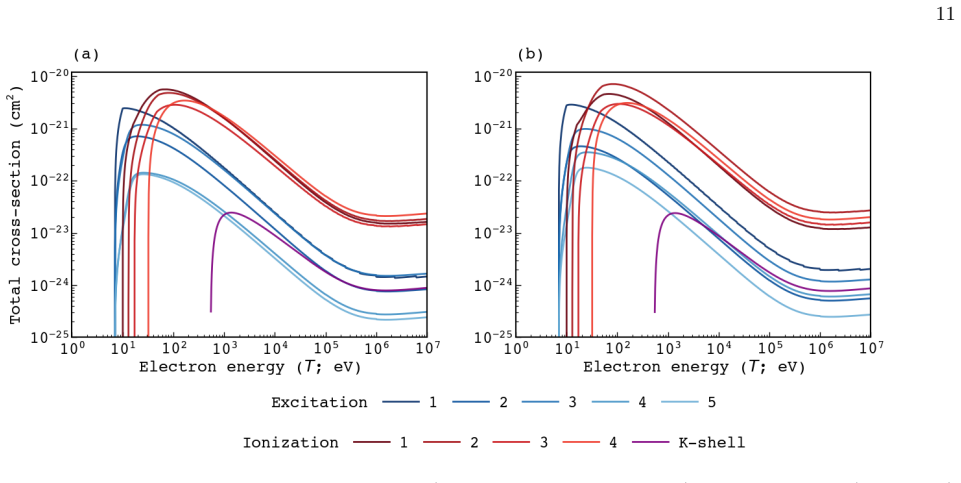
- [§3] §3: The adaptation of elastic and inelastic cross sections and interaction models from Geant4-DNA (originally for liquid water) to amorphous and hexagonal ice is described in detail, but the manuscript supplies no quantitative validation such as comparisons of simulated stopping powers, range distributions, or secondary-electron yields against experimental data for ice at keV energies. This is load-bearing for the central claim of an accurate transport simulation.
- [§4] §4: The specific Europa deposition profiles (upper ≲0.1 cm trailing vs. tens of cm leading) and the suggested link to lens-like radiolysis enrichment rest directly on the unvalidated ice models; the absence of sensitivity tests to cross-section variations or phase-dependent effects leaves the quantitative conclusions open to systematic offset.
minor comments (2)
- [Abstract] The abstract states that this enables 'for the first time' a transport-ready simulation; a brief citation of prior Monte Carlo efforts on ice or related Geant4 extensions would better contextualize the novelty.
- Figure captions and axis labels should explicitly distinguish results for amorphous versus hexagonal ice to improve clarity when comparing the two phases.
Simulated Author's Rebuttal
We thank the referee for the constructive review and for recognizing the potential of Geant4-IcyMoons as a new capability for modeling radiation effects in astrophysical ices. We address each major comment below and will revise the manuscript to incorporate the suggested improvements.
read point-by-point responses
-
Referee: [§3] §3: The adaptation of elastic and inelastic cross sections and interaction models from Geant4-DNA (originally for liquid water) to amorphous and hexagonal ice is described in detail, but the manuscript supplies no quantitative validation such as comparisons of simulated stopping powers, range distributions, or secondary-electron yields against experimental data for ice at keV energies. This is load-bearing for the central claim of an accurate transport simulation.
Authors: We agree that direct quantitative validation against experimental data for ice is essential to support the accuracy claims. The cross-section adaptations follow established scaling procedures based on density, phase, and molecular differences between liquid water and ice, as referenced in the manuscript. However, we recognize the absence of explicit benchmarks in the current text. In revision we will add a new subsection that compares simulated stopping powers, CSDA ranges, and secondary-electron yields to the limited available theoretical calculations and experimental data for ice at keV energies, and we will explicitly discuss remaining uncertainties and model limitations. revision: yes
-
Referee: [§4] §4: The specific Europa deposition profiles (upper ≲0.1 cm trailing vs. tens of cm leading) and the suggested link to lens-like radiolysis enrichment rest directly on the unvalidated ice models; the absence of sensitivity tests to cross-section variations or phase-dependent effects leaves the quantitative conclusions open to systematic offset.
Authors: The Europa application is presented as a demonstration of the framework rather than a final quantitative prediction. To address the concern about systematic offsets, the revised manuscript will include sensitivity tests that vary key cross-section parameters within literature-reported uncertainties and that compare results for amorphous versus hexagonal ice. These tests will quantify the robustness of the reported depth scales and will clarify the strength of the suggested connection to observed radiolysis-product patterns. revision: yes
Circularity Check
No significant circularity; simulation framework uses external models
full rationale
The paper describes an extension of Geant4-DNA for electron interactions in amorphous and hexagonal ice, applying adapted elastic and inelastic cross sections and interaction models to Monte Carlo transport simulations. No derivation step reduces by construction to its own inputs, fitted parameters renamed as predictions, or load-bearing self-citations that close the argument. The Europa deposition profiles in §4 follow directly from running the adapted physics lists on incident spectra; the models themselves are imported from prior Geant4-DNA work on liquid water with phase-specific adjustments stated as inputs. This is a standard model-implementation paper whose central results are not tautological with the setup.
Axiom & Free-Parameter Ledger
axioms (1)
- domain assumption Geant4-DNA physics models for water can be extended to describe electron interactions in amorphous and hexagonal ice phases.
Lean theorems connected to this paper
-
IndisputableMonolith/Cost/FunctionalEquation.leanwashburn_uniqueness_aczel unclear?
unclearRelation between the paper passage and the cited Recognition theorem.
We adopt the empirical elastic cross-sections for amorphous ice measured over the energy range 1–100 eV... blended elastic cross-section is then given by σ_blend(T) = [1−S(T)] σ_ice(T) + S(T) σ_ELSEPA(T)
-
IndisputableMonolith/Foundation/RealityFromDistinction.leanreality_from_one_distinction unclear?
unclearRelation between the paper passage and the cited Recognition theorem.
the dielectric response reduces to ε(E,0)... Drude-type oscillators fitted to the measured optical data
What do these tags mean?
- matches
- The paper's claim is directly supported by a theorem in the formal canon.
- supports
- The theorem supports part of the paper's argument, but the paper may add assumptions or extra steps.
- extends
- The paper goes beyond the formal theorem; the theorem is a base layer rather than the whole result.
- uses
- The paper appears to rely on the theorem as machinery.
- contradicts
- The paper's claim conflicts with a theorem or certificate in the canon.
- unclear
- Pith found a possible connection, but the passage is too broad, indirect, or ambiguous to say the theorem truly supports the claim.
Reference graph
Works this paper leans on
-
[1]
, " * write output.state after.block = add.period write newline
ENTRY address archivePrefix author booktitle chapter doi edition editor eprint howpublished institution journal key month number organization pages publisher school series title misctitle type volume year version url label extra.label sort.label short.list INTEGERS output.state before.all mid.sentence after.sentence after.block FUNCTION init.state.consts ...
-
[2]
" write newline "" before.all 'output.state := FUNCTION format.url url empty "" new.block "" url * "" * if FUNCTION format.eprint eprint empty "" archivePrefix empty "" archivePrefix "arXiv" = new.block " " eprint * " " * new.block " " eprint * " " * if if if FUNCTION format.doi doi empty "" " " doi * " " * if FUNCTION format.pid doi empty eprint empty ur...
-
[3]
thebibliography [1] 20pt to REFERENCES 6pt =0pt \@twocolumntrue 12pt -12pt 10pt plus 3pt =0pt =0pt =1pt plus 1pt =0pt =0pt -12pt =13pt plus 1pt =20pt =13pt plus 1pt \@M =10000 =-1.0em =0pt =0pt 0pt =0pt =1.0em @enumiv\@empty 10000 10000 `\.\@m \@noitemerr \@latex@warning Empty `thebibliography' environment \@ifnextchar \@reference \@latexerr Missing key o...
discussion (0)
Sign in with ORCID, Apple, or X to comment. Anyone can read and Pith papers without signing in.