Enhancing Robustness of Federated Learning via Server Learning
Pith reviewed 2026-05-13 20:02 UTC · model grok-4.3
The pith
Server learning with update filtering and geometric median aggregation makes federated learning robust to over 50 percent malicious clients even under non-IID data.
A machine-rendered reading of the paper's core claim, the machinery that carries it, and where it could break.
Core claim
The authors claim that their heuristic algorithm, which uses server learning to guide aggregation along with filtering of client updates and geometric median aggregation, can achieve substantial improvements in model accuracy in federated learning settings where more than half the clients may be malicious and client data distributions are heterogeneous.
What carries the argument
The heuristic algorithm that integrates server learning with client update filtering and geometric median aggregation to neutralize malicious updates.
If this is right
- Model accuracy improves significantly even with over 50 percent malicious clients.
- Performance holds under non-IID data conditions.
- Small or synthetic server datasets suffice without needing to match client data distributions.
Where Pith is reading between the lines
- Server-side data can serve as a reliable anchor for detecting anomalies in client updates.
- This method might extend to other aggregation-based distributed systems facing adversarial participants.
- Reducing reliance on perfect data matching between server and clients could simplify deployment in privacy-sensitive applications.
Load-bearing premise
The proposed combination of server learning, client update filtering, and geometric median aggregation will reliably identify and neutralize malicious updates under non-IID conditions without requiring the server data to match client distributions.
What would settle it
An experiment showing no accuracy improvement when more than 50 percent of clients are malicious, using non-IID data and a small synthetic server dataset.
Figures


read the original abstract
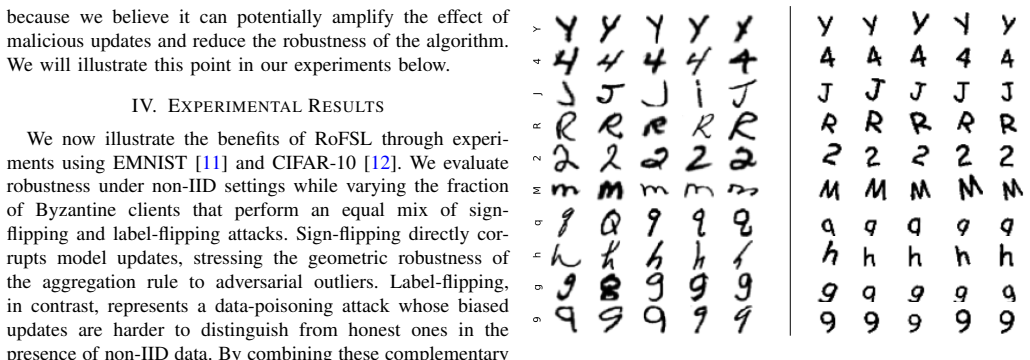
This paper explores the use of server learning for enhancing the robustness of federated learning against malicious attacks even when clients' training data are not independent and identically distributed. We propose a heuristic algorithm that uses server learning and client update filtering in combination with geometric median aggregation. We demonstrate via experiments that this approach can achieve significant improvement in model accuracy even when the fraction of malicious clients is high, even more than $50\%$ in some cases, and the dataset utilized by the server is small and could be synthetic with its distribution not necessarily close to that of the clients' aggregated data.
Editorial analysis
A structured set of objections, weighed in public.
Referee Report
Summary. The paper proposes a heuristic algorithm combining server learning, client update filtering, and geometric median aggregation to enhance federated learning robustness against malicious attacks. It claims significant accuracy gains even with >50% malicious clients under non-IID conditions, using only small or synthetic server data whose distribution need not match the clients'.
Significance. If the experimental gains hold under rigorous controls, the method would address a practical gap in FL defenses by tolerating high malicious fractions without requiring matched server data, which is common in real deployments.
major comments (2)
- [Abstract, §4] Abstract and experimental section: the central claim of 'significant improvement' is asserted without reporting baselines, attack models (e.g., label-flipping, backdoor), number of runs, statistical tests, or exact data splits, making it impossible to verify whether the accuracy numbers support robustness under the stated conditions.
- [§3] §3 (algorithm description): the heuristic relies on an unanalyzed assumption that server learning plus filtering will reliably separate malicious updates from non-IID benign ones; no sensitivity analysis or counter-example is provided for cases where server data is synthetic and distributionally distant.
minor comments (2)
- [Figures 1-3] Figure captions and axis labels should explicitly state the malicious fraction and server-data size used in each plot for immediate readability.
- [§2.2] The term 'server learning' is introduced without a precise definition or pseudocode step that distinguishes it from standard server-side fine-tuning.
Simulated Author's Rebuttal
Thank you for the constructive referee report on arXiv:2604.03226. We address each major comment below and will revise the manuscript to improve clarity, reproducibility, and analysis of the proposed heuristic.
read point-by-point responses
-
Referee: [Abstract, §4] Abstract and experimental section: the central claim of 'significant improvement' is asserted without reporting baselines, attack models (e.g., label-flipping, backdoor), number of runs, statistical tests, or exact data splits, making it impossible to verify whether the accuracy numbers support robustness under the stated conditions.
Authors: We agree that the abstract and §4 require additional details for verification and reproducibility. In the revised manuscript we will expand both sections to explicitly list the baselines (FedAvg, geometric median alone, and other robust FL methods), specify the attack models evaluated (label-flipping, backdoor, and model poisoning), report mean accuracy and standard deviation over at least five independent runs, include statistical significance tests, and provide precise descriptions of data splits, non-IID partitioning, and server-data sizes. revision: yes
-
Referee: [§3] §3 (algorithm description): the heuristic relies on an unanalyzed assumption that server learning plus filtering will reliably separate malicious updates from non-IID benign ones; no sensitivity analysis or counter-example is provided for cases where server data is synthetic and distributionally distant.
Authors: The comment correctly notes that §3 presents a heuristic without formal analysis of the separation assumption. We will add a dedicated sensitivity-analysis subsection (and corresponding experiments) that varies the distributional distance between synthetic server data and client data, reports filtering success rates under increasing distance, and discusses observed failure modes. These additions will appear in the revised §3 and §4. revision: yes
Circularity Check
No circularity: heuristic proposal validated by experiments only
full rationale
The paper presents a heuristic algorithm that combines server learning, client update filtering, and geometric median aggregation. No equations, derivations, or fitted parameters are introduced. Claims rest entirely on experimental results under varying malicious client fractions and non-IID conditions. No self-citations, self-definitional steps, or renamings of known results appear in the provided text. The approach is therefore self-contained against external benchmarks and receives the lowest circularity score.
Axiom & Free-Parameter Ledger
axioms (1)
- domain assumption Geometric median aggregation remains robust when a majority of client updates are malicious
Reference graph
Works this paper leans on
-
[1]
Ma- chine learning with adversaries: Byzantine tolerant gradient descent,
P. Blanchard, E. M. El Mhamdi, R. Guerraoui, and J. Stainer, “Ma- chine learning with adversaries: Byzantine tolerant gradient descent,” in NeurIPS, pp. 119–129, 2017
work page 2017
-
[2]
Robust aggregation for federated learning,
K. Pillutla, S. M. Kakade, and Z. Harchaoui, “Robust aggregation for federated learning,”IEEE Trans. Signal Process., vol. 70, pp. 1142– 1154, 2022
work page 2022
-
[3]
Zeno++: Robust fully asynchronous SGD,
C. Xie, S. Koyejo, and I. Gupta, “Zeno++: Robust fully asynchronous SGD,” inInternational conference on machine learning, pp. 10495– 10503, PMLR, 2020
work page 2020
-
[4]
A study of enhancing federated learning on non-iid data with server learning,
V . S. Mai, R. J. La, and T. Zhang, “A study of enhancing federated learning on non-iid data with server learning,”IEEE Trans. AI, vol. 5, no. 11, pp. 5589–5604, 2024
work page 2024
-
[5]
Zeno: Distributed stochastic gradient descent with suspicion-based fault-tolerance,
C. Xie, S. Koyejo, and I. Gupta, “Zeno: Distributed stochastic gradient descent with suspicion-based fault-tolerance,” inInternational confer- ence on machine learning, pp. 6893–6901, PMLR, 2019
work page 2019
-
[6]
Z. Zhang, X. Cao, J. Jia, and N. Z. Gong, “FLdetector: Defending fed- erated learning against model poisoning attacks via detecting malicious clients,” inProc. 28th ACM SIGKDD, pp. 2545–2555, 2022
work page 2022
-
[7]
Contra: Defending against poisoning attacks in federated learning,
S. Awan, B. Luo, and F. Li, “Contra: Defending against poisoning attacks in federated learning,” inEuropean symposium on research in computer security, pp. 455–475, Springer, 2021
work page 2021
-
[8]
Federated distillation: A survey,
L. Li, J. Gou, B. Yu, L. Du, Z. Yi, and D. Tao, “Federated distillation: A survey,”arXiv preprint arXiv:2404.08564, 2024
-
[9]
Communication-efficient learning of deep networks from decentralized data,
B. McMahan, E. Moore, D. Ramage, S. Hampson, and B. A. y Arcas, “Communication-efficient learning of deep networks from decentralized data,” inArtif. Intell. Stat. (AISTATS), pp. 1273–1282, PMLR, 2017
work page 2017
-
[10]
Geometric median in nearly linear time,
M. B. Cohen, Y . T. Lee, G. Miller, J. Pachocki, and A. Sidford, “Geometric median in nearly linear time,” STOC ’16, (New York, NY , USA), p. 9–21, 2016
work page 2016
-
[11]
EMNIST: Ex- tending MNIST to handwritten letters,
G. Cohen, S. Afshar, J. Tapson, and A. Van Schaik, “EMNIST: Ex- tending MNIST to handwritten letters,” inInt. Jt. Conf. Neural Netw., pp. 2921–2926, 2017
work page 2017
-
[12]
Learning multiple layers of features from tiny images,
A. Krizhevsky and G. Hinton, “Learning multiple layers of features from tiny images,” tech. rep., University of Toronto, 2009
work page 2009
-
[13]
Breakdown points of affine equivariant estimators of multivariate location and covariance matrices,
H. P. Lopuha ¨a and P. J. Rousseeuw, “Breakdown points of affine equivariant estimators of multivariate location and covariance matrices,” The Annals of Statistics, pp. 229–248, 1991
work page 1991
discussion (0)
Sign in with ORCID, Apple, or X to comment. Anyone can read and Pith papers without signing in.