What Makes a Sale? Rethinking End-to-End Seller--Buyer Retail Dynamics with LLM Agents
Pith reviewed 2026-05-10 20:00 UTC · model grok-4.3
The pith
LLM agents with personas simulate the full chain from seller persuasion to buyer purchase and match real economic patterns.
A machine-rendered reading of the paper's core claim, the machinery that carries it, and where it could break.
Core claim
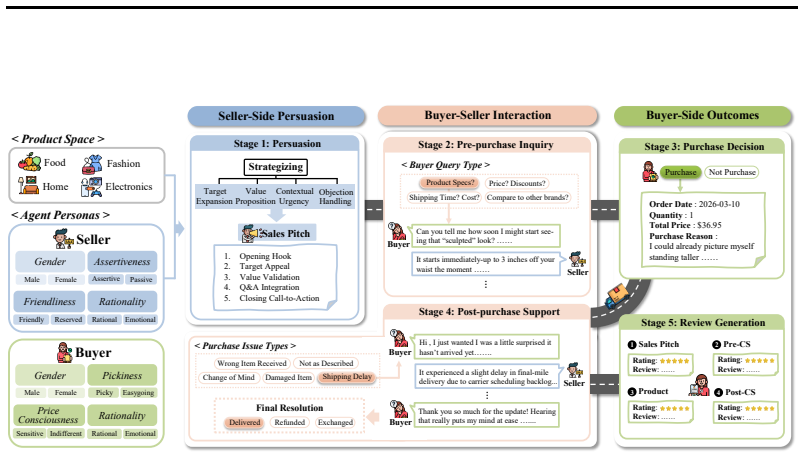
RetailSim is an end-to-end retail simulation framework that models the full pipeline from seller-side persuasion through buyer-seller interaction to purchase decisions in a unified environment. It is designed for fidelity using diverse product spaces, persona-driven agents, and multi-turn interactions. Evaluation with human checks and comparison to real economic data shows it reproduces demographic purchasing behavior, the price-demand relationship, and heterogeneous price elasticity. The framework also supports practical tasks such as inferring personas from interactions and evaluating sales strategies.
What carries the argument
RetailSim, the unified simulation environment that connects seller persuasion, multi-turn buyer-seller dialogue, and final purchase decisions through LLM agents given distinct personas and interaction rules.
If this is right
- Seller decisions made early in the interaction can be traced through to their impact on final purchase rates in a controlled setting.
- The same setup can be used to test how different buyer personas respond to price changes without needing live customer data.
- Sales strategies can be compared side by side by measuring outcomes across the full pipeline rather than single stages.
- Interaction logs from the agents can be analyzed to understand which dialogue patterns lead to higher conversion.
Where Pith is reading between the lines
- The same agent-based pipeline could be adapted to test negotiation dynamics in other service markets such as insurance or consulting.
- If the fidelity holds, the framework offers a way to generate synthetic training data for improving real retail recommendation systems.
- Extending the product space to include seasonal or fashion items might reveal whether the current patterns generalize beyond standard goods.
Load-bearing premise
The assumption that LLM agents given personas and multi-turn rules can copy the linked decisions real human sellers and buyers make well enough to show the same patterns as actual markets.
What would settle it
Running the simulation for a specific product category with known real-world data and finding that the generated price elasticity or demographic buying rates do not match the observed values.
Figures
read the original abstract
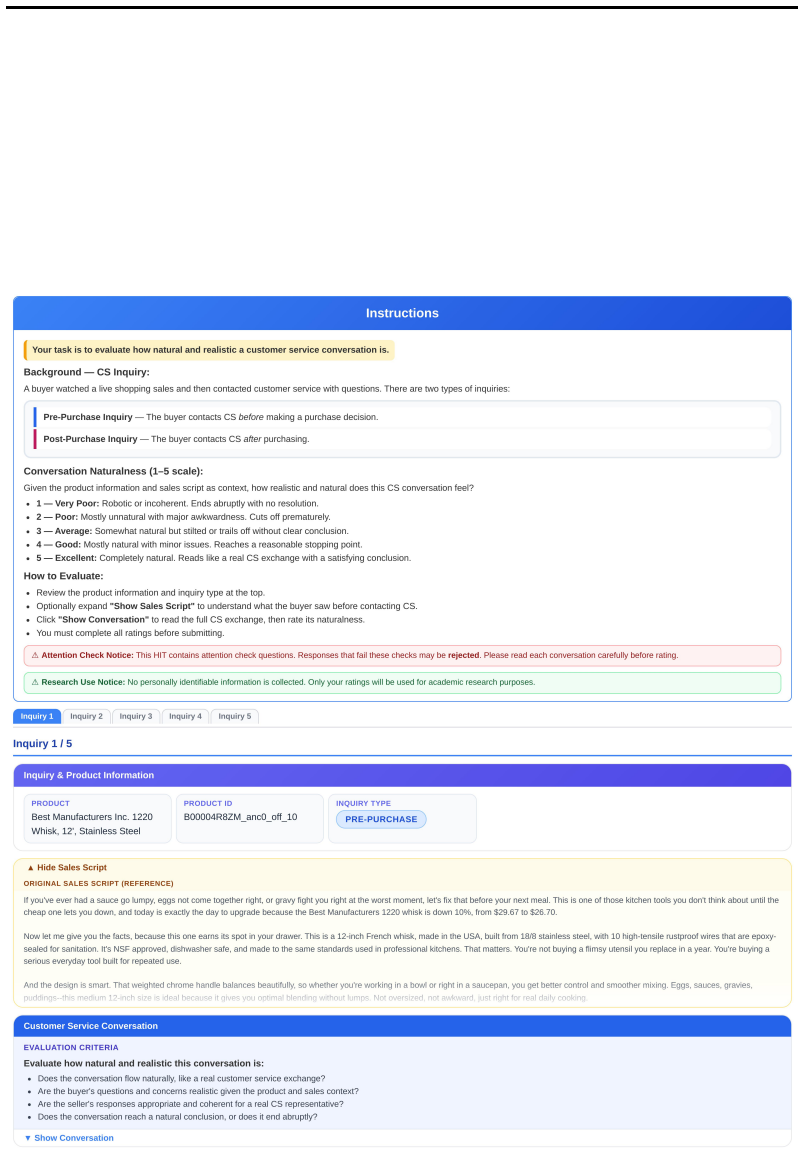
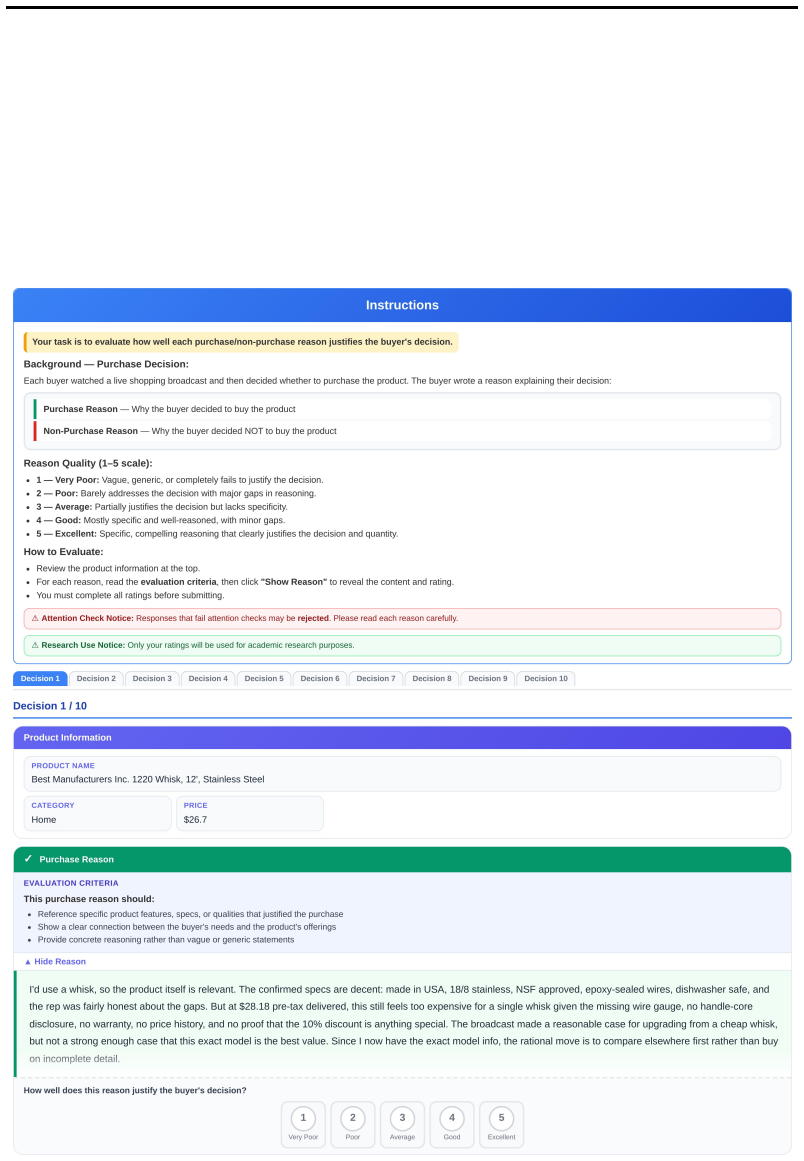
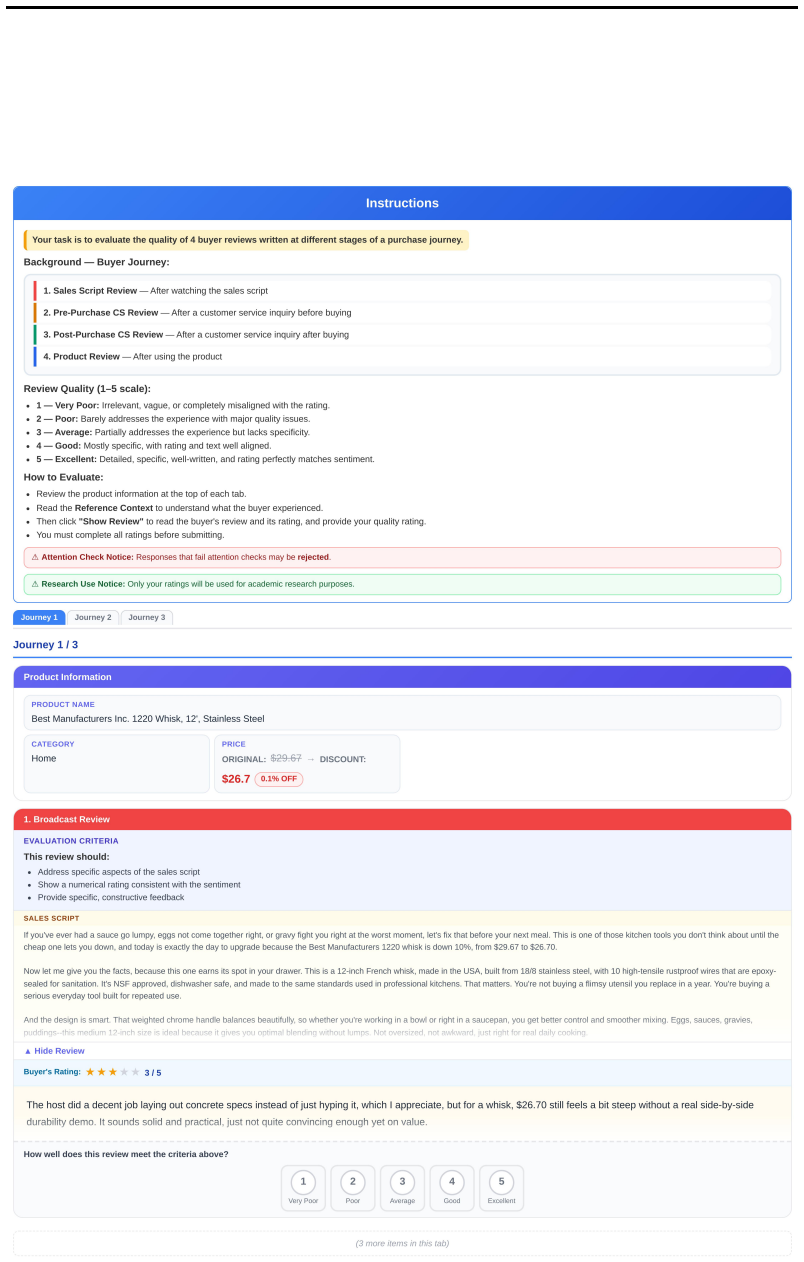
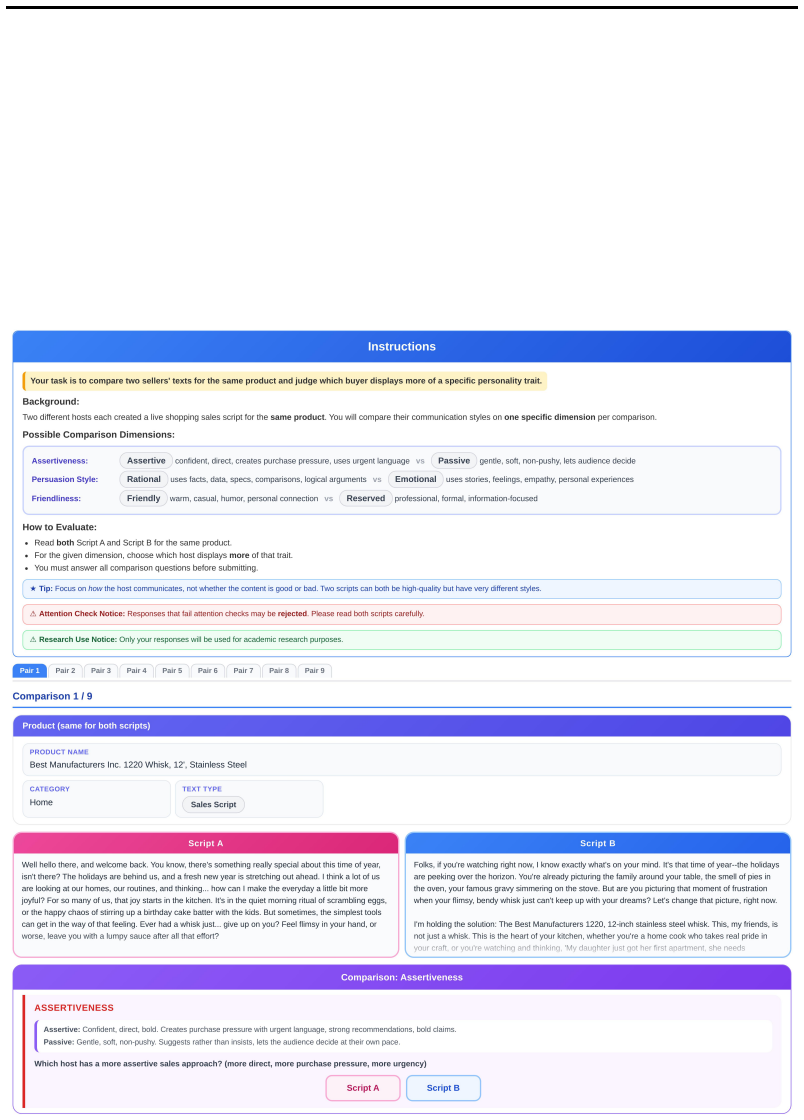
Evaluating retail strategies before deployment is difficult, as outcomes are determined across multiple stages, from seller-side persuasion through buyer-seller interaction to purchase decisions. However, existing retail simulators capture only partial aspects of this process and do not model cross-stage dependencies, making it difficult to assess how early decisions affect downstream outcomes. We present RetailSim, an end-to-end retail simulation framework that models this pipeline in a unified environment, explicitly designed for simulation fidelity through diverse product spaces, persona-driven agents, and multi-turn interactions. We evaluate RetailSim with a dual protocol comprising human evaluation of behavioral fidelity and meta-evaluation against real-world economic regularities, showing that it successfully reproduces key patterns such as demographic purchasing behavior, the price-demand relationship, and heterogeneous price elasticity. We further demonstrate its practical utility via decision-oriented use cases, including persona inference, seller-buyer interaction analysis, and sales strategy evaluation, showing RetailSim's potential as a controlled testbed for exploring retail strategies.
Editorial analysis
A structured set of objections, weighed in public.
Referee Report
Summary. The manuscript introduces RetailSim, an end-to-end retail simulation framework that uses LLM agents with diverse personas and multi-turn seller-buyer interactions to model the full pipeline from persuasion through purchase decisions. It claims simulation fidelity via a dual evaluation protocol (human behavioral assessment plus meta-evaluation against real-world economic regularities) that reproduces patterns including demographic purchasing behavior, the price-demand relationship, and heterogeneous price elasticity, while also demonstrating utility for use cases such as persona inference, interaction analysis, and sales strategy evaluation.
Significance. If the fidelity claims hold under rigorous validation, RetailSim would offer a controlled, scalable testbed for retail strategy exploration that captures cross-stage dependencies better than partial simulators. The persona-driven LLM approach aligns with growing interest in agent-based economic modeling, but the absence of detailed quantitative metrics, baselines, or mechanistic isolation in the provided description limits the assessed impact to exploratory rather than conclusive.
major comments (2)
- [Abstract and Evaluation sections] The central fidelity claim (reproduction of demographic purchasing, price-demand curves, and heterogeneous elasticity) rests on aggregate pattern matching via human evaluation and meta-evaluation, but the description provides no quantitative metrics, statistical tests, baseline comparisons against non-LLM simulators, or explicit checks against post-hoc adjustments; this is load-bearing because aggregate alignment can arise from LLM training priors without validating the claimed cross-stage causal mechanisms.
- [Evaluation Protocol] The dual protocol does not isolate whether observed patterns emerge from the multi-turn interaction protocols and persona-driven decision dependencies or from prompt-induced statistical recall of economic regularities; without trajectory-level analysis or ablation of the interaction component, the claim that RetailSim models the actual persuasion-to-purchase pipeline remains untested.
minor comments (2)
- [Section 3] Clarify the exact composition of the 'diverse product spaces' and how they were sampled to ensure coverage beyond common retail categories.
- [Abstract] The abstract's phrasing of 'successfully reproduces' would benefit from explicit qualification that this is pattern-level reproduction pending further mechanistic validation.
Simulated Author's Rebuttal
We thank the referee for their constructive feedback, which identifies key opportunities to strengthen the quantitative rigor and mechanistic validation in our evaluation of RetailSim. We address each major comment below and will incorporate the suggested enhancements in the revised manuscript.
read point-by-point responses
-
Referee: [Abstract and Evaluation sections] The central fidelity claim (reproduction of demographic purchasing, price-demand curves, and heterogeneous elasticity) rests on aggregate pattern matching via human evaluation and meta-evaluation, but the description provides no quantitative metrics, statistical tests, baseline comparisons against non-LLM simulators, or explicit checks against post-hoc adjustments; this is load-bearing because aggregate alignment can arise from LLM training priors without validating the claimed cross-stage causal mechanisms.
Authors: We agree that additional quantitative metrics and explicit comparisons are needed to support the fidelity claims more robustly. The current human evaluation uses Likert-scale ratings from multiple assessors for behavioral realism, and the meta-evaluation aligns simulated patterns with documented economic regularities, but formal statistical tests, correlation coefficients, and non-LLM baselines were not reported in the initial submission. In the revision, we will add Pearson correlations and regression analyses for price-demand curves, chi-square tests for demographic purchasing differences, and direct comparisons against a rule-based baseline simulator. We will also discuss potential LLM prior influences and how the persona-driven multi-turn structure provides evidence for cross-stage dependencies. revision: yes
-
Referee: [Evaluation Protocol] The dual protocol does not isolate whether observed patterns emerge from the multi-turn interaction protocols and persona-driven decision dependencies or from prompt-induced statistical recall of economic regularities; without trajectory-level analysis or ablation of the interaction component, the claim that RetailSim models the actual persuasion-to-purchase pipeline remains untested.
Authors: We acknowledge that the existing dual protocol evaluates end-to-end fidelity but does not include explicit ablations or trajectory analyses to isolate the contribution of multi-turn interactions. To address this directly, the revised manuscript will include ablation experiments comparing full multi-turn persona interactions against single-turn and non-interactive variants, along with sample trajectory analyses that trace how specific persuasion steps affect downstream purchase decisions. These additions will help demonstrate that the reproduced patterns arise from the modeled interaction dynamics. revision: yes
Circularity Check
No circularity: external validation against real-world regularities
full rationale
The paper's core contribution is the RetailSim framework for end-to-end retail simulation using LLM agents with personas and multi-turn interactions. Its claims rest on empirical reproduction of demographic purchasing behavior, price-demand curves, and heterogeneous elasticity, validated via a dual protocol of human behavioral fidelity judgments and meta-evaluation against independent real-world economic data. No equations, parameter fitting, or derivations are described that would make any reported pattern equivalent to its own inputs by construction. Self-citations, if present, are not load-bearing for the central results, and the evaluation protocol explicitly uses external benchmarks rather than internal consistency checks.
Axiom & Free-Parameter Ledger
axioms (1)
- domain assumption Persona-driven LLM agents can simulate realistic human seller-buyer interactions and decision processes across multiple stages
invented entities (1)
-
RetailSim
no independent evidence
Forward citations
Cited by 1 Pith paper
-
SoCRATES: Towards Reliable Automated Evaluation of Proactive LLM Mediation across Domains and Socio-cognitive Variations
SoCRATES introduces a benchmark for proactive LLM mediators across eight domains and five socio-cognitive axes with topic-localized evaluation, finding top models close only about one-third of the unmediated consensus gap.
Reference graph
Works this paper leans on
-
[1]
this is exactly what I need right now
Opening Hook • Address the buyer’s current discomfort or situational needs • Use the ‘Contextual Urgency’ from your strategy • Make them feel “this is exactly what I need right now” 2–4. Core Selling Points(weave these together naturally, ANY order) These three elements should blend seamlessly into your pitch naturally. •Target Expansion: - Naturally ment...
-
[2]
Closing Call-to-Action • Close with a logical ‘Reason to Buy Now’ based on product-specific milestones • Make the buyer feel this is a rare opportunity they might miss if they wait • Strong but persona-appropriate call-to-action CRITICAL Instructions: • Write the script in ENGLISH • Write in natural spoken language, as if you’re actually on air • Output O...
-
[3]
You are asking questions BEFORE deciding whether to buy
You have NOT purchased, ordered, or bought anything. You are asking questions BEFORE deciding whether to buy
-
[4]
You are a potential buyer gathering information
-
[5]
Write like a real-time chat — brief and natural. User {buyer_persona_block} {broadcast_script} Product: {title} (Original: ${price}, Discounted: ${discount_price} - {discount_rate_pct}% off) Topics you may ask about: {inquiry_topics} For this first message, ask 1–2 questions about what matters most to you. Write your FIRST message to the service represent...
-
[6]
The seller’s LAST response answered your remaining questions
-
[7]
You have NO new questions or concerns to raise (in most cases, 1–3 focused questions are enough, but if you still care about something, you may naturally ask more)
-
[8]
What about the warranty? [DONE]
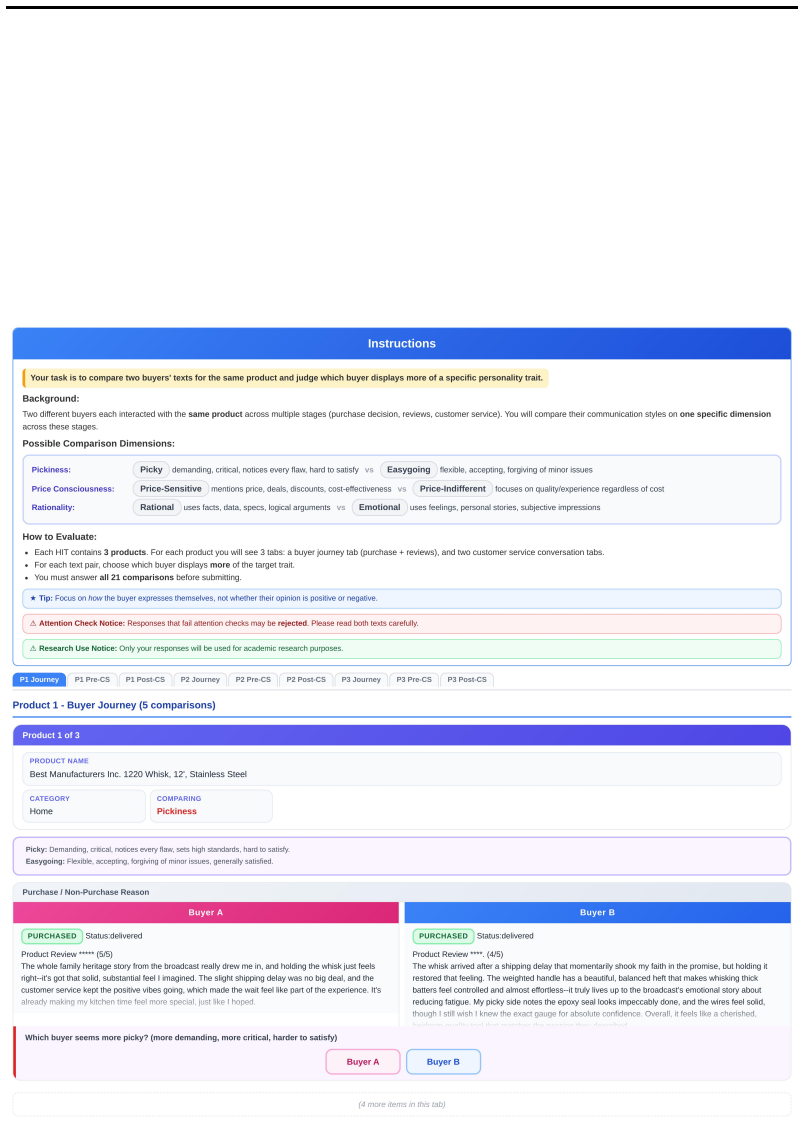
You are ready to end the conversation • WRONG: Asking a new question and adding [DONE] (e.g., “What about the warranty? [DONE]”) • Do NOT force the conversation to continue if you have nothing more to ask. • Do NOT end prematurely if you still have genuine concerns. Output ONLY your message (with [DONE] if done), nothing else. Table 22: Prompt for Pre-Pur...
-
[9]
The seller’s LAST response resolved or addressed your issue
-
[10]
You have NO follow-up questions or unresolved concerns
-
[11]
Can I get a tracking number? [DONE]
You have accepted or rejected the resolution — the conversation is truly over • WRONG: Asking a new question and adding [DONE] (e.g., “Can I get a tracking number? [DONE]”) • Do NOT force the conversation to continue if the issue has been addressed. • Do NOT end the conversation prematurely if you still have unresolved concerns. Output ONLY your message (...
-
[12]
Why you bought {purchase_decision_summary} Product: {title} | ${discount_price} ({discount_rate_pct}% off) | {main_category} What you saw on TV: {broadcast_script} Pre-purchase chat with counselor: {pre_purchase_inquiry}
-
[13]
Below is that conversation.) Post-purchase CS conversation: {post_purchase_inquiry}
What happened after you received it (You contacted CS about an issue. Below is that conversation.) Post-purchase CS conversation: {post_purchase_inquiry}
-
[14]
How it was resolved Your satisfaction with CS handling: {post_cs_review} Final order outcome: {order_outcome} Write your honest product review based on the FULL journey above Your rating MUST align with the order outcome: • Refunded→you were dissatisfied enough to return it • Exchanged→the original had problems • Delivered and kept→rate based on actual sa...
discussion (0)
Sign in with ORCID, Apple, or X to comment. Anyone can read and Pith papers without signing in.