Recognition: 1 theorem link
· Lean TheoremIndividual and Combined Effects of English as a Second Language and Typos on LLM Performance
Pith reviewed 2026-05-10 19:08 UTC · model grok-4.3
The pith
Combining English as a second language variations with typos leads to larger performance drops in large language models than either factor by itself.
A machine-rendered reading of the paper's core claim, the machinery that carries it, and where it could break.
Core claim
When inputs include both ESL variations and typographical errors, LLMs show larger performance reductions than when facing either alone, though the combined impact is not simply additive, with the effect appearing most consistent on closed-ended tasks.
What carries the argument
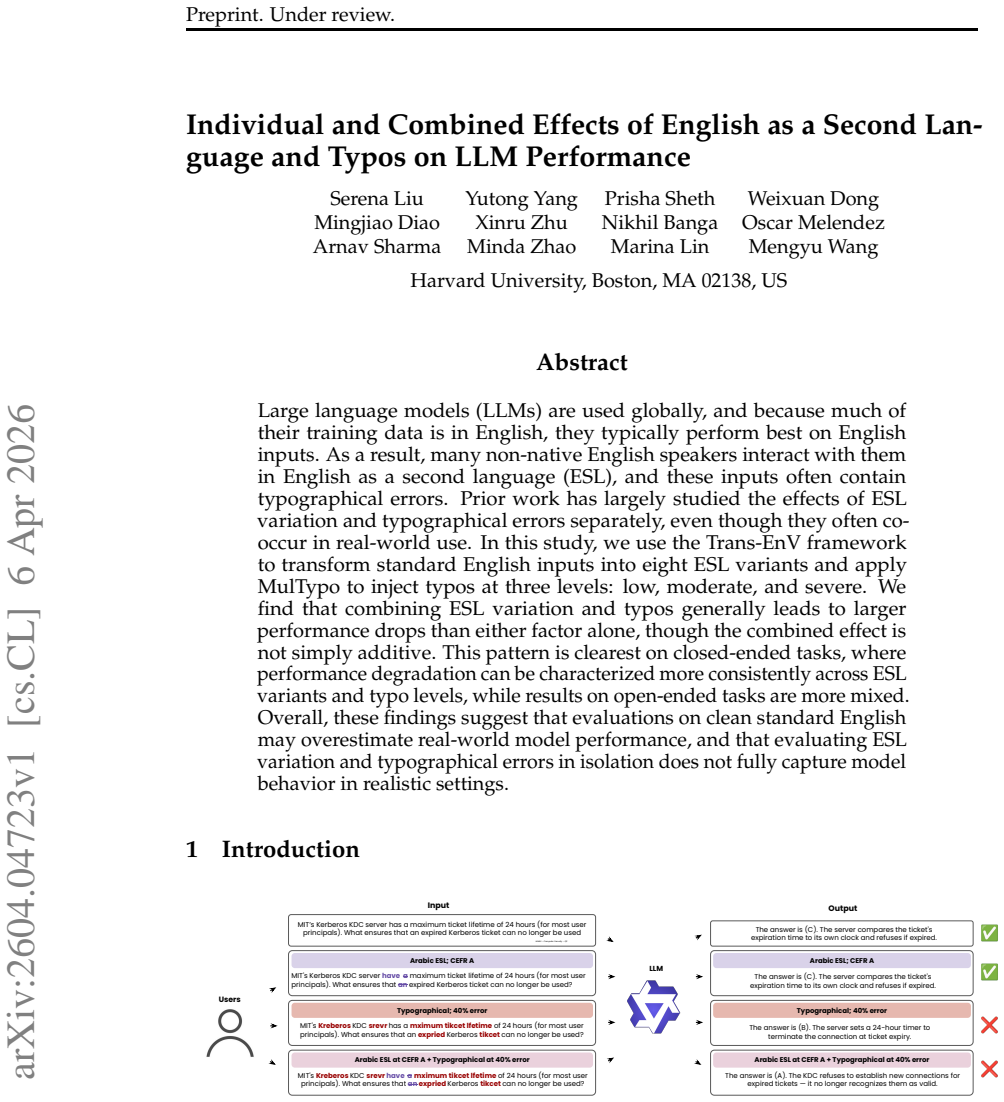
Methods that transform standard English into eight English-as-second-language variants and inject typos at low, moderate, and severe levels to measure resulting performance changes.
Load-bearing premise
The eight ESL variants and three typo levels adequately represent the range of real non-native English inputs with errors that users actually produce.
What would settle it
Running the same tasks with authentic inputs collected from non-native English speakers and finding no greater combined performance drop or inconsistent patterns would challenge the findings.
Figures


read the original abstract
Large language models (LLMs) are used globally, and because much of their training data is in English, they typically perform best on English inputs. As a result, many non-native English speakers interact with them in English as a second language (ESL), and these inputs often contain typographical errors. Prior work has largely studied the effects of ESL variation and typographical errors separately, even though they often co-occur in real-world use. In this study, we use the Trans-EnV framework to transform standard English inputs into eight ESL variants and apply MulTypo to inject typos at three levels: low, moderate, and severe. We find that combining ESL variation and typos generally leads to larger performance drops than either factor alone, though the combined effect is not simply additive. This pattern is clearest on closed-ended tasks, where performance degradation can be characterized more consistently across ESL variants and typo levels, while results on open-ended tasks are more mixed. Overall, these findings suggest that evaluations on clean standard English may overestimate real-world model performance, and that evaluating ESL variation and typographical errors in isolation does not fully capture model behavior in realistic settings.
Editorial analysis
A structured set of objections, weighed in public.
Referee Report
Summary. The paper examines the individual and combined effects of English as a Second Language (ESL) variations and typographical errors on LLM performance. It uses the Trans-EnV framework to generate eight ESL variants from standard English inputs and applies MulTypo to inject typos at low, moderate, and severe levels. The central claim is that combining ESL variation and typos produces larger performance drops than either factor alone (though not simply additive), with this pattern clearest and most consistent on closed-ended tasks; open-ended tasks yield more mixed results. The authors conclude that evaluations on clean standard English overestimate real-world performance and that isolated studies of each factor are insufficient.
Significance. If the empirical patterns hold after addressing validation concerns, the work is significant for LLM evaluation practices in NLP. It provides evidence that interaction effects between common real-world input perturbations matter, which could inform more realistic benchmarks, robustness testing, and model development. The study builds on prior separate examinations of ESL and typos by directly testing their combination, highlighting a gap in current evaluation protocols.
major comments (2)
- The experimental setup (as described in the abstract and methods) relies on Trans-EnV and MulTypo to produce the eight ESL variants and three typo levels, but provides no calibration or comparison against real non-native learner corpora (e.g., error-type frequencies, syntactic patterns, or co-occurrence rates of grammatical and typographical mistakes from sources like the Cambridge Learner Corpus or TOEFL data). This assumption is load-bearing for the central claim of non-additive combined effects and the suggestion that clean-English evaluations overestimate performance; without it, the observed patterns risk being artifacts of the generators rather than generalizable findings.
- Results section: The abstract reports only directional findings (larger drops, non-additive, clearest on closed-ended tasks) without quantitative metrics such as exact performance deltas, error bars, statistical significance tests, or details on model selection, task distribution, number of runs, or variance across ESL variants. This limits assessment of the magnitude and reliability of the interaction effect, which is central to the paper's conclusions.
Simulated Author's Rebuttal
We thank the referee for the constructive comments, which highlight important aspects of validation and reporting. We address each major comment below and describe the revisions we will undertake.
read point-by-point responses
-
Referee: The experimental setup (as described in the abstract and methods) relies on Trans-EnV and MulTypo to produce the eight ESL variants and three typo levels, but provides no calibration or comparison against real non-native learner corpora (e.g., error-type frequencies, syntactic patterns, or co-occurrence rates of grammatical and typographical mistakes from sources like the Cambridge Learner Corpus or TOEFL data). This assumption is load-bearing for the central claim of non-additive combined effects and the suggestion that clean-English evaluations overestimate performance; without it, the observed patterns risk being artifacts of the generators rather than generalizable findings.
Authors: We agree that the absence of direct quantitative calibration against real learner corpora such as the Cambridge Learner Corpus represents a limitation for claims of generalizability. The Trans-EnV and MulTypo frameworks were selected as established tools from prior work for controlled generation of ESL variants and typos. In the revised manuscript, we will add a dedicated subsection in the Methods or Limitations section that details the generation parameters, qualitatively compares observed error patterns to known characteristics of learner data where feasible, and explicitly states this as a limitation while recommending future validation against corpus resources. This will clarify the scope of our findings without requiring new experiments. revision: partial
-
Referee: Results section: The abstract reports only directional findings (larger drops, non-additive, clearest on closed-ended tasks) without quantitative metrics such as exact performance deltas, error bars, statistical significance tests, or details on model selection, task distribution, number of runs, or variance across ESL variants. This limits assessment of the magnitude and reliability of the interaction effect, which is central to the paper's conclusions.
Authors: We acknowledge that the current abstract and results presentation emphasize directional patterns over detailed quantitative reporting. To improve transparency and allow evaluation of effect magnitudes and reliability, we will revise the abstract to incorporate key quantitative examples (e.g., average performance drops and interaction patterns). We will also expand the results section to report exact deltas, include error bars or variance measures, specify the number of runs, detail model selection and task distribution, and add statistical significance tests for the non-additive effects. These changes will directly address the concern about assessing the interaction effect. revision: yes
Circularity Check
No circularity: purely empirical measurement study
full rationale
The paper conducts an empirical evaluation by applying the Trans-EnV framework to generate eight ESL variants and MulTypo to inject three levels of typos, then measuring LLM performance drops on closed- and open-ended tasks. The central claim—that combined ESL+typos produce larger non-additive drops, clearest on closed-ended tasks—is a direct observational result from these experiments, not a quantity derived from or defined in terms of itself. No equations, fitted parameters, predictions, uniqueness theorems, or ansatzes appear in the provided text; prior work is referenced only descriptively without load-bearing self-citations that reduce the findings to tautology. The derivation chain is empty because none exists.
Axiom & Free-Parameter Ledger
axioms (1)
- domain assumption Trans-EnV and MulTypo produce representative ESL variants and typo patterns
Lean theorems connected to this paper
-
IndisputableMonolith/Foundation/RealityFromDistinction.leanreality_from_one_distinction unclear?
unclearRelation between the paper passage and the cited Recognition theorem.
We use Trans-EnV to transform standard English inputs into eight ESL variants and apply MulTypo to inject typos at three levels
What do these tags mean?
- matches
- The paper's claim is directly supported by a theorem in the formal canon.
- supports
- The theorem supports part of the paper's argument, but the paper may add assumptions or extra steps.
- extends
- The paper goes beyond the formal theorem; the theorem is a base layer rather than the whole result.
- uses
- The paper appears to rely on the theorem as machinery.
- contradicts
- The paper's claim conflicts with a theorem or certificate in the canon.
- unclear
- Pith found a possible connection, but the passage is too broad, indirect, or ambiguous to say the theorem truly supports the claim.
Reference graph
Works this paper leans on
-
[1]
" write newline "" before.all 'output.state := FUNCTION n.dashify 't := "" t empty not t #1 #1 substring "-" = t #1 #2 substring "--" = not "--" * t #2 global.max substring 't := t #1 #1 substring "-" = "-" * t #2 global.max substring 't := while if t #1 #1 substring * t #2 global.max substring 't := if while FUNCTION format.date year duplicate empty "emp...
-
[2]
\@ifxundefined[1] #1\@undefined \@firstoftwo \@secondoftwo \@ifnum[1] #1 \@firstoftwo \@secondoftwo \@ifx[1] #1 \@firstoftwo \@secondoftwo [2] @ #1 \@temptokena #2 #1 @ \@temptokena \@ifclassloaded agu2001 natbib The agu2001 class already includes natbib coding, so you should not add it explicitly Type <Return> for now, but then later remove the command n...
-
[3]
\@lbibitem[] @bibitem@first@sw\@secondoftwo \@lbibitem[#1]#2 \@extra@b@citeb \@ifundefined br@#2\@extra@b@citeb \@namedef br@#2 \@nameuse br@#2\@extra@b@citeb \@ifundefined b@#2\@extra@b@citeb @num @parse #2 @tmp #1 NAT@b@open@#2 NAT@b@shut@#2 \@ifnum @merge>\@ne @bibitem@first@sw \@firstoftwo \@ifundefined NAT@b*@#2 \@firstoftwo @num @NAT@ctr \@secondoft...
-
[4]
@open @close @open @close and [1] URL: #1 \@ifundefined chapter * \@mkboth \@ifxundefined @sectionbib * \@mkboth * \@mkboth\@gobbletwo \@ifclassloaded amsart * \@ifclassloaded amsbook * \@ifxundefined @heading @heading NAT@ctr thebibliography [1] @ \@biblabel @NAT@ctr \@bibsetup #1 @NAT@ctr @ @openbib .11em \@plus.33em \@minus.07em 4000 4000 `\.\@m @bibit...
discussion (0)
Sign in with ORCID, Apple, or X to comment. Anyone can read and Pith papers without signing in.